The story so far: we introduced our subject in Part I by detailing how Chavez Ravine’s Master Narrative, from which came the Reparations Bill, is equal parts unsupportable claims and outlandish disinformation. Part II made sure you knew Chavez Ravine’s history. Part III provided a snapshot of life in Palo Verde, La Loma and Bishop during the 1940s, before it was forever changed. Part IV ran us through the story of the ill-fated Elysian Park Heights project, for which the Housing Authority removed all the residents and demolished the structures. Part V told the tale of how and why the Brooklyn Dodgers moved to Los Angeles. Part VI detailed that First Family of Chavez Ravine, the Arechiga clan, in all their complexity.
Today! We wrap up our seven-part series with a few more odds & ends that didn’t make it into the previous posts, serving to underscore that everything you hear about Chavez Ravine is tainted by agendas and incompetence, so, take it with a grain of salt. With that in mind, we review a few of the key takeaways from our study here.
*********
What’s at issue with Chavez Ravine is that just about everything you hear, or read, is wrong.
Just to hammer home that point, here are a couple more tidbits that I couldn’t fit in to the preceding six posts.
Tidbit 1: No, no part of To Kill a Mockingbird was filmed in Chavez Ravine

The book was published in July 1960, when Dodger Stadium was already under heavy construction, so, no.
Then people will backpedal and say “well, houses from Chavez Ravine were moved to the Universal Studios lot for the movie!” Again, impossible: TKaM production began in the spring of 1962, so, houses would have had to have been moved three years previous, in 1959, when a handful of houses still existed. Didn’t happen.
Moreover, Mockingbird’s art director Henry Bumstead was quite clear when he stated that while the studio did purchase some old condemned houses for scenery, those structures were sourced in 1962 from areas in the path of freeway construction, not Chavez Ravine.

See here and here for the press kits. Here for a newspaper account. Here are Bumstead’s own words, again.
HOWEVER! Wanna know about a movie that was filmed in Chavez Ravine? The incredible Robot Monster! Take a look at the Call Sheet—
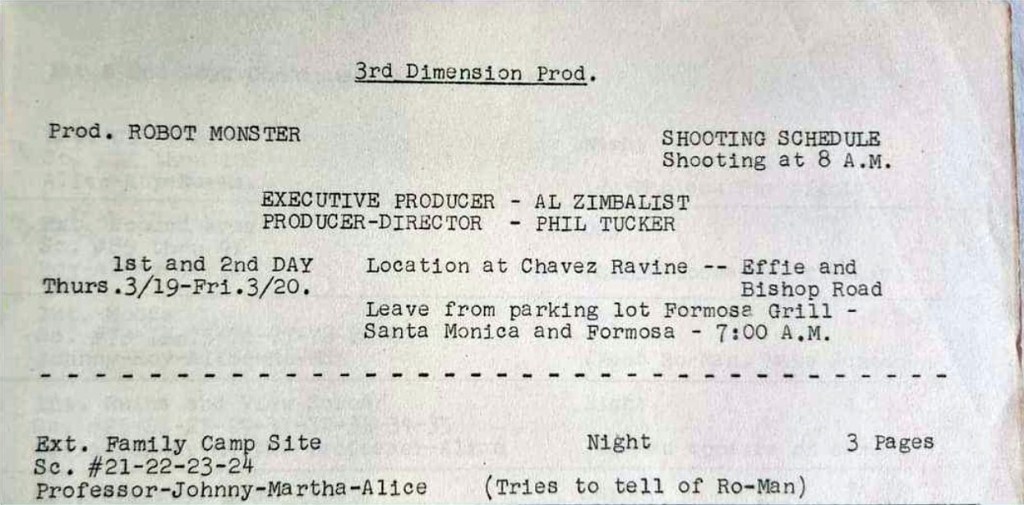
—which is attached to George Nader’s personal annotated copy of the script, that you may see for yourself on display at the 3-D SPACE museum in Echo Park!
As you can see, the crew met up at the Formosa on March 19 & 20, 1953, and then lit out for the corner of Effie & Bishop. Why? Because they needed a post-apocalyptic landscape:
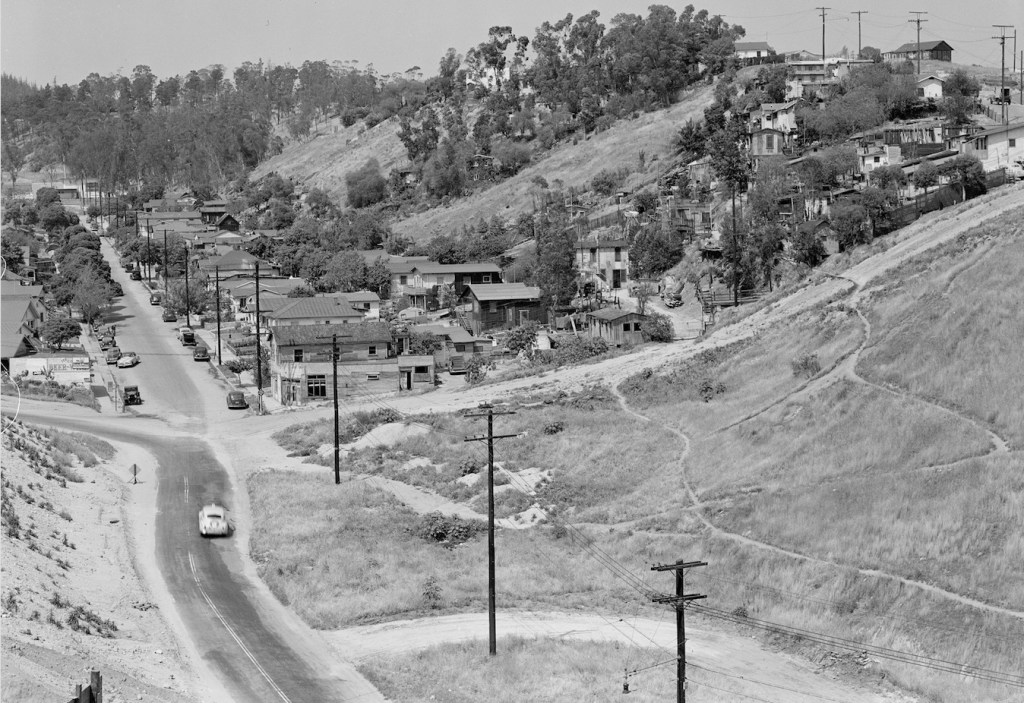
More often than not, when people talk about Robot Monster’s shooting locations, they’ll mention the famous Bronson Canyon caves:

However, most of the picture is shot in the springtime fields of Chavez Ravine, looks to be just above Effie, on the La Loma side of Bishop.

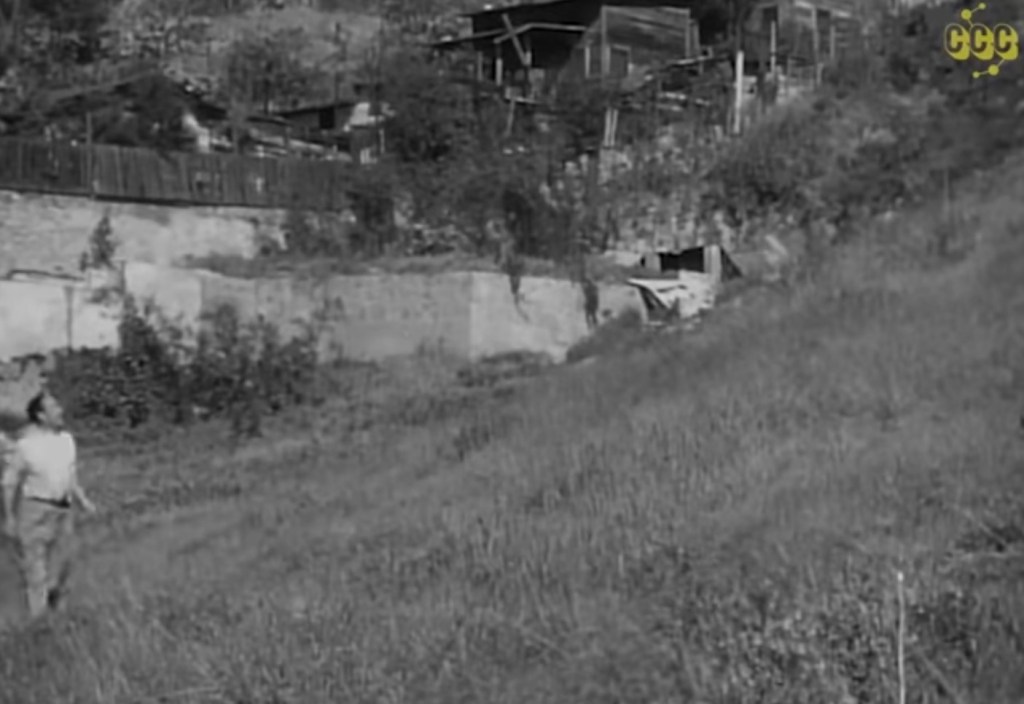
Of course, you may watch Robot Monster streaming online if you poke around for it, but might I suggest you actually watch it in 3-D? Get it here!
(I am deeply indebted to Eric Kurland, CEO and President of 3-D SPACE, for sharing with me the Chavez Ravine/Robot Monster connection)
Tidbit 2: No, Christine Sterling was not evicted from Chavez Ravine
Because anything Chavez Ravine touches turns to lies, we have this whole story about how Christine Sterling was one of the removed. You see this repeated in her Wiki page:

As we know, all residents had left by 1959 and the totality of residents they “began evicting” that May numbered about ten. (Of course “but there’s a footnote! It must be true!” and, like all Wikipedia footnotes, the article it links to doesn’t make any mention whatsoever of this nonsense.)
Though little remembered today, Christine Sterling was a huge presence in Los Angeles. Consider: while she’s now remembered (if at all) for something she did in 1930—the year of the opening of her pet project, Olvera Street—after the 1930s, she still made it into the newspapers over 400 times. If a public figure like Sterling had been ejected for redevelopment, that would have been a major story.
Of course, everyone loves to repeat this patently fictional tale, e.g. PBS, KCRW, the LA Weekly, et al.

Now, no surprise that Wikipedia is rife, as it generally is, with nonsense, but one would expect PBS or KCRW or maybe the Weekly to do even the bare minimum of fact-checking, which believe it or not used to be a “thing” in journalism.

Five minutes looking into the story would have told them: Sterling lived for a short time at 935 Chavez Ravine Road, until the early 1940s, when Sterling, now in her sixties, then moved in with her daughter June Park. (Née Rix: June was married to John Park, an engineer; June’s maiden name was Rix; Christine Sterling’s birth surname was Rix.) John and June Park owned a home at 916 Chavez Ravine Road. Chavez Ravine Road was far to the south of the action, away from the neighborhoods of La Loma, Palo Verde and Bishop, etc. Incidentally, her daughter’s house, the other side of the Naval Armory, was lost not to the Elysian Park Heights project, but to Pasadena Freeway construction.
Let’s look at the phone books from 1951 and 1955:
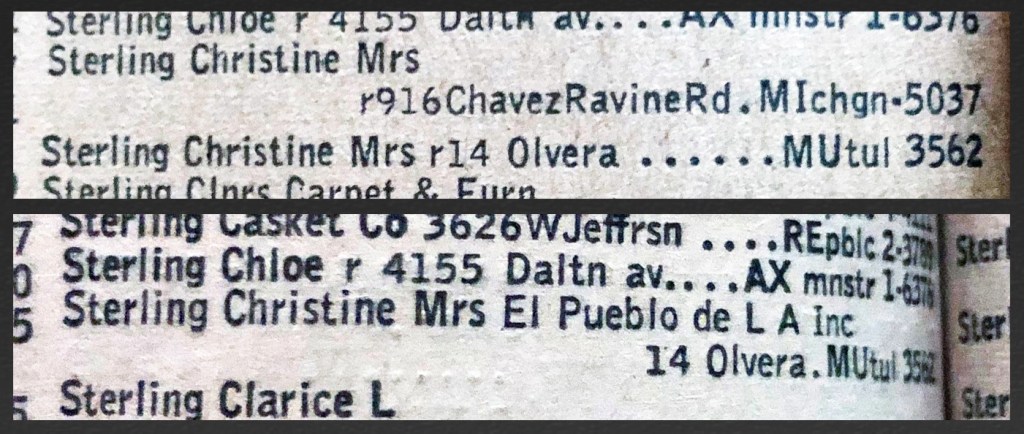
Early 1950s, Christine Sterling is dividing her time between the Avila Adobe and her daughter’s house by the Naval Armory; by the mid-50s Sterling is now domiciled wholly on Olvera Street. Even the newspapers mention, in the mid-50s, that Sterling had moved onto Olvera Street and into the Avila Adobe:

Tidbit 3: No, there was never a school buried in Chavez Ravine
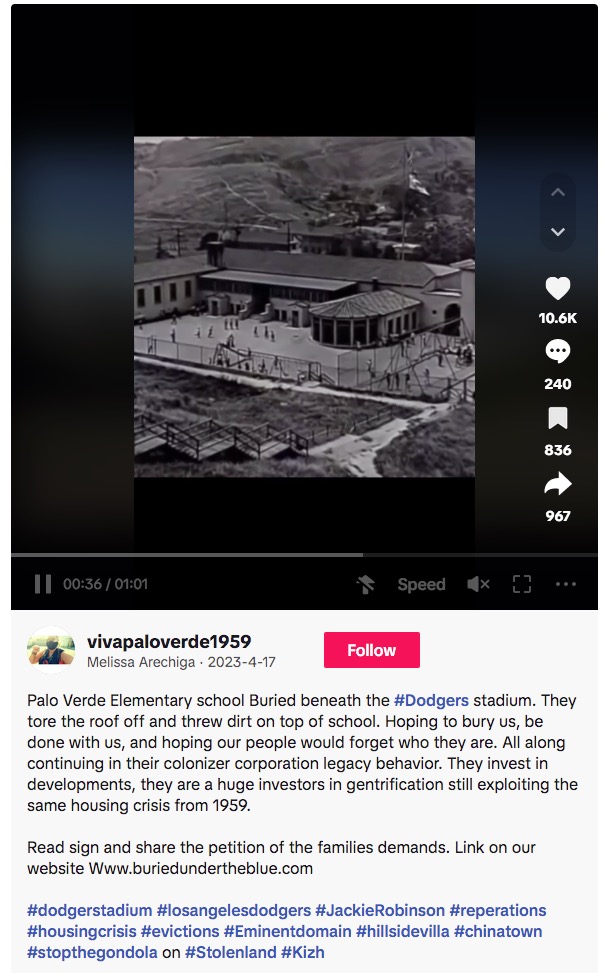
The story concerns Palo Verde elementary, built in 1925, at Effie and Paducah (A structure I discussed a bit back in Part II).

And because they were moving so much earth to build Dodger Stadium, they just tore the roof off the school and filled it with dirt, and “in a thousand years somebody’s gonna start digging, and they’re gonna find a school down there.”
No. What’s important to understand is that the stadium and the school co-existed for at least five years; Dodger Corp. used the school for storage until about 1967. Here’s a shot from 1962 next to one from 1972:

See the red arrows? That’s the site of the school. Note that there’s nowhere for dirt to come from, to bury the school. More importantly and most obviously, the topographic level at which the school once sat is the same. It was the same when built in 1925, and it remains the same now. Ergo, it was not buried. It was demolished. (The idea that the civil engineers at LADBS would allow anyone to backfill a structure like this is ludicrous.)

Note how next to the school, to its east, there is a hill (which had Davis Street running atop it). That hill is still there. Still in its same height and configuration and topography. It still has the flat land next to it where the school was built in 1925.
While I am not certain when the school was demolished, we know it was between 1964 and 1968:


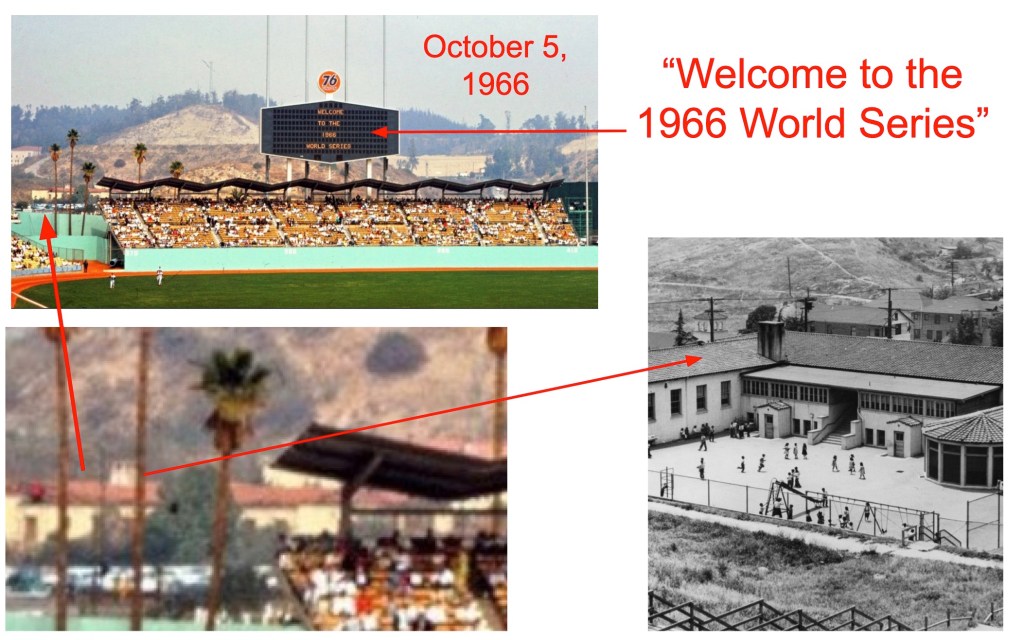


Interestingly, Buried Under the Blue literally named themselves after this fiction:

(Big thank you to researcher Malcolm Gafton, who was the first to debunk this myth, and to Zhando Atosl, who graciously informed me as to the existence of the aerial photos, 1966 WS image, and Ruscha picture)
Tidbit 4: No, the Queen of Elysian Heights house doesn’t have a relationship to Chavez Ravine
I touched on this in Part VI, but, it bears fleshing out a bit, since the topic has made recent news.
There is a house in Echo Park at 1553 Ewing Street, which was made a Los Angeles Historic-Cultural Monument (courtesy Paul Bowers, of the Silver Lake Heritage Trust, using Charles J. Fisher as monument application author). It is a classic Queen Anne, built about 1888, at the corner of Echo Park and Ewing. It’s a great house: I love the gable with the shingle-clad pediment, the clapboard siding, the two-story bay, decorative brackets, the multi-light fixed transom windows, and that eight-light porthole window just slays me. Needless to say, I am thrilled it has become an HCM.

The house made the news recently, as there was concern about evicting an elderly renter, who had moved there in 1962. I won’t comment on the legality of new owner NELA Homes removing the renter, which is outside the scope of this post. Rather, let’s examine the claim that the house is where the all the Arechigas fled after the May 08 1959 demolition of the Malvina houses.

Don’t get me wrong, I’m all for Lupe staying in place, and I’m glad she got some money. But, let’s look at some of the reasons people gave her money: contrary to what you were told, Lupe didn’t designate the house; the designation began back in 2020, and was the work of the Silver Lake Heritage Trust. And no, nothing was ever under threat of demolition.
And, to *our* Chavez-related point, the house-losing Chavez Arechigas, contrary to what you have been told one million times, didn’t live there.
It is true, the Ewing house was owned by an Arechiga. An Arechiga who didn’t live in Chavez Ravine, and who owned the house for all of five years. But, no-one who had a Chavez Ravine house destroyed, or lived in a Chavez Ravine tent, ever lived at Ewing: it’s a made-up and easily disprovable fantasy. And yet here’s a typical response after the November 9, 2022 designation of the house as HCM #1272:
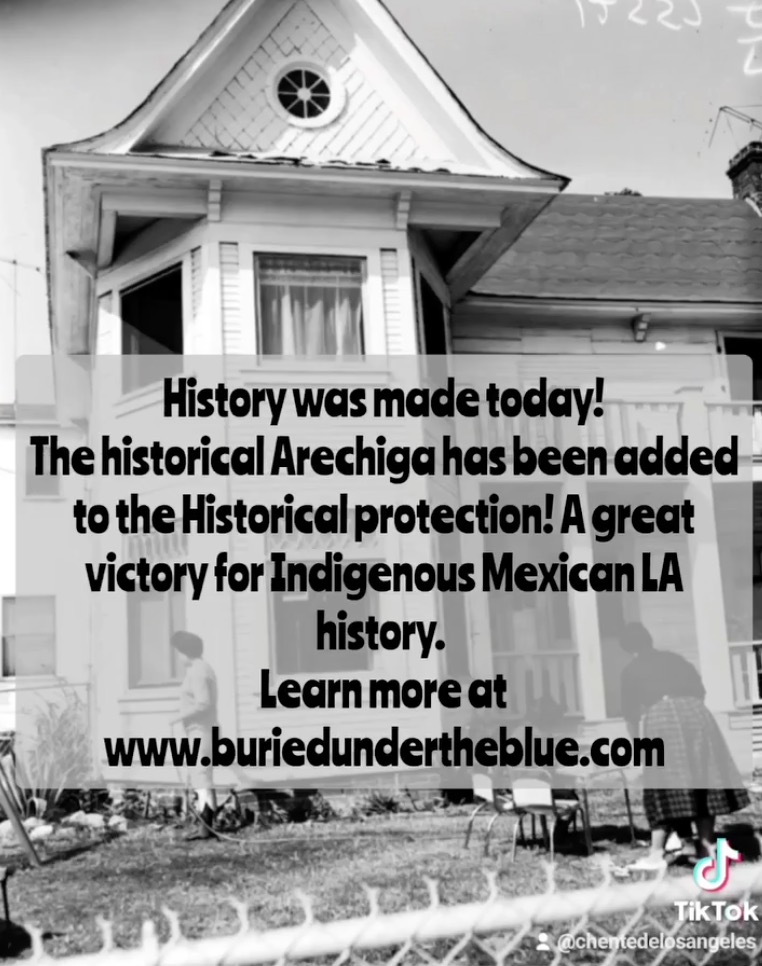
This is an extremely odd statement, since the tract it’s on was laid out by a Scot named Maltman, and the long list of the house’s owners (names like Rudolph, Garfield, Murray, Champion, Staub, Wood, Shely, Runyon, etc.) reads like a “who’s who” of “Let’s Be Anglos.” It’s a victory for Mexican Los Angeles because, why? It had one Hispanic owner for five years? (Who then sold it to another Anglo named Maurice Eubanks.) No, it’s a victory because—as we are told in every single news story on the subject—the fabled Chavez Arechigas “fled there,” settling in the house because they’d lost their home in Chavez Ravine.
But that’s not even remotely true. Here’s what actually happened:
During the latter half of the 1950s, when time grew short for the Arechigas in Palo Verde (e.g., the eviction of August 1957, the eviction notice of March 1959), Manuel and Abrana’s only son Juan was already living elsewhere. Juan and wife Nellie lived in a house at 2651 Benedict Street, which they purchased in the spring of 1955 for $10,250 (they are in the phone books at that address through the rest of the 1950s).
In March 1959, without selling his Benedict Street house, Juan Arechiga purchased the house in question at 1553 West Ewing Street, which we are told became the “refuge for the Arechiga Family.” However, when Juan’s parents’ Chavez house on Malvina was famously demolished that May, his folks did not move into Juan’s house, but rather, Manuel and Abrana relocated into one of the two homes they owned outright, specifically, into the house they had owned, for some years, at 3649 Ramboz (see their 1960 phonebook listing here).
Did anyone “displaced” from Chavez Ravine ever go to the Ewing house? No. Juan’s sister Victoria lived in the house she owned on Allison. Aurora Vargas, the daughter famously carried out of “her” house in Chavez Ravine, was already living in one of the two houses she owned on Simmons Avenue. Again, the Ewing house was owned by Juan Arechiga, who lived miles away from Chavez Ravine, and who only owned the Ewing place for a short time; he sells the property in March 1964.
When you are told Lupe Breard “lived alongside the Arechiga family” remember this: Lupe moved there in 1962, when she was two years old. The Ewing-owning Juan and Nellie, with daughters Helen and Jeannie—who, again, were absolutely and positively not displaced from Chavez Ravine—were the ones with whom toddler Lupe lived alongside, before the Arechigas sold the place and left in early 1964, not long after Lupe turned four.
I’m not even sold that Juan ever lived in the house; three-year-old Lupe might remember them being there now and then, but probably as owners, not residents. Consider: Juan also owned the house on Benedict, in which he and his family had lived since 1955, during this entire time. Juan, it seems, bought Ewing as an investment property: the 1960, ’61, ’62, and 1963 telephone directories list Esperanza T. Marquez at the property, not an Arechiga.

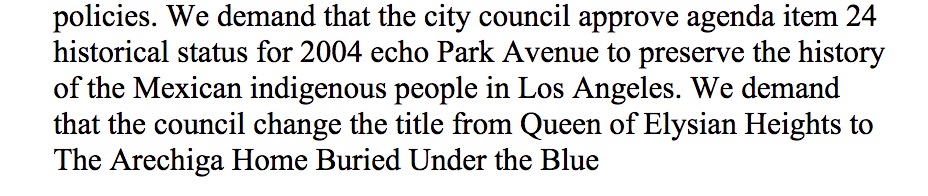
Here’s Buried Under the Blue demanding the historical name of the house be changed to “The Arechiga Home” for no other reason than…one Arechiga, who lived two miles away from Chavez Ravine, bought and owned the place for five years, 65 years ago. And to reiterate: indisputably, no-one removed from Palo Verde, La Loma or Bishop ever lived there…well, that seems like a reasonable reason to use their favorite phrase “we demand“:
So, having run through a few odds & ends, let’s recap!
**********
The Top Dozen Dumb Myths about Chavez Ravine
In no particular order:
Removing the people from Chavez Ravine was a racist act.
The only logic or reasoning behind this assertion being “because everything was racist in the past, what happened must have been racist!” However: The Health Department chose Chavez Ravine as a redevelopment site involving metrics that existed outside of ideology (e.g., the American Public Health Association’s rubric regarding blighted neighborhoods vis-à-vis lack of toilets, high disease rates, public dumping, makeshift structures, streets inadequate and grades too steep for emergency vehicles, etc.); their intention was to better the living conditions of the poor.
Then the Housing Authority went through depopulating Chavez Ravine based on slum-clearance ideology, but consider, that organization was replete with Jews and Communists (Wilkinson, Jack Naiditch, Frances Eisenberg, etc.; Sidney Green, who signed the infamous 1950 “Wilkinson Letter,” was among the group of Communists dismissed from the CHA in the fall of 1952). Jews and Communists spent their time writing for the People’s World, fighting for civil rights, and working to secure a just and equitable society for all peoples. Those are the racists you’re talking about.
The other player besides the health and housing departments was the mayor. Fletcher Bowron was a liberal pro-housing mayor, and although the left’s paternalistic, patronizing anti-poverty policies via social welfare legislation can arguably be deemed racist, it’s hardly the rabid White Supremacy critics describe it as.
The handful of Chavez Ravine residents who were actually evicted, were evicted illegally.
Not only was the process legal, it had been hashed out by the courts endlessly. It was the same kind of eviction that had been done—legally—hundreds if not thousands of times in Los Angeles. There are lots of reasons not to like it, but, just calling it illegal doesn’t magically make it so.
The Arechigas were evicted on Mother’s Day.
No, they were evicted on a Friday, and Mother’s Day was on Sunday. “Well, then, it’s just mean they were evicted on Mother’s Day weekend.” That is true, but note: The Arechigas were duly notified, on March 11, they had 30 days until eviction, and that said eviction was scheduled for April 10. It was the Arechiga lawyer who got the April 10 eviction delayed another 30 days, thus, it was the Arechigas who made the whole thing go down on Mother’s Day weekend.
Dodger Stadium is on top of the communities of Palo Verde, La Loma and Bishop/the communities of PV, LL and B are buried beneath Dodger Stadium.
The stadium, specifically, is on land that had had a brick factory. If you’re referring to one of the parking lots, though, the stadium’s parking lot to the north is on land that had had those neighborhoods (and again, the neighborhoods were demolished years before the parking lot was even a gleam in someone’s eye, ergo, nothing is “buried”).
The Dodgers owe something to the descendants.
They do not. The City of Los Angeles had one job: deliver an empty plot of land. The city, being the city, in the grand tradition of bureaucracies, of course did a poor job of this. Then the city had to play mop-up at the 11th hour. The Dodger corporation was in no way involved in removing people who had lost their homes years before (yes, that includes the Arechigas).
We are told we must “hold the Dodgers accountable for their part in destroying Palo Verde, La Loma and Bishop!” But no…we don’t. Because DodgerCorp. were not “complicit” with the city in destroying one single house. If they were, then, when and how? Exactly: didn’t happen.
People in Chavez Ravine had to flee, and scramble to find housing, but it was impossible to go anywhere else, because of redlining.
What is redlining? As part of Roosevelt’s New Deal, the government began something called the Home Owners’ Loan Corporation. The HOLC produced color-coded “Residential Security” maps that gauged areas where they could or should refinance existing loans. The ones coded “red” were deemed high-risk (“hazardous”); and yellow indicated “declining areas.” Any Mexican-American was more than welcome in either area. Now let’s look at one of their maps:

The area inside the black square, that’s Chavez Ravine. And what do you notice? The entire surrounding area is by and large red or yellow. It’s hard to believe that the residents of the sparsely populated Ravine area couldn’t find a house in Los Angeles, which was mostly red and yellow. (The white areas were parks, industrial, business, and areas that had mostly apartments. Remember, despite the prevailing narrative, most of Chavez Ravine’s residents were renters. They would have gone to any the majority areas.) Note that, for example, nearby Bunker Hill (majority Caucasian) is redlined. Most people believe that redlining was done largely or primarily on the basis of race, which is untrue: the vast majority of US citizens “redlined” were white.
And remember, HOLC went out of business in 1951, so, these maps would not have applied to the people of Chavez Ravine.
“But the HOLC shared their maps with private banks!” No, that was a wishful claim made years ago that has been debunked. “But the HOLC shared their maps with the Federal Housing Administration!” Maybe, but the FHA had their own maps (which they did on a block-by-block basis, and guess what, they burned all their maps in 1969 when a lawsuit came after them), but yes, the New Deal feds at the FHA and their hateful-of-Blacks Fannie Mae lapdogs were super racist, no doubt. “But okay even though the HOLC maps had nothing to do with mortgage refinance after the eminent domain in Chavez Ravine, it still made things really bad for Chavez Ravine in the 1940s!” Actually, evidence shows the HOLC did in fact loan heavily in red-shaded areas.
Oh, and I shouldn’t have to remind you, but no one had to flee or scramble, since in Chavez Ravine there was (in accordance with the law) an office to assist in finding people new homes, be they rental or purchase. The lady who ran the office was Vicki Alonzo.
People kicked out of Chavez Ravine had nowhere to go, because it was illegal for Mexican-Americans to own houses.
BUtB repeats this one a lot, but no-one ever indicates what that law was. Because it didn’t exist. (In fact, it’s especially funny the Arechiga family say it was illegal for Mexican-Americans to own houses, when they owned 11 houses…13, if you count the two in Chavez Ravine.)
It was difficult for Chavez residents to find housing, because of restrictive covenants, whereby most areas of Los Angeles were where POC weren’t allowed to buy houses.
Some residents of Chavez Ravine may have moved to Chavez Ravine because there was a covenant against their purchasing a house in, say, Brentwood. But, restrictive covenants were de facto done away with in Los Angeles in 1945, and declared Federally unlawful in 1948. Ergo, the people of Chavez Ravine displaced in 1950-1953 would have had no problem with them.
Moreover, most of Los Angeles’s restrictive covenants, written into subdivision title deed language ca. 1903, had expired by the 1940s. You know what I’ve never seen? A map of these restrictive covenants. Try and Google it—you’ll get a lot of pictures of the infamous HOLC “redlining” maps, but, no: maps that evaluate mortgage lending risk are not the same thing as the exclusionary language of a title covenant.
Chavez Ravine was home to generations of families.
Most moved there in there in the mid-20s, and were gone by early 50s. On average, 25 years. Which is one generation.
Residents didn’t get compensation/got below-market compensation.
Except, they were compensated at or above market rate. Each property had multiple appraisals, and the court awarded the highest appraisal, in accordance with the law.
Residents were forced to sell cheap, because the city caused a panic through a tiered buying system.
Some say this fiction was concocted by Mike Davis, but there’s no evidence of that. There’s actually no evidence the “tiered buying system” happened at all in any way shape or form: if such a flagrant violation of law were to happen during the very publicized and public workings of a highly-scrutinized public agency, it would have left a mark. Had there been unhappy homeowners because such a thing happened, it would have left a mark. There was an entire month-long investigation of LA public housing by a House of Representatives Subcommittee, in hearings that lasted through May of 1953, where residents aired their grievances in no uncertain terms, up to and including every last thing they didn’t like about how they were treated by the Housing Authority, and not a single person mentioned this? Copious interviews with residents, in the 1950s and beyond (with anger directed at length in, say, the 1957 issue of The Torch Reporter) and it was never mentioned? The Los Angeles Housing Authority were accepting Federal money, and as such were under Federal oversight; HACLA were, moreover, bound by the strictures of the Court, who directed and oversaw appraisals and payments; and as a public local agency were, again, under scrutiny, and yet we’re to believe HACLA went totally rogue, running roughshod over laws, to create community panic because…why? To save money? (Yeah, those government agencies given absurd amounts of other people’s money to play with suddenly becoming prudent and frugal…that’s a first.) HACLA was going to get all the property through eminent domain, as they had countless times before in the very commonplace and workaday performance of their tasks; why would they suddenly turn full-eeevil in this one particular case?
Chavez Ravine = Palestine.
No. Equating the two reveals a jejune understanding of both Los Angeles and the Middle East.
**********
As long as we’re on the subject of picking apart what people have said about Chavez Ravine…the Los Angeles Times published this opinion piece a couple weeks ago.

I’ll run through some of its contentions, quickly: people lived in Chavez Ravine because they legally weren’t allowed to live anywhere else (absolutely untrue); Frank Wilkinson came up with the Elysian Heights project (not by a long shot—he was the Director of HACLA’s Office of Information); the city offered people below-market monies for their homes (a debunked lie); the unjust treatment of the residents is a blight on LA history (were the residents treated more unjustly than other residents removed for projects? No, so how is CR in particular a blight?); the property was unjustly taken (though the process was in the courts for years…I’m going to need a breakdown of the judges’ decisions detailing exactly how they made purposely unjust decisions from the bench); taking of homes resulted an inability to build wealth (it can be argued the opposite is true: the people, compensated for their homes, bought homes elsewhere, which were in an area that had actual city services, and would therefore be worth much more today than the CR homes could ever have achieved); “some got nothing” (um, source?); the CR project was racist because the substandard neighborhood happened to have Mexican-Americans living in it (see my paragraph on CR and racism, above); the baseball stadium is not a “public good” (though it was deemed by the courts to be); the Dodgers should “give back” to the residents who were removed 73 years ago (the Times doesn’t say what they should be giving to these people, of course…they also neglect to mention that it was five years between the cancellation of the public housing project, and the Dodgers being offered the land).
Point being, the Times editorializes, based on a whole host of “alternative facts.” I decided to write about Chavez Ravine after I read the Reparations Bill (everything is racist! there was below-market compensation! the Dodgers got the land for an insignificant amount! schools were buried! it was all fraudulent! and we use terms like redlining without knowing what redlining is!) because it contained a plethora of similar falsehoods and delusions. So, I hope you have found these seven posts edifying, as I have attempted in them to correct the record.
********
Now then, I will reiterate what I said in Part I: Hey, City of Los Angeles!
Hire me as part of the task force to establish a database. I will be absolutely fastidious and singleminded in my dedication to producing a database of all former residents with every house catalogued (and, ideally, pictured) up to and including dates of construction and demolition. I’ll dig into City records and find what the houses were valued at, what the residents were paid, where they relocated, the whole magilla. Of course that will depend on what records were actually retained and maintained, but if the preceding 26,914 words over the last two weeks have indicated anything, it’s that I’m obsessively thorough, and will get to the truth.
And here’s something else I think we should do. A number of the houses were moved.

Moved houses would have their destination listed in DBS records. If I find a survivor (roughly akin to this one, say) I suggest the city buy a relocated house, and return it to Chavez Ravine. There’s a lot of empty land up there north of the parking lot, put the house there, looking down over Dodger Stadium. The house can be turned into an interpretive center. Now that’s living history. Isn’t that a great idea? I think so too.
That’s my pitch, Councilmember Carrillo, so drop me a line at oldbunkerhill@gmail.com. I look forward to hearing from you, and thanks!
************
This is seven-part series. Its component parts being:
Part I: Chavez Ravine and the Mainstream Narrative
The master narrative, as promulgated by the mainstream media; its result, a reparations bill; the good and bad of that bill. Published Friday, May 10.
Part II: What is Chavez Ravine
Its beginnings, development, and evolution to 1950; its history of demolition prospects; and, can you call it Chavez Ravine? Published Sunday, May 12.
Part III: Calm Before the Storm
A snapshot of life in the area in the 1940s. The mythos of small-town life; Normark’s documentary work; a study of the people of Chavez Ravine; churches, markets, bus lines, etc. Published Tuesday, May 14.
Part IV: The Rise and Fall of Elysian Park Heights
A history of public housing; Neutra’s Elysian Park Heights project; its proponents and opponents; the area’s demolition; the downfall of public housing, and its relationship to anticommunism; land use after the demolition and nullification of the contract. Published Thursday, May 16.
About the Dodgers; what constitutes public purpose; an illegal backroom deal? Published Monday, May 20.
The Arechiga family history to 1950; eviction from Malvina Street; eventual removal in May 1959; the multiple Arechiga houses; life after Malvina; the next generation of Arechigas. Published Thursday, May 23.
Part VII: In Summation, plus Odds and Ends
Key takeaways; plus a collection of *other* commonly-held beliefs about Chavez Ravine, conclusively debunked. Published Monday, May 27.
If you have comments or corrections, please don’t hesitate to write me at oldbunkerhill@gmail.com.
And don’t forget, give us a follow on the ol’ Instagram!
 Bunker Hill, Los Angeles
Absolutely brilliant Nathan. Thank you for sharing what was obviously a lot of work. I look forward to more posts.
LikeLike
Thank you Nathan. I thought I had a good handle on the whole story, but even I fell for the buried school tripe.
LikeLike
Man, I love a thoroughly well researched debunking of “common knowledge”, no matter what the politics. Thanks for the great read.
LikeLike
Thank you sir! A pleasure and an honor. One of these days I’ll take on the Streetcar Conspiracy and the Zoot Suit Riots!
LikeLike
The wikipedia article “Chavez Ravine” seems to be the source of the “tiered buying” assertion attributed to Mike Davis and City of Quartz. And it is not backed by anything substantial. I’ve done a search of the book by checking it out at archive org. “Chavez Ravine” is not in the book’s index. Searching for “Chavez Ravine” in City of Quartz does bring up two mentions spaced a paragraph or so apart but nothing about “tiered buying”.
I’d appreciate a credible citation of this. From “City of Quartz”, from any written work by Mike Davis. Please be specific. Title, chapter, page number, quotation in whole.
LikeLike
Thank you so much for your comment. I couldn’t do what I do without thoughtful folk willing to think *critically* about what they read.
And, you’re absolutely right.
So, I have these binders full of notes (yes, I know, I’m old) regarding Chavez Ravine and in those notes, re: this issue, it indicated Davis was the original source. I have no idea when I wrote that or what my source was, but I considered the claim as bolstered by the number of internet mentions including Wikipedia. That was needless to say quite foolish on my part, since the internet is a cesspool of lies, Wikipedia especially. I am shame-faced that I didn’t do the requisite due diligence in getting “eyes on” with the source material. I have since revised the text, and again, I thank you (which I have also done in the edited text [in Part I, final sentence of my critique of Shatkin’s LAIst article]).
The other side of this coin, though, remains: if not Davis, what then IS the origin point of this claim?
There are no contemporary accounts that refer to said activity. For example, had such a thing happened, why was it not mentioned by homeowners in the 1953 “Hearings Before a Special Subcommittee of the Committee on Government Operations, House of Representatives: Investigation of Public Housing Activities in Los Angeles” wherein, for example, housewives complain the HACLA folk were mean, and offered too little money, etc. Among the homeowners and attorneys and civic activists and so on, I find it hard to believe no-one mentioned such flagrantly illegal activity. Or in 1957, when the anti-government/anti-Dodgers editor of “The Torch Reporter” wrote extensively about Chavez Ravine, and gave angry homeowners (Alice Martin, Glen Walters) a voice, still, no-one mentioned this egregious activity. It’s never mentioned by a single homeowner in any of the papers (and yes I know we’re “not supposed to” trust anything the *Times* says, but there existed more left-leaning papers, e.g. the Lincoln Heights Bulletin-News and the Highland Park News Herald, which covered Chavez Ravine extensively).
So, since Mike Davis *didn’t* come up with the story in the early 90s, then, whence did it generate? It seems to have emerged much more recently, within the last few years, and has zero actual source. It’s getting repeated in books like Bruce Bertrand’s recent “One Town, One Team” and he doesn’t have a source for it, either. The earliest instance I can find for the claim is Elina Shatkin’s 2018 article in the LAIst, and *that* piece is so full of ridiculous nonsense, it wouldn’t surprise me if she made it up out of whole cloth…but I think it more likely she was just told it by someone, and it was printed without any fact-checking…par for the course in an era of known only for its general absence of both capability and accountability.
That Davis was not, apparently, the source of yet another fabulated story, should give the few remaining Davisites some succor.
In theory—in a perfect world—Carrillo’s reparations bill will result in a deep dive into the City Archives/HACLA archives/etc. and we’ll find the smoking gun that will give us all closure on the matter.
LikeLike
Nathan, I appreciate you being forthcoming about this. I remember reading that assertion about Mike Davis and City of Quartz as far back as 2015 and it definitely was from Wikipedia. I’ll give the metadata behind the Wikipedia article a look and see if I can figure out the source or at least get some clues.
My family was evicted from la Loma so I’m personally interested in getting this stuff right. With all of this in mind, I’ll cease my public facing commentary and engage with you directly via e-mail. Thank you.
LikeLike
I found your posts here via a random search on Dodger history – truly a serendipitous find for me! I have read a little about the history of CR but most of what I have found before offers just “hints” at the facts and documentation you present here. I grew up in Orange County during the early 60s and remember (vaguely) the opening of Dodger stadium — and for most of my life it seemed the general attitude of the Mexican American community towards Dodger Stadium and the history of Chavez Ravine was that there was community pride the stadium had been built there (especially during the period when the Angels played in “Chavez Ravine” [AKA Dodger Stadium]).
Thank you!
LikeLike