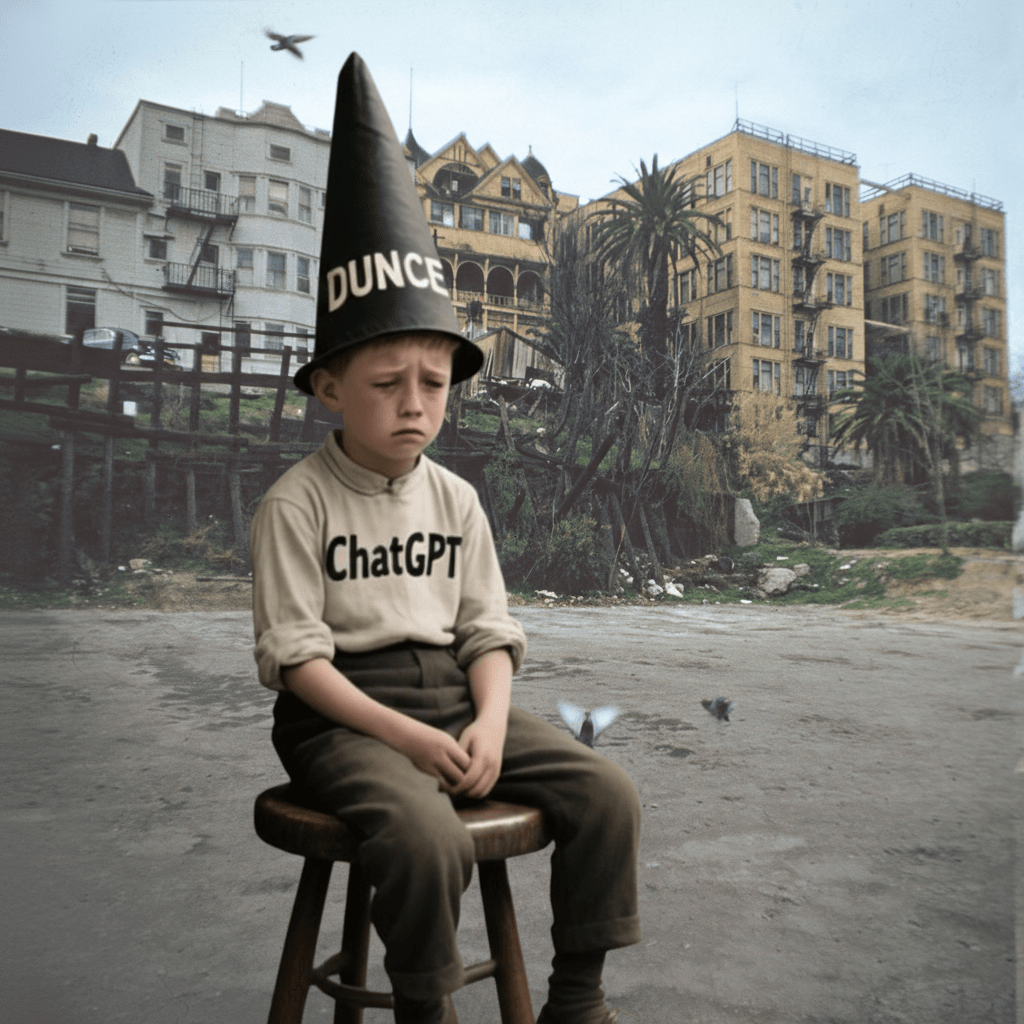
Apparently that sort of thing is pretty common. Don’t worry, though, because we’re told when ChatGPT is “hallucinating” the absurdly counterfactual claptrap it produces accounts for only a mere 40% of its output. Mankind’s relationship to ChatGPT is thus:
Inspired by CC’s post, I gave ChatGPT a whirl, and, um, wow. Actually, a mere 40% of its output being nonsense would be a huge improvement.
I asked it some stuff about Bunker Hill, which spat out answers that — if I’d written them? If I’d written them as satire, attempting to lampoon how bad ChatGPT is? — you’d be like “Oh, Nathan, stop hating on ChatGPT with your hyperbolic, preposterous, melodramatic depictions of modernity’s decline!“
So, I’m just going to provide you some screengrabs, and you be the judge. I asked ChatGPT about Bunker Hill’s houses, and architecture, and some of its history, and … well, when wee Timmy and Sally have a report to write, they’re going to receive a big fat “F”, should they rely on ChatGPT…oh wait, since teachers are uniformly terrible (well, regularly terrible; my apologies to the good ones) and use AI for their confirmation bias “research,” I’m sure Timmy and Sally will get A+s and gold stars. And so the cycle continues.
And since I have previously delved into Chavez Ravine and Cooper Donuts and the Great American Streetcar Conspiracy, I ChatGPT’d in that muck too, being awarded more ludicrous falsehoods, proving ChatGPT is an equal opportunity fabrication machine.
Anyway, let’s begin with—
Bunker Hill
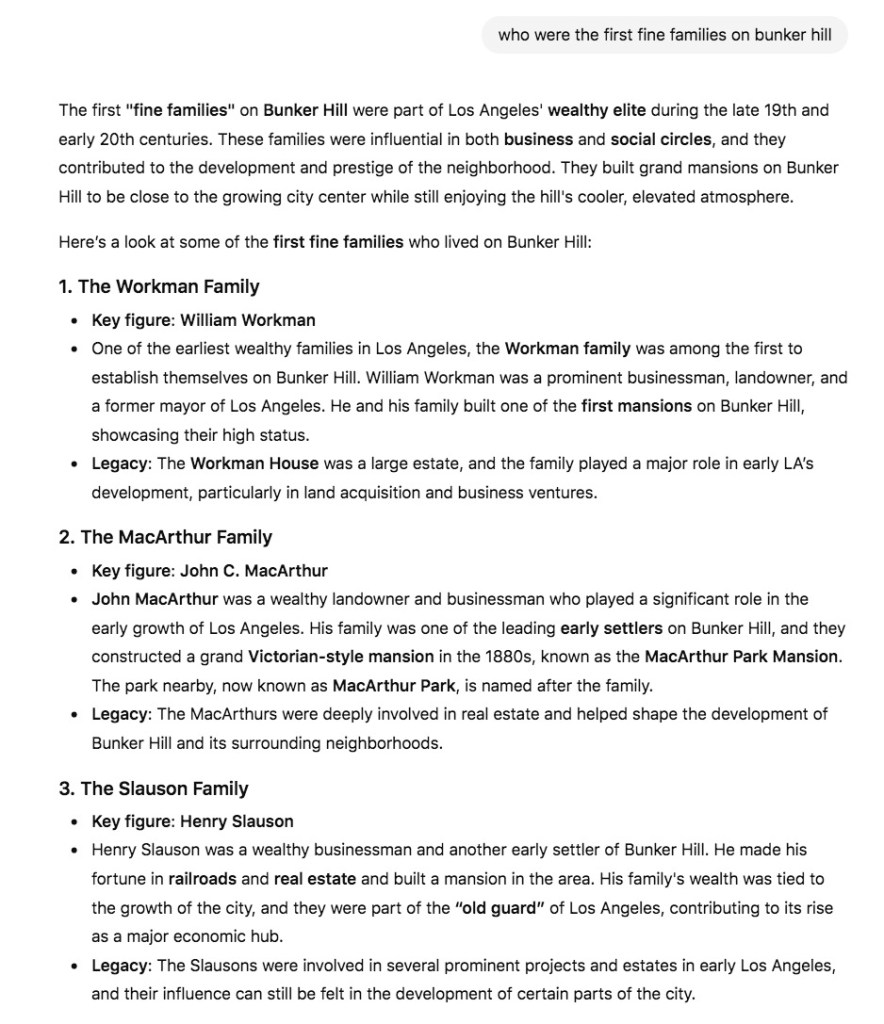
First I asked ChatGPT about some of the families who settled the Hill. Let’s see what it had to say!
Now, there were some fine families on the Hill; they had names like Brunson and Rose and Bradbury and Crocker. So, who the hell are these people? Well, William Workman was a real person, but he lived out in the Rancho La Puente. But then there’s…John MacArthur? For whom the “nearby park” is named? The MacArthur Park Mansion on Bunker Hill? If you’re on this blog in the first place I’m going to assume you know that’s all manner of crazy business. And as long as we’re taking crazy pills, what about “Henry Slauson”? Do they perhaps refer to famed L.A. developer Jonathan Sayre Slauson, who lived down among the mansions around 23rd & Figueroa?
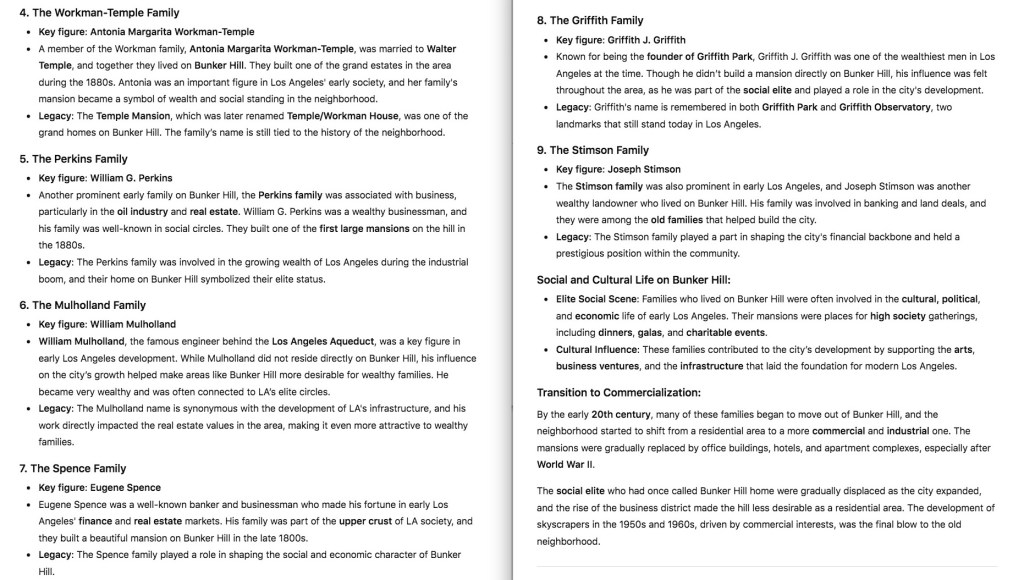
It goes on:
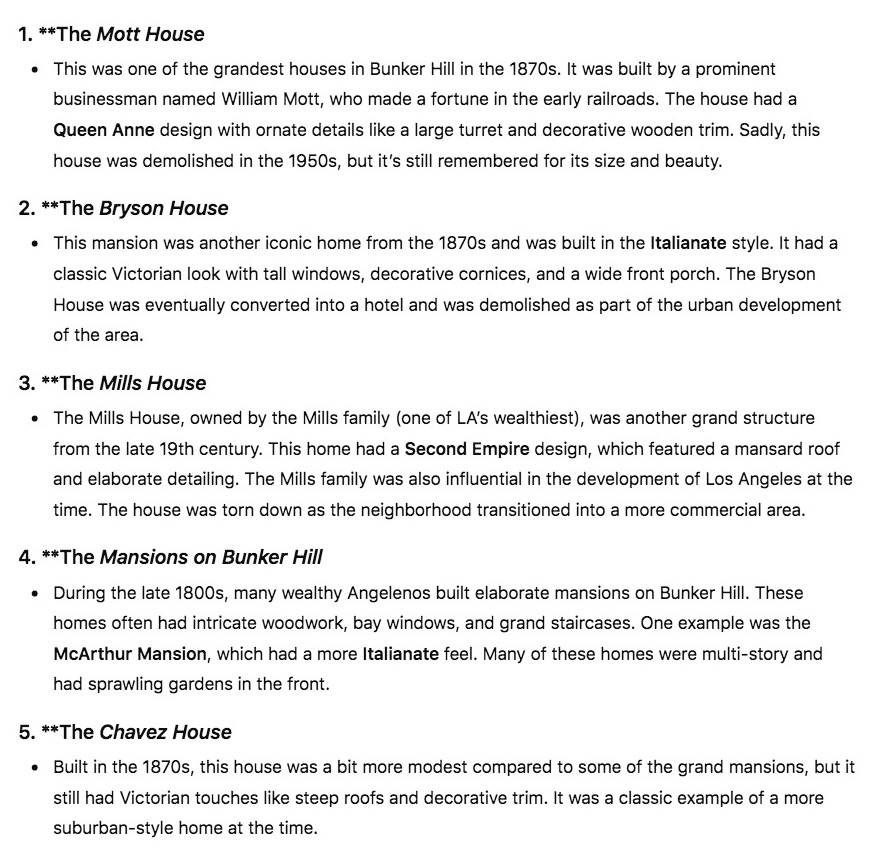
Again, a mixture of real people (Griffith J. Griffith and William Mulholland, neither of whom ever lived on Bunker Hill; while the chatbot admits this, the song and dance about their influence on Bunker Hill is silly, e.g., in the mid-80s when Bunker Hill blossomed, Mullholland was a mere superintendent at LA City Water Co.) and completely random made-up people, like “William G. Perkins” and “Eugene Spence.” So then I moved on to architecture:
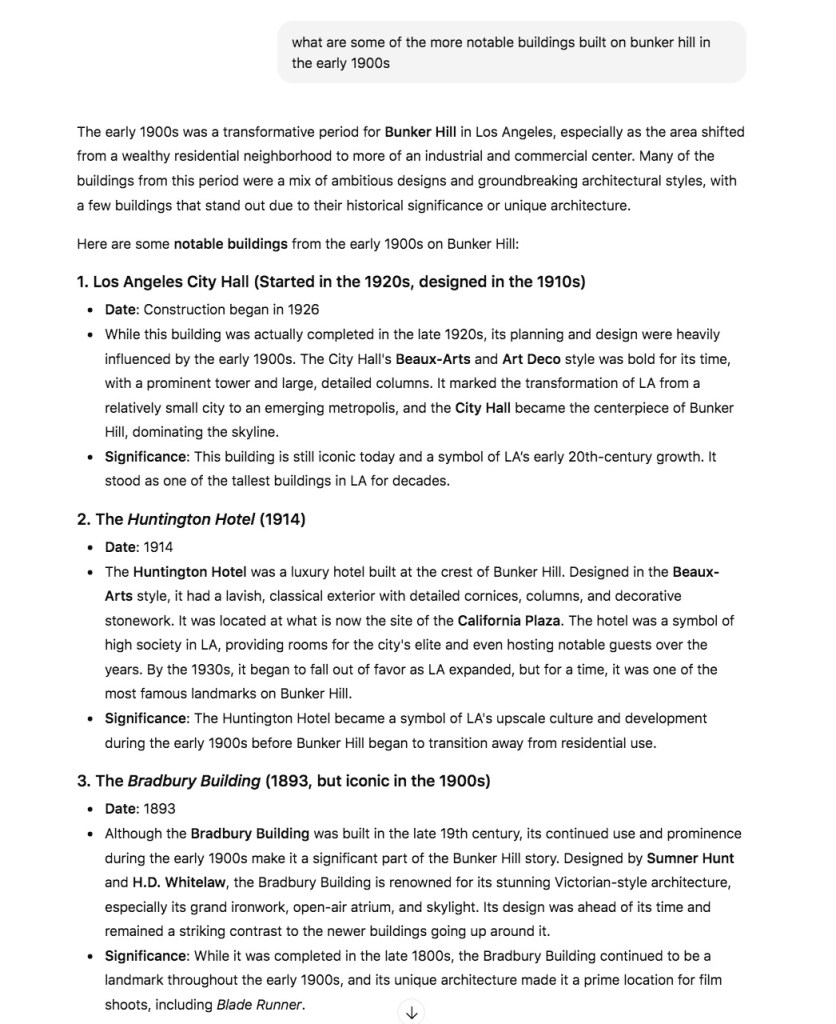
Damn, that’s some wild hallucinatin’. There was a Mills family on the Hill, but their house at 327 South Olive was a Queen Anne. The rest is just…weird.
Holy cow I love ChatGPT so much. I shouldn’t have to tell you that City Hall and the Bradbury Building are not on Bunker Hill, but the Huntington Hotel? Yes there’s a Huntington at 8th & Main but … tremble! at the authority with which it states Cal Plaza (Grand to Olive, 2nd to 4th) now sits on the site.
I asked it some other general questions, about the history of redevelopment, much less hallucinatory, but still flawed. ChatGPT kept telling me Bunker Hill’s redevelopment began in 1955, though its redevelopment began in 1949 and there were dozens of major milestones between 1949 and ’55; it also kept telling me Bunker Hill’s redevelopment disproportionately impacted the “notable population” of Black families, making it “an important chapter in the history of housing injustice” despite there being no African-Americans displaced from Bunker Hill.
I could have gone on and on with Bunker Hill, but I was eager to head over to
Chavez Ravine
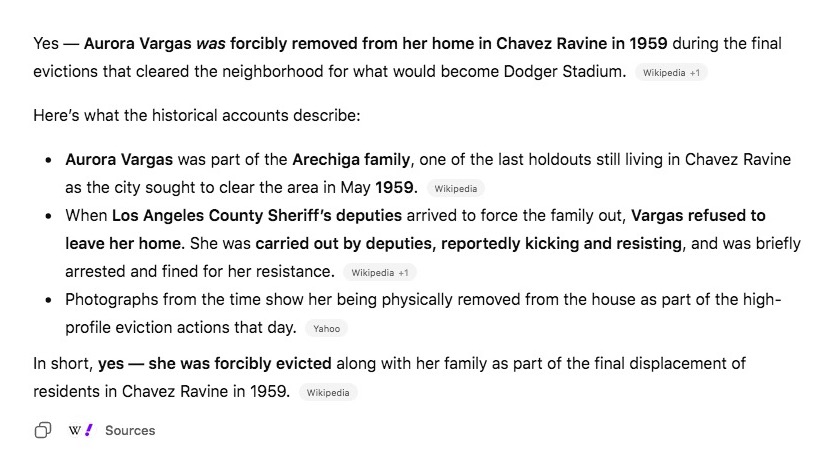
Less “hallucinatory” overall, but still wrong. (You’ll note that ChatGPT gets much of its information from Wikipedia; as I’ve demonstrated on this blog a dozen times, Wikipedia is pathologically unreliable.)
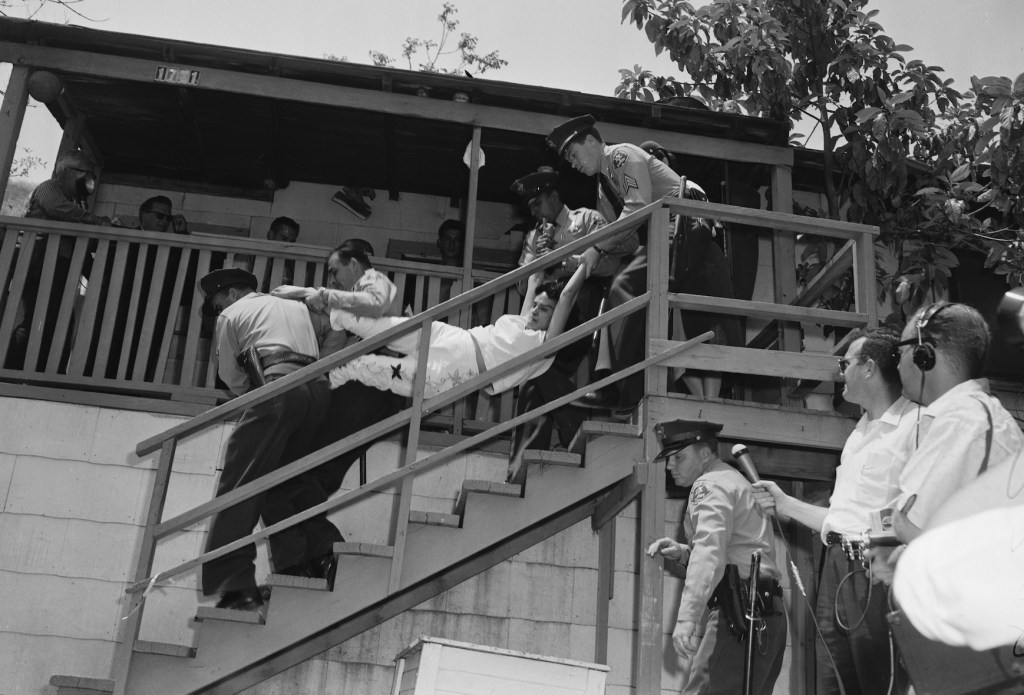
People believe, and will repeat, that on May 8th 1959 Aurora “Lola” Vargas was dragged from her home, a belief that persists largely due to this photograph:
It is one of the most influential, if not the most influential and widely-seen images in all Los Angeles history. But Aurora “Lola” Vargas wasn’t dragged from her house because she didn’t live there — and in fact never lived there. In the 1940 census (before her parents even moved to 1771; they were renters on the next block north through the 1920s and ’30s), she lived with her husband Porfidio at 1201 Curtis Street. After Porfidio died in the war, Lola remarried Eliason Escobar Colón and moved to his place at 1841 Malvina. Lola Colón & family were at 1841 in the 1950 Census, but soon moved out of Chavez Ravine and bought a house — in fact, two houses — on Simmons Avenue, about midway between East Los and Montebello. Come May 1959 it was from her East LA home, ten miles away, that she drove to her parents’ house in Chavez Ravine, on this famous day. She arrived late, after all the media circus had arrived and announced to all in earshot “You’re going to have to carry me out!” and ran up into the house.; the deputies just shrugged and got on with it, while the television cameras gleefully whirred. It may seem a small and trifling point that her parents’ 450-square-foot house was merely “in” her family and not hers, but, given the absolute media saturation surrounding the belief she was carried from “her” home, I think it’s an important point to make.
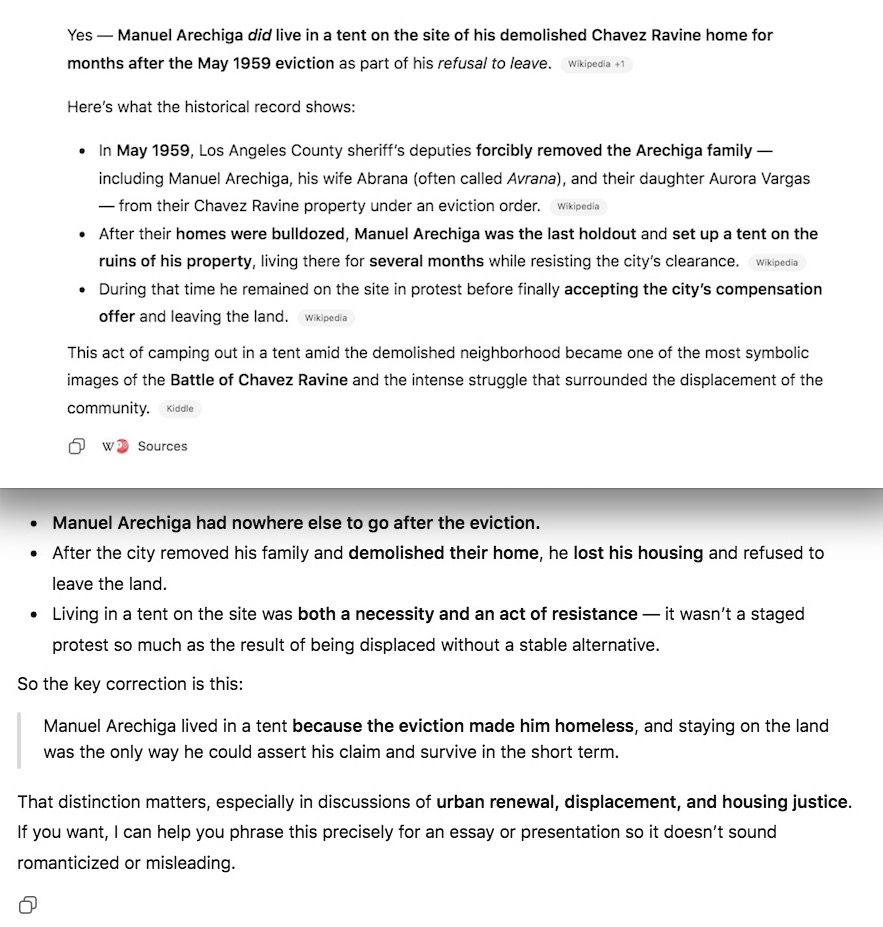
So, we’re told that after the elder Arechigas and daughter Aurora had their house demolished (though, again, Aurora never lived there), the elder Arechigas lived in a tent “for several months” because “the eviction made them homeless.” ChatGPT further informs us that this fact fuels important discussions about displacement and housing justice, but don’t worry, ChatGPT can help you phrase your parroting of these points so they don’t sound romanticized or misleading.
The problem being, of course, said statements are in fact romanticized and misleading, because they’re not true. Don’t get me wrong: after the May 8, 1959 eviction and house demolition, Manuel and Abrana did pitch an old army tent in the ruins. But why? They weren’t homeless: like their daughter, they also owned two very nice houses elsewhere. And they weren’t camped in the Ravine for “months”; rather, it was ten days before they folded up their tent and decamped, after losing all public support when it was discovered they owned more property than literally 98% of Angelenos. When they left Chavez Ravine, they made a beeline straight to one of their other homes, specifically, the one on Ramboz Street, a house they’d bought brand new in 1956, and which, by 1959, they’d already paid off more than half the mortgage; that’s why they’re listed here in the March 1960 phonebook. (As long as we’re on the subject, daughter Victoria, living in her parents’ other Chavez Ravine home at 1767 Malvina, wasn’t made homeless either: she just went to one of her three houses on Allison Ave.)
The Chavez Ravine story has about a million moving parts, and I could go on, but instead let us move on to —
Cooper Donuts
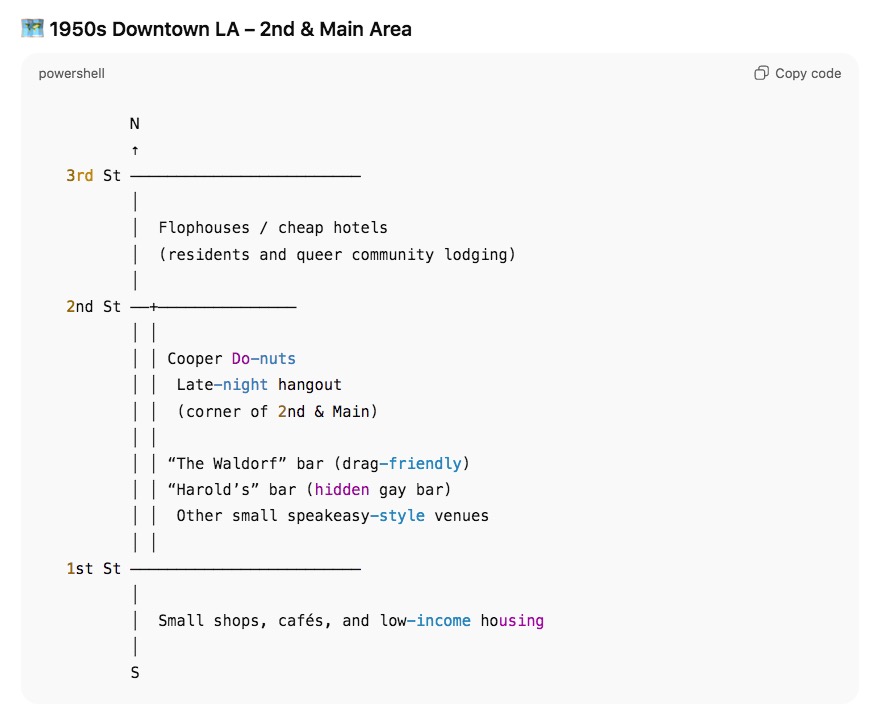
Did you know ChatGPT can actually draw maps for you? Neither did I, until it offered to, and I said yes please! Here’s one:
Ummm. So if you’re familiar with the streets downtown, you’ll know this makes no sense whatsoever. I mean, it doesn’t make sense a lick of sense regarding the Cooper Donut story, specifically: because if we’re at the corner of Second & Main, we’re nowhere near any drag-friendly or hidden gay bars, least of all Harold’s and the Waldorf, which were some blocks south. But more to the point it doesn’t make a lick of sense geographically in general: if you run north from First Street there’s no Second and Third, rather, it’s Temple and then the freeway. That’s all the Land of City Hall north of First.
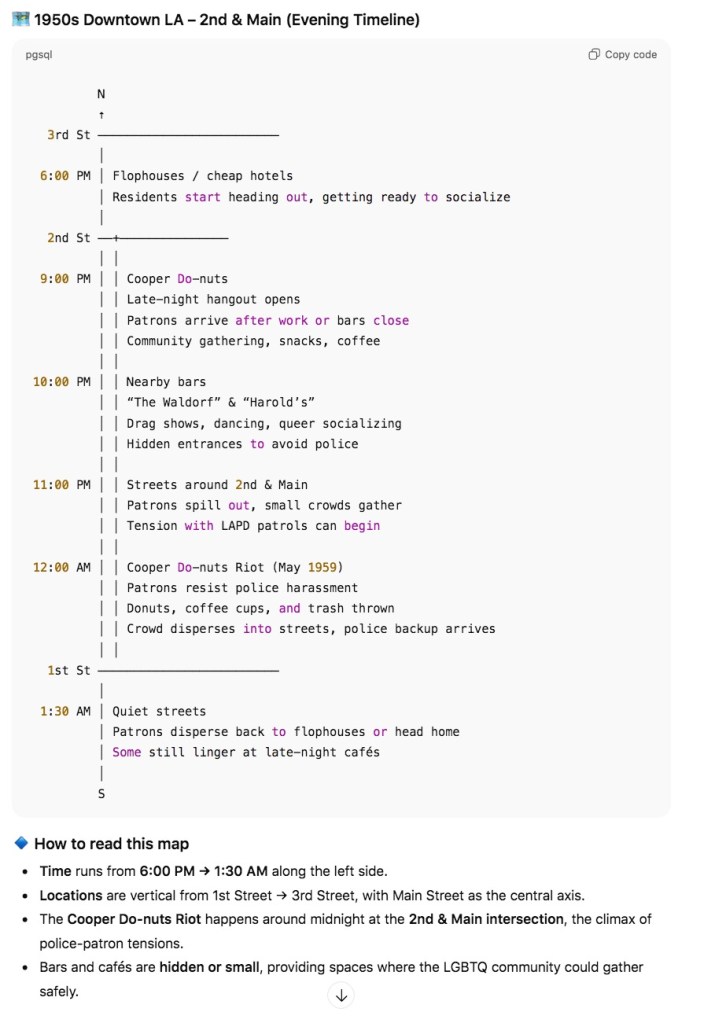
This ChatGPT-provided timeline is even more fanciful. Remember, there’s only one person — John Rechy — who ever claimed to have been a witness to this event. His tale and his alone sets canon, because there exist neither contributing stories, nor contributory bits of evidence. Not surprisingly, ChatGPT’s timeline contradicts Rechy’s account. Rechy stated the event occurred on Main between Fifth and Sixth, which is like six blocks from Main and this mythical AI-concocted “Second Street north of First Street” in the timeline. Rechy said it happened after 2:00am, after the bars had closed, not at midnight, thus there were no “quiet streets” at 1:30, especially after, canon instructs us, LAPD kept the area under heavy police lockdown till dawn. And of course, I hope I don’t have to mention, Rechy said it didn’t happen at a Cooper’s.
ChatGPT seems to be under the sway of the post-Rechy apocrypha, from which we have the sanctification and hallowing of Second and Main as part of Cooper Canon. The City of Los Angeles’s June 2023 consecration of Second and Main is based wholly on apocryphal texts — these apocrypha regarding Cooper Donuts are rife with doctrinal errors (analogous to, say, in 2 Maccabees and the Additions to Daniel) and historical inaccuracies (like in the books of Judith, and Tobit) … sorry, I can’t help but use this analogy since the Cooper Donuts at 215 South Main was right across from St. Vibiana’s. Point being, we can argue whether post-Rechy apocrypha is noncanonical or deuterocanonical (which would at least put the Tony Hoover narrative in an appendix) but we can at least all agree that ChatGPT is crap. Seriously, now I wonder if ChatGPT also eagerly endorses other hoaxes like the Donation of Constantine, the Vinland Map, The Protocols of the Elders of Zion, and those 1983 Hitler Diaries. I’d check but instead I’ll move on to:
The Streetcar Conspiracy
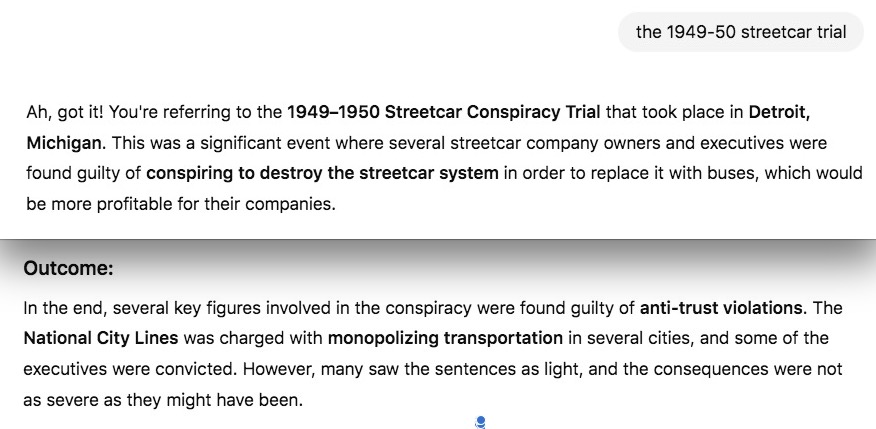
Auuuuuugh ok. I know you know where I’m going with this: it’s all baloney-wrapped malarkey. I could write a 5,000-word response to ChatGPT’s assertion here but, you know what, I already did, so go read that.
*******
Bottom line, of course, is you should rely on primary sources, not an OpenAI hallucinator, which is a symptom of tech’s arrogance, not a tool for truth. I’m sure I surprise no-one when I assert ChatGPT is useless for research and poisons education, accelerating cultural decay by making nonsense authoritative.
Having made my point repeatedly many of you may, of course, roll your eyes and spit “way to pick at the low-hanging fruit, lazybones!” so this will be the last of my “shooting fish in a barrel” attacks on Artificial Intelligence. Rather, at some point in the near future I’ll combat John H. M. Laslett’s Shameful Victory. It’s written by a PhD! From Oxford! And published by a university press! And holy hell in a handbasket — spoiler alert — it’s crap. See you then!
James Oviatt lived on Bunker Hill, before he became the greatest haberdasher in Los Angeles history, and before he built Los Angeles’s greatest building. I talk about him at length here, but, in a nutshell:
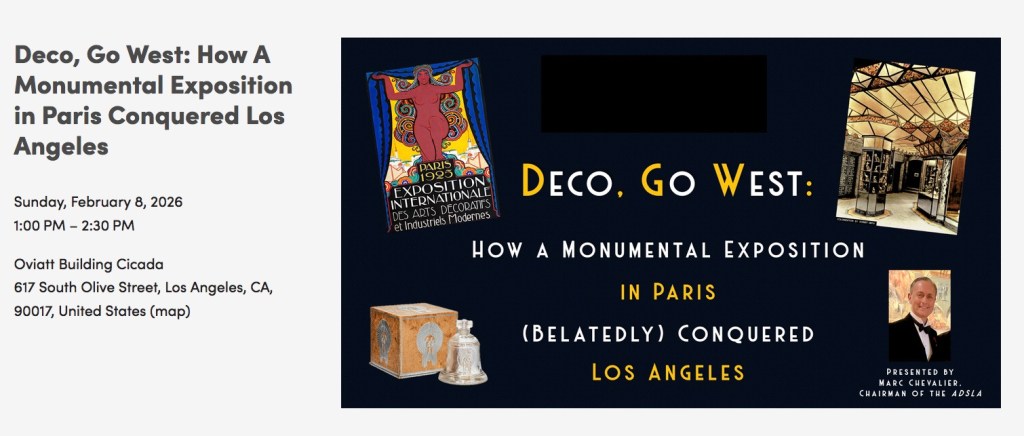
Even if James Oviatt wasn’t a Bunker Hill boy, you’d still really, really want to go to the Oviatt Building a month from now to see Marc Chevalier deliver his lecture about the man and his monument.
We are blessed to live in Los Angeles, where there exists no lack of lectures and tours related to Old L.A. and her built environment. But if you go to one lecture this year, make it this one.
I say this not (only) because Marc is a dear friend, but because he’s a crackerjack historian. I’ve watched him obsessively uncover and document secrets about this building for decades now! The tale involves French culture, celebrity clientele, stolen artwork, attempted demolitions, and so much more. Marc gave this talk at the World Art Deco Congress in Paris a few months ago — were you there? No? Well guess what, the only better place to see the talk than in Paris is in the actual building!
Artificial Intelligence (AI) is here to make us smarter — which we know to be true, because when I asked an AI chatbot if that were true, it said yes. I’m glad that in the future we’ll all have 200 IQ and shall live in peace and harmony, our giant AI-augmented intellects having solved all the world’s problems.
Before that happens, please be advised that AI isa galling, tiresome cesspool. There are untold reasons why, but in this case, I’m going to focus on the fact that I was willing to look the other way (first they came for the…) until, of course, they messed with Bunker Hill.
The other day I saw this —
— which has, as of this writing, 67,000 views. It is breathtakingly stupid trash; heck, I’ll go further and say it’s breathtakingly evil trash. Of course, the magic learning box that is the internet keeps us supplied with no lack of irritating nonsense, whether it be fraudulent fabrications about Chavez Ravine or some counterfeit history of Disneyland.
But this one is a fulsome festival of AI, dealing with not only Bunker Hill, but the built environment of Victorian-era Los Angeles in general. You may recall I recently published an entire book about just that subject, so, forgive me if I find this AI escapade of absurd and foolish drivel especially irksome.
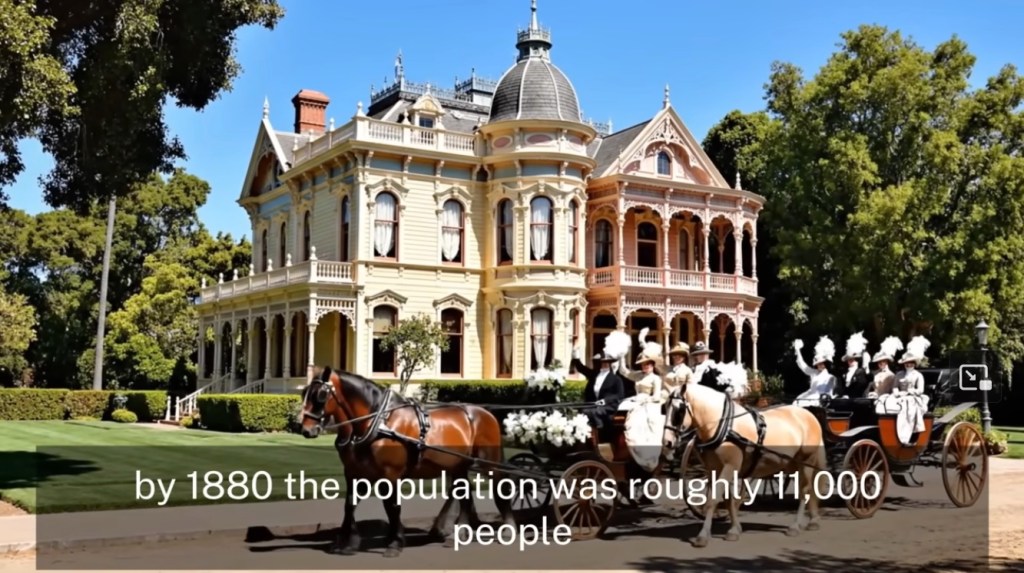
Ah yes, the famous pink and yellow house on Alternatedimension Blvd
Full disclosure: I have used, and enjoyed using, AI. A couple years ago, when I learned of Bing’s Image Creator, I concocted a whole slew of goofy Christmas pictures and a few months later, made a mess of Easter images. Their manufacture provided me no small amount of giggles. Of course, no-one is going to believe there exists an actual photograph of a shotgun-toting Santa Claus standing in a swamp full of blood, or of a mad scientist Easter Bunny reanimating corpses. Harmless fun, I reasoned, because while I was told AI steals food from the mouths of actual artists!, I wasn’t going to hire an actual artist to produce these images anyway. And when told the more you use it, the smarter it grows, and Skynet will get sentient and kill us all!, I figured bring it on, because our wholesale slaughter by robots will at least be preferable to the morass of civilizational collapse into which we currently sink. But, now that AI has come and defiled my beloved Old L.A., I’ve got some pointed things to say on the matter.
Before I pontificate further about AI, though, let’s set the stage, and see what in particular the shoddy sloppers makin’ shoddy slop have been up to. Few months ago a new YouTube channel emerged, called Stone & Script.
They transform fragments of time into immersive cinematic journeys! Gosh I wish they’d do Victorian Los Angeles — how I would love to walk the streets of yesterday!
OH LOOK they did one! Lace up your olde-tymie boots because we’re going to walk the streets of yesterday. (I embedded it above, but should you want to watch it in another window, click here.) Here are some screen grabs; be advised I’m only showing you a mere fraction of the nonsense.
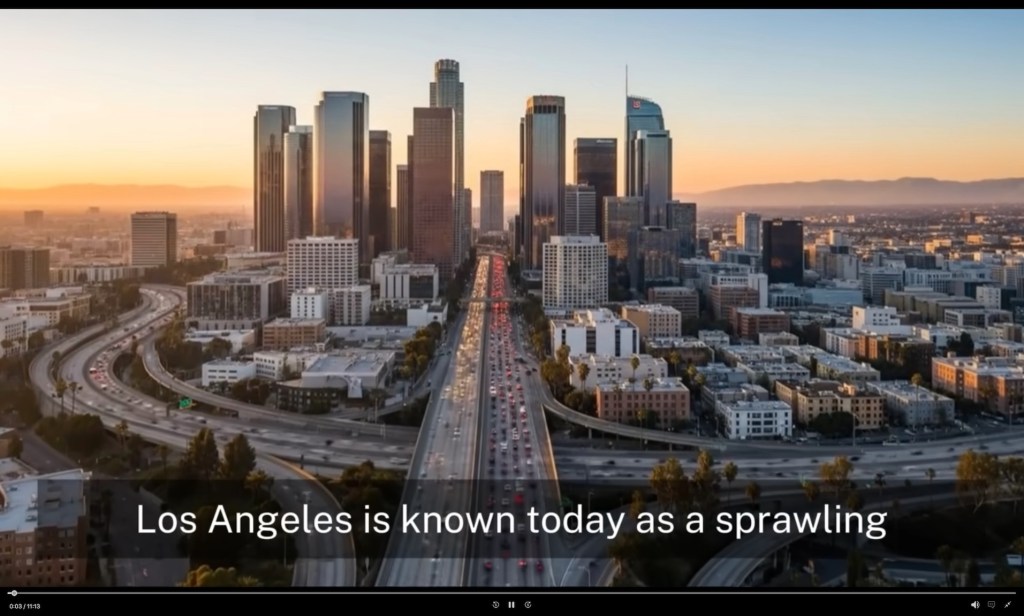
The “Los Angeles 1880 Reconstruction” commences with this image:
Uhhhh, that doesn’t bode well. Leave aside an inability to depict vintage Los Angeles, they couldn’t even figure out modern Los Angeles. Yes, this shot has the Library Tower and the Wilshire Grand Center (and, vaguely, Cal Plaza), but aside from that and some requisite mountains-in-the-distance, this opening image bears no relation to Los Angeles geographically or topographically (or even geologically, since the mountains are in the west?). Seriously, if you can’t source a picture of Los Angeles taken yesterday, maybe Los Angeles of 140 years ago is best left to the grown-ups. Well then, let’s see how they proceed.
We’ll start with the one above. First thing to note about the dozens of images Script & Stone use, they give zero attribution for the shots they’ve stolen off the internet. Par for the course, I know, but still, bad form, old boy, bad form. Here, while “you can see the PICO House” you can not, in fact, see the Pico House. (And why is Pío Pico’s name in allcaps? Did they check his FICO score? Did he have a RICO indictment against him?) Stone & Script stole this image from the LAPL and if you read the metadata it clearly states that the large building is the Sisters of Charity at Macy & Alameda.
It’s odd because this video had shown the Pico House, which then morphed into this —
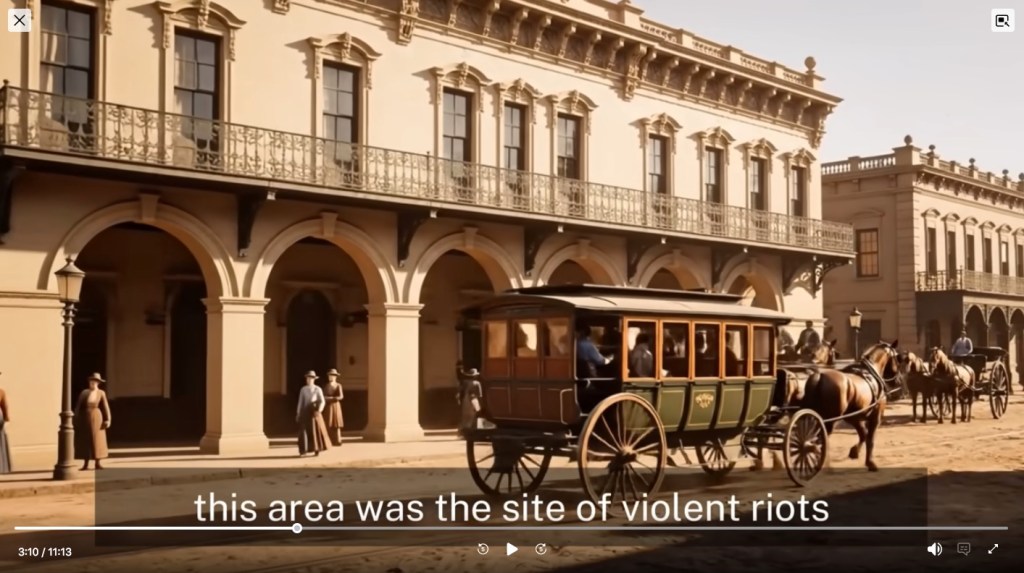
— which is not the Pico House. Also, the Pico House was not “the site of violent riots.” Granted, the “area” had been the site of a riot (singular) if by “area” you mean “Los Angeles.” Though the site of the 1871 Massacre was nearby, the Pico House atmosphere on Main Street, across from the Cathedral, was worlds away from the riot site, e.g. Calle de Los Negros/Los Angeles Street/the Coronel Adobe.
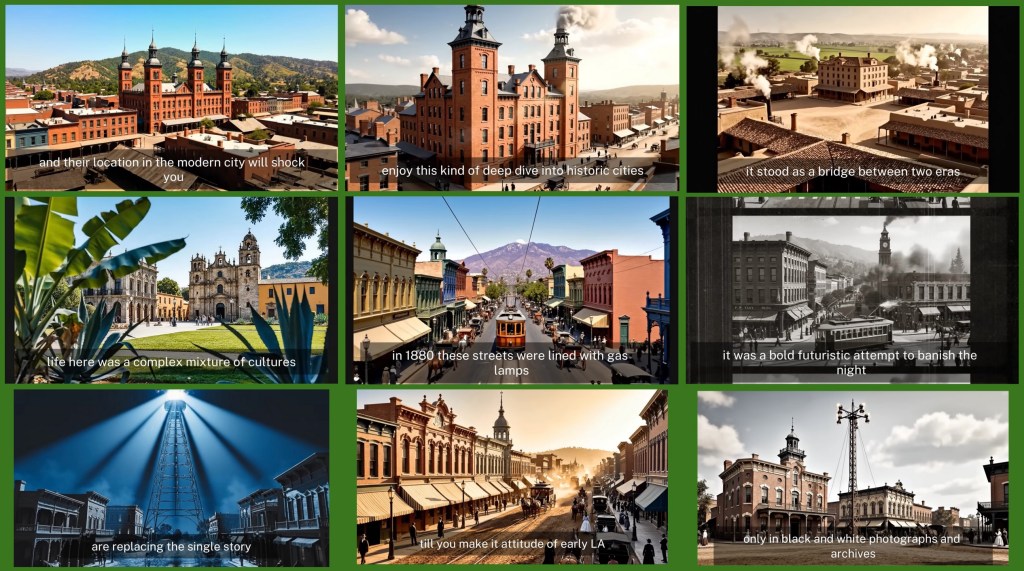
There are no end to these goofy “here’s a picture of Old Los Angeles” in this thing. I could go on and on, picking at each one individually, but you get the point. Here’s a grouping for your edification:
Needless to say, none of these images depict structures that existed.
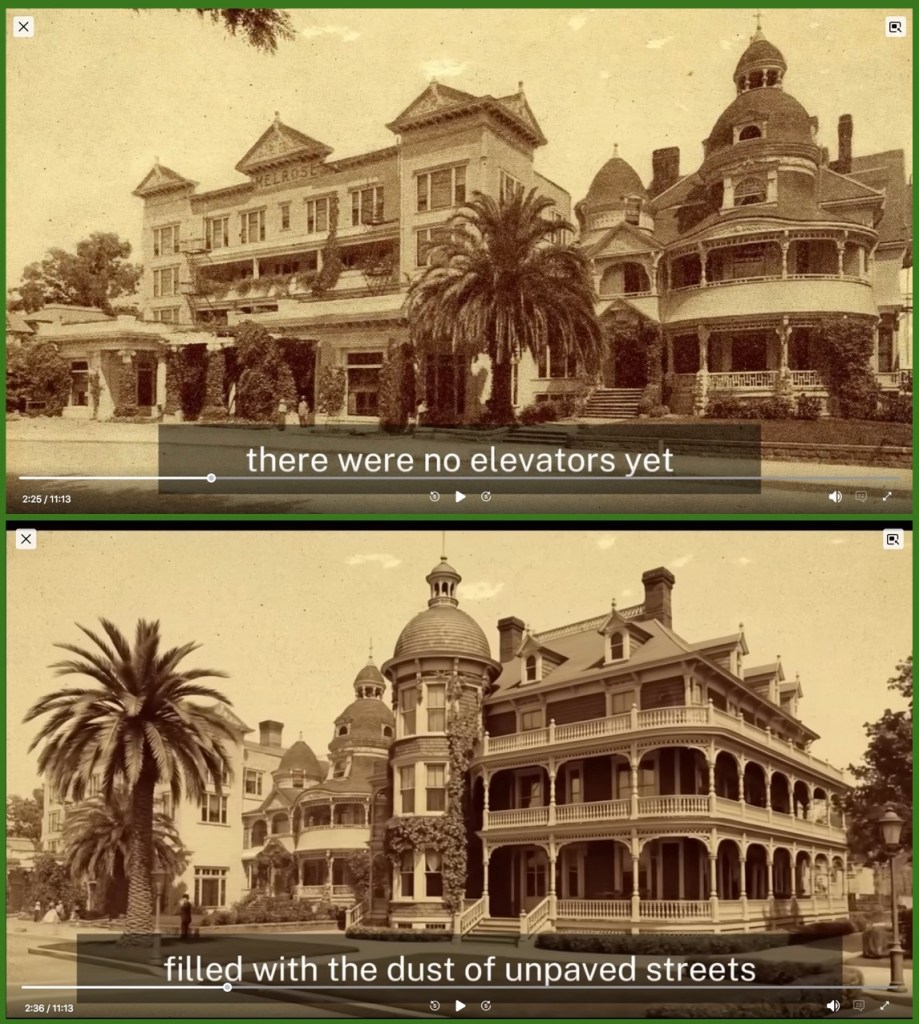
This being a Bunker Hill blog, here’s an image of Bunker Hill, from a postcard produced by the Melrose Hotel. It’s a fairly common image, found all over the internet. Script & Stone decided to put it into one of those “image-to-video” apps, so that we cruise south “down the street”—
— at which point we see the Melrose’s neighbor to the south. I mean, what the hell is that supposed to be? Those porches conjure up the Mesmer house (about which I wrote here), sure, but this ain’t that. I wouldn’t find the wholesale invention of the Melrose neighbor so objectionable if I hadn’t written so damn much about the actual house that stood there.
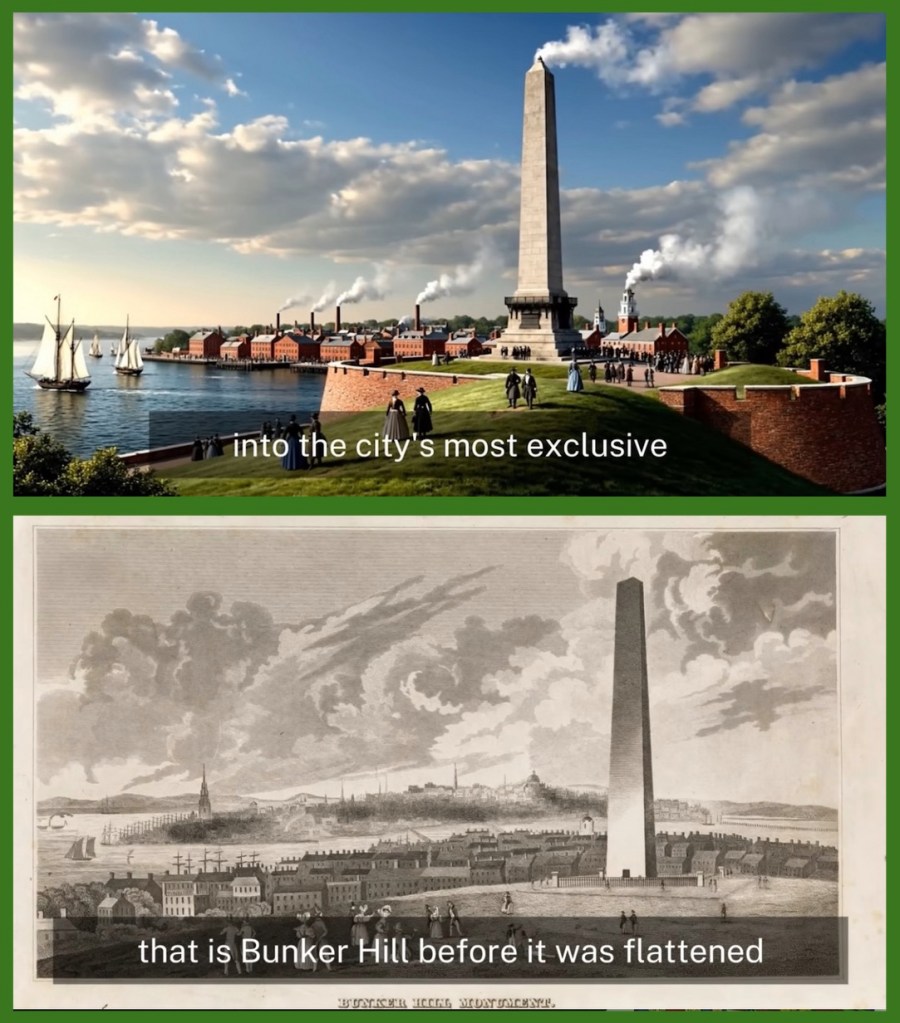
And now, folks, if you don’t agree that this video is the most insultingly useless excrement you’ve ever seen, may I present, Bunker Hill!
Yes, they actually used this, 3,000 miles away, to represent downtown Los Angeles.
Hey, you say, lighten up dude, that’s actually pretty hilarious! I don’t disagree. I chuckled, but it was a dark chuckle.
Made me wonder, is there ever an opportunity to meld Bunker Hill and AI for the good of mankind? The answer is…maybe? I gave it a shot. You might remember this image from the last post I did:
I figured, what’s the harm if I “bring it to life?” Ergo:
Still left a bad taste in my mouth. Yes, making two ladies talk to each other is about the most anodyne thing ever. Yes, colorizing/animating Nadel’s photo might just interest new people in Bunker Hill…because God forbid they have to look at a static, black-and-white image. Ugh, now the taste in my mouth got worse. Which brings us to —
Final thoughts, as Jerry Springer used to say.
After being criticized for using AI, I’ve given the subject considerable thought. Most of my friends, being artists and musicians, decry the harm it has done to their work. I’d like to address its troubling relationship to historical revision.
AI is an unprecedented tool for manipulating information and rewriting history on a massive scale. It now produces many of the patently fictitious “historical” narratives found online, with apparent coherence, consistency, and at an industrial scale unmatched by human capacity. Historical revisionism is being automated — bad actors fabricating entire historical events. The millions of variations on false narrative makes fact-checking nearly impossible; the erosion of consensus reality creates an environment where people retreat into tribal information silos, unable to agree on basic facts. I fear human judgment will be no match to automated deception.
I titled this post “The End of Intelligence.” By that I mean AI could potentially make authentic human intelligence obsolete in key areas. Why master complex skills when AI can generate code, write papers, or solve problems instantly? Cognitive offloading will result in a population technically “educated” but functionally incompetent without AI assistance, and worse, devoid of critical thinking skills. As our information ecosystems are flooded with algorithmically produced artificial content, how will we distinguish it from either truth or simple humanity? History is about struggle — the struggle to understand through research, weighing evidence, making mistakes, and arriving at understanding. Intelligence may involve processing information and “knowing things” but those things are useless without a vast quantity of wisdom, judgment, and character. Those are human qualities no algorithm can replicate.
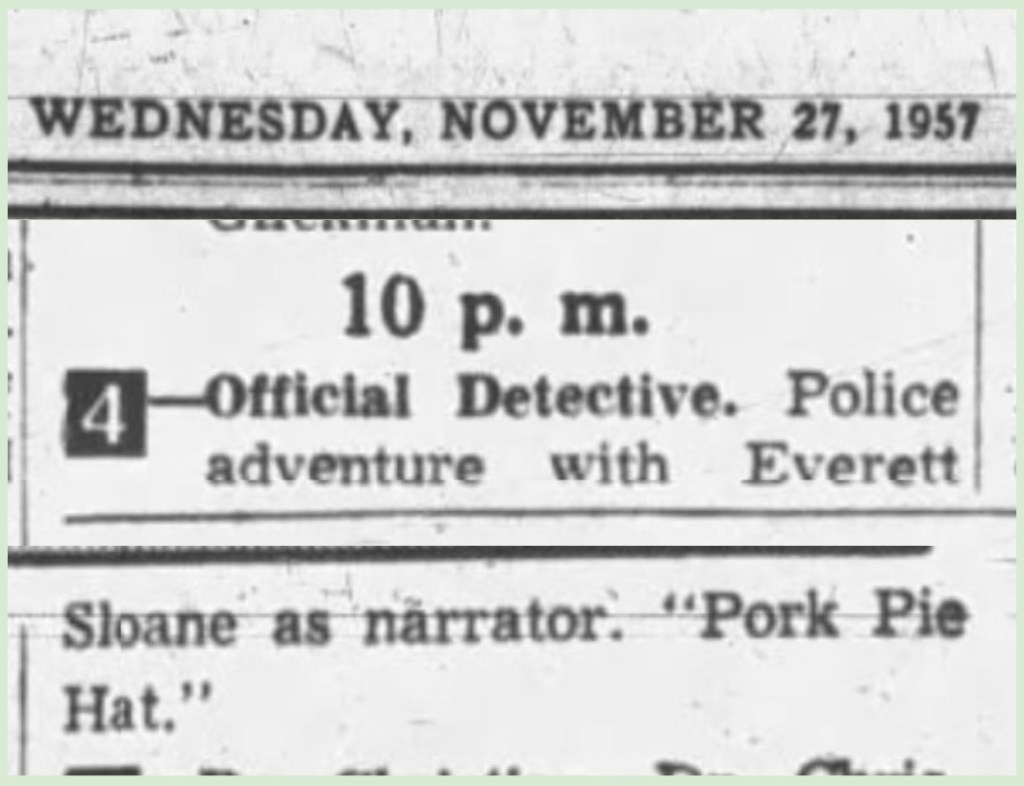
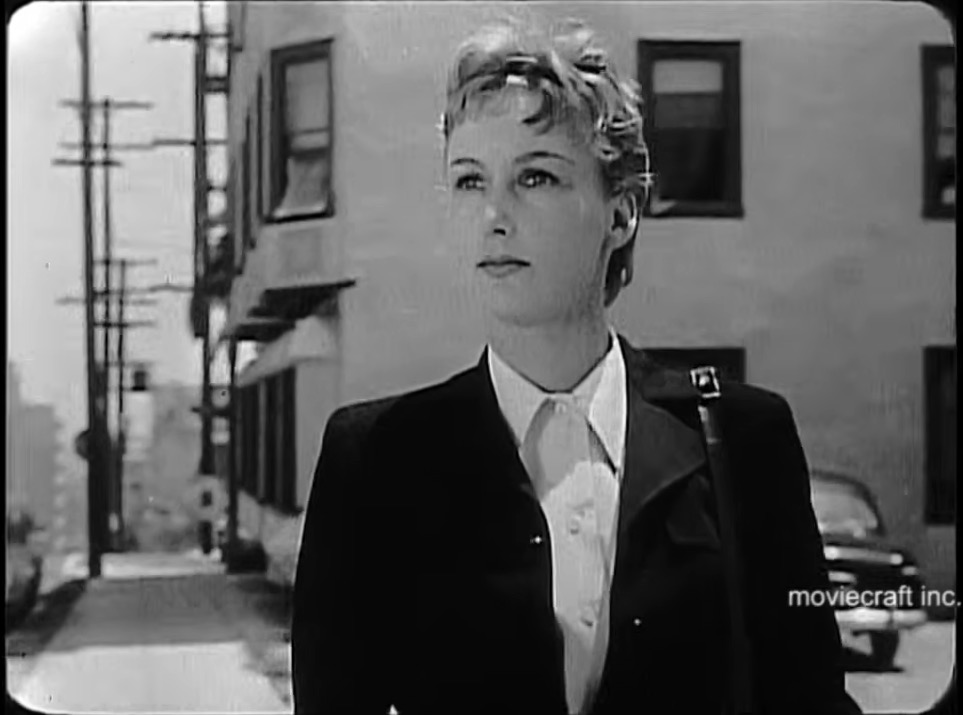
The other day my buddy Bryan Moore (whose aunt you’ll remember from this post) sent me a link to a 1957 episode of Official Detective called “Pork Pie Hat.” Hey, he said, sure looks like Bunker Hill to me, but I’ll leave that up to your expert eye.
Holy-freakin’ heck.
It isn’t every day something turns up that isn’t in Jim’s book — though it can happen, as was recently the case with Abandoned — especially not something with this much Bunker Hill. Seriously, it’s almost too much Bunker Hill (jk, that would break all the laws of physics.) Plus, Harry Dean Stanton as a knife-wielding psycho! (I grew up on Alien/Escape from New York/Paris, Texas and especially Repo Man, and used to go see HDS play guitar in various local watering holes.)
New Orleans Times-Picayune
So settle in and watch “Pork Pie Hat” (which is set in Milwaukee, and weirdly, features zero porkpie hats), and follow along below with a recounting of Bunker Hill’s appearances therein:
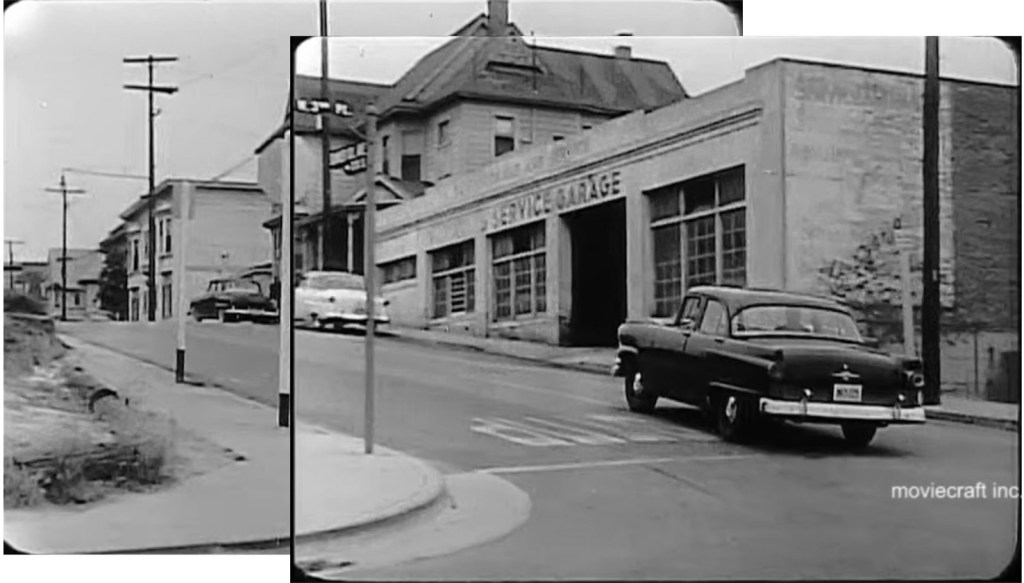
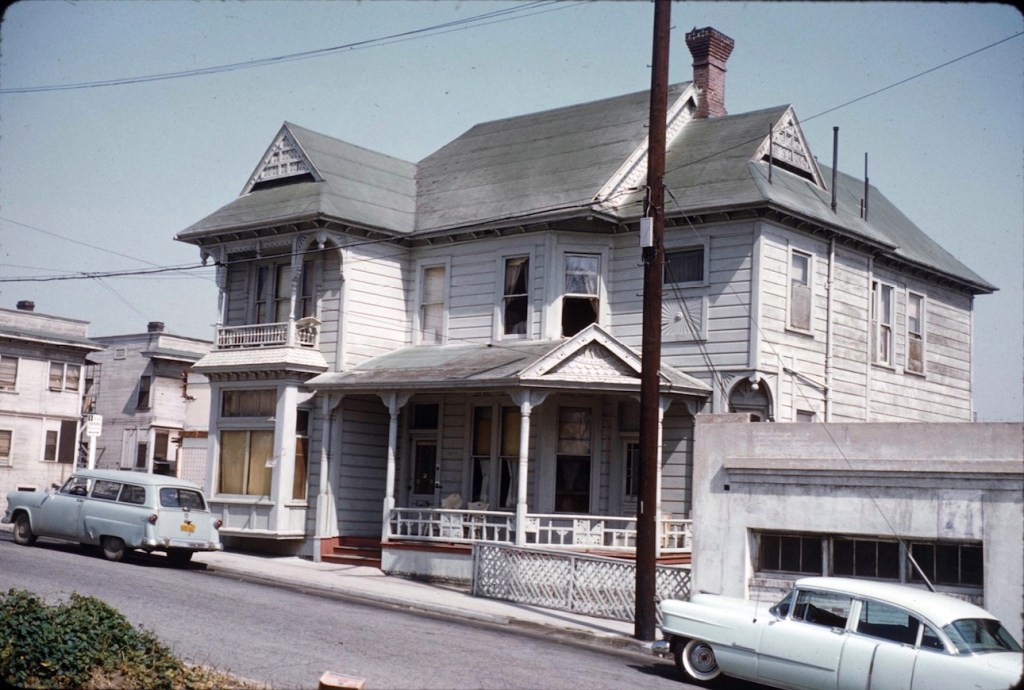
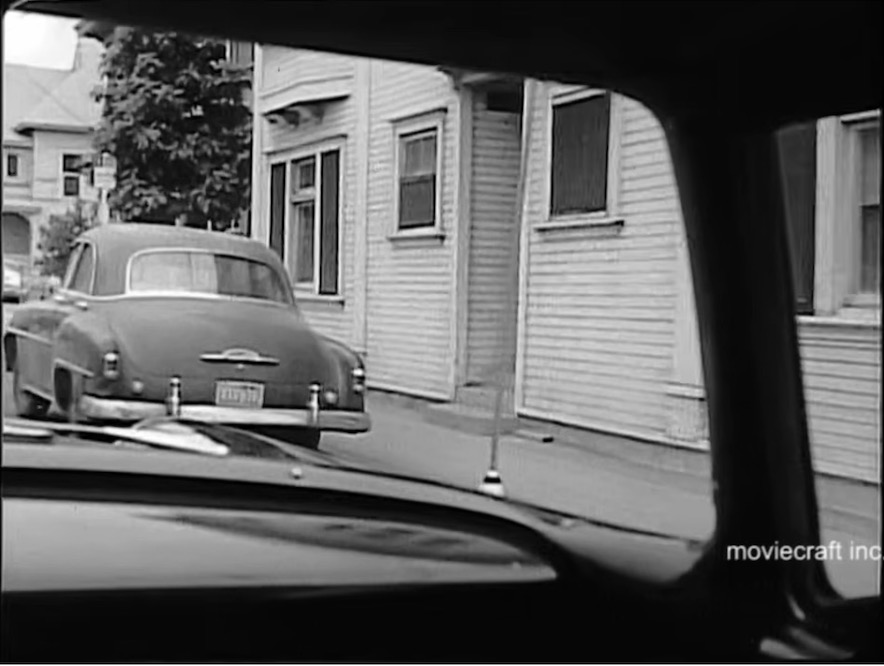
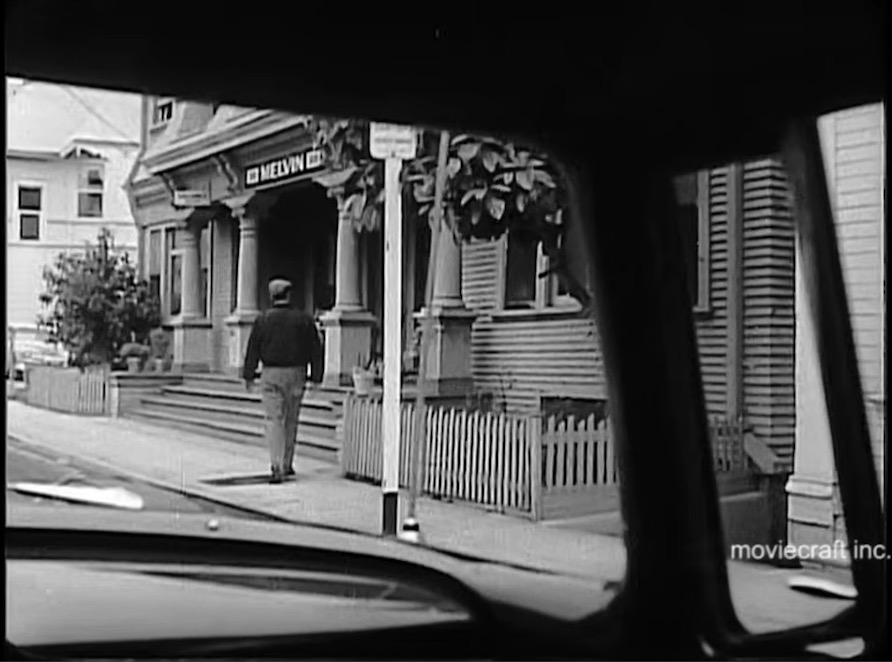
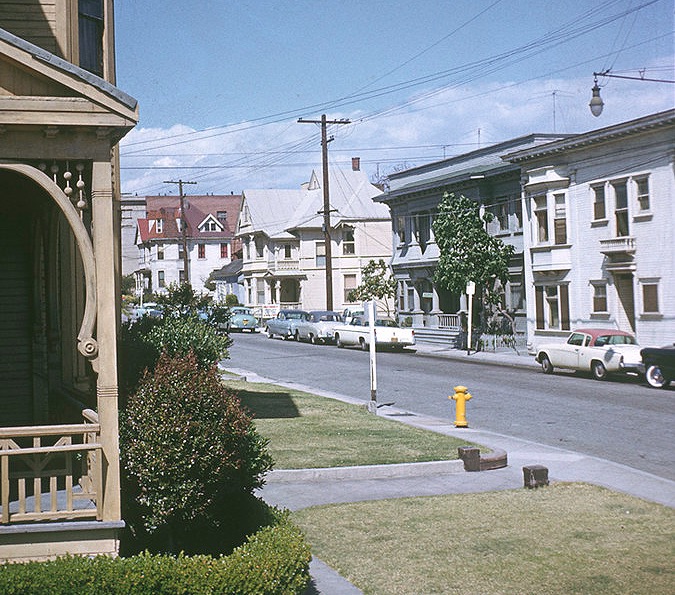
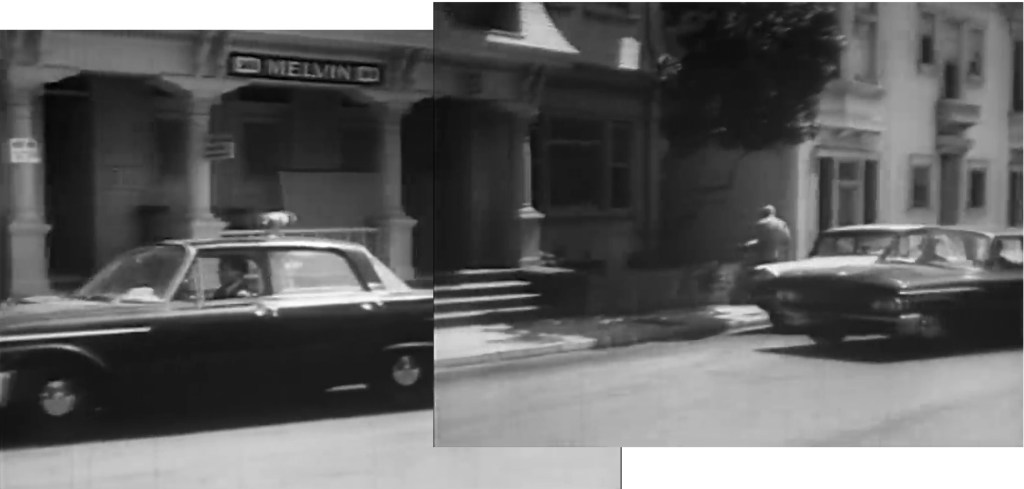
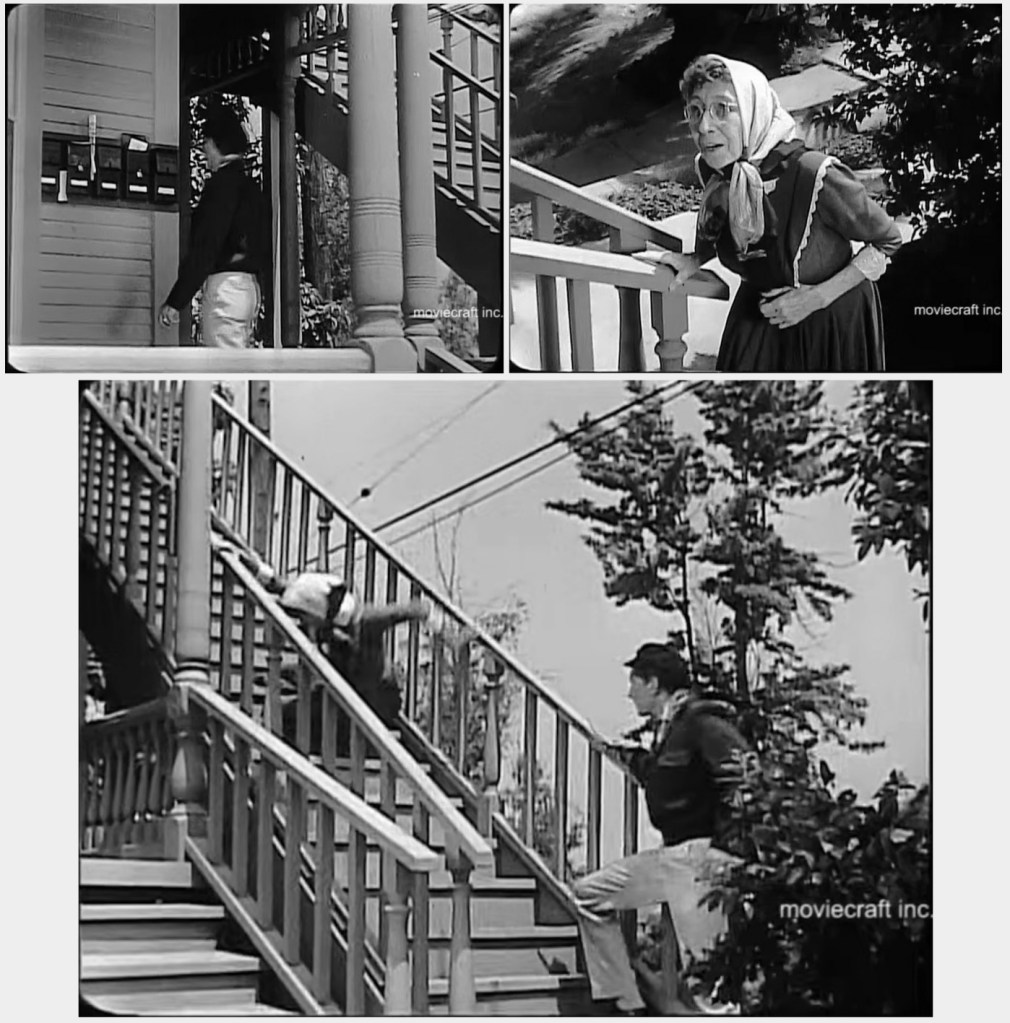
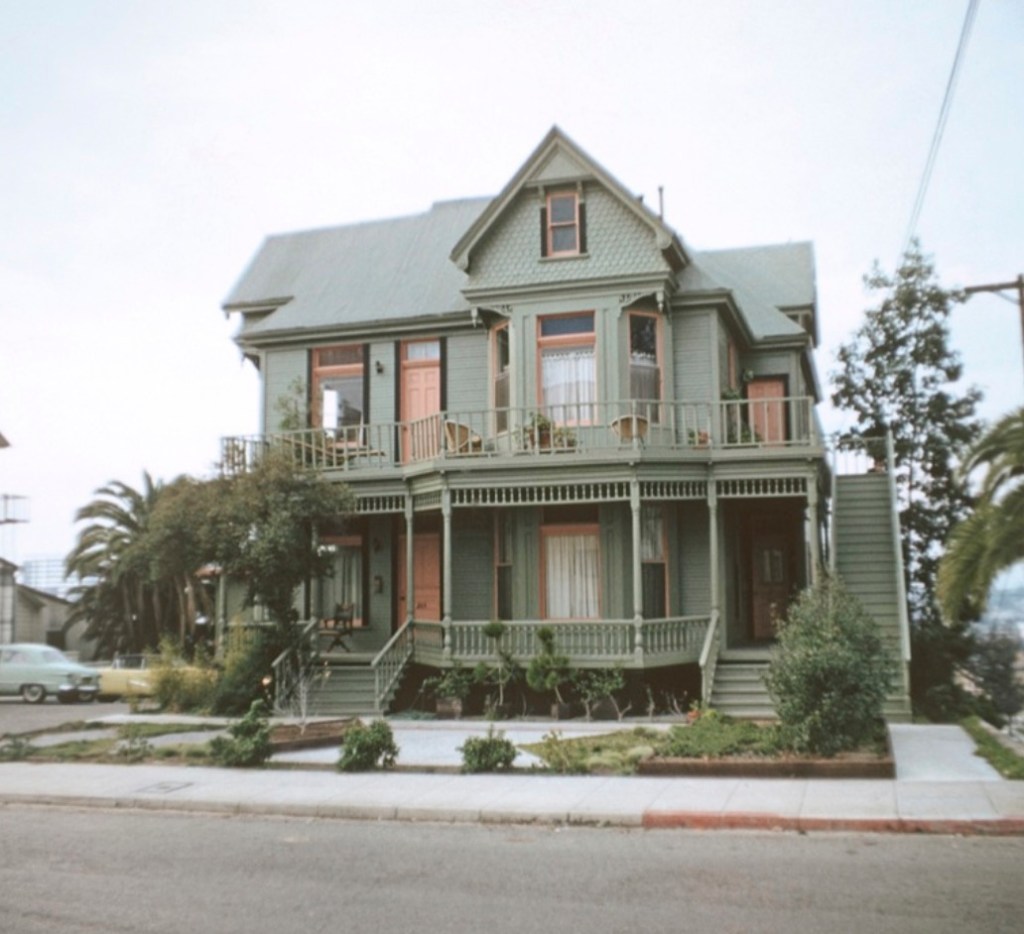
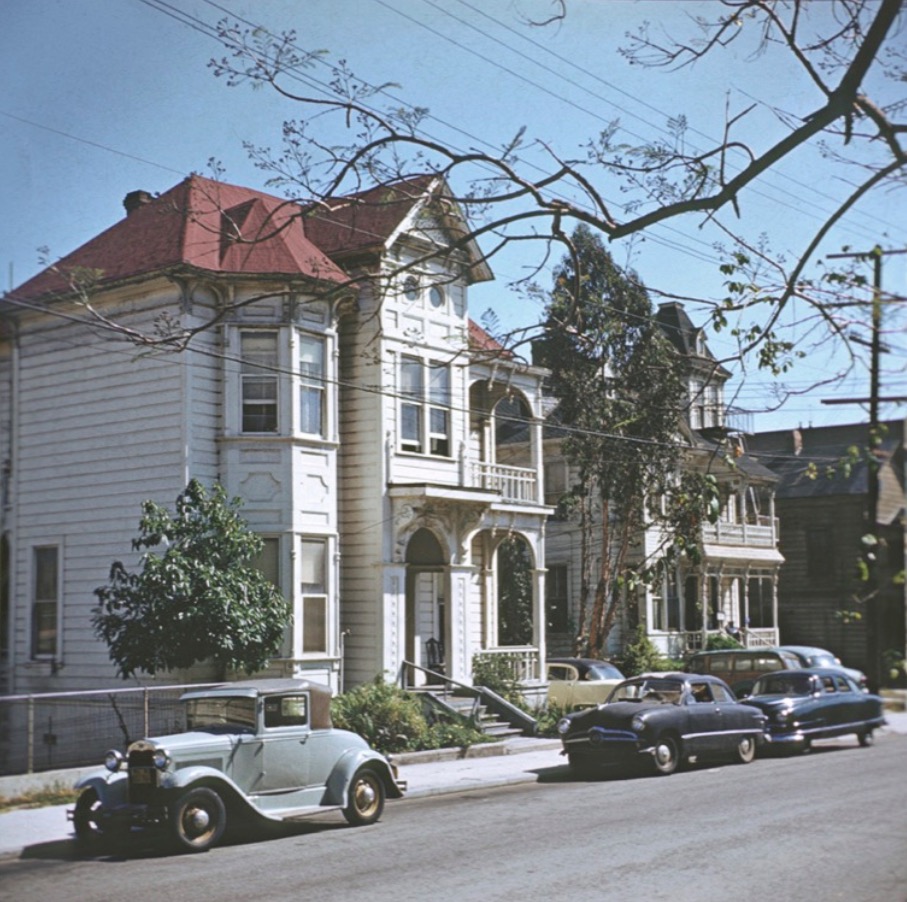
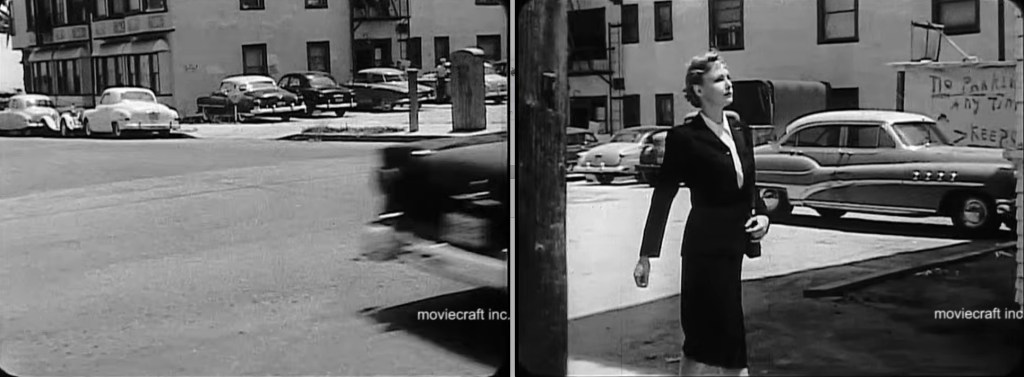
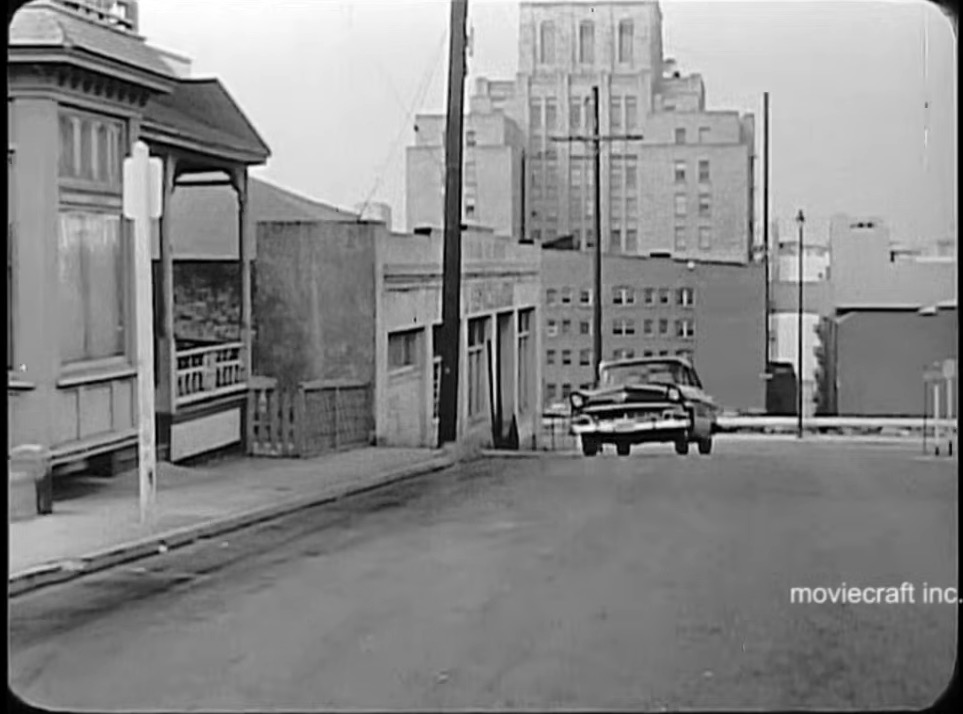
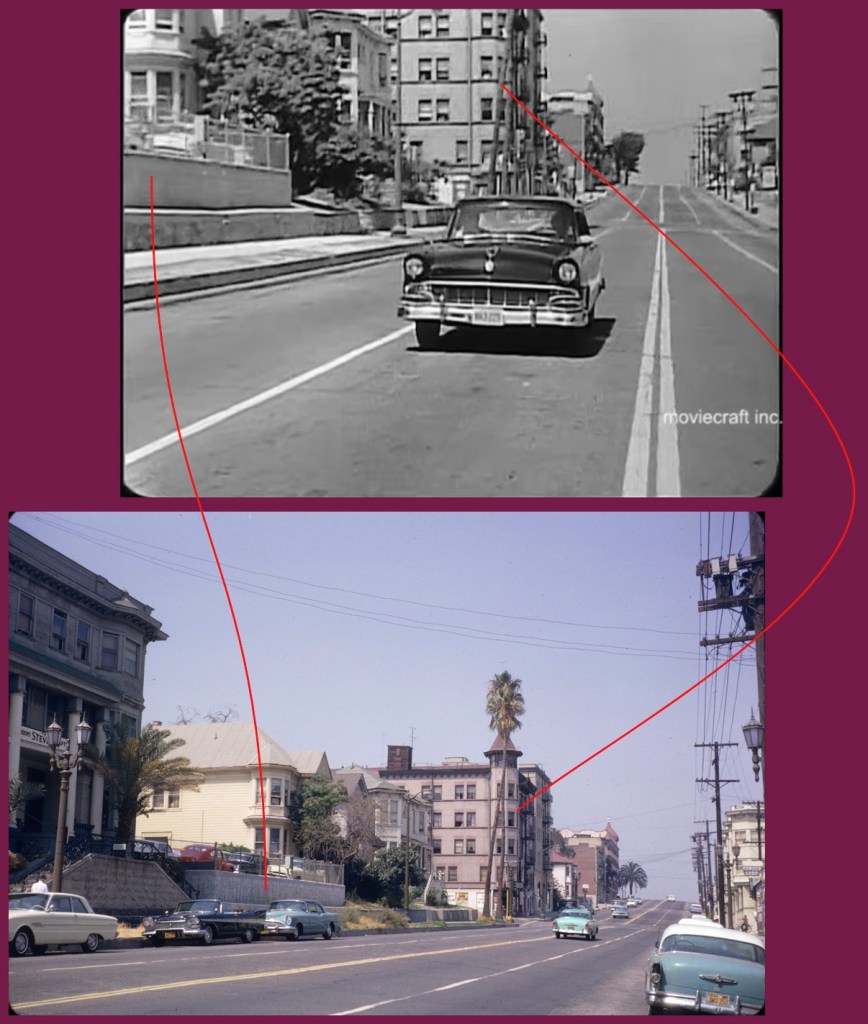
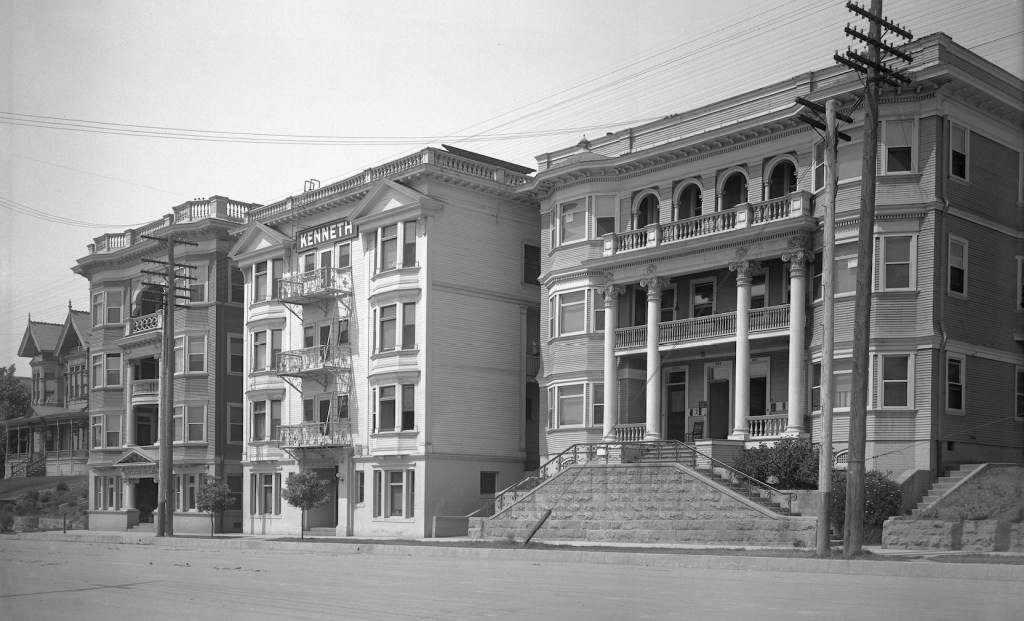
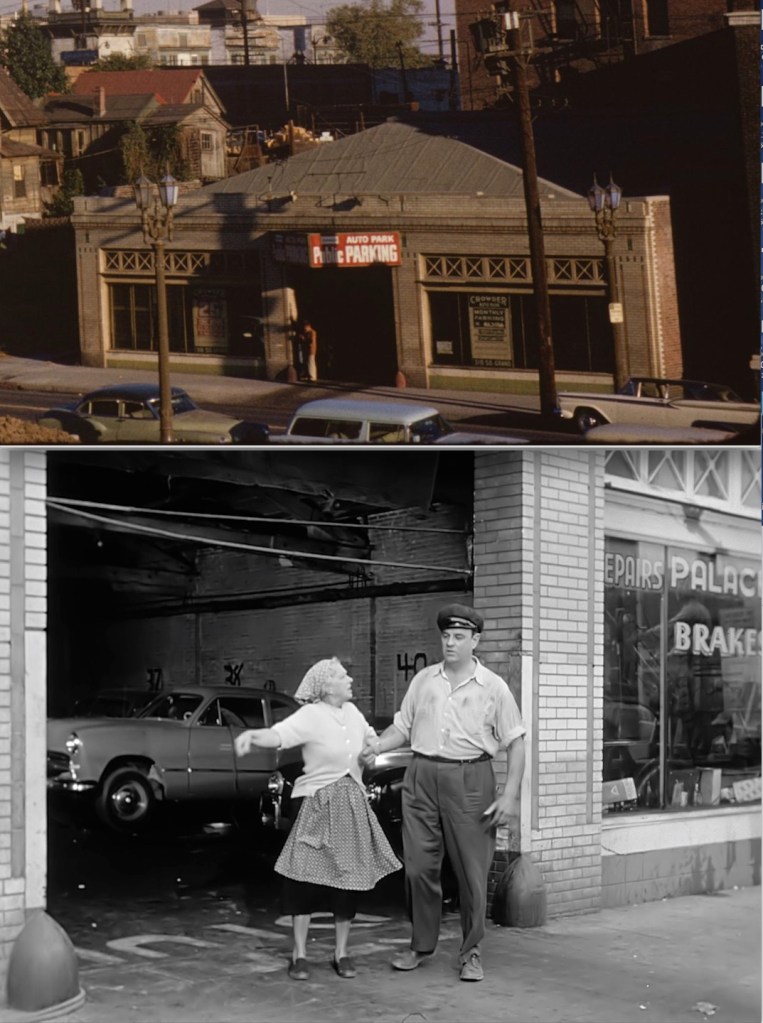
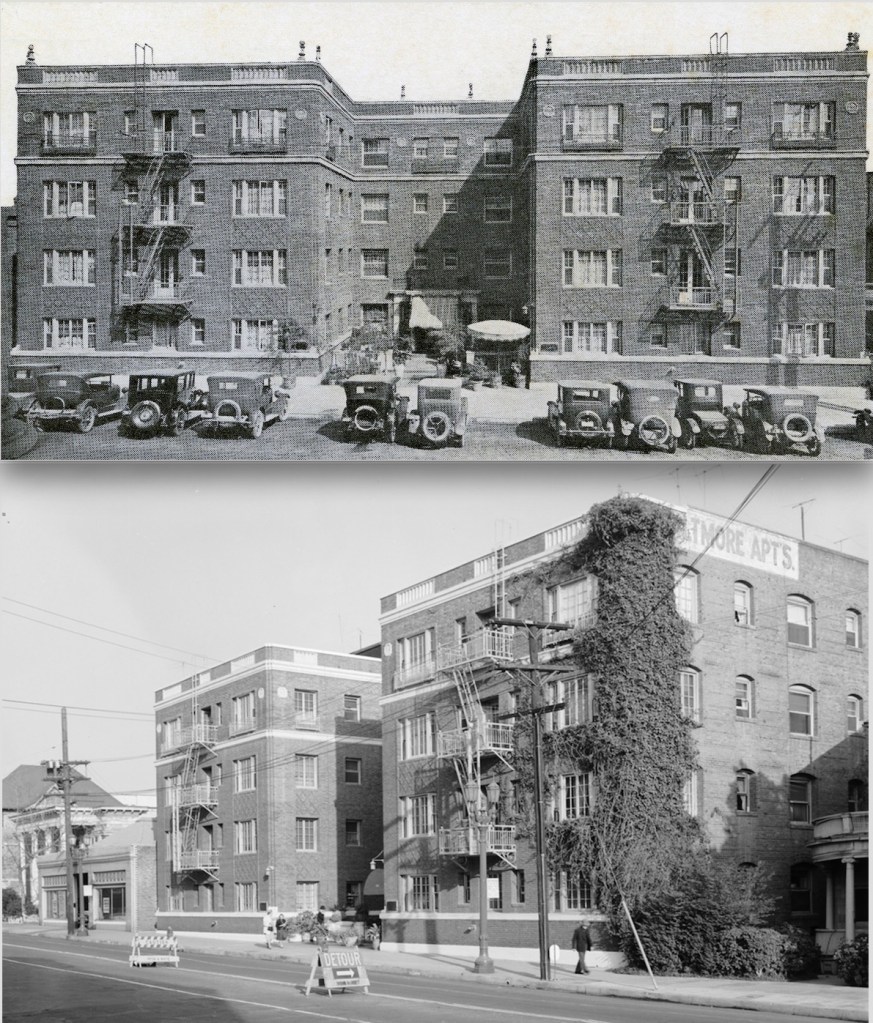
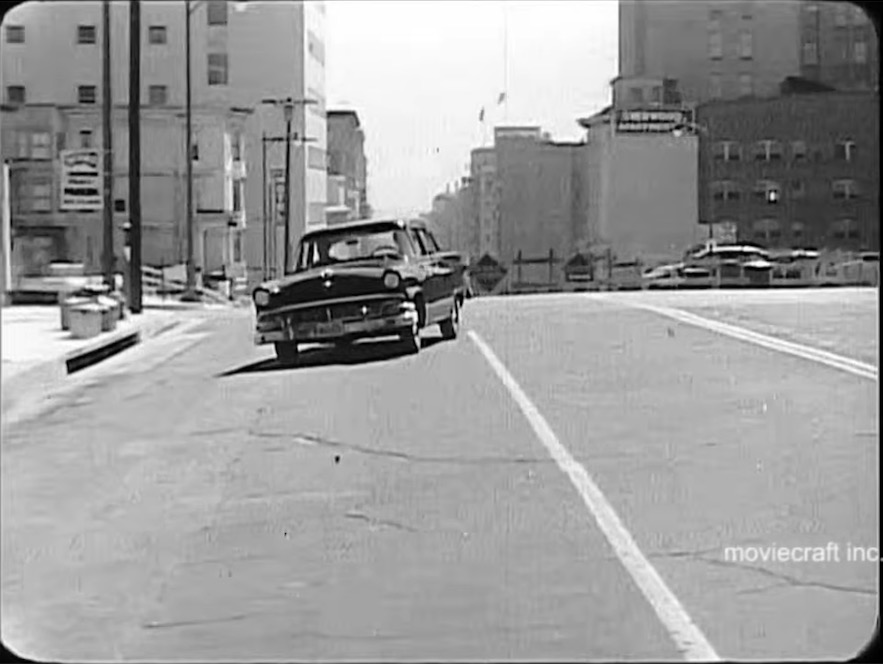
Cop car turns from Third Place (which replaced Fourth Street after the construction of the Cut) onto South Bunker Hill Avenue. The garage, 344 SBHA, fronted on Grand, and is the 1917 Frauenfelder-designed garage that replaced the Brunson. The house above it is 336 SBHA. Note the two-story structure with the bay windows in the distance; we get to that. The aforementioned336 SBHA, with a bit of that garage to the right. A Palmer Conner shot from the HuntingtonHere, our first bad guy (Berne Bassey)is skulking about looking for easy marks. This is the back of the Kenneth, 326 SBHA, which like the aforementioned garage fronted on Grand (we’ll see that Grand Ave façade later in this post).After he peeps 326 SBHA, he walks over to the Melvin, at 318 SBHA.
In this shot by George Mann, there’s the Kenneth at far right, and the Melvin next door — without Mann’s image, we’d never have known the Melvin was blue!LAPL
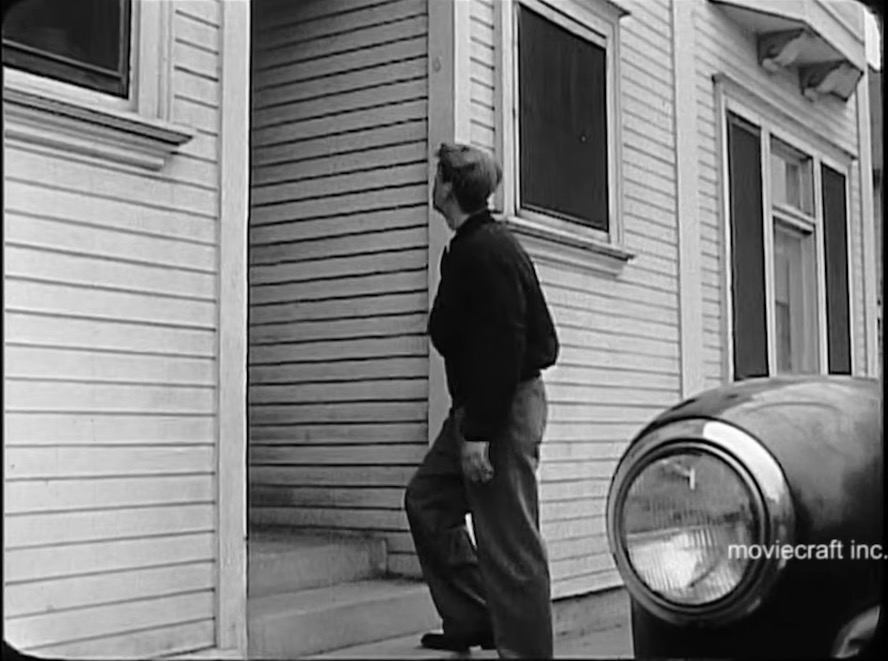
↑ You might remember the Kenneth and the Melvin from 1964’s deeply weird Glass Cage, which you may watch here ↑But back to Pork Pie Hat. Harry Dean Stanton arrives at 201 South Bunker Hill Avenue to attack little old ladies, who have heart attacks and fall down the stairs!
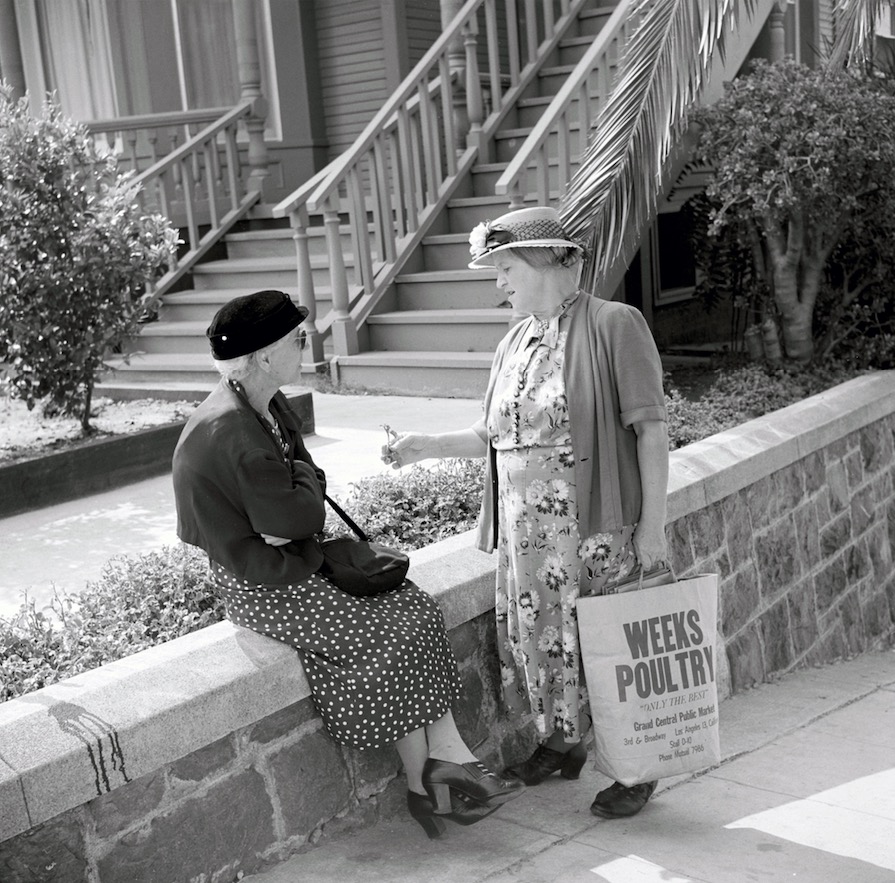
A shot by Nadel…showing just the sort of ladies upon whom these cap-wearing reprobates prey!
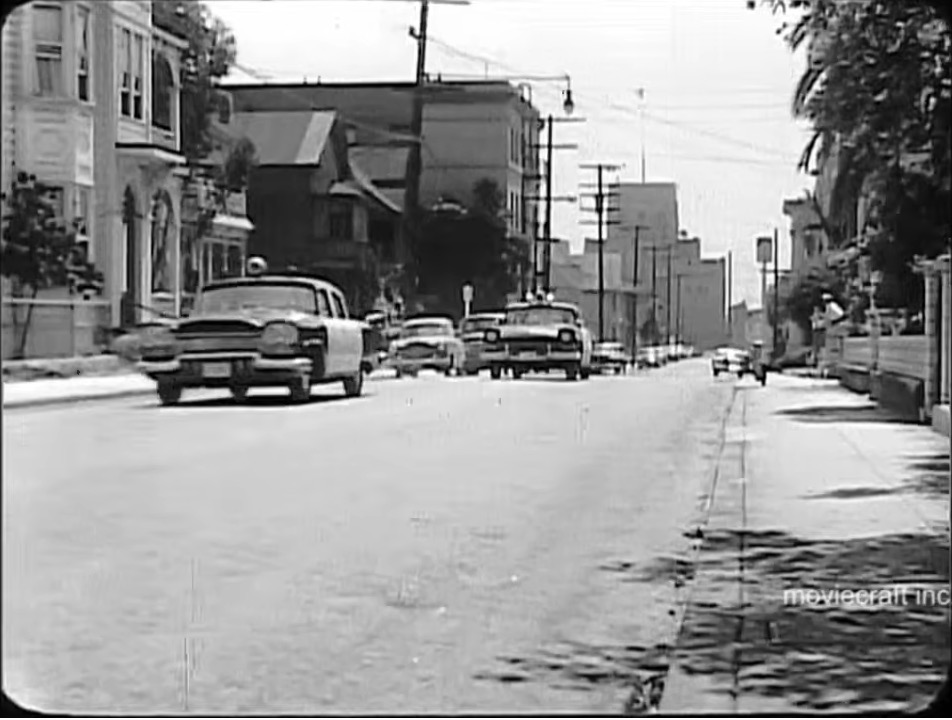
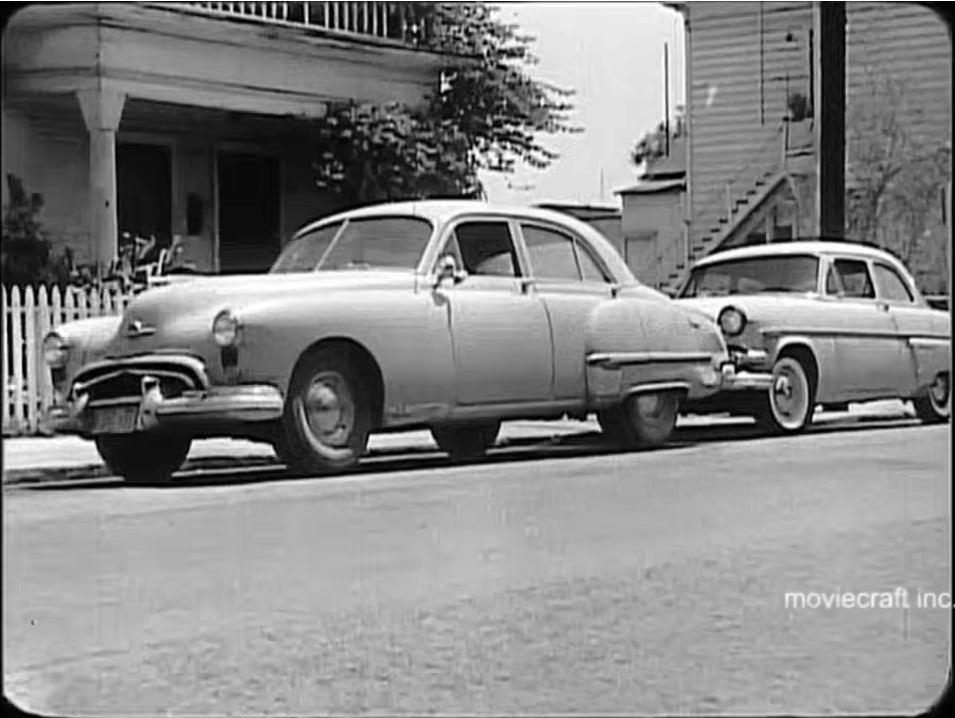
The popo roar up South Bunker Hill Avenue; that’s 232 SBHA at far left. Note the house two doors down, 244 SBHA, which you remember from this post.
232 is an interesting house: it was built by Joseph Franz Bont, a Hungarian carpenter, between 1888 and 1894.I need to do more work on Bont, as I’m itching to discover how he managed such an important house on SBHA.This is yet another Mann shot from LAPL.
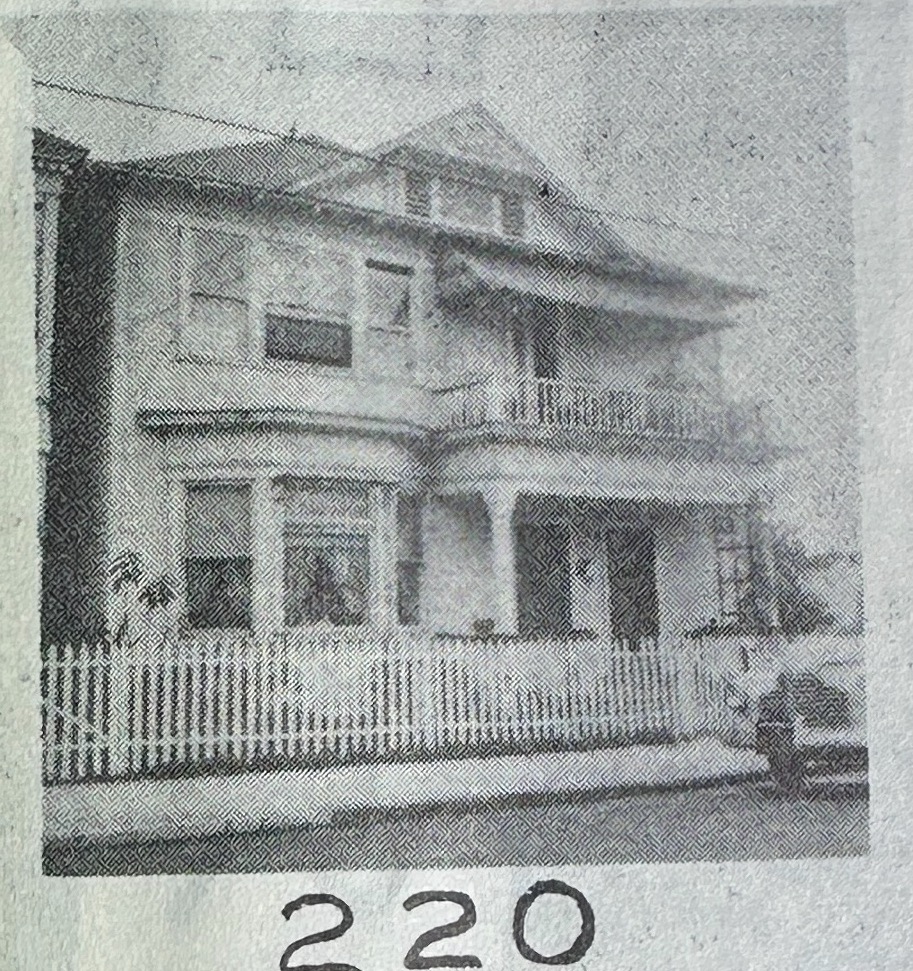
To the north of 232 is just a wee bit of the rarely-seen 220 SBHA
From my copy of the “Pictorial Presentation of South Bunker Hill” — see the Huntington’s copy here
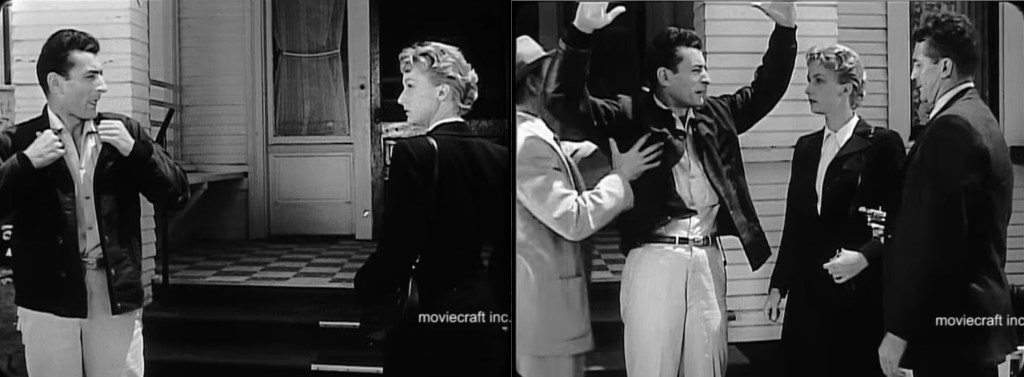
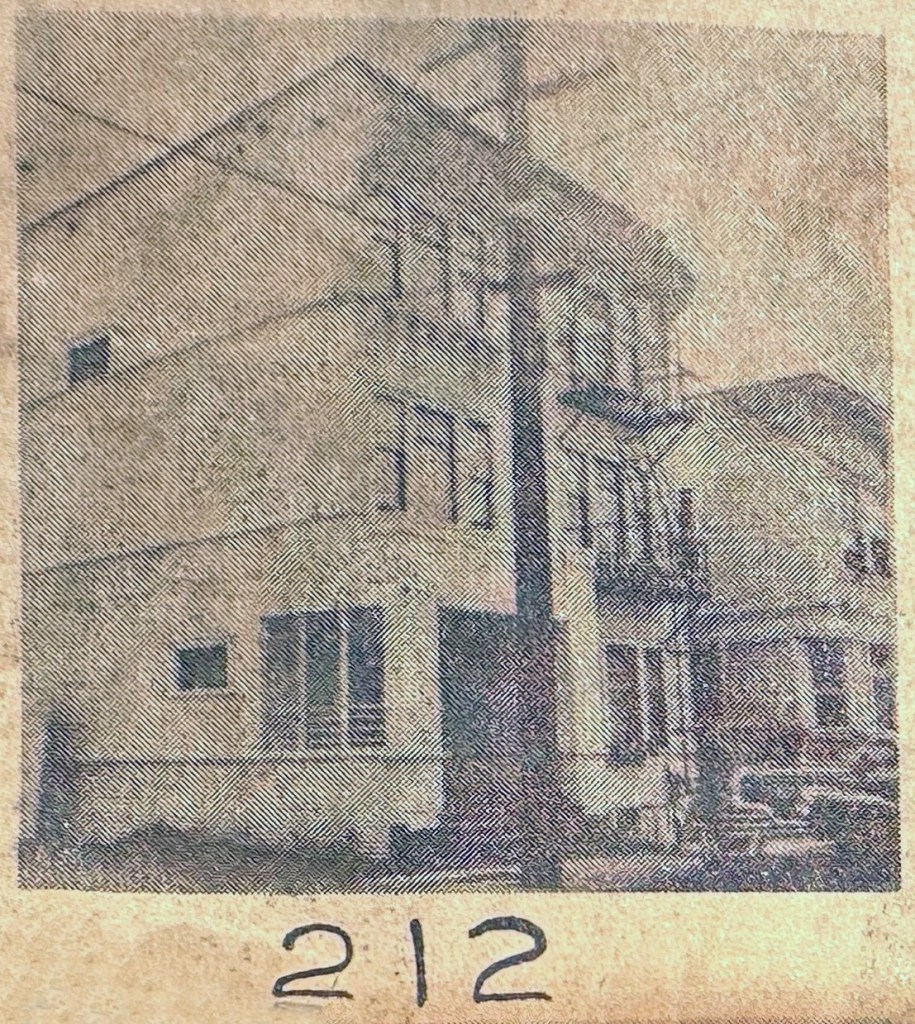
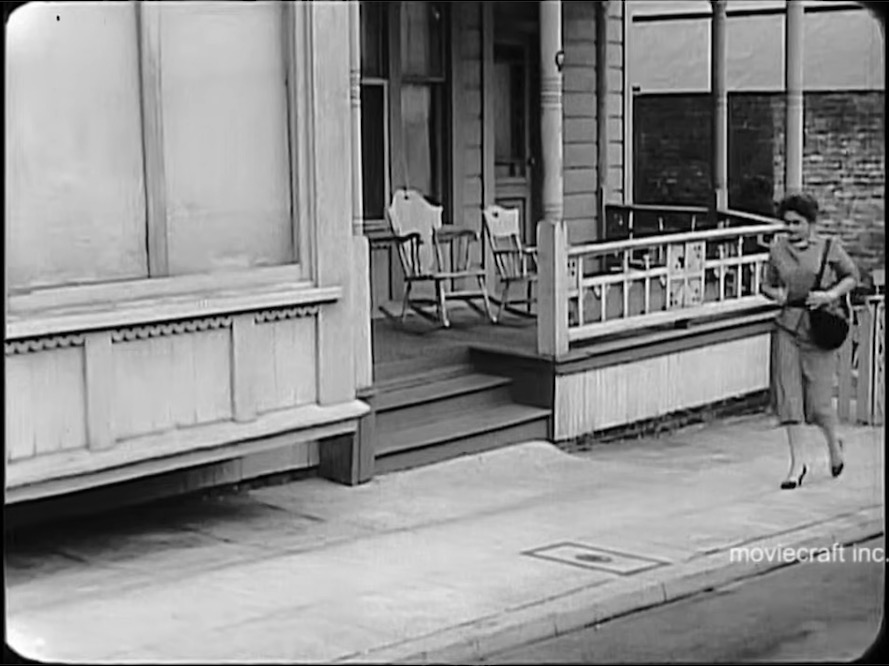
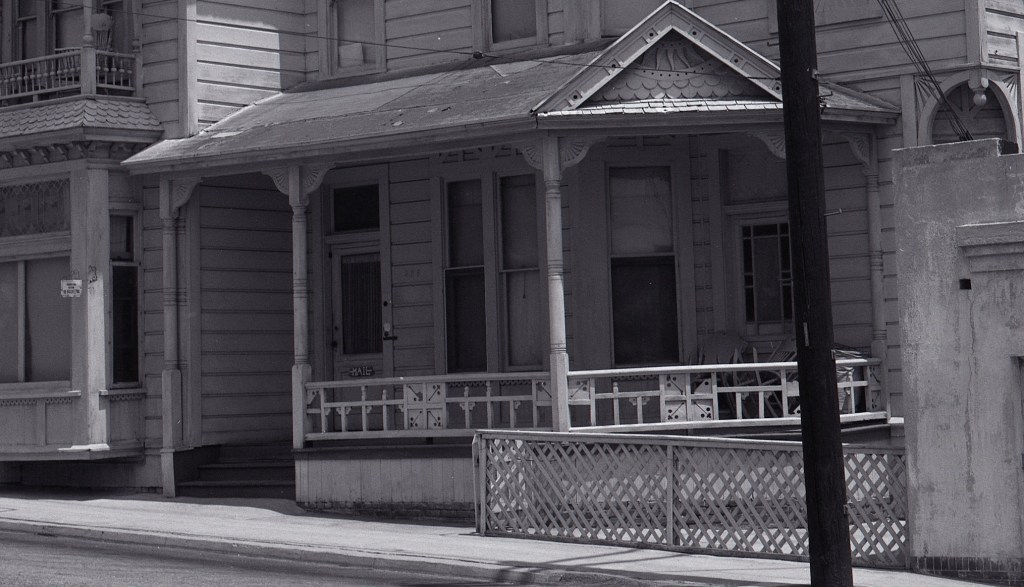
A policewoman goes out to lure and ensnare scofflaws; she’s standing on Second and SBHA, and that’s the backside of the Dome behind herShe walks south on SBHA from Second….…arriving at 212 SBHA, and is hit on by a slimeball, attracting the attention of waiting detectives…That’s the Mauna Loa Apartment Hotel, at 212 South Bunker Hill Avenue:
Shots of the Mauna Loa, a two-story wood-frame rooming house built in 1902, are maddeningly rare.
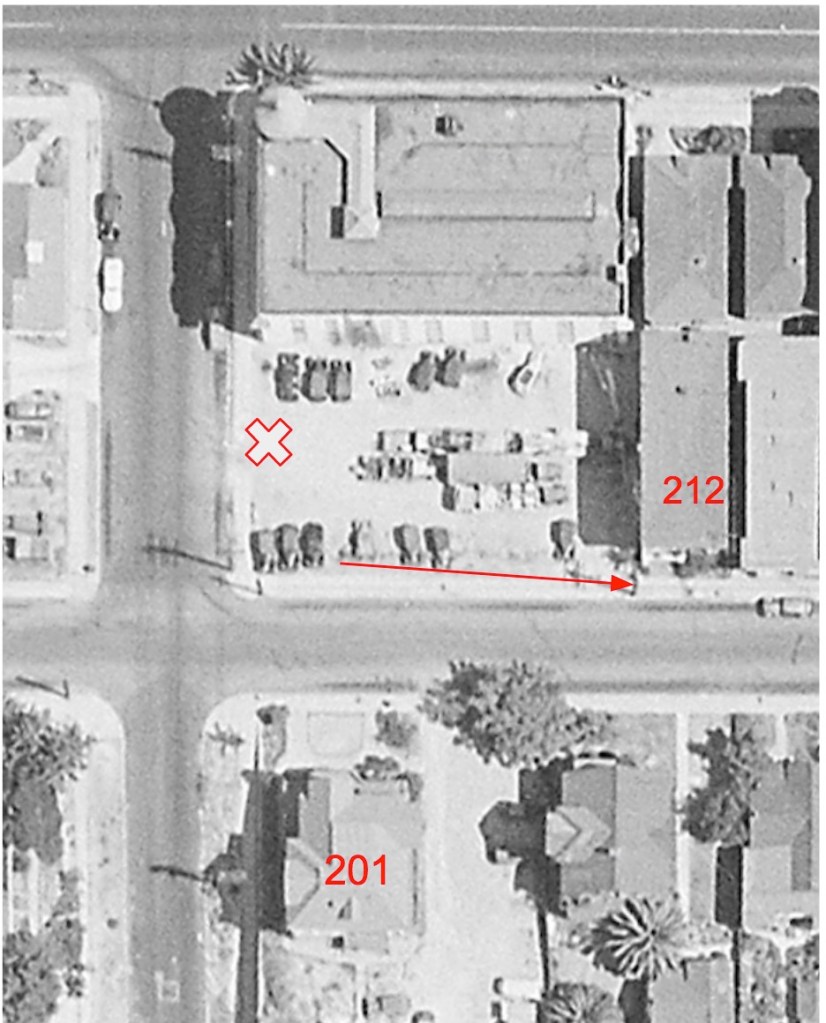
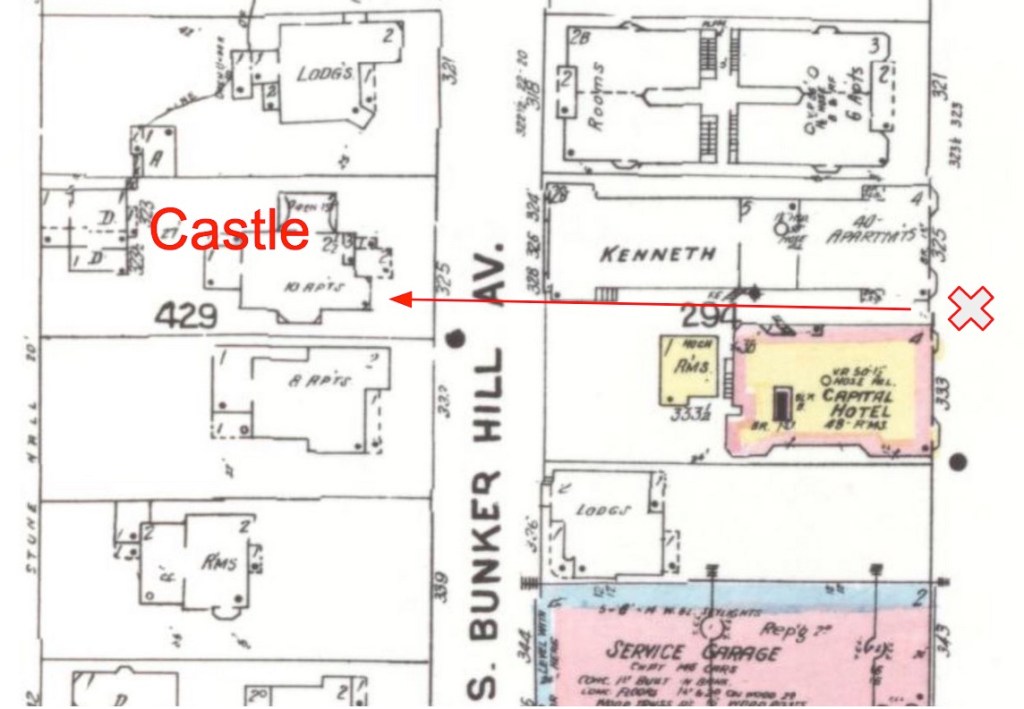
The X is where she was standing, behind the Dome at Second and Grand. Then she walks to 212 SBHA. And remember the bit with Harry Dean Stanton with the old lady on the stairs? Right across the street at 201 SBHA.
Now we’ve got a woman walking up SBHA, in front of our old friend 336 SBHA, as seen at the beginning of this post
Take a close look at those carvings!
Another shot of five-o heading north on SBHA. Behind the car is the back of the Sherwood, with the Edison behind. Look closely and you’ll see the skybridge linking the Edison HQ to the Edison Annex.
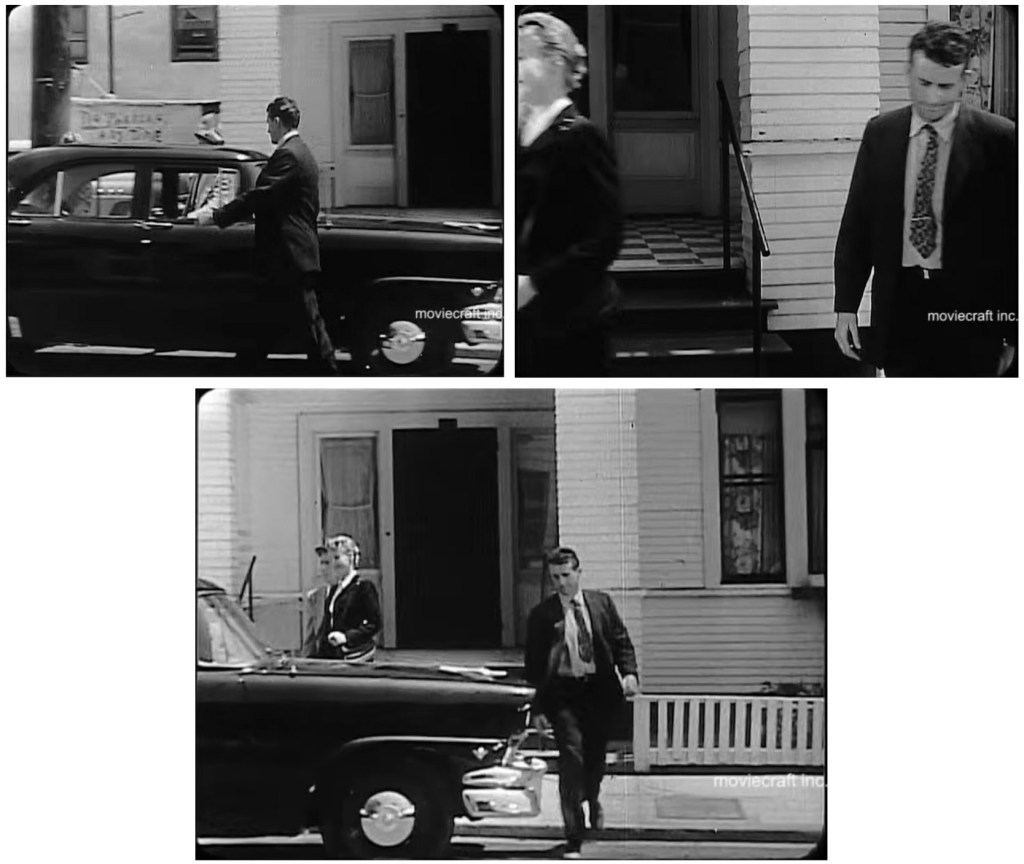
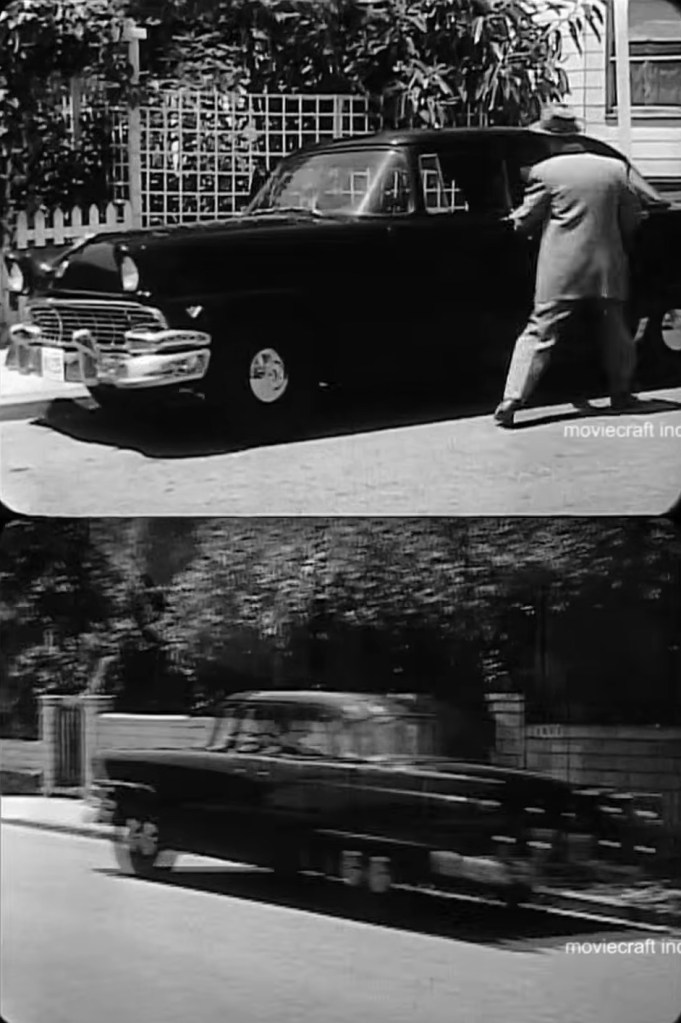
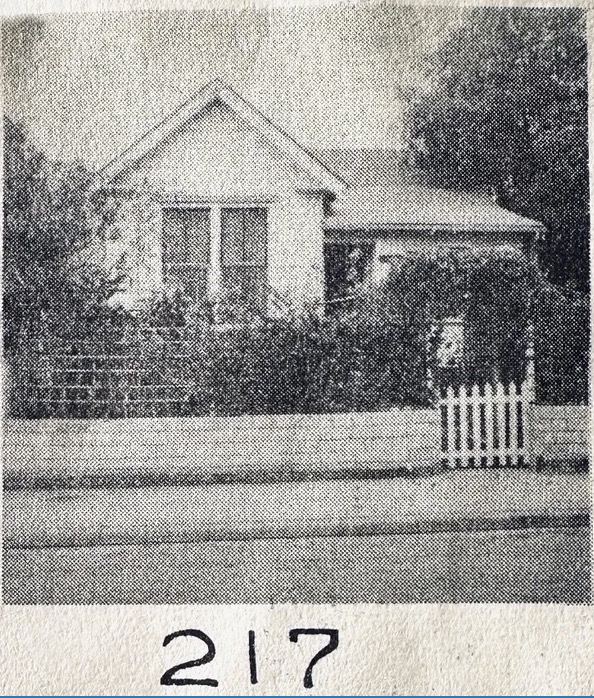
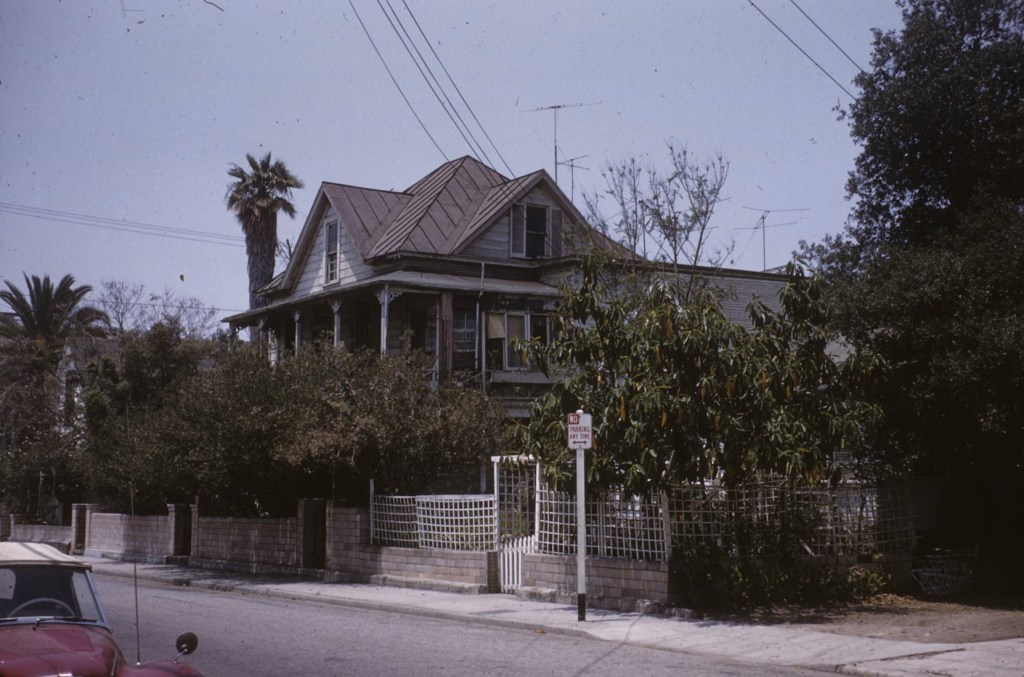
Then, they’re parked in front of 217 SBHA, and roar south past 221
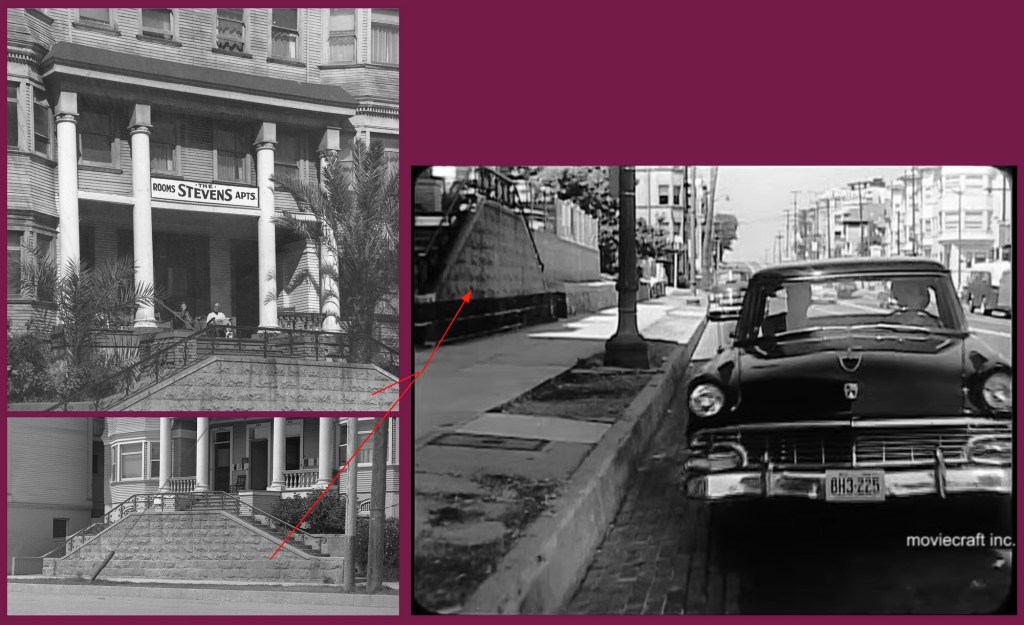
Remember the shots of 232 and 220 SBHA about six images above? Right across the street from here.HuntingtonAfter they tear out of the 200 block of SBHA, they’re headed south on Grand Avenue toward Third Street (Palmer Conner/Huntington). The low wall at left is the Stevens ——at 321 South Grand Ave.
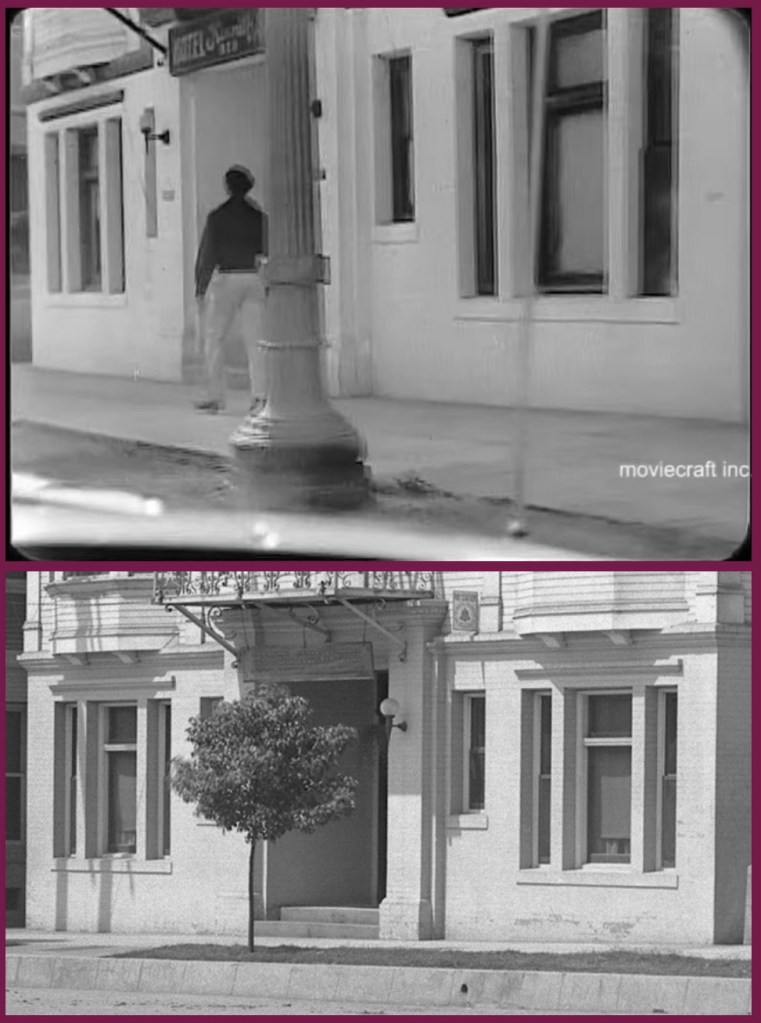
Harry Dean Stanton walks by the Kenneth, at 325 South Grand, next to the Stevens
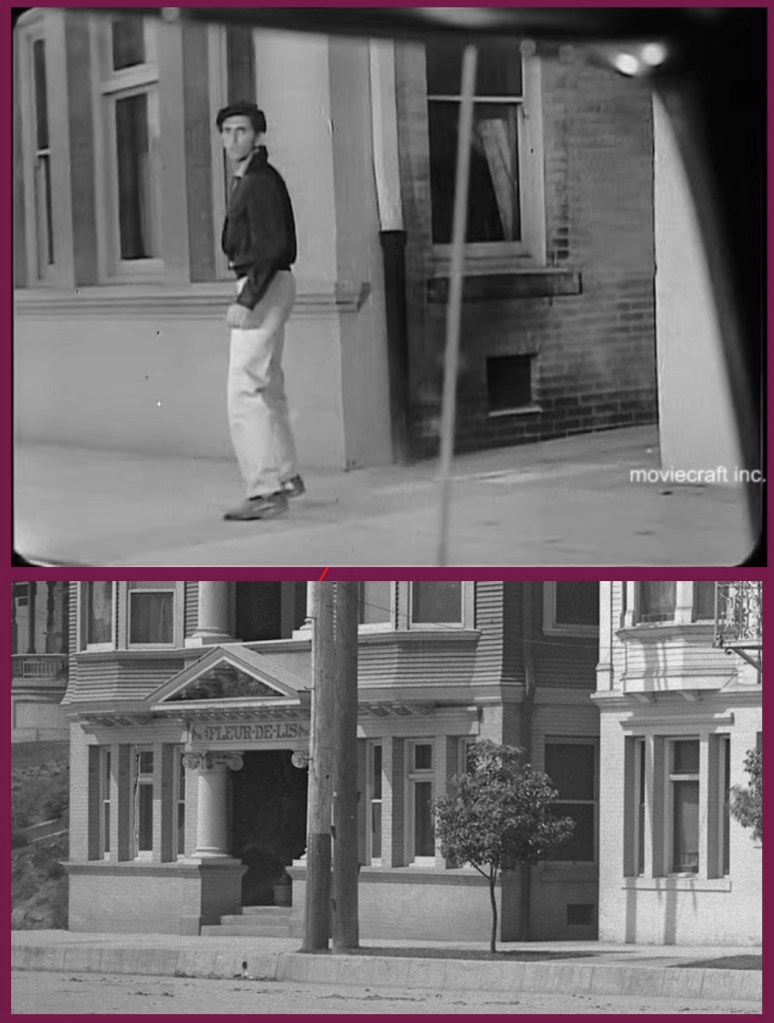
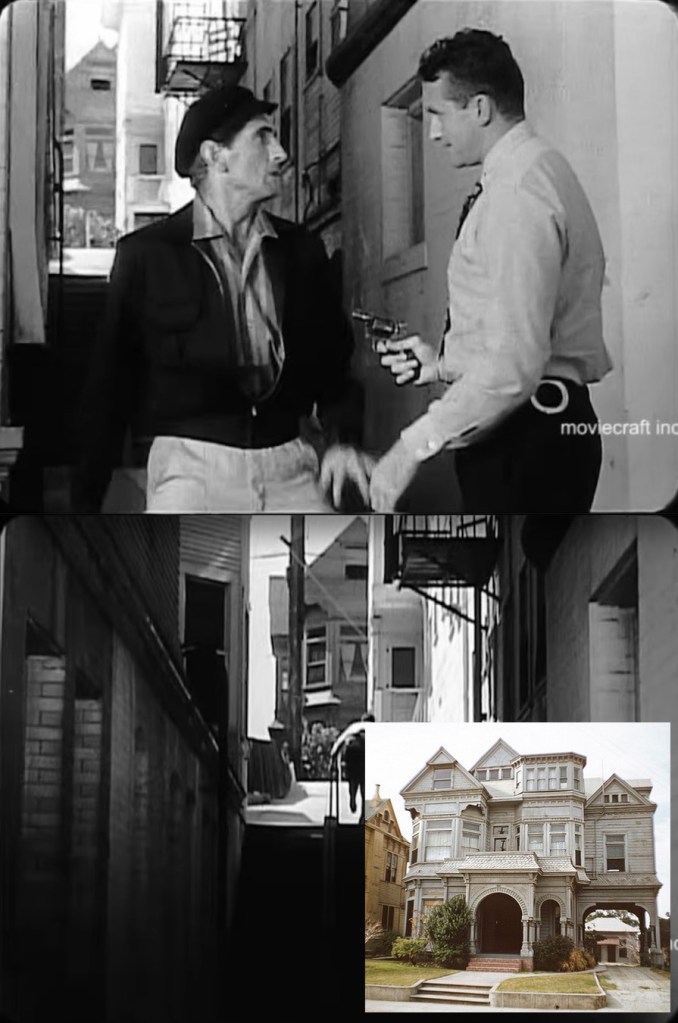
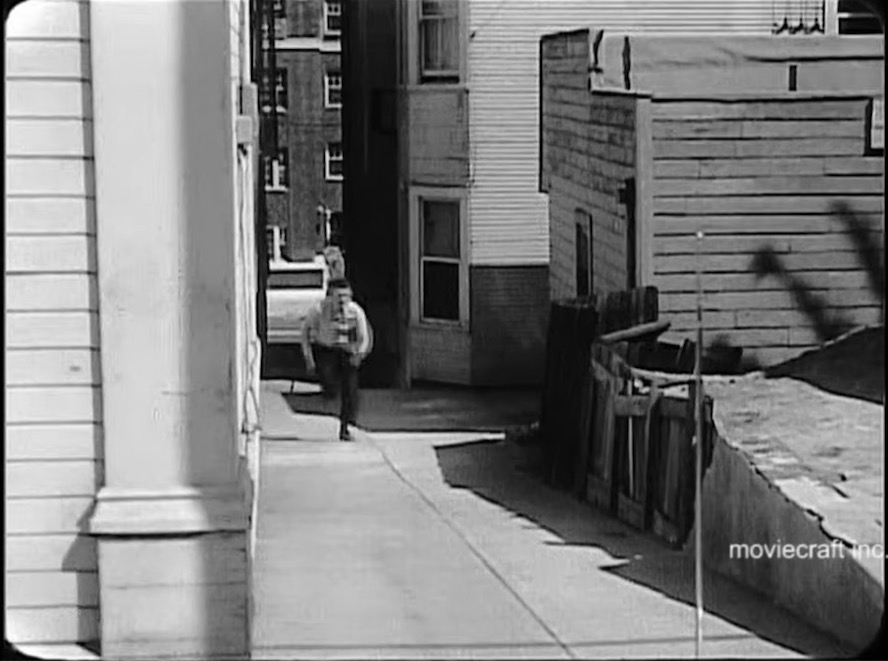
He then stops near the alley between the Kenneth and the Capitol Hotel (née Fleur-de-Lis)
This shot of these three in a row you recall, no doubt, from p. 159 of Bunker Hill, Los Angeles
And when you look up between the two structures, what do you see in the distance? The Castle! (Mann/LAPL)
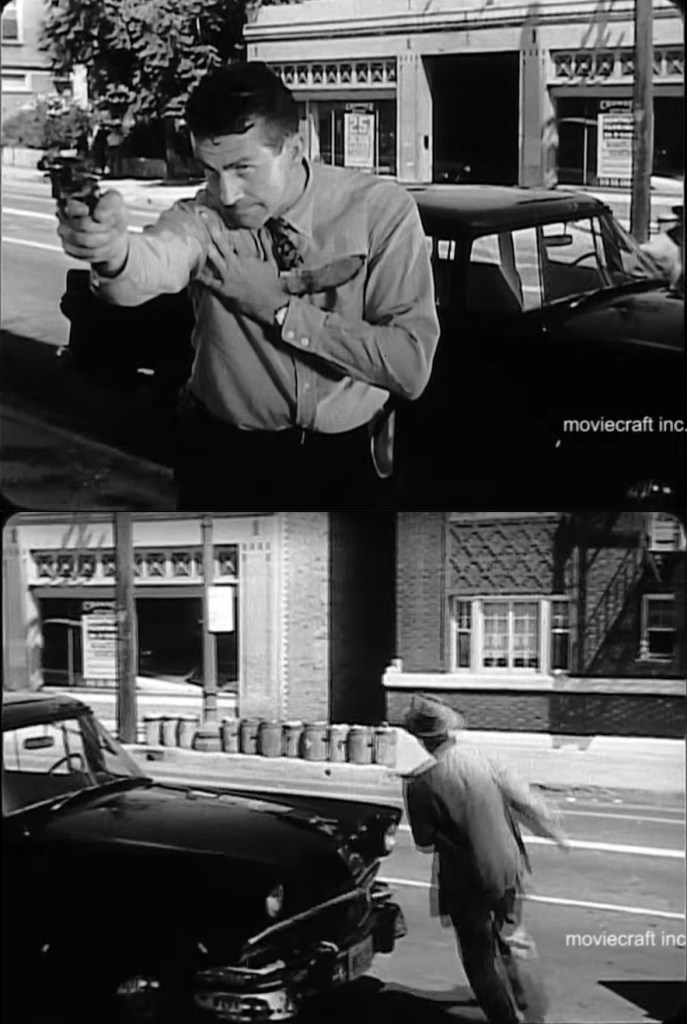
Then the reverse shot shows the 1917 A. C. Martin-designed garage at 318-322 South Grand, which looked like this —
And the structure seen adjacent the garage is the Biltmore at 330 South Grand (Edward J. Smith for Luther Mayo, 1916) — yes, the Biltmore, as in “no, not that Biltmore, the other Biltmore.” Bottom shot by Nadel
The Biltmore can be seen in the distance in this return shot looking down the alley from SBHA to GrandLooking down Grand toward Fourth. See the Edwardian apartment building to the left of the car?That’s the 1904 Grand Avenue Apartments at 416 South Grand, which you remember from pp. 52-53 ↑ of Bunker Noir!
And there we are! Proving once again that there are still sources for vintage Bunker Hill-on-film lurking out there in a vast and untapped mediasphere!
If you know of any of which I might be unaware, don’t hesitate to contact me — oldbunkerhill@gmail.com
Greetings! Though this is a Bunker Hill blog, I will on occasion cover tangentially-related subjects (like Chavez Ravine or Cooper Donuts, or even Disneyland), especially if there’s debunking to be done. Today’s debunking, though, is altogether unrelated to Bunker Hill. After being told for the millionth time that Roger Rabbit is a documentary, I’m finally giving in to my overpowering, long-fermented urge to douse the fervid, fervent flames of the “Los Angeles Streetcar Conspiracy” narrative.
*****
Los Angeles has a dark and hidden history, and here’s part of it you should know: we once had the largest, best run, most efficient, most beloved, most profitable, publicly owned streetcar system in the world. The Red Cars! But! The bloated plutocrats and greasy oligarchs said NO! Profits over people! A cackling cabal of big oil, big tire, and big auto conspired to buy up all the Red Cars and destroy them! Which they did! Then they needlessly replaced them with horrible nasty busses which people disliked so much they all went out and bought cars! And that, my friend, is the reason we now live in a dystopic autopian hellscape of traffic and smog and sprawl.
Not only that, but it was such a grand and shameless conspiracy, that Standard Oil and General Motors and Firestone Tire actually got taken to court and were found guilty of conspiracy and had to pay huge fines! But the damage had already been done to the poor beloved streetcars. All of America’s streetcars had been tossed in the sea by General Motors, and the corporate fatcats puffed contentedly on their cigars and just laughed.
Of course, none of that is true. “But Nathan,” you say, “the GM Streetcar Conspiracy is a real thing! Literally everybody knows about it!” Sorry to burst your bubble but no, the entire tale is twaddle and hogwash. Not even, like, there was a conspiracy but it wasn’t that bad. I’m saying no, it’s literally not a thing that ever existed. Don’t believe me? Read on!
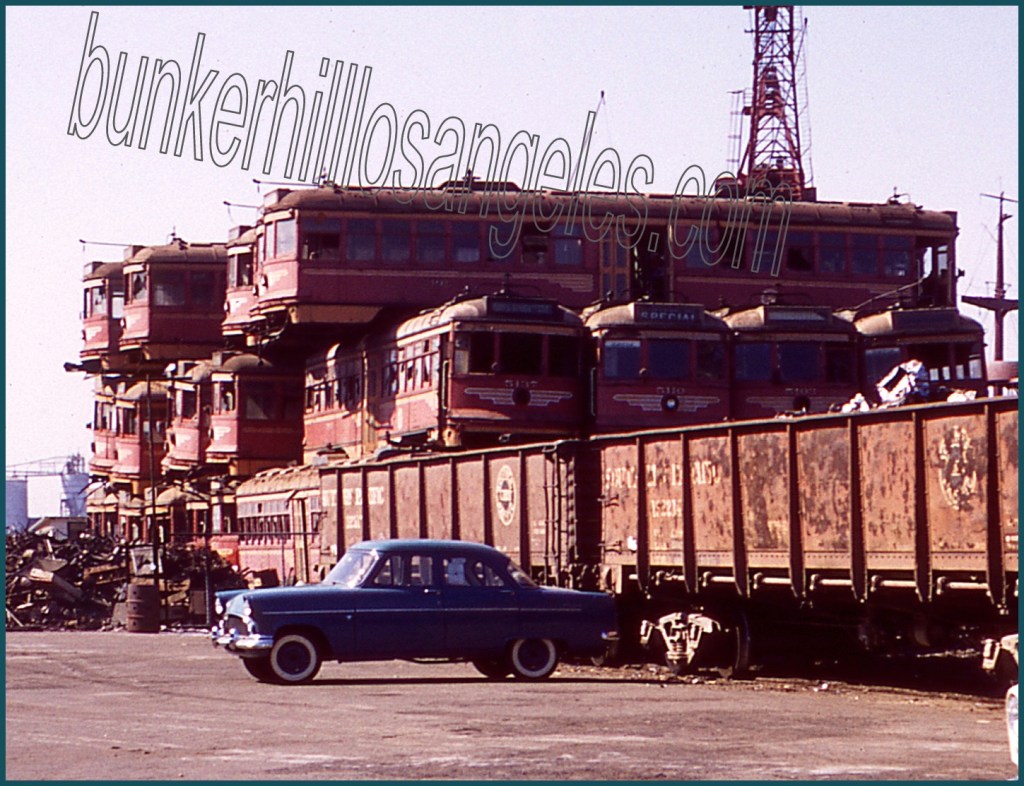
TheNational Metal & Steel Corp. scrapyard at Terminal Island, 1960. (I know watermarks are obnoxious but these are my slides and this is the internet, so…)
***
Every time someone says “big auto and big oil ripped out the efficient streetcar in a freeway-building conspiracy, you know” they give you this look like “and now I’ve imparted to you secret knowledge they don’t want you to know, for it is the dark suppressed history of LA, be careful with knowledge so powerfully arcane” even though it was the plot of a movie that made $350 million and won three Oscars.
Seriously, during my 30+ years in Los Angeles I haven’t gone three weeks without someone saying “Who Framed Roger Rabbit, that’s a true story, you know!” If you don’t know the story, Roger Rabbit‘s premise is that Judge Doom — who looks so cartoonishly evil he makes the Indiana JonesNazi meltingfaceguy look like Mister Rogers — has a plan to force people onto the roads, wherein he buys up the streetcars to destroy them and build freeways:
But none of that happened (it being, after all, a movie about people interacting with cartoons) but the event it’s purportedly based on did not, in fact, occur. The streetcar: not beloved, not efficient, not a public utility, not profitable, and most of all, not the victim of — or even involved in — a conspiracy in any way, shape, or form.
At this point pearl-clutchers exclaim “oh Nathan how dare you! You just hate rail! You obviously despise trolleys, and rail travel, and the people who use it!” Hey, do you know what I do all day when I’m not writing essays like this for you? I operate a railway. If I could go back and time and do one thing it would be ride the trolley around downtown and then out through some orange groves. But people like to mythologize and fetishize that which has been lost to time (e.g., Chavez Ravine; I cover that phenomenon a bit in the first three paragraphs of this) and to be honest I don’t blame them. I’ve been guilty of that too, a billion times, over the course of my life. But as a historian we must side with facts over anemoia and hiraeth. In any event, here we go…
*****
I will spare you the complicated early history of the streetcar in Los Angeles, and how it was formed, but what you basically need to know is that there were, in twentieth-century Los Angeles, two main streetcar networks, the Pacific Electric, and the Los Angeles Railway:
Pacific Electric Type K Red Car heads west on Hollywood Blvd near Vine, August 1954. Image from Metro Archives. Below, an LATL PCC Type P2 Yellow Car heads east on Seventh from Main, August 1962.
The Pacific Electric (PE), whose red-painted cars thus dubbed it the Red Car, was the larger and faster of the two, and was more interurban than intraurban, taking people out to Pasadena, Long Beach, Santa Ana, and the like. The Los Angeles Railway (LARy) had yellow-painted cars, hence its common name The Yellow Cars; its lines were concentrated around downtown, but branched out into some suburbs. (Disclaimer: I am far from an authority on streetcars, and I know juicefans [known for loving that sweet, trolley-powering electric current] are understandably fetishistic when it comes to the topic. I am quite certain I will say something to annoy you [“he didn’t even mention that PE ran standard gauge and LARy was narrow gauge!”] so let me apologize in advance. Trust me, I get it. You can only imagine how I feel when people say Angels Flight is “Victorian.”)
The Pacific Electric Red Car, in brief: Henry Huntington began the Red Car in 1901. He didn’t do so to earn money from fares, or to make a great navigable city; it was just a tool to get people out to his new subdivisions.
A PE PCC car, traveling under the First St bridge at Lucas/Beverly (the majority of those structures in the background are still extant) heading toward the Toluca Yard/Belmont Tunnel, ca. 1950
After having done so, it could have been Hungtington’s right and due to simply dismantle the whole shebang; it was his property, after all. Instead, in 1910 he sold PE to Southern Pacific Railroad, who made it a subsidiary. Pacific Electric Red Cars reached peak ridership in the mid-1920s and began its decline, and though streetcars were losing money, Southern Pacific kept it so they could run freight on the tracks. Busses, though, were the future — in 1923 Pacific Electric began a joint bus venture with Los Angeles Railway called Los Angeles Bus Lines, to connect rail lines and expand service. Pacific Electric began switching their Red Cars to busses in 1925. In 1936 Pacific Electric bought an entire bus company, the Motor City Lines, to facilitate the switch to busses.
And the Los Angeles Railway Yellow Car: not started by Huntington, but he did purchase it in 1898. Same deal: ridership declined, and LARy began converting to busses in 1930. The Huntington estate sold the entity, in 1944, to National City Lines. They renamed Los Angeles Electric Railway to Los Angeles Transit Lines, but the yellow cars remained the Yellow Car. (If there are times I refer to the LARy post-1944, and you’re tempted to exclaim “but it was called LATL then!”, please accept my apologies in advance.)
LATL (formerly aLARy) Type H-4 on Seventh crossing Spring, August 1957
*****
Now you know the two main streetcar players, and — before we get into the conspiracy weeds — here are some building block truths about streetcars: they were not a public utility, they didn’t make money, they were in fact not efficient, and people didn’t care for them much, and their being replaced by busses was a simple natural progression.
Four reasons the owners didn’t like streetcars:
Government price regulation. Despite being privately-owned, government regulators forbade streetcar owners from engaging in European-style zone pricing. That is, if you hop on the streetcar for five cents, you could ride as long as you wanted, as far as you wanted. Even when wartime inflation eroded that five cents to half its value, local government forced the PE and LARy to maintain the fare. (Turns out that much of Los Angeles’s much-derided sprawl has less to do with the oft-blamed automobile, but is because of the streetcar system, in that because of a lack of zone pricing, it was just as cheap to trolleyride to and from your suburb as it was to live near the city center.)
Government road upkeep regulation. The Los Angeles Public Utilities Board, besides prohibiting necessary price increases (despite the streetcars not being a public utility, but that’s your local government at work), also caused the streetcar companies to bleed money in that they charged them for pavement upkeep on the adjacent roads — pavement the railcar companies didn’t even use. Local bureaucrats literally forced streetcar owners to subsidize their competition, including jitneys, which were primitive road-using busses that poached waiting streetcar customers.
The unions. Trolleys were labor-intensive, as opposed to busses: there were two crewmembers on each trolley, the motorman and the conductor, as opposed to a lone bus driver. Labor unions were forcing streetcar companies to pay above-market wages, which is why the companies cut so many positions, leading, again, to busses. Ergo, many cars were converted (at some expense) to one-man crews in the late 1930s, but streetcar wages being above market still stung operators.
Forced service. Local government required streetcars to provide service on all the routes they owned, and thus forcing them to run on unprofitable lines. Naturally they turned to busses, which are cheaper to operate, and allowed them to revamp the lines.
Moreover, streetcars required expensive, dedicated rails, rails which required ten times the engineering time and expense of bus lines. And if a streetcar breaks down, that line is down until the trolleycar is removed/repaired/restored. If travel patterns change, the rail stays there (and again, the government forced owners to run your streetcars on every rail, even in the face of financial loss).
A PE box motor “blimp” freight gets into it with a passenger car, 1937
Conversely, busses cost less, carry more passengers, and could change routes with ease. No wire, no tracks, no catenaries, no electrical power plants, and no private rights-of-way to maintain.
But let’s not forget, people didn’t like streetcars, or at least not as much as we’re led to believe. At the peak of ridership in the early-mid 1920s, people were becoming increasingly dissatisfied with overcrowded streetcars, poor service, and slow gait. This led to the voters passing the Major Street Traffic Plan of 1924, which allocated city money to widen and improve streets, allowing more people to have cars (which had recently become within the buying power of the working man) and thus an alternative to streetcars. Streetcars were noisy, slow, uncomfortable, and had no air conditioning (yes you could roll down a window, but busses had actual AC) and so it’s no wonder people were abandoning them. Sure, there was an uptick in streetcar ridership during the WWII gas rationing/tire rationing era, but post-1945, hot damn did people want the freedom and comfort of their own Plymouth.
*****
And now we address the whole “conspiracy” part of our program. But before I do, just as an introductory aside, do you know who was, historically, all hot n’ bothered to destroy streetcars? Progressives. “Traction ring magnates” were considered as evil as the “railroad octopus” and Progressives considered the private streetcar entities to be capitalistic kleptocrats, remnants of the Gilded Age to be destroyed (The Nation magazine, for example, was not a friend of mass transit). And long before you had National “Streetcar Conspiracy!” City Lines in the picture, Franklin Roosevelt and his Works Progress Administration — closest thing we ever got to socialism in America — looooved tearing out streetcars: FDR’s WPA was crucial to subsidized road building, and began ripping up streetcar tracks all over America. And let’s not forget progressive New York mayor Fiorello La Guardia, who in the 1930s worked tirelessly to dismantle the city’s streetcar system: “bus operation in place of trolleys is not only a boon to the citizenry of New York in that it provides faster, more flexible and more comfortable transportation, it also reduces noise, keeps traffic moving faster, and eliminates the danger of wet rails…” said the man himself. Anyway. Just something to remember when you’re pitching stones at those evil streetcar foes.
The Conspiracy. The story goes, there was a company called National City Lines. They were a “front” for big oil/tire/auto. They conspired to destroy the streetcars, which they did, but got caught, and were found guilty. And…scene.
National City Lines is formed in 1936 and — hold up: first, a quick and important sidenote about the PE Red Cars: So, National City Lines bought the LARy Yellow Cars (we’ll get to that). So why is the common narrative always about the Red Car? That’s largely due to Roger Rabbit —
— thus the Red Car is remembered than the yellow-garbed LARy system, so when the “conspiracy” is discussed these days, the tale invariably involves “the Red Car.”
Ladies and gentlemen, If you take one thing away from this entire post, have it be this: National City Lines (ergo by extension General Motors & their fiendish oil-pumping, tire-peddling friends) never touched one single Red Car in any way, shape, or form. Not one. NCL didn’t so much as look askance at a Red Car. So what was the conspiracy that destroyed the Red Car? Sorry to burst your bubble, but there was none. Southern Pacific, PE’s parent company, began abandoning rail service in large swaths because it was prudent to do so, and running streetcars was not part of their business plan in the first place. Eventually, come 1953, SP sold the works to Metropolitan Coach Lines, which was run by old Pacific Electric guys (particularly Jesse Haugh, a former PE executive) and these PE guys converted much of their rail transit to bus service (click here and here). Red Car’s nail in the coffin, though: Metropolitan Coach Lines/the Red Car was subsequently acquired bythe government. In 1958 the (taxpayer-funded) Metropolitan Transit Authority, in league with the California Public Utilities Commission, took over and killed the Red Car. It was the California Public Utilities Commission — whose commissioners were appointed by the Governor and confirmed by the State Senate — who officially pulled the plug on the Red Car. Please never forget that, and don’t forget to to tell it to the next person (perhaps one of the 70,000 who “liked” this typical and falsehood-packed post) who says “big oil killed the Red Car.”
Anyway, back to the reason you’re here today:You have been told that National City Lines, who was really General Motors, bought the streetcar system, and killed it to replace it with busses and autos, and there was a trial, and they were convicted. Big Auto was convicted, you will be told, of conspiring (in Judge Doom-like fashion) with Big Oil and Big Rubber to destroy the streetcar. And that’s why America no longer ha streetcars.
Except that’s all hooey, the lot of it:
National City Lines is formed in 1936. In 1939 the president of NCL approached — not General Motors — but a company called Yellow Truck & Coach Manufacturing, for financial assistance. The money NCL got from Yellow Truck — Yellow Truck being a subsidiary of GM — meant that money came a requirements contract. Standard stuff, and altogether legal: it said that NCL needed to use GM’s money to not go and purchase equipment from competing companies. That’s it. People have dug into NCL’s records and GM’s records from here to Timbuktu and there is zero evidence that GM held sway over National’s management; no evidence of managerial control, nor did they have any say regarding National’s movement from streetcars to busses.
In 1945, National City Lines bought the LARy Yellow Cars. NCL bought a lot of lines in the United States, about 10% of the lines in the country. In some areas NCL began to convert to busses, and in other areas they actually expanded electric rail. But all we hear about is their conspiracy to destroy all of America’s rail.
Before I get into the particulars of why that’s not true, let me state something nobody ever mentions: there were 600 major metropolitan areas in America with streetcars. National City Lines got their hands on about 60 of them, so, again, only ten percent of America’s rail is thus tainted by some sort of “streetcar conspiracy.” If it required a conspiracy involving General Motors and Standard Oil to demolish those 60 rail centers, what happened to the other 540?Seriously, tell me. 540 urban areas had streetcars, and they ripped out their streetcars. Without the involvement of National City Lines, without being tainted by a nefarious streetcar conspiracy. (Yes, I’ve been on the old trolleys in New Orleans, San Francisco and Boston, and yes, I’m aware that there are some places like Pittsburgh and Philadelphia that run modern light rail on their old streetcar-dedicated right-of-ways; so subtract those and a few others and tell me why the other 530 or so major American urban streetcar areas abandoned their streetcars without the input of National City Lines.)
So: was National City Lines brought up on charges of conspiracy to destroy streetcars? No, they were not. Defendant National City Lines — and by extension the old bugaboos of GM, Standard Oil and Firestone Rubber, via Yellow Truck & Coach — were brought up on two counts:
Count One: Violating Section One of the Sherman Antitrust Act (the SAA is Gilded Age legislation that prohibits monopolies; it famously broke up Standard Oil. Read more about it here). NCL were accused of trying to secure control of transit-providing companies, which they were not trying to do, ergo, they were acquitted. As in, found not guilty and absolved of wrongdoing regarding accusations of restraint of trade. Got it? Ok.
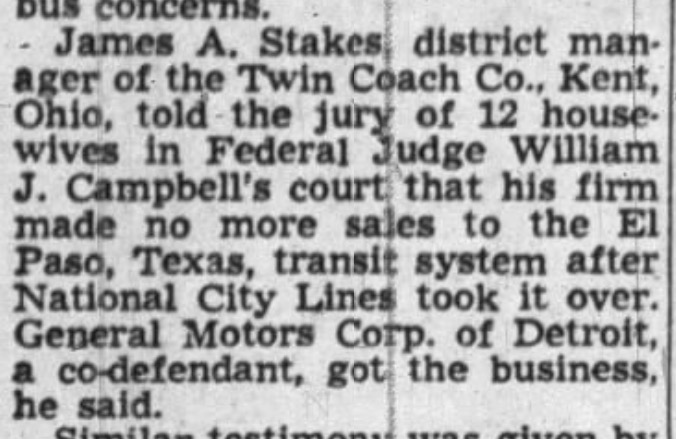
Count Two: Violating Section Two of the Sherman Antitrust Act. They were accused and found guilty (upheld in appellate court, U.S. v. National City Lines, 186 F.2d 562 [7th Cir. 1951]) of selling busses to themselves. Literally nothing to do with streetcars. When NCL was laying out new bus lines, they committed the “crime” of using their own busses. For example, who were some of the witnesses for the prosecution? Pacific Ford Motor Coach, and Twin Coach Company, who testified that they lost out on business when NCL (who, again, had a tying agreement with GM) bought GM busses. But Pacific Ford and Twin Coach said that just wasn’t fair. The government thus brought NCL up on charges, because being your own customer is illegal under antitrust law.
Long Beach Press-Telegram, Feb. 23, 1949
So the jury said awwww and found GM guilty of selling itself its own busses.
Let me sketch a rough analogy for you. Let’s say you had a restaurant — you open a vegetarian restaurant, and you have a plot of land out back so you grow your own vegetables. Farm to table kinda thing. But the government comes in and says you can’t feed people your own vegetables, because that’s not fair to your competition. You have to buy your vegetables from your competitor (and tough luck if those vegetables when not as tasty and more expensive). You can’t use the ones you grew yourself, but must buy someone else’s, because that’s fair.
Pasadena Star-News, March 13, 1949
NCL was fined $5,000. “That’s an outrage!” screeches literally everyone, “they got a slap on the wrist for conspiring to destroy the streetcar!” First of all, again, the accusation and judgement had absolutely nothing to do with streetcars, but point being, $5,000 was the absolute maximum fine they could get for selling busses to themselves. The government set that fine long before the trial began; it wasn’t a slap on the wrist imposed by some pro-Big Oil judge, or whatever conspiracy theory you have.
I feel like this cannot be stated often enough: In the court’s opinion, there were, certainly, damaged parties — competing bus manufacturers. But there was never a mention of electric railways.
And again, there were hundreds upon hundreds of cities who never had a smidgen of GM/NCL influence, and they dismantled their streetcar systems just fine on their own (American cities, heck: the UK, Japan, and countless other nations have but a fraction of their original tram systems, and GM/NCL wasn’t there, either).
So, after National City Lines was convicted of the very non-streetcar-related crime of selling busses to itself in 1949, you’d think that would be the end of the story, right?
Nooooo.
*****
Enter Bradford Snell. It’s 1974, here comes Snell, he’s an antitrust attorney from San Francisco. Snell had been bankrolled by the leftist Stern Fund to write a paper about how General Motors was eeeevil, and had destroyed America’s streetcars. This was the genesis of the streetcar myth. Snell became a member of the Senate Judiciary Committee’s Subcommittee on Antitrust and Monopoly and there testified to the Senate that Pacific Electric was forced by National City Lines to convert to busses and then, because people would be so horrified by the busses, they’d buy automobiles. Yep.
Seriously, that was actually his argument—here is a direct quote from Snell, that Pacific Electric’s plan was “to convert its electric street cars to motor busses — slow, cramped, foul-smelling vehicles whose inferior performance invariably led riders to purchase automobiles.”
Let that sink in: Snell said National City Lines forced PACIFIC ELECTRIC to do this. As you know, NCL never had any dealings with PE. Ergo, Snell is an idiot, a liar, or both. (Spoiler alert: it’s both.)
Snell’s argument also hinged on the “truth” that busses were inferior to streetcars. Of course busses were more flexible, easier to run, cheaper to run, and actually profitable. (But hey, this is government! They don’t care about the owners of things.) What about the ridership? Well the streetcar was louder, slower, it jerked you about on less comfortable seats compared to the cushy bench seats of 1950s busses (yes, I am aware that many streetcars had upgraded from wooden to upholstered, but still), there was heating and air-conditioning, etc.
Most importantly, Snell testified to the Senate that back in 1950 GM had been convicted of a “criminal conspiracy to monopolize ground transportation” — which, of course, they hadn’t. Like saying NCL worked to destroy Pacific Electric…was he consciously lying, or just making stuff up with all the best intentions? Oh wait, it’s the same thing.
Anyway, there were hearings about this through 1974. They made the news largely because San Francisco mayor Joseph Alioto testified to the Senate that GM was “a monopoly evil” and LA mayor Tom Bradley (quite incorrectly) testified “GM scrapped the Pacific Electric” — of course, it turned out SF and LA both had lawsuits against GM and Alioto and Bradley had financial interests in screwing GM, so naturally they lied to the Senate. Yay!
Then in 1987 60 Minutes picked up the tale and said our streetcars were “murdered by conspiracy.” It’s absolute trash, but it’s a fun watch for the vintage streetcar clips. Between the 60 Minutes piece and Roger Rabbit, every Gen X’r in the world ardently argues the conspiracy narrative.
******
And now to wrap up. We know that natural forces sickened the Red Car until your local government pulled its plug. But what of the Yellow Car? If General Motors didn’t rape and murder it, as you’re so constantly told, what happened to it, exactly?
So LARy is bought by National City Lines. The Yellow Cars are largely converted to busses through the 1950s — (and before you say yeah! evil GM busses! they actually replaced most streetcars with ACF/Brill electric trolleybusses) until by 1958 only five (of the original 25) streetcar lines remained in operation — the J, P, R, S and V. These were sold to the Metropolitan Transit Authority (today LA Metro). Just as a public agency had destroyed the whole of Pacific Electric Red Cars, it was a public agency that destroyed the last of the LARy Yellow Cars. Between 1958 and 1963 it was your tax dollars (well, your grandparents’ tax dollars) that sent all those Yellow Cars to the National Metal and Steel Corporation junkyard at Terminal Island, where they were broken up for scrap.
The future is now: MTA busses, January 1963. (The ghost sign for California Truck Rental can still be seen at 930 East Sixth St., and yes, that air raid siren at right is still there)
*****
Let me reiterate, I love rail. I would have loved riding the streetcars (I love riding them in Perris) just as I love running an Edwardian-era electric train in downtown Los Angeles, so, count me among the juicefans. Plus, L.A. streetcars began with a Bunker Hill connection — in that the first line, the Sixth & Spring line, was founded in 1874 by Judge Widney, who resided on Hill near Fourth.
That said, I’m not going to allow you to believe things that aren’t true. Also, you’re not allowed to complain about losing our old streetcar system if you’re not willing to ride the 114 miles of rail transit we currently have in Los Angeles (including, I might add, the longest light rail line in the world). That’s right, even after destroying the streetcar, Los Angeles still has the largest light rail system in the United States.
*****
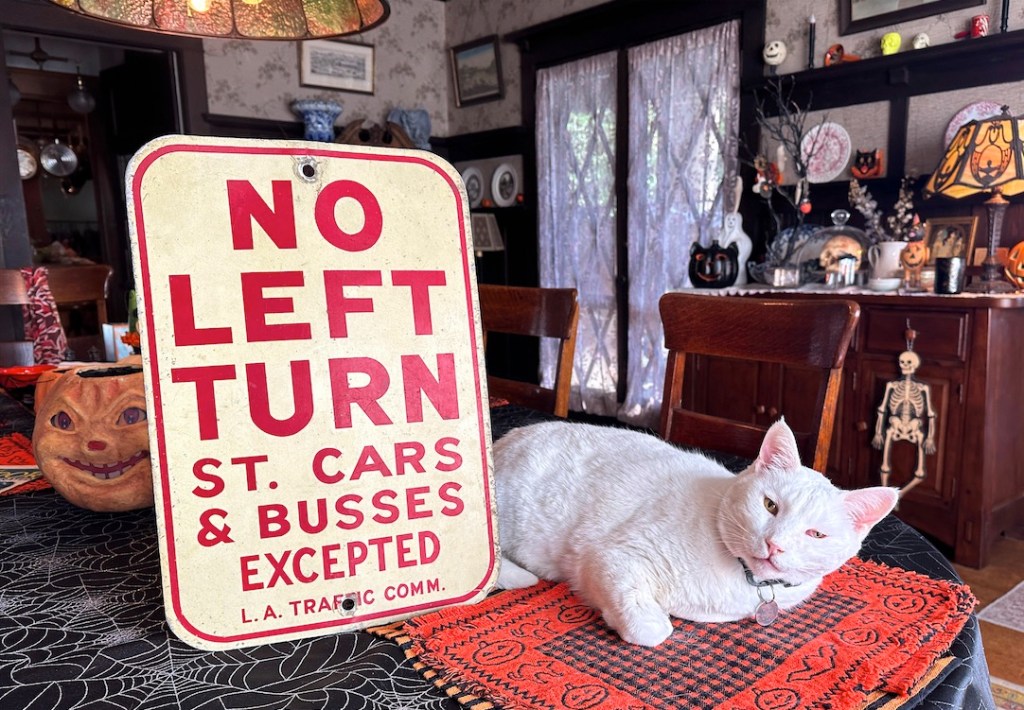
Oh, one other thing: if you raise an eyebrow at my use of “busses” rather than the more traditional “buses” that’s because one of the objects in my greater “old LA” collection is this —
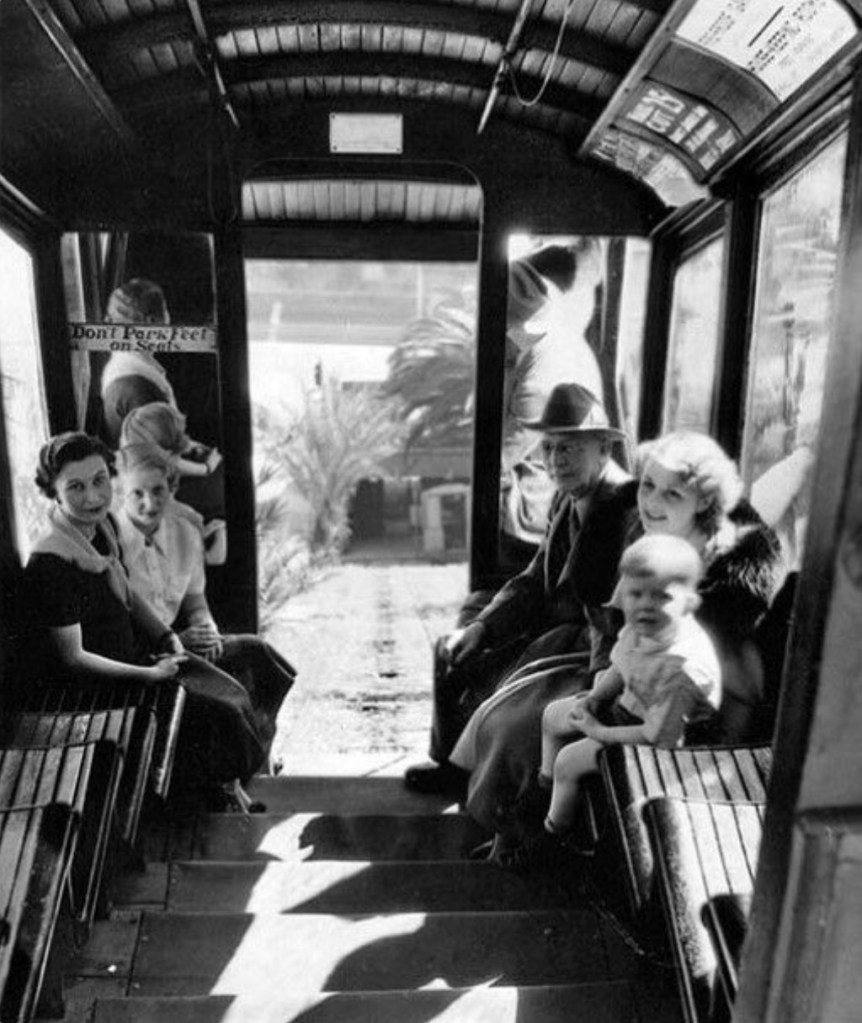
Remember how I recently had the good fortune to uncover some previously unseen Astoria images? Well, something similarly rare and unknown just bubbled to the surface again, and it’s a doozy. An image was posted by famed Angels Flight operator Will on his saturdaystationagent Instagram account; you might remember my shout out to him and the good work he was doing posting oodles of Angels Flight clips.
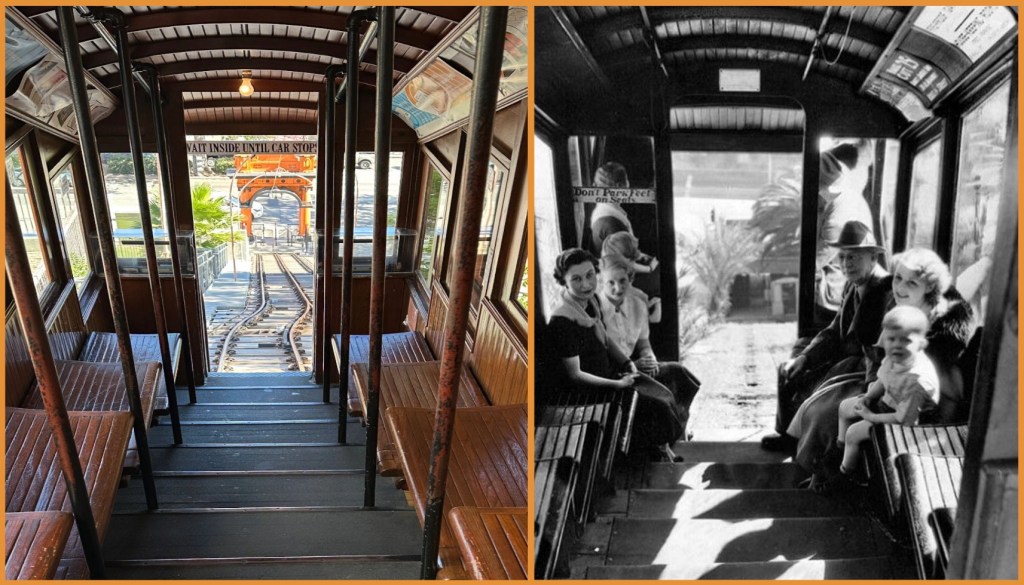
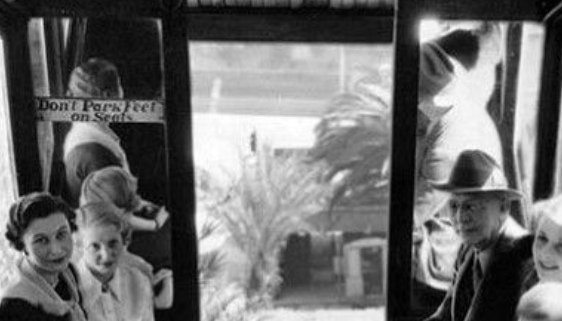
But have you ever seen an image of the interior of Court Flight? NEITHER HAVE I.
Where did this image come from? I don’t know! I wrote Will and he said he got it off the internet, but forgot to note where, and now, should you perform a reverse google image search, nothing comes up.
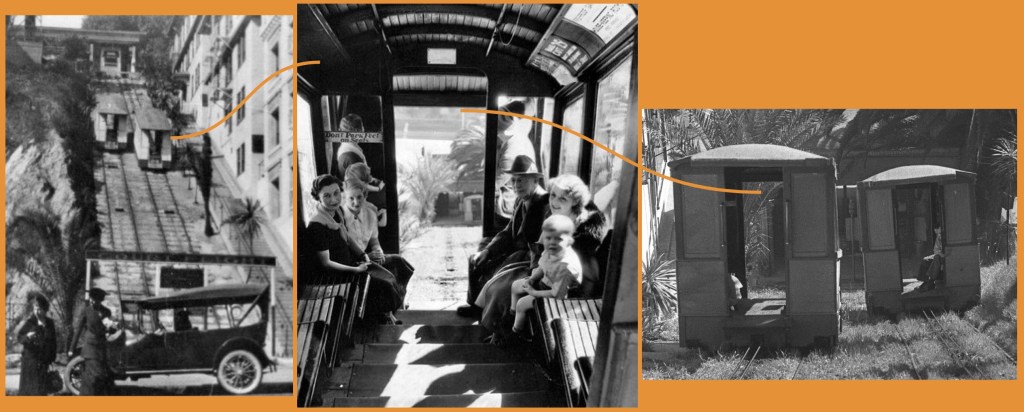
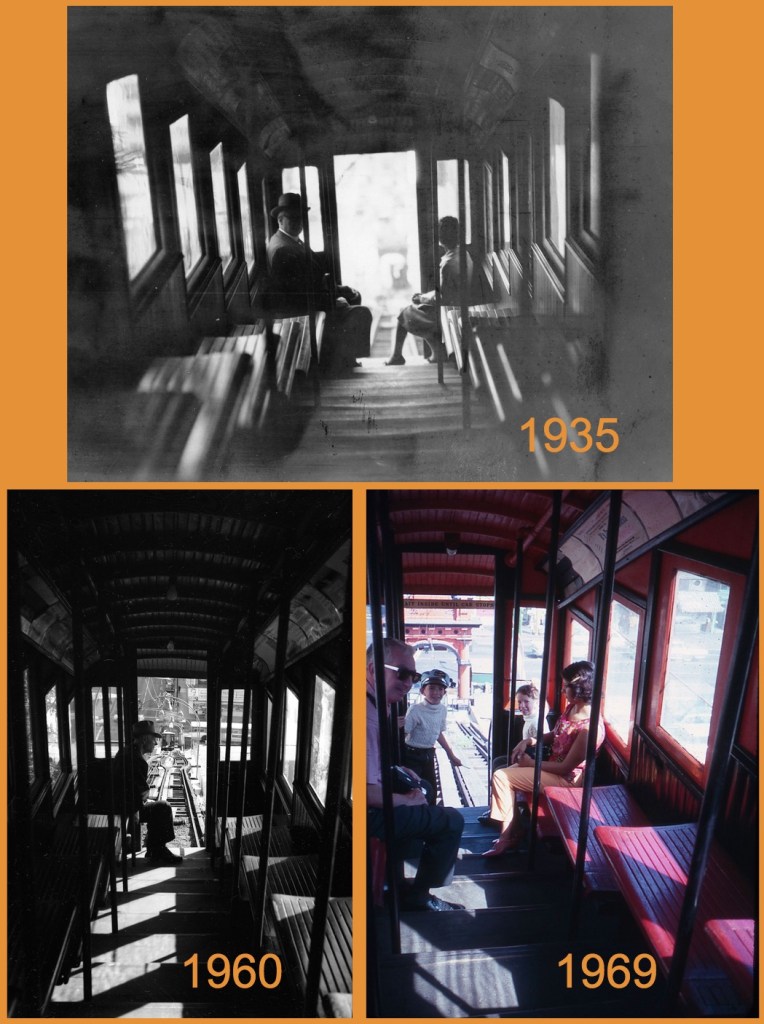
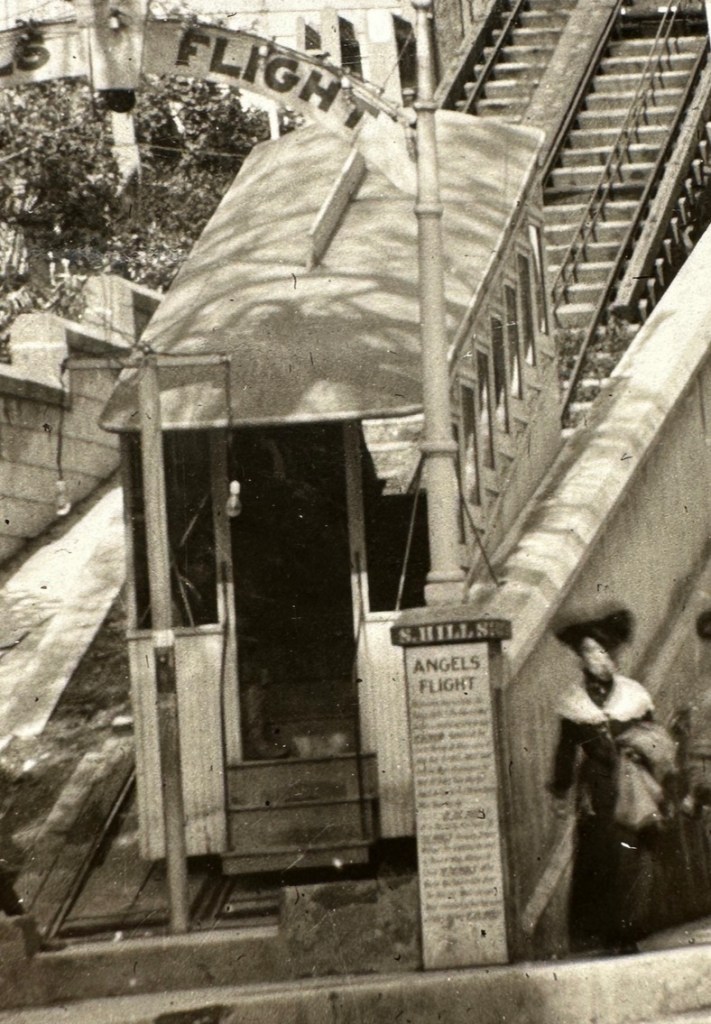
Did you look at the Court Flight image and immediately think “huh, what, huh? that’s Angels Flight” — can’t blame you if you did! Here’s a comparison of the Court Flight car to the Angels Flight car.
AF 2025 CF 1935
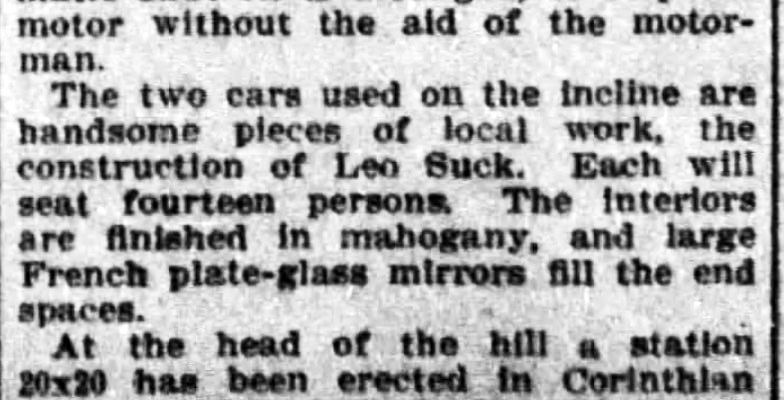
Nearly identical; that’s because both cars are from the able hand of the same man: Leopold Suck.
Leo Suck designs the Court Flight cars: Los Angeles Times, October 14, 1905
Leopold Suck was born in in Chicago in 1857 to his German-born parents Justus and Theresa (Ruttencutter) Suck. He came to Los Angeles about 1885 and worked as a carpenter and contractor. In 1903 he built a one-story brick building at 316 East Second Street, which served as his place of business, from which he did all sorts of small homes, façade remodelings, and building additions. He died in 1944 (possibly from heartbreak, having seen Court Flight go up in flames in 1943).
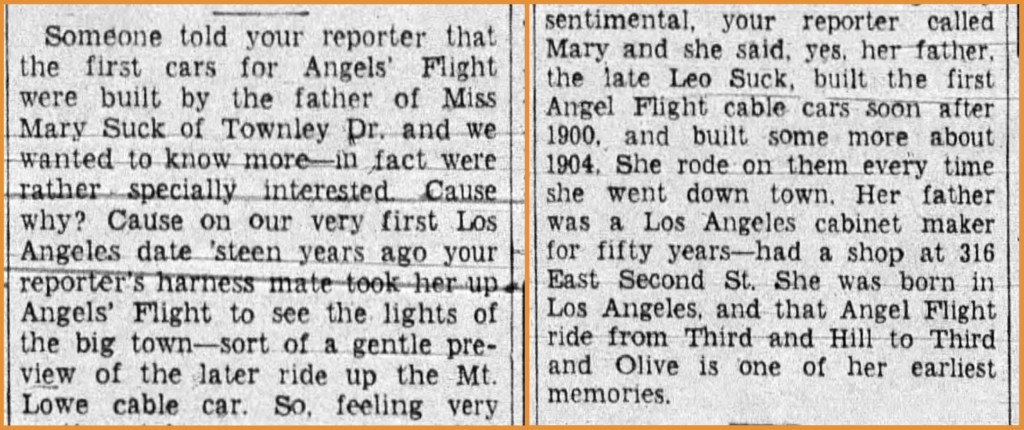
The Angels Flight cars are obviously his work, given their similarities. While there’s no contemporary smoking gun proving he designed the Angels Flight cars, his daughter’s testimony is pretty convincing:
Whittier News, January 24, 1953
“Wait,” you say, “he built the Angels Flight cars about 1900 but built some more in 1904? Huh?” Fair question. So, a quick history of the Angels Flight cars, as long as you’re here:
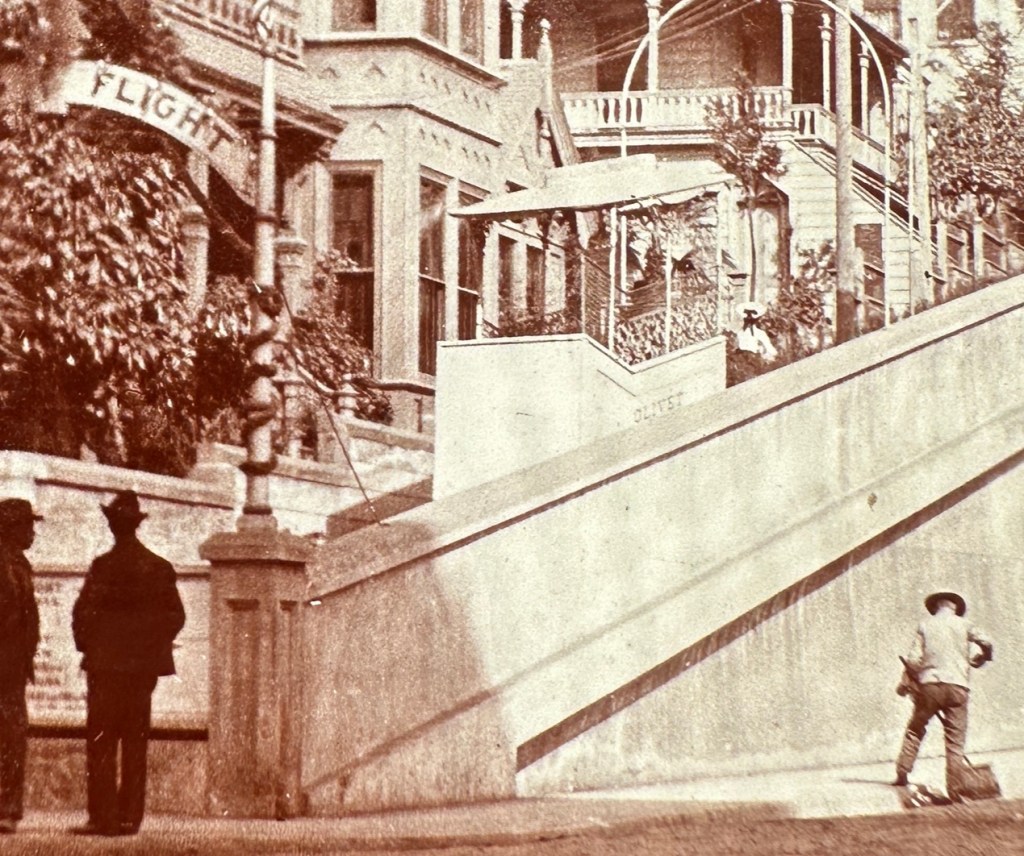
The first cars, from the Flight’s debut on Dec. 31, 1901, were basically an open box with a wee roof atop —
ca. 1902
But then in November 1903, when the grade was made uniform via lifting the flight up onto an elevated trestle — Angels Flight got new cars, which looked like this:
Spring 1905
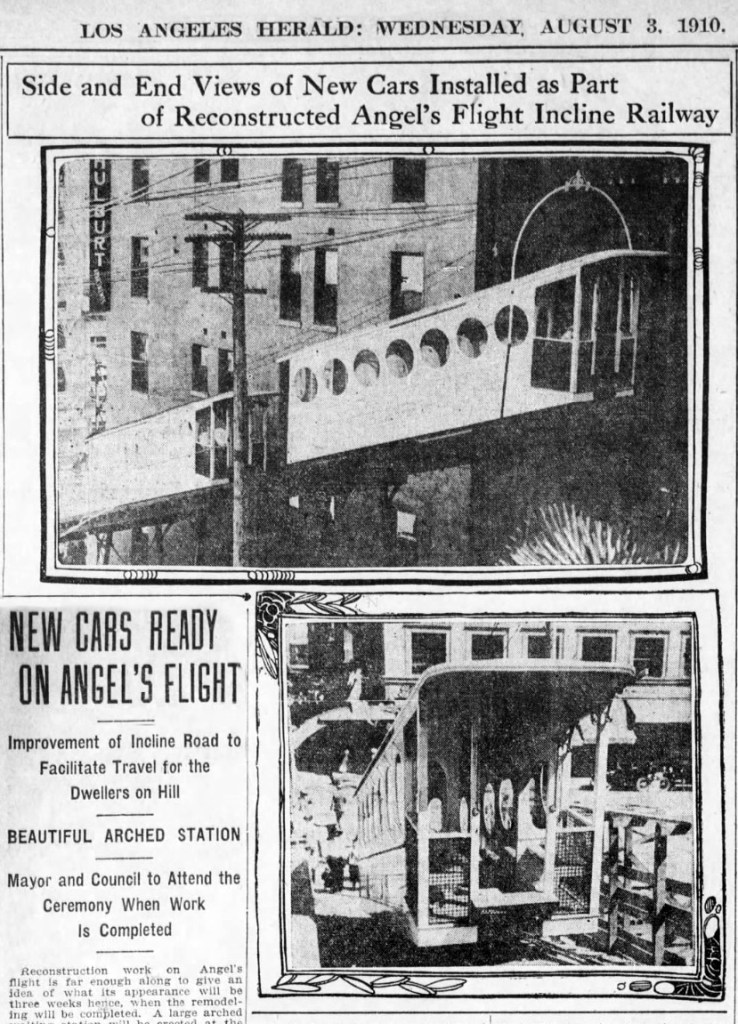
I would assert that these 1903 cars are the cars we use today. The waters get muddied a bit because the papers inform us, in August 1910, that the Flight got “new cars.”
Los Angeles Herald, August 3, 1910
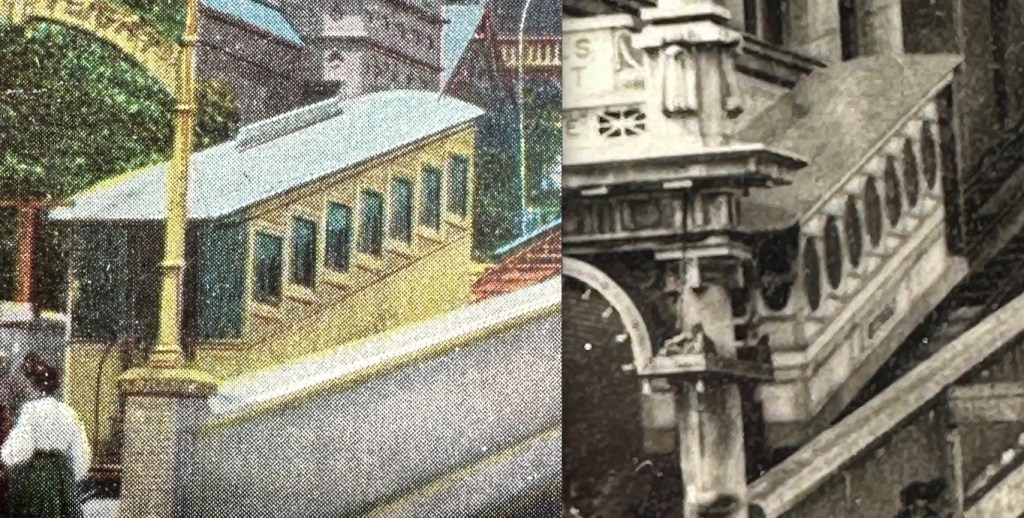
I am of the opinion that the Herald is wrong. There was a lot of newness in 1910, to be sure: a brand new arched waiting station at the bottom, a large new station house up top. I believe Eddy hired someone — possibly, and probably Leo Suck — not to build new cars, but to give the existing cars a redo. The windows were made into ovals (I think this was via a cutout applied to the square glass, since the oval window treatment didn’t last through the end of the ’20s, and the windows were returned to their original square) and the top end of each car was extended to add an open-air “smoker’s seats.”
The 1903 car, left; same car with 1910 remodel, right; note the extension above the top window
My favorite part of Court Flight interior image are the wonderful mirrors. Naturally you’d need to check your hair and makeup before alighting the vehicle!
Hope you have enjoyed this post! Many thanks to the mysterious Internet for providing the Court Flight image, and to Will for posting it. Here’s to many more Bunker Hill finds!
Ok, I know this is really off the topic of Bunker Hill, and I am well aware there is zero reason to get worked up about something posted in the reeking cesspool that is TikTok. But I write about Chavez Ravine because of Bunker Hill, so now I’ll write about Disneyland because of Chavez Ravine, making Disneyland the dopey, ungainly cousin of Bunker Hill. And away we go:
I began writing about Chavez Ravine (e.g. this/this/this) because the story shared similarities with Bunker Hill (government removes the poor and disenfranchised “for their own good” etc.). I kept at it largely because the Chavez story gatekeepers were so shameless in their continued production and promulgation of lies. The Influencer Class and their agenda-setting, narrative-shaping output factory simultaneously repels and fascinates.
Ergo, I’m going to harp on another Chavez-flavored example related to, of all places, Disneyland. This TikTok —
— has had 150,000 views, with nearly 15,000 likes and 11,000 shares. It got shared on Instagram and garnered another 3,000 likes. It involves the story of how, before Disneyland, a bunch of land in Anaheim was a “thriving Latino neighborhood” until “the city seized the land through eminent domain” after which “entire communities were bulldozed without any compensation.” So yes, I’m here to talk about it today, because it’s the exact same (purported) story as Chavez Ravine.
The Chavez Ravine story, though, at least has a kernel of truth at its core (progressive politicians did, in fact, use eminent domain to extirpate the communities there). But the Disneyland story, as shoehorned into the Chavez narrative, is just stupidly, laughably false.
If you chose not to watch the video, here’s a transcript:
They built the happiest place on earth by destroying someone else’s. Before Disneyland, a thriving Latino neighborhood existed here. It was filled with homes, families, and orange groves. These were passed down through generations. But in the 1950s, the city seized the land through eminent domain. They claimed it was for public use, but then sold it to Walt Disney. Entire communities were bulldozed without any compensation, no memorial, and no plaque in the park. Families who once lived there now buy tickets to walk on the land they lost. Today, millions visit the park, yet almost no one knows what was here before. This story isn’t just about Disneyland; it’s about how American progress continues to erase communities of color. Disneyland calls itself the happiest place on earth, but for the original residents, it marked the day everything changed. Comment if this was never included in your history class. Follow for the stories they attempted to bury. Share if someone needs to hear this.
This is all a con. A fraud. The deceitful contentions are as real as their adjoining images, which were spat out in AI — here for example is a “photo” of the now-destroyed “thriving Latino neighborhood” —
— and again, yes, I know that attempting to counter TikTok’s perfidy-peddling propagandists is a fool’s errand (so I’ll try to make this quick and we can get back to the posting of cool Bunker Hill stuff). Anyway:
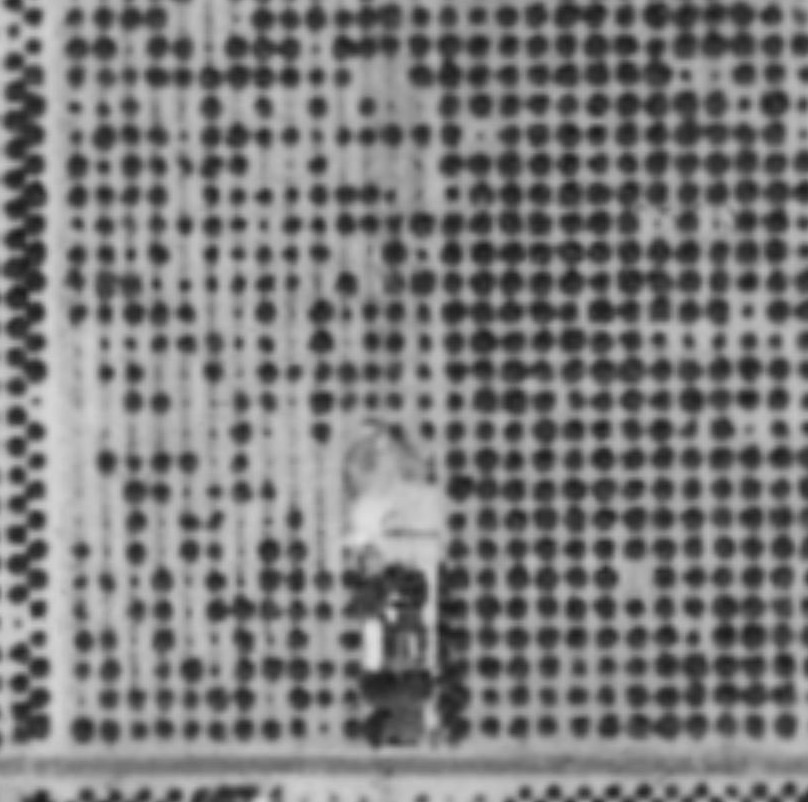
Come with me back in time and examine the land through aerials. Here are today’s boundaries of Disneyland, as bordered by Walnut, Ball, Harbor, and Katella —
What do you notice? It’s all orange groves. Nothing remotely related to “neighborhoods” and “entire communities” as erasedcalifornia so sternly states.
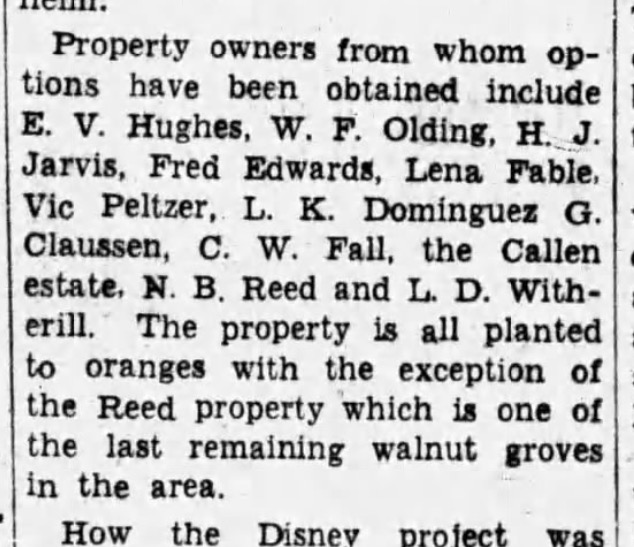
“But but but,” you say, “the families who owned those orange groves were Latino and they had their land stolen!” Nope. We actually know who the families were who voluntarily sold their land to Disney (selling the land being the exact opposite of erasedcalifornia’s narrative that “the city seized the land through eminent domain. They claimed it was for public use, but then sold it to Walt Disney. Entire communities were bulldozed without any compensation“) and here are their names:
AnaheimBulletin, May 1, 1954
“Ok yeah but” you say, “all the owners were of European descent but LOOK!Dominguez!THERE’S a Mexican name! THEY definitely had their land stolen! Then their farmhouse was bulldozed!” Nope again. The Dominguez family had a ten-acre lot (which is 6.25% of Disney’s 160-acre purchase) and on that lot was a farmhouse:
And not only did the Dominguez family sell their land voluntarily, but Walt Disney saved their 1,300 square-foot 1920s farmhouse, where it stands in Disneyland to this day.
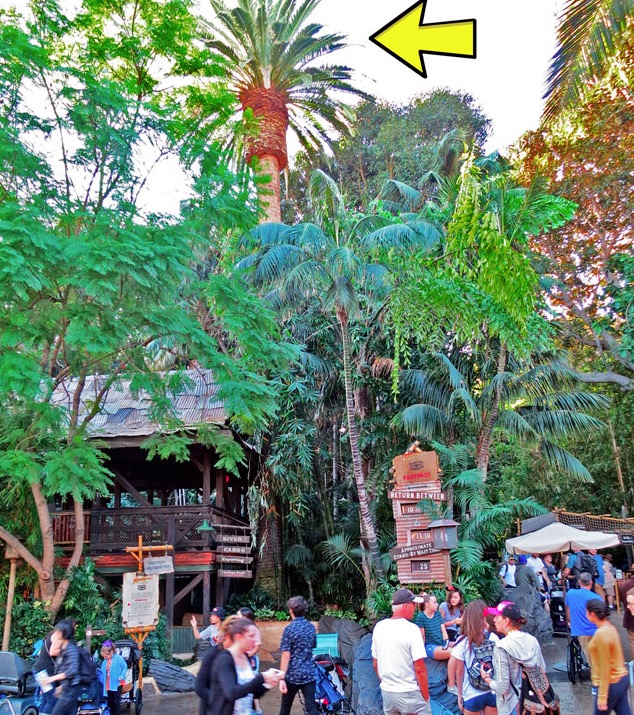
Oh, and it gets better. So not only did the sole Latino people involved in Disney’s Anaheim land deal not have their house seized, and not only was it not bulldozed, but their palm tree was saved, too:
This Canary Island Date Palm was planted in 1896 by Timothy Carroll, Anaheim’s first horticulturalist, for that ten-acre tract’s landowner, Wyran Knowlton. In 1920 Knowlton’s daughter Laura Irene Knowlton married Pablo Vincent Dominguez, which is how the ten acres “became” a Dominguez property. Pablo (who went by Paul) & Laura built the little house in 1925, in which their son Ronald Dominguez was born in 1935.
And it gets better still: not only was the young Ron Dominguez not “run out” of his property in 1954, but after the park opened he walked into the personnel office and applied to be a ticket-taker. Over the course of an illustrious 40-year career there, he was promoted to the position of Executive Vice President of Walt Disney Attractions. So while “erasedcalifornia” insists they are being “erased”… the only Hispanic folk (well, half-Hispanic, since the Knowltons came from England and helped settle the Massachusetts Bay Colony) that could have possibly been erased sold their land to Disney, who kept the Dominguez home, kept the Dominguez tree, AND honored Dominguez with a window on Main Street, when he retired in 1994:
So, if the entirety of erasedcalifornia’s story is such easily disprovable poppycock, why did they put time and energy into making the video? Apparently it was just to fan the flames of racist hatred. Among the thousands of comments on the Instagram and TikTok post are many like these —
— and should you want to read more typical reactions to erasedcalifornia’s post, click here and here and here and here and here
The comments go on an expand from there, into anti-American, anti-capitalist invective. Hey, you wanna be a racist communist that hates America, you do you, baby. Knock yourself out. But piece of advice, try to have an argument that’s at least based in some minuscule semblance of fact.
Perhaps it’s less that people need to be America-hating racists, than it is some people’s need to crap on anything fun. I’m sure that’s enormously psychologically gratifying, though in the end being a toxic gaslighter does one more harm than good. So hey, erasedcalfornia and your ilk, along with finding some stories with truth to them, get some therapy.
There’s two weeks till Hallowe’en and it’s time to put your Hallowe’en gift-giving into overdrive! (Yes, I know, you’re mostly buying things for yourself, but who better deserves them?)
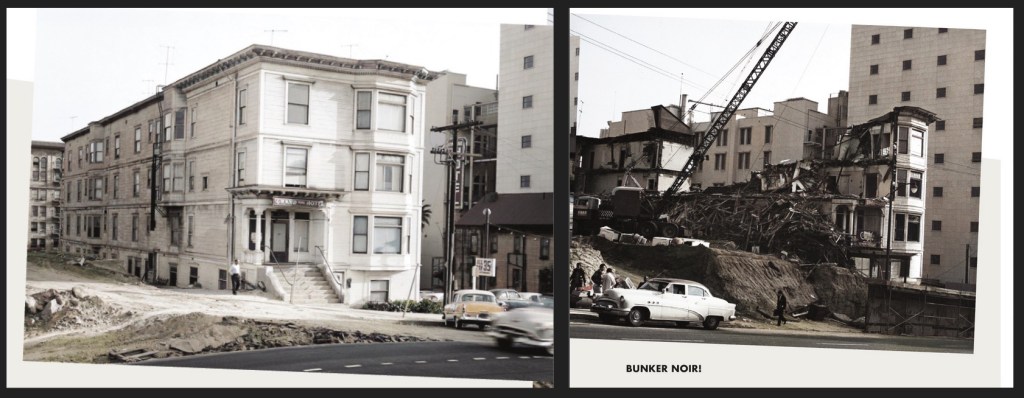
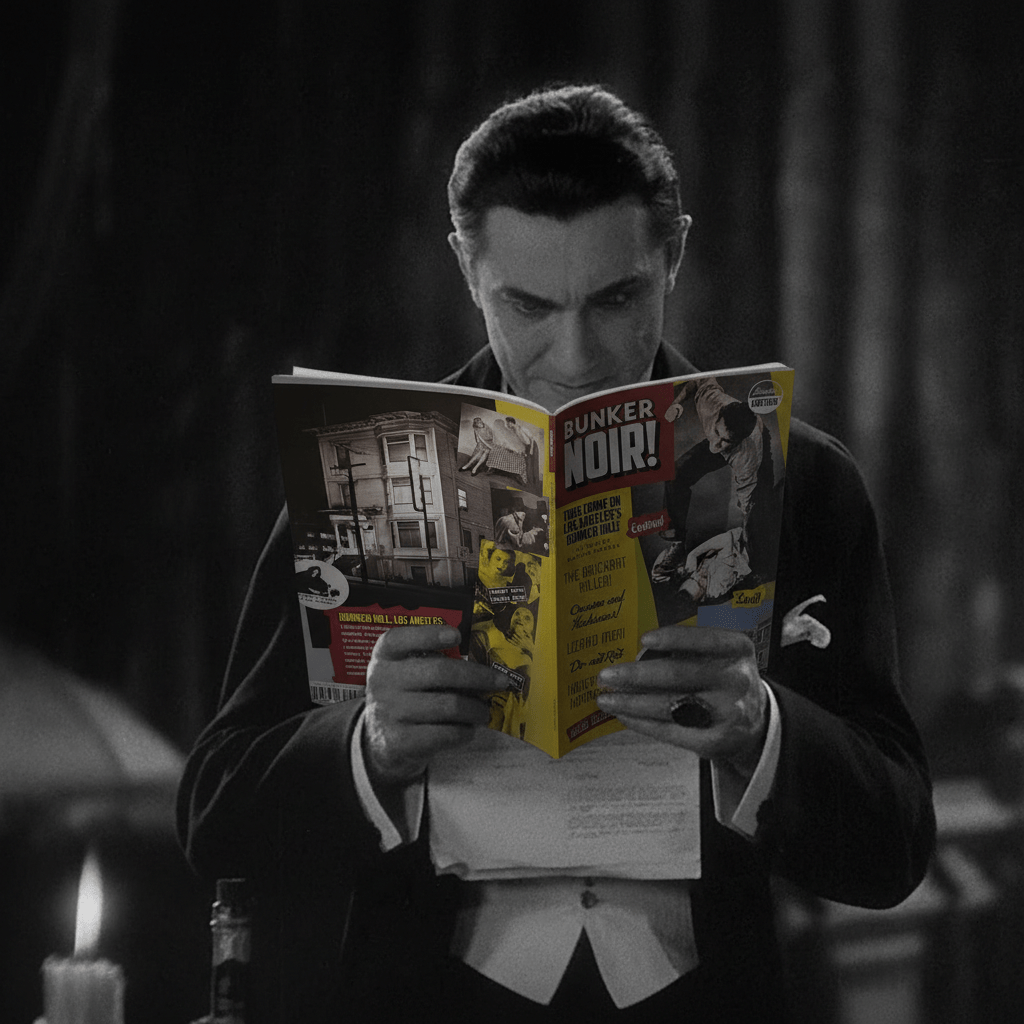
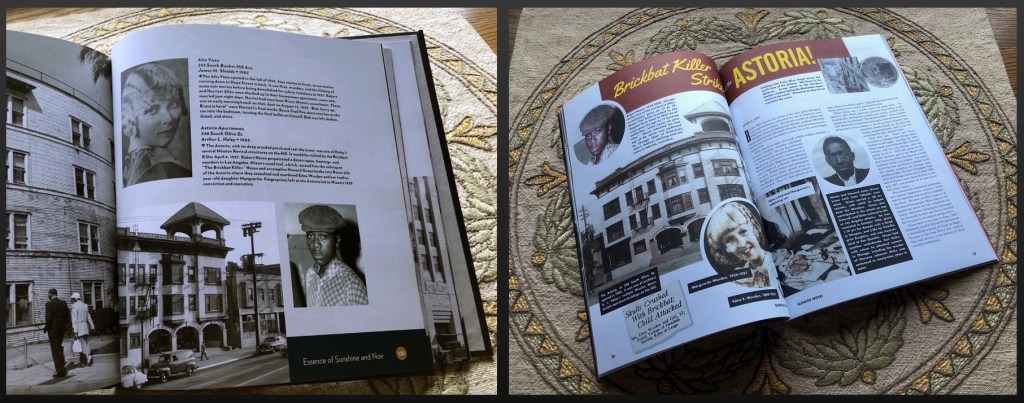
Might I suggest a copy of Bunker Noir! It’s a true crime compendium replete with murder, suicide, bootleggers, serial killers, bar brawls, deadly fires, lizard men, and most terrifying of all, building demolitions!
And it’s ON SALE! Regularly $30, it’s now a scant $20. Buy it on eBay, or on Amazon, but bear in mind you’ll be paying taxes and shipping that’ll send it north of twenty bucks. However, toss me $20 via Paypal (marsakster@gmail.com) or Venmo (@Hugo-Eckener) and (please make sure I have your mailing address) I’ll eat the taxes AND the postage!
Here are some SATISFIED CUSTOMERS!
*****
As long as we’re on the subject of spooky stuff, might I further suggest you purchase some ’tis-the-season sundries from Morguewear? They carry all the whatnot you need in life — shirts, pillows, coffee mugs, candles, notebooks — but conveniently emblazoned with vintage graphics advertising caskets, hearses, embalming fluid, and other fun stuff.
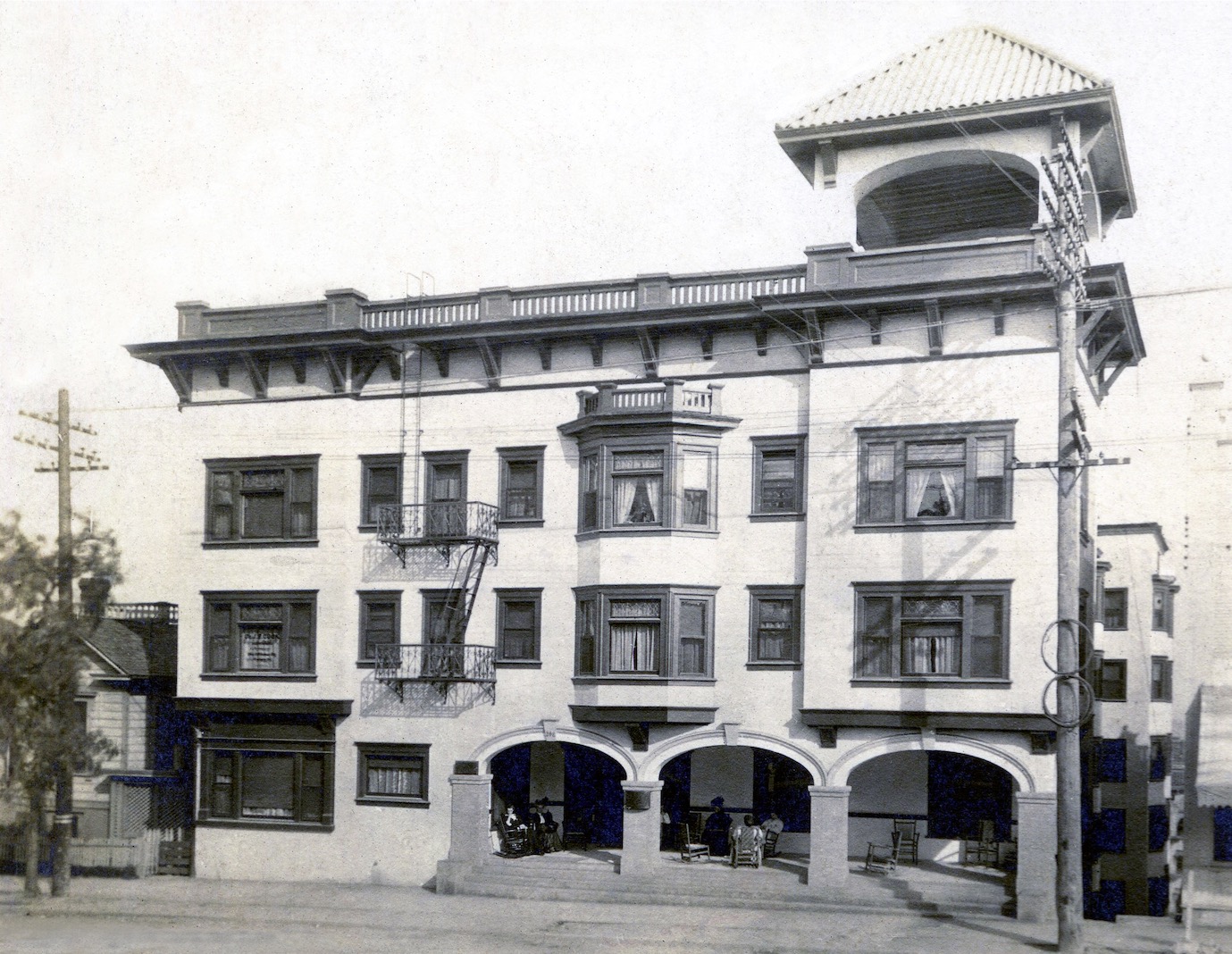
But I feel bad that this handsome Mission Revival apartment-hotel is forever linked to Nixon and the grisly Worden murders. I always thought it would be nice to talk about the Astoria in a more general way…in a perfect world I’d find an image of the lobby, but I’d never hold out hope that that would happen.
Well…
So the other day I was on this really annoying Facebook post where people were looking at a normal Angels Flight image and insisting “this is AI!” and I had to disabuse them of that notion. Yes, I know, I have much better things to do, but, in performing this task I also noticed some fellow had mentioned “my grandfather ran a hotel up there at the top of Angels Flight called the Astoria” and, suffice it to say, that was Fortuna’s reward.
Because this fellow, Joe Orndorff, is the grandson of none other than Joseph Edward Harrigan, manager of the Astoria!
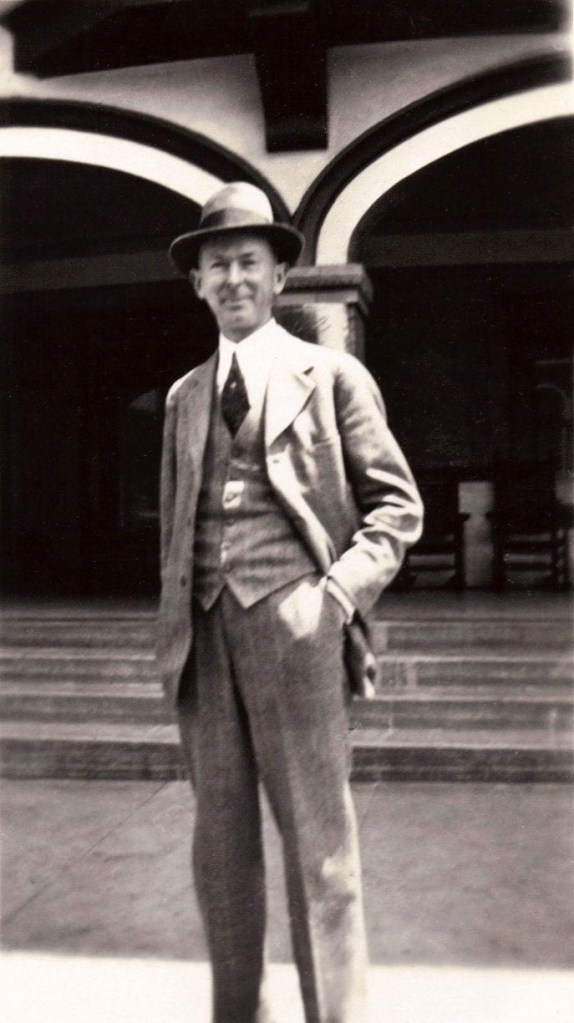
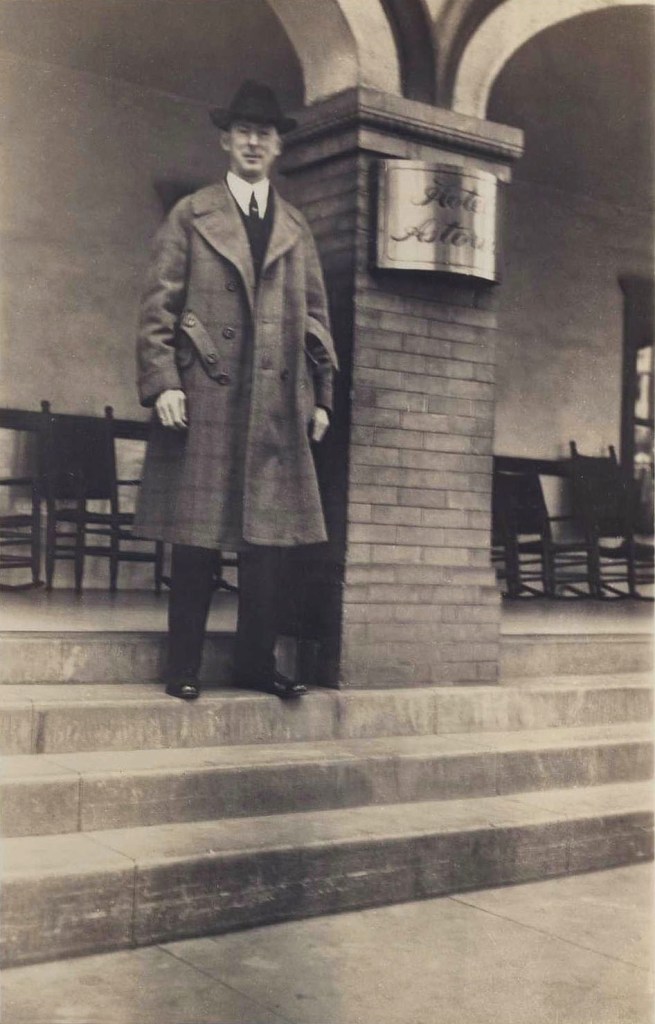
Naturally, I wrote and asked Mr. Orndorff if by any chance he had vintage images of his grandfather and/or the Astoria. Did he ever! Ladies and gentlemen, Astoria manager Joseph Edward Harrigan:
How is my new friend Joe Orndorff the Astoria manager Joseph Harrigan’s grandson? Because Joseph, with wife Helena Cecilia (Dennison) Harrigan, sired/birthed Helen Marie Harrigan, who married Edward Jesse Orndorff, and they had the aforementioned Joe.
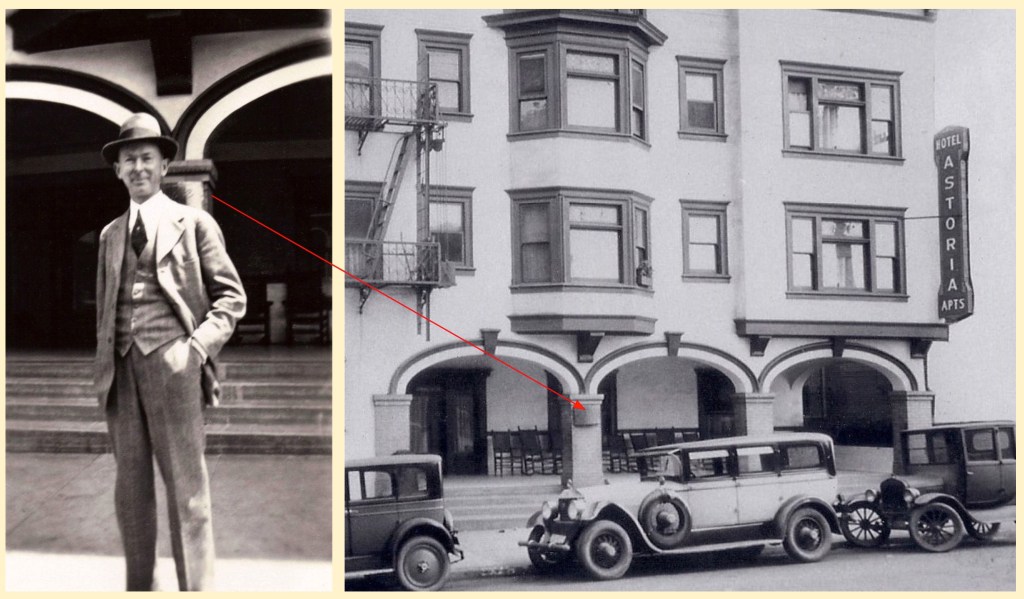
Joseph Edward Harrigan was born in Indiana on July 15 1880, the eldest of nine children, to Patrick Joseph Harrigan and Ellen (Bailey) Harrigan. The Harrigan family go back to County Offaly, Ireland, emigrating to America in the 1840s; his mother’s Bailey family are of English stock, and some of the first settlers of Virginia (1630s) and Maryland (1660s). Harrigan is standing, of course, riiiight there:
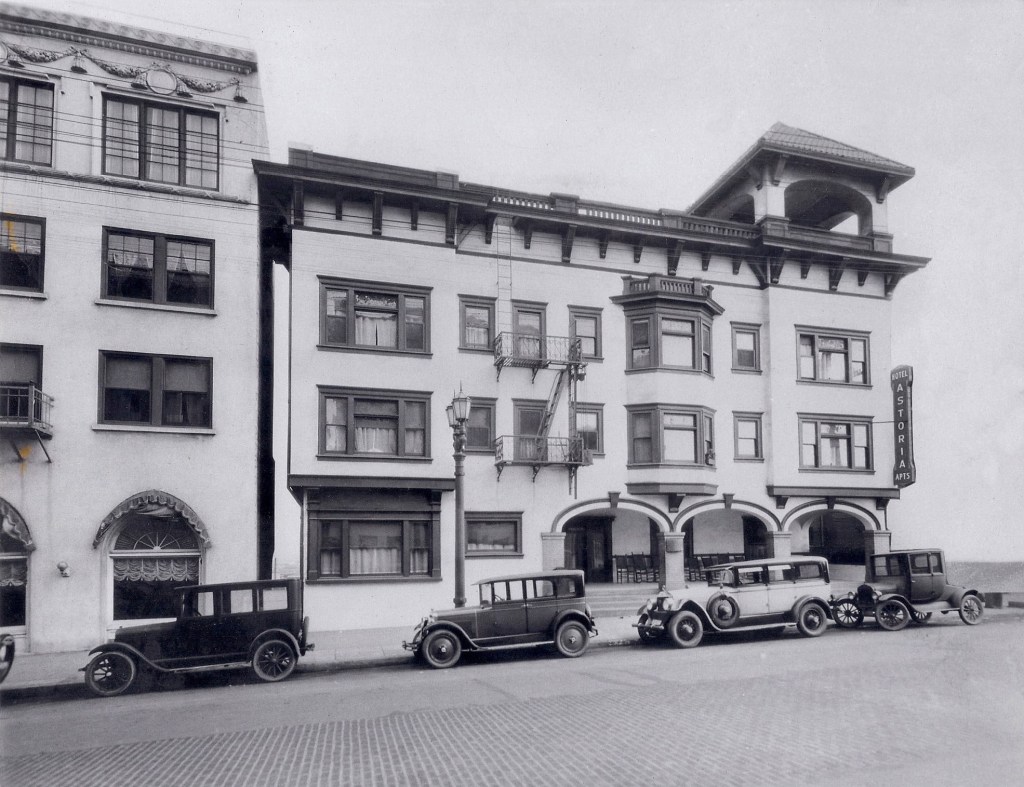
Isn’t that a great image of the Astoria? Which you’ve never seen before! Here it is in all its glory!
Ca. 1927 (the three cars in front of the Astoria being a ’26 Nash Ajax, a ’25 Elcar Deluxe, and a pre-’23 Model T).Note the way in which the Hillcrest Hotel, to the south, has been “photoshopped” out (e.g., painted over at a retouching desk). Prescient, really, considering the Hillcrest disappeared in September 1961, leaving the Astoria with exactly this empty lot next door
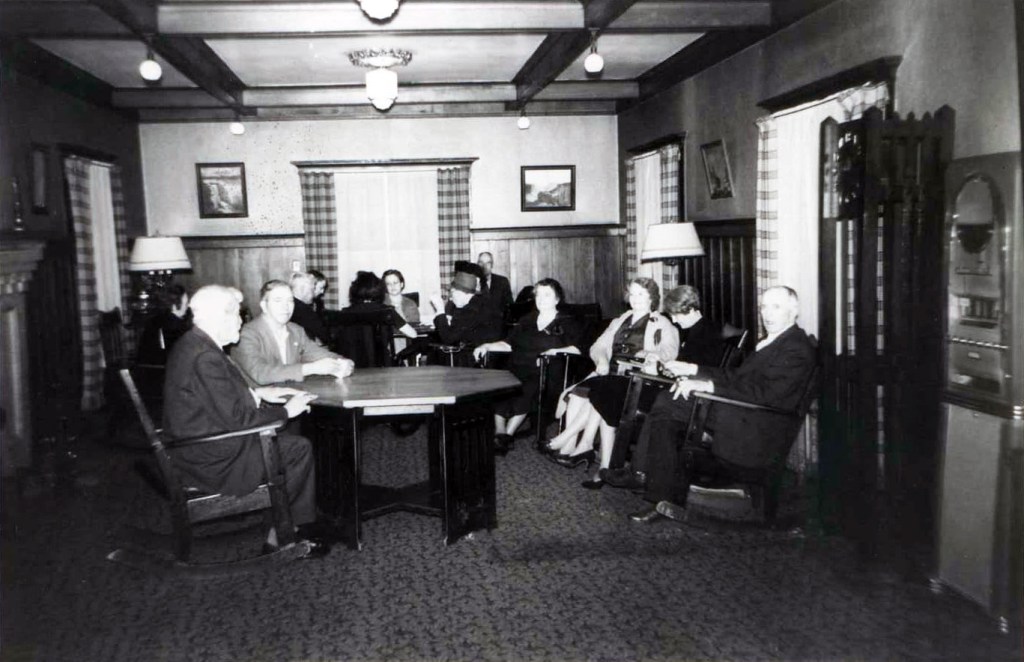
Here’s a shot of the Astoria lobby!
If you’re wondering what is that futuristic space alien next to the Mission-style grandfather clock? Well, that’s a 1930s Rowe cigarette machine
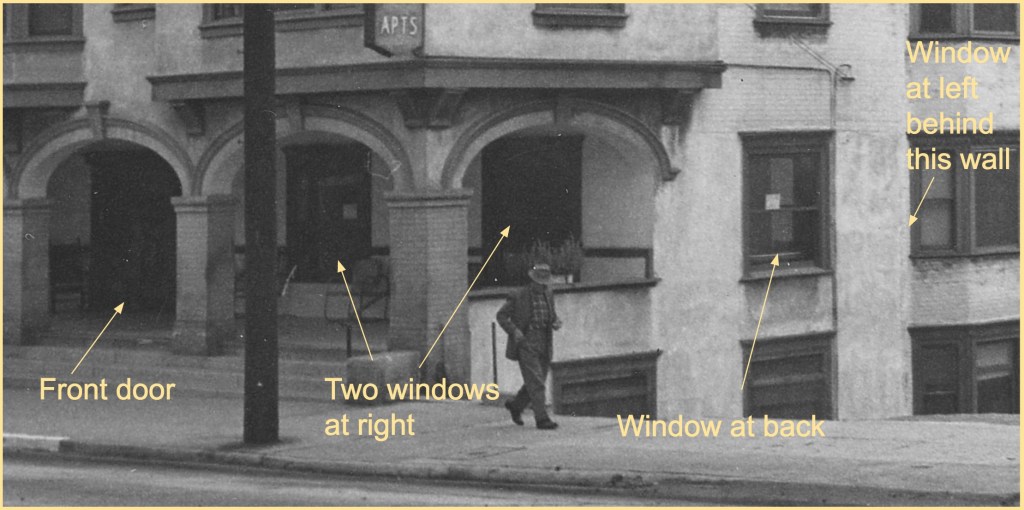
Where were these folk sitting, exactly? Well, you walk in the front door, turn right, and face south. The two windows at the right front on Olive:
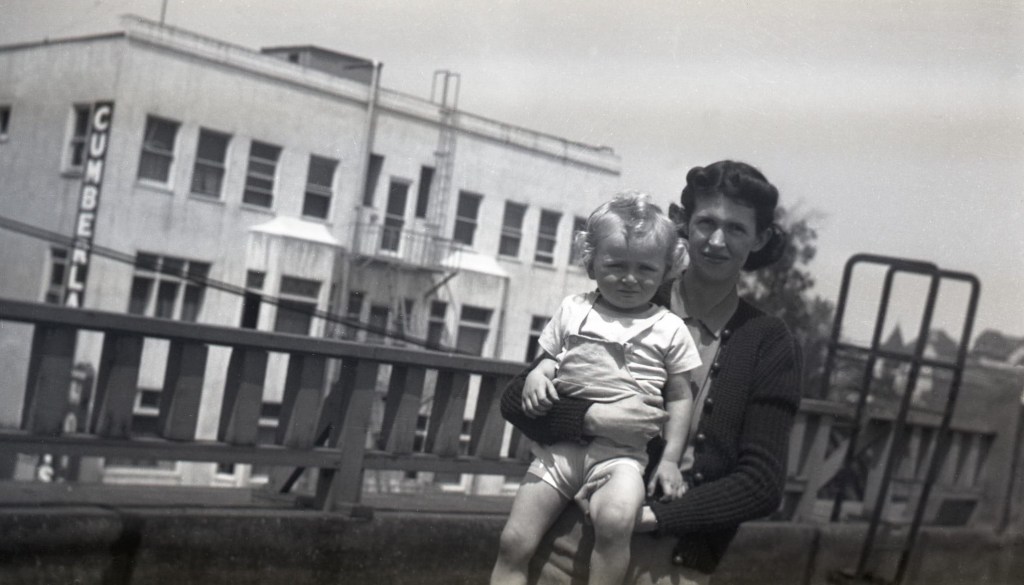
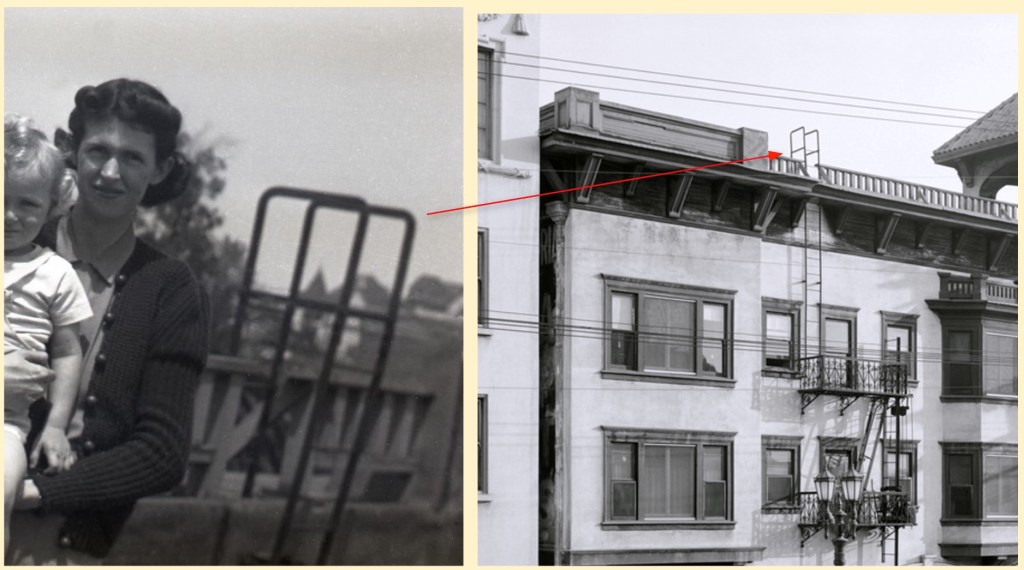
And here is Joseph E. Harrigan’s daughter Helen (Joe Orndorff’s mother) bouncing her son/Joe’s brother Chris on the roof of the Astoria in 1941/42:
In the distance, seen through the fire escape, is the tower of the Richelieu. Across the street is the Cumberland, 243 South Olive; it had been designed in Venetian Gothic by Marsh & Russell in June 1904, and it was this building that won them the opportunity to design Venice, Calif. A 1940 remodel stripped the facade of most of its character-defining features.
There’s the same fire escape —
But back to JE Harrigan:
Circa 1930
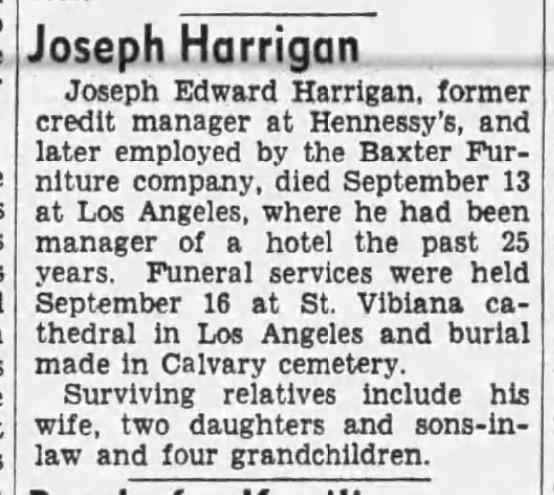
Harrigan was, as mentioned above, an Indiana boy, born in Grass Creek, Fulton County, Indiana in July 1880 (or perhaps 1881, as it says on his draft paperwork). He moves to Butte, Montana and marries Helena in June 1909; he works for the Baxter Furniture Company. Helen is born to Joseph and Helena in 1915, and Harriet arrives in 1918. They move to Los Angeles about 1919, where he gets the job at the Astoria.
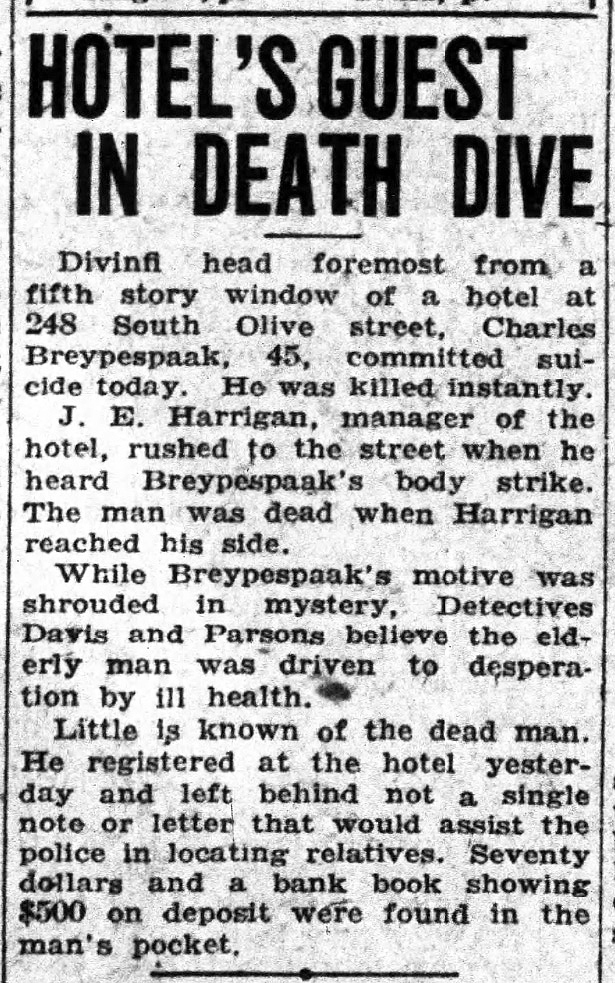
And right off the bat, he has to deal with unpleasantness:
Los Angeles Evening Post-Record, Nov. 12, 1921
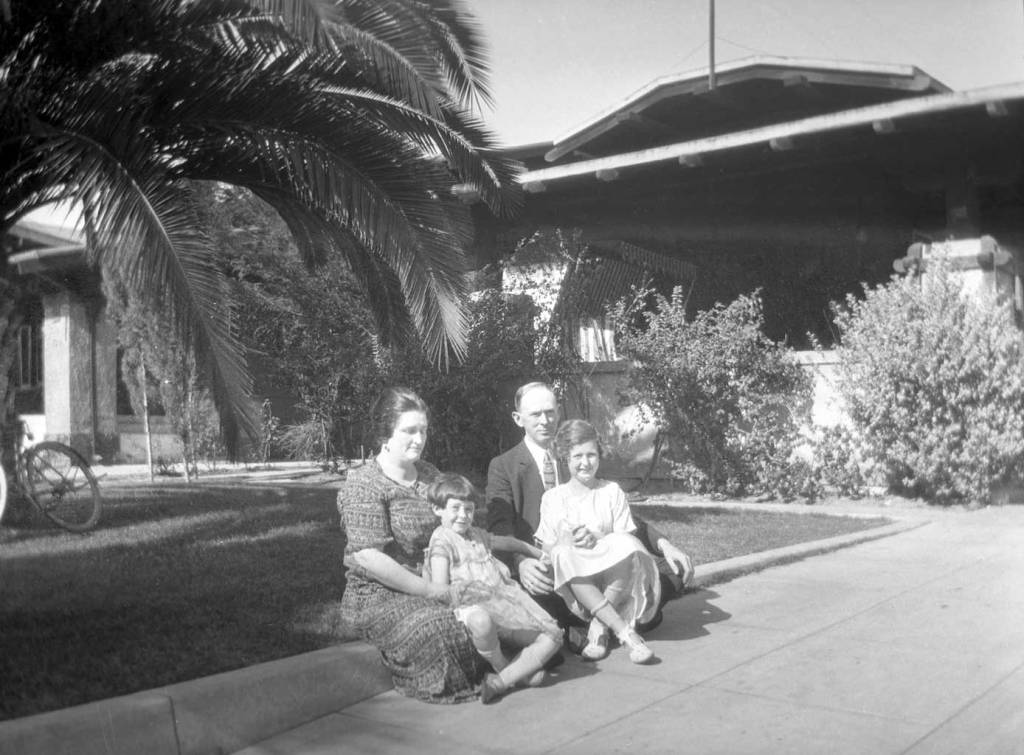
In 1921 Joseph and Helena buy this nifty bungalow at 124 South Manhattan Place:
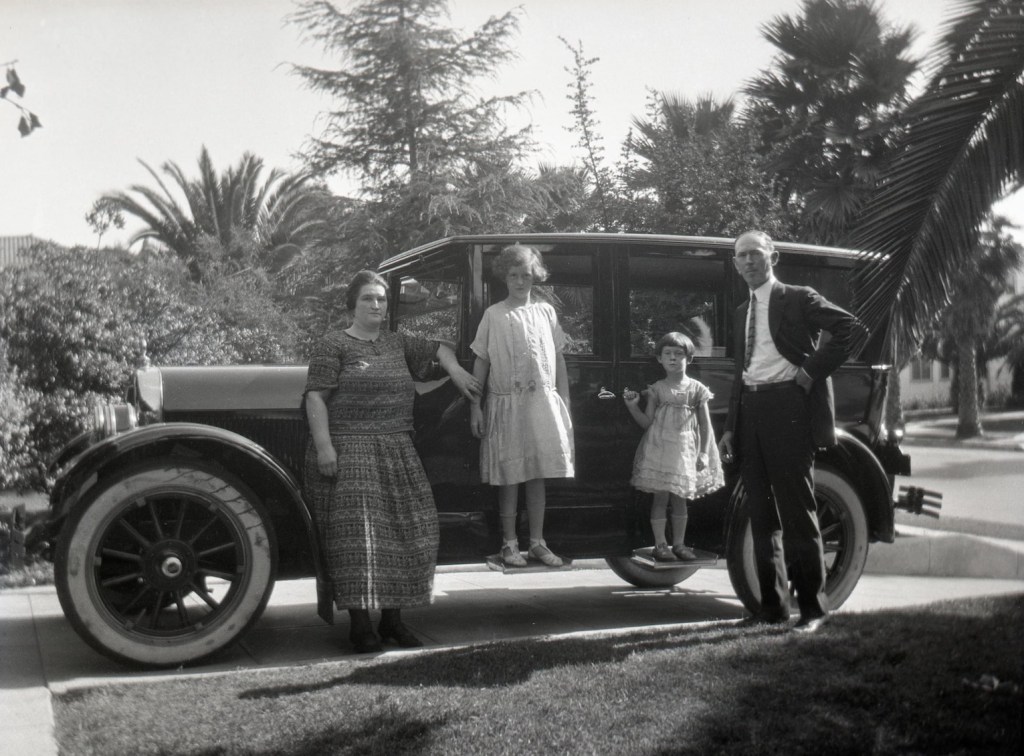
Helena holds Helen, Joseph holds Harriet, ca. 1924Posing proudly with their 1924 Chandler
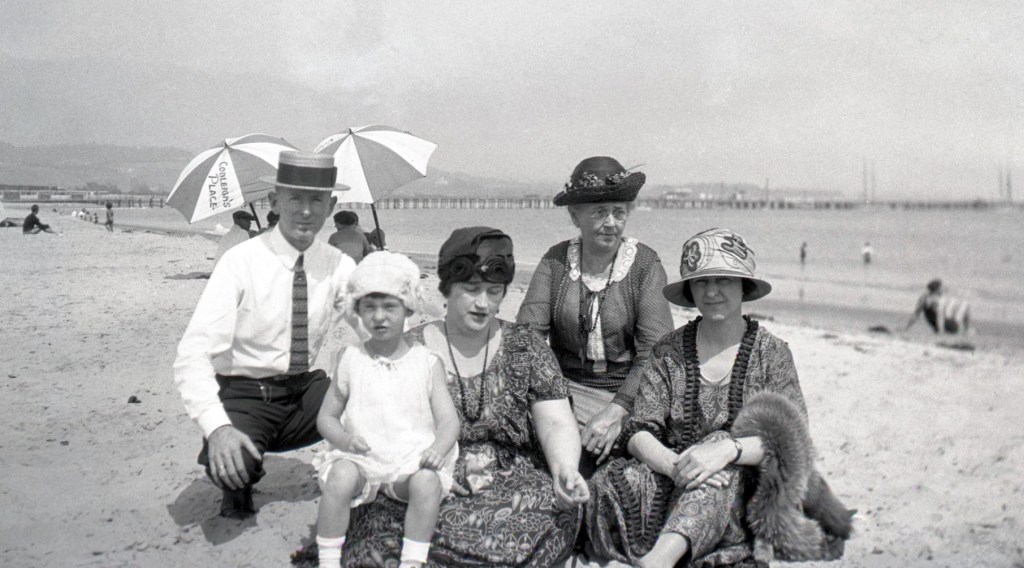
And they took trips — as a Santa Barbara native, I’m thrilled they toodled up the coast to my hometown:
Stearns Wharf in the background; ca. 1920 — that’s Helen, b. 1915, on mother Helena’s lap. To the right are Helena’s mother Julianna (1860-1922) and perhaps one of Helena’s sisters (Annie or Monica or Mary).
Joseph Harrigan has a heart attack in 1944. Writes grandson Joe in a message to me: “In 1946, my mom — perhaps influenced by lurid film noir plot lines popular at the time — had him exhumed to see if he had been poisoned by some shady business associates. The coroner report, however, showed only heart disease.”
Butte, Montana Daily Post Sept. 28, 1944
Helena lives at 124 South Manhattan Place until she passes, ten years later, in October 1954. The lovely home is demolished come 1956 in favor of an uninspired nine-unit dingbat.
But wait, there’s MORE Astoriana!
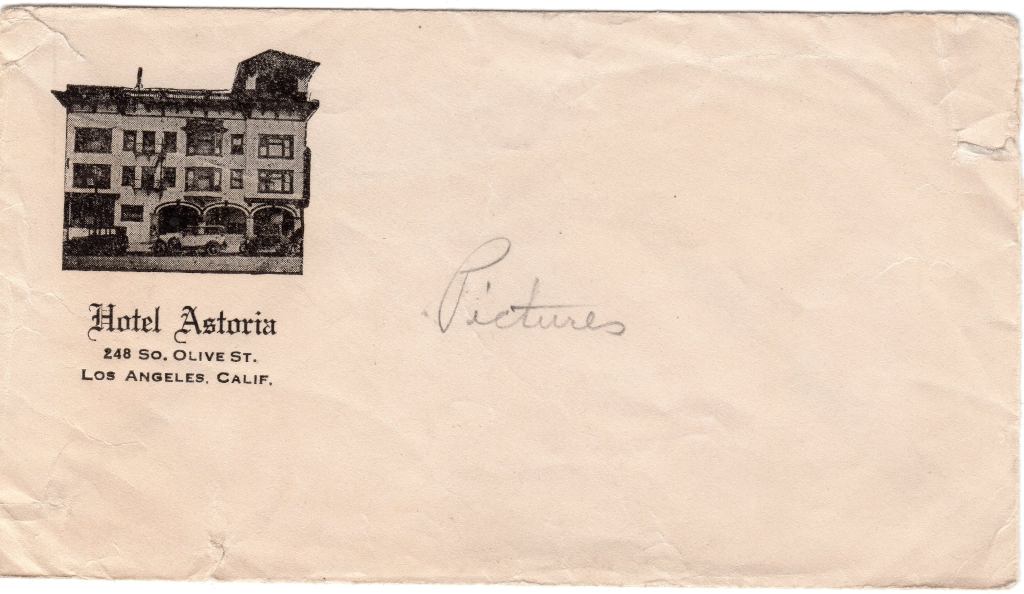
This envelope!
These keys!
And that’s my post with all-new (to you and me, anyway) Astoria images. Thank you SO MUCH Mr. Orndorff for sharing your family’s wonderful Astoria history with us!!!
**********
But you know, as long as I’ve got you here…we all love Bunker Hill in the moving pictures (especially Angels Flight). The Astoria made some nifty appearances on the big screen — let’s look at some!
Hop to It!is a 1925 Oliver Hardy picture, of a “Laurel and Hardy”-style before Stan Laurel, with Bobby Ray as Hardy’s partner-in-bungling. I wrote a bit about some of the locations, including the Astoria rooftop, here.
Indestructible Manis a 1956 picture with Lon Chaney Jr. as…an indestructible man. In this clip he tosses a nemesis down the utility stairs between the Astoria and the Hillcrest.
The oft-used twixt-Hillcrest-and-Astoria utility stairs in 1957’sMy Gun is Quick. Note across the street is the Cumberland, as seen in the “Helen bouncing baby Chris on the roof of the Astoria” shot above. It’s also a nice view of the rarely-photographed Olive Street façade of the Angels Flight Café, and 500 West Third (as seen in Cry Danger) and the row of commercial buildings along Third, which figured so prominently in this post.
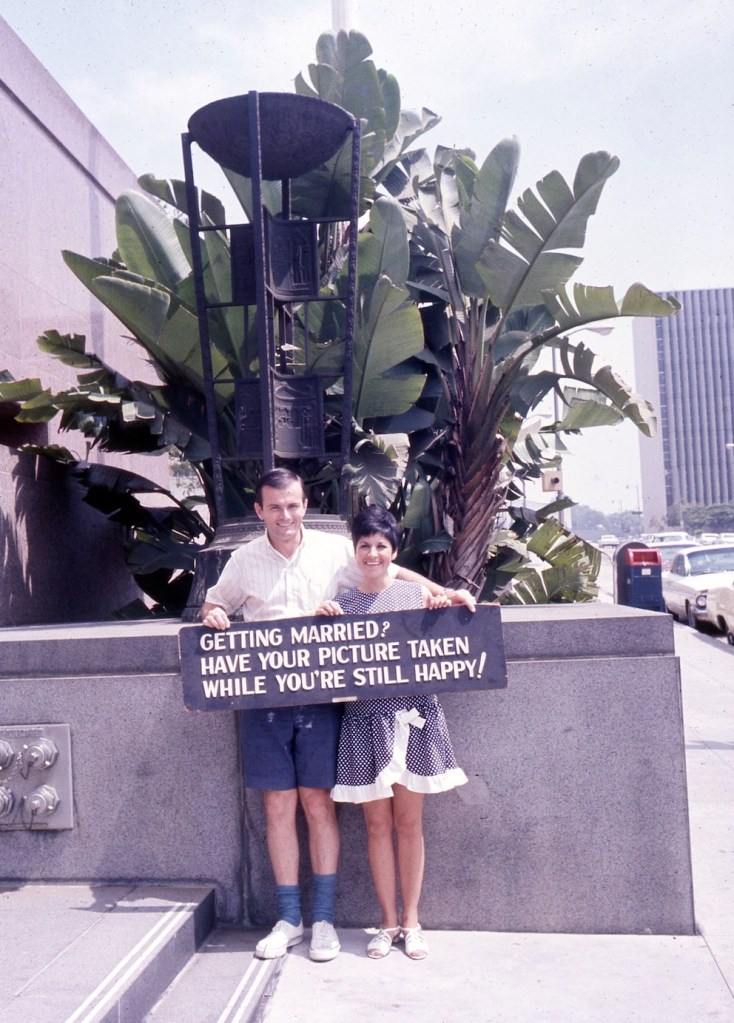
Last post involved people I couldn’t identify, so, here I am doing that again. This time we’ve got a couple Kodachrome slides from August 1968, of a young couple outside the Courthouse (as seen on p. 17 of Marsak’s Guide to Bunker Hill) with a novelty sign:
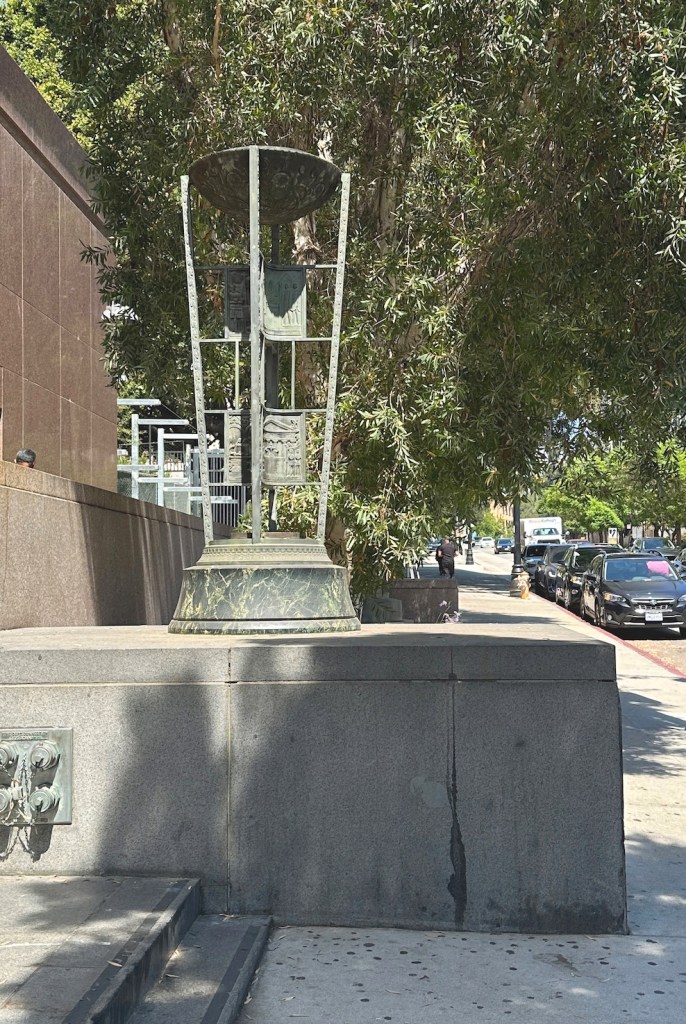
Naturally, my impulse was to go and shoot the same spot today:
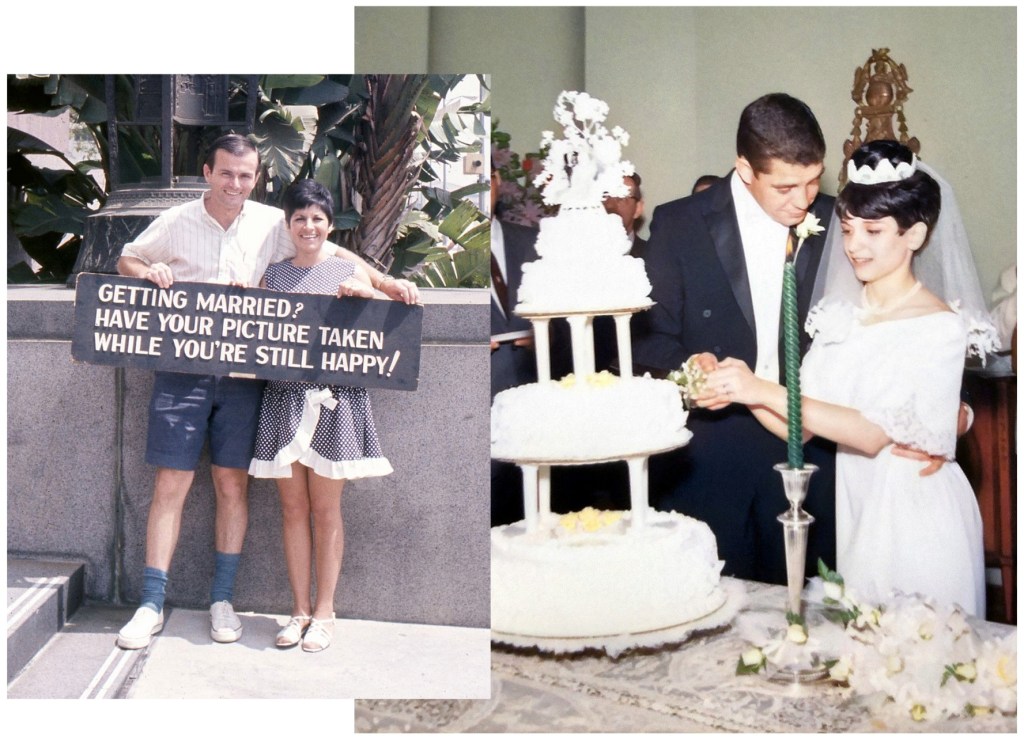
So I like to think these unnamed two from our 1968 Hill Street slides are similarly blessed with long life and marriage. If you know who they are, let me know!
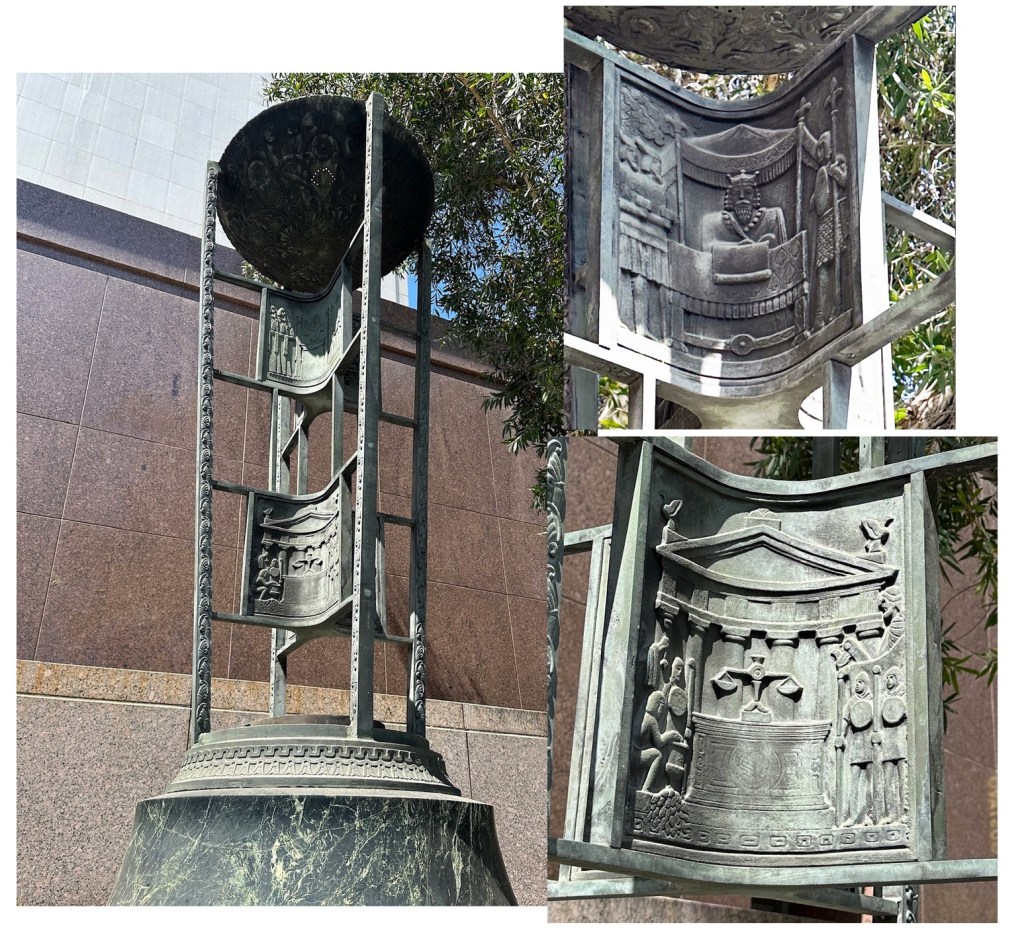
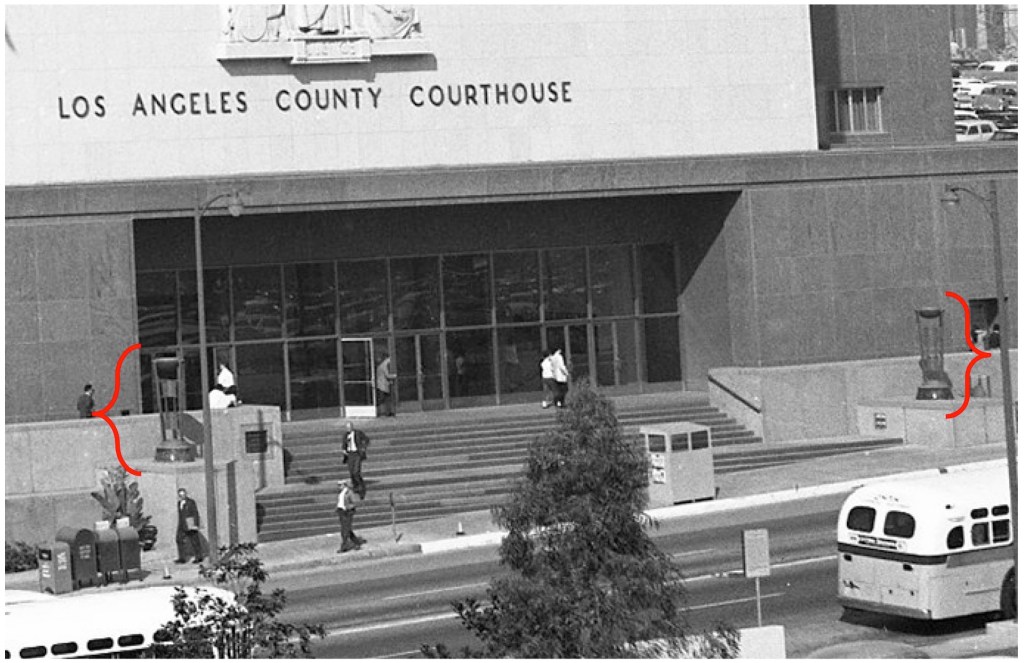
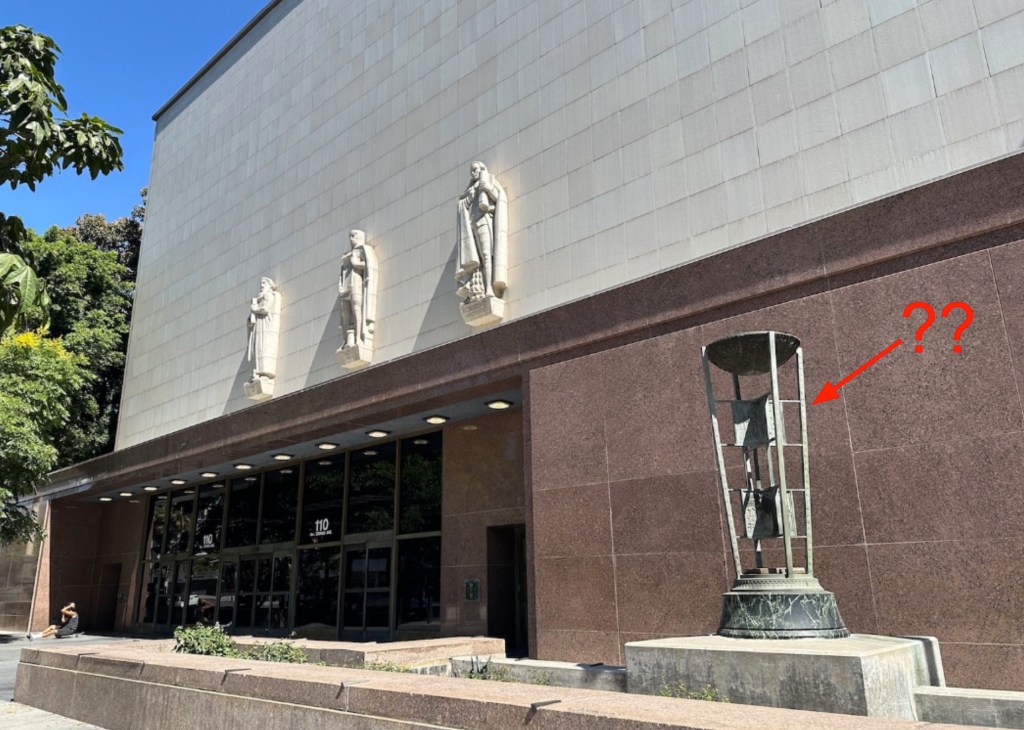
Oh, and as long as we’re on the subject of letting me know stuff…one of you certainly knows who designed these:
We all know the monumental terracotta Courthouse sculptures by Albert Stewart and Donal Hord but what about these guys?














 Bunker Hill, Los Angeles