Who doesn’t love a good then-and-now photo comparison? (If you hang around this blog, I’m gonna say you do at least). When I moved to Los Angeles thirty years ago, one of my first windows into Old LA was Gernot Kuehn’s Views of Los Angeles, an incredible then-and-now photobook published in 1978 (another reason you should get a copy is the 1970s “now” photographs are themselves amazing, and Kuehn’s Views deserves a contemporary “then and now and now” updating).
As regards Bunker Hill, of course, one issue with comparing past to present is the absolute obliteration of the landscape (e.g. this and this from Brian Hsu’s Urban Diachrony). A tangled nest of Victorian wooden buildings compared with some modern concrete behemoth isn’t nuanced; it’s just jarring.
So, I thought it would be interesting to compare modern Bunker Hill with…slightly more modern Bunker Hill. To this you may exclaim “what’s the point of comparing the Security Pacific Bank with…the Security Pacific Bank? It still looks the same!” and you’d basically be right. In any event, I’m going to compare some relatively recent shots of postredevelopment Bunker Hill with how it looks at present, just to gauge its changes, no matter how minor. This I do because it’s fun and interesting, but also underscores how much of “new” Bunker Hill is itself reaching its dotage—much of postredevelopment Bunker Hill is actually older than much of “vintage” Bunker Hill was when demolished in the 1960s—and as such, we’re in for preservation concerns among the modern landscape (a theme touched on in the last few paragraphs of this post).
Also, it occurred to me that I will likely go to my grave without anyone seeing even a fraction of my collection, including all those binders stuffed full of delightful (though less-desirable-to-the-masses) ’70s snapshots and ’80s Kodachromes. So, why not do a post that features some of ’em, just for kicks? Let’s go!
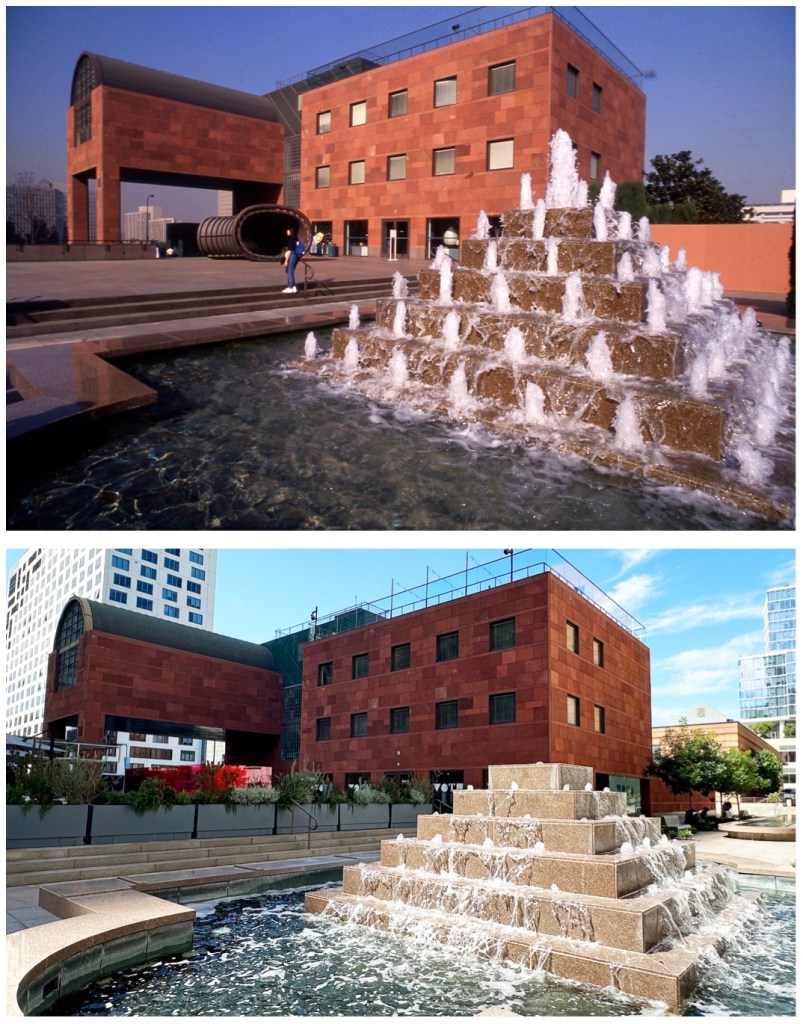
Looking south on Grand Avenue across Temple Street, March 1985. Note at left, the Crocker logo (Peter Graef, 1970), and at right, the Security Pacific logo (Saul Bass & Assoc., 1966), and between the two, the 1962 Wells Fargo “diamond” logo, designed by Walter Landor Associates, which WF ditched about 1995. Bottom image, post-1985 additions to the landscape include the Library Tower, the Wilshire Grand Center, and Disney Hall, glimpsed behind the Chandler Pavilion. Looking north on Hill across Fourth Street, January 1976. Today that hill maintains it basic contours (though the shape of old Clay Street has mostly disappeared), and is now known as Angels Knoll, or maybe Angels Landing, in any event, it’s totally fenced off, to the consternation of those wishing to recreate 500 Days of Summer. The bits of retaining wall glimpsed behind the bus I covered at length, here. That tree is of course of enormous importance, and lives to this day in the forecourt of Angelus Plaza, where it was moved in 1981. We’re told that, someday, this area—site of an unrealized third Cal Plaza tower—will look like this, but I wouldn’t hold my breath. Looking north across the Music Center Plaza toward the Mark Taper Forum, September 1967; in this image, the Taper had been open five months. The coolly elegant sunken plaza was designed by Cornell, Bridgers, & Troller, whose municipal projects included the nearby Civic Center Mall and the Department of Water and Power. Five years ago, the Music Center was “reimagined” by Rios Clementi Hale Studios, removing the sunken element so that mass rallies could be had in front of giant television screens. The area has since been renamed Jerry Moss Plaza; Moss was the “M” in A&M Records. Check out another nice vintage shot of the Taper and plaza on p. 21 of Marsak’s Guide.(Did I mention Marsak’s Guide to Bunker Hillis on sale?)Looking west from California Plaza toward the Museum of Contemporary Art, ca. 1987. Ah, MOCA, the World’s Worst Designed Museum™ (as discussed on p. 46 of Marsak’s Guide). Time was, you could stroll straight up onto MOCA’s forecourt from Cal Plaza, but the museum has since controlled that entrance. I’m thrilled the fountain is still there (water features are always the first to go) but its jets have gone a bit limp. The two major structures in the bottom image are the goofy-windowed Emerson Tower, left, and The Grand, right. Fun fact: my time at MOCA helped kickstart a fascination with Bunker Hill, so, I very much owe them that.
Crocker Court, July 1986 (known as Well Fargo Court after November 1987). In 1980, Crocker Bank commissioned famed landscape designer Lawrence Halprin to create an atrium filled with gardens, water features, and sculptures, as the centerpiece of the Crocker Center project, The $20million atrium was conceived of as “an urban, indoor Garden of Eden,” later described by Halprin as “a psychologically restoring haven.” Brookfield Properties bought Wells Fargo Center and demolished Halprin’s work in its entirety, replacing it with this inspiring laminate-covered food court. I discuss Crocker Court a bit in this video and, of course, in Marsak’s Guide.
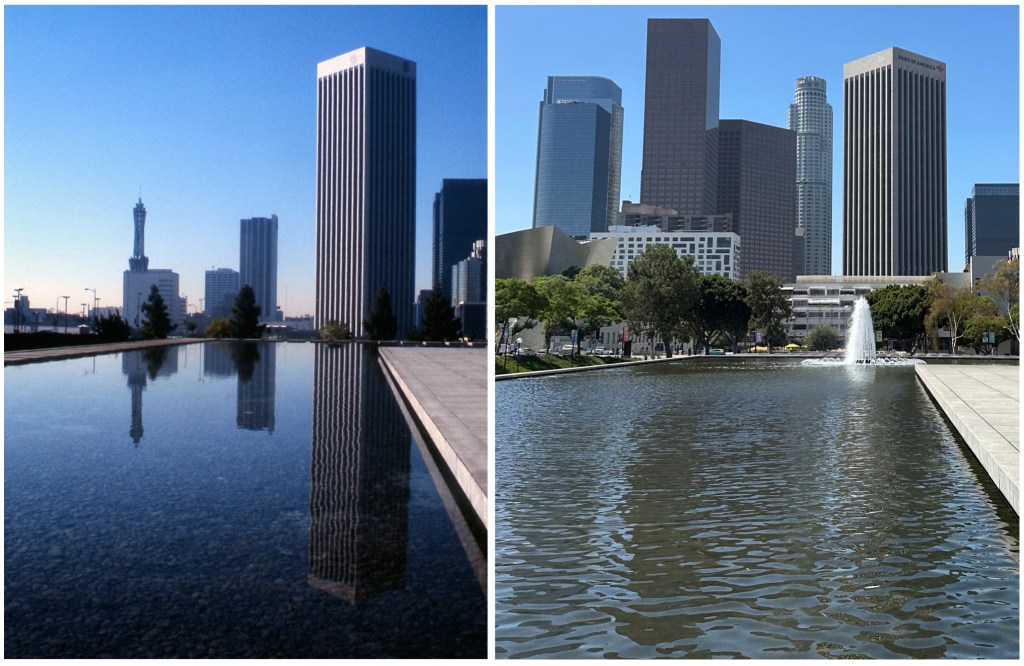
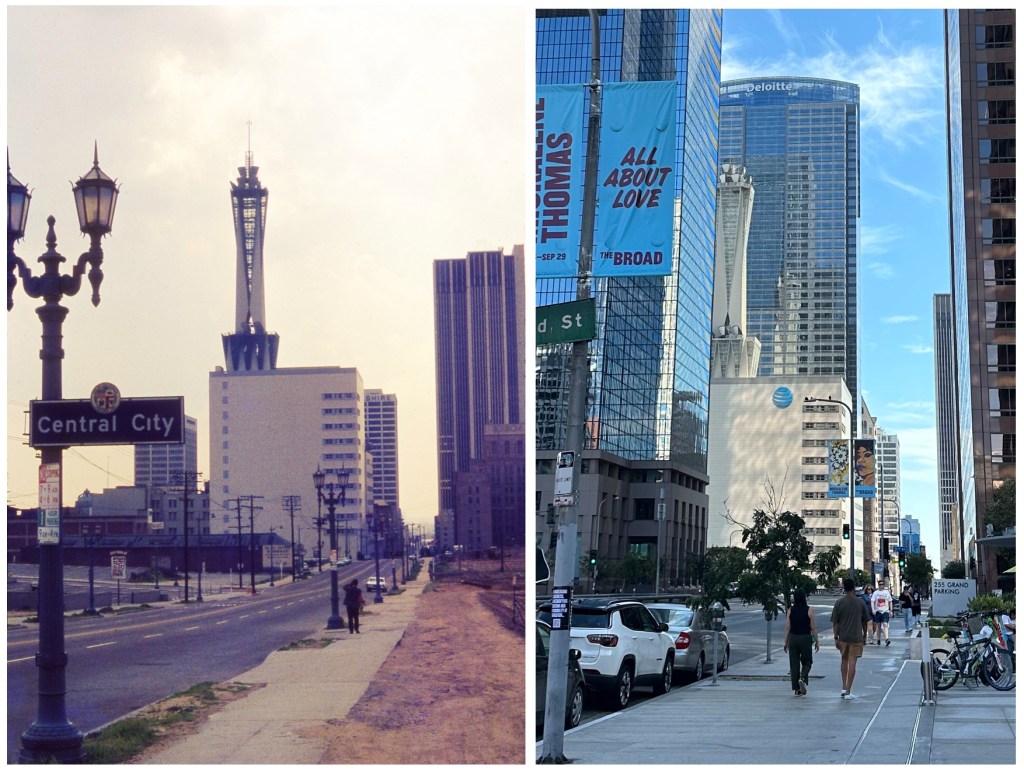
Looking north on Grand Avenue across Fifth Street, February 1978. The mighty Edison Building—as seen on p. 10 of Marsak’s Guide—stands proud and relatively unaltered: when ownership group Rising Realty/Lionstone/Hermes bought the building ten years ago, they pledged to rip off all those 1980s “greenhouse” additions; while they did replace the fourth-floor balcony greenhouses with canopy structures, the upper story greenhouses remain. The new owners also renamed the building CalEdison, which is all fine and good, but why can’t the neon lettering (as seen, for example, on p. 149 of the Big Book) be returned to its roof? At far left, note venerable survivor the Engstrum (BHLA, p. 169) which was finally replaced, of course, by the Library Tower. Note in left foreground, the low wall, enclosing Central Library’s east lawn at the southwest corner of Fifth and Grand, until replaced by this (Hardy Holzman Pfeiffer Associates, 1993).Looking south across the east side of the reflecting pool at the Department of Water and Power, ca. 1976. There are few things I love more than the incredible “moat” that encircles the DWP building. (The fountain seen in the contemporary image is original to the DWP; it just wasn’t running when the earlier image was shot.) Look closely and you’ll note the pool was once lined in Mexican pebble. Also, if you look very closely, left, you’ll see the pool once had a border of rectangular aggregate panels, raised above the water’s surface on supporting members. Of course, in the distance, a whole host of new towers block some of the structures (Crocker-Citizens Bank, Pacific Telephone) that appear in the earlier view. Security Pacific is dwarfed by new neighbors, and Promenade East now obscures its bottom. Note that at far right, the ARCO towers—once, matching twins of Miesian grandeur—have had their bilateral symmetry ruined when A C Martin’s facade was bastardized (which I talk about, a bit, here). The view south on Grand Avenue from Third Street, April 1969. Most prominent is PacTel at 420 South Grand Ave., with its signature microwave tower. Also prominent in the 1969 shot is Crocker-Citizens, right, now obscured by the Wells Fargo (née Crocker) Center. Hey, if you really want to geek out on Hill minutiae—this building is the garage at 318-322 South Grand (seen here in 1962 and 1950). It was demolished by the CRA in June 1969, two months after the image at left was captured. And do you know who designed that garage in 1917? Albert C. Martin! And the “new” Bunker Hill has AC Martin represented via a number of structures including the DWP, Union Bank Square, Security Pacific Bank, Wells Fargo Bank, and Ketchum YMCA.
Ok! Well that’s some of the then-and-nows I have on hand. Come back next Sunday, when I’ll post another gaggle of these!




 Bunker Hill, Los Angeles