As promised, more then-and-nows!Part I of our three-part then-and-now extravaganza can be enjoyed by clicking here (and there’s a Part III as well).
I’ll admit, these then-and-now posts serve a twofold purpose: to broaden the discussion regarding contemporary Bunker Hill, certainly, but also to whet your appetite for exploring modern Bunker Hill’s structures, which is best done by buying a copy of Marsak’s Guide to Bunker Hill. (It would be extremely prudent to so this month, given as they are on massive sale, about which you may learn everything by simply clicking here.)
Now, on with the show!
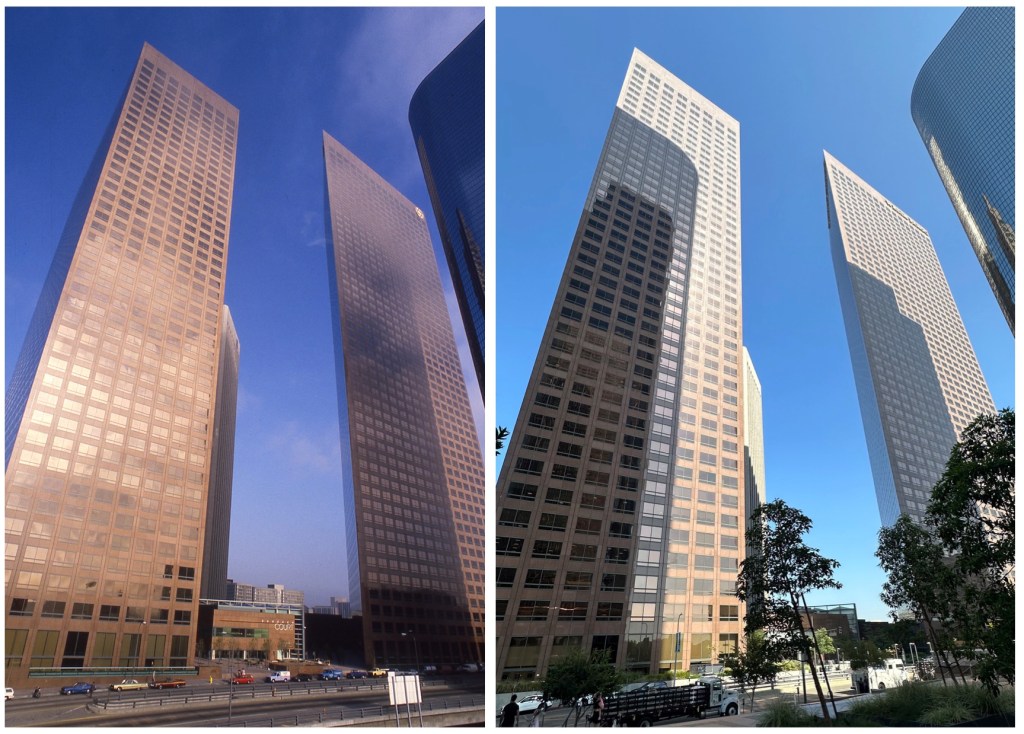
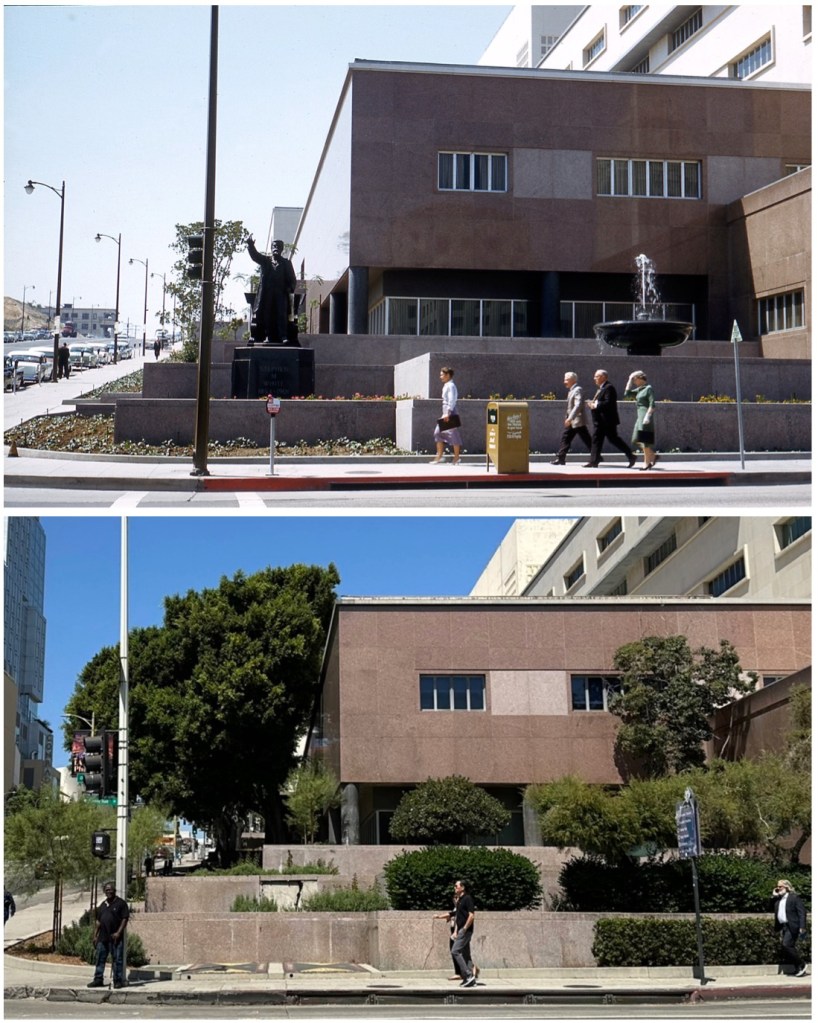
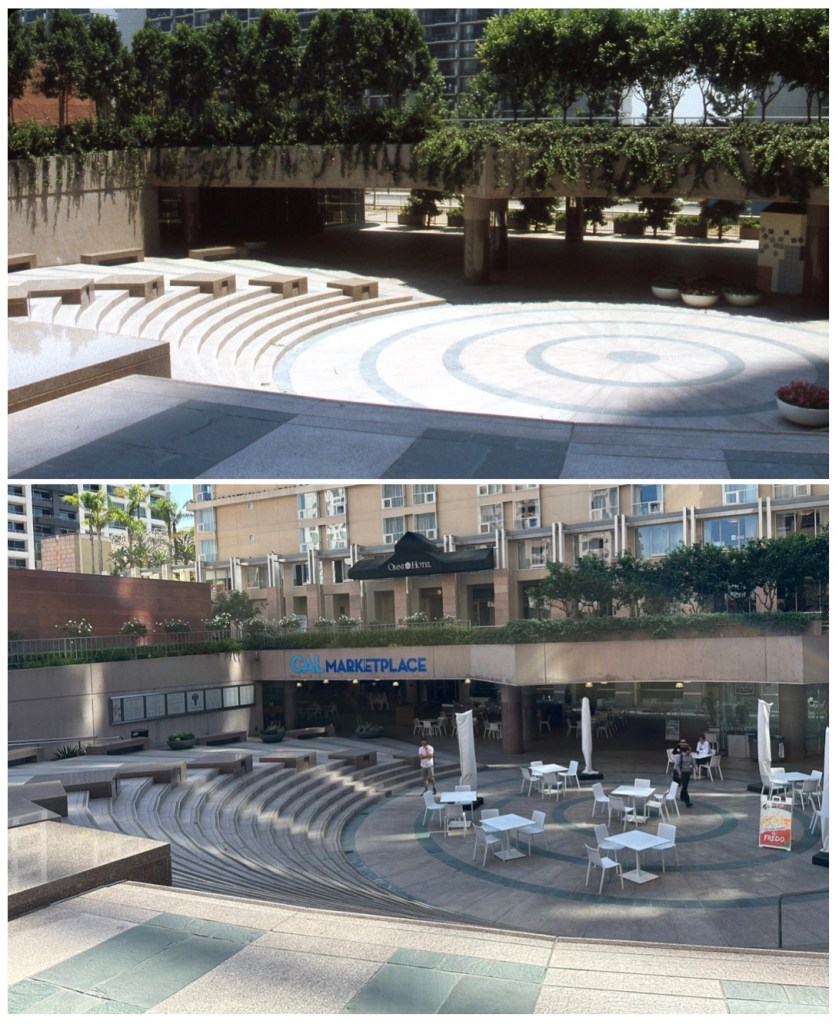
Looking south on Figueroa across Third Street, ca. 1985. Shot from the pedway connecting Bunker Hill Towers to The Park (a pedway in the distance connects the World Trade Center to the Sheraton Grande). Note the two-way Figueroa traffic; Figueroa became one-way northbound from Olympic to Third in December 1986. Also note Union Bank, upper right, has been painted white, in an early-90s remuddling by owners Equitable-Nissei. South of Bunker Hill, a number of towers have sprung up; most eye-catching is a glimpse of the curious Châteauesque roofline of the Home Savings Tower (Tim Vreeland/AC Martin, 1988).Looking south on the west side of the DWP “moat,” circa 1966. Prominent in the vintage image, the mighty Union Bank, still unmolested by white paint-slathering morons. At far left the Richfield Building and behind the fountain, the Architects Building, both replaced, now, by the ARCO Towers (seen poking out, just a bit, behind the 1968 Bunker Hill Towers, at left in modern image). The view to the southwest, where once we saw the Union Oil Center, is now blocked by the Promenande Towers, with 333 Beaudry behind—the Beaudry Center is by the now-forgotten William Rockhold, of Nadel Partners, the group who reached the absolute nadir (or would it be zenith?) of 1980s Los Angeles vacuity.Looking north on the hill near Hope and Third Streets, August 1968. The contemporary view is lower, since the hill was cut down for the Security Pacific Bank plaza. The structure at right is the 1966 cooling plant. Under construction is Bunker Hill Towers.Looking east across Grand Avenue toward the Crocker Center, July 1987. Note the Crocker Court, which once contained the Halprin atrium, as mentioned last week.The view north on Grand Avenue from near Third Street, ca. late 1986-early 1987. Behind, now, the Grand, the Colburn Expansion, and Museum Tower. And hey! Say what you will about our descent into barbarism, at least now we have trees.Looking west up First from Hill Street, May 1959. If the statue of Stephen White were still there, its pedestal would obscure the missing broken panel on the Courthouse. Look closely up First and you’ll see the Majestic/Lima/Rossmere at First and Hope Streets, two years prior to its July 1961 demolition.Looking east near Grand Avenue and Third Street, into California Plaza, circa 1988. Note that once you could look straight through at Angelus Plaza, fronting Olive Street, before the construction of Cal Plaza’s Hotel Inter-Continental.
The view south on Grand, November 1965. The Pacific Telephone Communications Center main entrance is marked with a mosaic mural by Anthony Heinsbergen, dedicated in May 1961. On the mural Heinsbergen attached coin box chutes and capacitors and other telephone components. The figure at center holds aloft tranatlantic cables and a satellite transmitter, and above, Echo One, the first Bell communications satellite, relays a radio transmission beamed to Russia. Heinsbergen’s vision also featured an odd placement of the continents, including an upside-down Australia. Los Angeles Times columnist Jack Smith launched a (tongue in cheek) crusade through the 1970s to have Australia righted, involving telephone company executives and the Australian consulate. Smith may or may not have had a hand in righting the continent, but at some point it was in fact removed, turned right side up, and reattached.
That’s it for today! Tune in next weekend for Part III! And remember, you can’t tell the players without a program!




 Bunker Hill, Los Angeles