And now, for your edification and delectation (and as a shameless plug for Marsak’s Guideto Bunker Hill, on sale!) may I present the third and final installment of Bunker Hill Then-and-Nows: The Modern Years—
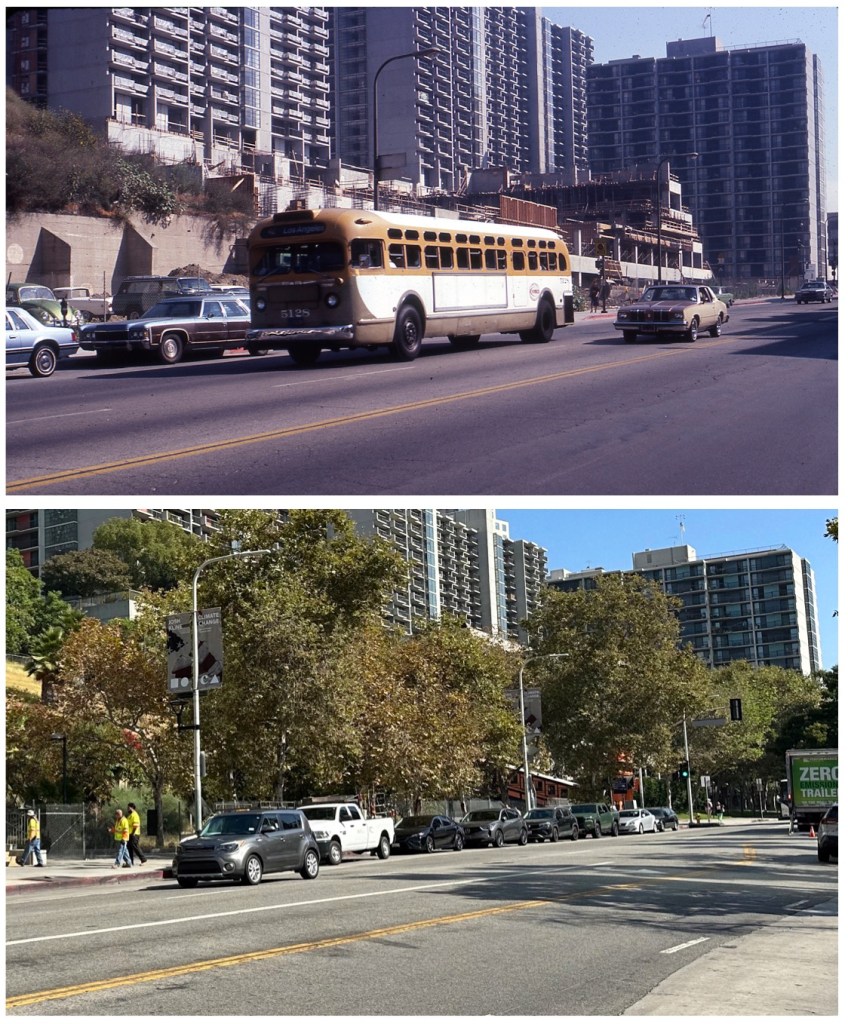
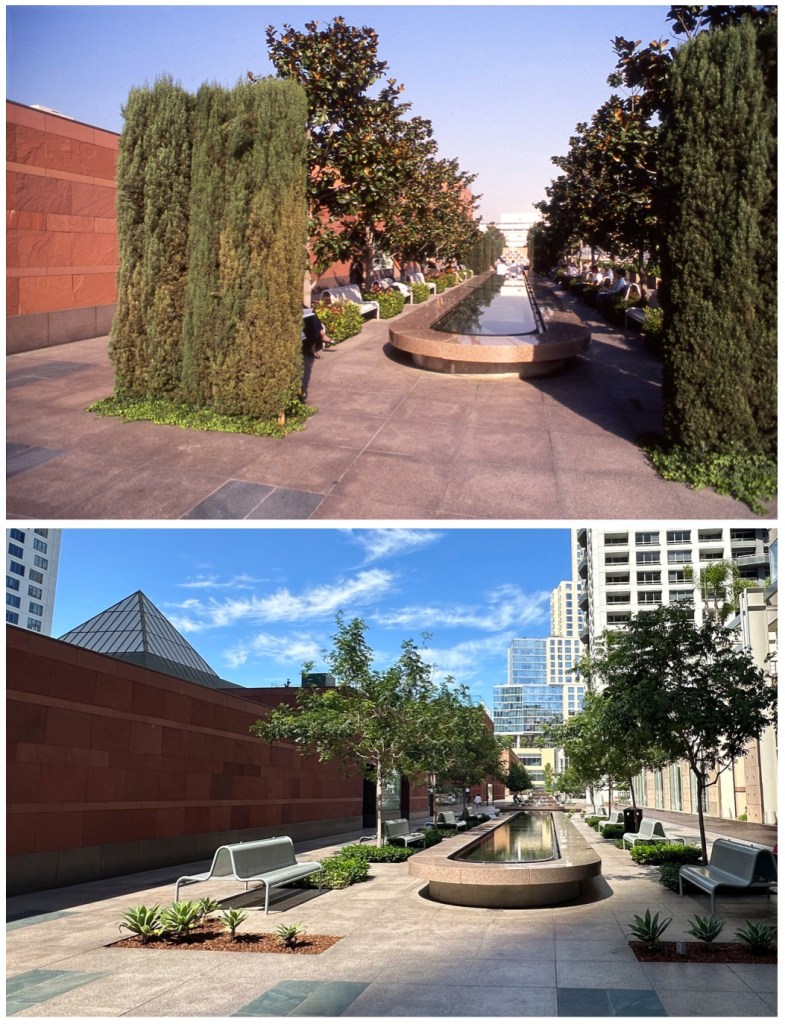
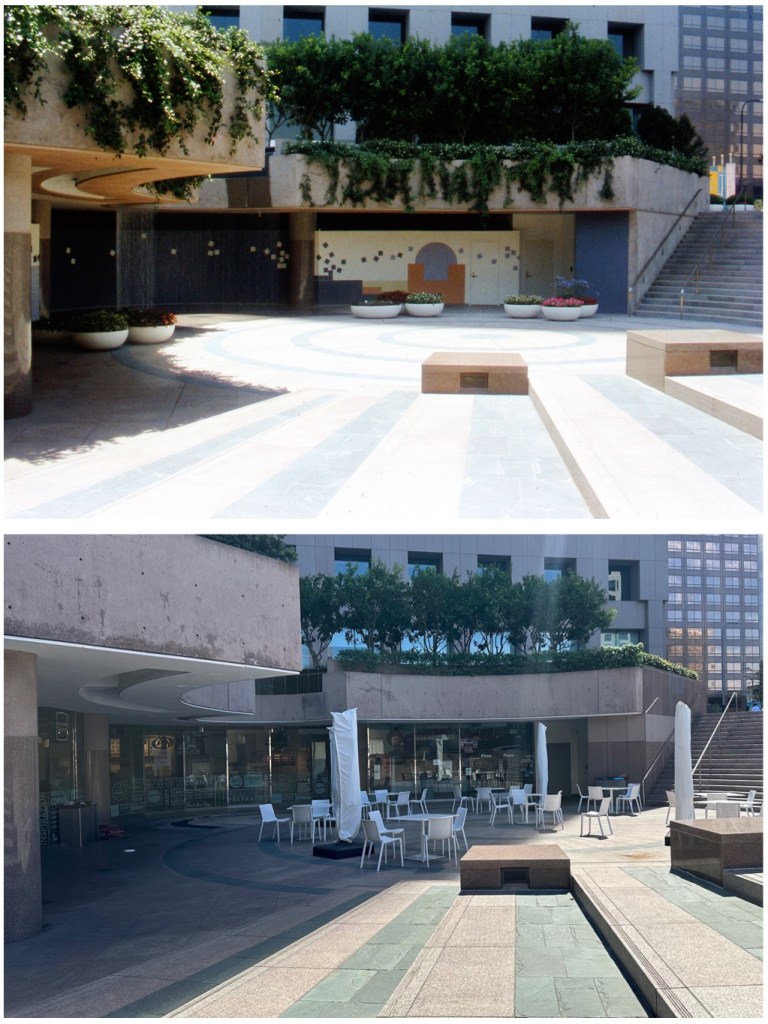
Looking west across the Music Center Plaza, August 1965. The view on the once-sunken plaza originally framed the neighboring DWP, flanked on either side by the Chandler and Taper. It is now however the scene of mass rallies in front of huge television screens (oft destroyed by blonde ladies flinging sledgehammers). The sculpture is Jacques Lipchitz’ Peace on Earth, dedicated May 1969, initially placed at the center of the plaza (since shunted off to the side in the recent Rios Clementi Hale reconfigure). At the dedication, Lipchitz stated “if peace does not come, it’s a bad sculpture.” Well… Looking north on Hill from near Fourth Street, July 1980. Behold the famed retaining walls, adjacent the slot where Angels Flight would be returned in 1996. Rising above, Angelus Plaza nears completion. Looking north inside California Plaza, ca. 1987. The reflecting pond (leading to the fountain) and original seating remains. It took vision and dedication to plant mature magnolias and cypress, which have since been replaced. The view west on Fourth Street from Grand Avenue, April 1981. At left, under construction, is the Manulife Plaza, a project of Manufacturer’s Life Insurance Co. (Albert C. Martin & Associates, 1982); that view is now blocked by the Ketchum YMCA (also AC Martin, 1986). Inside the Security Pacific Bank plaza, looking west, March 1984. Security Pacific’s 1974 gardens, by Sasaki, Walker & Associates, included an orchard of evergreen pears, with fountains cascading to a lower pool (intended to connote a Mayan cenote). The whole was ringed in jacaranda above and willows below, with masses of flowering plants throughout. The narrow fountain pools are based on Spain’s Alhambra and, though they are dry in our Sunday-shot “now” image, they do run on weekdays. “Most clients ask us for a plaza,” said principal Peter Walker in November 1975, “but Security Pacific asked us for a park, and that makes all the difference.” The gardens at Security Pacific are arguably the best spot in Los Angeles; owner Brookfield (the Toronto megacorp famous for demolishing Bunker Hill’s Halprin atrium at Crocker Court) intends to put a tower there. Looking south on Grand Avenue, ca. 1983. This image shows the O’Melveny & Myers Tower (Robert Tyler for Welton Becket Associates, 1982) with some of its original sixty-eight Italian cypress that ringed the structure (along with runnels and other water features, also lost). Dallas-based CBRE Group bought the tower in 2012, and while it retains that name on its facade, CBRE sold the building in 2016 to a partnership of Pittsburgh’s PNC Realty and Munich’s GLL Real Estate. Behind, the Library Tower looms o’er grandly. Inside California Plaza, looking south with Grand Avenue at right, July 1986. Above and behind the trees, the lower portion of skyscraper One California Plaza, which opened in December 1985; the plaza is oh so very, very Arthur Erickson. Though it has lost its planter pots and they’ve trimmed away the charm of hanging vines, the property remains remarkably intact. Less intact are crucial elements of Erickson’s Cal Plaza design, including the water features in neighboring parts of the plaza, now lost (e.g. this and this).
Looking southwest from near Temple at Hope, August 1967. This grouping of Inyo County boulders, at the northeast corner of the Department of Water and Power campus, are a significant, and fairly unknown, element of the DWP landscape. (For another nifty vintage pic of the grouping, check out this 1965 Shulman.) In doing this then-n-now, I discovered to my horror that one of the rocks (the smallest at center-left) was missing! The plaque in the modern photo (left) reads “These ancient granite boulders were brought from picturesque Alabama Hills in Owens Valley. The rocks are estimated to be 200 million years old. Owens Valley is the source of a large portion of the water service for the City of Los Angeles.” I don’t have to tell you, of course, that that plaque leaves out a lot of…stuff.
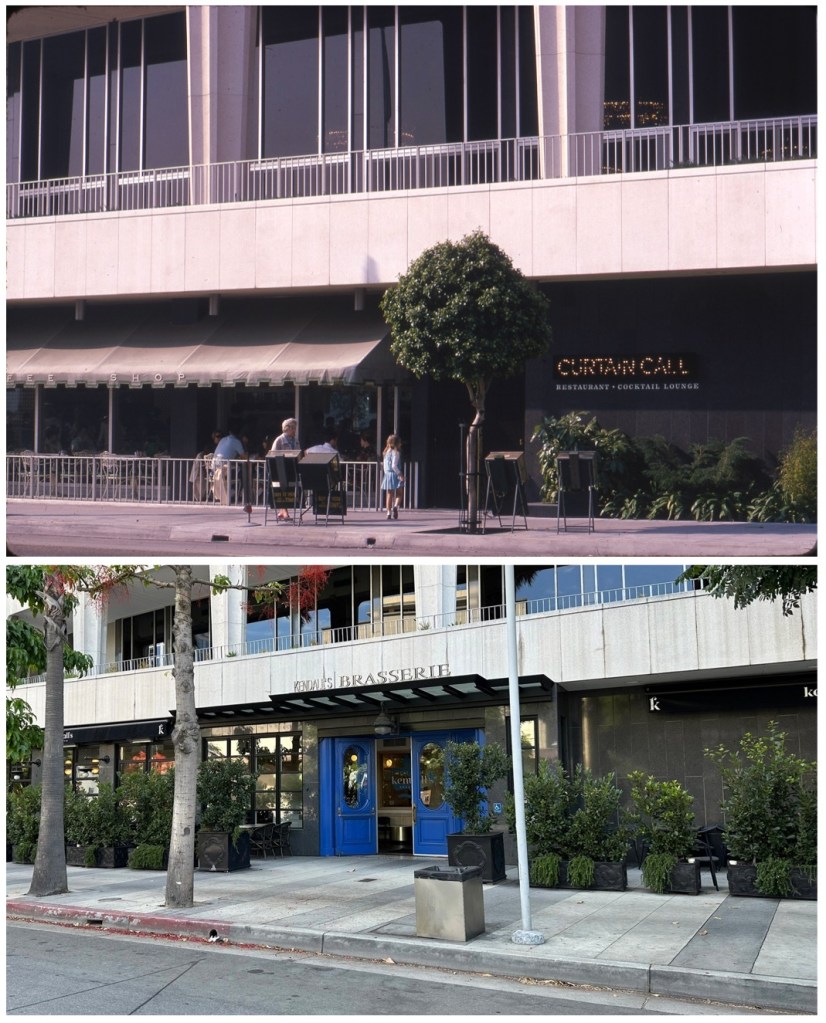
Looking southwest on Grand Avenue toward the Music Center, January 1967. When have you ever seen a shot of the Curtain Call? (If you have one, I showed you mine, you show me yours!) The fifth floor of the Dorothy Chandler Pavilion contained the large and elegant Pavilion Restaurant; downstairs was its smaller, warmer neighbor, the Curtain Call. Curtain Call was decorated with mementos of early Los Angeles theatrical life. Note that the bulb signage in the 1967 shot was used in its advertising, like this matchbook; as a Fred Harvey, with a penchant of vintage LA theater, it had an “olde-tyme” feel to its branding. The Curtain Call became a Hungry Tiger in 1980, which became Otto Rothschild’s Bar and Grill in late 1986. The space has housed Kendall’s Brasserie since November 2003.
I trust you have enjoyed these last three weekends full of Bunker Hill Then-and-Now photography.
If you’ve found these investigations of modern Bunker Hill interesting, might I suggest you buy the book! And again, I thank you for your attention.




 Bunker Hill, Los Angeles