As a teen in the 1980s I sat through no small quantity of “youth culture” pictures. Most were terrible. Some were great (Repo Man); some were so-bad-they’re-great (Valley Girl); and some were objectively terrible, and yet absolute genius (Surf II).
Some were a cut above, like 1984’s Night of the Comet.
Night of the Comet has a lot going on. It’s a feminist treatise on the power of strong women and sisterhood. It’s a trenchant critique of Reagan-era consumer culture. It explicates the ennui of Late Cold War nuclear anxiety.
Me, I just like it ‘cuz it’s full of Bunker Hill.
NIGHT OF THE COMET
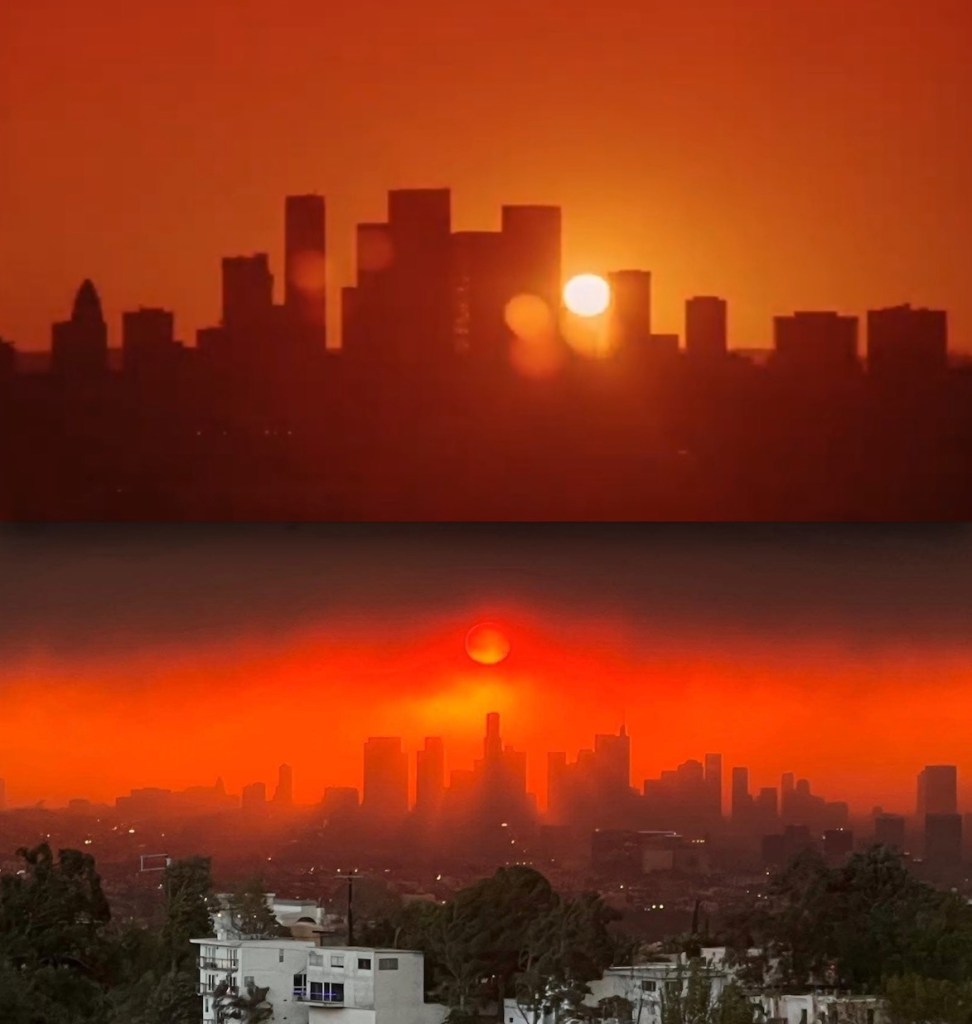
Let me mention at the outset, this was a really weird post to compile. Tuesday last I was busy command-shift-4’ing endless Comet screengrabs of an eerily still Los Angeles enveloped by a terrible reddish-orange post-apocalyptic haze. All of a sudden, wind roared like a freight train, and the power transformers exploded, plunging us into darkness. The next day, still no power — just an eerily still world outside, enveloped by a terrible reddish-orange post-apocalyptic haze.
An establishing shot of post-comet Los Angeles in Night of the Comet (at 11:15); downtown Los Angeles the morning of January 8, 2025(from here)
**********
Night of the Comet, in a nutshell: the earth has passed through the tail of a comet, wiping out all the people. But teen sisters Regina and Samantha are so independent (having sex! fighting with mom!) they are spared obliteration. They then must navigate a post-comet world full of zombies and mad scientists, while dancing around in a mall to Girls Just Wanna Have Fun. It’s basically Day of the Triffids, but looks like Liquid Sky, plus it’s a Christmas movie, with Mary Woronov. Like I said, there’s a lot going on.
Much of which is going on on Bunker Hill. The filmmakers figured Bunker Hill, then in its nascent days of development, would be pretty empty and therefore useful in depicting a desolate, uninhabited world. They figured right.
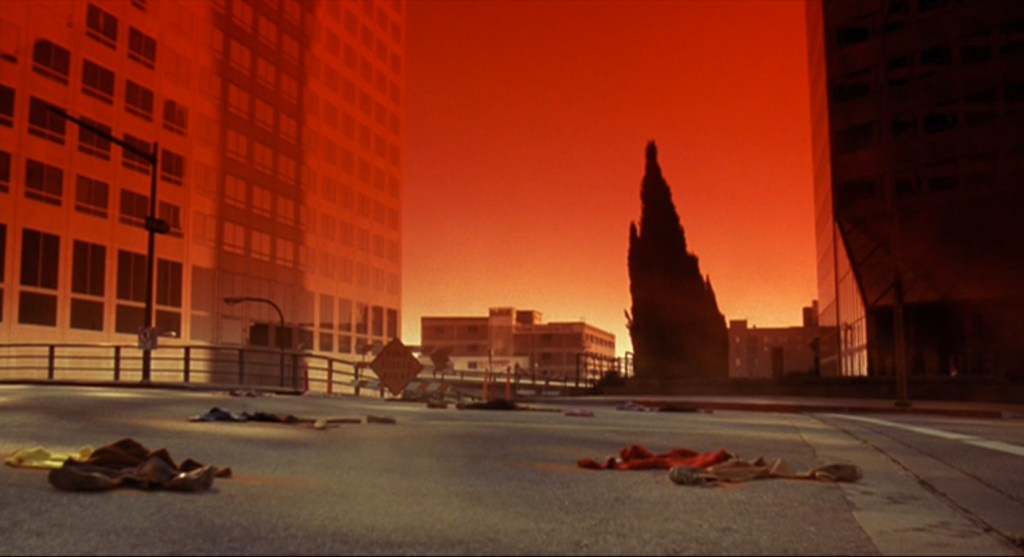
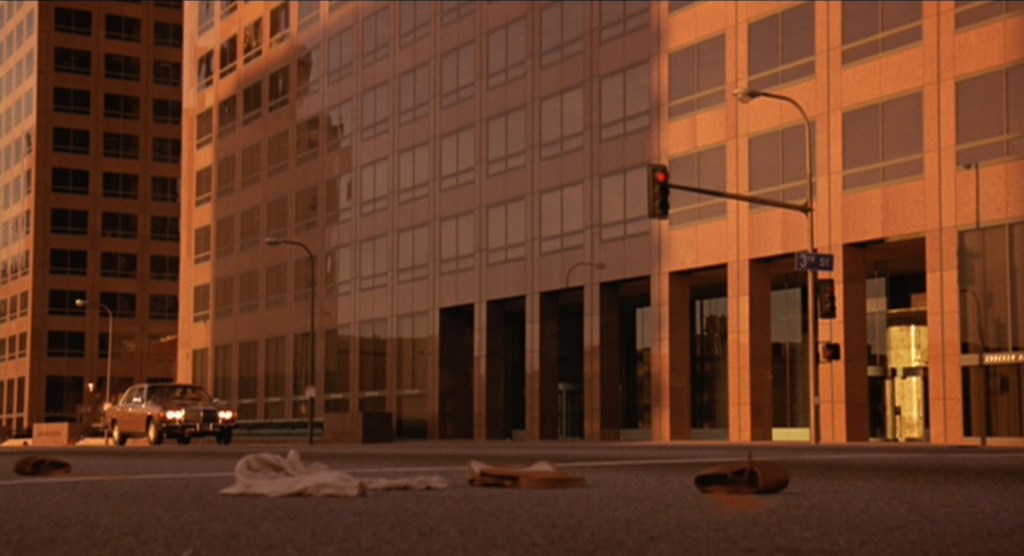
Note at lower left: see the heels and the dress and the pile of red dust? That’s what happens to you when you look up at a comet, you comet-looker.
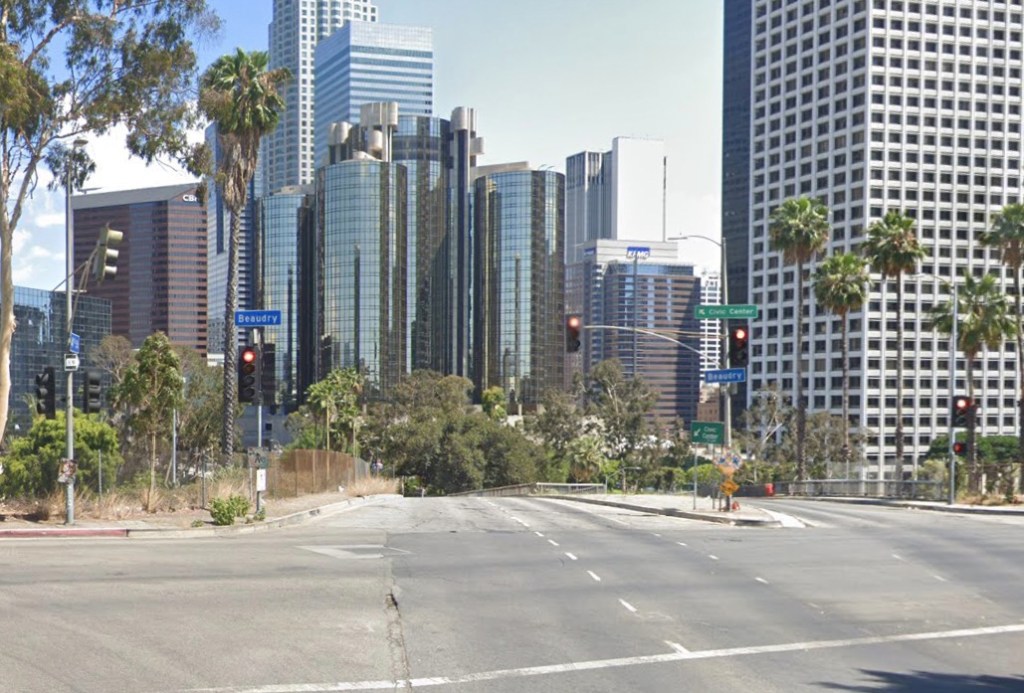
Looking east on Fourth across Beaudry
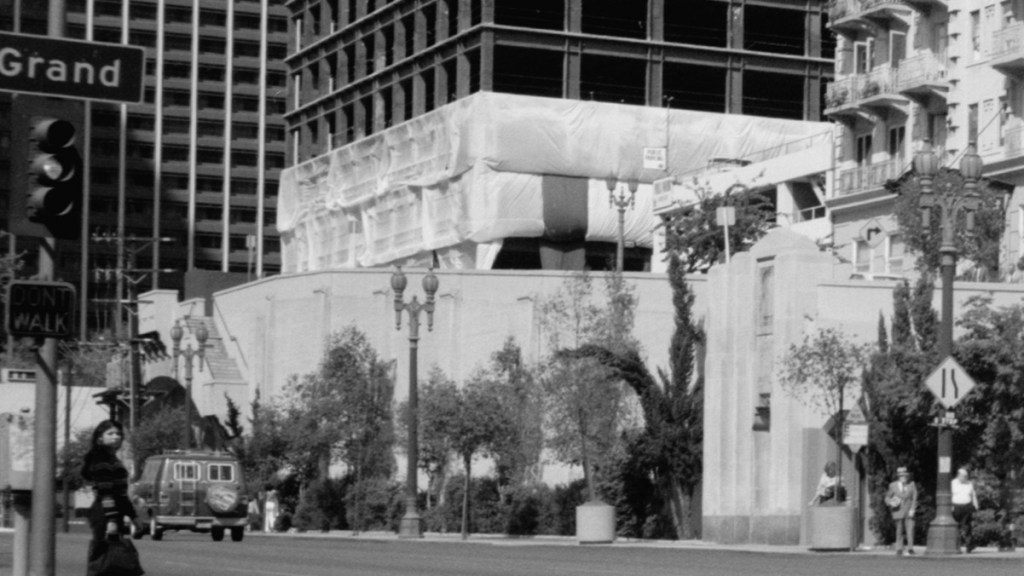
Looking east on Fourth across Grand Avenue. The low structure, center, at the northwest corner of Fourth and Olive, is the Mutual (née Central) Garage, built in 1923, demolished in 1989. Note the Italian cypress at center-right; they were installed as part of the 1982 O’Melveny & Myers bank tower project.
The garage is gone, having been replaced by Two California Plaza. The cypresses are gone, too, and O’Melveny & Myers is now CBRE. Right-center is 35-story Perla LA, at Fourth and Broadway, built by the Chinese government.
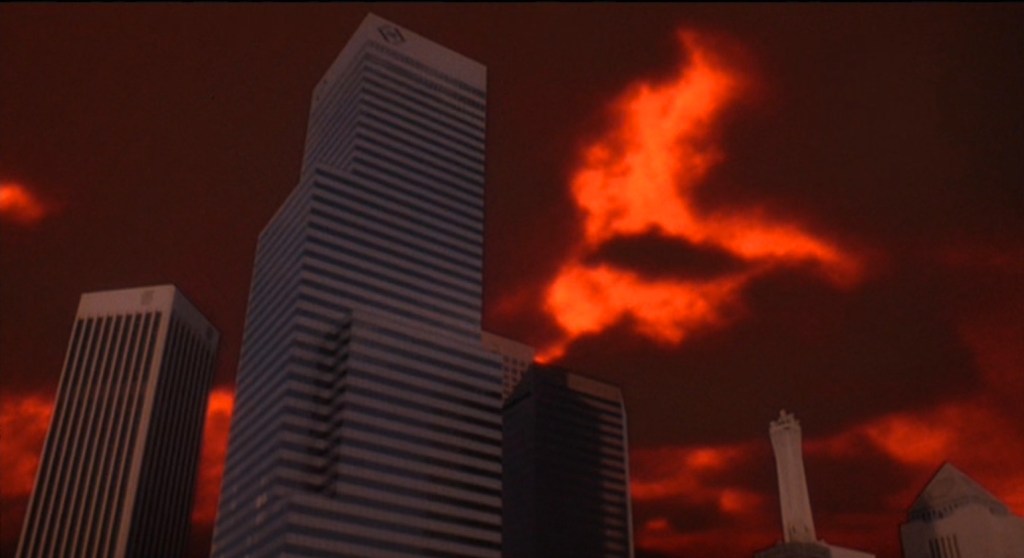
Looking up at the blood-red & Hallowe’en-orange post-comet sky from Flower just south of Fifth. Note the Wells Fargo and Security Pacific logos (about which I discuss a bit, here).
The Library (1989) and Gas Company (1990) towers have been added to the landscape. At right, behind CentralLibrary, a bit of the Biltmore Tower (1987).
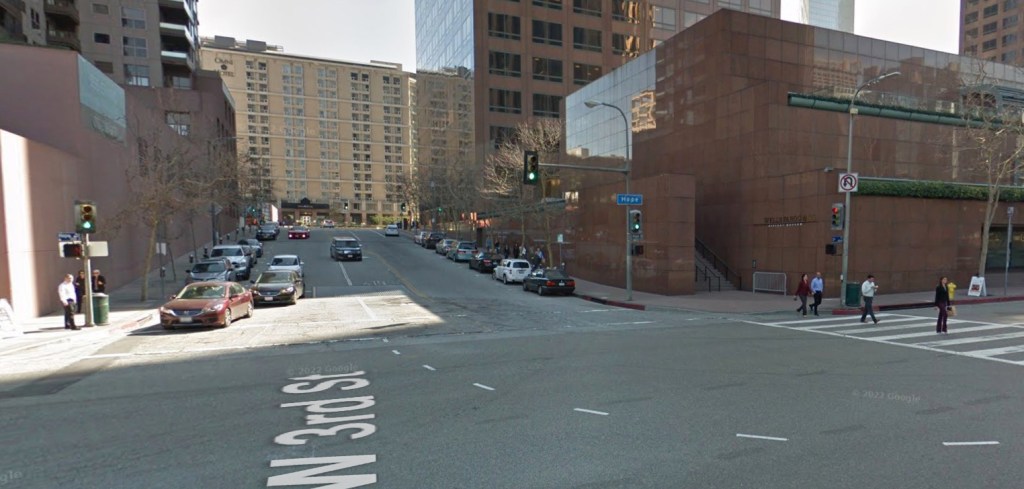
Looking up Third, from Hope, toward Grand. Note the Broadway tower of the Million Dollar/MWD at left-center, peeking above Grand.
The back stairs into the Wells Fargo Center appear much the same. The view across Grand, with the Angelus Plaza towers and the Million Dollar beyond, is now blocked by the Omni Hotel (1992). At left, the Grand Promenade (1989).
Looking south on Grand Avenue from Third. The Crocker Center south tower, left, was still under construction when this was shot; it opened in July 1985.
Crocker Center, now Wells Fargo Center, is the expression of early-80s corporate monolith. See what the late Fredric Jameson had to say about it, here.
Looking south on Grand from Third again. There’s that 1923 Central Garage at left.
Everything to the east of motorcycle-riding Catherine Mary Stewart is now the site of One California Plaza (1985) and Two California Plaza (1992).
The view across Third down Grand. That pit at left would be filled in by the Cal Plaza towers and MOCA; the pit at right, by the Grand Promenade and Emerson residential projects.
There are a whole lot of “let’s find movie locations” websites, and many of them cover Night of the Comet. But I notice—as far as I can tell—none have ever identified the location of this target practice sequence. Well, here you go.
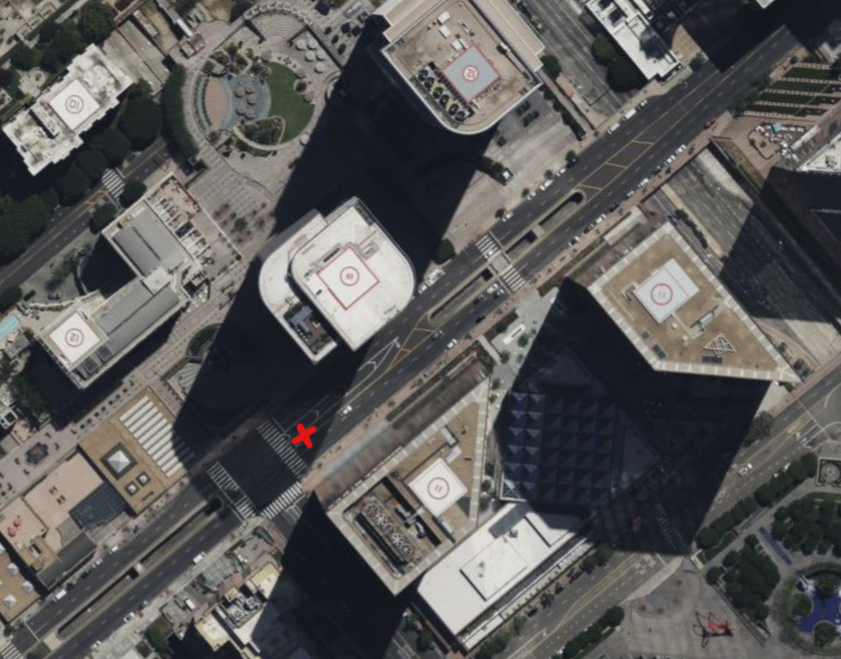
They are standing at the X, facing the oval, the car at which they shoot. A 1983 aerial via Framefinder
At this point you ask, what are structures behind them? Good question!
When Southern California Edison built their 1931 HQ, they had Allison & Allison design this Art Deco annex, attached to HQ by an elevated pedestrian bridge. To the left of the Edison Annex is Station 42 at 428 South Hope St, built by Los Angeles Gas & Electric in 1924 as a switch motor generator and transformer station. It was purchased by the Bureau of Power and Light in 1937, and served later as a distributing station for the DWP. Both structures were demolished in 1988 for the Library Tower project, which included a new street called “Hope Place.” Huntington
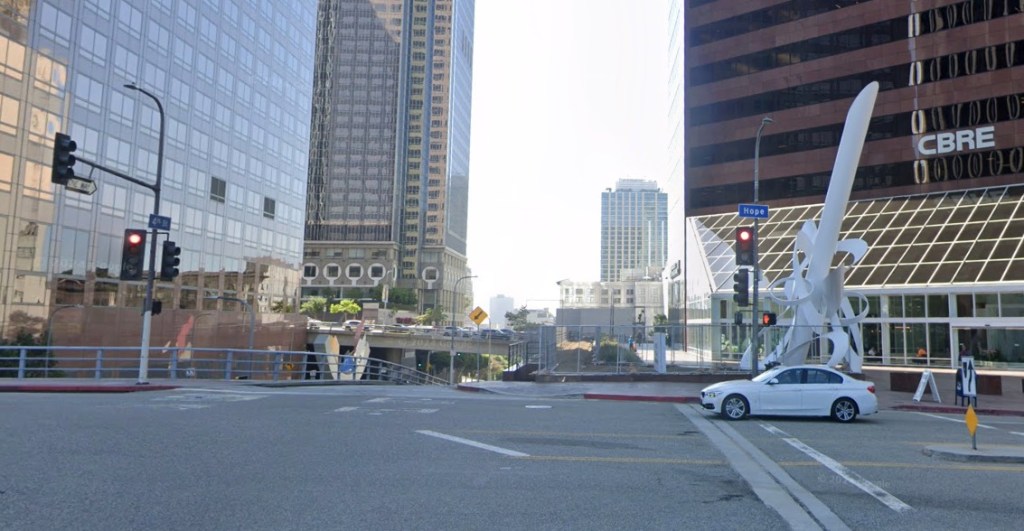
Hope Place, where the two structures once stood.Note in the machinegun-screengrab from NotC, at far left, you may glimpse the corner of the O’Melveny & Myers tower, also seen here at left
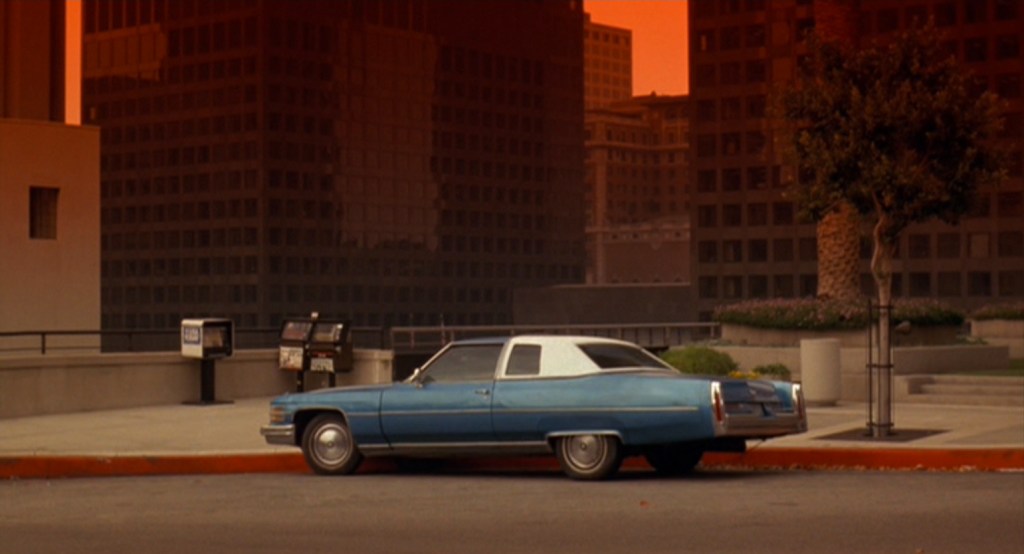
They then shoot the hell out of this poor defenseless ’75 Coupe de Ville:
In this shot, we are atop the old Fifth Street retaining wall (seen at left, with a window of Central Library behind). The tree at right is newly-planted, for the recently-completed Wells Fargo Tower (now 444 S Flower). The camera faced toward the X; note the Library at left, and how we peer between the two towers of the ARCO Plaza
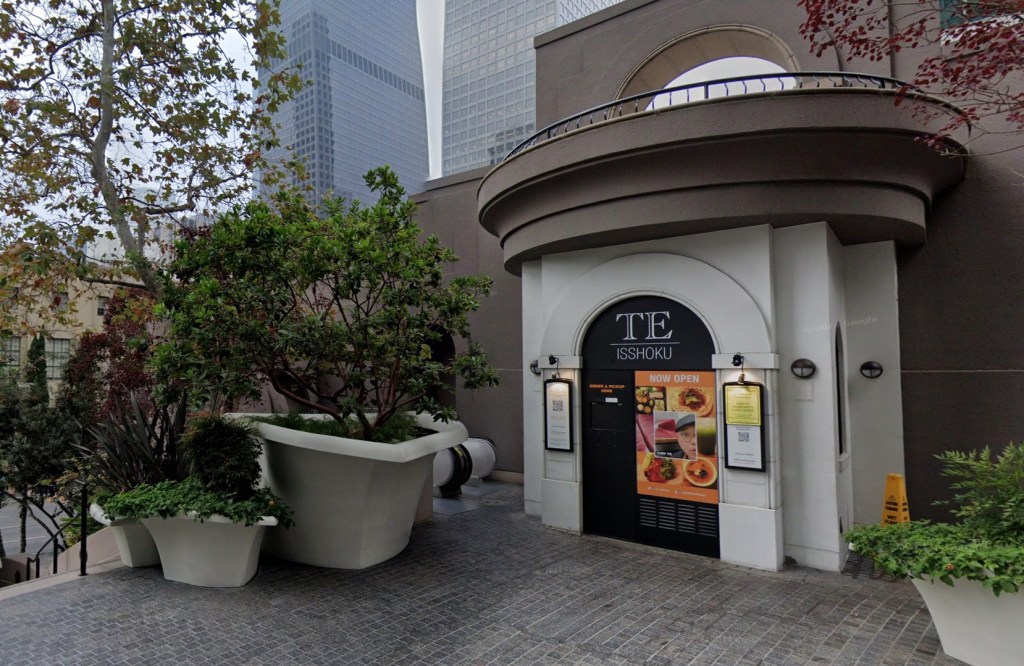
The Bunker Hill Steps replaced that length of Hope Street, so, midway up the steps is about where that Cadillac would have been.
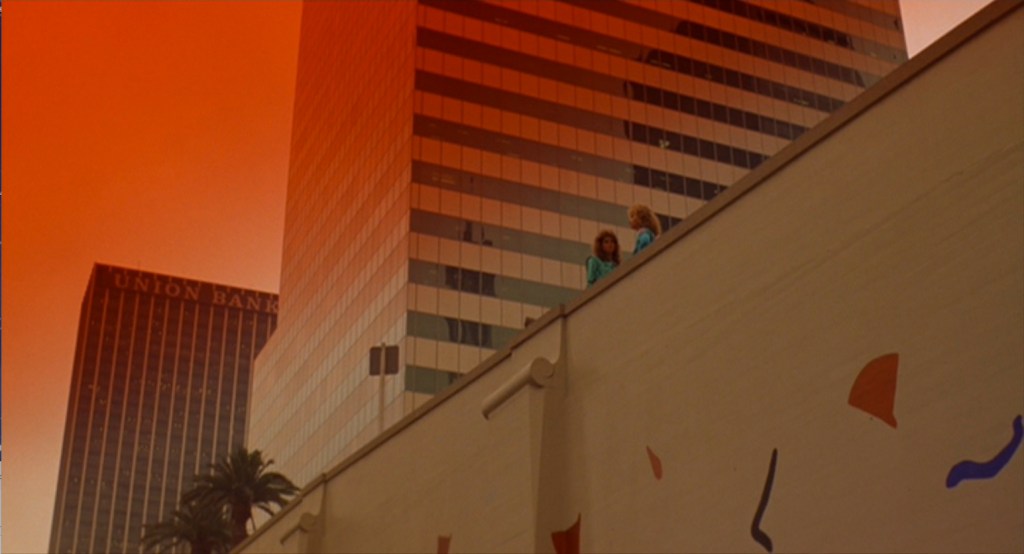
Then they chat atop the retaining wall, in front of the new Wells Fargo Tower, with Union Bank behind. A 1981 shot of the retaining wall, with the Wells Fargo Tower under construction, and Union Bank again in the distance. That retaining wall was demolished in 1986; you might remember this image from Part I of this series. LOC
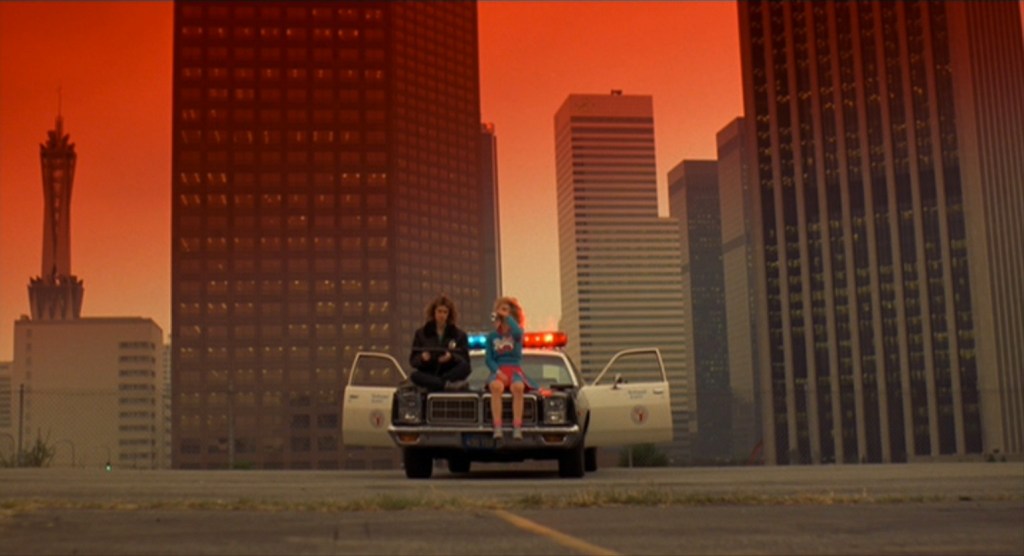
Then there’s this incredible and oft-used image of the two gals atop the hood of a cruiser:
Looking south from near First and FlowerNote how in the 1984 “gals on a patrol car” shot you could look up between the Crocker tower on the left and the Security Pacific tower on the right. No longer; today they’d be in the corner of the Disney Hall, and the view south is blocked by DH, as well as the Broad, Emerson, et al. Similarly, this was shot at the northeast corner of Third and Hope. Today it’s the backend of the Grand Promenade, now known as 255 Grand.
Oh, so, spoiler alert: at the end of the picture, with the death-dust washed away by rains, it’s up to Reggie and Sam to repopulate the world. Reggie becomes a suburban mom and Sam runs off with Reggie’s erstwhile videogame nemesis.
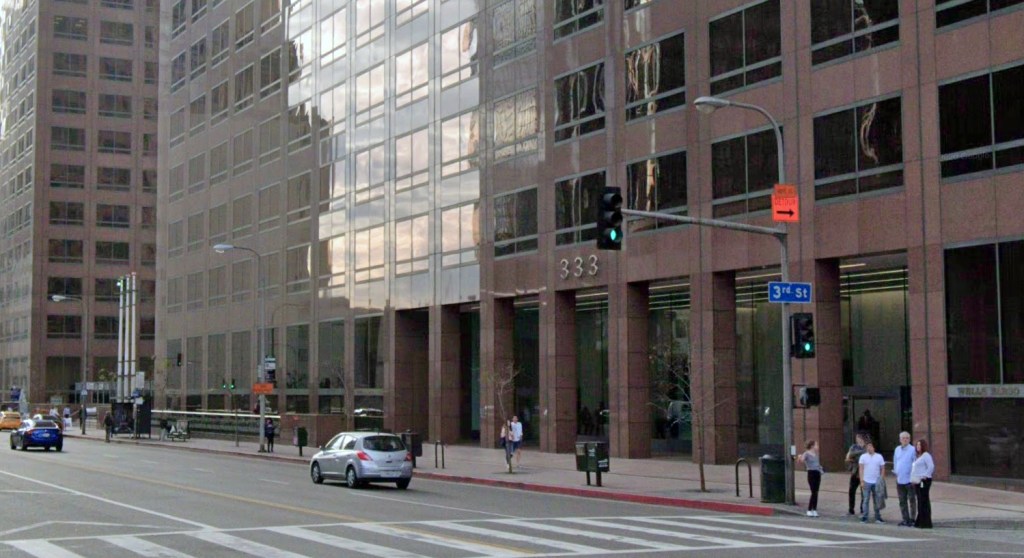
The happy family-of-the-future outside Security Pacific, 333 South Hope
Sam wonders “what’s my place in this new world?”
330 South Hope, AKA the backside of the Wells Fargo Center
But she needn’t wonder any longer, because here comes another Mercedes (an ’81 380 SL convertible) to whisk her awaytoward a glorious future
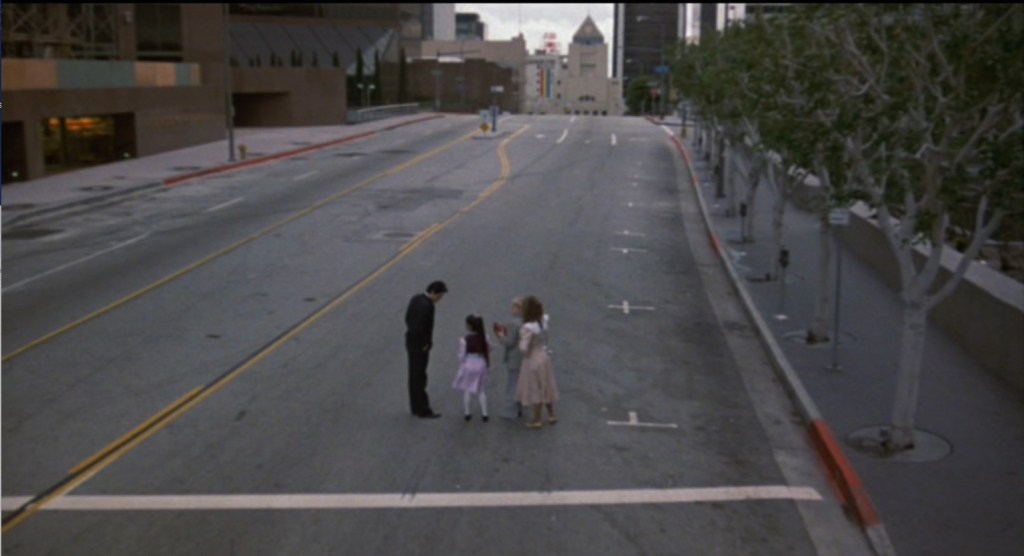
And in our parting shot, our new family plays football in the street —
Keen-of-eye folk will note the Jesus Saves neon to the left of the library tower
I spy Alexander Liberman’sUlysses, installed in 1987
***********
And that concludes our Bunker Hill-themed look at devoid-of-life, end-of-days LA. Shall it come to pass? Whither are we bound? I don’t know. But then, I never thought we’d live in a world without the McNally House.
My gut tells me Los Angeles’s dystopian future will look more than They Live than Return of the Living Dead, but I’ve been wrong before. God help us all.
Watch Night of the Comet in its entirety, here. A nifty music video that encapsulates the spirit of the film is here. Of course, if you want to learn more about the structures discussed in this post (the Bunker Hill Steps, Security Pacific Tower, Wells Fargo Center, etc. etc.) you might want to pick up the one-and-only guide to Bunker Hill, here.













 Bunker Hill, Los Angeles