Honestly, after last May’s Chavez-o-thon, I thought I was done with the subject. Of course with baseball season upon us, and the Arechiga eviction anniversary nearing, I assumed we’d be exposed to a bit more Chavez Ravine chatter, sure, but — behold! what is likely Chavez Ravine’s most-seen media concoction ever, a product of such shameless fabrication and falsehood I could not let it go unremarked upon.
***************
TL;DR: A web series does a video about Chavez Ravine, in which everything is untrue, so of course it has like a million views
***************
There’s a web series called Channel 5 with Andrew Callaghan; it can be pretty amusing, and I’ve watched more than a few. They do a vox-pop/gonzo journalism thing, and have amassed more than three million YouTube subscribers.
Couple months ago Channel 5 posted a video titled LA Dodgers Victory Celebration, which begins with nine exuberant of minutes of man-on-the-street interviews, and some commentary.

Then it shifts gears and becomes a ten-minute documentary about the history of Chavez Ravine. Spoiler alert: it’s a huge steaming load of horseshit. The video is replete with nonsense, and thus has had 887,000 views, with 1,800 comments. Who knows how many of those 887,000 actually watched the documentary part, but still. Entered into the purported canon of “Chavez Ravine’s Story,” it likely has more views than all those dreadful history-falsifying articles by Vox, LAist, and the Times put together. By contrast, this post will be lucky to get 100 views, but, I couldn’t sleep knowing I hadn’t done my part to disseminate truth, no matter how futile an enterprise.
For our purposes Channel 5’s video begins about nine minutes in, as host Andrew Callaghan introduces Vincent Montalvo and Melissa Arechiga, co-founders of Buried Under the Blue. Along with them is Montalvo’s mother Adela Montalvo, who had “lived in Palo Verde as a child.”
We’ll start with a quick side note about Adela Montalvo who, of course, did not live in Palo Verde as a child: she was born in 1951, and Callaghan says at 8:45 “she was forcibly displaced by the sheriffs at 9 or 10 years old,” so, they’re acting like Adela and her family were part of the famed 1959 eviction of the Arechiga family. Except, they absolutely were not. In an article about her family, Adela Montalvo’s mother, Adela De Nava, recounts that their address was 1776 Reposa. That house was sold to the Housing Authority, as so many were, soon after the famous July 1950 notice. Here is 1776 Reposa in an October 1951 auction of government surplus, and, here’s proof that 1776 Reposa was demolished between the July 1950 and August 1953, as per the Sanborn maps. Adela Montalvo herself says, at 9:20, she was “raised in Palo Verde till the age of going on nine” (despite her having stated in 2017 that she left when she was four [from here], which would be 1955, still wrong, but still many years earlier than 1959) thus placing her there in 1959 for the Arechiga eviction … except a) we have excellent records regarding who was actually there, and removed, that fateful day — scroll down to the timestamped quote at 14:51 below — and b) she just wasn’t: after her parents sold the Chavez Ravine house in 1951, they bought a house at 2017 Echo Park Avenue (see them listed in a 1958 directory here). In, again, this article, there’s a picture of her “on the front steps of her parents home, Palo Verde” but of course that’s a fiction. The 1952 image is on the fronts steps of their home on Echo Park:

There’s this whole thing about how we have to “listen to the elders” …what, you think they won’t lie to you too?
Anyway, prepare to be lied to — a lot:
10:44 (about Mexican Americans) “when they arrived, they weren’t allowed to live in the nice parts of town. Racially restrictive housing covenants imposed by the Home Owner’s Loan Corporation made it so they could only buy property in areas marked red” Nope. This is conflating two completely different things: redlining, and restrictive covenants.
First of all, by implicating the Home Owners Loan Corporation, Callaghan is attempting to talk about redlining. However, the HOLC in no way ever said “you aren’t allowed to live in the nice parts of town” or “you can only buy property in areas marked red.” The famous HOLC maps, made between 1935 and 1940 as a government project courtesy Franklin Roosevelt, were produced to gauge lending risk and creditworthiness. These maps indicated to the HOLC where it would, or wouldn’t, be prudent to refinance loans or issue insurance. Let’s look at one:
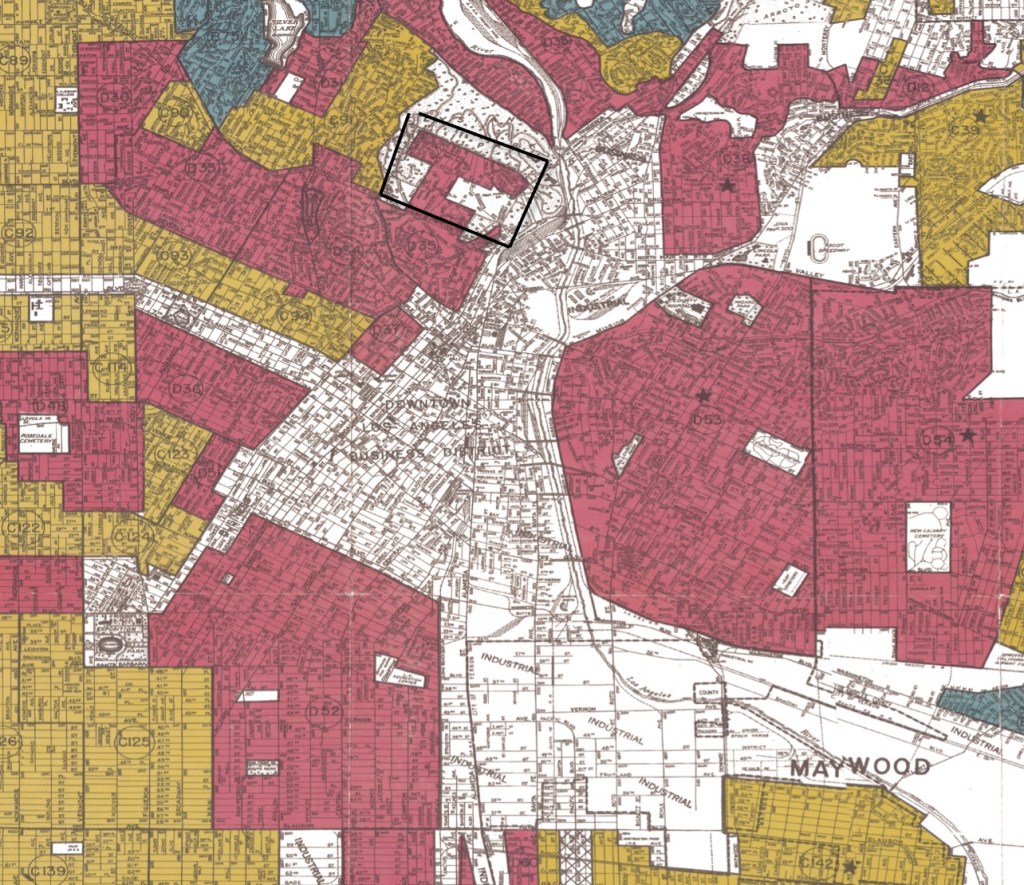
The area with the black square is Chavez Ravine. The white area represents mostly apartments, or commercial, so, not applicable. The red area is “risky” and yellow “declining” ergo, marked as risky for loan refinance. And while the notes in the government maps sometimes contained racist language (“subject area declining due to preponderance of foreign families” etc.) note that Bunker Hill, majority Caucasian, is redlined (in fact, the vast majority of US citizens “redlined” were white). Also, while redlining assessed lending risk and creditworthiness, evidence shows the HOLC did in fact loan heavily in red-shaded areas.
A common claim about the Chavez Ravine evictions is “when Chavez Residents lost their homes in the early 1950s they had no where to go and couldn’t buy anywhere because of redlining” but that’s not true: the HOLC ceased operations in early 1949. Ironically, the major effect of redlining was—due to the difficulty securing financing in “depressed” areas—those areas were unable to gentrify. So now, when someone says gentrification is evil, tell them they’d benefit from some Roosevelt-style redlining!
Restrictive covenants, on the other hand, were exclusionary CCR (Covenants, Conditions, & Restrictions) agreements either added by developers to subdivisions, or added by residents to their neighborhoods, which limited home sales to white-race only. No-one has ever made a map of where these were, or when they expired (the majority of these CCRs were established about 1905, and had a twenty-year sunset period). These absolutely existed in some Los Angeles neighborhoods (I have material relating to them in my collection) and as odious as they were, it’s important to remember CCRs applied to a small number of people, in a large city where the vast majority of its neighborhoods was unencumbered by color restrictions. So, until someone can produce a map of where the covenants were and what their respective CCRs said, the assertion that People of Color (who made up only about 10% of the population of Los Angeles in the interbellum period) were forced into ghettos because of exclusionary subdivision language is an unproven allegation. (I am aware of Laura Redford’s work, and her contention that “half” of Los Angeles was under racial deed covenants, but have yet to study her data.)
And similar to the claim about Chavez Ravine and redlining, a common claim about the Chavez Ravine evictions is “when Chavez Residents lost their homes in the early 1950s they had no where to go and couldn’t buy anywhere because of restrictions” it’s important to remember, covenants were made locally illegal in 1945, and federally illegal in 1948.
11:27 “by 1950, 1,100 families called the area home” Nope. The famous “1,100 families” concept comes from this Health Department graph:
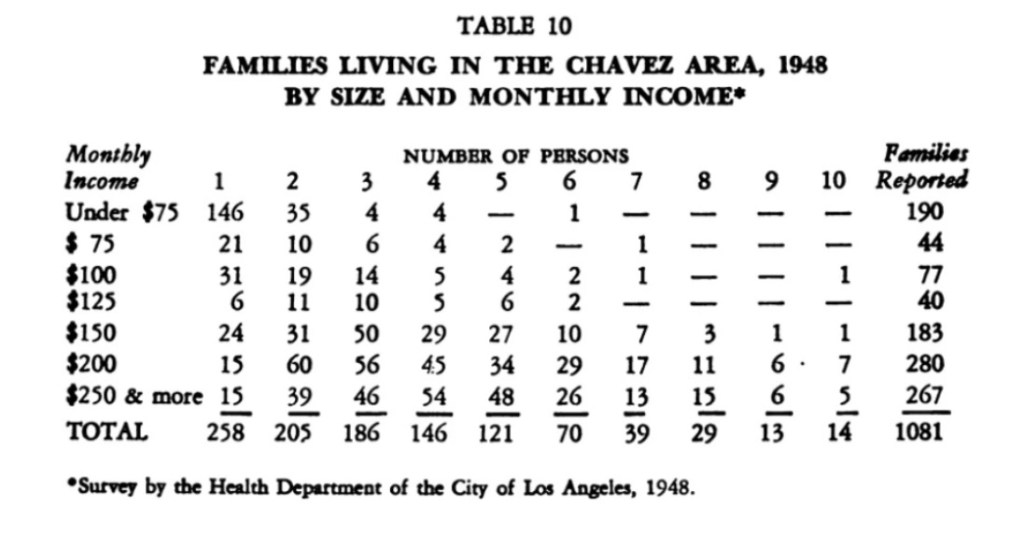
What’s at issue here is, what do they mean by “the Chavez Area?” This Health Department survey was 372 acres. However, the number of acres for the post-1950 Chavez Ravine redevelopment area was 315. The other 57 acres included Solano Canyon, which was densely populated (and still exists) and, as I understand it, the Alpine neighborhood (also extant). Therefore, the 1,081 number is very much inflated with neighborhoods and families that were never threatened by redevelopment.
Because if you actually count the number of structures (aerial views, insurance maps, etc.) in La Loma, Palo Verde, and Bishop? There’s about 250 residential structures, the vast majority of which being single family homes. Thus, the traditional referral to Chavez Ravine having 300 households is likely accurate (“household” including single people too) thus making the actual number of displaced people perhaps as high as 1,100 — but not, under any circumstances “1,100 families.” (What’s funny is, even with “1,100 families” a vast overstatement, you’ve got people like Councilmember Wendy Carrillo telling you it was “more than 1,800 families” which is patently ludicrous.)
12:27 “(Men going to war) lead to mild structural decay like plant overgrowth. That was enough for the Housing Authority to declare these three communities blighted” What? Ha ha ha, that’s an instant classic, “mild structural decay like plant overgrowth.“
First of all, Callaghan is saying the communities had a downturn because of…World War II? Um, the area was planned for total redevelopment in 1935. The Municipal Housing Commission produced many images of Chavez Ravine’s substandard shacks, and urged redevelopment, and depicted the type of modern homes with which they were going to replace Chavez Ravine’s residents.
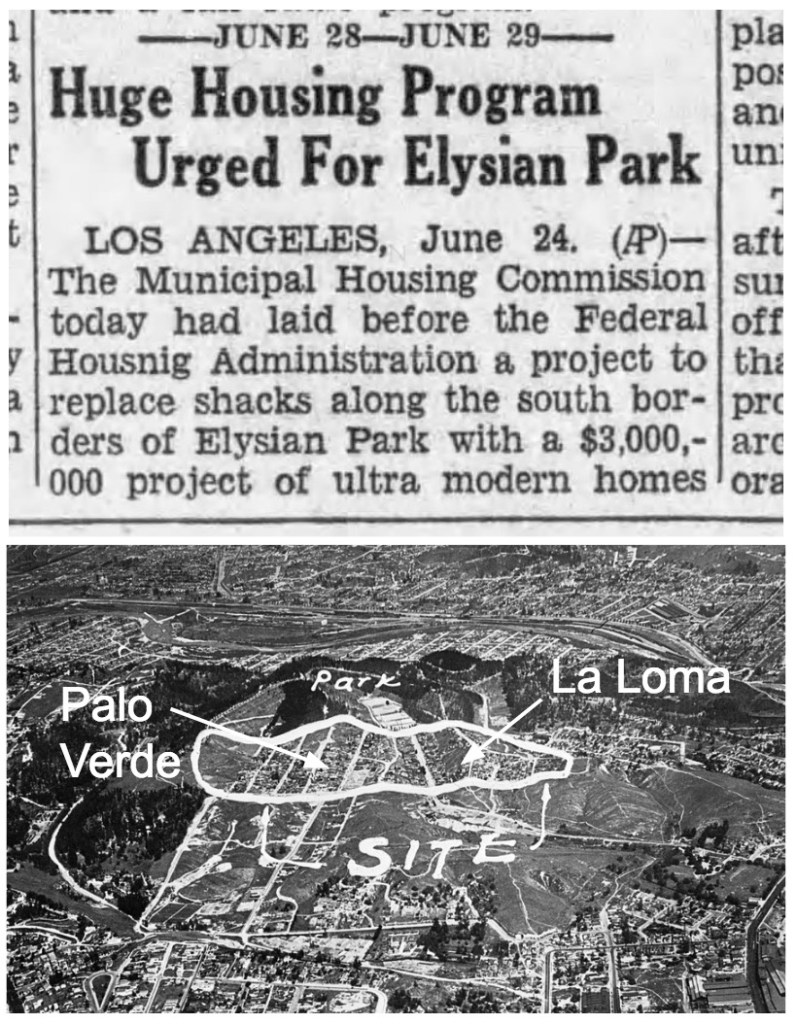
Now let’s get to the “mild structural decay like plant overgrowth” (that’s so precious I can’t stop repeating it). First of all, the Health Department was not the Housing Authority. You apostles of Regime Narrative will screech “the Housing Authority invented all this stuff about blight, to steal the land!” but that determination was made by the Health Department, who didn’t have a dog in the fight. Let’s look at some of the things the Department of Health found, when they did a door-to-door study in 1948:
Though 2/3rds of Chavez Ravine’s structures had been built after 1920, 55% were of legally substandard construction, and considerably deteriorated. Most structures built on steep hillsides had inadequate foundations. Many of the dwellings were borderline habitations, with people living in tiny one room shacks, chicken coops, sheds not meant for human habitation, tents, and shelters made of packing boxes. 390 units were without a toilet, 377 had neither toilet nor bath, and almost half lacked any bathing facilities. There was no running water in 174 units. Wood was used for cooking and heating in many units. Tuberculosis cases were twice the city average. Hey, tell me again about mild structural decay like plant overgrowth!
12:56 “in 1951 they received notices, threatening them, if you don’t sell your home, we’ll condemn it and you’ll get nothing” WOW. No, that’s literally completely made up. As regards “receiving notices,” Mr. Montalvo is referring to the July 1950 letter delivered to every household:

Notice what you don’t see—threats saying “if you don’t sell your home, we’ll condemn it and you’ll get nothing.”
“Let‘s be needlessly, brazenly cruel, and openly cheat the poor” is a bizarre fantasy because the Housing Authority was a progressive leftist group, that had had a ton of federal money dropped in their lap. So the narrative is, these leftists want to screw impoverished homeowners? By withholding lots of taxpayer money they were legally bound to disperse? Consider: the guy who signed the letter, Sidney Green, was a Communist Party member. The man who delivered the letter, Frank Wilkinson, was a Communist Party member. (Green and Wilkinson were both fired for being Party members, two years later.) Communist Party members who worked hard to take your Chavez homes included Housing Authority employees Adena J. Williamson, Jack Naiditch, and Elizabeth L. Smith; other likely but unproven Party members in the Housing Authority were Sarah Fefferman, Ruth Johnson, Jessie L. Perry, Fay Kovner, Hy L. Sunshine, Dorothy Foster, and Carol Andree.
Anyway, leaving aside the improbability of leftists, people of color, and Peoples World-reading Hebrews (by the way, wanna see some of the actual people who took the Chavez homes? wanna see the actual face(s) of L.A. Housing Authority’s “white settler colonial imperialism?” well here you go) feeling an overpowering need to screw the poor, it would have been impossible to do so by law. Los Angeles had previously removed large groups of people — dozens of times — for housing projects, and each time, there were federal, state, and city laws that had to be adhered to. The courts were involved every step of the way. When a property is taken from a person, they are paid “the highest price the land can bring if exposed for sale in the open market.”

In short, redevelopment law is very clear cut and redevelopment agencies were under intense scrutiny, up to and including the May 1953 month-long investigation of LA public housing by a House of Representatives Subcommittee, where none of the Ravine resident testimony mentioned anything about “threatening notices saying you’ll get nothing.” If there had been any funny business withholding federal funds, that would have brought the FBI down on the Housing Authority. And that didn’t happen, did it?
13:10 “at least 75% of the community resisted for the next three years” Well of course some people did, so would I and so would you. I only want to comment on this because it’s important to remember why they resisted. Residents wanted to keep their homes and have fresh air and chickens, and not be put into a concrete filing cabinet, that’s obvious, but remember, too: in 1951 the attorney for the Chavez Ravine families, at a hearing before the City Planning commissioners, attacked the Elysian Park Heights housing proposal as the “cancer of socialism.” Manuel and Agnes Cerda, who lived on Effie and ran the information office for other Chavez Ravine residents fighting the City, denounced the Housing Authority as un-American, and, said Manuel, “they didn’t want to be socialized.” The people of Chavez Ravine proudly spat squarely in the face of progressive-left Mexican-American civic organizations, like the Asociación Nacional México-Americana, and El Congresso, who were pro-public housing.
This underscores a fundamental fact in the tale of Chavez Ravine: the conservatives are the good guys. That statement makes folk clutch their pearls, but it’s absolutely true. Consider: many residents of Chavez Ravine had abandoned their home nations in search of America, yearning for Americanism. They were conservatives because they wanted to conserve their way of life, and felt pride in American homeownership. The bad guys are, however, were the liberal progressives: public housing was pure New Deal social engineering. Left-technocrat “planners” have always been eager to blueprint top-down collectivism and, then as now, forever demonize the singe-family home.
…that said, despite the statement about “75% resistance for three years” — while there was some resistance, in reality more than 75% hadn’t resisted, and in the first three years sold their property and left. As is shown by the Sanborn maps, 80% of Chavez Ravine had been demolished before the public housing project was cancelled.
13:34 “somehow, someway, a real estate company hired a PR firm to run negative stories about the Elysian Park Heights building, calling it a ‘socialist communist experiment'” This is stupidly untrue. If it’s not, go ahead and name the real estate company, or name the PR firm. Better yet, just show me one of these “negative stories” — because the only time anyone in the 1950s called something a “socialist communist experiment,” it was New York Congressman Ralph Gwinn in 1954, referring to the TVA.
13:50-14:50 Here Callaghan talks about the incoming Dodgers. Something about how the Dodgers were in a rivalry with the Yankees, which might be true, but has no bearing on the story of Chavez Ravine. Why did they move out of Brooklyn? After all, the Dodgers owner Walter O’Malley attempted, valiantly, for years, to stay in Brooklyn. O’Malley was, however, opposed by master builder/power broker Robert Moses.
Callaghan then links the Dodgers to Chavez Ravine. In doing so, of course, Callaghan neglects to mention that the Elysian Park Heights housing project was cancelled because the City Council, and then the voters of Los Angeles, and then the Mayor, in that order, told the federal government they wanted no more of any public housing project. Callaghan further neglects to mention that then the land sat empty for five years, while the city tried to find a use for it — music center? cemetery? zoo? lake? until presented with the opportunity to have a rich guy build a 56,000 seat stadium on his own dime.
Lastly, when Callaghan says, at 14:40, “intoxicated by the idea of MLB investment, the city of LA decided to extend its eminent domain notices over the ravine,” that’s absolute nonsense. Not one single new eminent domain notice was ever sent because of the Dodgers. Every single Chavez “we’re taking your home!” notice was sent during the administration of liberal pro-housing mayor Fletcher Bowron; neither mayor Norris Poulson (shown in the video at 14:43 when Callaghan states, falsely, “LA decided to extend its eminent domain notices“) nor the Dodgers are to blame for that.
14:51 “and it was only until 1959, when they forced most of the families out, there were probably about twenty families left in 1959 when they came in, that they call today now Black Friday, where they were forcefully displaced by the sheriffs” Nope. On May 8, 1959, there was one family forcibly removed, not twenty, hell, not even two. With all the photographers and reporters and TV cameramen there, how is it the only family we see removed is the Arechiga family? Incredibly, no-one (especially journalists) has ever thought to ask “hey, how come there’s no documentation regarding all the other people whose homes were demolished on Black Friday, but there’s a million photographs and articles about the Arechigas?“
Despite no-one ever having asked this question, I’m going to answer it anyway. Let’s look at exactly who was still in Chavez Ravine in May 1959.
First let’s tackle the tale of “Most Famous Chavez Residents of May 1959” Mr. & Mrs. Manuel and Abrana Arechiga. Their story, in brief — Manuel Arecghiga owned two houses: 1771 Malvina Ave. (450sf, built in the 1930s, where he and Abrana lived), and 1767 Malvina Ave. (784sf, built in 1923, where daughter Victoria lived with her husband Mike) and, despite what you are told, Manuel built neither structure. The Arechigas had owned another house, at 1801 Malvina, which they tore down themselves for reasons unknown.
After the famous HACLA letter of July 1950, Manuel was offered $10,050 for the property. But someone, we don’t know who, told the Arechigas their property was worth $17,500. The Arechigas were more than willing to leave; they just wanted that extra seven grand (they even made signs that said so). Here’s the thing: if you didn’t like the remuneration you were offered by the court, you filed an appeal. Lots of Arechiga neighbors filed appeals and got more money. But the Arechigas just decided not to, and the appeal window closed in February 1953, thereby indicating a tacit and legal acceptance of the city’s offer, which meant the Authority now owned their property free and clear.
But eight months later, in October 1953, Manuel Arechiga filed suit in Superior Court against the Housing Authority. In return the Housing Authority obtained a Writ of Possession, which meant that not only did the city own the houses legally, a court order existed directing law enforcement to evict residents there and then. However, the Arechiga attorney secured the Arechigas a 30-day stay, which stretched out for years of legal battling. Ultimately the District Court of Appeals ruled against the Arechigas in 1957. The Sheriff Deputies finally arrived in August 1957 and hauled out all their belongings. But Councilman Roybal intervened, and everything got put back; this two-week stay on the eviction stretched out into a couple more years. Manuel Arechiga keeps battling in court, but the case is struck down once and for all by the appellate court in April 1958. In March 1959 the Arechigas are told pack up your stuff, we will be there to remove you—from the house you have not legally owned for six years—on April 10th. Of course, their lawyer gets another delay, so the new date was set for May 08. Which became the famous Black Friday we now hear so much about (people often mention how the city was cruel to do this on Mother’s Day weekend, but, that was completely orchestrated by the Arechigas, or at least by their lawyer).
People get some funny ideas about who the Arechigas were, how many of them lived in Chavez Ravine, and how they become “homeless” in 1959. So, I made y’all this:

Besides the Arechiga family, there were three women who walked away from Chavez Ravine on May 8th 1959: Alice Martin, 1456 Davis, whose house, built by her husband John G. Martin in 1924, she bought back from the city for $2500 on condition it be moved, and Alice departed that day without incident. Sally Ramirez, 1850 Reposa, is a mystery — despite the dozens of newspaper articles printed about the event, there’s only a single newspaper mention of her, and 1850 Reposa left no paper trail at Department of Building and Safety, and as such was likely illegal, and in any event, she also left without incident. Film and television actress Glen Forestine Walters, of 1853 Reposa, left her home on her own terms, though she was charged with obstruction in the Arechiga removal. Walters is an interesting character: like the Arechigas, she also owned multiple homes around town. In 1951, for example, she moved her house at 2601 Riverside to 2429 Forney Street, and opened a trailer park. She moved another of her houses, from 2902 Worthen, to the Forney Street trailer park in 1953. (This was a RESTRICTED trailer park. Gasp! you say, restricted to exclude who?? In a world where residential complexes often had a “no pets allowed” policy, you were not able to take up residence in Glen Walter’s trailer park unless you had a pet! Glen Walters is my spirit animal.) Walters had a string of bad luck with her homes; her house at 534 Fenn Street was heavily damaged when struck by lightning in 1967, and then it burned to the ground in 1975. (Oh, and see Glenn Walters act in a 60s western by clicking here.)
Then there were the other folk who owned houses during (and after) the Arechiga removal: Ramon Contreras, Francisco de Leon, Charlotte Hansen, Regugio Nava, Francis Scott, John Chaffino, Luis Lopez, Manuel Corronza, Regina Carrillo, Louis Longoria, and Remigo Nila. They were still there in May 1959. Why didn’t the deputies kick down their doors? Because unlike the Arechigas, those folk actually followed the appeals process. All those houses were still standing in February 1960 when the Dodgers paid those homeowners quite handsomely for them, many times more than the City condemnation offers had been. Why didn’t the Arechigas just go that route? We’ll never know.
15:02 “from the stories that my mother has shared with me, who was there, and a young kid, she shared that she was very frightened, that it was scary, that they had put her on a little chair, on the backside of the door, with a little cup of hot chocolate. My grandfather had told her don’t move, sit there, and so they’re kicking in the door, all the cops and everything, everyone is coming in, the cameramen, and so they drag them out, they drag out my aunt, my mom ends up being in the police car with my aunt, they take them up to the hill to kind of separate everybody, to kind of calm things down, because it had gotten kind of crazy, with my grandmother throwing rocks. My mom shared with me that when they took her up to the hill with my tía, that they ended up beating my tía in front of my mother, so she watched, as the cops beat my aunt.” Ugh. Okay, there’s a lot to unpack here. First, let’s delineate our cast of characters: this is Melissa Arechiga speaking, co-founder of Buried Under the Blue. Her mother is Jeannie Arechiga, daughter of Juan and Nellie Arechiga; Juan is the son of Manuel and Abrana. Jeannie’s tía is Aurora Arechiga Vargas, daughter of Manuel and Abrana. Got it?
So: Juan and Nellie didn’t live in Chavez Ravine. They lived three miles away, on Benedict Street. Their daughter Jeannie — born on September 21, 1955 — was 3+½ years old in May 1959. Her parents decided it was a good idea to pick up a preschool-age girl, drive her to her grandparent’s house, and plop her into the middle of a violent confrontation. Not only that, they put her in front of the door they knew deputies were going to kick in. She was told “don’t move, sit there” as the door splintered open and yelling cops and cameramen came thundering in. In the Buried Under the Blue bio (see a snippet here) they write “This experience left a lasting impression on Jeannie’s young mind and continues to affect her mental health and well being.” Yeah, do ya think? Funny, that could have been avoided if you’d let the 3+½ year-old girl stay at home and watch Romper Room instead of picking her up and taking her into the maelstrom just so she could be photographed:

“Jeannie Arechiga was at Eviction Day” is a fact — it’s disturbing child abuse, sure, but at least it’s fact. But then, the obvious untruths creep up: according to Melissa Arechiga, her then-three-year-old mother ends up in the police car with her aunt, Aurora “Lola” Vargas (the one made famous as the woman who drove from her home miles away, to go to Chavez Ravine — arriving after the deputies and TV cameras had in Chavez Ravine — and ran up into her parents’ house, just so she could be carried out). However, because of the massive media presence, we actually know who was put in the car with Aurora Vargas: the aforementioned Glenn Walters, whom you’ll remember I said was charged with obstruction.


Soooooooo, this was an exceptionally, heavily documented event. If the cops had tossed a three-year-old-little-girl into a police car, then that would have been the photo plastered all over the newspapers and television, not the carrying out of Aurora. Oh, and then — we’re now told — the cops beat Aurora in front of the preschool-age girl, which the newsmen didn’t think was newsworthy, and which neither Aurora nor her lawyers mentioned at trial, nor has it ever been mentioned…ever…in the last 65 years. Huh. Usually Melissa Arechiga just tells the sandwich story. Cops beating a war widow in front of a little girl is something the Arechigas have omitted from the tale the last 1,000 tellings—heck, they failed to mention it to the New York Times—I guess NYT aren’t mainstream media enough for Buried Under the Blue, and were waiting for the outlet that would guarantee them nearly one million views.
16:19 “after the forced evictions, most residents either became homeless or had to move to other parts of LA with pennies to their name” Except that’s not true. Assuming Callaghan is talking about the forced evictions of May 1959, when the “most residents” were just the Arechiga family, guess what, they simply moved into all the other houses they owned. Manuel and Abrana, who owned both Chavez Ravine houses that were seized that day, at first attempted to pretend they were homeless, and when it was discovered they owned two houses outside of Chavez Ravine, they gave up pretending and just went to one of their other houses.
Sometimes people will say “no, they didn’t really own a house, it was owned by, like, a cousin or something,” but that’s bullshit. Manuel Arechiga, patriarch of the clan, had purchased a just-constructed house in 1956, 3649 Ramboz Drive in City Terrace. It cost $8,500, and by May 1959 the Arechigas had already paid off more than half their mortgage; that’s where they went in 1959, ergo, here they are there in the 1960 phonebook. Then also owned outright another house at 2410 Glover Place, where Abrana’s daughter Delphina lived. I won’t even go into the fact that Aurora owned two houses, John owned two houses, and Victoria owned three houses! Heck, even daughter Celia, whom you never hear about, owned her own house.
At which point you say “yeah well the Arechigas owned lots of houses not in Chavez Ravine, but…what about all the other people in Chavez Ravine! They were totally made penniless and homeless!” No. The courts mandated you had to be paid and paid well, and to boot, there was a relocation office set up in Chavez Ravine. If you were a renter, you didn’t leave until they’d found you new digs (the woman who ran the relocation office, Victoria Alonzo, was fresh off of relocating all the people removed for the Civic Center expansion north of Bunker Hill). If you’d sold your home, the relocation office helped find a new one. That was, after all, the law. Los Angeles had been removing people for decades to build public housing projects, civic structures, freeways, etc. — we were quite well versed in just compensation and relocation assistance. It’s not rocket science, and yet, people always argue the Chavez Ravine project was somehow the only one where, for some absolutely unknown reason, we decided to cheat the poor, beat them, and disperse them into a void of misery, poverty, and death.
16:36 “in a sadistic act of 5D chess, not all of the homes were demolished…some were physically moved to more affluent areas and marketed for their rustic charm” Um, source? While there are a couple of instances of homeowners moving their own homes onto lots in other areas of the city…there was no subsequent “marketing,” least of all “sadistic” marketing. But then it goes on to say:
16:45 “or sold to movie studios in the Valley… Universal Studios also has some on their set…they used, what was that movie, To Kill a Mockingbird? To Kill a Mockingbird. The house that Finch was in, that was from Palo Verde.” Nope. This is one of most oft-repeated fantasies (Buried Under the Blue has also claimed that film was shot in Chavez Ravine). I mean, aren’t we constantly told that the “last houses in Chavez Ravine” were demolished in May 1959? To Kill a Mockingbird, the book, didn’t even come out until July 1960!
Fact is, there were other houses still in the Ravine post-May 1959, for which the Dodgers paid handsomely. Those houses were demolished in February 1960, still well before the publication of To Kill a Mockingbird. Preproduction for the movie version of TKaM began in October 1961—long after every last home had vanished from Chavez Ravine, making it impossible for them to source houses from the ravine in advance of the start of filming in April 1962 (coincidentally, the same month Dodger Stadium had its opening day).
Sure, we have a couple internet randos claiming Chavez Ravine homes were moved to the Mockingbird set, but when that’s claimed, there’s never a citation, no actual primary source, no attribution, no evidence. That’s because it never happened. TKaM’s production designer Henry Bumstead did get some old L.A. houses, to be sure…houses that had been condemned, being in the path of freeway construction.
Let’s take a look at some Mockingbird presskits, issued for the December 1962 movie release, which state the houses were sourced via freeway construction:
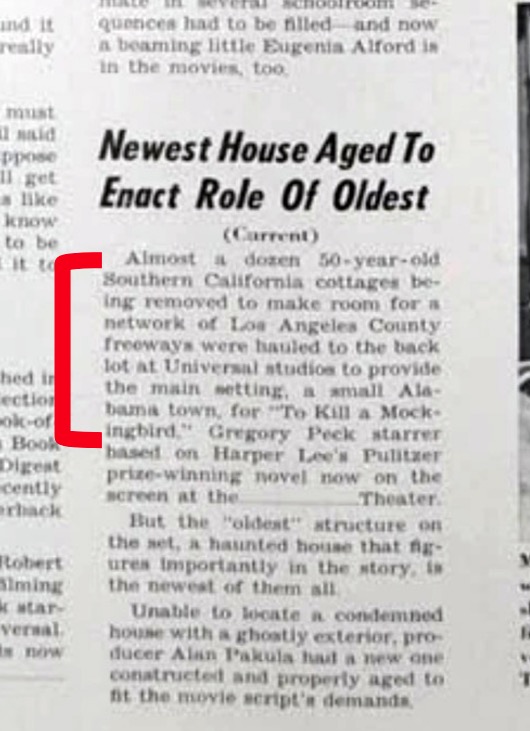
Here’s another presskit article stating, again, that the houses had been sourced from freeway construction:

Hell, it even made the newspapers:
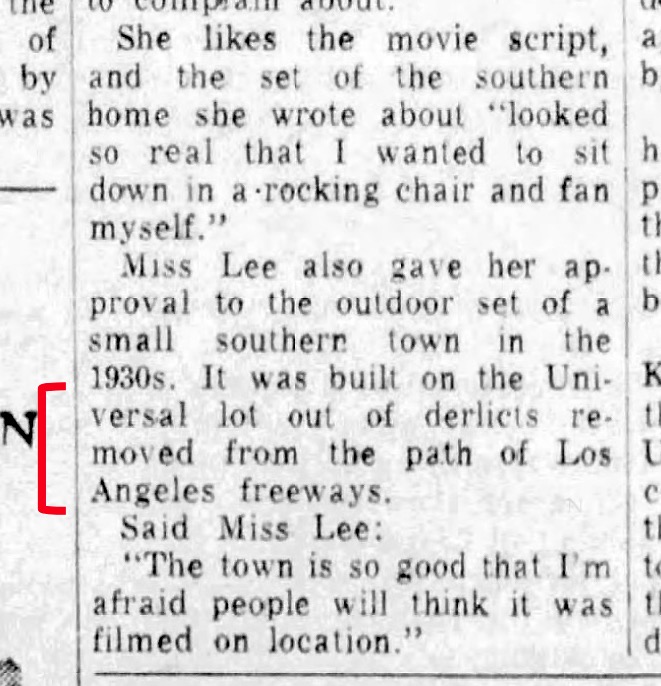
Remember, the construction of Dodger Stadium was a huge deal, and an enormous source of civic pride. Leaving aside the actual physical impossibility of Universal getting “Palo Verde houses” in late 1961, had they actually magically done so, it would have been a nifty human interest story in the papers and for the presskits to talk about houses sourced from the Dodger Stadium site.
Not only that, but production designer Henry Bumstead himself said in Andrew Horton’s Henry Bumstead and the World of Hollywood Art Direction:

The Bumstead papers are at the Margaret Herrick Library, and in one of his letters to Mockingbird‘s producer Allan J. Pakula, he refers to the structures they had sourced as “the freeway houses”—

What’s annoying is that here we have some people just making up stuff, and nearly a million people have been taken in by this poorly-concocted twaddle. Among the 180,000 comments are lots like this one:

17:08 “as far as the homes that remained, most were replaced by mounds of dirt, but others were replaced by the baseball field itself” Nope. Not a single home is under the baseball field. Not one. Zero. This is not an arguable point. If anyone ever says this to you, remember, nothing they say afterwards is worth listening to. For the millionth time, people, the baseball field was built on the old site of a brick factory. Click here. See where it says “closed brick factory?” That’s where the stadium was built. (Click here and here.) Were Palo Verde and La Loma demolished? Did about half their former site become parking lot? Sure, nobody’s arguing that. It might seem like splitting hairs — because one way or another, the communities are gone — but the point is, the continual drumbeat of “houses were where third base is now!” is a consciously deceitful lie attempting to mislead and emotionalize people.
17:10 “from third base on, the school was there. And then from third base to second all the way to the pavilion seats there were houses going up the ridge there…that was a school on third base? Yeah that was a school on third base, all they did was take the roof off and they threw the dirt in, its still there today.” Oh lord, this again. It’s so easily disprovable it’s kind of embarrassing. I have no idea who first made up this story but it’s super annoying, because it’s so very, very stupid.
The Palo Verde School at 1029 Effie was built in 1923, designed by Pierpont & Davis in Institutional Spanish Colonial. It looked like this:

Palo Verde elementary was closed by the City Board of Education in 1955, since there were no more kids left.

Then, if you believe the dominant narrative, it was “buried.” It was buried, according to Melissa Arechiga, because we were hoping to bury your people, be done with you, so you’d forget who you were because that’s just our colonizer corporation legacy behavior.:

Uh-huuuh.
Only (apart from the obvious fact there’s no alternate universe where Building & Safety’s civil engineers would allow anyone to backfill into standing walls) the school wasn’t buried. It wasn’t buried because the Dodgers wanted to keep it. They used it, mostly for storage, all the way until about 1967, when it was demolished. Look:

Above, there’s the school in 1962 co-existing with the stadium. At right, an aerial from 1972. Look closely: notice the sloping dirt rising up on three sides of the school in 1962, and all that dirt is in exactly the same place in 1972; there’s no-where for dirt to have come from to bury the school. Notice the level of the roadways and parking lot in front of the school in 1962, and, its site is at the same damn topographical level in 1972.
Pay attention: the land on which the school sat, from 1923 till the mid-60s, was at 535 feet above sea level. The present parking lot site — where the school stood — is at…535 feet above sea level. Therefore, not buried. Seriously, if one more person mentions this absolutely idiotic “buried school” crap I’m gonna throw something. (Amusingly, Buried Under the Blue literally named themselves after something ridiculously false.)
Though I’m uncertain as to when, exactly, the school was demolished, we do know that it exists in a mid-1964 aerial and is gone in another from early 1968.


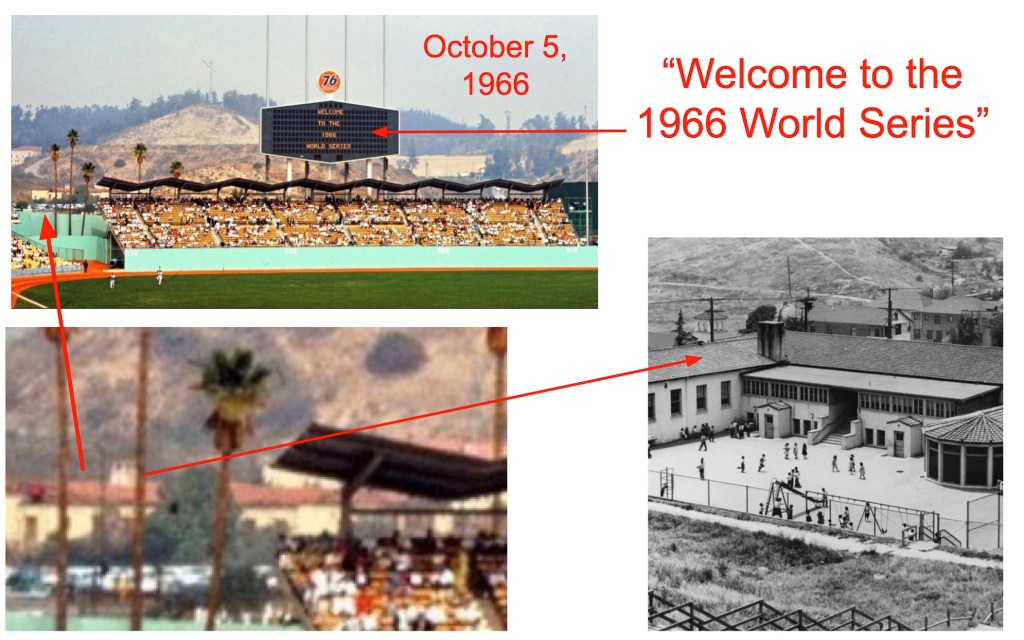
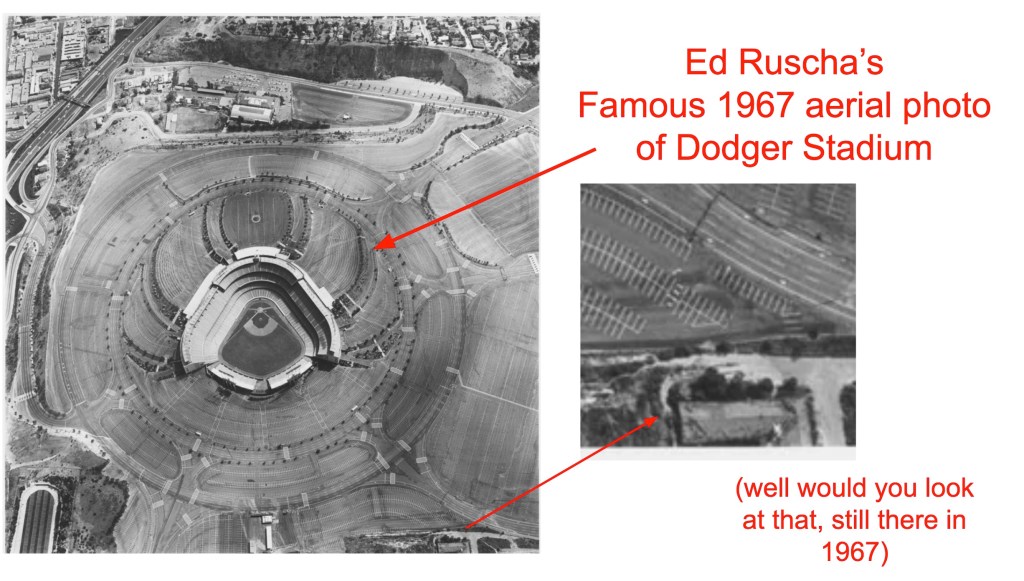
17:32 “there was a cemetery too, that’s why they say Dodger Stadium is haunted” NO. Just, god, you think you’d quit while you’re behind, but you just had to add one more thing…
First of all there were two cemeteries nearby…but neither were near Palo Verde/Bishop/La Loma and neither were near nor impacted by the construction of Dodger Stadium. Calvary Cemetery, to the southeast of Chavez Ravine, had its dead disinterred, and then reinterred at New Calvary, in 1896; old Calvary is now the site of Cathedral High School (which is why they are called The Phantoms). And a Jewish cemetery was south of Chavez Ravine, the other side of Lilac Terrace—but the Hebrew Benevolent Society removed their dead (reinterred at Home of Peace in Whittier) by 1910, which is before the communities of Chavez Ravine even existed.
***************
And that, my friends, is my long n’ involved point-by-point debunking of so many silly stories told by Big Media.
You might be asking, dude, why do you care, and more importantly, why should I care? Well, because truth is important. More to the point, telling untruths is bad, and snowballs into more bad things. Let me give you a recent example:
In May 2021, up in Canada, the Tk’emlúps te Secwépemc First Nation band announced it had discovered a mass grave — specifically, 215 unmarked graves of children— at the site of the former Kamloops Indian Residential School. This was repeated, unquestioned, by the media, most notably on the front page of the New York Times. The shocking announcement sparked international attention, prompting riots, memorials, and much government funding. The tribal band, which numbers 1,500 people, were given $8million, and another $3million for a death register, and $242million was given to an indigenous Residential Schools Missing Children Community Support Fund, with another $200million handed out to reconciliation initiatives, investigations, and activist groups. Almost immediately, many other tribes discovered their own mass graves of children. Indigenous organizations received further settlements, land deals, and political concessions based on the allegations. Statues were toppled across Canada (e.g. Queen Victoria, Egerton Ryerson, John Macdonald, etc.). Most notable was the rash of church burnings, and wave of hate crimes against Christians, including a 260% increase in hate crimes against Catholics. The church burnings (70+, with another 100 or so vandalized and desecrated) were called “understandable” by Trudeau, and the domestic terror wave against churches and Christians was treated as “justice”; church burnings were commonly cheered on by the media (e.g., here and here).
There’s just one problem, of course. It was a moral panic built on lies. It was a hoax: a financially and politically motivated scam. The last four years of searching have uncovered zero human remains, and the graves that were “definitely found” were only underground anomalies detected by ground-penetrating radar, later revealed to be the odd tree root or sewer line. Now, I don’t fault the Canadian government for paying out untold millions in “reconciliation” based on unverified and ultimately false claims, because governments love to do performative justice bows to extremist demands all the damn time. But I’m an architectural historian, and love old structures, and so it breaks my heart when lies result in the burning of, for example, St. Jean Baptiste in Morinville (1907); Sacred Heart, Penticton (1911); St. Paul’s Anglican, Gitwangak (1893); and Holy Trinity, Orlow (1898).
Which is ultimately the issue with the dominant Chavez Ravine narrative. You can get 887,000+ views if you peddle deceptive sophistry, which results in folks in full fits of righteous indignation, like this YouTube enjoyer:
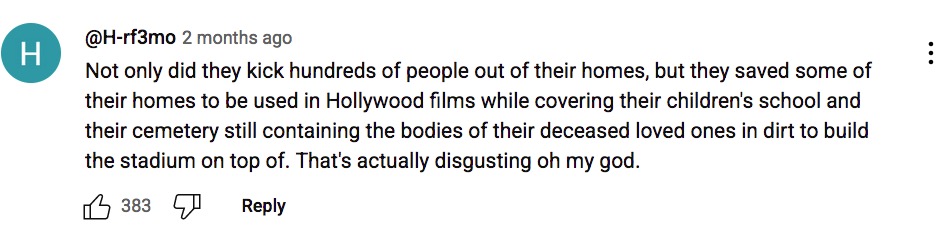
— and it’s frustrating because everything “H-rf3mo” is upset about didn’t happen. This is how your birth people marching with torches, hot to “burn it all down.”
************
Oh. One more thing.
Everything in Channel 5’s video is debunked nonsense, and you might say well, they had no way of knowing the truth, because who reads your meagerly-read blog posts anyway but, guess what, they knew my work well.
Channel 5 contacted me in December 2024 to ask if I’d be interested in being filmed for a piece about Dodger Stadium. I said count me in! and we set up the interview for a Saturday morning in Chavez Ravine — but they sent me a text the Friday afternoon before saying “sorry for the short notice but we have to cancel.”
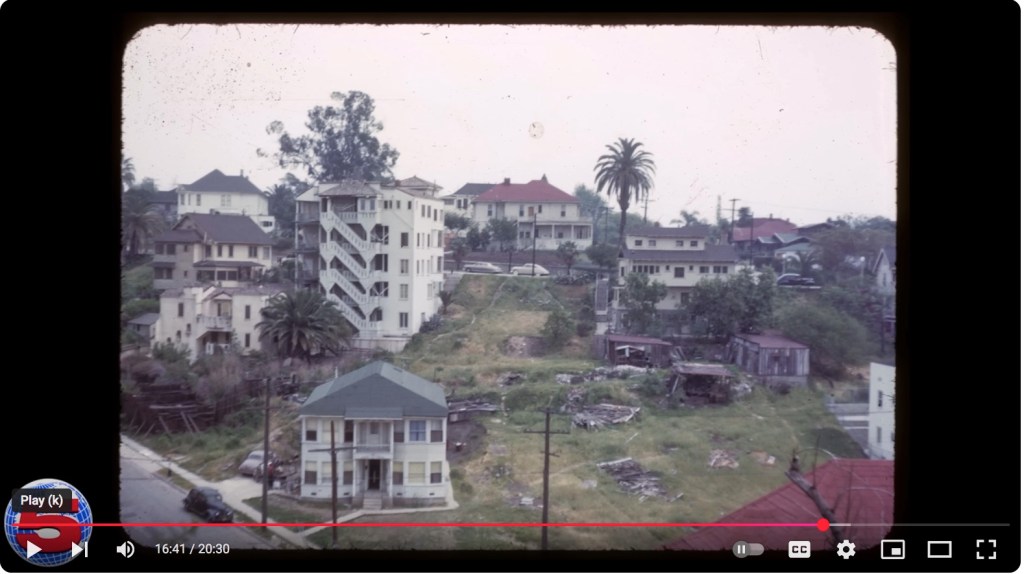
I kind of forgot about the whole thing until their video was posted, and, wouldn’t you know it, they stole from me:
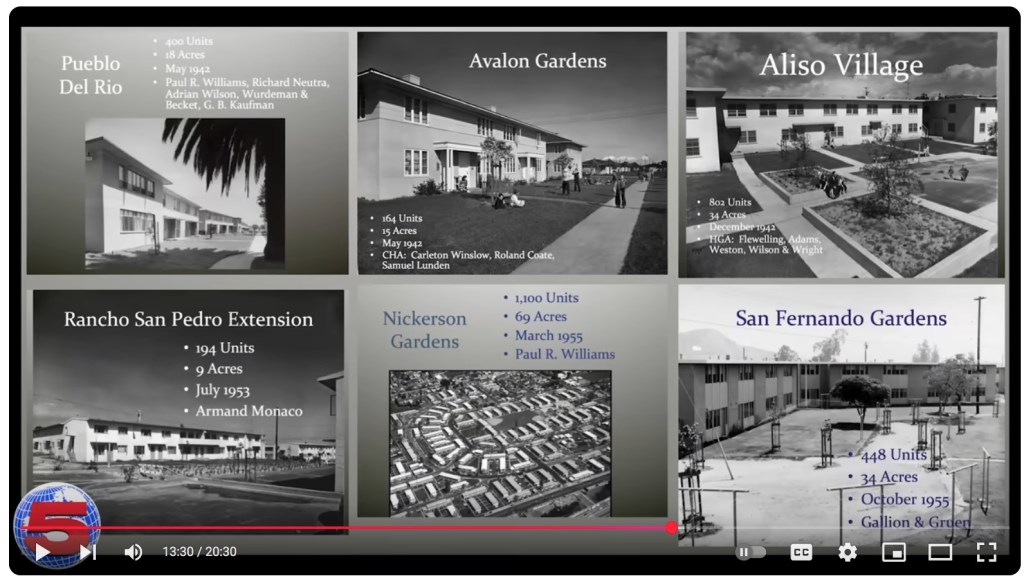

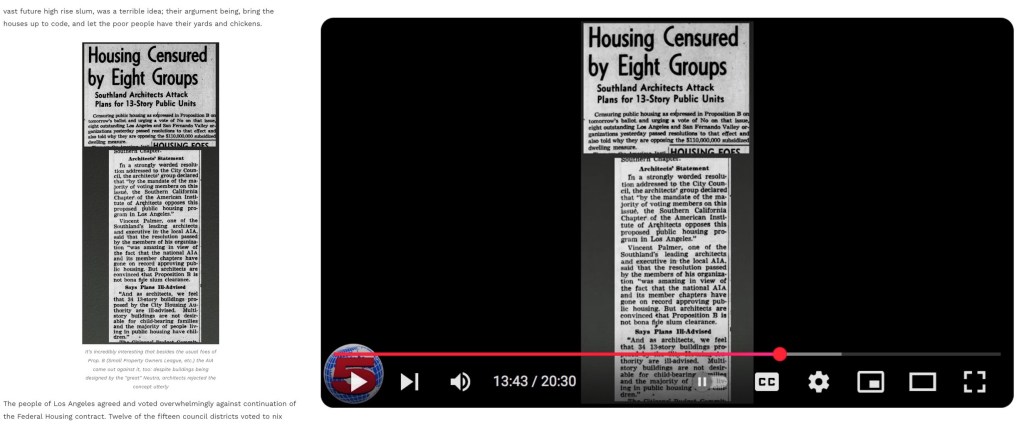
Which is fascinating, because it means they’d read my work, and consciously, purposely decided to ignore everything I’d written, favoring instead a bunch of deceptive, misleading, specious tripe.
Oh well. I did my best.
 Bunker Hill, Los Angeles
fascinating read.
LikeLike