Hello again! After last Friday’s blogpost about Channel 5’s Chavez Ravine video, blog reader janey_dlh asked “did you listen to the new Tinseltown Ghost Stories podcast?” so, here’s a rather similar investigation (though, good news, much shorter than last Friday’s post) into the claims made on the Tinseltown podcast. Granted, I was moved to pick apart Channel 5’s video because it had had so many views, so I feel a little bad picking on a podcast that has had significantly fewer. But, we put out the fires we find.
Also, while my Channel 5 takedown was lengthy and thus may seem comprehensive, be advised that this podcast contains a whole host of absolutely different mistaken assertions! Yes, like Channel 5, Tinseltown Ghost Stories repeats the ol’ “buried school” myth, but TSG goes off on all sorts of other wild flights of fancy like “there were no paved streets” and “Chavez Ravine residents banded together to shut down the local brick factories.” Read on!
***********
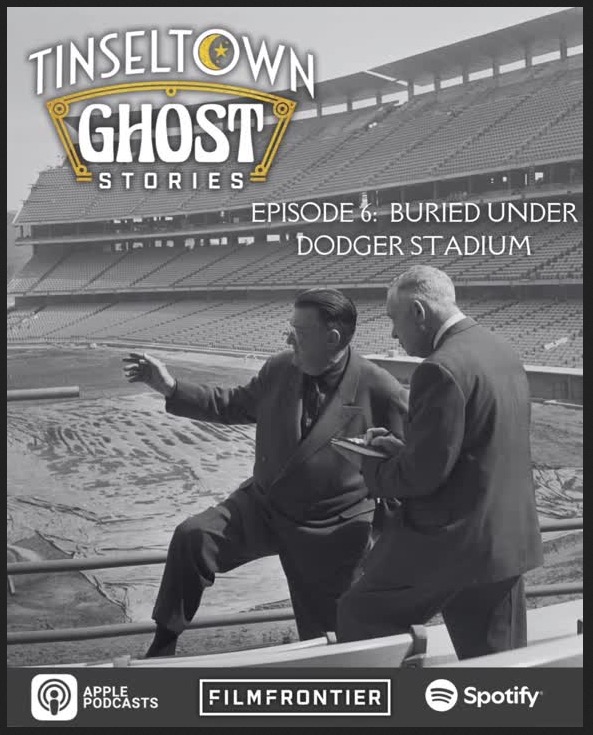
There’s a new episode of the podcast Tinseltown Ghost Stories: apparently, if you’re a security guard at Dodger Stadium, you spend as much time dealing with unquiet specters as you do unruly spectators. Ragged dust-covered children laugh and run about and then disappear into solid concrete walls. I can’t speak to the veracity of those claims, but, the majority of the podcast concerns the history of the land upon which Dodger Stadium is built, and because I have a keen interest in how and why do people believe what they believe about Dodger Stadium? it is my duty to address the podcast’s litany of spurious claims.
Sure, I get it, a podcast is not “real” journalism, and I shouldn’t expect the kind of fact-checking employed by, say, the Los Angeles Times or KCRW. (Oh, wait, those guys’ve published dozens of specious claims about Chavez Ravine, so, never mind.)
And honestly, I’m not trying to be a total asshat on the subject — the podcast’s author Kyle F. Andrews obviously likes spooky stuff, and is thus one of my kinsmen, and I certainly wish him no ill will — but it’s beyond my abilities to not nitpick a new piece of fable-peddling Chaveziana when it hits the market…so:

Let’s look at some of TGS‘s contentions, following (clickable) timestamps from the YouTube upload.
9:20 “the City enticed O’Malley by practically giving away land it already owned.” Nope. The city and O’Malley did an even swap. Walter O’Malley had, in 1957, purchased Wrigley Field, bounded by Avalon, 41st, San Pedro, and 42nd. It was valued at $2.25 million. O’Malley transferred that land to the city in exchange for the Chavez land, which was valued at $2.2 million. (Cue someone yelling “but the Chavez land should have been worth more, because it was bigger“, but the Wrigley Field land was flat, in a developed urban area, and fitted with modern infrastructure; the Chavez land would require a princely sum before ground could be broken for anything — in fact, an argument could be made that the city got the better end of the deal, rather than O’Malley.) The even swap was made with the proviso that O’Malley fund construction of the ballpark out of his own pocket; the city didn’t have an extra $23 million ($2.65 billion USD2025) in their coffers to spend building a ballpark, a major city improvement that cost the city nothing (and has since generated nearly a billion dollars in property taxes, to say nothing of the jobs and other tax revenue it has provided).
12:32 “(Julian Chavez) used his connections to buy up what had been a stone quarry and the land around it…” Nope. The land Chavez purchased (a purchase that, it should be noted, did not require any “connections”) was far to the north of the stone quarry. A ravine to the south ran up to near his land, thus, it was named for him (for example, a neighboring ravine that ran down to near the cemetery was called Cemetery Ravine…and one that ran up to near the reservoir was called Reservoir Ravine).
Ms. Lopez goes on to say “not much is known what Chavez did with his ravine…” Yeah, cuz, you know, he didn’t own the ravine.
Oh, and strictly speaking, since Mariano Chavez’s land was nearer the westernmost ravine that became Chavez Ravine, logically, Chavez Ravine is named after Mariano Chavez, not Julian Chavez. Right? Because, consider: no-one has ever asked WHY we associate Julian Chavez, specifically, with Chavez Ravine. Though Wikipedia authoritatively instructs us Julian “is the namesake of Chavez Ravine,” the first person to ever connect Julian to the ravine was an unnamed city employee in a 1957 issue of the city employee magazine El Pueblo, and that writer went on to say Julian owned the land that held the cemetery and pest house, which is absolutely untrue, thus the spew of our-friend-the-1950s-city-employee is to be rejected in toto. The Los Angeles Mirror, however, repeated the assertion in April 1957 and it has stuck ever since. I’m not saying it’s not true, necessarily, but we also can’t say we have proof that it is.
If you must nitpick, since the ravine-in-question-called-Chavez Ravine (ostensibly named for Mariano and/or Julián Cháves), which subsequently lent its name to the area as a whole, actually ran up to property owned by Jean Bouet (see here), really the ravine-and-thus-greater-area should be called Bouet Ravine…but, you know, I wonder if people would care as much if the whole place was named after some guy from the Nouvelle-Aquitaine.
13:27 “after Chavez died of a heart attack in 1879…the rural communities…soon moved in to take up residence.” Nope. Apart from two industrial brick yards, the area was empty until 1913; thirty-five years is hardly “soon.” Settlement began after 1913, and the majority of CR residents didn’t arrive there till the mid-late 1920s.
13:44 “Palo Verde, La Loma, and Bishop represented thousands of people on land that had been discarded.” Nope. The communities of Palo Verde and La Loma contained a few hundred people, and the community of Bishop barely existed before 1930. At the height of Chavez Ravine’s population, in 1950, the three communities contained a sum total of about 1,100 people.
And the land had never been “discarded.” The land where the Palo Verde and La Loma were established, were on tracts owned by George Hansen and Isaias Wolf Hellman, subdivided by developer James Richard Riggins, with many lots purchased and subsequently sold to early residents by lawyer Marshall Stimson. Exactly the opposite of “discarded.” The small community of Bishop, to the south of Palo Verde, was owned and developed by the father-son team of Joseph and Giovanni Garibaldi. It’s hard to imagine a less likely scenario than Los Angeles, a continuously burgeoning community where property was always at a premium, containing “discarded” land.
14:28 “Los Angeles essentially ignored these people —there were no paved streets…and no public transportation.” No, and “true, but“. The whole “there were no paved streets!” is a favorite and timeworn litany but in fact the vast majority of Chavez Ravine’s streets were paved, including Lilac Terrace, Bishops Road, Paducah Street, Davis Street, Effie Street, Gabriel Avenue, Boylston Street, Chavez Ravine Road, Garibaldi Drive, and Reposa Street. Here’s a “paved streets” shot of Boylston/Malvina Avenue/Stimson Court/Curtis Street; did you notice “Malvina”? Yes, even the most famous Chavez Ravine roadway, where the most famous Chavez Ravine house stood, was paved: here’s a shot of the Arechiga pad at 1771 Malvina, with a freakin’ manhole cover right outside the entrance.
And as far as there being no public transportation—that’s true, there was no public transportation, but also and more importantly, of course there wasn’t. “Public transportation” at that time didn’t exist, at least in the sense that the busses and streetcars that served the public were not publicly owned. All transportation that shuttled the public was privately owned and run, and if a bus or streetcar line didn’t turn a profit, it was shut down. If a proposed new bus or streetcar line was likely not going to turn a profit, you didn’t add that line. Government can afford to subsidize, and charities can afford to give away money, but public transportation during the time of Chavez Ravine was neither, because LA’s busses and streetcars were privately-owned companies. Believe it or not, private companies are in the business of making money — not losing money — and if they ran busses into areas that subsequently incurred financial losses, you can bet the shareholders would oust the board, or the board would oust management, and businesses really, really like to avoid that sort of thing. In short, Chavez Ravine got its death notice in 1950, was depopulated and demolished by the end of 1953, but there existed no taxpayer-funded/city-run bus line in Los Angeles until March 1958. So no, there was no public transportation to Chavez Ravine, and for good reason.
14:46 “the city was more than willing to move people into the ravine, as they did in 1913, after a flood” Nope. The city never moved a single person into the ravine. Private developers had bought tracts and subdivided (e.g., when the aforementioned James Riggins bought the Palo Verde Tract and portioned it up into individual lots). Then, from 1913 on, a man named Marshall Stimson—an attorney, and a bigwig in Republican politics—purchased individual plots and marketed them to some of the river-dwelling people who had recently crossed the border, fleeing the Mexican Revolution.
15:00 “they fought for themselves…when the pollution of the nearby brick factory became unmanageable, they took the owners to court…got the factory shut down” Absolutely not. The actual name of the case, heard Monday morning January 4, 1926, was People of North Broadway, College Street, North Figueroa St., White Knoll Drive, Marview Ave., Lookout Dr., Elysian Park Ave., VS The Los Angeles And Western Brick Co. The suit contended that blasting and dynamiting had ruined the plaster and foundations of houses in “the district bounded by North Broadway, College Street, Bishop Road, and Figueroa Street.” And, I might add, Municipal Court judge James Harlan Pope did not rule in favor of the plaintiffs. However, by the summer of 1926, the North Civic Center Improvement Association, located in the Alpine area south of Chavez Ravine (and headed by White Knoll Drive resident George Strong, who had brought the court suit in January), successfully campaigned City Council to pass a resolution shutting down the factories. What do you not notice in all this? The presence of any Chavez Ravine residents.
15:26 “the city turned its eye to the land and what it could mean to developers” Nope. “Developers” weren’t involved after the initial tract layout and plot sales, which, after about 1910, is the last time developers were involved in the process. Forty-some years after those developers had moved on, the city—specifically, a city agency called the Housing Authority—”turned its eye to the land” as a place to build a massive housing project. “Developers” connotes private, for-profit entities. The Housing Authority was taxpayer-funded progressives doing some social engineering, precisely the exact opposite of “developers.”
15:30 “But rather than work with the people, now numbering over 1,800 households, the city sneered at the community, labeling it blight and a slum” Nope. First of all, 1,800 households? The three communities contained no more than a sum total of 275 residential structures; the vast majority of which being small single family homes. At the height of its density, La Loma/Palo Verde/Bishop contained only about 1,100 individuals.
Also, the city labeled it blight and a slum because it was, or, at least, they had reason to believe it was. Hey don’t yell at me, I’m just saying: The American Public Health Association had a very strict rubric as to what defined blighted slums. LA’s Public Health Department followed these federal guidelines in ascertaining Chavez Ravine’s designation. Were there some excellent, well-maintained homes in Chavez Ravine? Of course there were. That said, in the area as a whole, more than one-third lacked indoor toilets, and one-quarter had no running water. Disease rates were off the charts: tuberculosis, diphtheria, scarlet fever, many times higher the city average. There were many makeshift structures, built of substandard building material. The area had a large amount of public dumping. And as has been noted, there were some inadequate streets, but more importantly, streets at grades too steep for emergency vehicles. The Municipal Housing Commission declared the area a blighted slum in 1935, fifteen years before the Housing Authority got to work redeveloping the area. (To see some images of Chavez Ravine housing, click here.)
And, the city “sneered” at the community? Nah. LA’s city government is famous for being moralistic and condescending, but it doesn’t sneer. The city, rather, patted the community on the head like it was a sick child and, in its paternalistic way, said “don’t worry, this is in your own best interests.” That’s not sneering, that’s being progressive.
15:45 “in the wake of war, the city would get its hands back on that land, no matter the cost” Huh? None of that even makes sense. How did the city not have its hands on the land? It’s not like Chavez Ravine’s residents seceded from the Union, refusing to pay property taxes and rejecting municipally-provided water or electricity. Even if they did, what did WWII have to do with it?
16:38 “legendary architect Richard J. Neutra” NOO-tra? Ok, fine, I don’t expect everybody to be able to pronounce German. Still, there was what, ten people who worked on this podcast? Nobody could pronounce Neutra, or thought to Google it, or watch any one of a million videos about him? Yeah, it’s not the end of the world, but if I went around pronouncing “Chavez” like “Chay-veez”, I’d never hear the damn end of it, would I?
16:51 “(Neutra was chosen because he designed) city projects, including Baldwin Hills Village” Noooooooooo. The chief architect of Baldwin Hills Village was Reginald Davis Johnson, with the firm of Wilson, Merrill & Alexander, in collaboration with consulting architect Clarence S. Stein. And in what universe was it a “city project?” It was privately developed and owned. Yes, the owners benefited via Depression-era federal funding through the Federal Housing Administration’s (FHA) Section 207 loan program, but that doesn’t make this government housing.
17:27 “(Elysian Park Heights was going to have)…schools, churches, and community centers.” Nope. ‘Twas not going to have any of that. In May 1950, EPH architect Richard Neutra suggested the plan could have three churches, three schools, nurseries, kindergartens, a community hall, and a 1,500-person auditorium; this was months before any actual drawings were made. Those lofty ideas never made it past the planning stage, and the actual project-as-developed contained no schools or such whatnot. Unfortunately, in his popular 2005 book Making a Better World, Don Parson wrote “incorporated within the project were to be sites for three churches, three schools…” etc. etc. which has forever cemented the mistaken idea that the subsequent actual plans included any of these amenities.
17:56 “and while much of the headstrong community had initially supported the idea of better housing, they soon realized that the city was intent on cutting them out of the deal entirely” Huh? How? The city made it very clear that the residents of Chavez Ravine would have the first spots in the new housing development. Of course, whether anyone would want to move from a rural village into a high-rise concrete filing cabinet is up for debate, but that still doesn’t mean the city “cut them out of the deal.” And there’s no evidence that residents had “initially supported the idea of better housing,” in fact, all evidence points to the opposite.
18:13 “city officials offered money to residents who agreed to move. Some took the payment, but it was barely enough to find a new home, much less uproot an entire family from land they had lived on for generations” Nope. 97% of the homeowners took the money, and that money was both legal and more than adequate. It was enough to buy new houses because that was the law. The monies being given to residents were under the strictures of federal, state, and local law, and continuously scrutinized by the courts. Each Chavez Ravine house to be purchased required multiple appraisals, and the law required a homeowner, thereafter, had to be paid the highest of all the appraisals. Thus, most homeowners got paid over the value of their homes. And, the city worked to find them new homes (and, new apartments were found for renters). And if you didn’t think they city was giving you enough money? You filed an appeal. Lots of people did and…got more money.
Also…land they had “lived on for generations?” A generation is twenty-five years. Most people built there in the mid-late 1920s and were gone by the early 50s; that’s one generation. When the very-earliest-circa-1913-colonizers departed, they hadn’t been there long enough to count as even two generations.
18:23: “as a result, a majority of residents remained where they were, holding out for a better deal” Nope. The majority were gone by 1953, having relocated elsewhere; they may not have liked it (contradicting 17:56 above, where we are told they “initially supported” the idea) but they did accept it. Compare the Sanborn maps from the summer of 1950 with the summer of 1953 (do so here): there were 311 structures in 1950, and 80 in 1953, indicating that 75% of Chavez Ravine was demolished. The ones who held out for a better deal? They got it, cashed their checks, and departed. Those families who held out to the very end — i.e., the Contreras, de Leon, Hanson, Nava, Scott, Chaffino, Lopez, Caranza, Carrillo, Longoria, and Nila clans (FWIW, here’s the Scott house, and where it was located) — worked with the system, and made out like bandits. The Arechigas, of course, are a whole ‘nother story; we’ll get to them.
18:30: “the city pushed its weight around, and gave Chavez Ravine residents an ultimatum: either accept cash for the residents now much lower than it was initially…” Nope. For the millionth time, that never happened. There’s this popular story that there was a “descending tier” of payments, to panic residents into selling. I won’t bother to recount why that’s a stupid fantasy, but if you really want to read about it, click here. Or here.
19:07 “however, just as soon as Neutra was prepared to break ground, another force came out against the housing project…the red scare…fears of secret communists…people who hated public service that smacked of socialism…” Okay, “Nootra” again, but, whatever. There’s a grain of truth to this part, but to be accurate, anticommunists didn’t come out against Elysian Park Heights in particular; they rebuked public housing in general. We’d built a whole lot of public housing but the time had come to say enough was enough. The City Council voted to end the federal contract. Then, the people of LA voted to end the federal contract.
The use of “red scare” and “fears of secret communists” winks at us “oh weren’t those red scare people silly and stupid” — because of course you were taught (as was I) that the Cold War was manufactured as a political tool, so that we could be repressive at home and aggressive abroad; everybody knows it was concocted by conservatives who ginned up a ridiculous fear-mongering narrative in order to control the populace. However, surprise surprise, that regime narrative is bullshit; and if you’re interested in the subject I go on about it here. (At the end of the day, all you really need to know about Communists, is they hate dogs, and delight in killing them.)
19:26 “Citizens Against Socialist Housing, or ‘CASH’…led the charge against public housing projects…with an assist from new anti-housing mayor Norris Poulson” Ehhhh, yes but mostly no: yes there was a thing called CASH, but only briefly, and it disappeared before Norris Poulson was on the scene.
First of all, it was the Committee Against Socialist Housing (though its full and proper was, apparently, actually the “Citizens Committee Against Socialist Housing” — but what fun is that since CCASH doesn’t acronym as “CASH”). CASH only existed between March and August of 1952, to help sway the voters against the public housing referendum Proposition B, as voted upon on June 3, 1952; CASH disbanded after the voters of Los Angeles did in fact reject public housing. Norris Poulson wouldn’t be elected for another year, so, no, there was no “assist” on his part. When Poulson formally nullified the housing contract in July 1953, he was just following the will of the people, and the directions of City Council; by that time, “CASH” had long since evaporated.
19:54 “eventually, the land was traded to the Dodgers, and William O’Malley and his team’s vision for a stadium won public approval” Who the hell is William O’Malley? Let’s move on.
20:02 “as for the families that were still living there, the city was done playing games. Sheriff’s deputies arrived in 1958 and forcibly evicted the remaining residents in an event still known as the Battle of Chavez Ravine.” 1958? Do you mean the deputies who showed up in May 1959 to remove the Arechiga family? That’s like the most famous part of the whole story, and you get that wrong?
20:27 “houses built higher on the hill were torn down, while those in the ravine itself were simply buried underneath all the displaced rubble. That includes Palo Verde Elementary, where neighborhood students once learned, sang, or played, now buried dozens of feet beneath the stadium complex” Auuuuuugh this again. First of all, there were hills and valleys among the five ravines in the greater Chavez Ravine area, so you can’t speak of “the ravine itself”. More importantly, no house was buried, least of all the damn elementary school. Here, take a look.
“But…but…SINGING CHILDREN!!!” At 21:55 Ms. Lopez continues that while we don’t know how the dead children who haunt Dodger Stadium died, we should not be at all surprised they wander the area, because there’s that whole buried elementary school down there! Damn, this is like the annoying cousin of the Kamloops Grave Hoax.
Then there’s talk about the mysterious Lady in White, a spectral apparition who haunts the grounds, because she is:
22:56 “expressing her displeasure at the city’s lack of empathy for its poorest residents” Uhhhhhh….that’s actually completely backwards. The poor folk of Chavez Ravine were displaced because of too much empathy. Every single person who lost their home did so because progressives were hell-bent on expressing empathy, sympathy, and compassion. The fact that patronizing, paternalistic do-gooders screwed the pooch on the whole shebang shouldn’t surprise anyone — but you can’t deny they were lacking empathy. You’ve heard of the road to hell?
And it goes on for a bit more (the Chavez Ravine kerfuffle is referred to as “one of the city’s original sins,” which indicates a complete misunderstanding of foundational acts) and then it’s over.
************
The nonsense of it all gave me a headache, but don’t get me wrong, I still kinda liked it. I dig anything involving spookiness, and Bianca Lopez has a wonderful voice. But, I mean, come on. If y’all had dug into the subject past the first page of Google, you might have seen my posts on the subject from a year ago, and therefore avoided some of the more embarrassing gaffes. But that wouldn’t have been nearly as much fun to podcast about, would it?
 Bunker Hill, Los Angeles