Greetings, faithful Bunker Hill blog reader! Having perused my posts here, you know I criticize incompetent “journalists” who befoul the mainstream press, and routinely malign those propaganda-pushing “historians” who infect the internet with their mortifying twaddle. But then I’m sure you roll your eyes and say “well, Nathan, anyone can deride AI, or pick on TikTok; if you think you’re so smart why don’t you actually take to task some real scholarship?” Well…okay then.
There are two books about Chavez Ravine — one is Eric Nusbaum’s Stealing Home, which I rather like, and have mentioned in passing. Nusbaum’s a sports journalist who based much of his book on oral histories. The other book, though, isn’t journalism, it’s scholarship, built on a framework of academic rigor and intellectual elbow grease.
Thus I trembled with trepidation as I approached the REAL book about Chavez Ravine, it having been penned by a bigshot UCLA history professor with a PhD from Oxford. Certainly a bigshot UCLA history professor with a PhD FROM OXFORD will marshal historical fact with erudition and insight!
Ha ha, nah.
I speak of the late John Horace Michael Laslett and his Shameful Victory. I took a look and, um, ooof. In an effort to understand how and why do people believe what they do about Chavez Ravine? the proper response to Laslett’s book should be a page-by-page, line-by-line refutation of its poor research and fanciful claims, à la Larry Harnisch’s takedown of Donald Wolfe’s The Black Dahlia Files. But I don’t have time for that. I glanced at Shameful Victory and, from my admittedly extremely limited exposure to Laslett’s work, I can say the book certainly appears to be garbage.
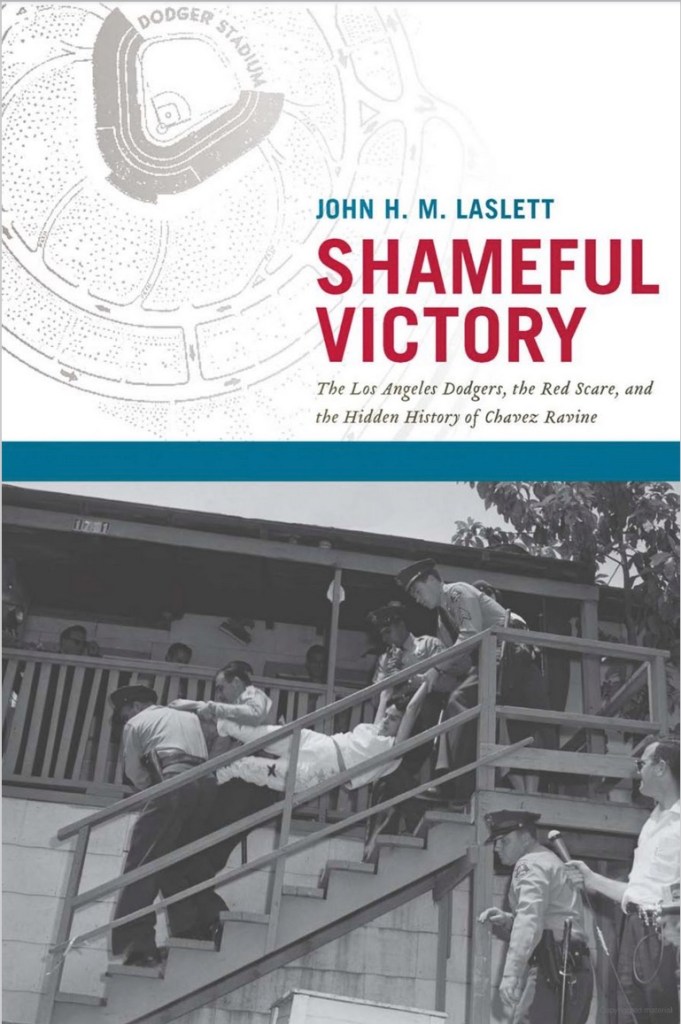
The fact that a professor emeritus at UCLA’s History Department wrote garbage — garbage subsequently published by the University of Arizona Press…garbage published in part with your tax dollars — should surprise absolutely no-one.
Hey, maybe the book is not garbage: I don’t actually know, because to be honest, I didn’t read the book. (Having already penned 40,000 words on the subject, I’m not sure an exhaustive takedown of Shameful is the best use of my time, and certainly not of yours.) Instead, I read the prologue, which is on books.google.com — and that told me everything I needed to know.
Ergo, in lieu of dissecting all 218 pages of the entire book, we’re going to go through the introductory opening salvo of the book’s prologue line-by-line (something I’m woefully known and prone to do):
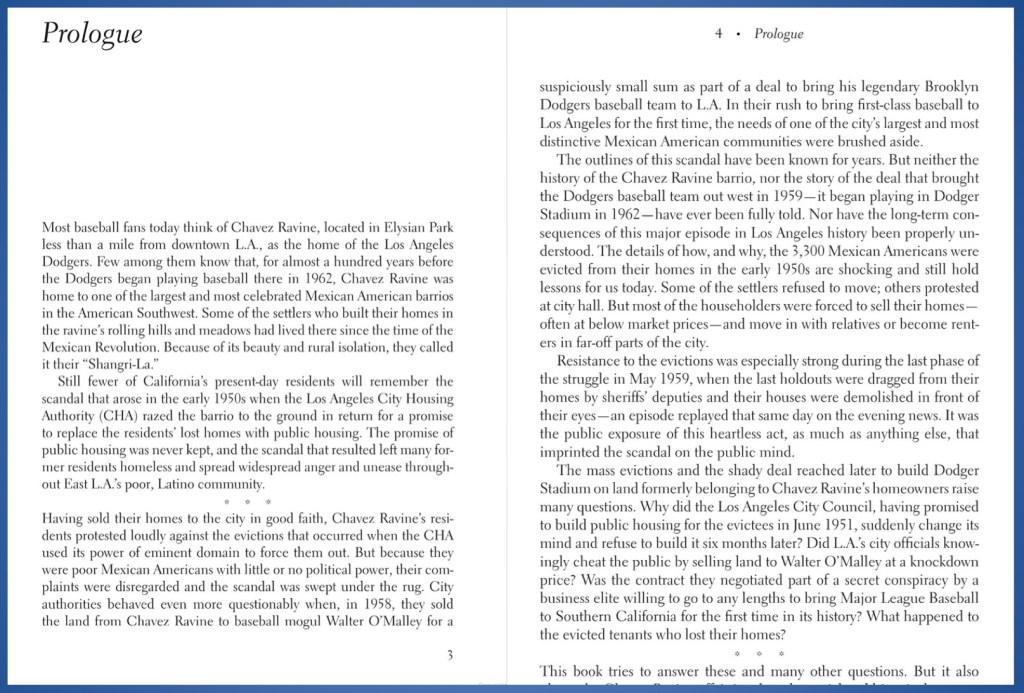
I’m willing to concede that if and when I actually read Laslett’s book, I may very well exclaim “holy carps Laslett is a genius and I’ve had my beliefs about Chavez Ravine totally remade!!! This isn’t garbage AT ALL!!!” …but until I do so, let’s content ourselves with Shameful‘s six opening paragraphs, whose nineteen sentences spew a gusher of nonsense:
Paragraph 1.
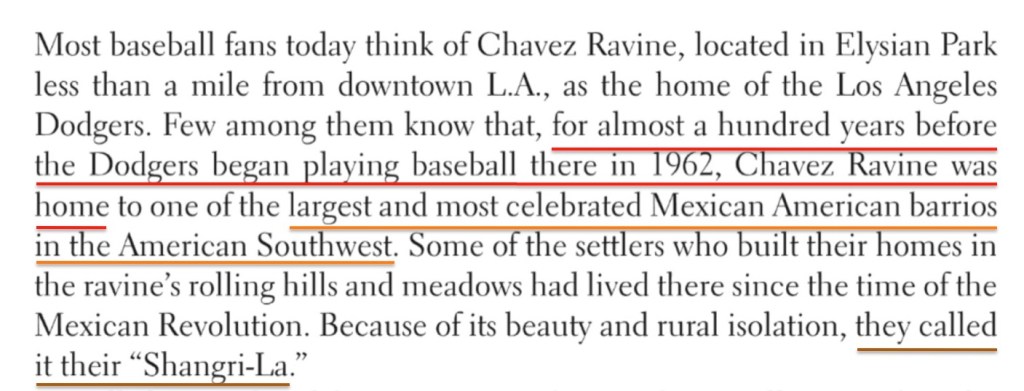
a) there was a barrio in Chavez Ravine “for almost a hundred years” before 1962. No: from 1862-1913 the area was empty, save for industrial plants, and a pest house/cemetery on its southern ridge. It was settled, sparsely, after 1913, though the vast majority of settlers arrived in the 1920s, especially after the 1926 closure of Chavez Ravine’s industrial plants. It was thus “home to a barrio” for about thirty-five years, a far cry from “almost a hundred.” To be accurate, the barrio existed a scant twenty-five years, because the area was depopulated and demolished not in 1962, but in 1952.
b) said barrio was “one of the largest and most celebrated” before its demolition by the Housing Authority. That’s a ludicrous assertion. There were 115,000 Mexican Americans in Los Angeles in 1960, in barrios much larger than Chavez Ravine. And “most celebrated?” CR is certainly celebrated now, but definitely not during its actual existence. One of the very few mentions of the place, during its limited lifespan, was in this 1928 Evening Express feature. There were also a few newspaper stories about the area as it was being demolished in the early 1950s, and news accounts of the 1959 Chavez Ravine eviction, but those were hardly celebratory. Perhaps Laslett is attempting to connote, in a convoluted way, “it was home to a barrio that was celebrated forty-some years after 1962” but that’s definitely not the way it reads.
c) “…they called it their ‘Shangri-La’.” Nope. There are no accounts and zero evidence “they” did anything of the sort. Yes, one person said it one time, but that was a white guy from Seattle, who wrote—fifty years after the fact—that when he first saw it, he “began to think he had found a poor man’s Shangri-la.”
Paragraph 2.
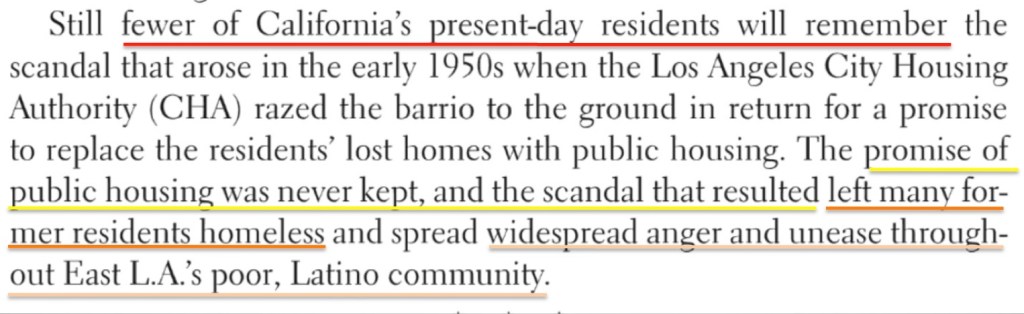
a) “few people today remember…” Ugh. When I moved to Los Angeles in 1993, I constantly heard tales (tall and otherwise) about Chavez Ravine, while chatting up the local barflies; Mechner’s documentary came out in 2003, as did Culture Clash’s play; then came Cooder’s album in 2005; and the “Battle of Chavez Ravine” Wikipedia page in 2006; and let’s not forget the many news articles (e.g., this and this and this and this and this) let loose on the world well before Shameful Victory‘s publication in 2015. I’m willing to accept that people-at-large may be more Chavez-savvy now, in 2026, than they were when Shameful Victory was published in 2015, but given Chavez Ravine’s indisputably prominent cultural place before the publication of Laslett’s Shameful Victory, I totally reject Laslett’s “few know and few remember” shtick.
b) “public housing promise not kept, resulting in scandal” No, because there was no scandal. The people of Chavez Ravine didn’t want to live in public housing, promise or not. They weren’t going to be made to, although, they would have had first crack at life in the projects come their completion (five? ten?) years down the line. That said, the homeowners who bought new houses, and the renters who were relocated, were perfectly content not being placed in the high-rise projects.
c) “…left many former residents homeless” Noooooo, no-one was left homeless. NOT ONE PERSON. Each and every person was relocated, in accordance with the law. Somehow we’re supposed to believe that the Housing Authority of Los Angeles—staffed by starry-eyed leftists, who had been handed huge sums of Federal money—rather than relocate people, elected instead to break the law, for no reason, in a concerted effort to make poor people homeless. We’re supposed to accept that — despite there being a relocation office in Chavez Ravine, staffed by Spanish-speaking city employees with a long record of relocating people — they broke federal, state, and city law in not relocating people, AND not one person complained? No-one mentioned it to the newspapers, or during the month-long 1953 investigation of LA public housing by a House of Representatives Subcommittee, during whose hearings residents and activists aired their grievances in no uncertain terms?
d) “not building the public housing project = anger and unease among Latinos” Nah. I reject the notion that residents were angry they didn’t get to live in public housing, because, on the contrary, we do have contemporary accounts of residents saying they didn’t want to live in public housing. Moreover we have zero accounts of residents being angry because of the cancellation of Elysian Park Heights. If the Latino community had anger and unease just because they were removed for the project (which is not what Laslett is saying), well, with that I would agree completely. I’d be angry too. But that doesn’t make Chavez Ravine special. I’m sure the greater Hispanic community felt that way about eminent domain when it was used to expand the Civic Center in the 1950s (for which thousands more Latinos were removed than for Chavez Ravine) or the dozens of other times people were removed for slum clearance/public housing, not to mention all the roads, schools, fire stations, and other governmental “takings” involving eminent domain.
Paragraph 3.
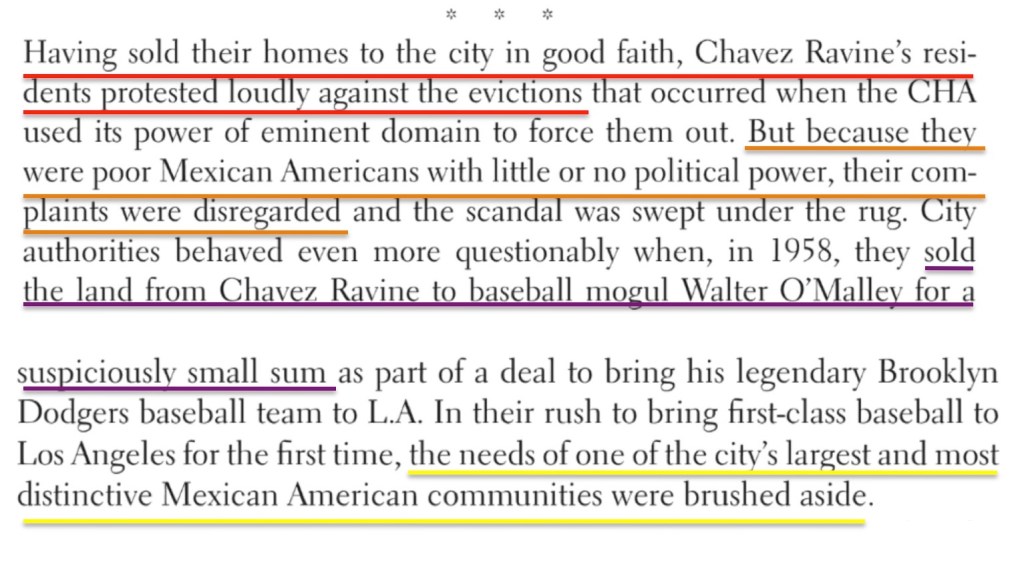
a) “…they sold their homes in good faith but then protested when forced out” This doesn’t make any sense: yes residents protested, but, the way Laslett frames this with “having sold their homes to the city in good faith” he thus connotes that residents were protesting the subsequent cancellation of public housing. Which never happened. Rather, there were resident protests in the spring/summer of 1951 because they didn’t want to lose their homes to a public housing project (e.g., this and this) which was two years before the cancellation of the project.
Again, it just doesn’t make sense that they “sold their homes in good faith” and then were “forced out.” It shocks me that University of Arizona Press doesn’t have an editor on staff (jk, the buck stopped with Kristen Buckles, who ignored said buck).
b) “because the people involved were poor and Mexican, the scandal was buried and their complaints disregarded” Not true. Laslett has constructed a narrative here that CR residents complained/there was a scandal due of the cancellation of a public housing scheme (for which they had “sold their homes to the city in good faith”). First of all, that didn’t happen, and then he plays the race card, saying they were ignored because they were poor and brown. In actuality, the opposite of Laslett’s contentions was the case. The people had complaints about the odious public housing scheme, and these complaints were heard. Residents packed Council chambers and the mothers staged a sit-in. They didn’t want public housing because they liked fresh air and having chickens, and, believe it or not, working-class Mexican Americans didn’t like socialism. Point being, this sentence, and most of Paragraph 2 before it, are about how sad and angry residents were, because they didn’t get the public housing they were promised. Which is nonsense.
Note Laslett goes on to say there was a “scandal” when again, there was no scandal involved when City Council voted to nullify the public housing contract with the feds in December 1951, and more to the point, there was no scandal when the people of Los Angeles voted to nullify the public housing contract in June 1952. In fact, the district that included Chavez Ravine voted overwhelmingly to do away with the public housing contract.
While Laslett says the cries of “poor Mexican Americans” were disregarded by the politically powerful, let’s remember who turned their backs on the aforesaid poor Mexicans: the politically powerful Mexican-American lobby of civic groups like El Congresso, and Asociación Nacional México-Americana. They were the ones who aligned with the progressive Housing Authority, and against small homeowners who wanted to be left in peace.
c) “Walter O’Malley got the land for a suspiciously small sum” Oh dear, this again. So, no: Walter O’Malley had, in 1957, purchased Wrigley Field, bounded by Avalon, 41st, San Pedro, and 42nd. It was valued at $2.25 million. O’Malley transferred that land to the city in exchange for the Chavez land, which was valued at $2.2 million. (Someone always asserts “but the Chavez land should have been worth more, because it was bigger“, until they are reminded the Wrigley Field land was flat, in an urban area, and fitted with modern infrastructure; the Chavez land would require a princely sum before ground could be broken for anything.) The even swap was made with the proviso that O’Malley fund construction of the ballpark out of his own pocket; the city didn’t have an extra $23 million ($2.65 billion USD2025) in their coffers to spend building a ballpark, a major city improvement that cost the city nothing (and has since generated nearly a billion dollars in property taxes).
d) “in the rush to bring a baseball team, this Mexican community’s needs were brushed aside” Ugh. So, regarding the “largest and most distinctive” community to which Laslett refers: they were told of their fate in 1950. They had their day in the sun to argue said fate, but lost, because one always loses to paternalistic, progressive, publicly-funded government agencies who “know what’s best for you” (and who, I might add, never thought one whit about a baseball team). The community then had its needs met, in being relocated, save for handful of stragglers, by mid-1953.
The “rush” to which Laslett refers conveniently ignores the rest of 1953, all of 1954, plus all of 1955, and 1956, and much of 1957. So the only “rush” began in 1957, and was composed of two solid years of Dodger-related scrutiny and debate through 1958, and into 1959. During this time the matter was hashed out in the courts up to and including the Supreme Court, and during this “rush” the City Council voted on the matter, and during this “rush” the citizens of Los Angeles voted on the matter. More importantly, no “community needs” were “brushed aside” at that time, since the community in question had been dispersed five years before.
Paragraph 4.
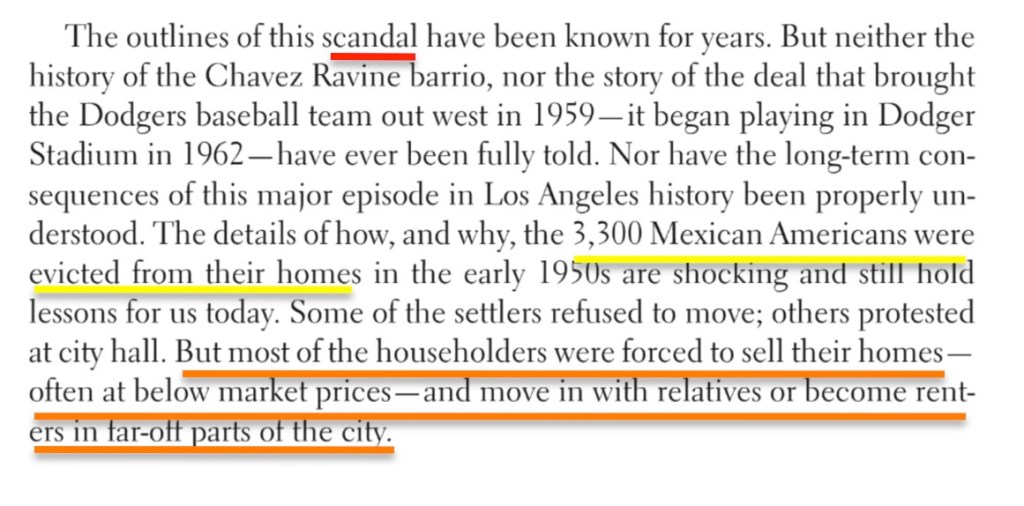
a) “this scandal” Jeez, again: The asserted scandal, as outlined by Laslett in Paragraph 2, is that there had been a plan to build public housing, which was, however, not built. Not a scandal. Laslett may not like it, and he clutches his pearls and is positively scandalized by this happening, which doesn’t make it a scandal, nor was it ever considered a scandal. “No,” I hear you say, “the scandal is that after the public housing contract was cancelled, the residents didn’t get their homes back.” First of all, that’s not what Laslett was saying. But even if he was, still not a scandal. The people were paid for their homes. They were 80% demolished by the time Poulson killed the housing contract in mid-1953, so there was nothing to give back, plus, 99% of its residents had already been relocated, with government help.
b) “3,300 Mexican Americans” Noooooooooo. As has been conclusively and repeatedly demonstrated, there were a total of about 350 structures in the Chavez Ravine area. Of those (after subtracting stores, schools, churches, garages, chicken coops, and other outbuildings) approximately 275 structures were residential. Figure about four persons to one dwelling, and we’re looking at 1,100 people. (What needs to happen is the production of a spreadsheet of every house with every person. I am more than willing to take on this formidable research task, but, I’m tired of doing this stuff for free.)
So, where does Laslett source this “3,300” number? Likely from Drew Pearson. Pearson — a famously slimy, unscrupulous Washington DC rumor-monger, whose scurrilous attacks always contained absurd falsehoods — dashed out a piece about Chavez Ravine in December 1957, and needed a number…and in classic Pearson fashion, he just made one up, when he asserted the city had removed “3,300 families“…which it would appear Laslett downgraded to 3,300 people, which is still about three times too many. (Fun fact: the only other time Pearson [who lived in DC and never set foot in Los Angeles] spoke about Chavez Ravine was a couple weeks after the Watts Uprising; on September 3, 1965, Pearson stated the riots happened because the city had torn down the “Negro shacks” of Chavez Ravine and relocated all the Negroes to Watts. Now that’s journalistic excellence!)
Also, Laslett stating we only removed “Mexican Americans” directs us away from the fact that 3/4 of Chavez Ravine residents were born in the United States; it’s natural to assume CR residents were of Mexican birth, rather than Americans with Mexican ancestry, but the facts are more nuanced. And, of Chavez Ravine’s small foreign-born population, even they weren’t overwhelmingly Mexican-born; nearly half were European-born (mostly from Central Europe, Germany, and Italy).
EDIT: since publication, I have been contacted by two separate and esteemed researchers about this subject. Both pointed out that a sensitive reading the Enumeration Districts of the 1950 Census indicates that the 3,300 number is likely correct. My next mission is to the check population schedules vis-à-vis map boundaries, and look forward to updating everyone as regards this important element of the topic.
c) “forced to sell at below market…had to move in with family or become renters in some far-flung part of the city” Omigod for the last time, people, NO. First of all, the majority of residents were already renters. 60% of Ravine residents were renters, according to a study by Eduardo Obregón Pagán. And of course, there was the aforementioned relocation office in the Ravine, helmed by the Victoria Alonzo, who kept a file of everyone’s needs, and worked to relocate them nearby. And of the people who sold their homes, they stayed in their homes until the relocation office found them somewhere to their liking.
Here’s a point I have to stress: you will frequently hear that the homeowners of Chavez Ravine were robbed of the ability to build generational wealth. This is BS, and in fact, the opposite is true. They were taken from a rural area with high disease and crime rates, with substandard services and substandard housing, and relocated into areas with grade-A housing and proper urban infrastructure. So yeah, you may have listened to your grandparent’s tales of the wonders of Chavez Ravine, but the reason you inherited your grandparents’ two-million-dollar house in Echo Park is because they were relocated to a better area.
Laslett starts this sentence with the old “forced to sell at below market” which is, again, a fantasy. The Housing Authority—city—had federal money and had to abide by state court strictures, so they had the unholy triumvirate of local, state and federal oversight into their means, methods, and adherence to legalities. Because the feds were involved, if the HA had tried any funny business, you know who would have gotten involved? The FBI. And you don’t mess with 1950s FBI.
In short: redevelopment law requires any redevelopment agency to buy at the very highest end of fair market value. Fair market value is determined by independent appraisers. The redevelopment agency is required by law to pay you the highest appraisal. If you and the agency still do not agree, you file an appeal with the court, who will make a determination. I won’t bore you with the intricacies of Sacramento v. Heilbron 156 Cal. 408, or Eachus v. City of Los Angeles 130 Cal. 619, but suffice it to say, when “assemblydems” or whoever say there was “little or no compensation” they are either stupid or lying. Or both. But I expect mendacity from politicians and people who spew on the internet. I would like to think university professors, like Laslett, held themselves to a higher standard.
Paragraph 5.
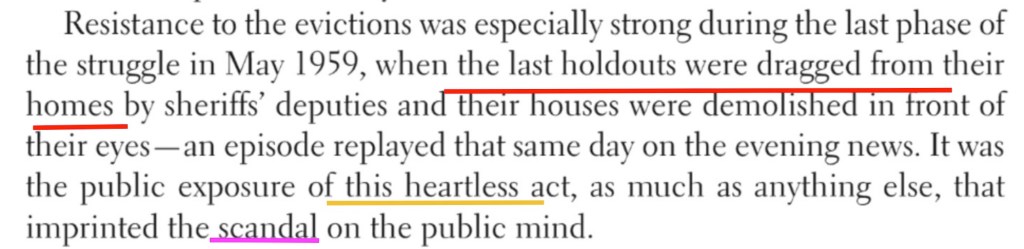
a) “….the last holdouts were dragged from their homes….” Dramatic nonsense. If by holdouts you mean one family—the Arechigas—and by dragged from their homes you mean one member of that family who, I might add, never even live there, and showed up after the sheriff deputies had arrived and camera crews had set up, only to run up and into the house for no other reason than to be hauled out for the television cameras.
And…. “last holdouts?” There were actually a bunch of other holdouts, with names like Contreras, Lopez, Caranza, Carrillo, Longoria…and they stayed in their homes all the way into the spring of 1960. Because they, unlike the famed Arechiga family, had gone through proper channels, and got hefty payments. The Arechiga family—well, a small slice of them, since it was just Manuel & Abrana who lived at 1771 Malvina and daughter Victoria who lived in her parent’s house next door—were removed because they considered themselves above the rules. Then they left, and went to some of the many other homes they owned outside of Chavez Ravine.
b) it was a “heartless act” Oh dear. Laslett makes it sound like the Arechigas were poor people who had no idea this would happen to them, and/or had nowhere to go. But they hadn’t held legal title to their house for over seven years; they hadn’t paid any property taxes during that time. They’d been in and out of the courts repeatedly. They’d weathered and stalled previous evictions. And all during this time they’d been buying up other houses around Los Angeles…like, lots of them. The final straw against them was the judgement Arechiga v. Housing Authority of City of Los Angeles, 159 Cal. App. 2d 657, 659-60 (1958). They were told in March 1959 they were absolutely going to be out in April 1959, but their lawyer still managed to stall another month, so come May 1959, yes, sheriff’s deputies got them out.
Was it “heartless?” Sure, maybe. Eminent domain is a bitch; consider Kelo v. New London or Berman v. Parker or the odious Hawaii Housing Authority v. Midkiff or, more to our point, Cascott v. City of Arlington. But the two Arechiga dwellings were ordered demolished by the Board of Public Works after the Department of Building and Safety declared them unsafe, having been built of substandard building materials. After losing their homes in 1953 were they heartlessly removed? No, they were allowed to occupy them for another five years.
c) “scandal” God, there’s that word again. You know what the scandal was, Professor Laslett? Not that the Arechigas had to be presented with a Superior Court Writ of Possession and moved out and their house torn down, though that certainly scandalized the nation at the time.
No, the scandal was that the Arechigas claimed to be homeless, when they owned a bunch of other homes. The scandal was that a man named Jim Donnell very nicely brought them a 19-foot trailer in which to live, but indignantly reclaimed it (and told the papers he “felt like a boob”) when the world found out the Arechigas owned eleven other homes.
Paragraph 6.
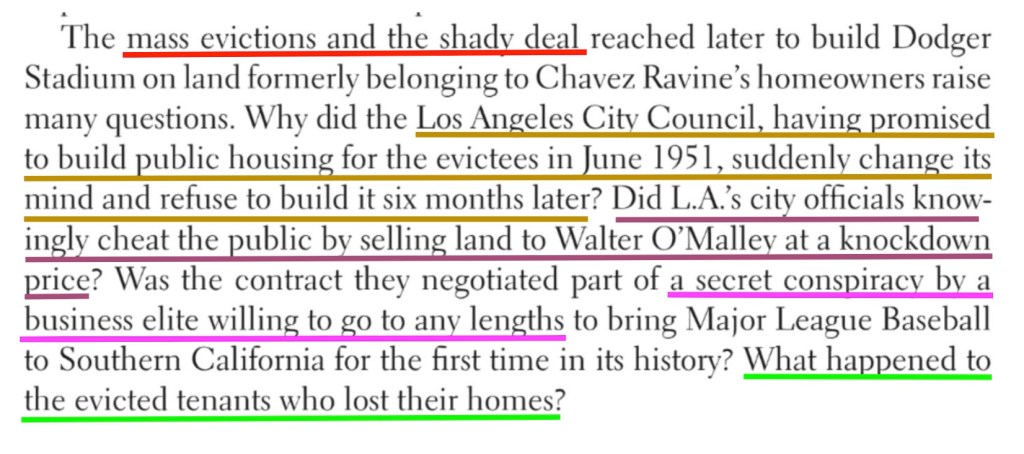
a) “…mass evictions and shady deal” Welllll... “mass evictions” certainly sounds terrible, but let’s remember, total Chavez Ravine evictees number barely one-third of the number displaced by the County for the Civic Center in 1949-50, and about a tenth the number of people displaced by the CRA on Bunker Hill in 1961-64. Government’s primary function is, apparently, to displace people constantly.
But let’s talk about the “shady deal” that allowed Dodger Stadium to be built. Pretty simple, actually: the City spent years trying to figure out what to do with the land (cemetery? zoo? music center?) until they decided baseball stadium. The City didn’t have the money to build a baseball stadium, but this Walter O’Malley character did (to the tune of about a quarter billion dollars, adjusted for inflation). Was O’Malley given the land in a sweetheart deal, as folks often assert? No. He owned Los Angeles property worth $2.2 million, and the Chavez property was worth $2 million, so, he and the City swapped. Still, if something smelled funny about the deal, it could have easily been nixed by the City Council, who instead voted to approve it. And yet still, it went before the voters, and it didn’t seem shady to them, who also approved it. Because the deal was endlessly hashed out by the media, the courts, the voters, it was in fact the most transparent and scrutinized deal in freakin’ history, but it’s fun to call things “shady” nevertheless, isn’t it?
Laslett says the “mass evictions and shady deal…raise many questions” and these are they:
b) “why did the City Council suddenly change its mind?” Dun dun DUNNNN! Laslett states they “suddenly” changed their mind and “refused” to build public housing…. ooooobviously there’s something fishy here…something suspicious! Except there’s not. So, the City Council approved the sites of multiple proposed public housing developments on November 22, 1950, and on June 26, 1951 the City Council upheld the site selection when the City Planning Commission wanted it reduced. At that point the council was pretty evenly divided between pro-and-anti public housing, with a slant toward public housing proponents, however, the scales were tipped when Charles Navarro, a public housing opponent, assumed the seat of pro-housing councilman G. Vernon Bennett (Bennett had been found guilty of lewd conduct with another man in a Lincoln Park restroom, which killed his career). Then, at year’s end, councilmen Harold Harby and Ed J. Davenport changed their minds on public housing, which meant an antihousing bloc had a majority in the Council. Of course, many people allege conspiracy! and collusion! because it’s somehow inconceivable that Harby and Davenport could change their minds. But change their minds they did, even in the face of tremendous political opposition: the mayor, all the labor unions, all the church organizations, all the progressive ethnic and civic organizations, all who desperately wanted to confiscate Chavez Ravine homes and relocate CR’s residents into high-rise concrete filing cabinets.
I know we all like to believe that a councilman will only change his mind about something because he’s being blackmailed (e.g., the freeway in LA Confidential is approved when a councilman is blackmailed via compromising photographs) or they’ve stupidly fallen for ludicrous red-baiting (Harby switched his vote, he said, to combat “the creeping cancer of Socialism”) but in any event, on December 3, 1951, the Council voted 8-7 to rescind the fed contract.
c) “…did the City cheat the public by selling the land at a knockdown price?” Um, no, because that didn’t happen. See above.
d) “…was there a secret conspiracy by a business elite?” Ugh. Well of course, the 98-degree Masons and the Elders of Zion conspired with J. Paul Getty to gain control of Chavez Ravine’s oil deposits, drilled in secret by the Lizard People’s COO James Jesus Angleton.
e) “…what happened to the evicted tenants who lost their homes?” Again, it’s called relocation assistance. The relocation division of the Housing Authority was fresh off of moving 3,000 people from Bunker Hill. Their Chavez Ravine relocation office worked with the residents — for example, those who had sold their dwellings remained in their dwellings until a satisfactory place had been found for them. Those who were renters were found satisfactory units nearby … only, you know, up to code and with toilets.
Don’t get me wrong, the question of “what happened to the residents of Chavez Ravine” is intensely fascinating. In early 2024, when Wendy Carrillo floated the Chavez Ravine Accountability Act/AB 1950 reparations bill, part of its demands included a database identifying all the area’s landowners and renters. I was hoping I’d be thrown into the mix, so I could spend my days entering 1950 Census information into a master list, and digging through Housing Authority records at City Archives in hopes of ascertaining the exact payments and resident movement and the rest. I’d still like to do that, of course, but I have so few years left to realize so many projects. (Though if you pay me, I’ll start tomorrow!)
**********
And that, faithful reader, is my thorough review of Shameful Victory: The Los Angeles Dodgers, the Red Scare, and the Hidden History of Chavez Ravine, if by thorough you mean a rigorous review of the opening part of the prologue. Seriously though, if the mere prologue is that full of absolute crap, what’s the point of reading further?
Of course, I may still recant everything I’ve said above. Should I actually read Shameful Victory, there exists the possibility I will be so won over by Dr. Laslett’s assiduous arguments, and so convinced by his scrupulous source citing, that I will be forced to make a point-for-point retraction of what I’ve said in this post. Stranger things have happened.
However, I’m not going to spend $25 on a copy. If you’d like to send me your copy, please feel free, and I’ll read it and make a follow-up post allll about it. Drop your used copy in the mail to Nathan Marsak, PO Box 412636, Los Angeles, CA 90041.
Veritas numquam perit!
 Bunker Hill, Los Angeles
You would honestly think a Professor of History at UCLA would take the small amount of time to check his facts first. It also bothers me that a Professor of History would perpetuate the lies that constantly circulate about Chavez Ravine. Like you, I won’t waste the time or money on him. That prologue told me all I need to know. I bet the Arechigas family will embrace him with open arms.
LikeLiked by 1 person
UCLA should give you a job teaching future historians, journalists, etc. how to fact check. God only knows a horrifying number of them suck at it or don’t even try.
LikeLiked by 1 person
I have a copy of the book that I was planning on reading but your review has convinced me to mail it to you. Expect it soon – Rich Woolery
LikeLiked by 1 person
You’re doing the Lord’s work by refuting this narrative point by point. I hope the official Dodger historians are aware of it and have added it to their archive.
LikeLiked by 1 person
I’m sure Laslett was a very competent Labor Historian before he confused activism for history while at UCLA (see the obit written by his son at https://history.ucla.edu/wp-content/uploads/2025/03/John-Laslett_-A-Scholarly-Remembrance_Dec-2025.pdf ). Shameful Victory was written in his 80’s when he was obviously not at the top of his game. More of a love letter to La Raza de Aztlan than a scholarly work.
LikeLike