Since you’ve read Bunker Hill, Los Angeles and Los Angeles Before the Freeways, you are aware that early Los Angeles was shaped by an impressive array of top-shelf architects, most of whom have receded into obscurity.
Antonio Gonzalez, a distinguished librarian and devoted chronicler of early Los Angeles, seeks to deepen your understanding of this vital subject. In 2019, he published Architects Who Built Southern California, a concise but incisive monograph profiling Harrison Albright; John Austin; Claud Beelman; Elmer Grey; Hudson & Munsell; Albert C. Martin; Meyer & Holler; Julia Morgan; Morgan, Walls & Clements; and Alfred F. Rosenheim. He’s also had an incredible blog called misterdangerous.
Flash forward to today and he’s out with his new contribution, entitled Early Architects of Los Angeles: Fifteen Profiles, 1884-1951.
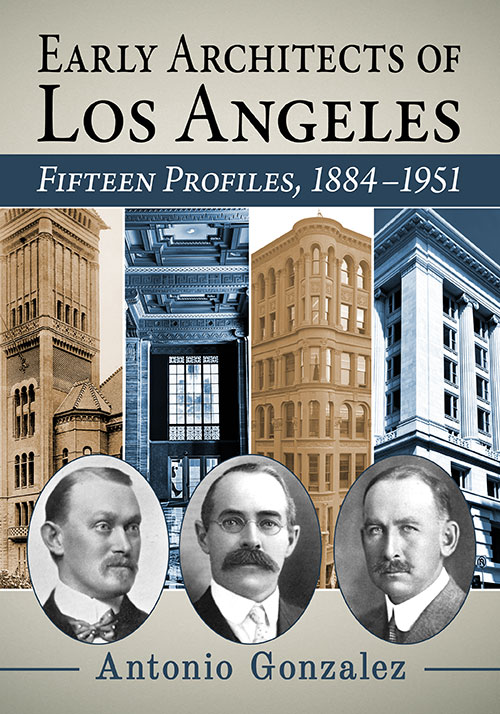
This one’s a whopping 287 pages and covers the following:
Allied Architects (Hall of Justice, Patriotic Hall, the Los Angeles County General Hospital); Allison & Allison (UCLA’s Royce Hall, the Southern California Edison Building, the Friday Morning Club); Arthur B. Benton (Mary Andrews Clark home, the 1908 Los Angeles YMCA); Caukin, Haas & Boring (the 1887 Los Angeles Times Building, the 1889 Los Angeles City Hall); Robert Derrah (Crossroads of the World, the Coca-Cola Building); Theodore Eisen (the 1891 Los Angeles County Court House); Robert D. Farquhar (William Andrews Clark Library, William Andrew Clark, Jr. Mausoleum, the California Club); Arthur Harvey (Los Altos Apartments, the Villa Carlotta); Myron Hunt (the Ambassador Hotel, Occidental College); Sumner P. Hunt (AAA building, Bradbury Building, Southwest Museum, Wilshire Ebell); Fernand Parmentier (Cambria Union Apartments); Train & Williams (Conservative Life Insurance Building, Tally’s Theater); Walker & Eisen (United Artists Building, Sunkist Building); Paul R. Williams (28th Street YMCA, Al Jolson Mausoleum, the Golden State Mutual Life Insurance Building); and R. B. Young (Hotel Westminster, Lankershim Building, Lankershim Hotel, the Young Apartments).
Gonzalez’ scholarship excels particularly in biographical detail—information on these architects that is unavailable elsewhere. He also unearths a wealth of previously unseen images by delving into rarer periodicals such as Inland Architect and News Record and American Architect and Building News, alongside obscure volumes like Los Angeles of Today Architecturally. His analysis of the perennial “Who designed the Bradbury Building?” question in the Sumner Hunt chapter is notably even-handed.
Yet my favorite revelation remains the Caukin & Haas drawings of City Hall from the City Archives Special Collections—a Romanesque Revival treasure I revere and one that featured in my talk about the subject, many years ago—drawings I had no inkling even existed!
As Gonzalez observes in his preface, scholarship on Wright, Lautner, Schindler, Greene & Greene, and even Irving Gill abounds. Beyond these luminaries, Fifteen Profiles rescues from obscurity those overlooked architects and their predominantly demolished structures that helped shape and define our city. Get your copy today!
 Bunker Hill, Los Angeles
Can’t wait to read what he says about Walker & Eisen!
LikeLike