The story so far: In Part I, we outlined how the habitual narrative—including most everything that made it into the Reparations Bill—is a mixture of urban legend, conspiracy theory, manipulated facts, confirmation bias, and outright nonsense. In Part II, we examined the area’s genesis and growth into the 1940s. In Part III, we looked at a snapshot of life in the Ravine in the 1940s, immediately before the turn of events that would erase the neighborhoods and reshape Chavez Ravine forever.

And why was Chavez Ravine depopulated and demolished? Because the City knew best! Read all about it:
************
It’s a sunny summer day in 1950. You live in Chavez Ravine. Minding your own business. You enjoy the open spaces, the fresh air. You love the yards full of ripe vegetables, the streets full of happy children, the hills full of grazing sheep. You get home from work one day—
—and you’re met by these two guys.

The suit is very officious. He’s got a fellow in tow who translates into Spanish for him. That guy seems nicer, but what he’s saying is terrifying: “We’re here from the government, and we’re here to help you.” There are no more chilling words in any language.
Then they pull out this letter, hand it to you, and move along to the next house.

Good news, it says, we’re taking your home.
The Mexican fellow is named Ignacio “Nacho” Lopez. He’s a Spanish-language newspaper publisher and civic activist.
The suit is named Frank Wilkinson. He’s an ardent leftist, and as such, he and his buddies know what’s good for you.
That’s a statement that may bristle some readers, but it is absolutely accurate. The common narrative is frequently “greedy Republican developers kicked out the residents of Chavez Ravine” but that could not be further from the truth.
Don’t believe me? Read on!
I. A Short History of Public Housing
It’s 1929, there’s a stock market crash, and faith in laissez-faire capitalism is shaken. Therein begins our nation’s shift into Keynesian economics, whereby large-scale macroeconomic state intervention is considered necessary, and therefrom we enact a welfare state and other programs protecting the working class against the ravages of capitalism.
The Roosevelt Coalition steered us into a world of mass social engineering. From this came the fifty-some alphabet agencies, like the NRA and the WPA. Mass American slum clearance began in 1933 under the PWA, the Public Works Administration, and ramped up in 1934 via the FHA, the Federal Housing Administration.
Progressive Democrats believed that remaking the physical environment would improve living conditions and engender better social behavior, so, we take your home—despite it having fresh air and chickens—and put you in the projects, AKA huge reinforced concrete filing cabinets for humans. The courts said no, that’s literally un-American and you can’t do that, so Roosevelt said ha ha! here’s my Housing Act of 1937, which gave the State absolute power on the matter.
And with that came the USHA, the United States Housing Authority, whose first Director was Catherine Bauer. Bauer was trained in Europe and under the sway of Le Corbusier, from whom blossomed large scale concrete mass housing. Bauer literally traveled to Russia to see how they were doing it, came back and said, well, if its good enough for the Soviets it will be good for America!
Meanwhile Los Angeles Mayor Frank Shaw, a staunch supporter of the New Deal, through LA’s Municipal Housing Commission, got assistance from the PWA to clear slums in 1934. He then established Los Angeles’s Housing Authority in March 1938 and contacted Bauer and said hey Ms. Bauer, be a pal and give us $25,000,000 for slum clearance. Bauer wrote Shaw the check, at which point Los Angeles starts taking people’s homes and businesses and began building housing projects.

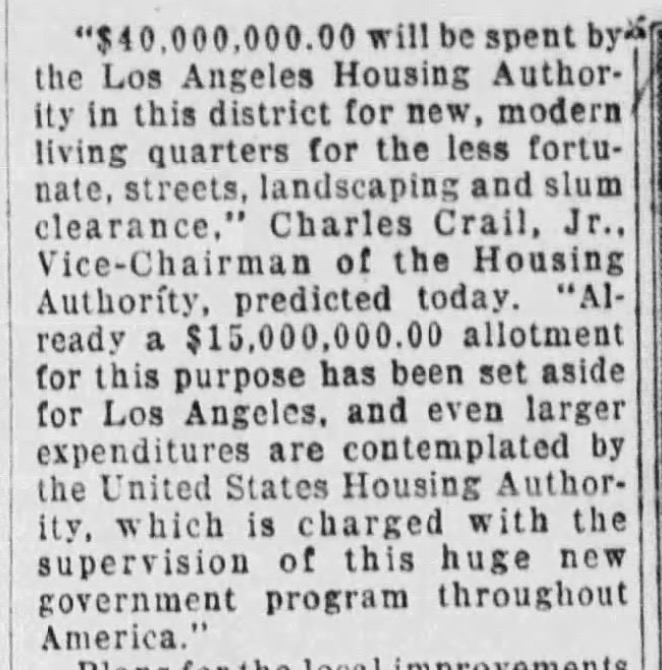
Before the start of World War II—before we really started cooking building housing projects—we’d cleared 175 acres and built about 3,500 units.
You will be told that there was something illegal (or at least special) about the removal of all the residents of Chavez Ravine for public housing, but, we literally did it all the time. Between 1937 and 1942 thousands were removed for the construction of Ramona Gardens, Pico Gardens, Pueblo Del Rio, Rancho San Pedro, Aliso Village, William Mead, Estrada Courts, Rose Hill Courts, Avalon Gardens, Hacienda Village…and were those all illegal evictions? You might say confiscating people’s homes is morally repugnant—you might be right—but it was typical and standard fare. Hard to argue something’s illegal when it’s cleared by the courts time and time again.
The aforementioned ten prewar housing projects were built via Roosevelt’s New Deal program. His successor, another Democrat named Harry Truman, had the less-remembered “Fair Deal.” Truman’s Fair Deal had a housing act in 1949, with greater powers than his predecessor’s 1937 legislation: just under the 1949 Housing Act, Los Angeles cleared 276 acres of slums and built 4,350 units, at Jordan Downs, Nickerson Gardens, Aliso Apartments, Pueblo del Rio extension, Rancho San Pedro extension, Imperial Courts, Estrada Courts, Mar Vista Gardens, and San Fernando Gardens.
Here’s where you’ll accuse me of whataboutism, but, what about the two and a half thousand people forcibly removed by the Housing Authority from the area between First and Temple Streets, in 1949-50, for the expansion of the Civic Center? Or the 9,000 people removed for the Bunker Hill project? How are the people of Chavez Ravine special, and above and beyond every person whose home was taken and demolished for a school, police facility, fire station, civic/government building, or freeway? Point being, the idea of demolishing Chavez Ravine was neither new nor unusual, especially after the 1949 Housing Act (which demolished 400,000 structures nationwide).
It is often asserted that the people of Chavez Ravine are noteworthy or remarkable because in their case the government project wasn’t eventually built (neither was the vast early-1950s expansion of Rose Hills, cancelled along with Chavez Ravine, which took people’s homes and that didn’t get built either; no-one ever mentions other government projects that took homes and remained unbuilt, like the 710 Freeway extension). Fact is, the Chavez Ravine homes were bought, paid for, and demolished, before the project was cancelled; the people to whom the lands might be returned had moved on. More to the point, the concept of Chavez Ravine Exceptionalism was argued in the courts repeatedly, and the government was affirmed as owner each time, irrespective of the project being cancelled.

Back to 1950: Chavez Ravine denizens get the letter that says we have to kick you our and remake the landscape in toto. The Housing Authority chose that land because when the health department did a survey, one third of the houses had no toilets, and a quarter had no running water.

While a third were made from standard building materials, the other two-thirds were in poor condition or constructed of packing cases, or old lumber of insufficient grade to legally build with, and the like. The area’s tuberculosis rate was four times that of the city. A typical sampling of news notices regarding the area:

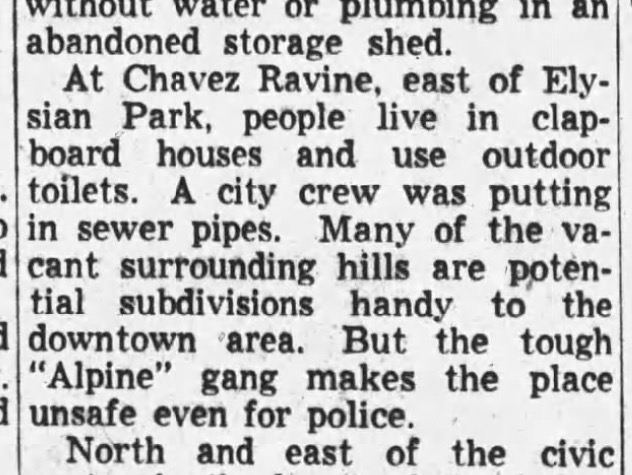
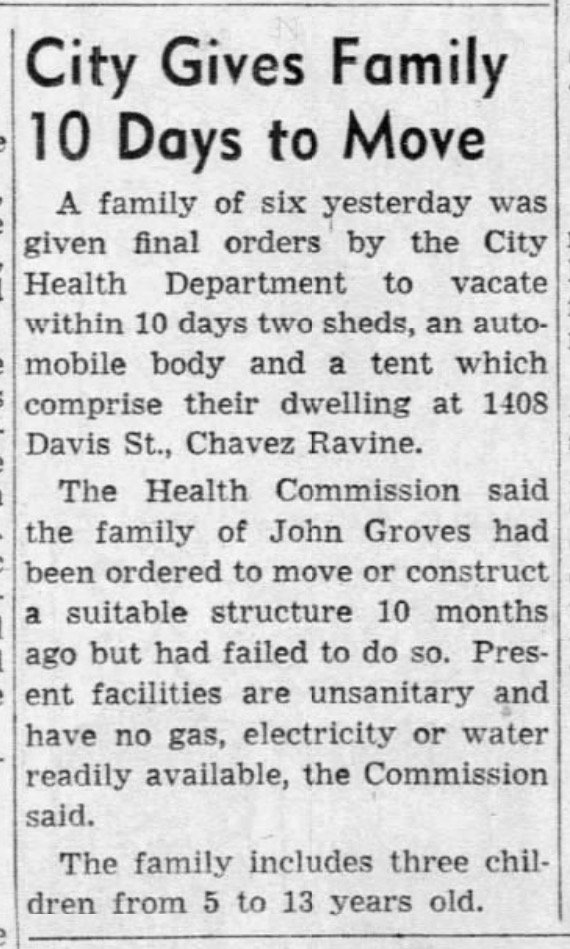
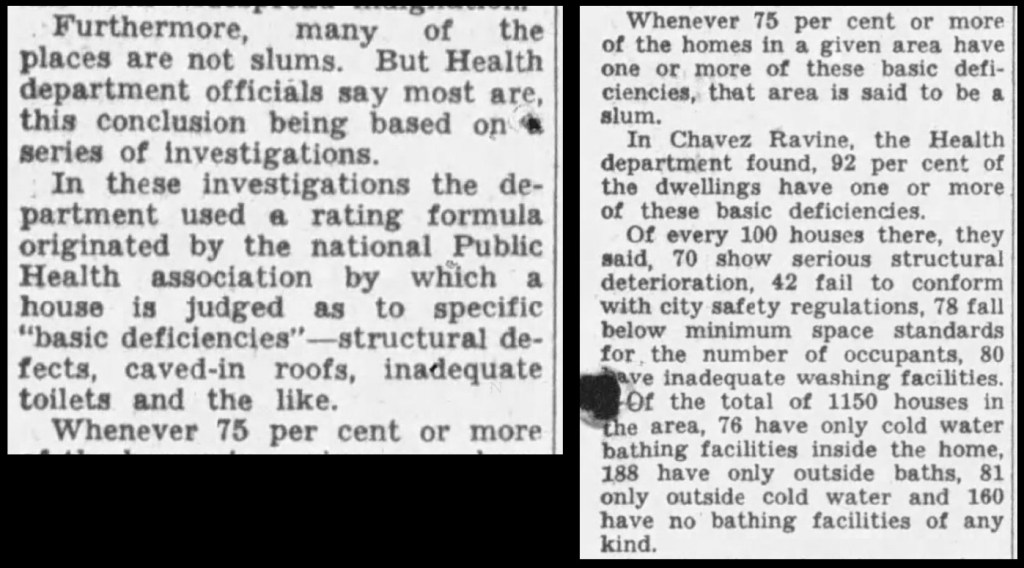
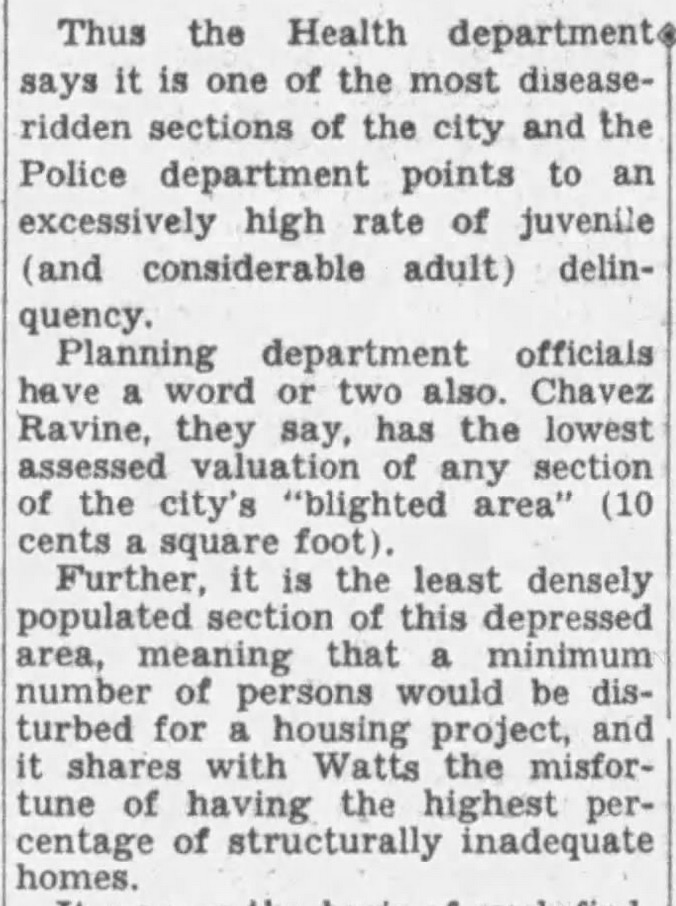
In short, Chavez Ravine was boilerplate slum clearance and project building, just like the two dozen other federally-subsidized projects Los Angeles had built.
II. Elysian Park Heights
In Los Angeles, slum clearance/building public housing projects was a common and routine activity, but: our particular Chavez Ravine project was to be quite different from the others we’d built. A lot different.
What made the Chavez Ravine project—named “Elyisan Park Heights”—so dissimilar, was the scale and scope of what was going to replace the semirural sunny slopes. The Elysian Park project was massive, intended to put us in the league with the “big boy” cities constructing huge high-rise housing projects.
LA’s public housing had been, up to then, low-rise, two-story, comprised of open spaces with courtyard living. Here’s a handful of examples, to give you an idea of the traditional massing of Los Angeles public housing:
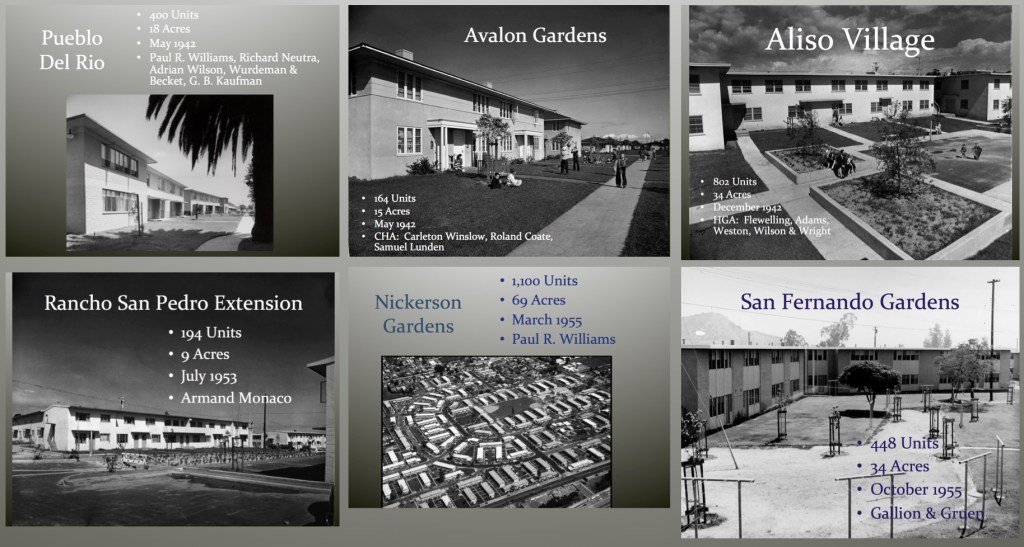
For Chavez Ravine, the Housing Authority of the City of Los Angeles, with the Federal Housing Authority, bought up 806 individual Ravine parcels, in an effort to build this:
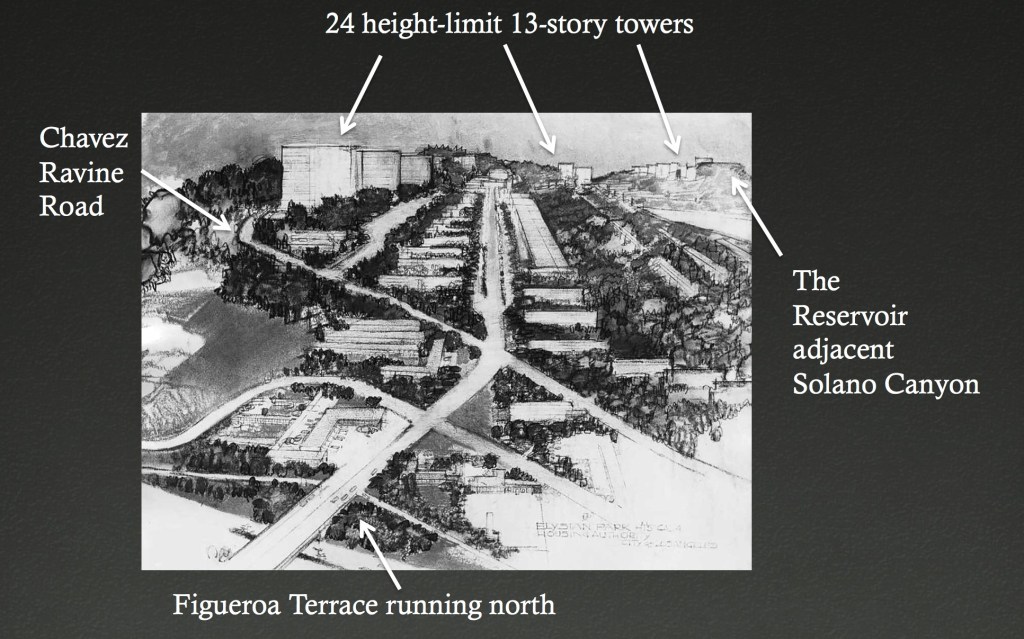
Their plan was to chop down the hills, fill in the ravines, pave the thing in concrete, ring it with 24 thirteen-story concrete apartment blocks, and fill in the middle with another thousand units, in 163 two-story buildings.

Yep, large housing towers, just like the big projects in eastern cities, which by and large did not go well. Many large-scale postwar projects have had to be demolished because they became ungovernable and dangerous. Los Angeles’ Elysian Park Heights: built on the same model as Chicago’s Cabrini Green—which fared so poorly, and we had to tear it down. Los Angeles’ Elysian Park Heights: built on the same model as St. Louis’ Pruit-Igo—which became so unmanageable, we had to blow it up.
At 3364 units, Elysian Park Heights would have been larger than Queensbridge in New York; Queensbridge is America’s largest, and arguably the most dangerous, housing project.
Let me be clear, I’ve nothing against public housing. It fulfills a necessary purpose and by and large, it is well-run and provides decent and affordable housing for people in need. But there is, statistically, a major difference between low-rise and high-rise public housing. Studies show that crime increases proportionally with height. Only 27% of government housing in America is highrise, and yet that 27% provides the vast majority of the problems, from drug dealing and murder, to unemployment and single parenthood. In every instance, highrise public housing has led to greater segregation by race and of the poor, impacted by underfunding and government neglect, which only perpetuated the cycle of both physical and societal decay.
People say “but Neutra was such a great architect! OURS would have been amazing!” Here’s Neutra designing the thing with all his Viennese best intentions.

Of course you can’t prove a negative, so there’s no telling what Elysian Park Heights actually would have turned out like. That said, yeah, nah, I *am* gonna tell you what Elysian Park Heights would have turned out like, Neutra be damned: an isolated urban high-rise reservation. With the poor shunted off into concrete height-limit filing cabinets, the whole thing would have incontrovertibly descended into a dystopian nightmare of bizarre proportion. That’s just my opinion, but I sure have a lot of precedent to back up my argument.
Point being: EPH was to be obnoxiously huge like those projects back east, which are famously plagued by dead elevators, broken windows, drugs, crime, and malaise. Now consider, in Los Angeles we’ve had to tear down plenty of our little ones. We’re tearing down Jordan Downs and tearing down Rose Hill Courts. EPH would have just been a high rise version of Aliso Village, which we had to tear down because it was more dangerous than Fallujah. Miraculously, concentration and isolation in high-rise inner-city ghettoes was something Los Angeles had somehow managed to avoid. Oh, but don’t worry, Neutra will figure out how to give us a 3500-unit project that will magically prevent pesky modern problems like crime and despair. (Just so we’re clear, I’ve nothing against Neutra, a brilliant Modernist who produced many of the most compelling icons of the age, but his talent lay in designing homes and offices for his deep-pocketed celebrity clients.)
III. Who Wanted Elysian Park Heights?
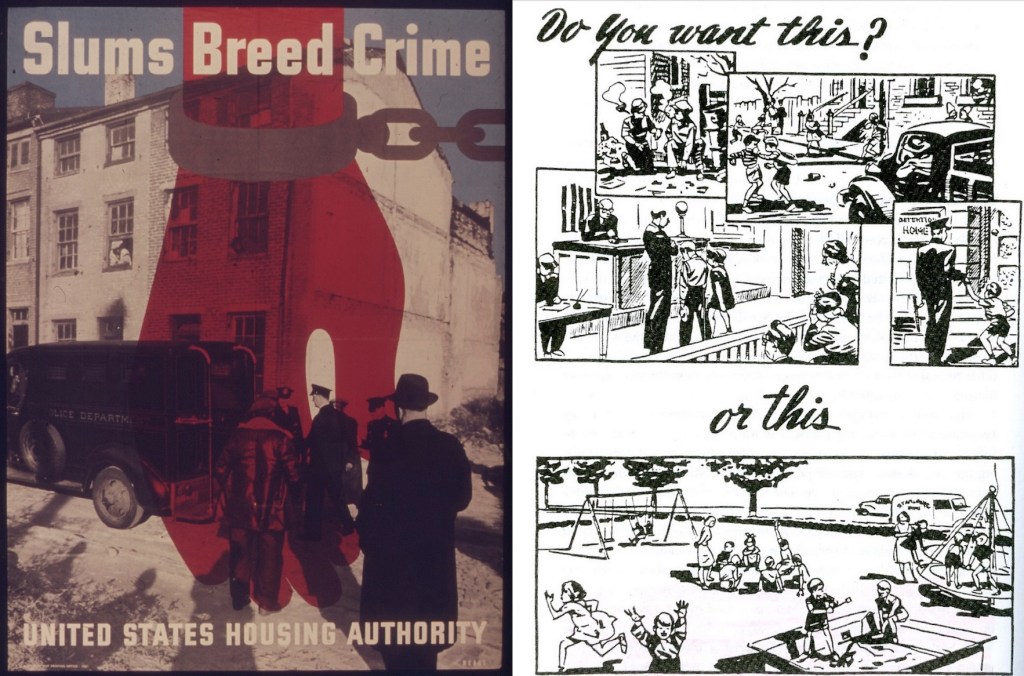
I told you about Wilkinson, the Red with the black heart delivering Chavez Ravine’s death knell, and at this point you say “yeah, he just delivered the letter, surely the people who wrote the letter though were evil greedy developers doing back room deals?!” Naaaah, it was just the Housing Authority, publicly supported by socially conscious trade unions, International Ladies Garment Workers Union, League of Women Voters, NAACP, AFL, CIO, churches, liberal veterans and citizens groups. Fact is, progressive Los Angeles was convinced that razing slums and replacing them with public housing would improve living standards, reduce poverty and crime:
While on the other side of the ideological aisle you had conservative fellows like Fritz Burns, who argued that private ownership was the most important of American rights so let’s help get these folk up to code, and then leave them be to prosper…but nobody listened to him. The people of Chavez Ravine listened to him. But the Powers That Be didn’t listen to him or the people of Chavez Ravine.
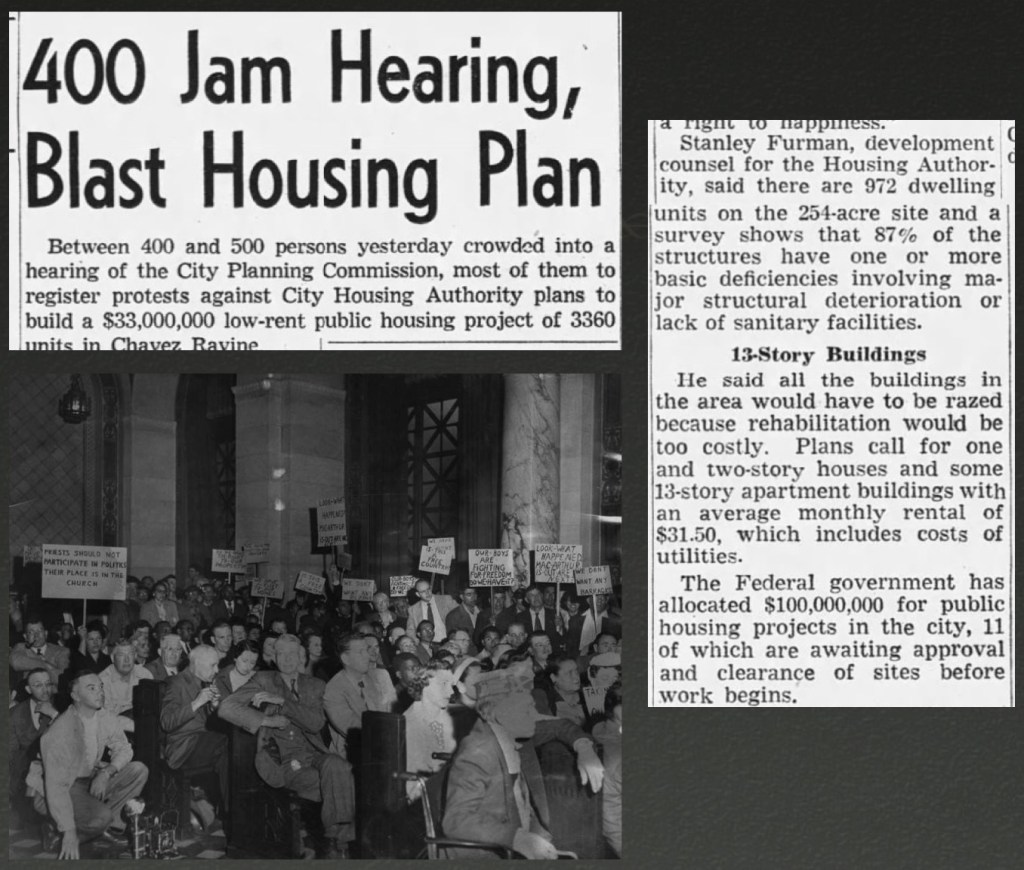
And the people of Chavez Ravine, they wanted to be heard. In April 1951, the people of Chavez Ravine spoke up to protest the City Housing Authority:
But the City didn’t listen. So, in May 1951, the people of Chavez Ravine, mostly the mothers, stormed Mayor Bowron’s office.
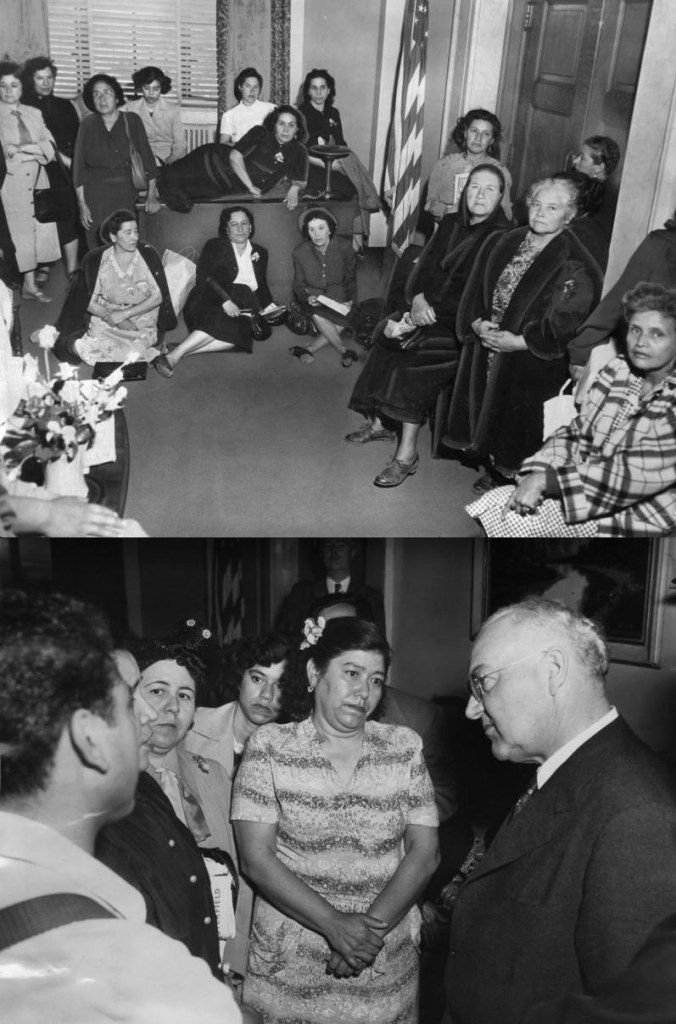

He didn’t listen then, either. Yes, Bowron was a Republican, but a liberal pro-housing mayor. Most importantly, the people of Chavez Ravine were saying to hell with you to the Civic Leaders of the Los Angeles Mexican-American community. El Congreso, and Asociación Nacional México-Americana, and other Mexican-American organizations were pro-public housing and were aghast that the people of Chavez Ravine had aligned themselves with conservative members of the City Council and members of the conservative privately-run housing industry, who believed in bringing already existing homes up to code. Mexican-Americans turned their back on liberal social engineering, stating, in effect, “because it’s not ethically or morally right to do this to people who like open air and yards and gardens and chickens, even if you did just get $110,000,000 in federal money to do it, don’t do it.”
Note in the news clipping above, the mention of Agnes Cerda. Below, the home of Mr. Manuel and Mrs. Agnes Cerda, 1026 Effie Street (George L. Gardner & Sons, 1925).

It was from here she and Manuel ran the City Center District Improvement Association. The CCDIA, like the rest of the denizens of Chavez Ravine, abjured the left in general and rejected the entirety of the Mexican-American establishment in particular, up to and including Councilman Edward Roybal, the first Mexican-American elected to City Council since the 1880s. Rather, Chavez Ravine’s community organization sided with the conservative real estate lobby. Agnes Cerda, at the April 1951 hearings, loudly denounced the City Housing Authority as being un-American.
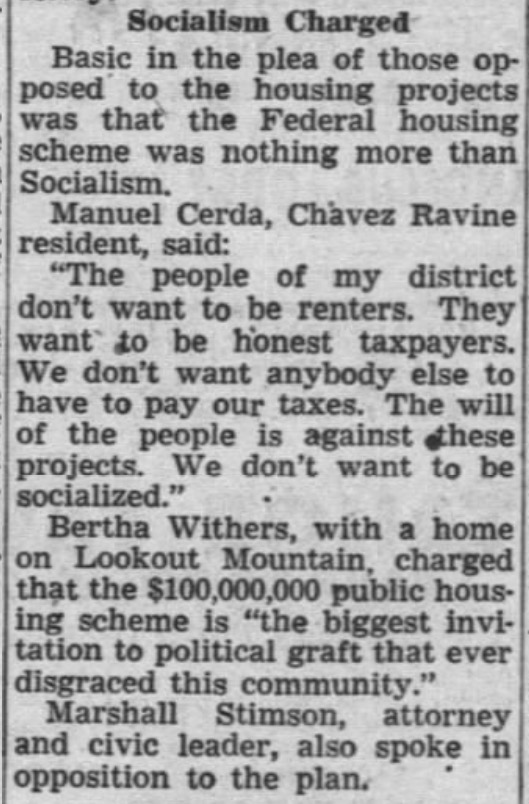
They fought the good fight, but all the fight in the world could not change the course of government.
IV. The Demolition of Chavez Ravine
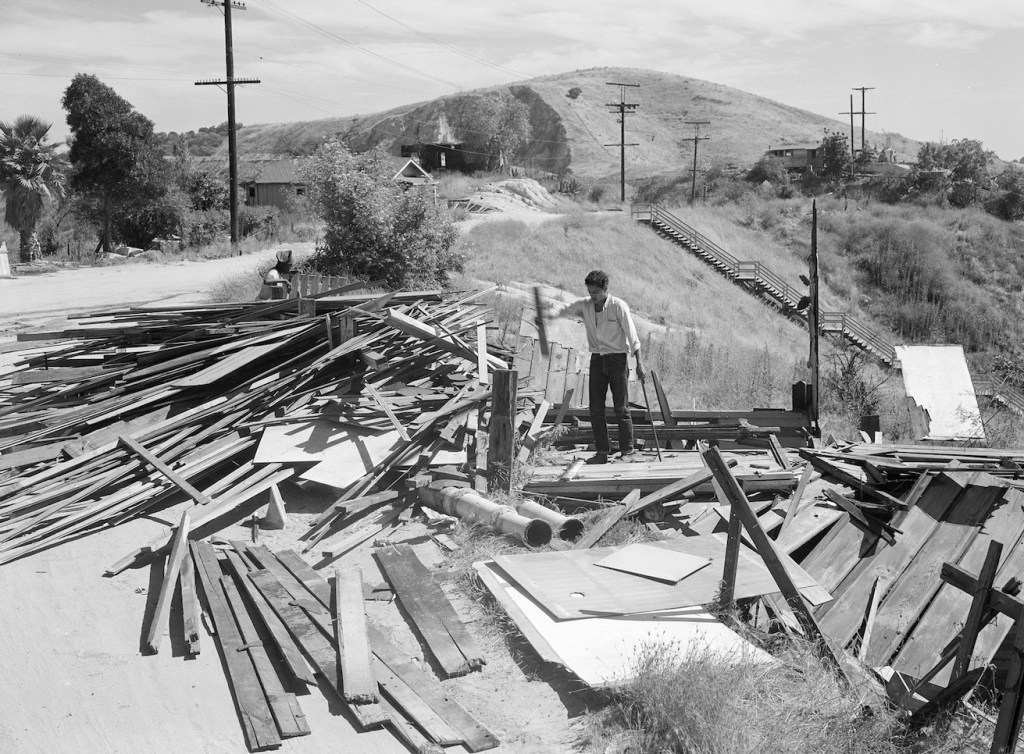
So the California Housing Authority buys up most of Chavez Ravine in late 1950, and demolitions begin and continue all through 1951, until it was mostly gone.
Here are the Sanborn Maps from July 1950 and August 1953. Covered here is all of Palo Verde and most of La Loma—a small portion of La Loma beneath Solano Canyon east of Brooks is missing, and we have none of Bishop, which consisted of homes the other side of (south of) Effie. But this is the majority of “Chavez Ravine” and for our purposes it is extremely illustrative:

So when people tell you that “Black Friday,” i.e. May 08, 1959, is when the bulldozers came and tore out all the homes, remember this image. There were 311 structures in 1950, and 80 in 1953, indicating that 75% of Chavez Ravine was demolished in three years.
People will tell you that the owners of the homes were illegally evicted, coerced, forced out, none of that is true; you may not like what happened, but that doesn’t mean it wasn’t repeatedly challenged and yet supported every step of the way by the courts, in lengthy, heavily scrutinized court battles.
You will be told homeowners were not compensated. A shameless falsehood: they were compensated millions of dollars, at market rate, and often above market rate.

There is a constantly repeated story, that homeowners were tricked and coerced and forced into selling because the “corporate developers” (despite there being no developers involved, corporate or otherwise, but, whatever) offered lots of cash to the first few homeowners who sold and to subsequent homeowners they said well, we won’t be able to give you that kind of money for long, so you better hurry, whereby owners were thus tricked and intimidated. There is zero evidence of even one such occurrence; were it true, it would have been mentioned in the myriad of court cases and appeals (certainly in the Transcripts of Hearings Before the City Council, which can be read at the City Archives, and definitely in the ever-fascinating Investigation of Public Housing Activities in Los Angeles, House of Representatives Hearings before a Special Subcommittee on Government Operations, US Congress, 83rd Congress, First Session, 13, 18-21 and 27 May 1953) where homeowners testified about the intricacies of selling their homes, including descriptions of dealing with Housing Department officials and policies. This tale regarding dastardly minor government bureaucrats provoking panic among homeowners because…they’re dastardly entered the public arena about ten years ago and, while sometimes credited to the late Mike Davis, has its actual origins in the typically anonymous vortex that is the internet.
To repeat the California Law under which Chavez Ravine homeowners were compensated (and under great scrutiny I might add): “the owner must be paid the highest price which the land will bring if exposed for sale in the open market.” There was no ceiling on the money paid either, and in fact, appraisals and thus monies paid often ran above assessed valuation, because, the court had to do three appraisals on each property and then were mandated by law to write a check for the very highest appraisal.
Don’t get me wrong. I’m not saying developers don’t cheat people all the damn time. But in this case? It wasn’t developers. It was local liberal government functionaries with a ton of money dumped onto them by the Federal Government. Imagine, $33,000,000 of Federal money dumped in the Housing Authority’s lap…and we’re supposed to believe a bunch of socially conscious liberals made a concerted and meticulous effort to nickel-and-dime the poor and disenfranchised, just to screw them?
Really. We’re supposed to believe for the first time in human history, political functionaries are given the opportunity to throw somebody else’s money—taxpayer money—at a project, that they DON’T throw that taxpayer money at the project? That’s what we’re supposed to believe? That somehow there was in fact ONE time since the development of political systems and public administration in Sumer in 3000BC, that it was in this lone and particular case, it was OUR left-liberal housing authorities who decided “let’s screw the poor!” Well, you believe what you want, but I’m here to say that dog don’t hunt.
Having said all that, let’s look at some images of CR demolition.
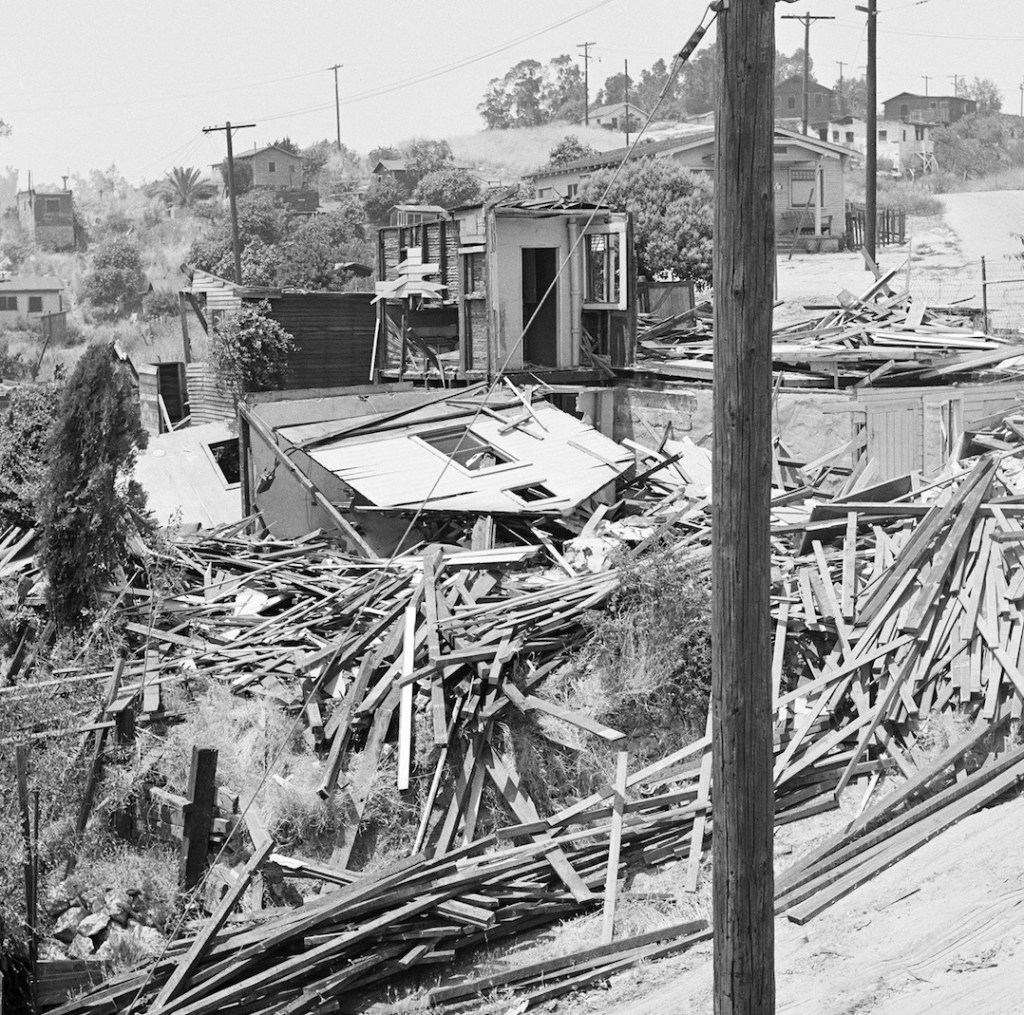


V. The Fate of Elysian Park Heights
So, why don’t we have Elyisan Park Heights, in all its overscaled-albeit-Neutra glory?
Because on December 26, 1951, the City Council, openly defiant against Mayor Bowron and the Housing Authority, cancelled the contract with the feds to build public housing… they’re like yeah no, we don’t like this anymore, we’re done.
But then The State said autonomy?! Not on our watch! The Feds insisted that the City Council had no authority to cancel a relationship with the Federal Housing Authority, so, local government put it to the voters as a referendum called Proposition B in June 1952.
The No on B people had argued that to destroy an established, functioning, low-income neighborhood like Chavez Raine, and in its place to plant the seedbed of a vast future high rise slum, was a terrible idea; their argument being, bring the houses up to code, and let the poor people have their yards and chickens.

The people of Los Angeles agreed and voted overwhelmingly against continuation of the Federal Housing contract. Twelve of the fifteen council districts voted to nix public housing. The voters defeated Prop B., 379,000 to 258,000—and yes, the three districts that voted yes, to maintain the federal contract and build lots of big public housing projects, were the three rich white districts that were never going to have to live in proximity to public housing.
And with that public housing (and thus the Elysian Heights project) was dead. Or was it? Pro-public housing Mayor Bowron was furious, and insisted that I’m just going to build Chavez Ravine anyway. Thus public housing became a huge topic during the mayoral race for the next nine months, wherein Congressman Charles Norris Poulson and incumbent Fletcher Bowron argued about very little else besides public housing projects. Come election day, May 26th 1953, Poulson beat Bowron by a wide margin; voters resonated with Poulson’s intention to formalize the cancellation of the Federal housing contract. New mayor Poulson then made good on his promise, in July 1953, putting an end to new projects, which were Chavez Ravine, Rose Hill, and Pacoima (numerous other public housing projects that had already broken ground were allowed to continue construction, and Pacoima did in fact still got built).
And with that, Elysian Park Heights was dead.
VI. Red-baiting Hysteria!
You will be told that nothing of what I just said matters, because in reality the project was cancelled due solely to the rabid Red Scare anti-Communist hysteria at the time. The common narrative is that the people of Los Angeles had no will of their own, no! They were duped by McCarthy and manipulated by the Red Scare political machine that tore through the nation! It is a fact that evil Joe McCarthy killed our noble, wonderful public housing (that sought to destroy Chavez Ravine).
Well, not exactly. The people were removed and their homes demolished by the left; of that, there can be no argument. The EPH housing project was cancelled a couple years later in part because of worries pertaining to socialism, and/or the communists involved in the implementation of the plan. Nowadays, any concern about socialism/communism is considered the bastion of far-right nut jobs, but back then, it was a rational and justifiable reaction to an existential threat.
For years on end, when I tell people that the destruction of Chavez Ravine was a product of the American Left and implemented by a communist named Wilkinson, they lose their minds. “You’re just trying to smear Wilkinson…you’re just a liar like McCarthy!” Fact still stands, Wilkinson was a communist, not a liberal who got labeled a communist by McCarthy (and I might add, McCarthy never actually said one word about Wilkinson). Wilkinson joined the Communist Party in 1942 and remained an active member until 1975; he does, after all, discuss this fact in his autobiography; it’s mentioned in all of his lengthy obituary notices. Ry Cooder has a whole song “Don’t Call Me Red” where Frank is narrator—and calls Fritz Burns a bastard despite a) yes we can call you Red, Mr. Devotee of Stalin Wilkinson, and b) Fritz Burns was pro-people and you were pro-statist, Frank.
People will then say “yes he was a documented Communist as were many members of the LA Housing Authority, well what does it matter, they were trying to do good, but there was all this Red Scare hysteria! The reason Dodger stadium is terrible is because of anti-Communist HYSTERIA!” Yes dear, we’ve all heard about the anti-Communist hysteria:
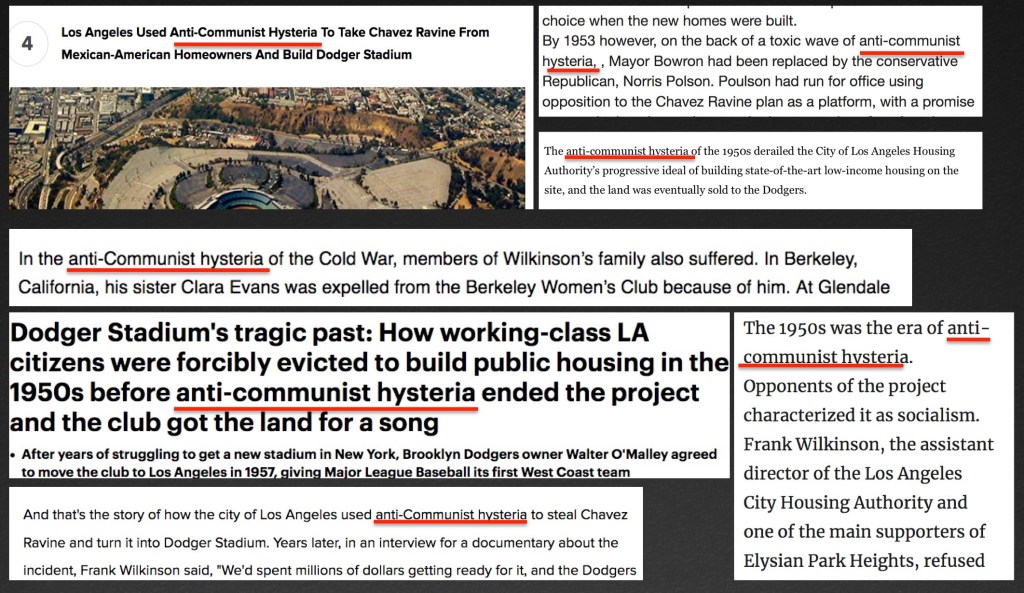
It breaks my heart that Americans today know nothing about Communism and anti-Communism. They just repeat what they have been told by the media (see above), a Frankenstein of ludicrous tropes and shameless disinformation bolted together via the holy trinity of deflecting, misleading, and fabricating.
Look. I know a thing or two about the matter. Like Wilkinson, my father was a Party member. Leonard Marsak was a professor at Reed when he was hauled before HUAC. He invoked the First and Fifth and told HUAC to go screw. The man was blacklisted, and didn’t work again for six years. Growing up, we had Reds and ex-Reds over all the time, and dinner-table talk about postwar Party membership went on for hours. So yeah, it’s a topic I was exposed to and which I have since studied in no small measure.
With that said, I’m now going to tell you something you’ve never heard, which will make you clutch your pearls and exclaim “of all the colossal impudence!”
It’s this: “anti-communist hysteria” — really a thing? or a justifiable reaction to being locked in an existential struggle with an enemy bent on our subjugation and destruction?
Bear in mind, my schoolteachers and the media fed me the same story you also received: that conservatives ginned up a ridiculous fear-mongering narrative in order to control the populace. And that the entire Cold War was manufactured as a political tool, so that we could be repressive at home and aggressive abroad. You and I both learned that at school, and it’s remained the Dominant Narrative ever since.
However, like so much I’m debunking here, that narrative is crap. I don’t mean it’s just an argument devoid of nuance and complexity—though it certainly is devoid of both; I mean it’s a palpable untruth. I’m not going to bog down the tale of Chavez Ravine with a refutation of your dearly-held beliefs about the big bad McCarthy Age (of course we live in an age where people yell constantly about genocide, yet know nothing about real genocide). Suffice it to say, the Soviets were some bad dudes, and their spies infiltrated our nation, to America’s great detriment. If you really want to learn more about the McCarthy Era (side note, there was no “McCarthy Era,” as McCarthy was just a bit player in the greater world of a broader and suitably legitimate postwar anticommunism) click here.
VII. After the Cancellation
So, Norris Paulson is elected mayor—because he promised voters he would uphold the will of the people and of the City Council—and then made good on his allegiance to the people and Council, in nullifying the housing contract. LA had very recently built a dozen major projects and some were still under construction, and they were all completed (including the Pacoima project, AKA San Fernando Gardens, which strictly speaking didn’t break ground till after Poulson’s election), and the two that would remain unbuilt were the Rose Hill Courts extension and…Chavez Ravine.
Many people today insist that, after the final cancellation of the federal contract in July 1953, the City should have given the land back.
Well, to whom? Those houses had been bought and paid for two and a half years previous. The people they gave money to, 2+1/2 years ago, bought new houses, or if they were renters, were provided relocation assistance from the city, and moved on.

Can’t give em back the old houses, because those were torn down or moved off site. Only thing left to do with those 300 acres, find a use for the land. As I mentioned in Part I of this post above, one family said “well you took our house to build public housing, and you didn’t build the public housing, so, that means we get our house back.” They took this argument to Superior Court in October 1953. The City’s title was upheld by the courts. The City’s title was upheld, again, in 1957, by the District Court of Appeal.
1953 goes on, and ends. 1954 comes and goes. 1955, and 1956, then 1957 trod by, and during all that time the Chavez Ravine area has been lying fallow. Not to say proposals weren’t floated: it was considered for a zoo, a cemetery (it was the dream of Maytor H. McKinley, President of Utter-McKinley mortuaries, to build a memorial park that would rival popular tourist attraction Forest Lawn), proposed to house a new jail, an expansion of the police academy, a golf course, a park, the Music Center (which when built on Bunker Hill displaced more people than lived in Chavez Ravine), and was even considered by Walt Disney for Disneyland.
Chavez Ravine’s schools are closed and shuttered, as were the churches, and the last of the houses were removed, save for a few that were stuck in the appeals process (they got more money…and the Arechiga family would have to, if they’d only taken the time to contest their property’s appraisal with the appeal board…as many of their neighbors had done). In May 1954 the City Council voted unanimously to spend 1.3 million dollars for the City of Los Angeles to get their own land back, by purchasing the land from the Federal government. The City paid half in May of 1954, and finalized the deal in July 1955. Thus it was owned by the City free and clear, and in the purchase language of the contract regarding the grant deed, a proviso stipulated the land be used for a public purpose.
And there we are. It’s the late-mid 1950s, and the nearly-empty land had been sitting for years, owned by the City. People wondered what to do with it…until…one day…
Thanks for reading Part IV, all about the Elysian Park Heights project! Come back for the next installment, Part V: The Dodgers Come to Town!
This is seven-part series. Its component parts being:
Part I: Chavez Ravine and the Mainstream Narrative
The master narrative, as promulgated by the mainstream media; its result, a reparations bill; the good and bad of that bill. Published Friday, May 10.
Part II: What is Chavez Ravine
Its beginnings, development, and evolution to 1950; its history of demolition prospects; and, can you call it Chavez Ravine? Published Sunday, May 12.
Part III: Calm Before the Storm
A snapshot of life in the area in the 1940s. The mythos of small-town life; Normark’s documentary work; a study of the people of Chavez Ravine; churches, markets, bus lines, etc. Published Tuesday, May 14.
Part IV: The Rise and Fall of Elysian Park Heights
A history of public housing; Neutra’s Elysian Park Heights project; its proponents and opponents; the area’s demolition; the downfall of public housing, and its relationship to anticommunism; land use after the demolition and nullification of the contract. Published today, Thursday, May 16.
Part V: Here Come the Dodgers
About the Dodgers; what constitutes public purpose; an illegal backroom deal?; a stadium is built. To be published Monday, May 20.
Part VI: The Arechiga Family
The Arechiga family history to 1950; eviction from Malvina Street; eventual removal in May 1959; the multiple Arechiga houses; life after Malvina; the next generation of Arechigas. To be published Wednesday, May 22.
Part VII: In Summation, plus Odds and Ends
Key takeaways; plus a collection of *other* commonly-held beliefs about Chavez Ravine, conclusively debunked. To be published Friday, May 24.
If you have comments or corrections, please don’t hesitate to write me at oldbunkerhill@gmail.com.
 Bunker Hill, Los Angeles
I learned a lot and would like to zoom with you. Raymond Richard Neutra
LikeLike