Everyone loves the boom-era mansions of Bunker Hill, which we know primarily through images shot as they neared their demolition, photographed in the 1950s and 60s by the likes of Hylen, Reagh, Conner, et al.
More rare and important are those images captured of a house in its early years. Luckily, many of the most important homes were photographed soon after completion, e.g. these shots of the Crocker, Rose, Melrose, Castle, and Bradbury—

But those shots have been in the public view a long time; many were used in 1977’s Bunker Hill: Last of the Lofty Mansions, and a lot of the shot-within-a-few-years-of-their-completion house pictures, captured from 1888-1900, were some of the first “old Bunker Hill” images to be put online in the mid-1990s. (I should mention as well all the above shots were indeed used in Bunker Hill, Los Angeles.)
So, when a new-to-us image of an early Bunker Hill house is uncovered, it’s big news.
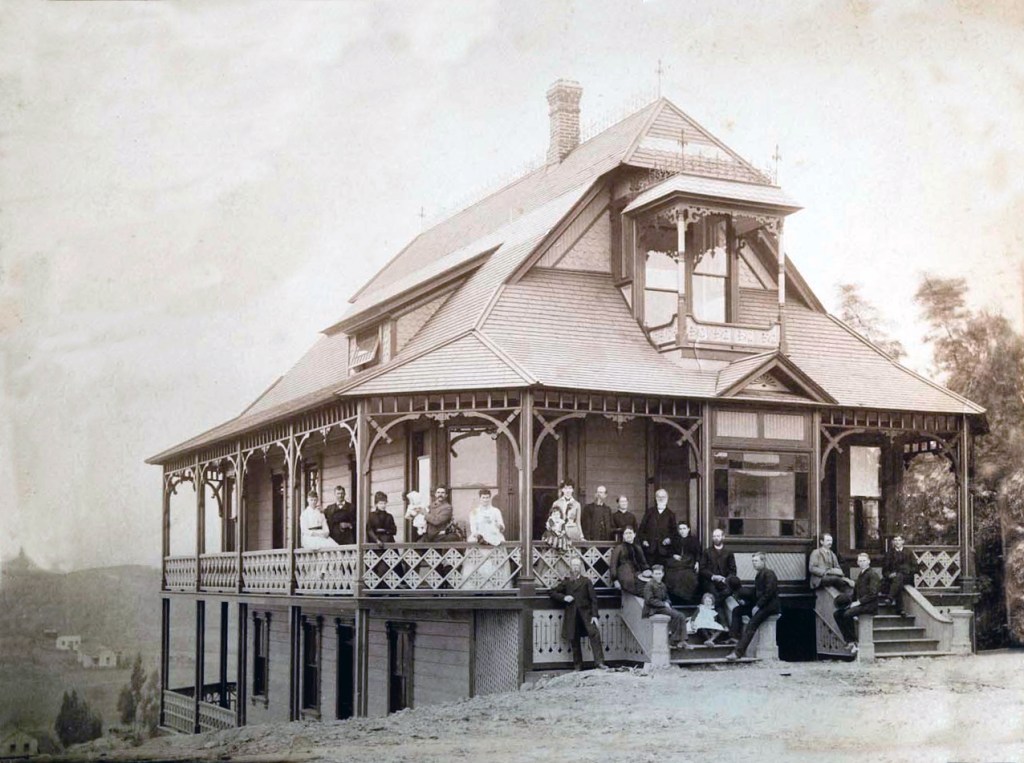
The other day I was contacted by a descendant of Samuel Weller, founding president of Occidental College. Said descendant wondered if I knew about Weller’s house on Bunker Hill, and, was it in my book? I said that no, 211 South Bunker Hill Avenue, built by Weller in 1886, was an important house, but, no decent images of it existed.
At which point she sent me this:

And my jaw dropped. That’s an incredible image of an important house!
The descendant said that the original of this image lay with Occidental, whom I contacted, and they said no, they had received it from the family, when they included it in this, ten-something years ago:
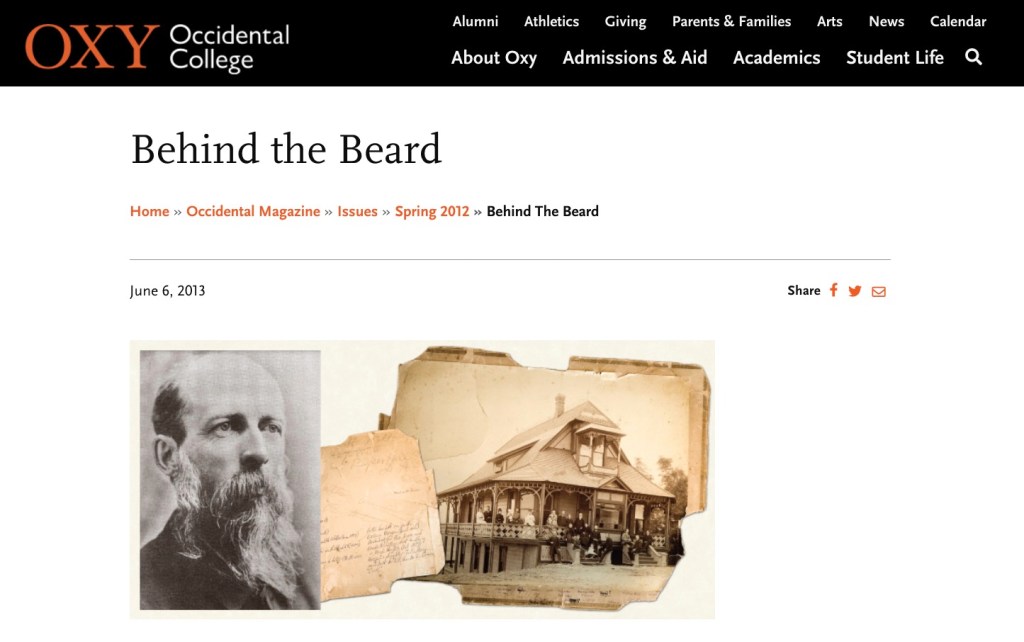
So the family says Occidental has the original and Occidental says the family has it, and while I still have no idea who is in actual physical possession of the original, I did get this (decent-sized, but I wish it were much larger) scan:
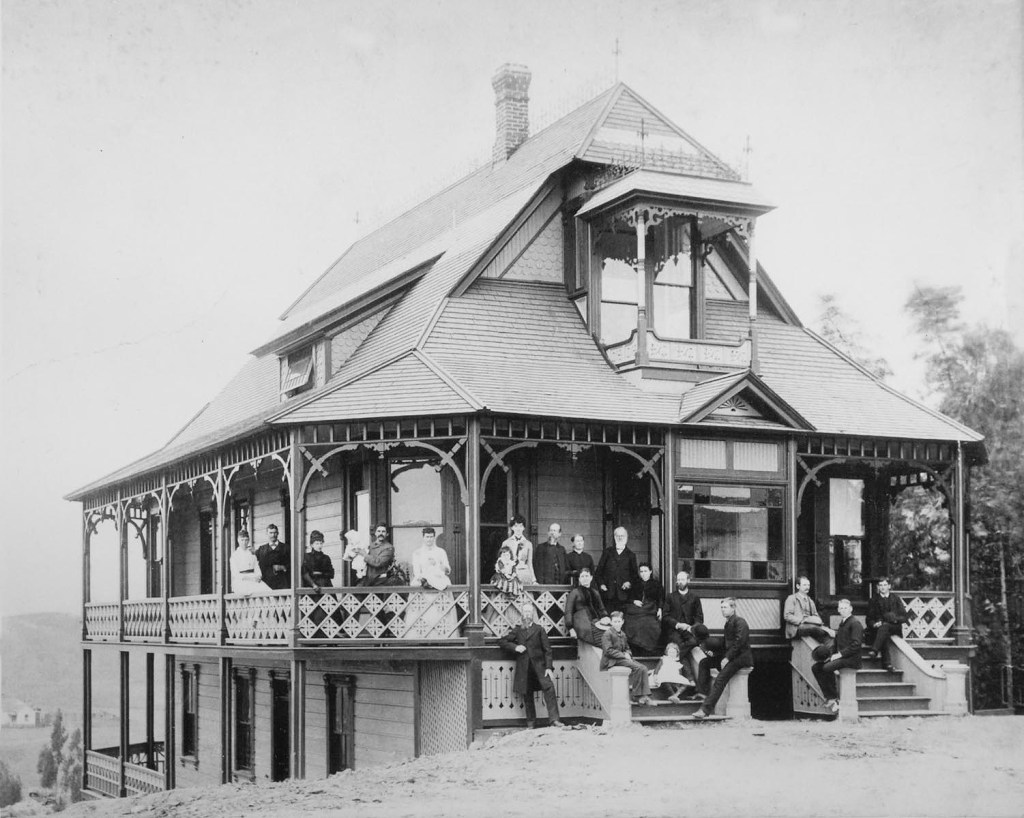
Which has on its verso—

Great information here, but, much of it a bit off. It was certainly not the “first house on Bunker Hill.” Samuel’s father was not named John (you’ll note someone scribbled “Tobias” in pencil to correct this). And it refers to “Samuel Higgins Weller” when his middle name was Harold (understandable, since Samuel’s mother’s maiden name was Higgins). “Octave” Morgan would refer to Octavius Morgan—of the firm Kysor & Morgan (becoming Kysor, Morgan & Walls in late-October 1886)—who certainly may have designed this house, but I do not believe designed “Occidental College’s first building,” which by all evidence was product of the Newsom boys. Of Morgan it goes on to say his “daughter Julia Morgan” designed Hearst Castle, which is a nice thought, but Julia Morgan’s father was Charles Bill Morgan, no relation.
Note, in pencil, “his fathers anniversary birthday” in pencil across: as June 18, 1886 was Tobias Weller’s 85th birthday, it’s not unreasonable to conjecture that that was the day of this photograph.


A bit about the Weller house construction—the house may have been built/owned not by Samuel Weller, but by the Rev. Oliver Clinton Weller (Samuel’s younger brother), or at least, that’s what the 1886-87 City Directory would indicate:

Nevertheless, come the 1887 directory, we have Samuel H. Weller in residence:

And in the 1887-88 Maxwells’ Directory:

But with the 1888 directory, Weller has already moved to Boyle Heights, site of his new school:

And the Weller house, thereafter, became rented rooms:
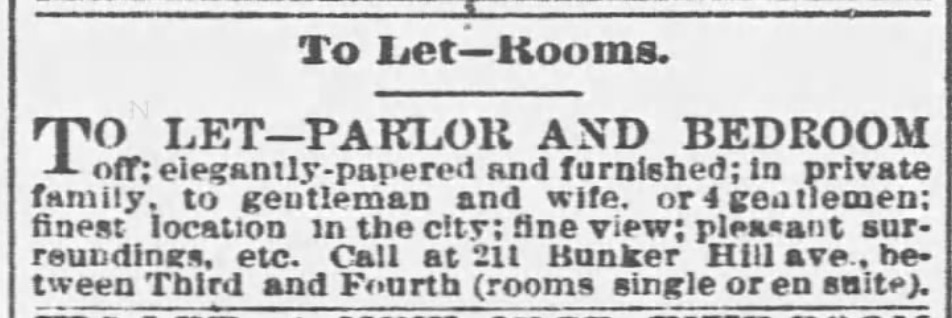

Let’s get you acquainted as to where 211 South Bunker Hill was—which gets tricky because of course it doesn’t retain “211” as its address for very long. Los Angeles went through street renumbering in December 1889, and 211 became 309.


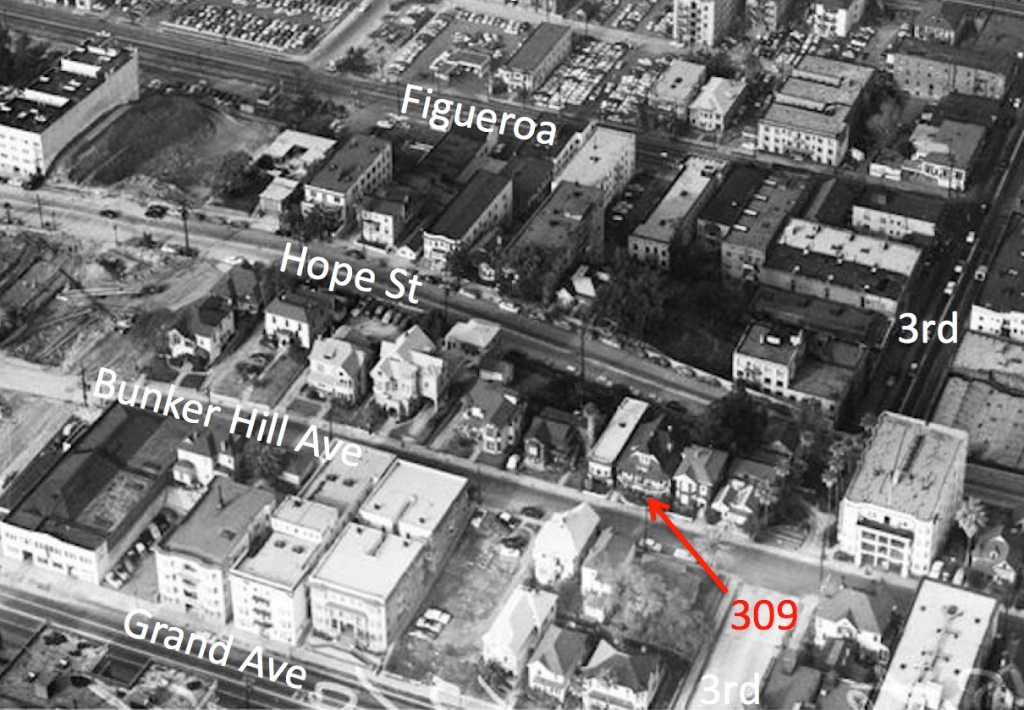
Here’s a shot looking east at Bunker Hill from Figueroa—


Now let’s look at the house again, and see what we see:

Two-story wraparound porches! Now that’s California living. That most of the detailing is reserved for the porch scrollwork and balustrade panels gives it a Folk Victorian flair, albeit not of the “gablefront and wing” configuration most commonly seen in the Folk styles of pre-Queen Anne Bunker Hill. Despite all its picturesque elements — a scrollwork’d balcony and a shed dormer and bicolor variegated shingle, this is a transitional house; had it been built two years later, we’d have seen a proliferation of gables and dormers and likely a turret. Instead, our massing is more sedate, but the Dutch Gable-Jerkinhead roofline is still pretty nutty. Note the stained glass window on the porch, flanked by the matching entrance stairs.
How rare is this image of the Weller house? Exceedingly; it’s basically the only decent image of the house we have. By comparison, we have well-known shots of the Castle near both its birth and death:

And yet virtually none of 309 South Bunker Hill (a scant three doors down from the Castle at 325). For example:

Note, though, a significant difference: the house as originally built was, at street level, one story (two, if you count the marvelous roof-balcony). Some time later, either the grade was lowered on Bunker Hill Avenue, or the house was raised to bring its lower floor up to the street.

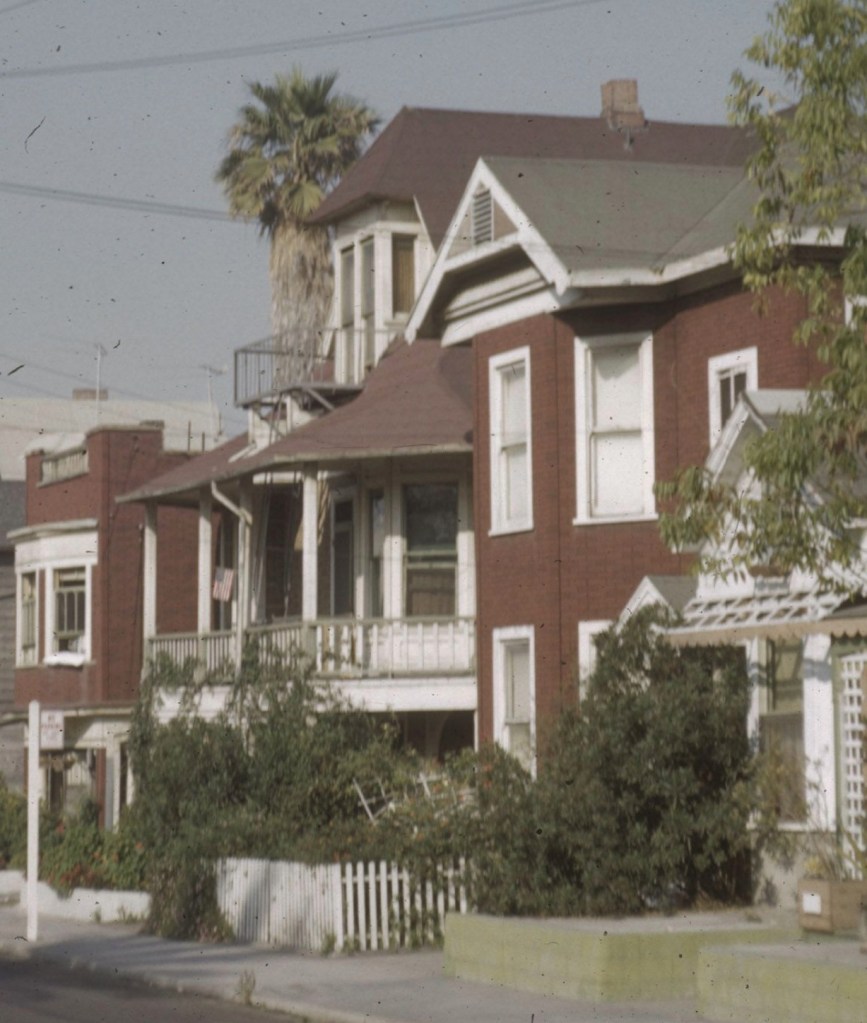


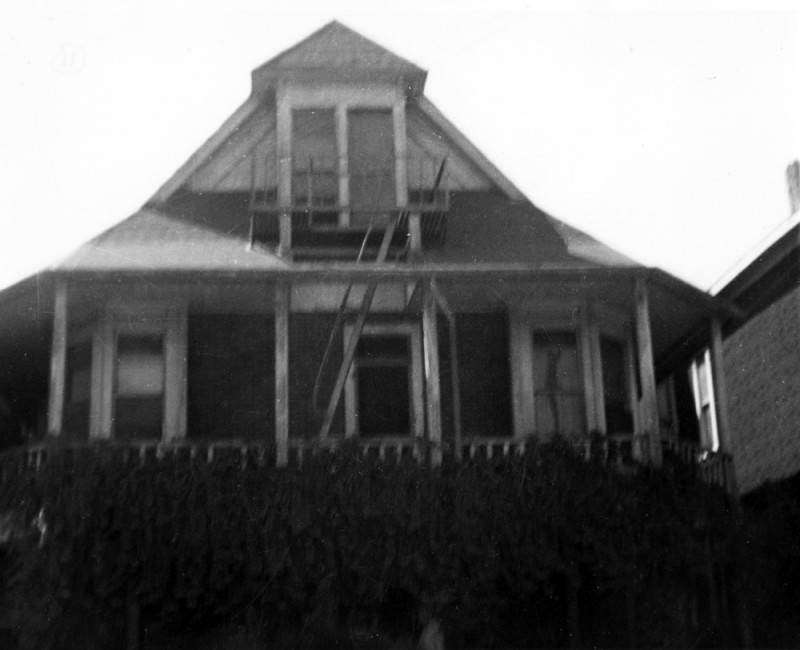
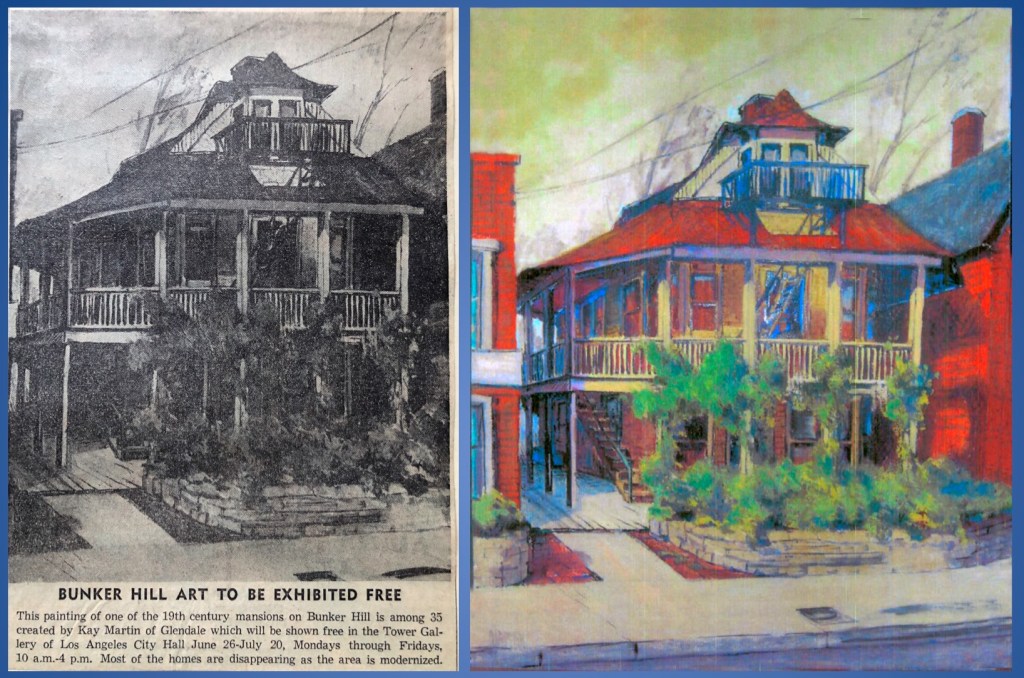

I don’t have to tell you what happened to the house—but I will anyway—it gets eminent domain’d by the CRA and receives its bye-bye papers in October 1964.
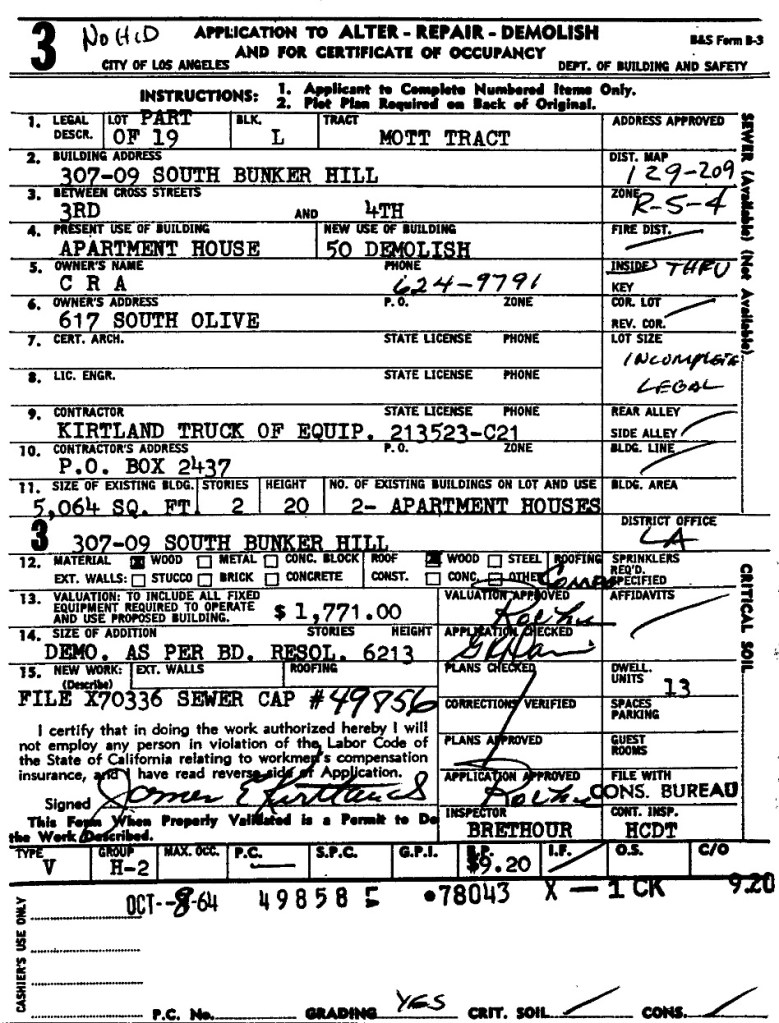
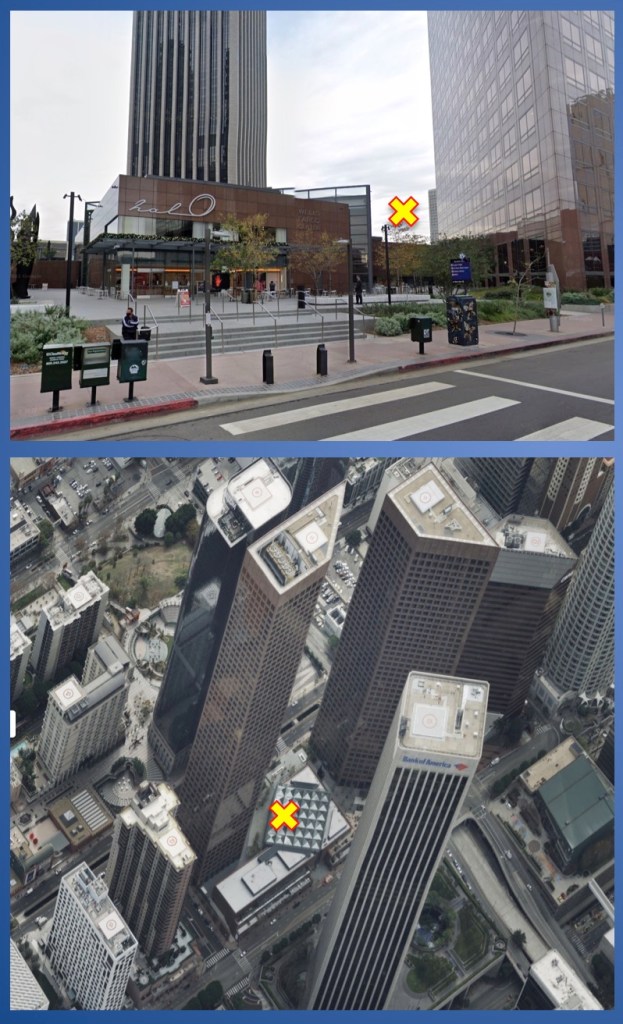
And in case you’re wondering about the former site of Weller’s house: since Bunker Hill Avenue between Third and Fourth has been wiped out, and the hill on which it ran was shaved down about forty feel, next time you’re at the Wells Fargo Center, picture the Weller house as floating over the north side of the Halo foodcourt, or thereabouts…
 Bunker Hill, Los Angeles
When I was a youngster, I lived across the street from the Weller house, and I must say I never paid it much attention. Had it looked like it originally did, I probably would have, but it was so transformed from its original interesting appearance, that it seemed to fade into obscurity in my mind. Anyway, thanks for bringing it back to life and paying it the attention it deserved. By the way, it appears to me that this section of S. Bunker Hill Avenue had originally had a small rise which was later regraded and lowered sometime after the Weller House was constructed so that the lower floor below the steps became the ground floor. The steps being done away with, the floor they led to became the second floor above ground level.
LikeLiked by 2 people