Angels abound! This is the City of Angels, after all. And I do work at Angels Flight. It seems only fitting that I should become steward of the most magnificent of our angels. A fallen angel, at that.
I speak, of course, about a Richfield Angel. Born at the high point of interbellum Los Angeles, silent protector of us all, until cast to earth by the pernicious hand of progress. And now, it is my duty to protect him.
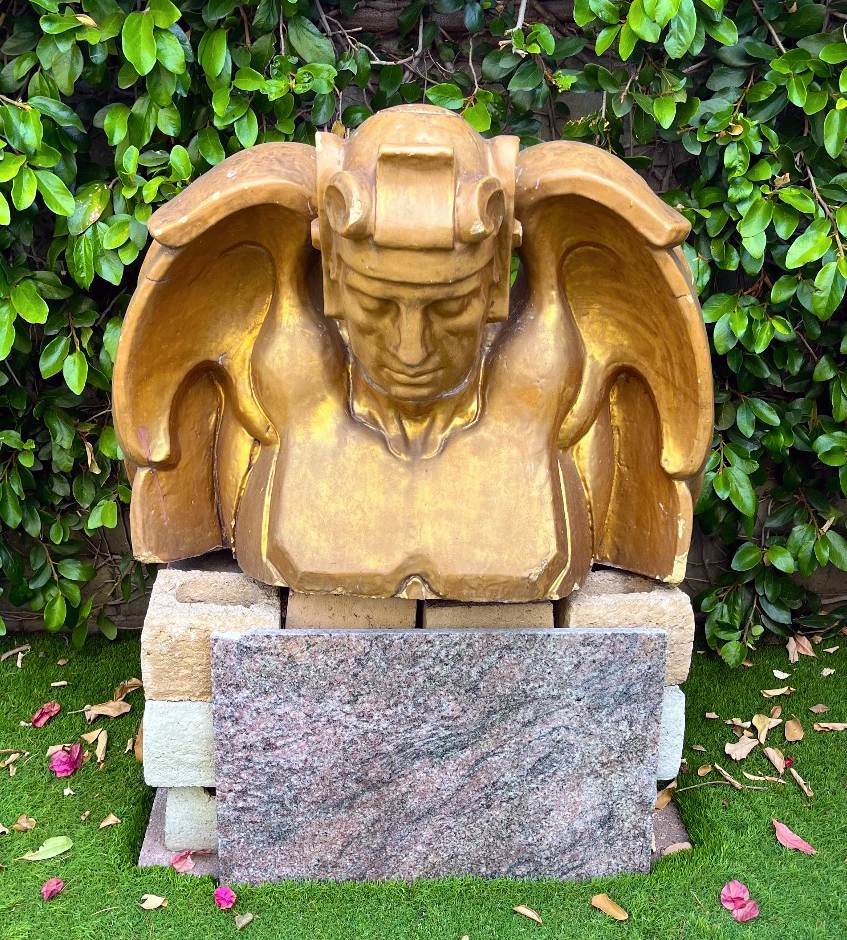
What is a Richfield Angel? Our story begins in 1876, up near Newhall, when the first gusher was brought in at the Pico Canyon oilfield. California oil strikes continued; Union Oil was formed in Santa Paula in 1890. In 1892 Edward Doheny struck oil just west of downtown Los Angeles, and from there, Southern California became one of the world’s great oil-producing regions. Countless hydrocarbon concerns sprung up including, in 1911, the Richfield Oil Company.
Through the 1920s oil companies built mammoth Los Angeles office buildings for their headquarters (I wrote a piece for DTLAX Magazine on the subject back in 2009) —
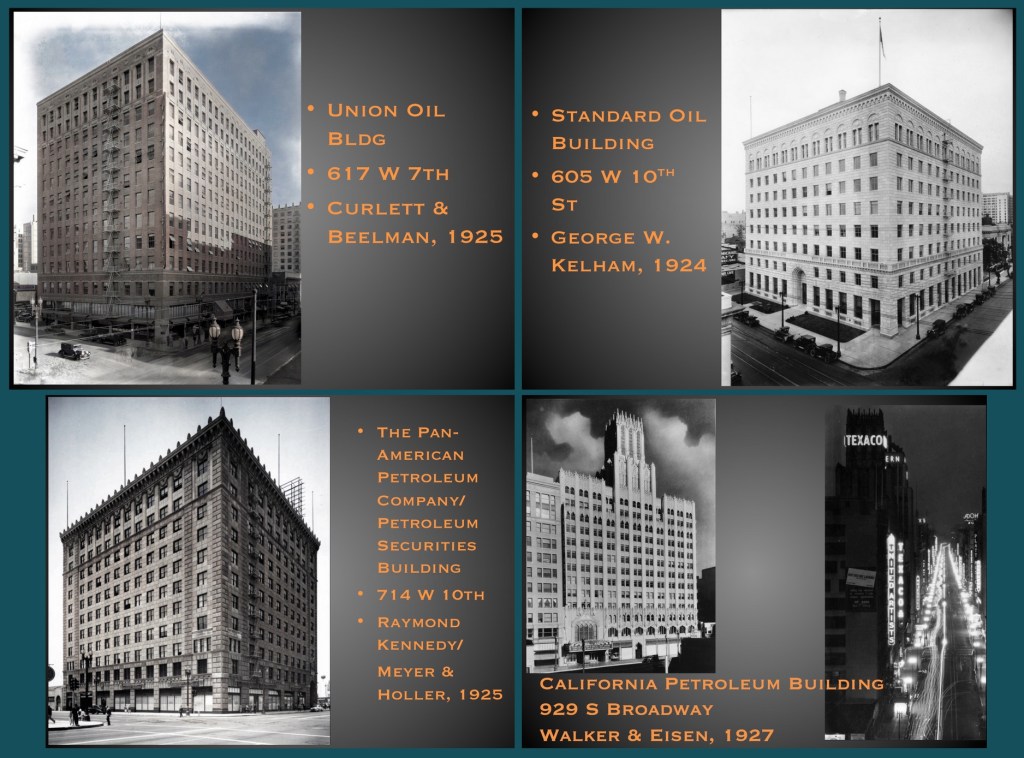
—but what do you notice about these edifices? Pretty standard Beaux Arts massing, all rough-hewn stone and neoclassical decorative elements. Sure, the California Petroleum Building has a setback tower, but it’s still replete with Spanish Gothic ornament.
Richfield Oil was having none of it. They needed to build an HQ, and it was going to express modernity. Richfield was known for its high-quality gasolines, as favored by race car drivers; Richfield showcased sculptures of streamlined race cars as advertising. Similarly, the company knew that the greatest advertisement would be a remarkable Art Deco building that declared this is the future.
So in 1927 they bought the northwest corner of Sixth and Flower streets, then called up the architectural firm of Morgan, Walls & Clements and said “hey! You got that Stiles Clements fellow there, he’s good! Give us something amazing!” And this is what Clements came up with:
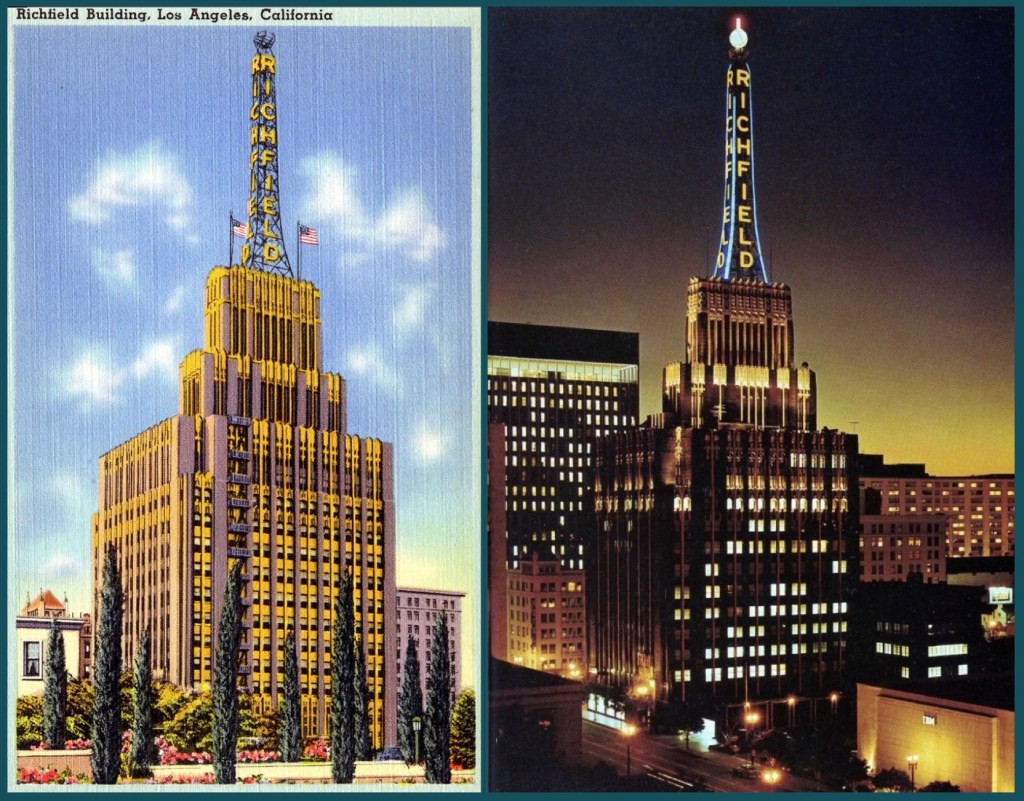
That’s right, an Art Deco height-limit skyscraper, done in black and gold (get it? Black gold?) with a giant neon tower intended to evoke a derrick.
And ringing the top of the structure were forty of these fellows:
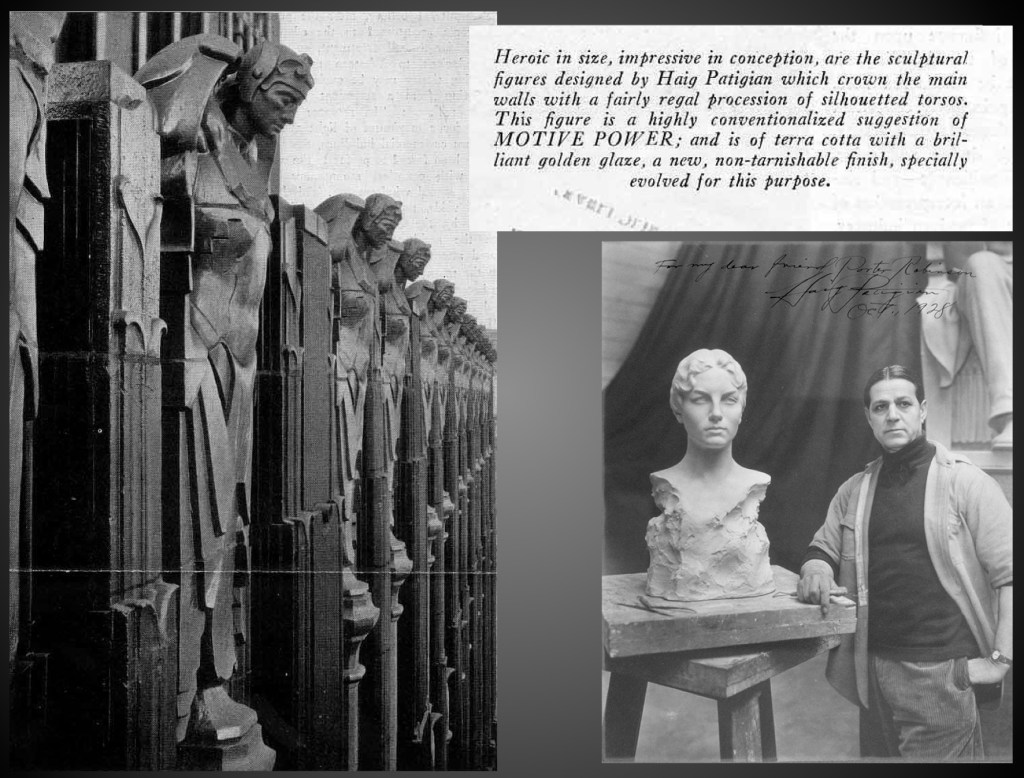
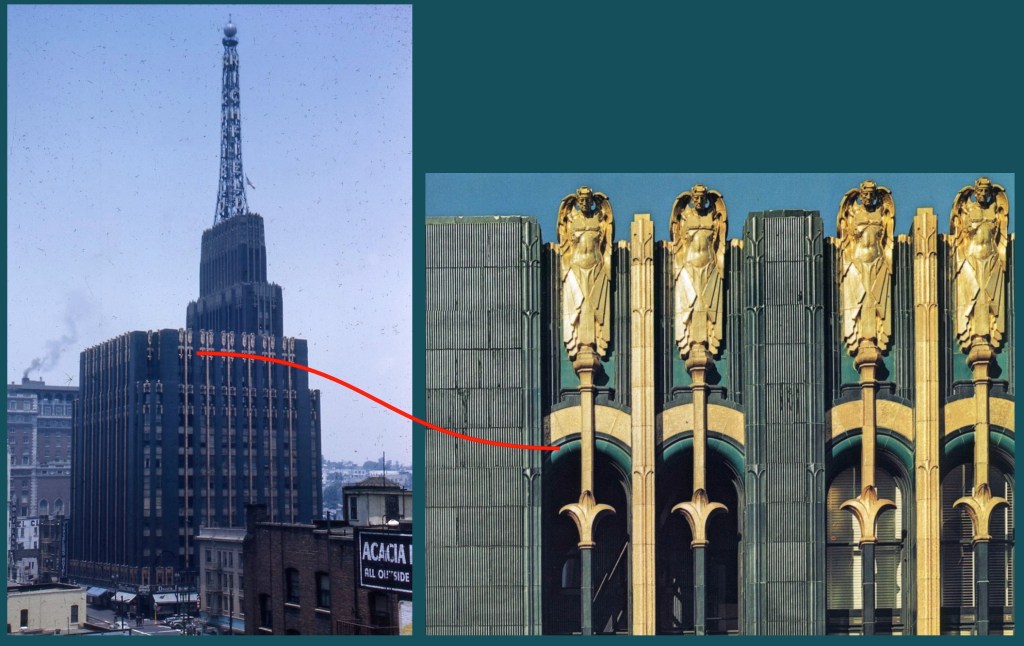
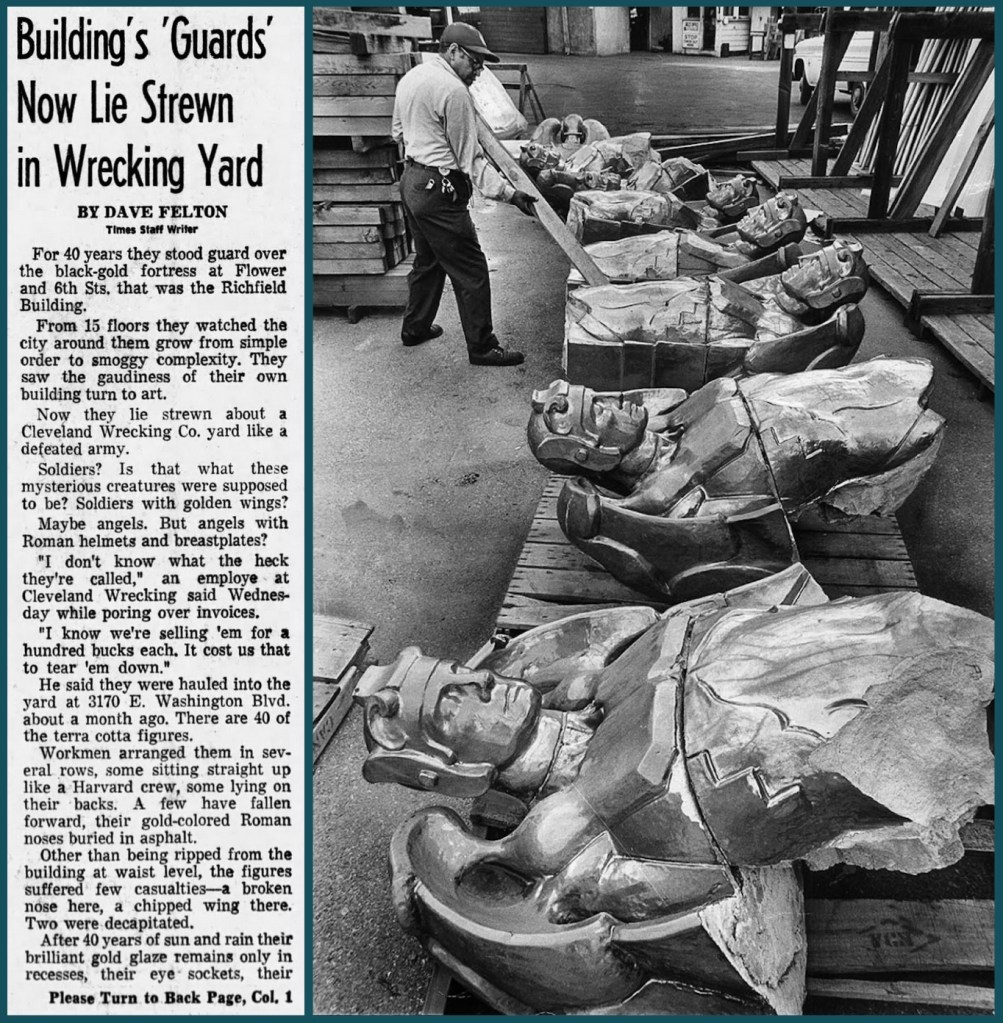
Needless to say, the Richfield Building was far too wonderful to exist in this world of ours. After a scant forty years, it had to be torn down. (There’s so much more to be said about the Richfield, and, if inclined, you may learn more than you ever wished to know by watching my lecture on the subject, though be forewarned its picture and sound leave much to be desired.)
During demolition, Cleveland Wrecking removed the angels and hauled them to their yard, where they were available to the public at $100 a pop. People carted them off become yard ornaments. A vast number of them disappeared.
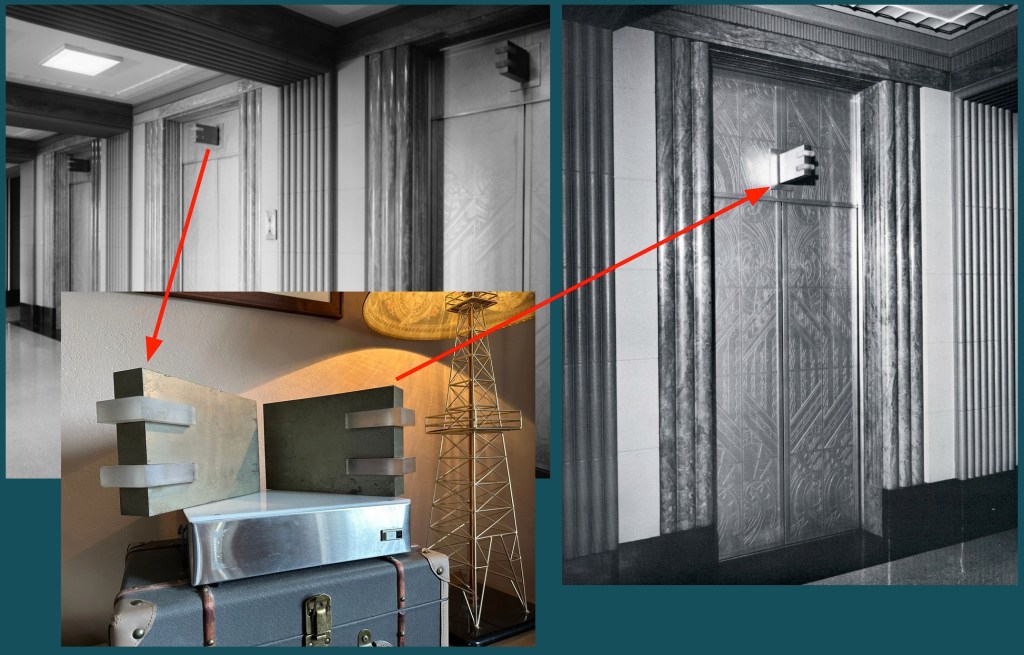
Naturally, I’ve always wanted one (well, I’ve always wanted ten, but would content myself with one). I did manage to get a couple of the Richfield’s upper floor elevator indicators, from the son of a guy who’d worked the demolition:
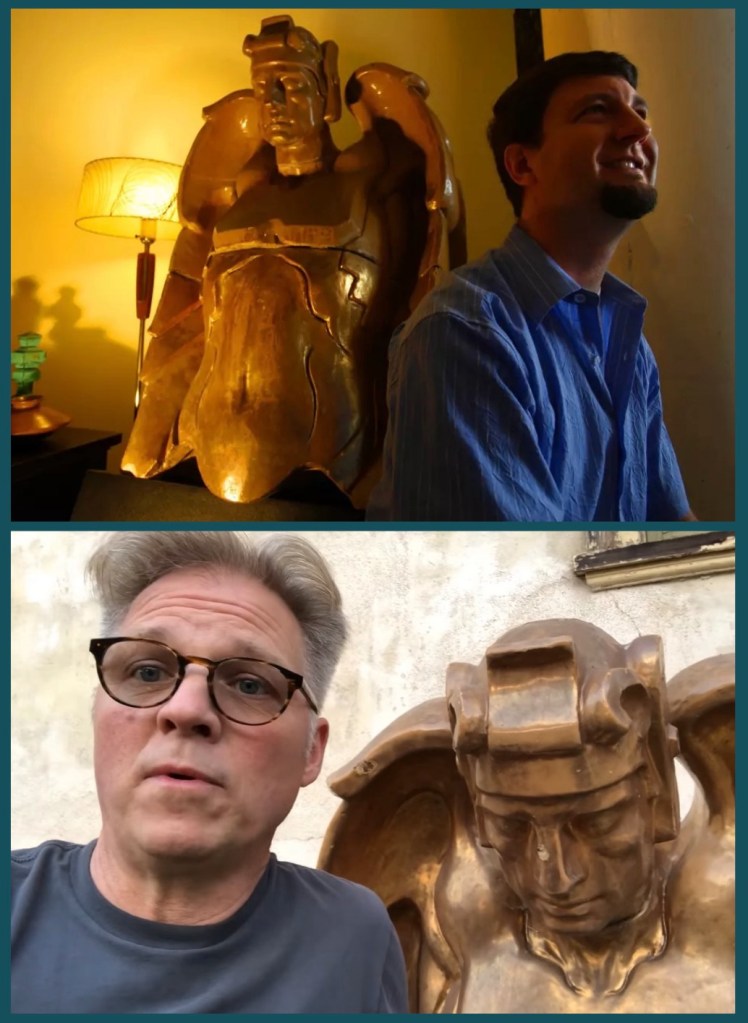
But still, an angel eluded me. A couple of my friends had them! Eric Lynxwiler (who designed Bunker Hill, Los Angeles and Before the Freeways) and Rory Cunningham (past president of the Art Deco Society of Los Angeles) were both proud owners:
Then about a month ago, I was contacted by Margot Gerber, Executive Director of the Art Deco Society. The conversation went something like this:
Margot: Hi, so, I was just contacted by a woman whose uncle recently passed, and—
Me: —and he had a Richfield angel and I need to go get it!
Margot: Huh? How did you know?
Me: BECAUSE I’VE BEEN WAITING FOR THIS CALL FOR THIRTY YEARS
I get in touch with the woman, who is absolutely lovely, and who is thrilled the angel would go to a good home. Her uncle, Donald Ray Alexander, was born in 1933 and had been, for many decades, a court reporter downtown; in his younger life he had worked for Texaco, so, there’s an oil connection. Nothing is known about when or how he came into possession of his angel, other than it was now at the Silver Lake home he’d purchased in 1979. Did he buy the angel from Cleveland Wrecking in 1969 and relocate it there a decade later? Or was it there when he moved in?
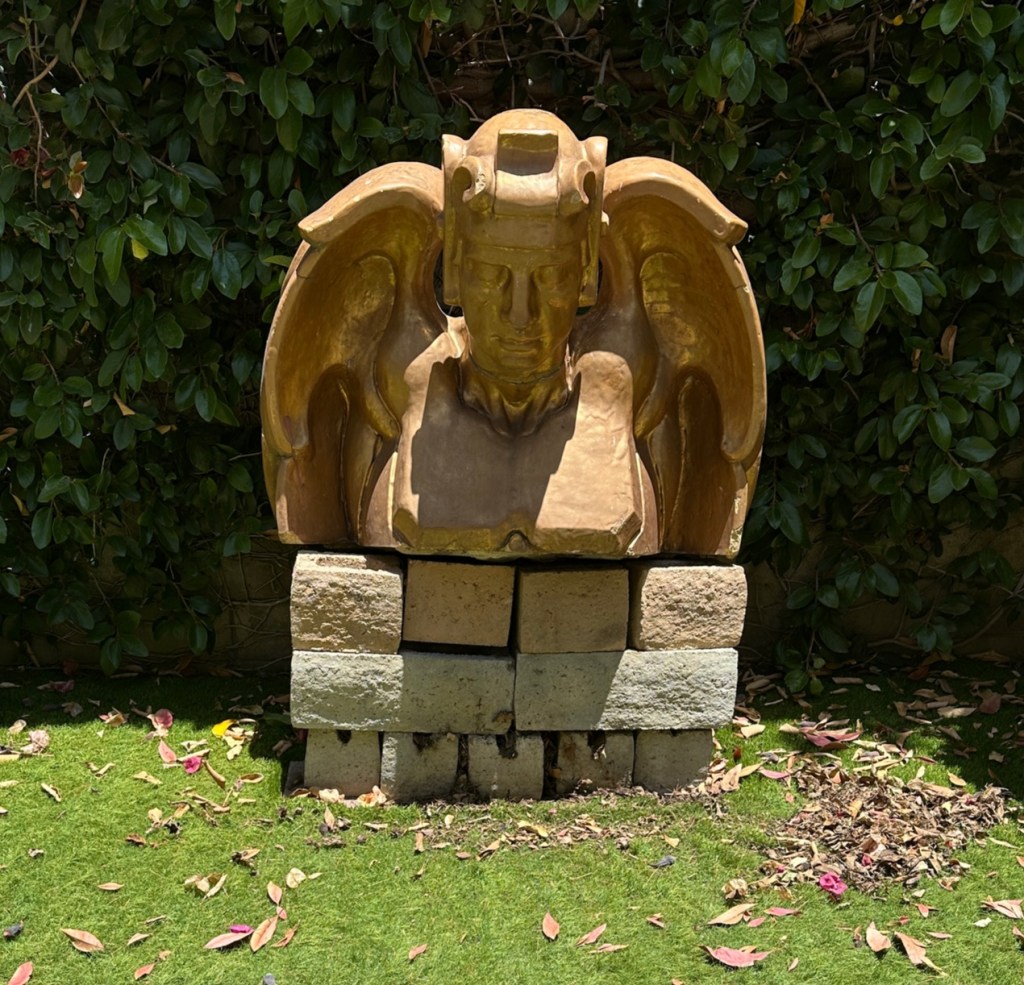
Whatever its history, it was coming home with me. This wasn’t a matter of simply loading it into the back of your SUV — at about 900 pounds, you’re looking at a professional moving company with a liftgate truck. I went through a couple of companies before I found one willing to tackle the task, but, a few days ago, it happened:

In his new home:
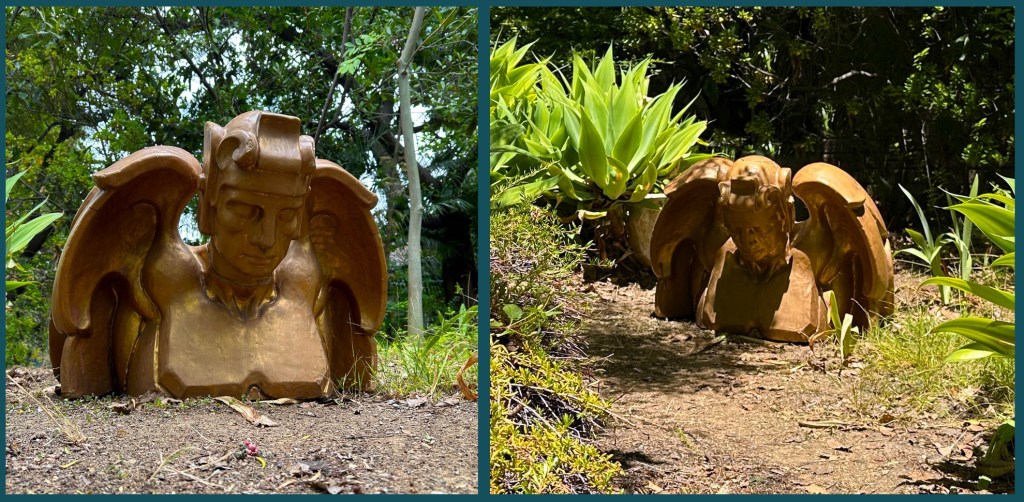
Obviously, he’s going to need a custom plinth built, one that will angle him back a bit so he’s not staring at the earth. Staring at the earth was, of course, his original purpose, but that was back when he was being viewed by people from a hundred feet below:
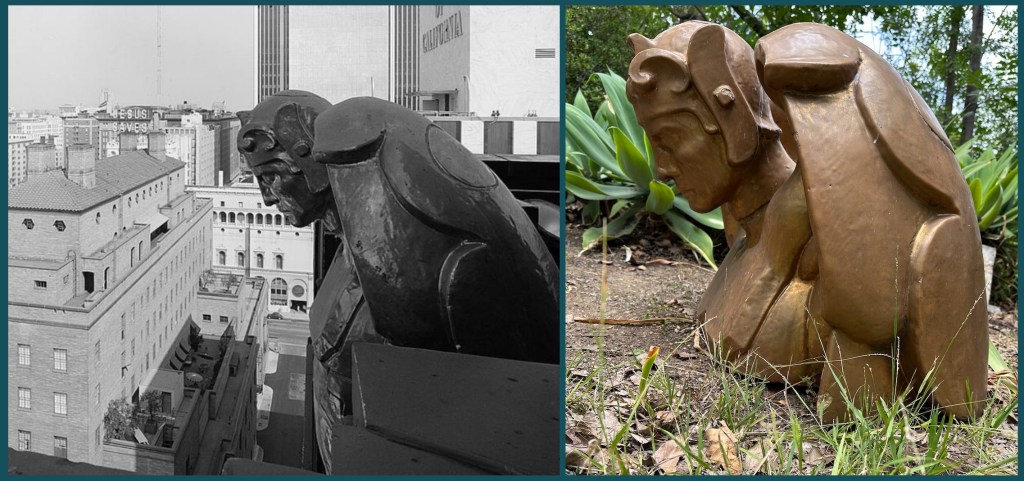
And that, ladies and gentlemen, is how I came to be the current steward of this magnificent beast. I know what you’re saying…that belongs in a museum! I don’t disagree, but we’re not there yet. There are two dozen major cities who have museums dedicated to their city’s history and culture — heck, New York alone has two. Maybe someday we’ll get there. Until then, what remaining years I have will be spent caring for this incredibly important fellow.
*****
Oh, one last thing, in case you’re thinking “hey, this blog is about Bunker Hill! The Richfield wasn’t on Bunker Hill!” You are correct, of course, but I’d say that the Richfield was an important touchstone in the community consciousness of Hill dwellers. Gordon Pattison, who grew up on the Hill, remembers well its looming presence, and the marvelous animated letters lighting up the “derrick” in the night.
Here, then, are some images that detail the Richfield’s proximity and relationship to Bunker Hill:
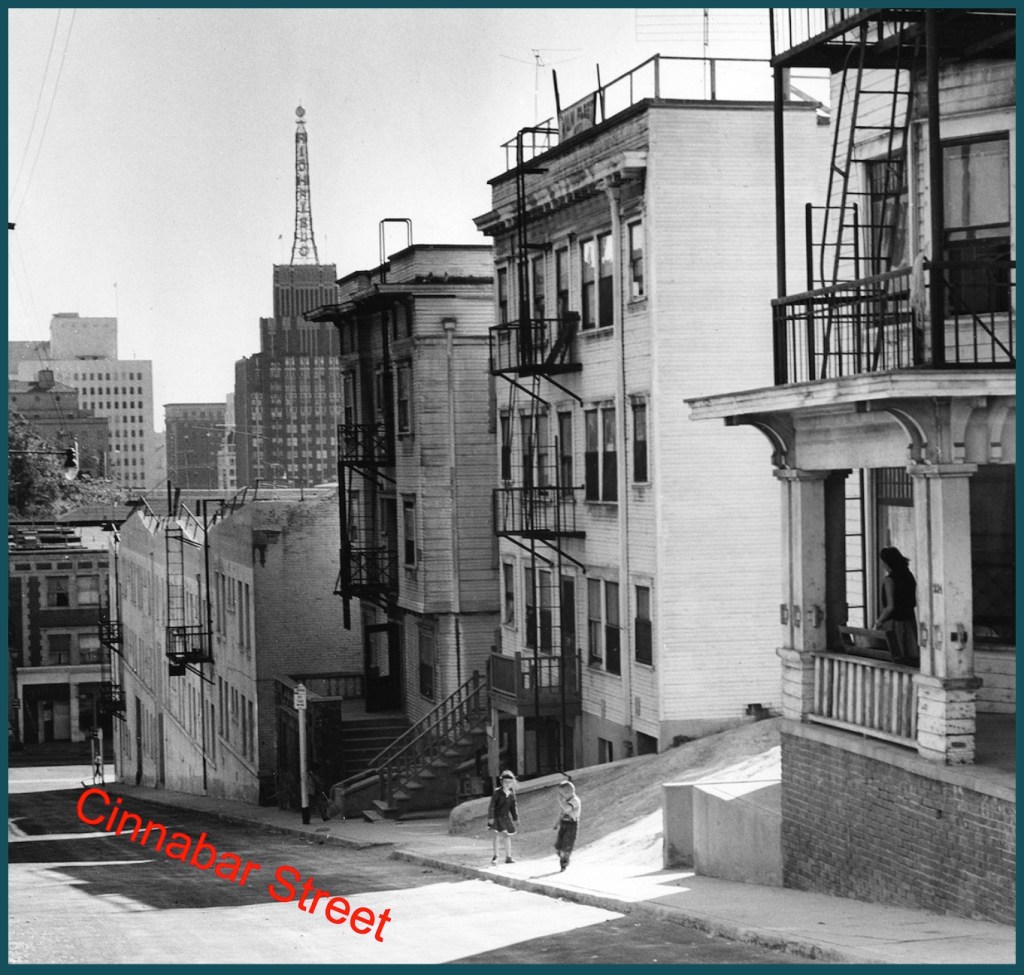
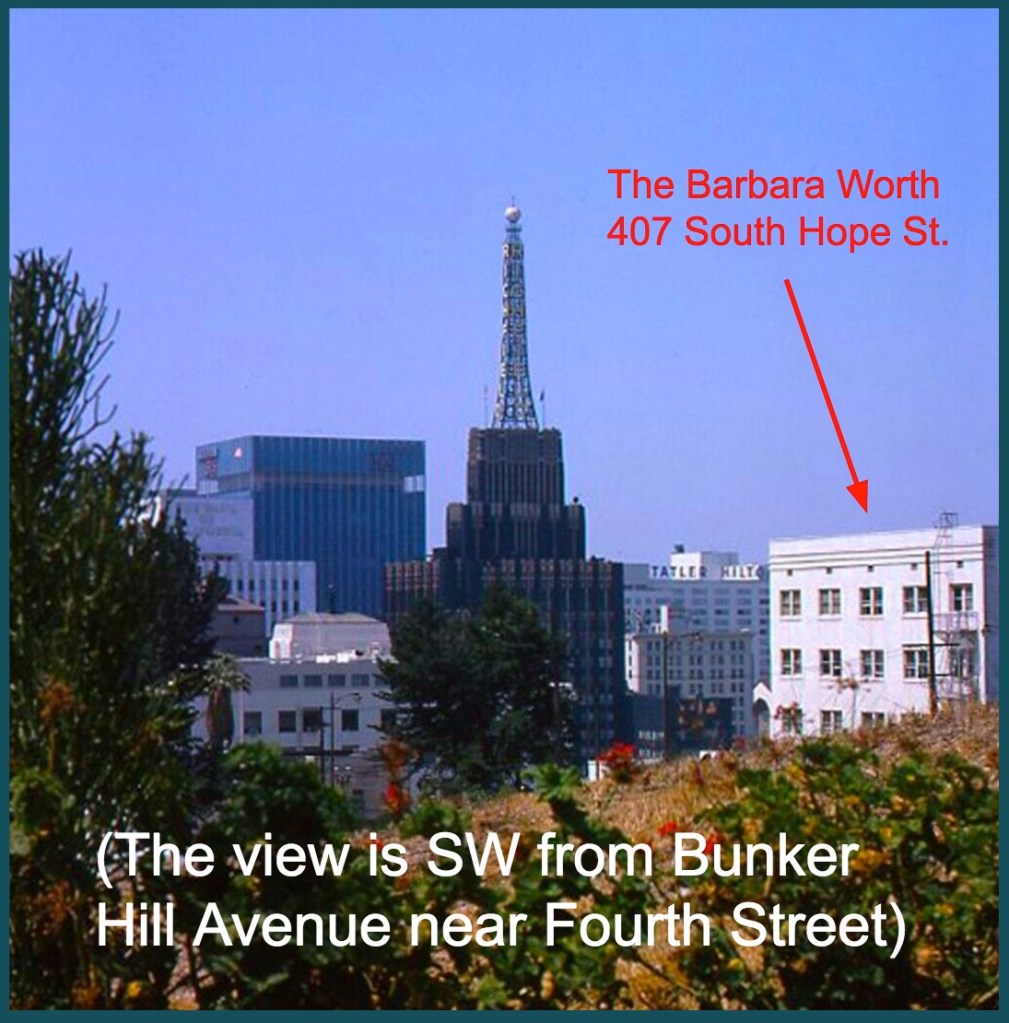
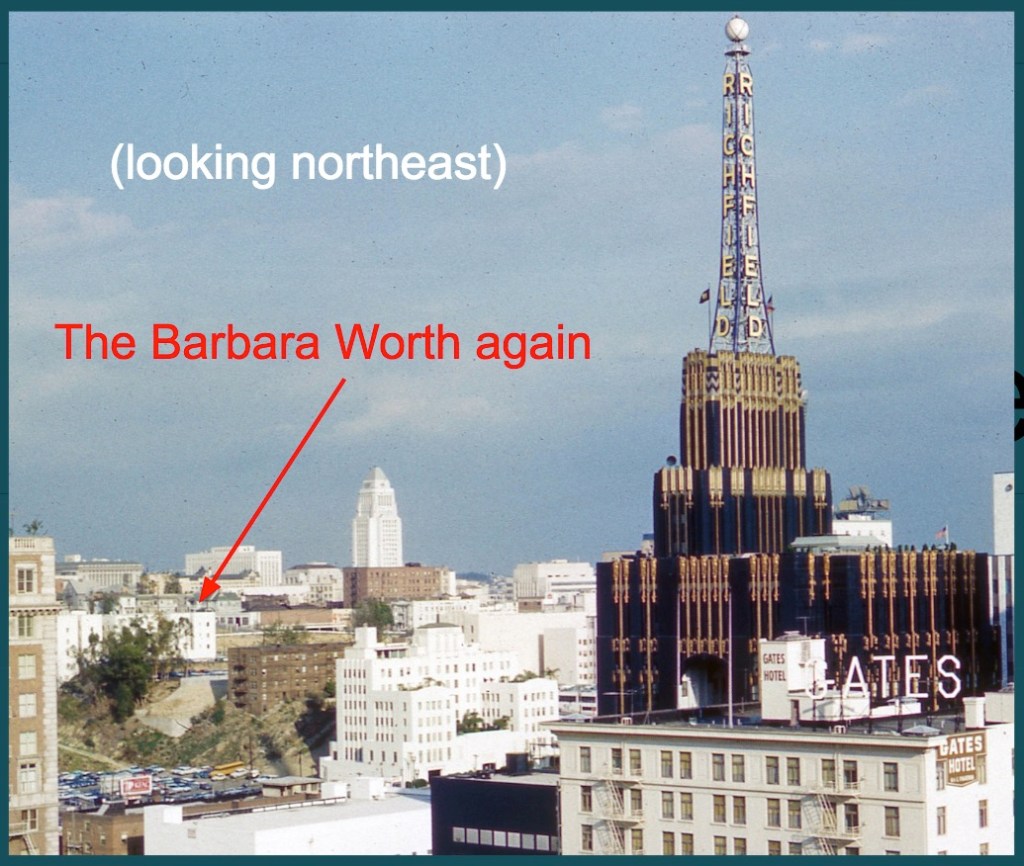
The Richfield shares its sad fate with Bunker Hill, being demolished in 1969 — same year the last two Bunker Hill houses got torched, and Angels Flight was dismantled.
The Richfield is enormously important in having galvanized our preservation movement. Its 1969 loss is roughly akin to New York’s 1963 demolition of Pennsylvania Station, which prompted widespread outrage and a renewed appreciation for architectural heritage. When Angelenos talk about the most lamented of our lost landmarks, the Richfield usually tops the list (there’s a reason it made the cover of Cindy Olnick’s L.A. Landmarks Lost and Almost Lost). Demolition permits were pulled for the Pellissier Building/Wiltern Theater twice in the late 1970s; the prospect of losing another Clements-designed ZigZag Moderne tower lit a fire under the nascent Los Angeles Conservancy.
So if there’s a silver lining to her demolition, it’s that.
Well, two silver linings: now I have a Richfield Angel.
 Bunker Hill, Los Angeles
Congratulations! Of all the people in the City of Angels, I can’t think of anyone more deserving than you.
Mark Lewis, Toronto
LikeLiked by 1 person
So glad it ended its journey and found a fine forever home with you Nathan!
LikeLiked by 1 person
Great news! And you so deserve the angel.
LikeLiked by 1 person
I WANT ONE
LikeLiked by 1 person
A young son of a friend of Dash Hammett and Lillian Hellman had come for a visit with them. During his stay, he fell in love with a custom made bow and arrow of Hammett’s that he played with during his stay. When the kid’s parents came to pick him up, Hammett sneaked the bow and arrow into the parent’s car. As the car pulled away, Lillian said to Hammett, “Dash, how could you do that? That bow and arrow was made for you, and it was so expensive!”
Hammett replied, “Lillian, don’t you understand? Things should belong to those who love them the most”.
LikeLiked by 1 person
Nice!!
LikeLiked by 1 person
Congratulations Nathan! I am glad this dear boy made his way into your hands because I know he will be safe with you.
LikeLiked by 1 person
So happy and excited for you and with you! A dream come true!! And thank you for providing me the answer to the question Where did my beautiful black & gold building go when I returned to the LA area in the early ‘70s?!?! I was well & truly stumped and couldn’t conceive of anyone demolishing such beauty!
LikeLiked by 1 person
Hi Nathan, congratulations, you deserve it! I have three silk screen images done in black and silver that are drawings of some kind that depict some of the Art Deco designs on the panels of the massive elevator doors of the Richfield Building. Ask Eric Lynxwiler — he came over to my apartment one time to see them. You are welcome to do so as well.
Michael
LikeLiked by 1 person
Hi Nathan,
Congratulations on the your new acquisition! As a kid I was fascinated & loved the gorgeous black & gold building with the “angels.” Are there any color pictures of the entire building? It was so incredibly beautiful!
LikeLiked by 1 person
congratulations Nathan,
great photos attached. You need to write a book on the LA oil companies. I would love to learn more.
Javier Lozano
LikeLiked by 1 person