The remains of Old Bunker Hill are few and far between. Yes, we have Bunker Hill captured in still images, and in cinema, but actual archaeological residua is scant. We have a house, of course, but attempts to analyze the greater Hill’s physical, material culture is generally limited to, for example, a retaining wall or two, and a couple pieces of wood. And a doorknob. So any time we rediscover an original remnant of Bunker Hill, it’s news! And I’ve got news!
*******
I was recently digging into the history of the First German Methodist Church, at 449 South Olive Street, on the southern edge of Bunker Hill. My need to document the church stemmed, in part, from regret it hadn’t been included in my book Bunker Hill, Los Angeles. The book featured the Olive Street synagogue on the northern end of the hill, but not the Olive Street Methodist church at the southern tip—omitted, but not disincluded for lack of trying, because if there’s one thing you learn about producing books like these, it’s that you can’t include everything. (You can try, but the editors will excise most of it, and then gently remind you that there are few buyers for 50-pound 1,000-page books.)
First German Methodist had been demolished in 1988, and I began to look into the status of the congregation. Had they survived? Maybe moved on and into new digs? Turns out they had, but what I didn’t expect is that they took a part of Old Bunker Hill with them!
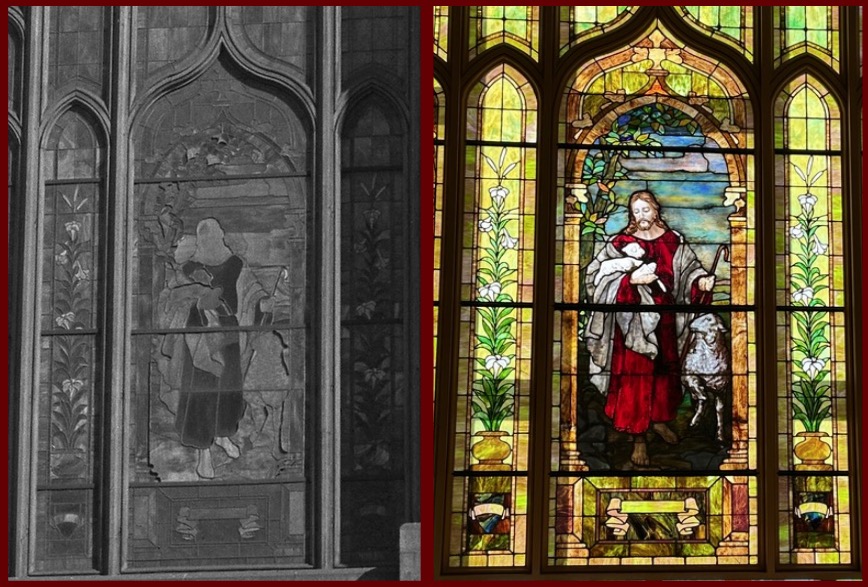
This, then, is the story of some incredible, beautiful survivors from Bunker Hill.
*******
THE GERMANS
Before we get to German Methodists in particular, let’s talk about Germans in general. The German contribution to the first century of Los Angeles—roughly from the 1840s through the 1940s—was foundational to the city’s transition from a dusty outpost to a global metropolis, proving absolutely essential to the economic, cultural, and political architecture of early Angeleno life. One hears a lot about, for example, our Spanish founders, and the ever-important French, and the primarily Anglo-Saxon and Scots-Irish Midwestern migrants of the boom years, but because of their propensity for assimilation (made more pressing due to anti-German sentiment in and around the wars) and intermarriage, the Germans rarely get examined. Traditional German sites like Alpine Village have faded away. When Germans do get mentioned as they relate to Los Angeles, it’s usually the interbellum-era intellectual class (e.g., this/this/this/this) who were largely irreligious, Jewish, or both; less so those of the earlier variety, whom we’ll examine here.
Germans had the numbers; in 1900, among the foreign-born population in Los Angeles, the Germans ranked first (those born in England ranking second). Their social institutions—including the Turnverein (athletic clubs) and various German-language newspapers like the Süd-Californische Post—wielded civic and political influence. Los Angeles was the winemaking capital of California largely due to Charles and Henry Kohler and their partner, John Frohling. The Maier and Zobelein Brewery, later known as the Los Angeles Brewing Company, became one of the largest industrial operations in the city, providing stable labor and significant tax revenue that funded early urban expansion. Anaheim was a massive German undertaking, back when it was still part of Los Angeles County. Germans were instrumental in banking (Hellman), mercantile trades (Newmark), manufacturing (Entenmann), and on and on.
And architecture? People think Romanesque Revival originated with that Franco-English guy Richardson, but it was in fact the product of Germans importing their Rundbogenstil (Round-Arch Style). Without the German tradition of Heimatstil—and its focus on woodcraft, exposed joinery, and natural materials—we would have neither the bungalow nor Craftsman home. Furthermore, we wouldn’t have Modernism. And no, I’m not merely talking about Gropius and Mies, Neutra and Schindler, Wachsmann and Pfisterer; I’m talking about the German-trained engineers who conceived the early American daylight factories, and whose structural calculus built them—the true progenitors of Modernism.
America’s educational system, agricultural mastery, and advances during the Industrial Revolution? Largely German. The German national consciousness brought to America a deep-seated cultural and philosophical tradition defined by the concepts of Kultur, Bildung, and Ordnung. This consciousness provided a structural backbone to the American experiment, grounding it in a heritage of disciplined intellect, vocational mastery, and high civic engagement. (And in case you’re wondering, no, I personally have no German ancestry, so I’m not trying to toot my own ethnic horn.)
Now, with all that in mind, for our purposes today, let’s not forget Los Angeles’s German churches. These include the German-language St. Joseph’s Catholic Church, at 12th and Los Angeles Street; German Baptist at 8th and Maple; German Lutheran at 8th and Flower; Trinity Evangelical German Lutheran at 18th and Cherry; the German Evangelical Association at 618 South Olive St. (later the location of Clifton’s Pacific Seas); and the German Evangelical Church under the Synod of North America, AKA the Friedensgemeinde, on San Julian Street near 7th, among others.
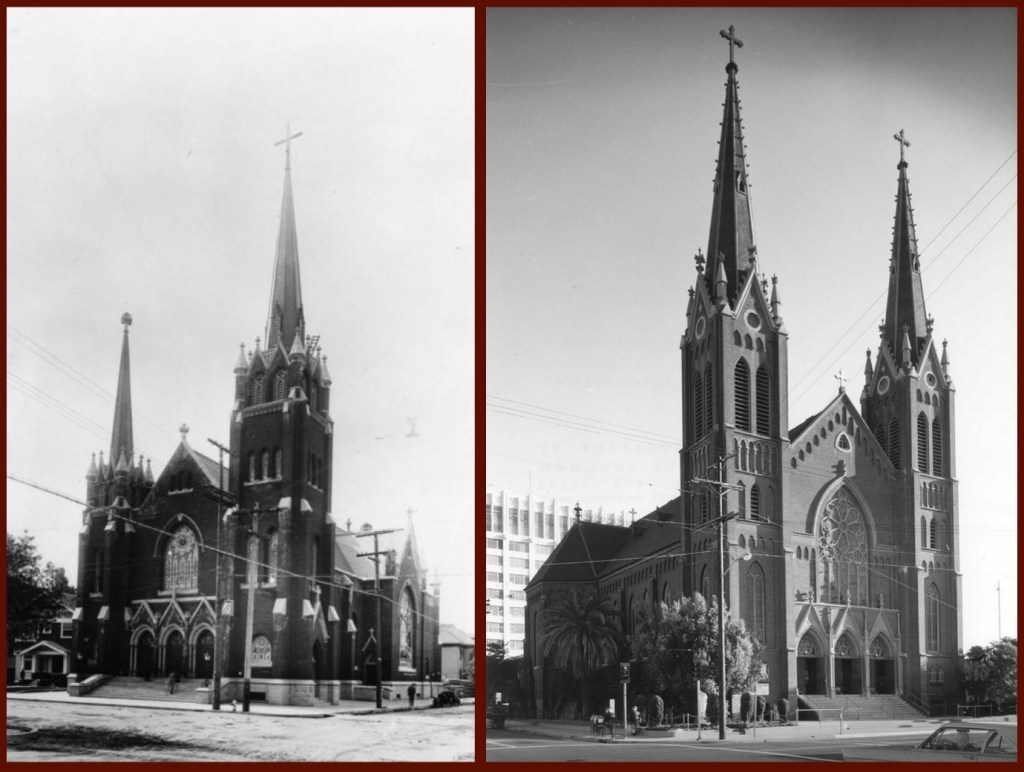
And then, of course, there was First German Methodist.
*******
FIRST GERMAN METHODIST
When you think of the Germans and their religion, what comes to mind is Western Christendom’s famous fracture between Lutheranism and Catholicism. Methodism in Germany was a later, less influential arrival, arriving in the 19th century through missionary efforts; it remained a “free church” movement, never gaining the deep institutional and historical ties that Lutheranism and Catholicism possess.
Methodism emerged from the eighteenth-century Anglican revival led by John Wesley. It emphasizes personal holiness, social concern, and an experiential relationship with God. Once a reformist movement within the Church of England, it evolved into a distinct Protestant denomination centered on methodical discipline, conversion, and global evangelism. I am far from a religious scholar, so I turned to one, asking about the difference between the Methodists and Lutherans. She wrote: ‘In essence, Lutheranism is a theology of the Cross—focused on the objective reality of what Christ has done for the sinner—while Methodism is a theology of Holiness—focused on how that grace manifests in the observable, sanctified life of the believer.’ Turning to another scholar for perspective on Catholicism, he noted, and here I am greatly paraphrasing: ‘Catholicism is an institutional and sacramental system that emphasizes the Church as the necessary vessel for salvation, whereas Methodism is a pietistic and revivalist movement that emphasizes the individual’s practical experience of holiness and the active application of faith in the world.’
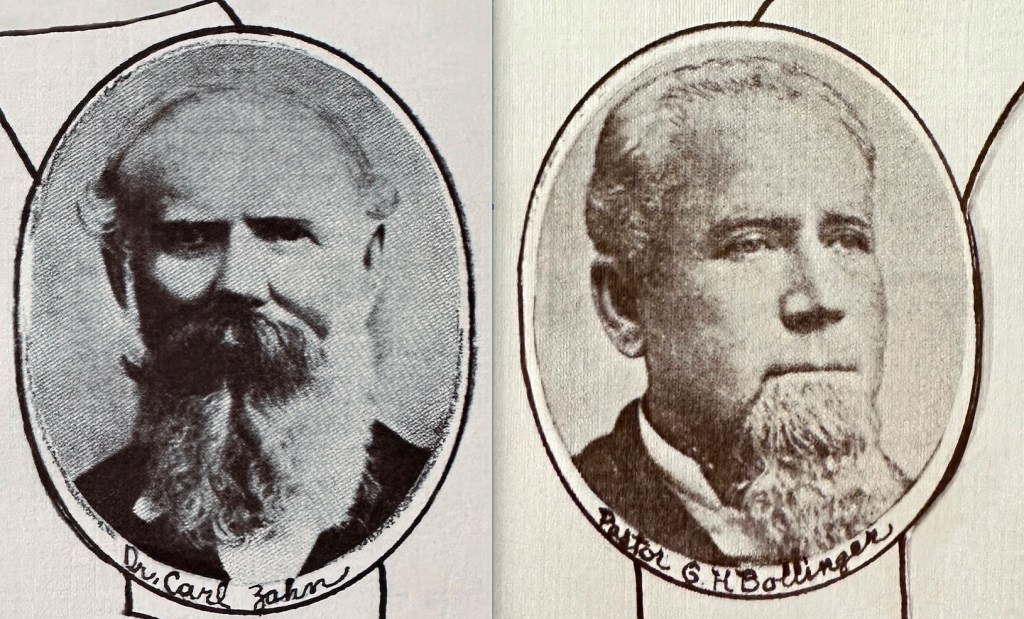
Now that we have defined our terms, we turn our tale to Dr. Johann Carl Zahn. Born near Halle an der Saale in 1822, he became a doctor in Saxony, and in 1848 emigrated to Australia. In Melbourne, in 1869, he met and married an English girl, an Anglican Church missionary named Frances Sharp. They moved to San Francisco in 1871 and come 1873 headed south for Los Angeles. While Los Angeles had the Turnverein Germania (the German gymnastics club) and the Teutonia Singing and Social Club, there were no German churches. Zahn built a house on Spring Street, between Fourth and Fifth, which included a congregation hall, and on July 5, 1874, he founded an independent German Protestant congregation.
There had been Englishmen practicing Methodism in Los Angeles since 1853. The Annual Conference of Methodists had been established in California immediately after statehood, and a Southern California Conference followed in 1875. That set the stage for the arrival of Gottlieb Bollinger.
Gottllieb Heinrich Bollinger had been born in Hattenhofen in 1829, emigrated to America, where he gained experience among the German Methodists of Cincinnati before being transferred to California in 1865. He founded many congregations and built churches and parsonages throughout the Sacramento area. Upon his arrival in Los Angeles in 1875, Bollinger was placed in charge of the Southern California Conference of Methodists, but his first move was to pay a visit to Dr. Johann Zahn. Zahn already operated the aforementioned German Protestant church—of which more than half the congregants were Methodist—which he then handed over to Bollinger. (Zahn and family went on to build a house on Bunker Hill, of course.)
In November 1876, Bollinger organized the congregation as the German Congregation of the Methodist Episcopal Church of the Southern California Conference. For its first three years, the German congregation met within the structure of the First Methodist Episcopal Church of Los Angeles, built in 1868 on Fort Street (now Broadway) between Third and Fourth. In the fall of 1879, the German Methodists completed their own church on Fourth Street, between Fort and Hill streets.
With the church established, Bollinger was transferred in 1883. He was followed by a number of successors, and the church continued to grow. Eventually, several more German Methodist congregations were founded—in Hollywood, Pasadena, Anaheim, and San Pedro—to the point that these congregations split from the American Methodist conferences to form the California Deutsche Konferenz in 1890.
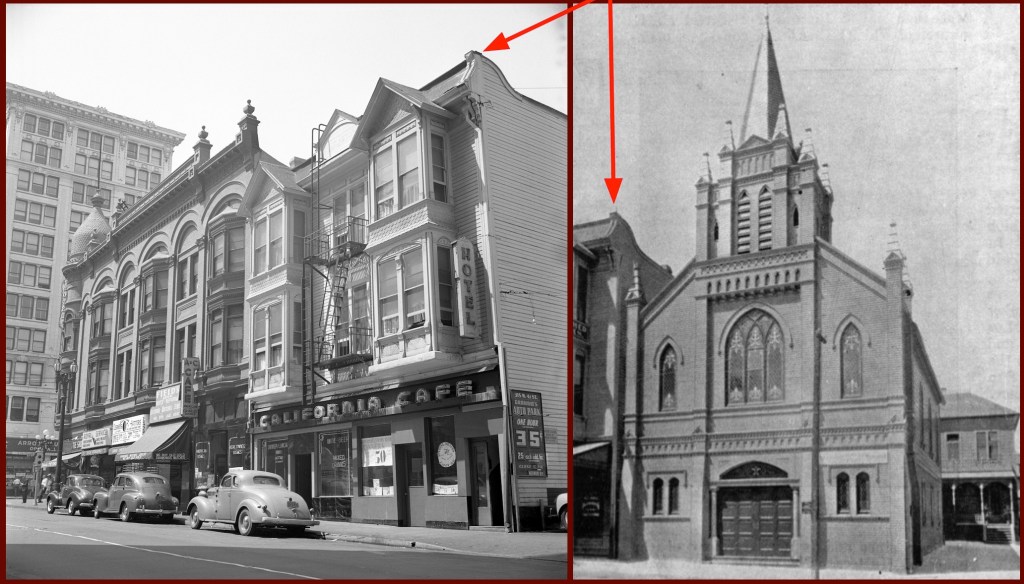
The downtown German Methodist congregation on Fourth Street flourished and prospered; within the church, countless baptisms and marriages were performed. Eventually, it became time for the building to expand. One of the congregants, William Knickrehm—who had been married in the church—was a building contractor well-established in the house-moving and house-raising business. In March 1897, Knickrehm did the work of raising the one-story building and constructing a ground floor underneath, where stairs, assembly rooms, and offices were placed. A pipe organ was added to the church as well.
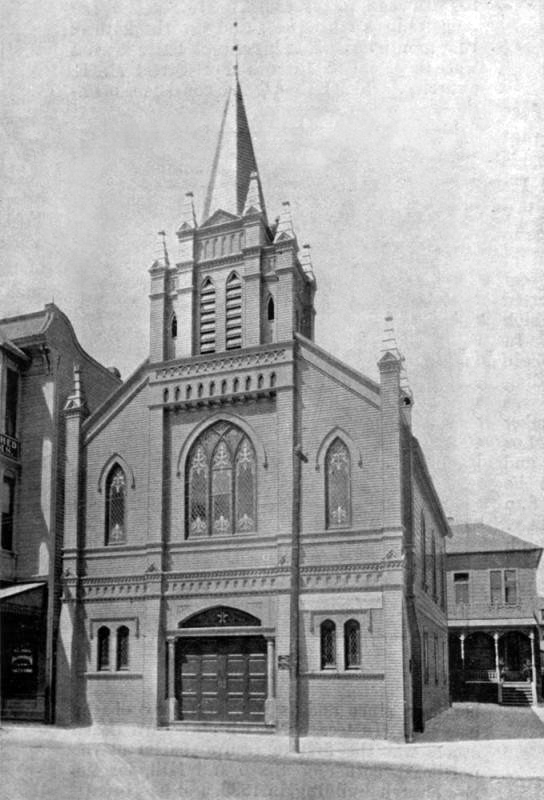
Above, the home of First German Methodist after the 1897 addition, but before it gets hauled off…
*******
THE ARRIVAL ON BUNKER HILL
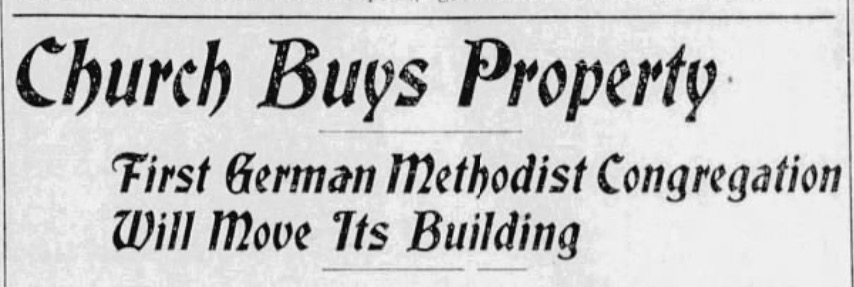
In 1901, the congregation sold the Fourth Street property seen above (for $23,000, having paid $750 for it in 1878) and purchased a lot on Olive, north of Fifth Street. William Knickrehm was again in charge of moving the church, but this time he hauled it a block and a half east on Fourth and a block south on Olive, plopping it down in its new Bunker Hill digs.
At 451 South Olive St. —
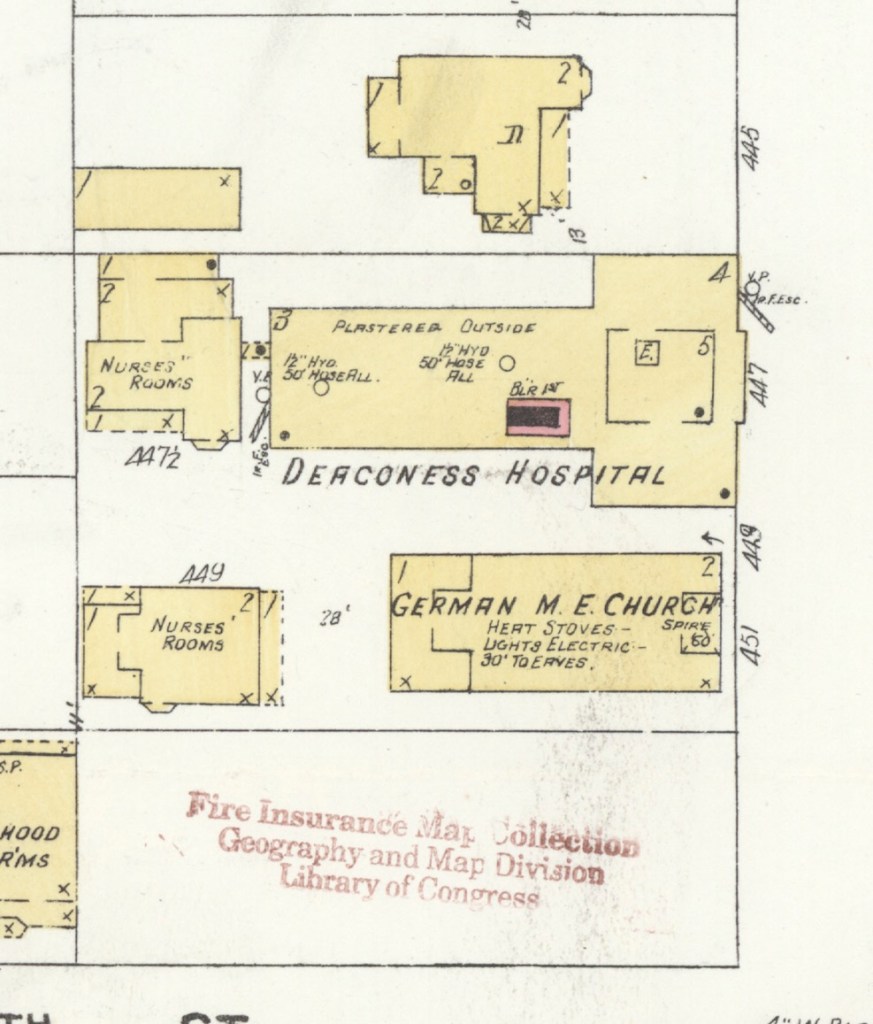
A quick aside—the church builds a hospital on the neighboring lot:
Dr. Zahn died in 1901, bequeathing $16,000 to the church. The congregation decided to build a hospital, so they purchased the house next door and welcomed nurses sent by the German Methodist Deaconess Motherhouse in Cincinnati. However, the church had grander plans: soon, a new hospital was under construction, which opened as the German Deaconess Hospital on February 8, 1904.
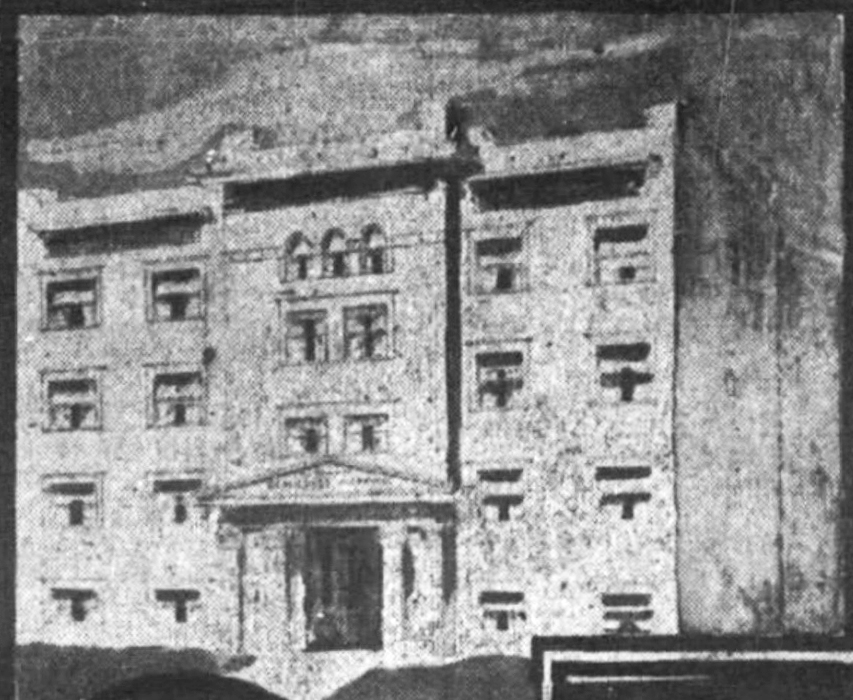
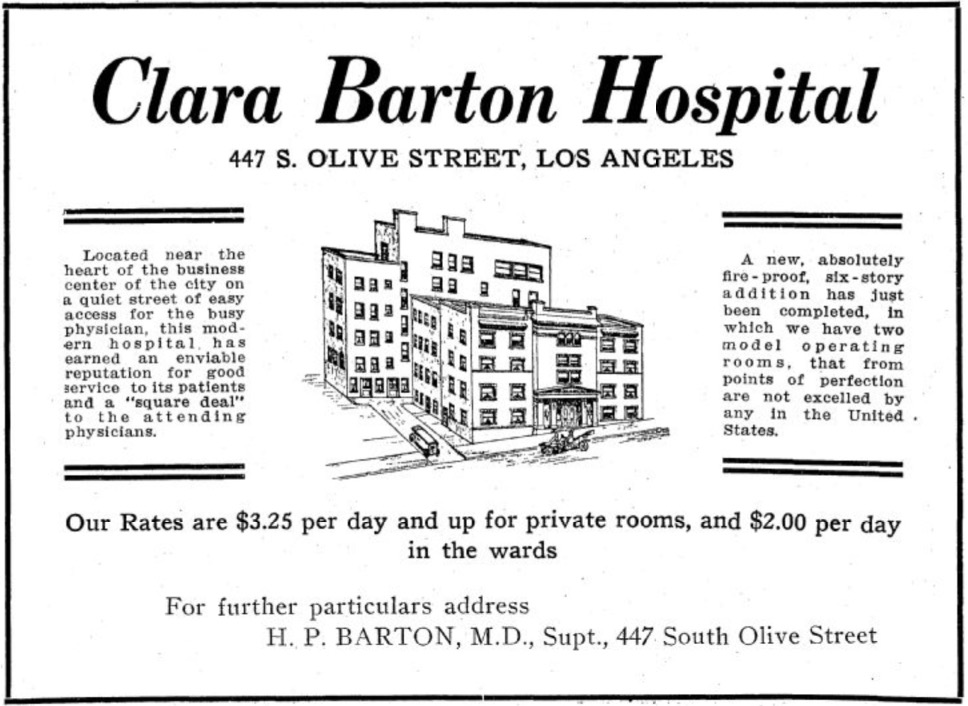
The church soon realized that running a hospital wasn’t in their business plan, and it was leased to the Clara Barton Hospital, who had outgrown their location at Hope & Pico.
*******
THE NEW CHURCH ON BUNKER HILL
In 1908, the church took on a new pastor. His name was Jakob H. Durhbahn—an American by birth, but one whose father had come from Schleswig-Holstein. The congregation had swelled, they had money in the bank, and it was time either to move from the now-too-tiny church on the southern tip of Bunker Hill or to demolish it and build anew. Durhbahn, the board, the congregation, and the superintendent decided on the latter. Thus:
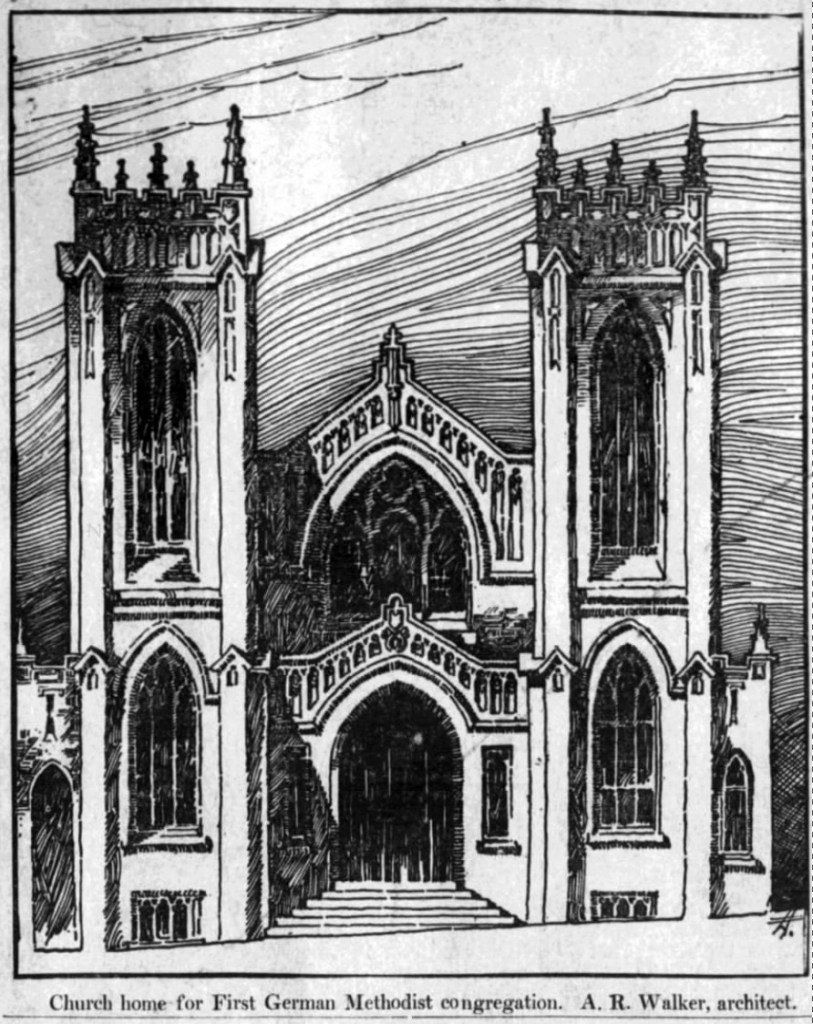
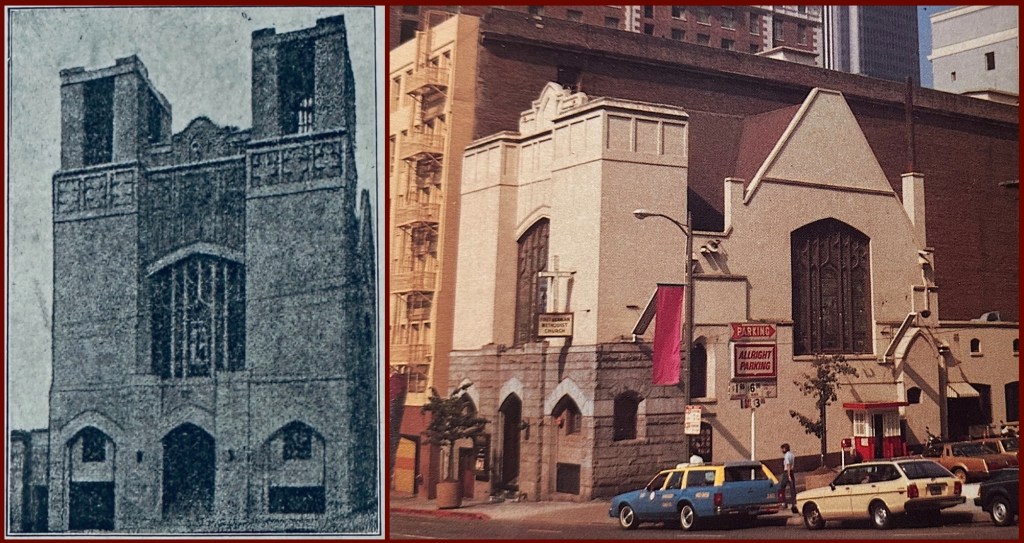
In February 1910, the Times published this rendering of the new church, with Albert Raymond Walker as the architect. For a German church, it is a rather English design—more an Edwardian interpretation of mid-19th-century Gothic Revival than pure Gothic Revival itself, if there can be such a thing. It appears to have roots in the enormously influential 1847 Trinity Episcopal Church in Columbia, South Carolina, which was itself based on York Minster. In the spring of 1910, however, Walker partnered with John Terrell Vawter, and by June, they had reconfigured the design:
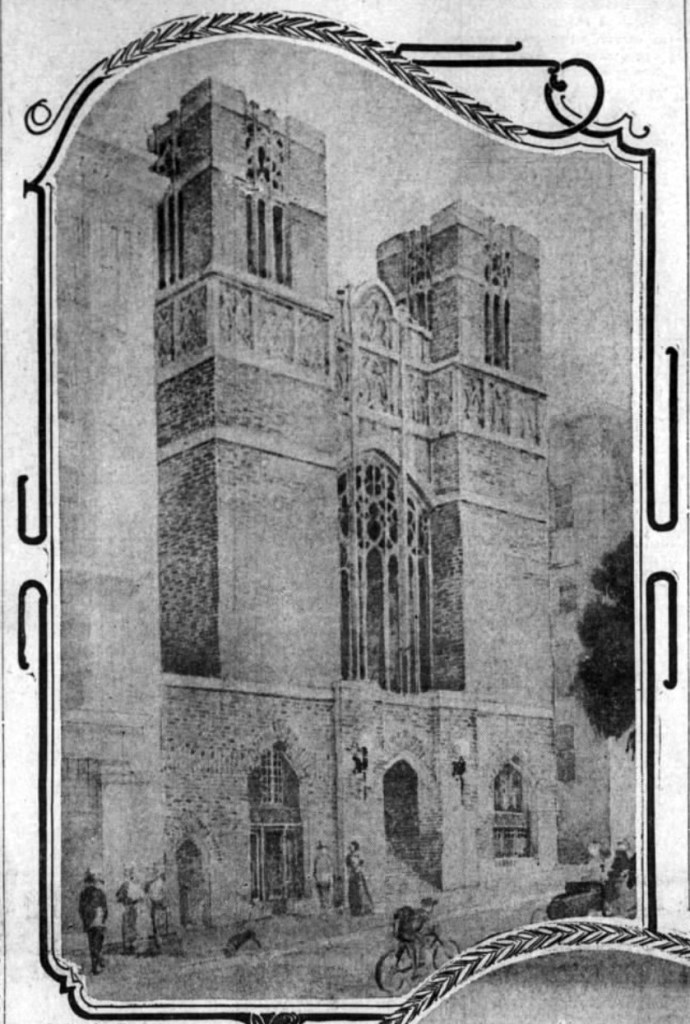
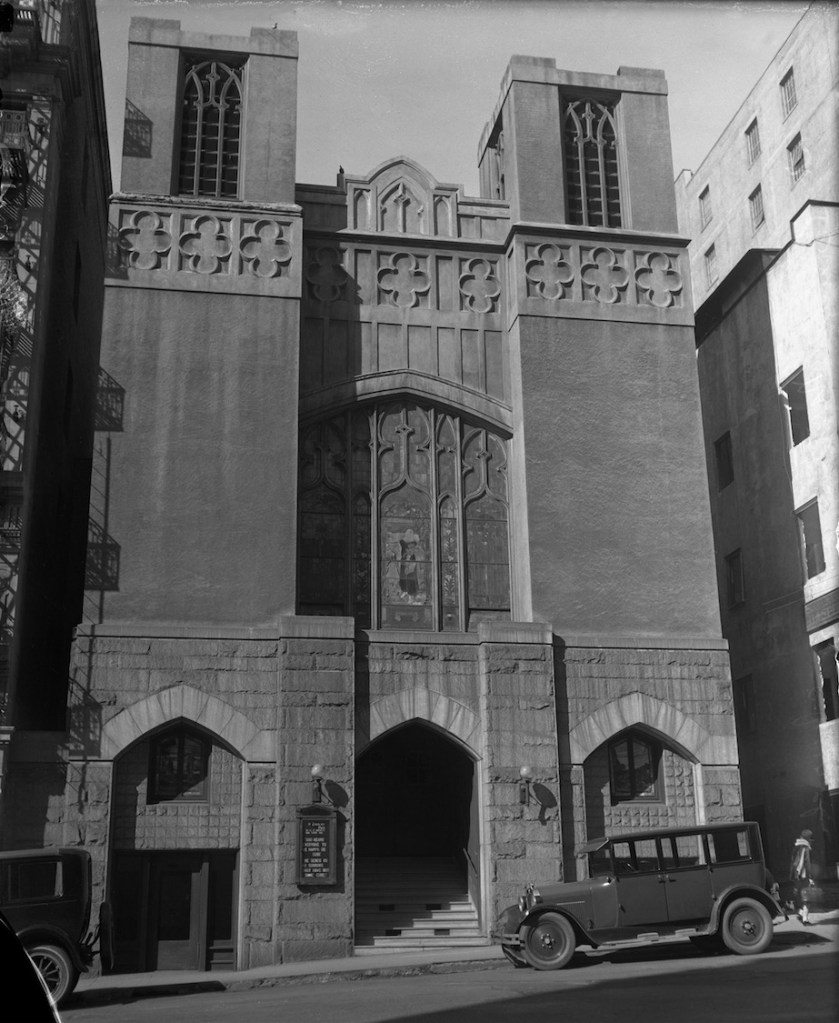
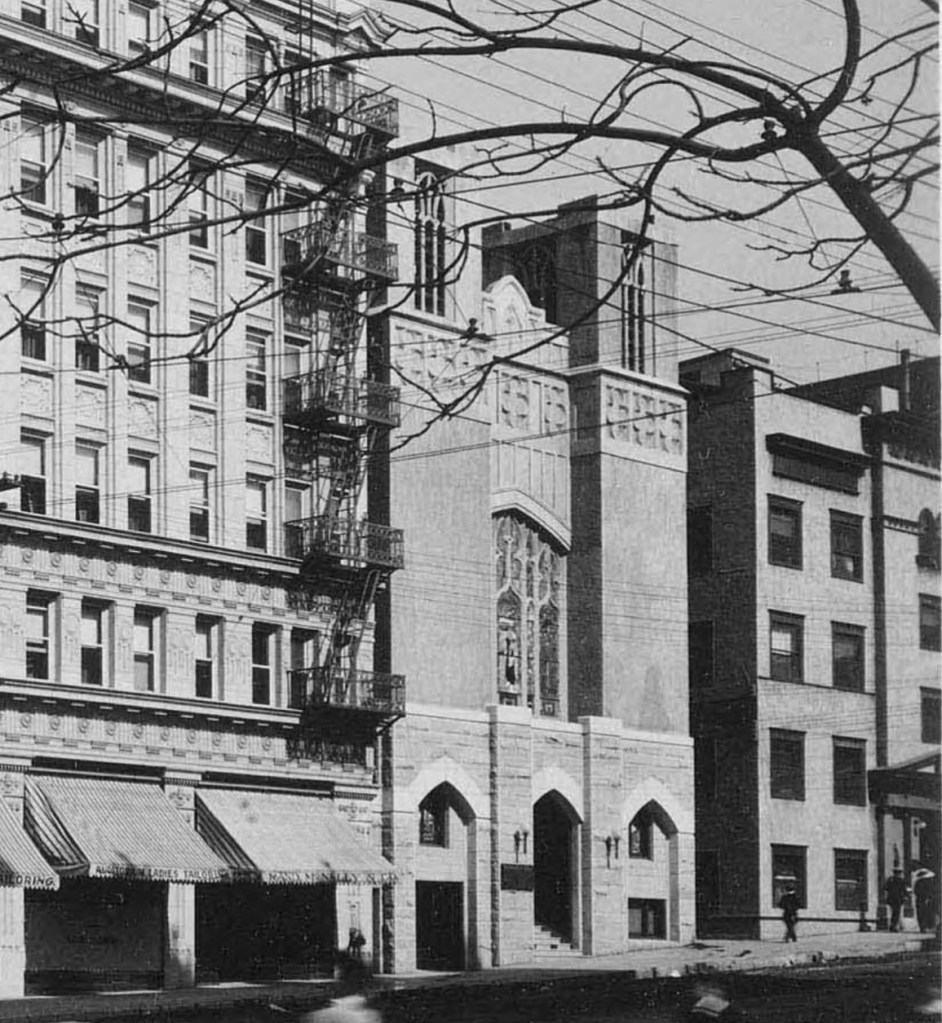
The style remained Late English Gothic, though with considerably less glass, likely due to financial considerations. The cornerstone was laid August 14, 1910, and the church was dedicated July 11, 1911.
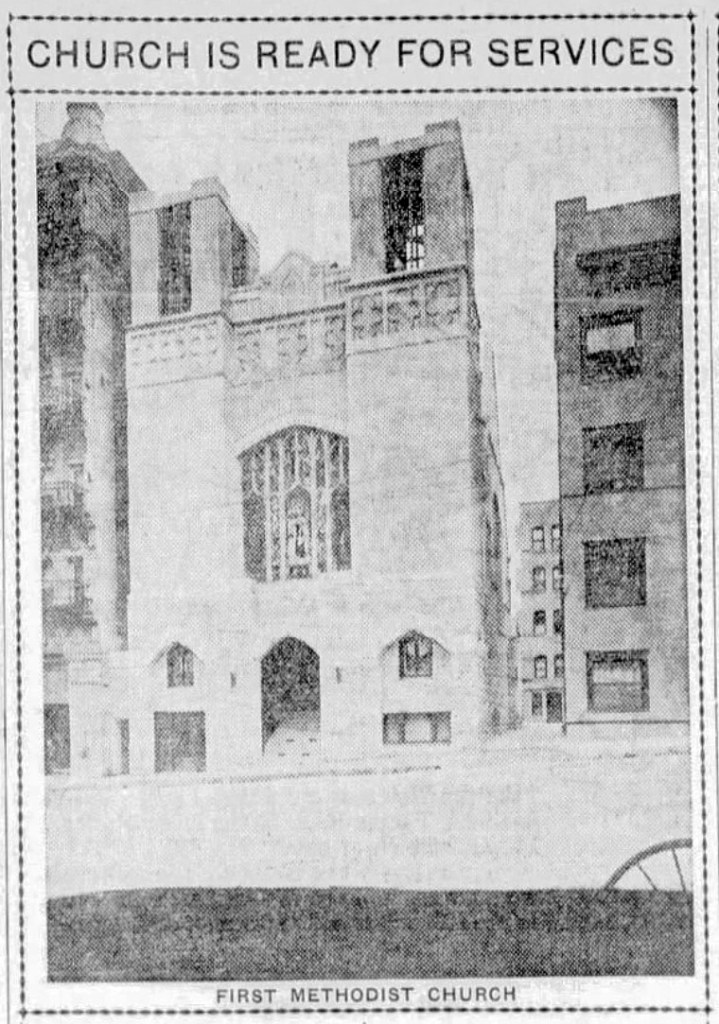
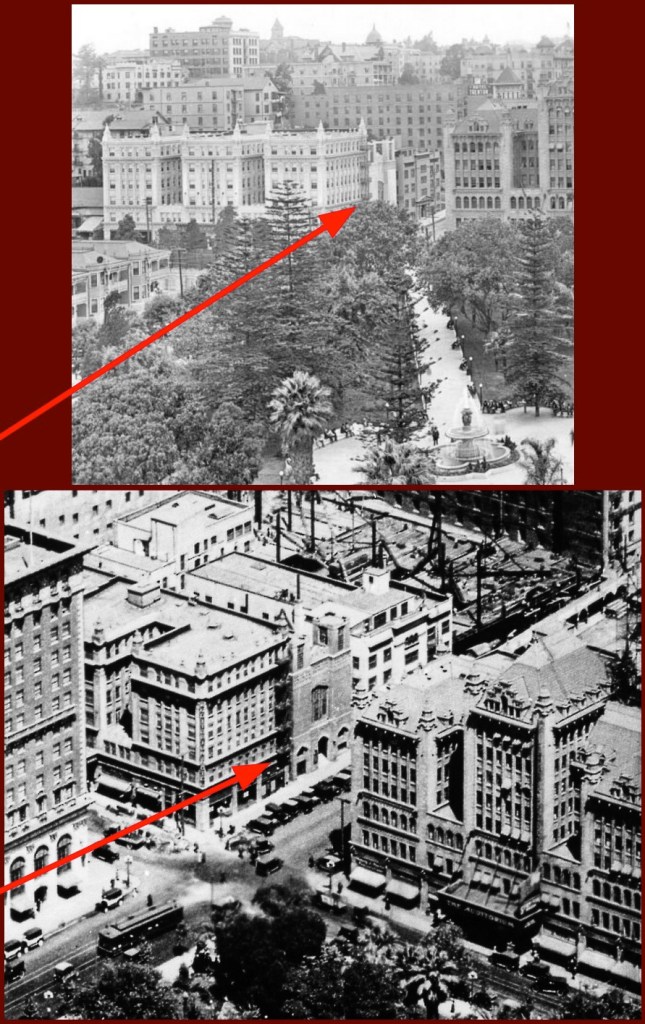
When finished, it looked like this:
*******
THE LIFE OF THE CHURCH, 1911-1988
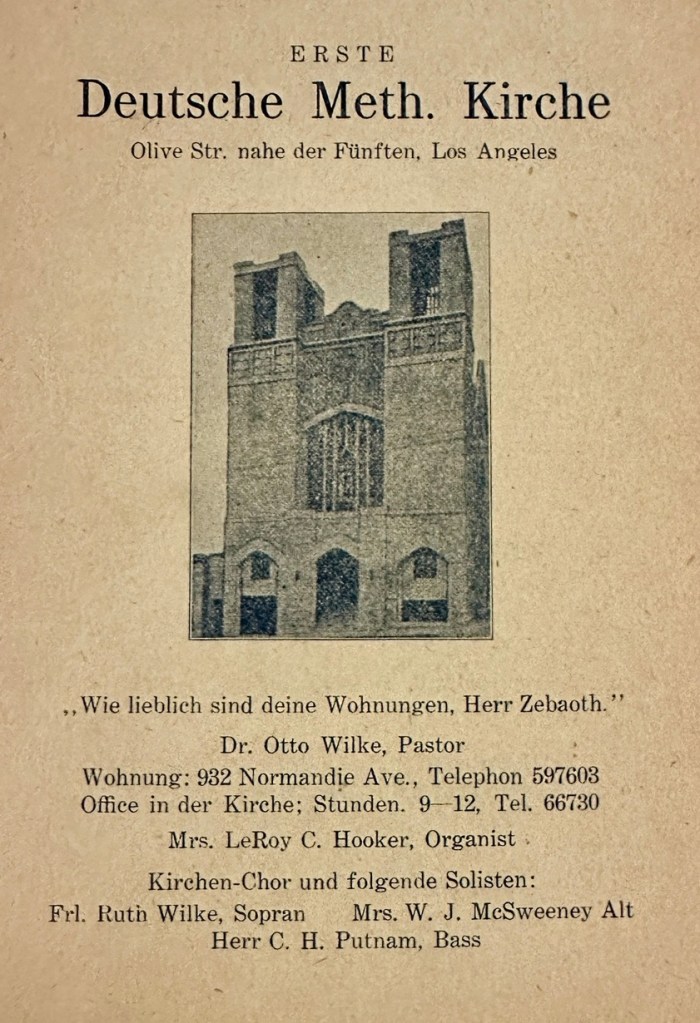
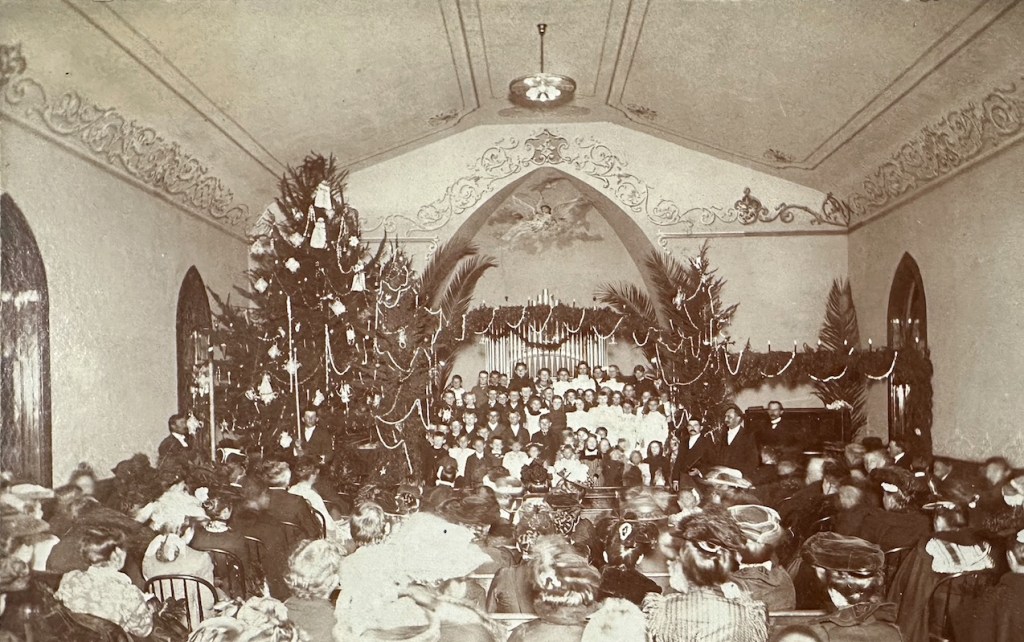
Its greatest flowering was during the 1920s. During the pastoral leadership of Rudolph Zurbuchen, between 1919 and 1933, the church had more than 250 members and many friends.
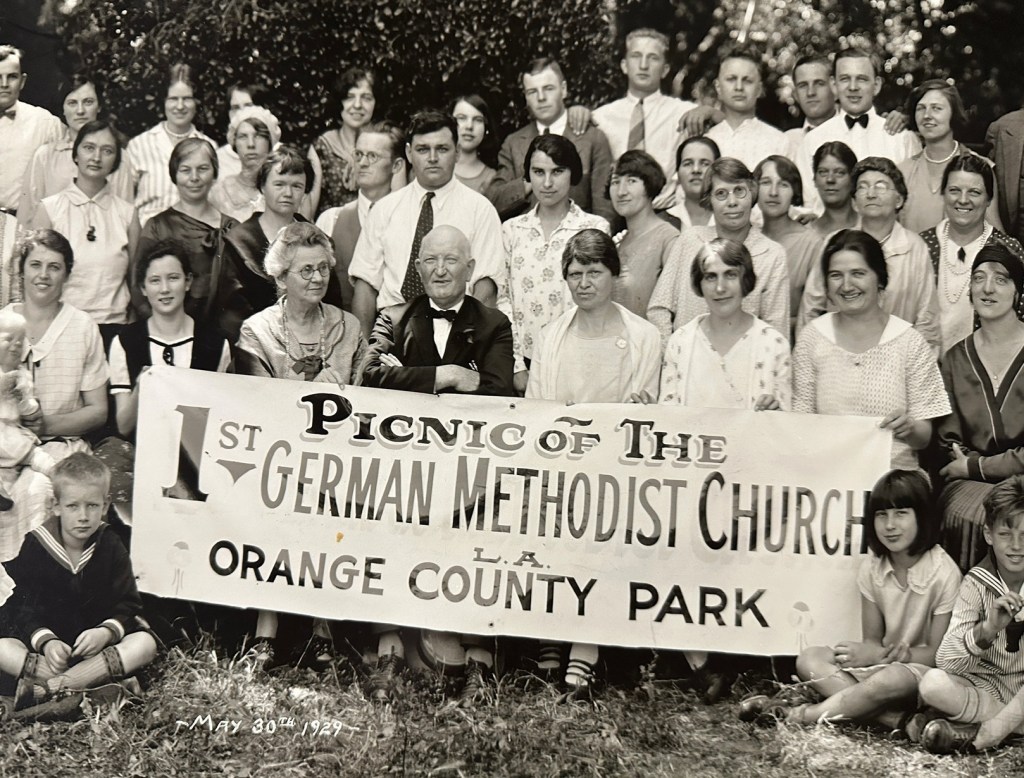
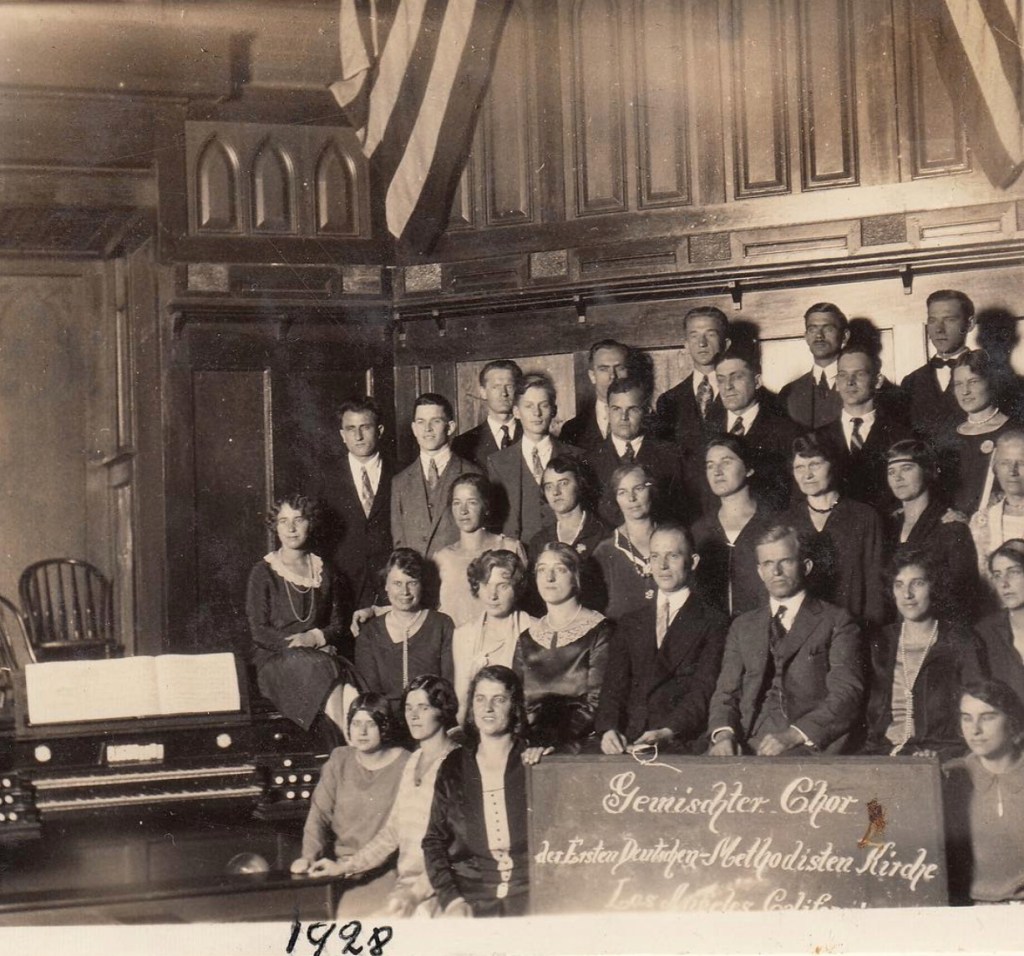
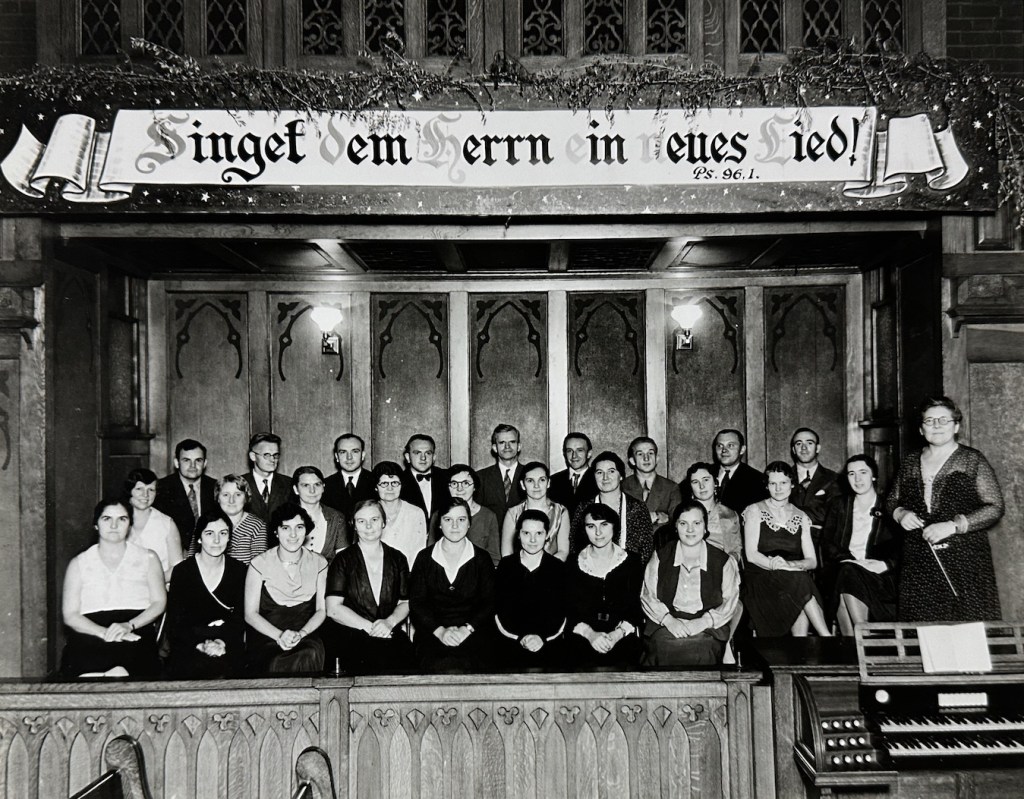
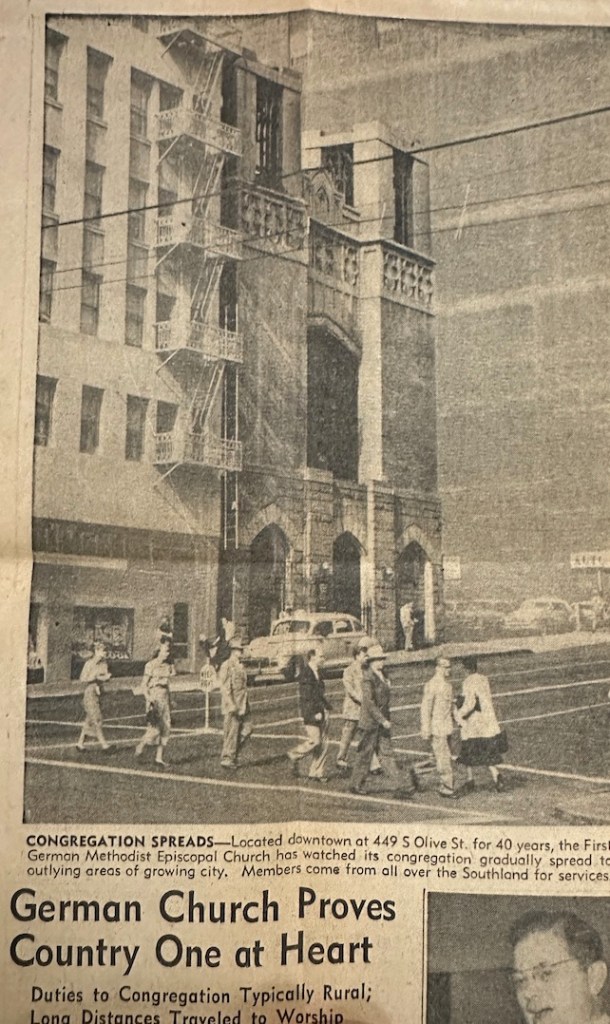
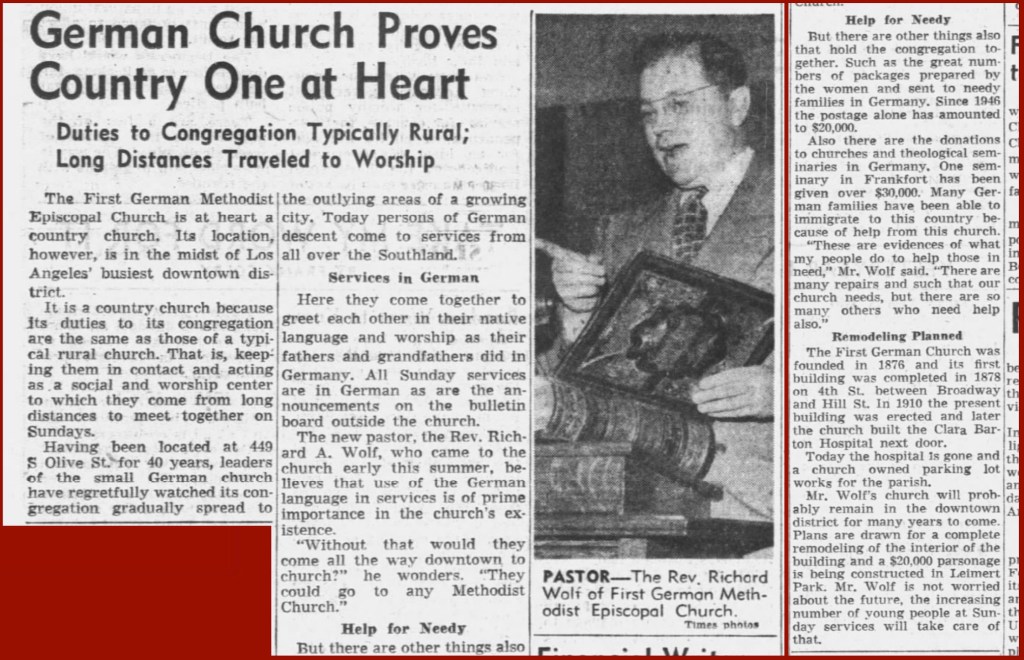
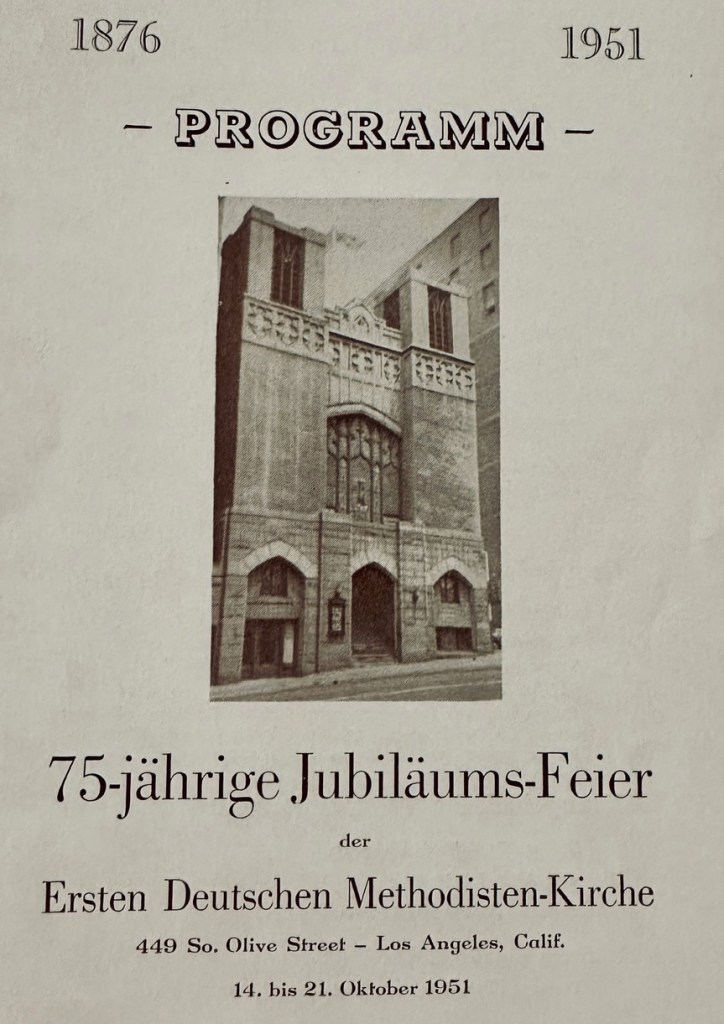
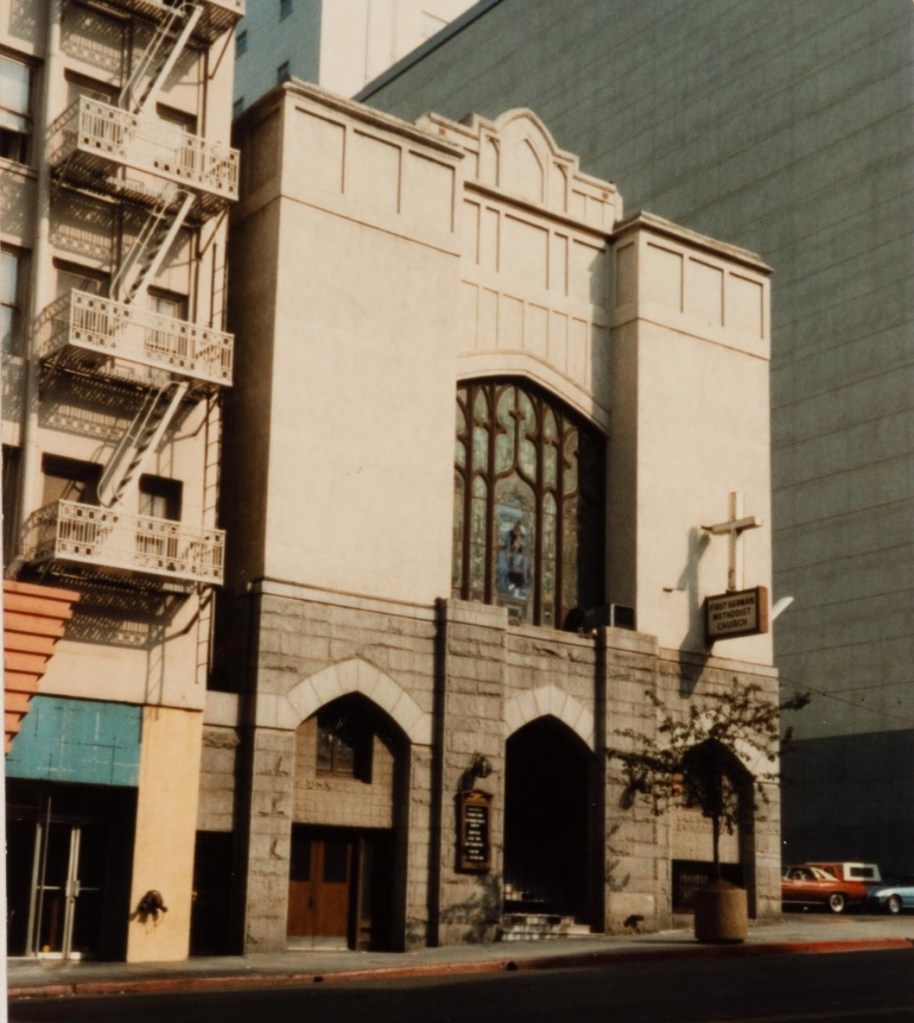
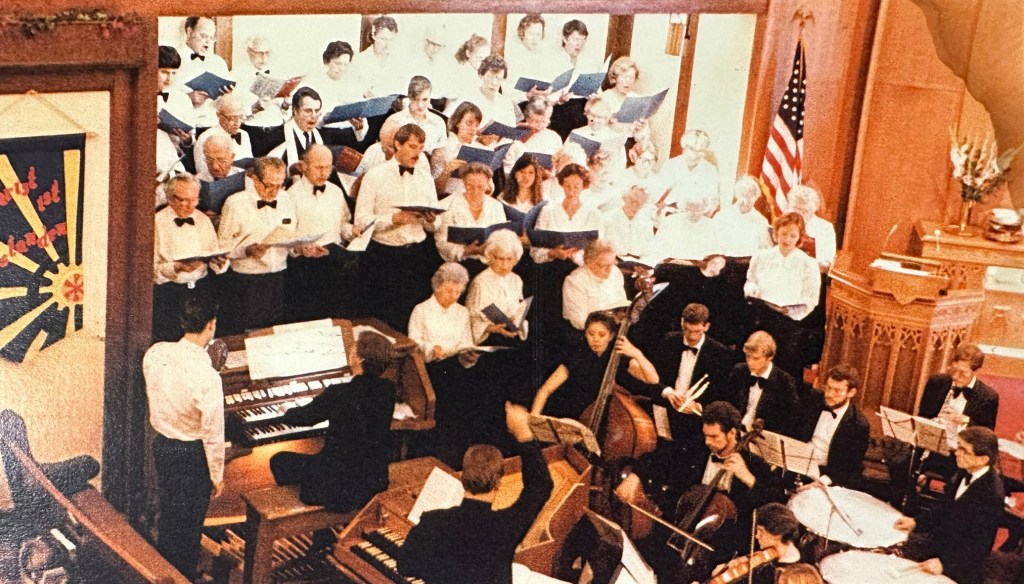
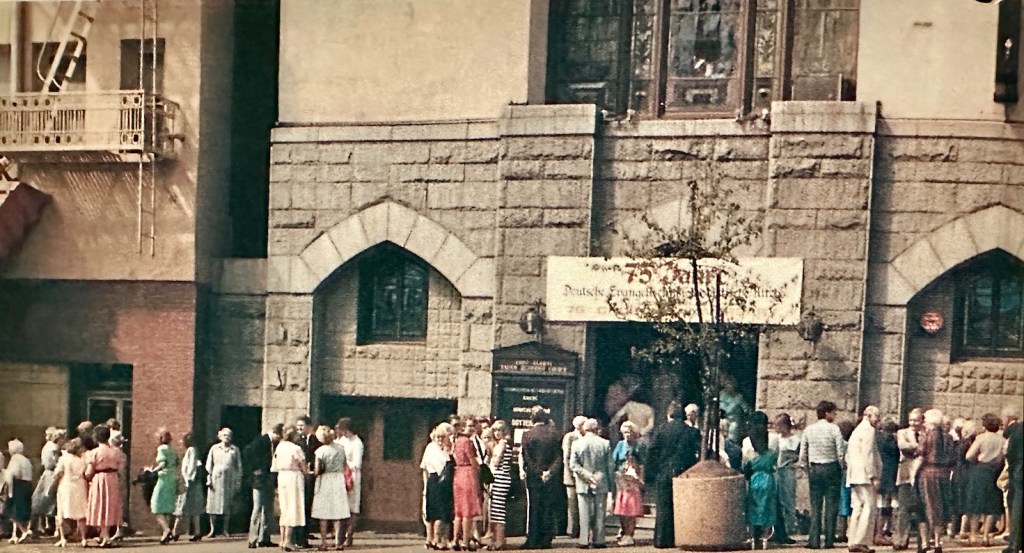
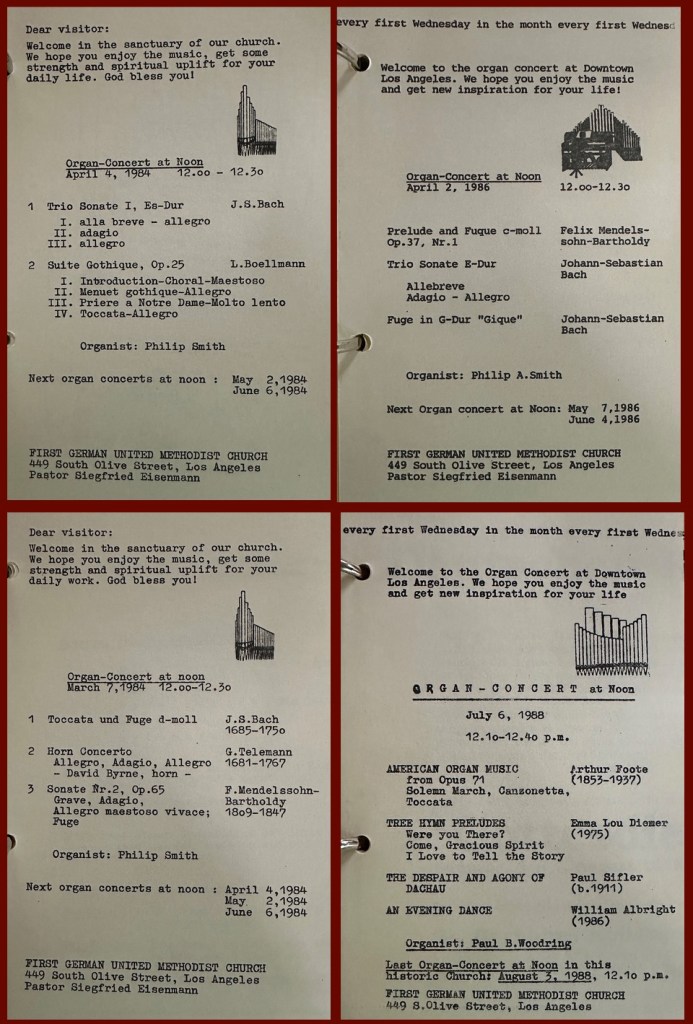
In the mid-1980s, average attendance was about 75 people at Sunday services, but the sanctuary would be packed to the gills during the Advent and Christmas seasons for traditional Christvespern, as well as for confirmation and cantata services. The mixed choir, men’s choir, and handbell choir helped draw in people, as did the monthly ‘Organ Concert at Noon.’ The church also produced a weekly half-hour radio program on AM KTYM and maintained a weekly column, ‘Word for a Sunday,’ in the German-language newspaper, the California Staatszeitung.
*******
A NEW CHURCH
It’s 1988, and downtown is in a serious period of doldrums. This was before the loft-conversion boom, so there were few actual residents. New commercial towers were sprouting up, especially on Bunker Hill. It was time for the German Methodist congregation to find a new home, so they sold the property to Maguire-Thomas Partners in May. MTP pulled the demolition permit that November and razed the church—after which lots 2 and 3, block 107 of the Beaudry Tract, became part of the greater footprint of the Gas Company Tower:
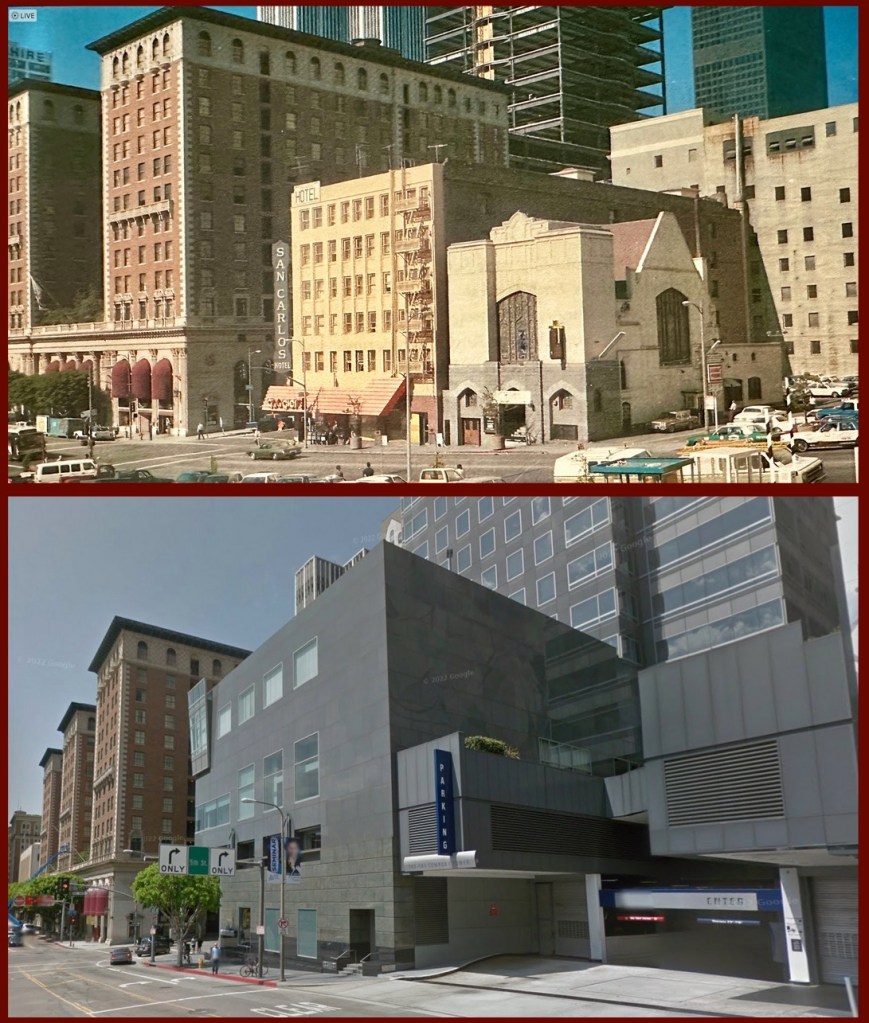
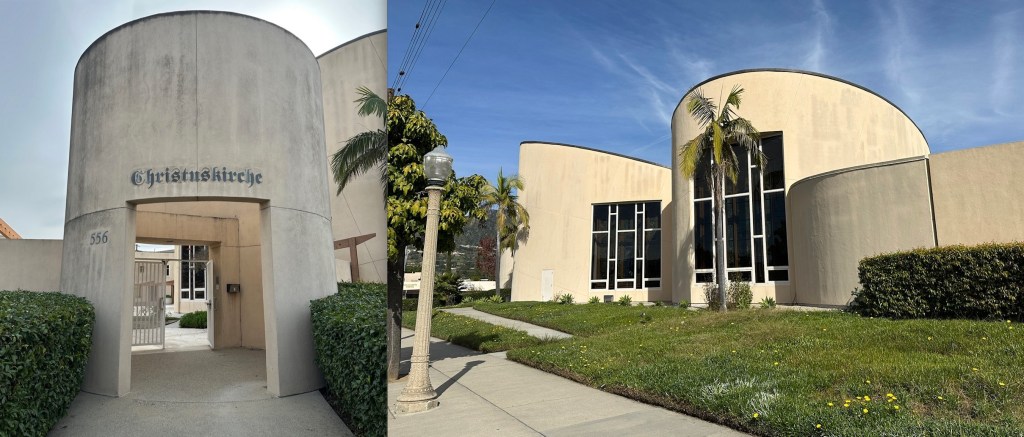
But before the wholesale wrecking began, the First German Methodist Church of Los Angeles took stuff. They wisely removed some important parts of their historic building and placed them into storage, awaiting the time they could build anew. These materials remained in storage for about a decade, while the congretation (who meanwhile held services in borrowed quarters at St. Barnabas Episcopal in Eagle Rock) looked for a suitable forever home. At last they found a spot of land in Glendale, hired Fields-Devereaux to build a new house of worship, and in August 1997 opened their doors:
And now, ladies and gentlemen, you may remember I mentioned the German Methodists grabbed a couple things on their way out the door…I may have undersold that a bit. Are you ready? Deep breath:
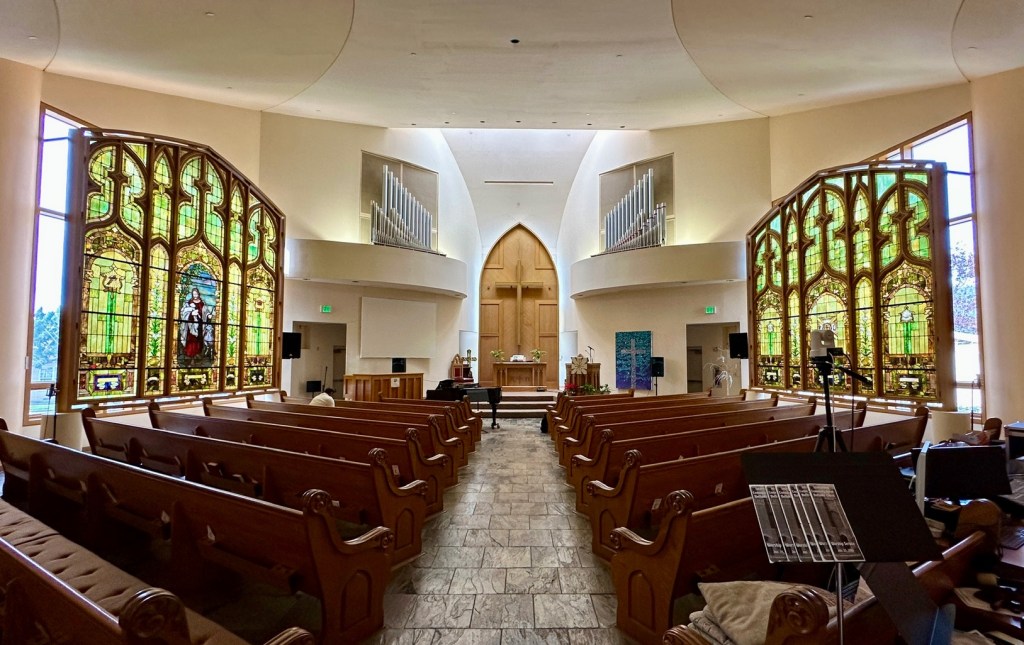
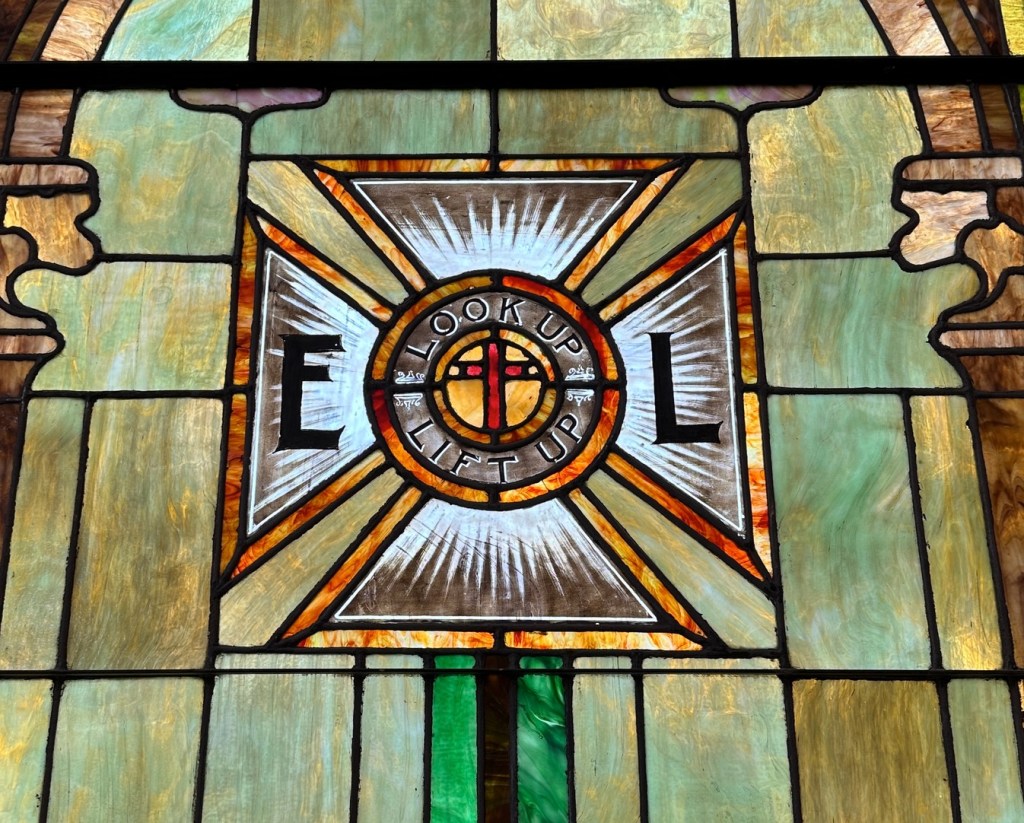
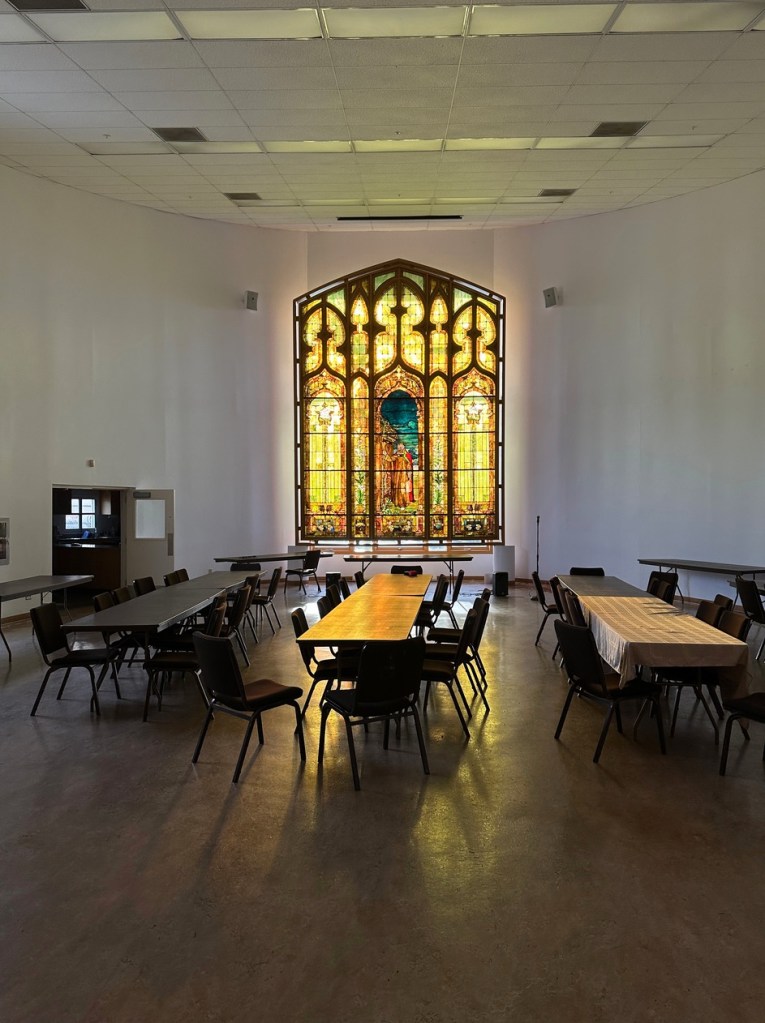
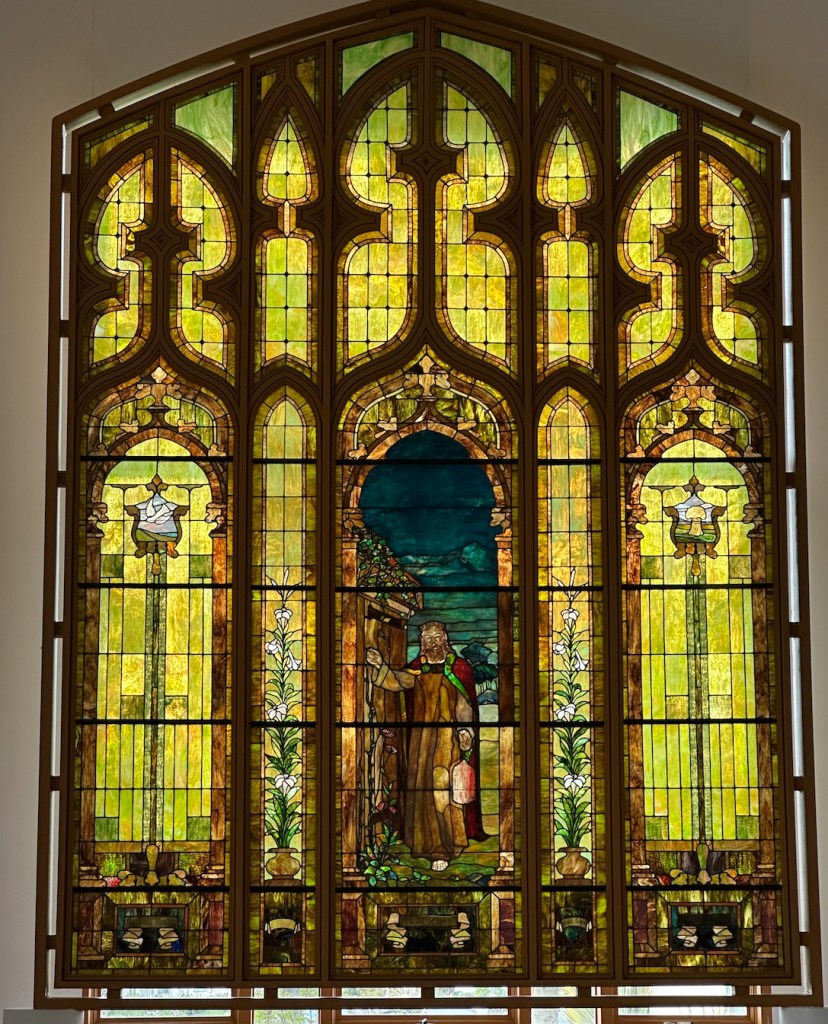
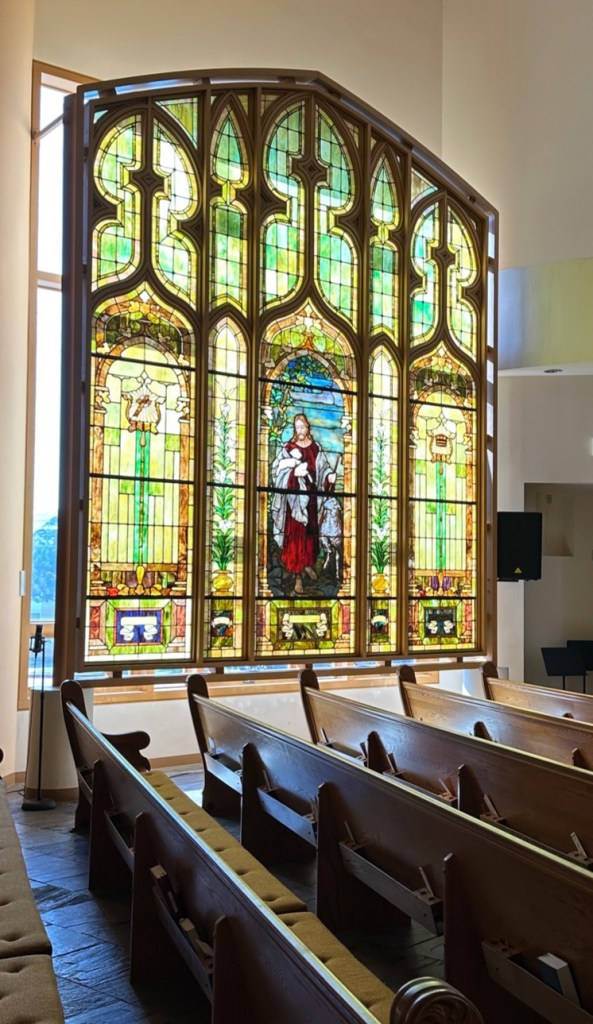
That’s right, they brought their giant stained glass church windows!
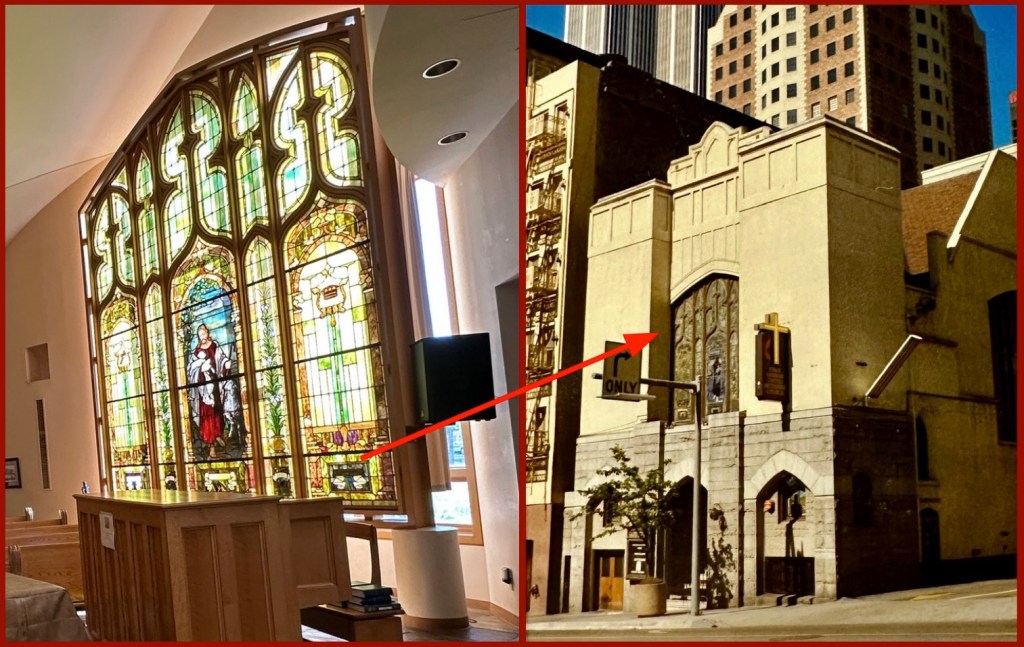
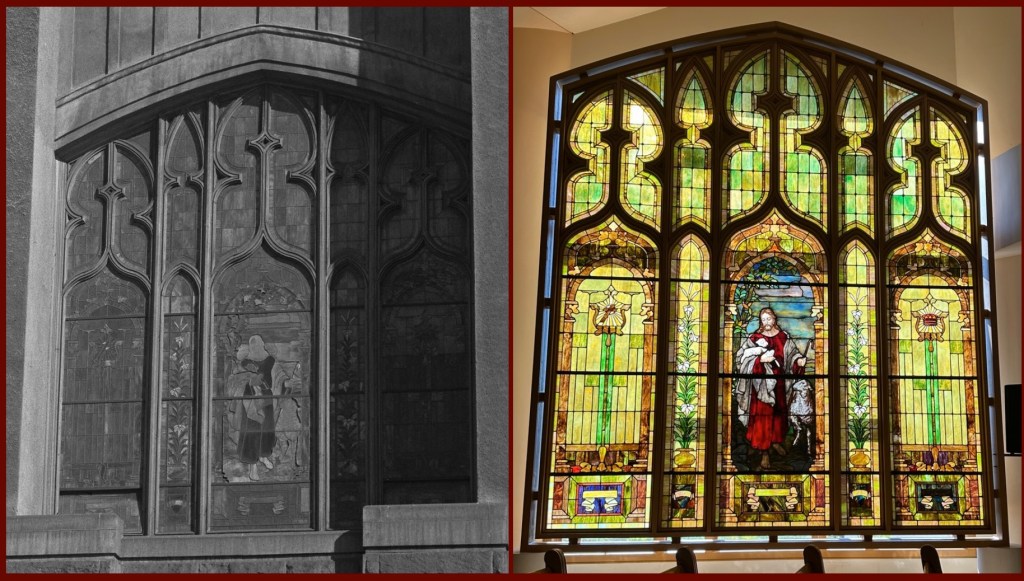
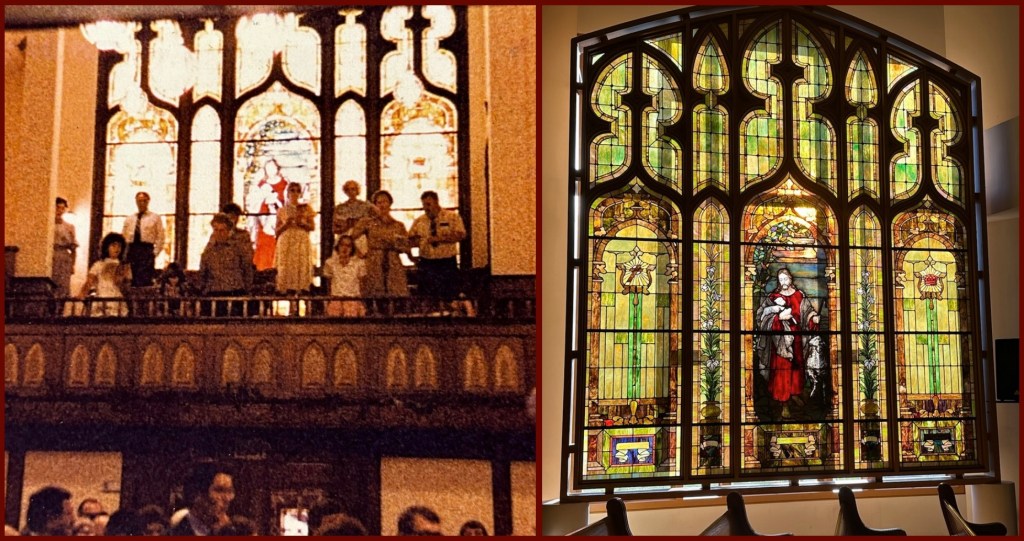
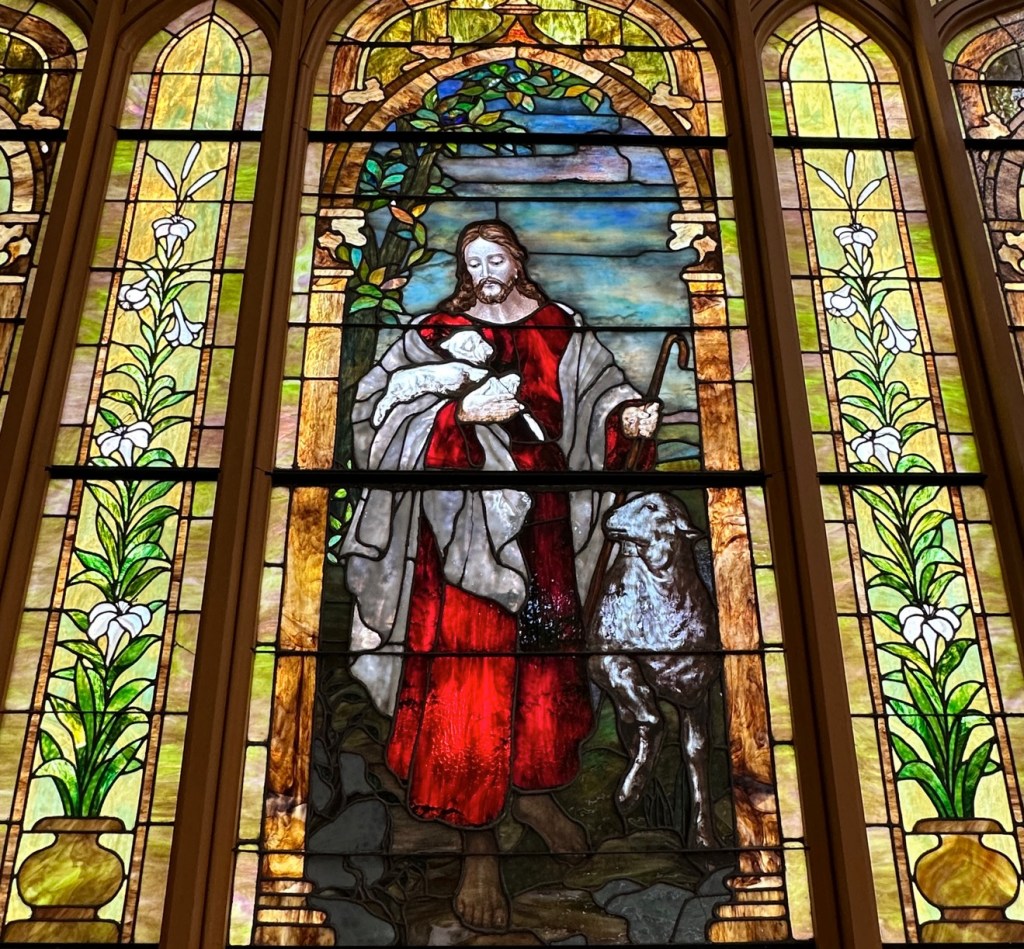
The window opposite Christ, in the chapel, is this beauty:
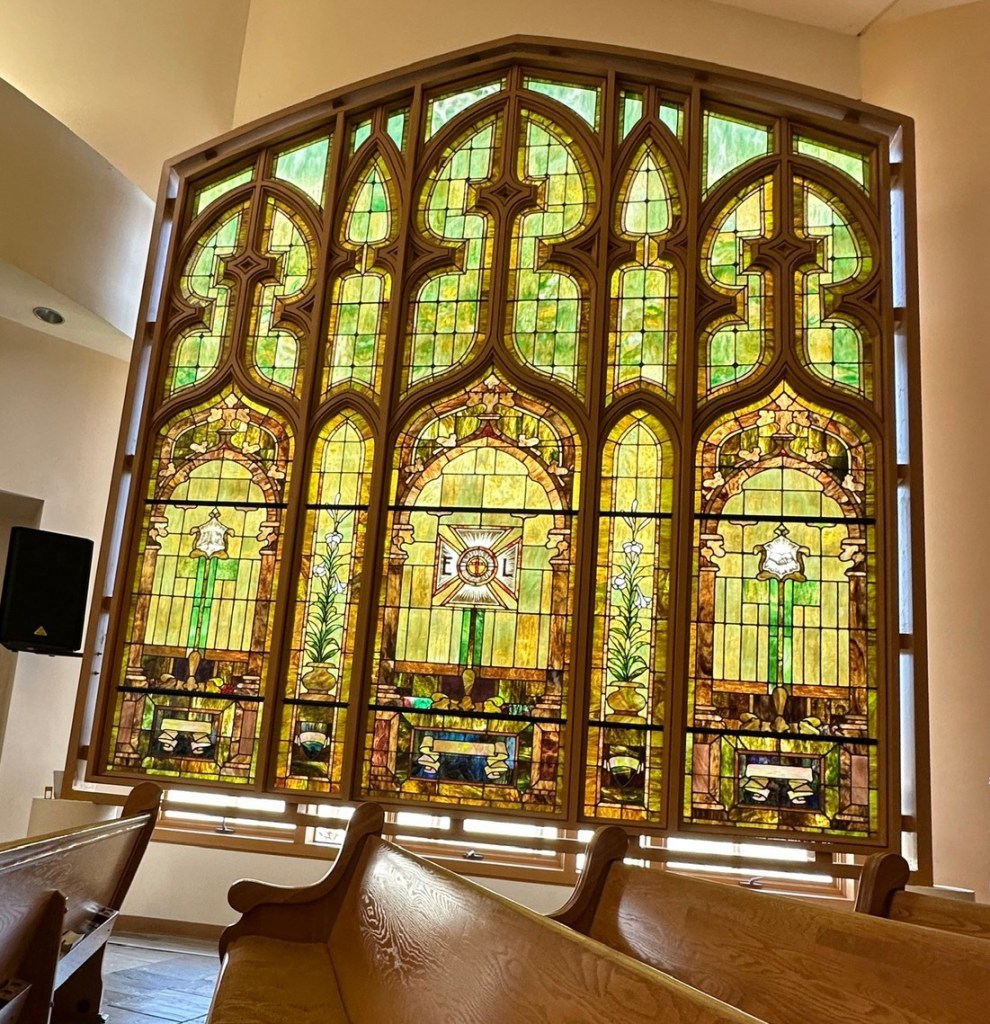
But wait! We’re not done! Let’s say you stay after service for a fellowship meal that’s held here—
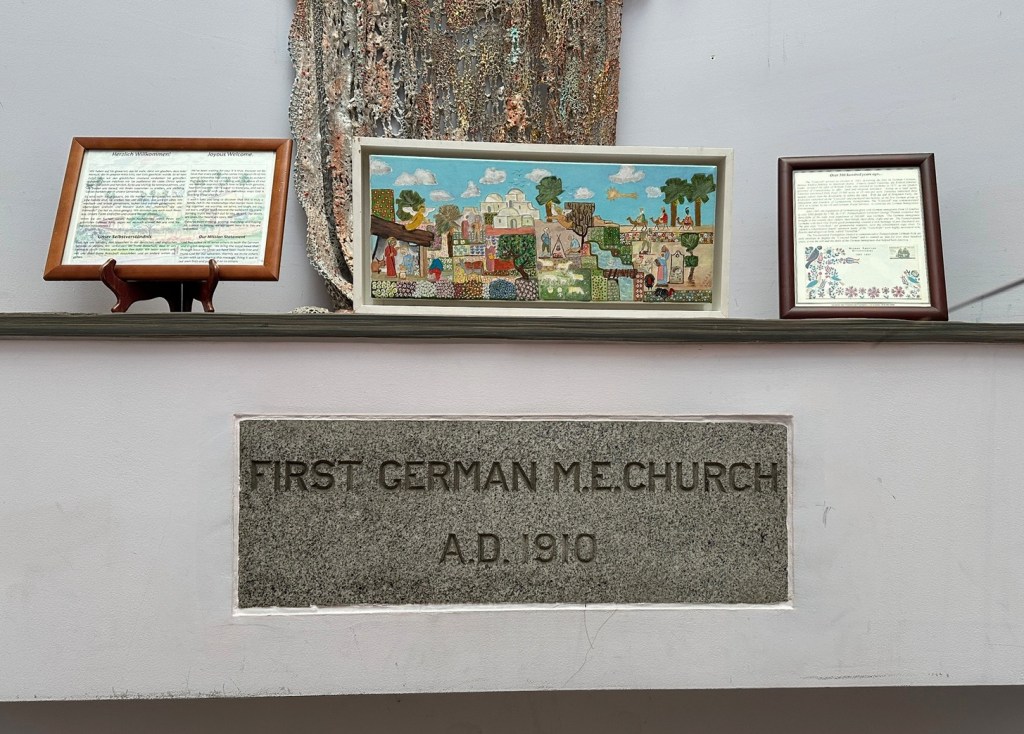
And that’s not all! Other material brought from Bunker Hill:
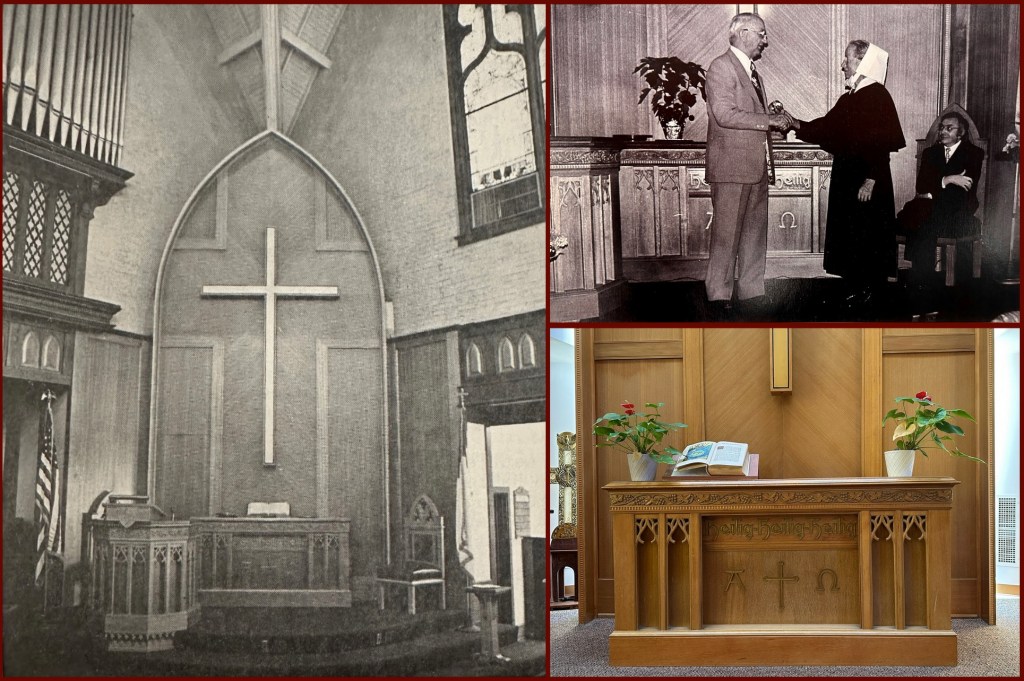
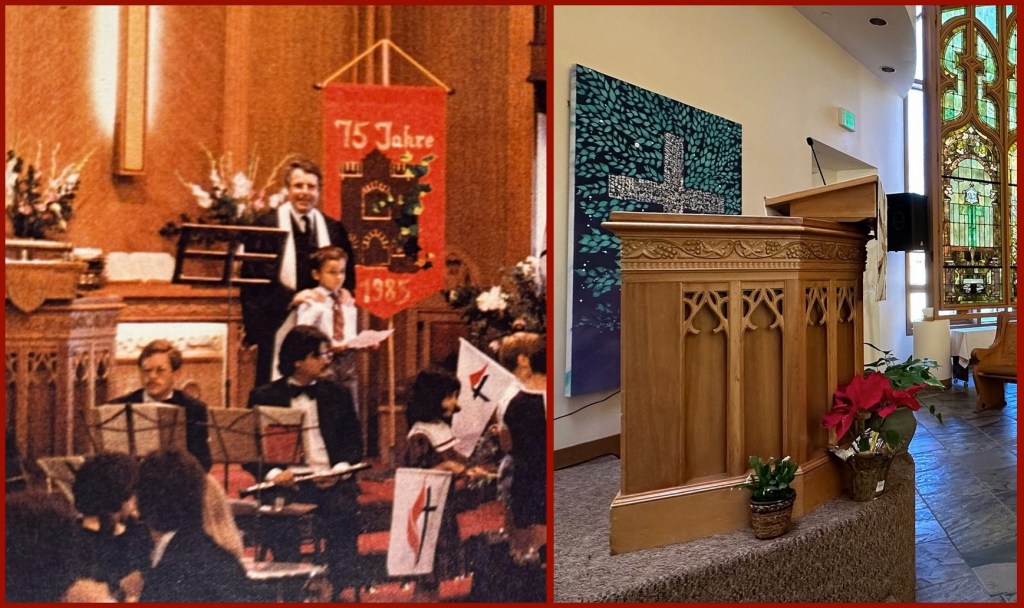
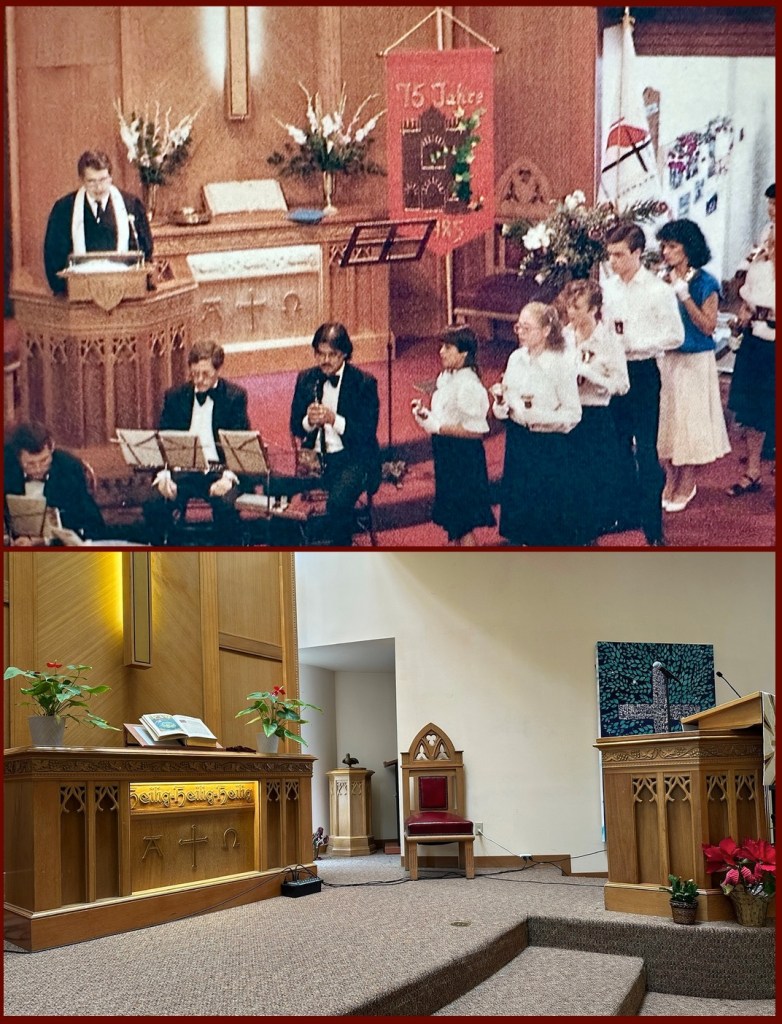
And that is the story of how the German Methodists brought the greatest and most important remnants from Bunker Hill to Glendale!
You may be wondering how I managed to get all the wonderful images that accompany this post. Earlier this year I called up the church, and after determining the windows were in fact there, I made arrangements to go photograph them. This I did, of course, by going to a Sunday service, and watching Rev. Kurt Poland in action at the pulpit:
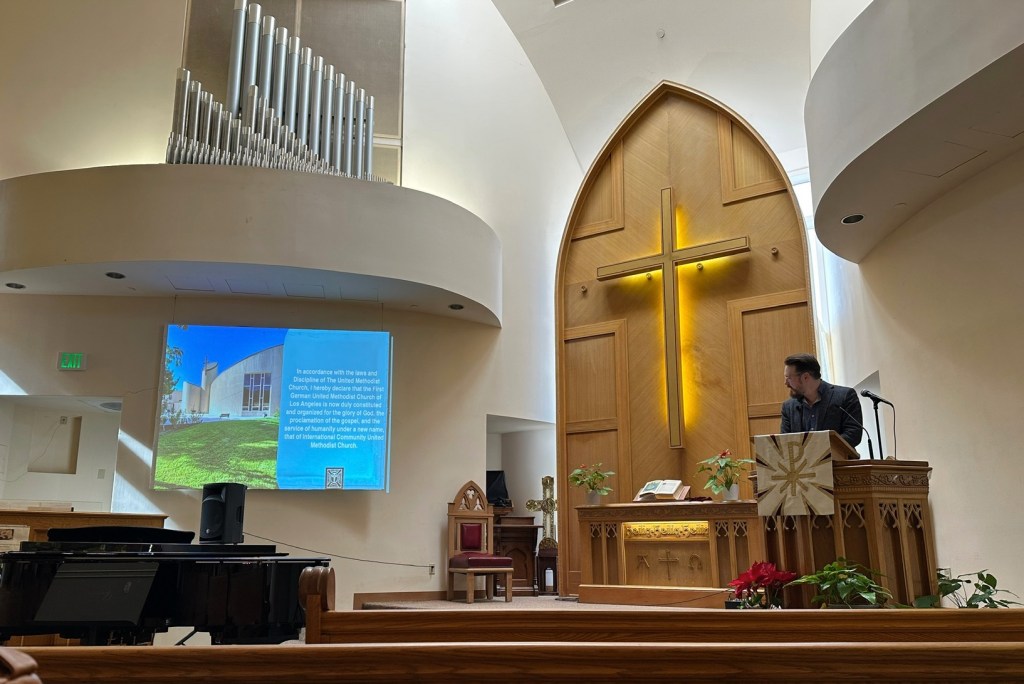
Pastor Kurt delivered a marvelous sermon, and it was a lovely service in general—beyond simply being surrounded by all that stained glass! I asked Pastor Kurt if he would be so kind as to allow me to poke around in the church archives, and he was gracious enough to say yes.
Remarkably, I happened to visit on the very day the congregation decided to change its name. Church name changes are routine, and First German Methodist is no exception; however, this was the day they elected to once and for all remove German from their name:
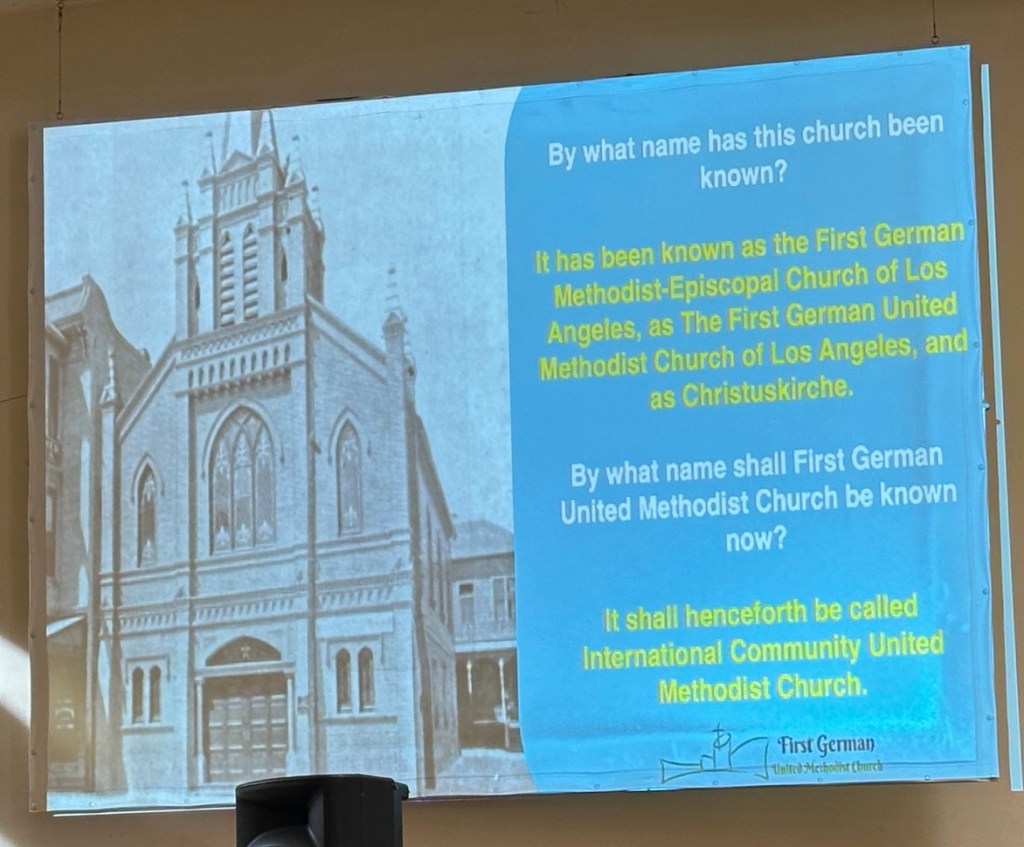
Naturally, it saddens me when the last vestiges of Teutonic influence disappear from the landscape; such reflects the sad state of our Zeitgeist. Still, whatever they need to do to help spread the gospel can’t be all bad.
So! Instead of spending your Sunday morning doomscrolling over avocado toast, go enrich your soul at International Community UMC. Tomorrow’s Pentecost Worship Service begins at 10:30am! Music, scripture, prayer, and seeing all that glass in person is the cherry on the top. You get wise! You get to church! — click here.


What a find. Thanks for the deep dive. It’s almost too much to fathom (sorry for the pun).
LikeLiked by 1 person
What a find. Thanks for the deep dive. It’s almost too much to fathom (sorry for the pun).
LikeLike
Great work, Nathan, as usual. I’m tempted to step inside the church and see those wonderful windows (though, being a heathen, I doubt if I’ll stick around for the good tidings).
LikeLiked by 1 person
While we are here, I want to recognize the Googie’s Coffee Shop which was located next door to the German Methodist Church in the San Carlos at the corner of Olive and 5th. It’s visible in the shot showing the Church, the San Carlos, and the Biltmore. I remember it because I went there several times.
LikeLike