TL;DR: I’m against renaming Pershing Square, but if we had to rename it (which we don’t) let’s name it after Clifford Clinton. Point being, we should name something after Clifford Clinton—a park? a square?—and, below, I make the case as to why Clifford Clinton is so unusually important and uplifting.
There’s a lot going on lately regarding Pershing Square, it having been renamed for Biddy Mason, who already has a park in her name (and a Metro stop). As such—because those figures central to Los Angeles’s history deserve an honest and faithful reckoning of their lives and legacies, free of invention, mythmaking, and political convenience—I’ve been busy pointing out that the majority of “authoritative voices” on Biddy Mason have overwhelmed her tale with falsehoods (here, for example, is Jacquelyn Dupont-Walker, Director of the Social Action Commission for the AME Church, presenting a fulsome paragraph about Biddy Mason in which every single thing she says is untrue).
But bear in mind, Pershing Square has not, as of yet, actually been renamed. City Council’s vote requested the Board of Recreation and Park Commissioners to rename Pershing Square: Council’s vote was not itself the final administrative act of the Board renaming the park. And, as it turns out, there was a lot wrong with the way in which Council conducted itself regarding the renaming, so much so, that Esotouric filed a Cure and Correct Demand. Among Council’s myriad of factual misrepresentations, procedural irregularities, violations of free-speech protections, and departures from the City’s own rules and policies, was the part when Ysabel Jurado told Council that General Pershing never set foot in Los Angeles, which is, of course, a fiction. Jurado gave Council a whole history lesson about Biddy Mason, which was predominantly bogus. Read some of the fabricated fables from Jurado’s hagiographic hoax by clicking here.
In short, the Biddy renaming is built upon a romanticized, fictionalized account of Biddy Mason, entangled in a disconcerting accumulation of historical misrepresentation, procedural irregularities, and questionable civic practices. Ugh!
My take? If we have to rename Pershing Square, rename it for Clifford Clinton!
Let me be clear at the outset: I do not agree with renaming Pershing Square. Pershing is an absolute titan in American history, having pulled the world from the jaws of tyranny. Moreover, Pershing Square honors our veterans in general, and Great War vets in particular: thousands of Angelenos served in WWI and 400+ never came home. Pershingphobes and other detractors will tell you Pershing had no relationship to Los Angeles (a lie), and/or was some sort of bad and terrible racist (an even worse lie).
But let’s just say flying saucers descended from the skies tomorrow, and aliens pointed their ray guys at us and declared “rename this square or we’ll blow up your planet!” — an odd request, but let’s say it had to be done. The choice is obvious: Clifford Clinton.
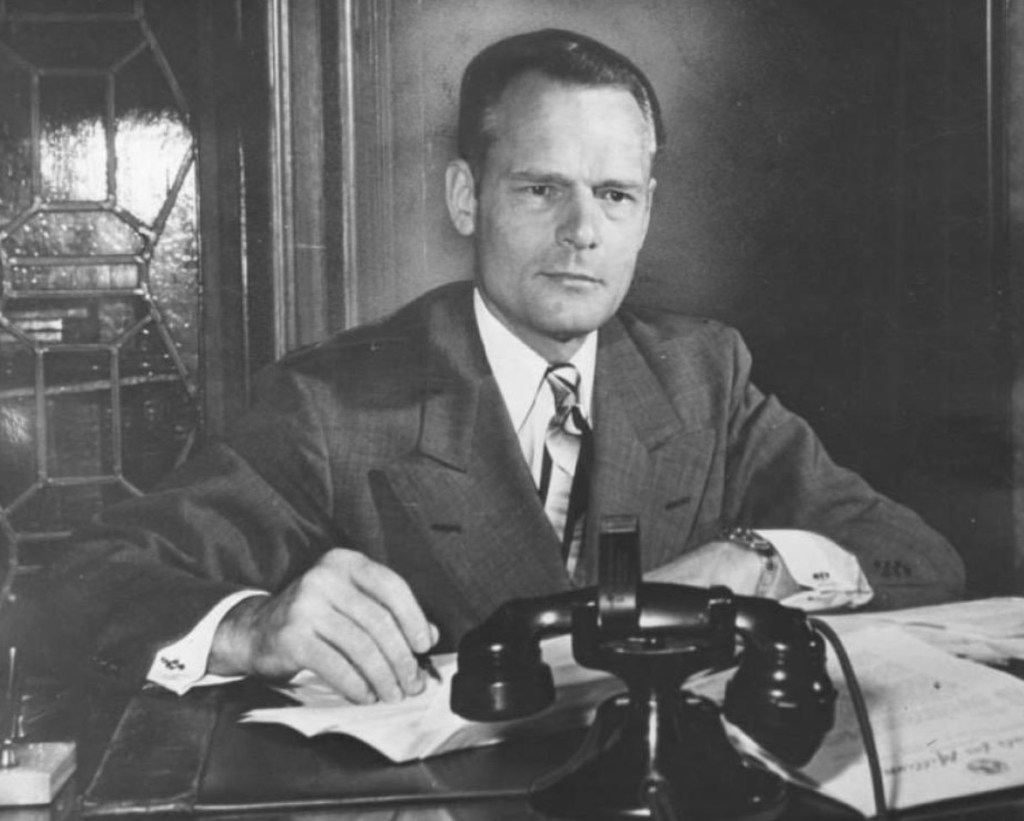
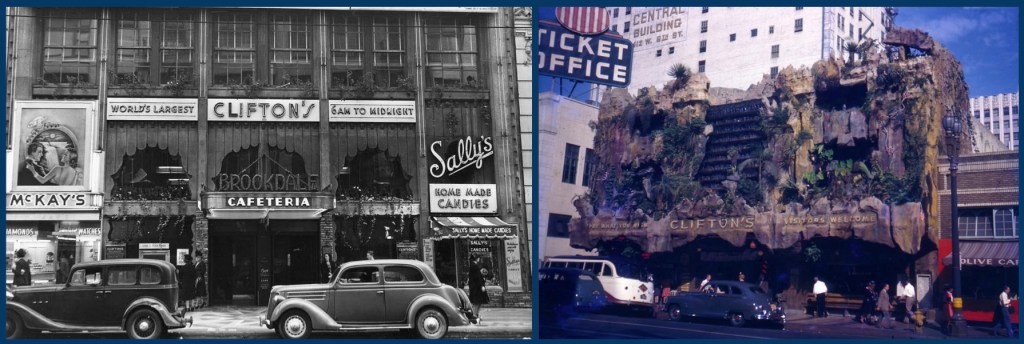
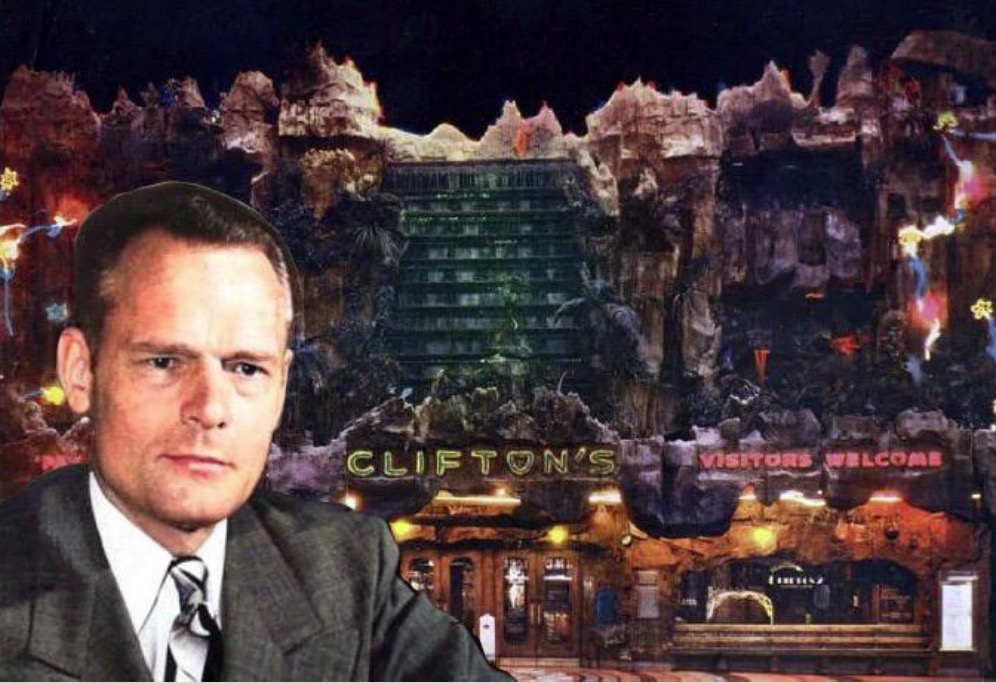
Clifford Clinton deserves consideration because his life’s work offers an unusually direct philosophy for what a public park is supposed to be: a place where nobody is excluded because they are poor, where strangers share a common space, and where civic life belongs to everyone. His iconic Clifton’s Pacific Seas stood at 618 South Olive Street, just below the park; the later Clifton’s Brookdale at 648 S. Broadway, a block east, became one of the city’s iconic gathering places.
Mason represents the struggle to become free and build a place in Los Angeles; and Clifford Clinton represents the proposition that the places we build afterward should belong to everyone. Both worthy of a park! Mason, of course (and, for the hundredth time — but I keep mentioning it only because the official City gatekeepers continue to, curiously and conspicuously, not mention it), already has a park named in her honor, a park that heavily features her story—plus she is taught in our schools (LAUSD developed Biddy Mason teaching with Stanford University spinoff Digital Inquiry Group, as part of LAUSD’s K-12 Lessons on African American History in Los Angeles series); and is part of the National Register; and there’s the sculptures and plaques and murals, and there’s no lack of books on the subject, including the scholarly 450-page (and Los Angeles Times bestseller) biography on Mason, etc. etc.
Clifford Clinton, by contrast, save for one book, is largely ignored and forgotten. And no, the fact that there’s still one “Clifton’s” cafeteria remaining does nothing to remember the man. In fact, it’s the opposite: what was once a cafeteria for the common folk, and which did not serve alcohol—embodying Clinton’s commitment to temperance, charity, and human dignity—has been repurposed as a space with no cafeteria, but with a half-dozen bars, catering to those who can afford the cover charge and then get drunk off expensive cocktails. Which is fine, but it’s not Clifton’s. Accordingly, they’re not even calling it Clifton’s: the new leaseholders have rebranded as “Sanctuary DTLA.”
Clinton deserves his due: he represents the era when civic duty and commercial enterprise were inextricably linked to the survival of the city’s working class. His legacy is not merely the operation of a restaurant chain, but the establishment of a proto-welfare infrastructure that provided affordable meals and dignified communal spaces during the country’s most dire economic collapse. His exposure of corruption in the Los Angeles municipal government—often at great personal and professional risk—demonstrates a commitment to the “Incorporating Founder” ideal: he did not just live in the city, he fought to ensure its administrative and moral integrity. A park named for him would honor a man whose life was defined by the tangible improvement of the material conditions of the people of Los Angeles.
But honoring one Angeleno need not mean overlooking another. Biddy Mason, let us not forget, already has a park. And Pershing Square is of abnormal importance to Los Angeles history, up to and including the thousands of Angelenos who served, and hundreds who perished, in the Great War.
The point of this post, ultimately, is to be a thought exercise demonstrating that if anyone were to have a park named for them, it would be Clifford Clinton: his record of feeding the poor, challenging City Hall, and creating radically inclusive civic spaces presents a compelling alternative to both Mason and Pershing—one that may have an especially resonant connection to the idea of a public park.
Clifford Clinton Fed the Poor
To which one may well retort Biddy Mason fed the poor! And yet, though everybody says Biddy Mason fed the poor, why do we believe that? How do we actually know she did so? There exists neither evidence nor mention of her doing so during her lifetime; nor is it mentioned in her obituaries. The first and only mention of her feeding the poor was in 1909 — eighteen years after Mason’s death — in which Kate Stovall related a single instance: “During the flood of the early ‘eighties she gave an open order to a little grocery store, which was located at Fourth and Spring streets. By the terms of this order all families made homeless by the flood were to be supplied with groceries, while Biddy Mason cheerfully paid the bill.” Which is wonderful, and is representative of the kind of charity the era’s wealthy Christians were duty-bound to perform.
Then, there’s the documented case of Clifford Clinton: he didn’t simply believe that poor people deserved food — he built businesses and charitable organizations around the principle that nobody should go hungry because they couldn’t afford to eat. During the Great Depression and in the decades that followed, he helped feed people in Los Angeles and supported efforts to fight hunger around the world.
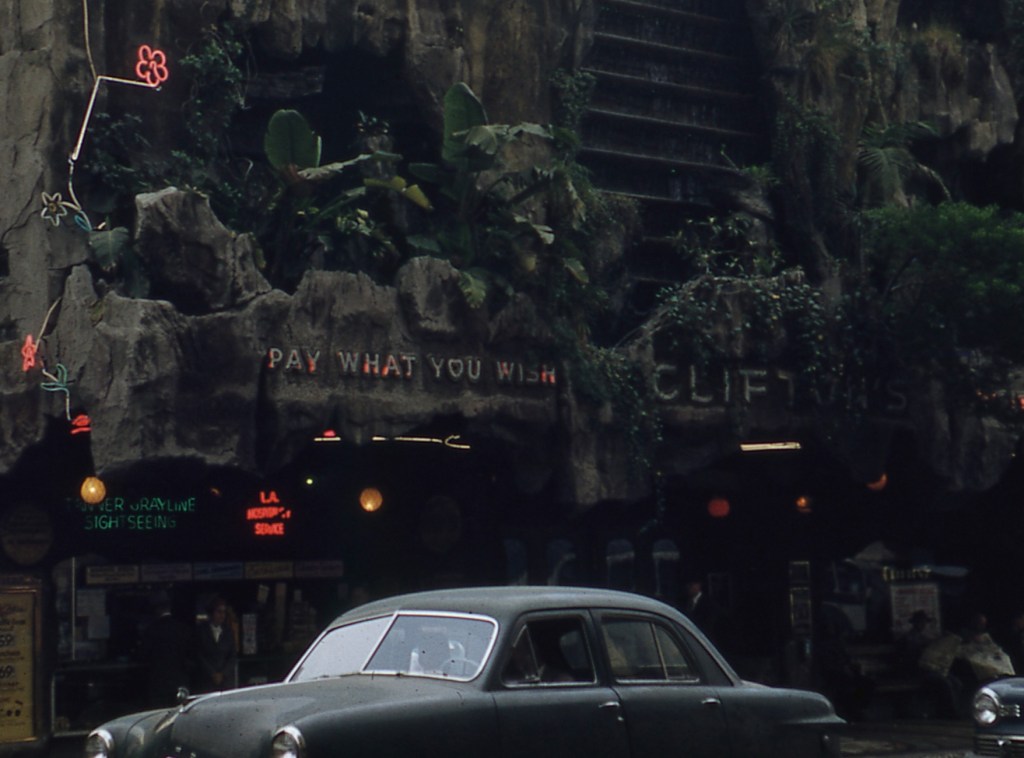
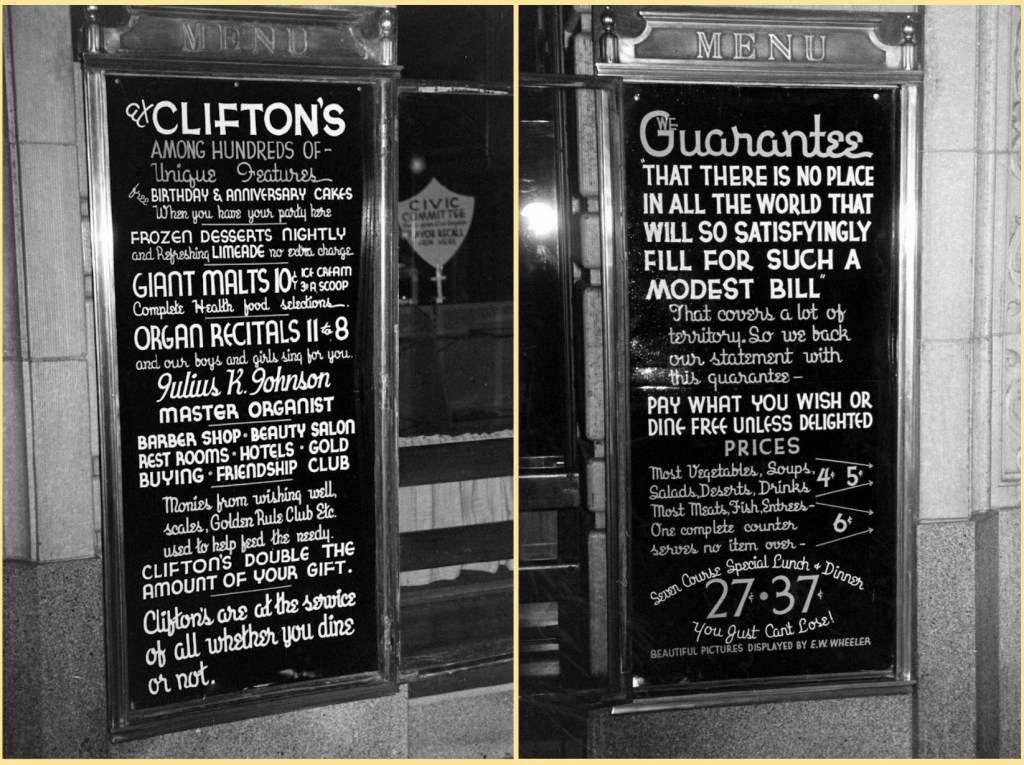
In 1931, as the Great Depression devastated families and workers, Clinton opened his first Clifton’s cafeteria—”The Cafeteria of the Tropics”—in downtown Los Angeles, at 618 South Olive Street, a stone’s throw from Pershing Square. He established a policy that people could eat even if they didn’t have enough money to pay.
The message printed on customers’ checks made the principle explicit:
“Regardless of the amount of this check, our cashier will cheerfully accept whatever you wish to pay — or you may dine free.”
This wasn’t just an occasional charitable gesture. It was a standing policy at his restaurant. Clinton made feeding hungry people part of the way his business operated.
Clifton’s served 10,000 free meals in its first 90 days. When Clinton opened his Penny Cafeteria at Third and Hill Streets in 1932, it served approximately two million meals over the next two years. That is tangible evidence of the scale of his commitment.
He didn’t stop at feeding people in Los Angeles
Clinton understood that a low-cost restaurant could help people in one city, but hunger was a much larger problem. He wanted to find a way to feed people who were poor, malnourished, or living in places where food was scarce.
In 1944, he put $5,000 ($96,986 USD2026) of his own money toward research by Caltech biochemist Henry Borsook to develop an inexpensive, nutritious food supplement. The goal was to produce a meal for just a few cents. That work led to Multi-Purpose Food, a protein-rich nutritional supplement designed to help address hunger on a much wider scale.
In 1946, Clinton helped establish the nonprofit Meals for Millions Foundation, pledging $40,000 in startup funding and providing office space in his cafeteria building.
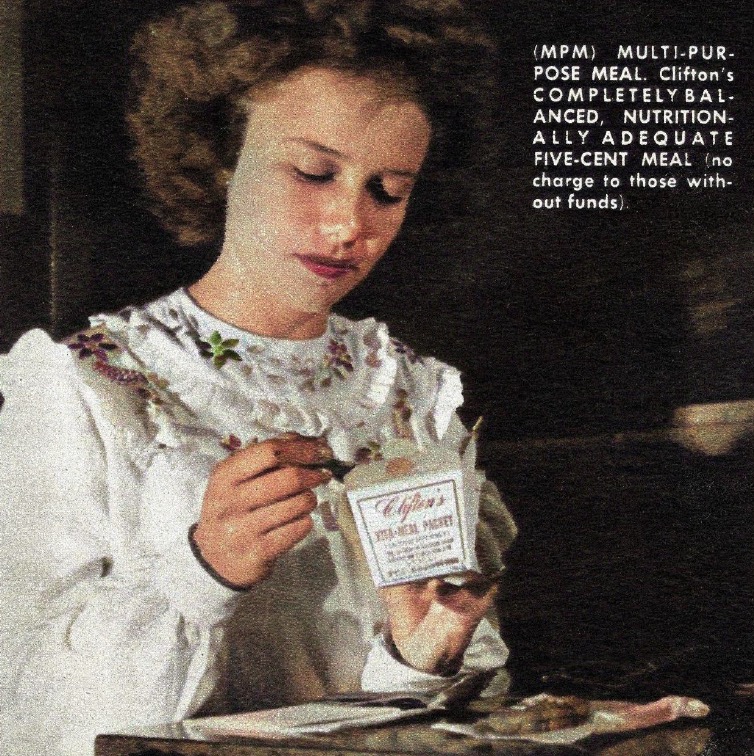
By June 1960, Meals for Millions had distributed approximately 62 million meals through relief shipments to 127 countries, working with 210 cooperating agencies. By 1963, its cumulative total had reached approximately 102.6 million meals.
The program distributed food through relief agencies in countries including India, Korea, Japan, China, Germany, the Philippines, and Haiti. Clinton’s original local mission had grown into an international hunger-relief effort.
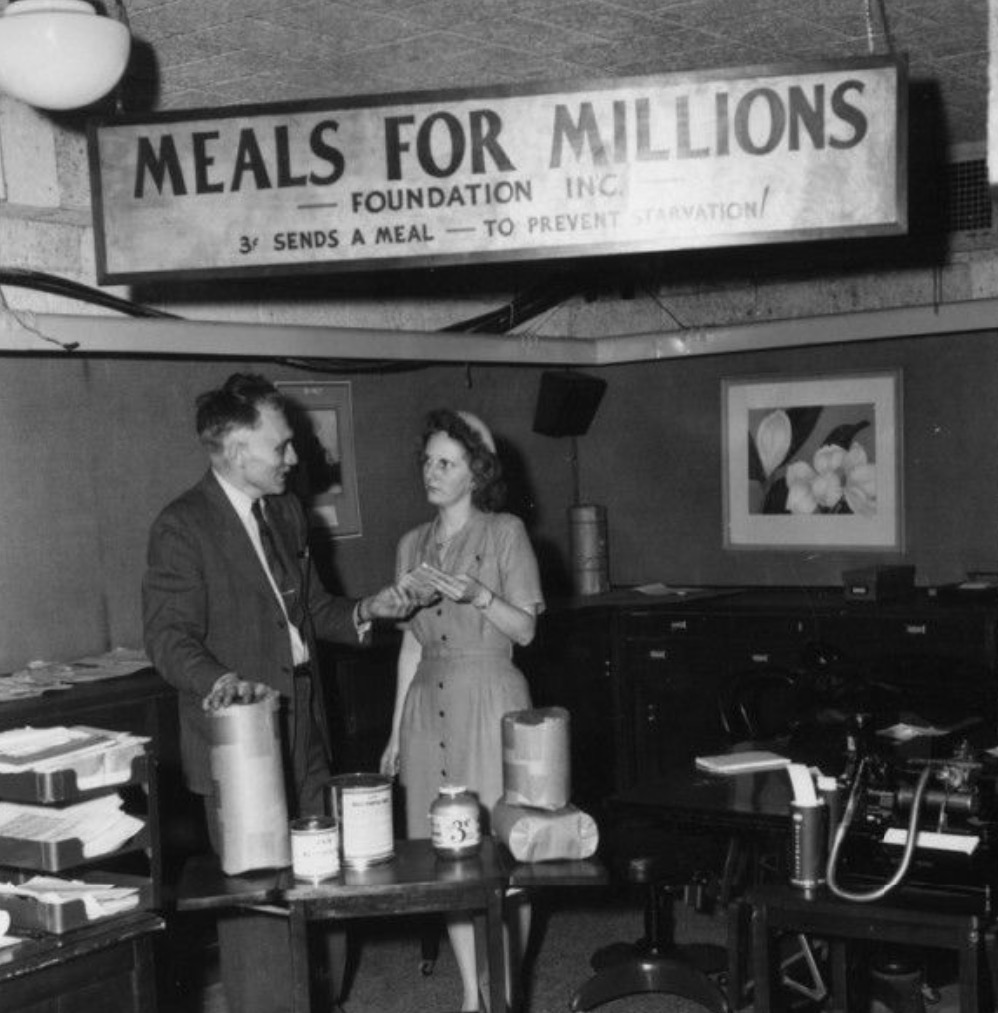
Meals for Millions was not a short-lived charitable experiment. It developed into an international humanitarian institution that survived its founder by decades. The work continues under the Grameen Foundation banner, which focuses on empowering women, improving financial inclusion, strengthening food security, and combating poverty through education, technology, and community-based programs.
He made dignity part of feeding the poor
Clinton’s contribution was not just about the quantity of food. It was also about how hungry people were treated.
During the Depression, people who couldn’t afford a meal were often left with few options. Clinton’s policy allowed them to sit down and eat without being turned away for lack of money. He also maintained a policy of serving customers of different races at a time when racial discrimination was common in American restaurants.
That matters because feeding the poor is not merely about supplying calories. It’s also about recognizing that people experiencing poverty deserve nourishment, respect, and a place in the community.
The case, in a nutshell
Clifford Clinton’s record supports three clear arguments:
- He fed hungry people directly. His cafeterias provided free meals to people who couldn’t pay, including during the Great Depression.
- He helped feed people on a massive scale. Through Meals for Millions, the work he initiated contributed to the distribution of more than 100 million meals by the early 1960s.
- He turned compassion into an enduring institution. He invested his own money in inexpensive nutritious food and established an organization capable of reaching people far beyond Los Angeles.
Clinton didn’t treat hunger as somebody else’s problem. He used the resources he had—a restaurant business, personal money, scientific research, and a nonprofit organization—to do something practical about it.
Clifford Clinton Fed the Soul
“Clinton fed the soul? So what! Biddy Mason started her own church! She founded the First African Methodist Episcopal Church!“
Granted, many claim that Mason was, in 1872, one of the twelve original founders of our local branch of the AME (founded in Philadelphia in 1816). However, despite what you’re told, Mason did not provide a large amount of funding, nor did she donate the land, nor did she do any work to incorporate a church, nor was she an early trustee (and the FAME church, it should be noted, was in fact founded in 1869).
One can argue that she was one of the twelve who came up with the idea, though, and her house on Spring Street was one of the rotating places they held services before the church was built. Which is great. But our First AME church is hardly exceptional in the greater history of Black American churches: post-slavery Reconstruction-era America (1865-1877) saw the most extraordinary episode of church expansion in history—an absolute explosion of AME church plantings across the United States. Every major American city began a new ME church, which were often called (as was ours)the “First African Methodist Episcopal” church. It would have basically been impossible for Los Angeles to not have had a First AME church founded during Reconstruction.
So, yes, there’s no doubt Biddy Mason played some part, and an admirable one, in starting a segregated and Methodist-specific church, whose evangelical preaching focused on the conversion of “unawakened sinners” to a life of faith and discipline. It should be noted, of course, that there was already an integrated Methodist Episcopal church in Los Angeles, founded in 1853—Fort Street Methodist Episcopal was the church Biddy Mason attended, and, in fact, where her funeral was held in 1891.
Then, there’s Clifford E. Clinton: he brought religious experience into the everyday public space of a restaurant. He wasn’t merely decorating cafeterias with religious symbols. He was creating places where people could eat, reflect, and encounter a Christian message—even if they hadn’t walked into a church.
The Garden of Gethsemane — Pacific Seas
Clinton conceived the Garden of Meditation in 1943 as an immersive recreation of Jesus praying before his crucifixion. The basement experience included interconnected rooms, a grotto, and a life-size figure of Christ kneeling in prayer. Artist Einar Petersen painted the background mural, and sculptor Marshall Lakey created the figure.
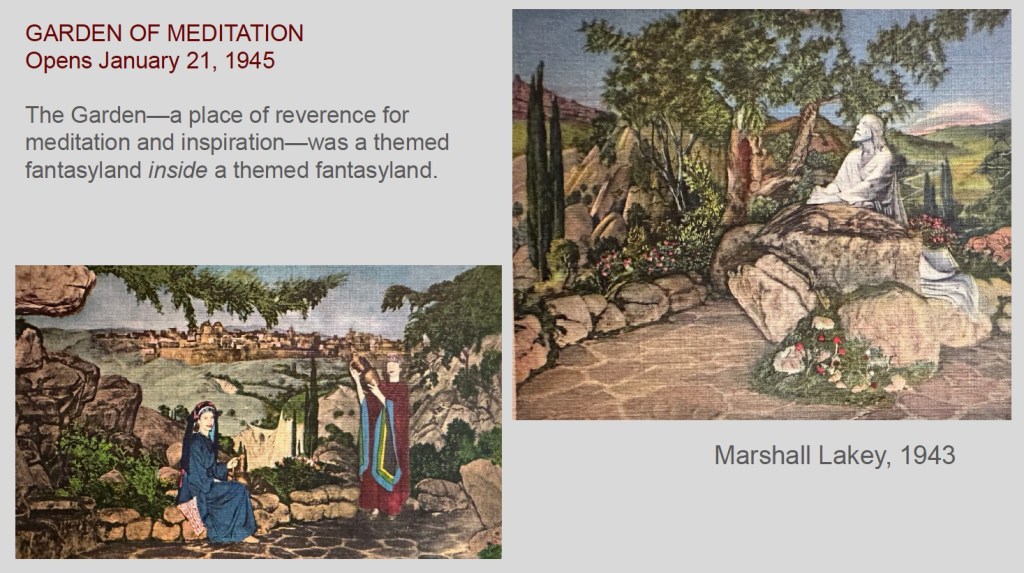
Approximately 7 million people visited Clifford Clinton’s Garden of Meditation at Clifton’s Pacific Seas between its opening in 1943 and 1960; an extraordinary testament to Clinton’s belief that a cafeteria should nourish the soul as well as the body.
The Little Chapel — Brookdale
Opened in 1935, Brookdale transformed a downtown cafeteria into an imagined redwood forest, complete with waterfalls, rocky formations, and a small chapel nestled among the scenery.
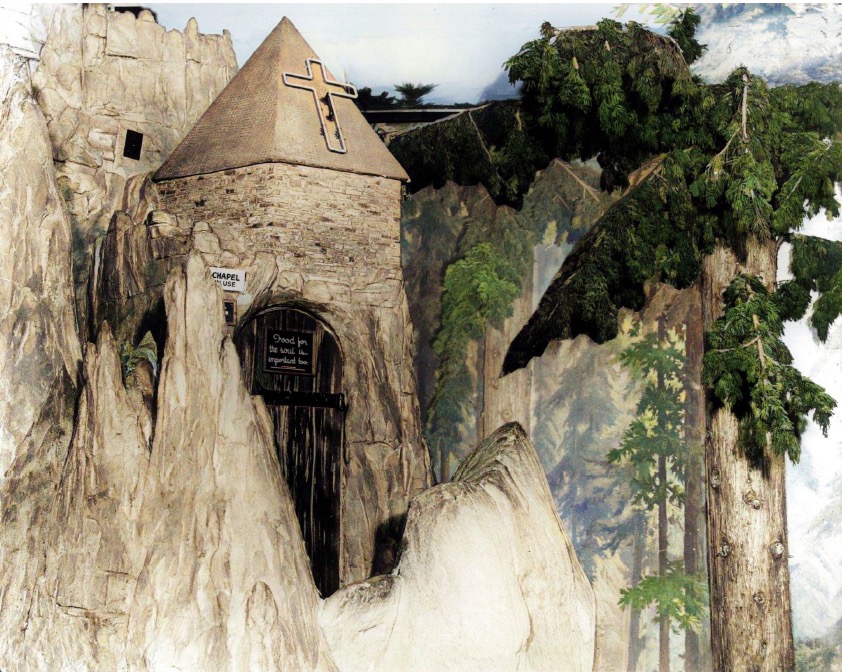
The chapel made spiritual contemplation part of an ordinary meal out, rather than something confined to a church building.
Clinton’s pioneering approach to spirituality
Three important aspects of Clinton’s vision:
- Accessible spirituality: People from different backgrounds could encounter a religious setting without attending a formal service.
- Faith expressed through hospitality: His mottoes, including “Dine Free Unless Delighted” and “Pay What You Wish,” connected Christian principles with feeding people, including those who could not afford a meal.
- Immersive religious environments: He used architecture, sculpture, murals, sound, and carefully designed spaces to create experiences that invited reflection.
There is a fascinating historical distinction here: Clinton was not planting churches in the conventional sense. He was creating quasi-sacred spaces within secular commercial institutions. That is a different form of religious outreach, and one worth studying in its own right.
I would be cautious about calling him the first person in American history to do this without a broader comparison. But the combination of public hospitality, elaborate biblical environments, and an explicit commitment to spiritual nourishment makes his work a distinctive example of prayer and meditation embedded in everyday life of Angelenos.
Clifford Clinton Transformed Los Angeles
Ysabel Jurado’s Council Motion to rename Pershing Square goes on about Biddy Mason being “one of the city’s most influential civic and business leaders” and her “extraordinary contributions to the founding and development of Los Angeles,” further claiming Mason’s “vision helped shape the city into what it is today,” et cetera. Don’t get me wrong—because I love Biddy Mason, for who she actually was—but although Mason is important historically, these Council Motion assertions are asinine and unsupportable. I’ve detailed the fatuous nature of these spurious statements in other posts, so I won’t bother to reiterate here, but I will certainly debate them should anyone wish to.
Let us turn our attention here to someone who definitely changed Los Angeles: Clifford Clinton was not just a socially minded restaurateur. He became an important figure in Los Angeles’s fight over corruption, political patronage, and the control of municipal government. His story connects business, religion, radio, investigative politics, and the risks of challenging entrenched power.
What makes him especially interesting is that he used the public reputation and resources he built through Clifton’s to pursue reform outside the normal channels of political office.
The campaign that helped bring down a corrupt city administration
In 1936, at the request of County Supervisor John Anson Ford, Clifford Clinton investigated food operations at Los Angeles County General Hospital. He uncovered widespread waste, overcharging, and corruption, producing reforms that cut the hospital’s annual budget by $120,000.
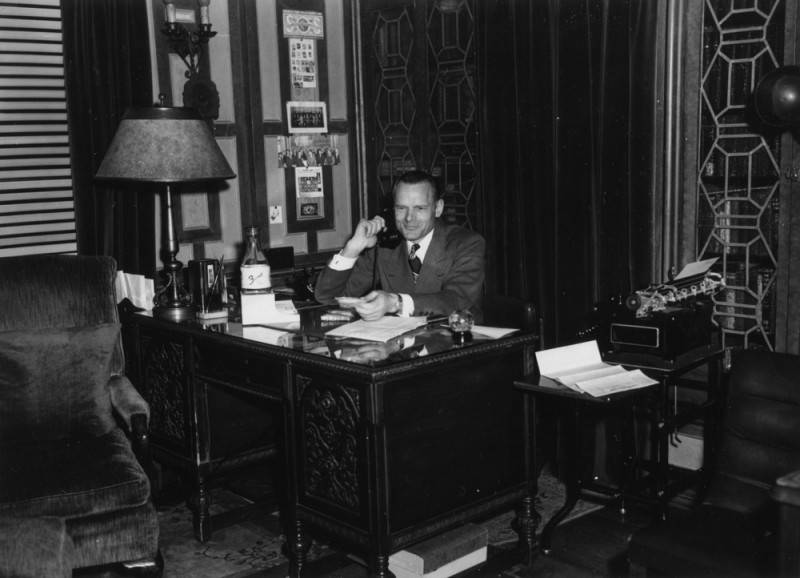
After exposing waste and abuses in Los Angeles County General Hospital’s food operations, Clinton expanded his efforts into a broader campaign against municipal corruption. He helped organize the Citizens Independent Vice Investigating Committee (CIVIC) and pushed for investigations into the connections among political officials, police, and organized vice.
A bomb exploded at Clinton’s Los Feliz home in October 1937. In January 1938, a car bomb seriously injured his investigator, former police detective Harry Raymond. LAPD Captain Earl Kynette was convicted in connection with the attack on Raymond. The violence exposed the extraordinary dangers facing people investigating police corruption.
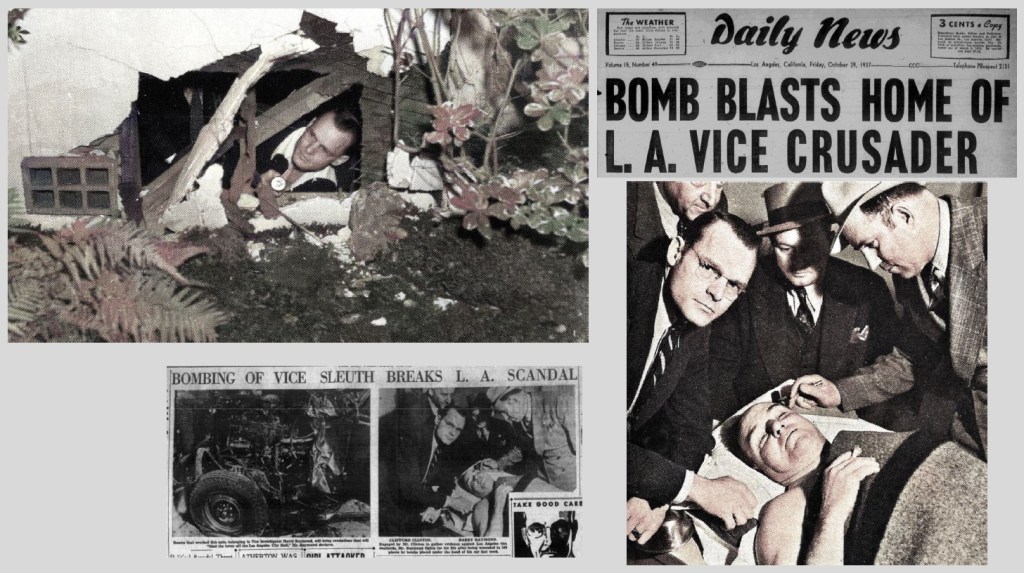
Clinton and fellow reformers helped mobilize opposition to Mayor Frank Shaw. Voters removed Shaw in a September 1938 recall election, and reform candidate Fletcher Bowron succeeded him. The scandal also contributed to the departure of Police Chief James E. Davis and other senior officers.
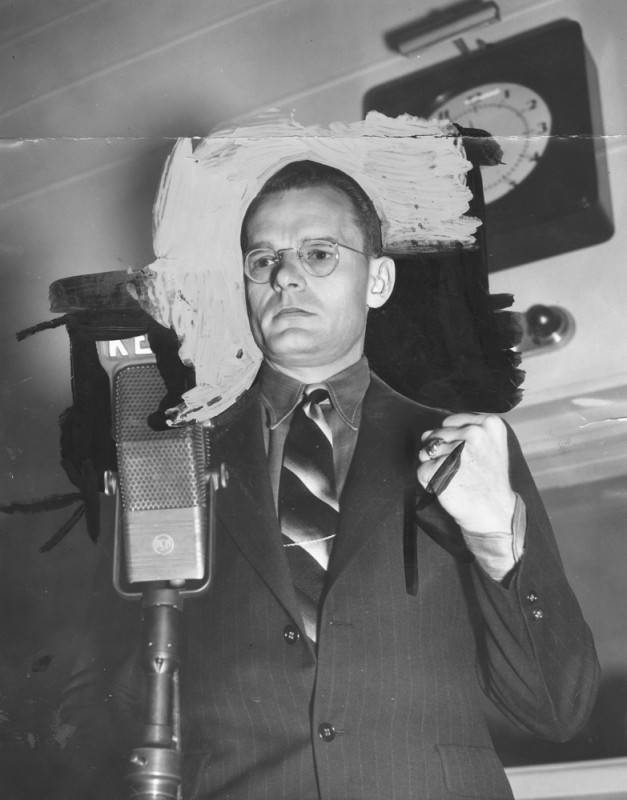
Clinton continued broadcasting about corruption, using radio to reach the public directly. When conventional media access was difficult, his broadcasts gave him a way to present evidence, challenge official accounts, and maintain pressure for reform.
Why his place in history deserves more attention
Clinton brought together several roles that historians often study separately:
- The entrepreneur who built a successful business.
- The religiously motivated philanthropist who believed feeding people was a moral responsibility.
- The investigative reformer who gathered evidence against entrenched political interests.
- The radio broadcaster who tried to make that evidence intelligible to ordinary citizens.
- The civic activist who helped mobilize voters to remove a mayor.
His importance was not that he single-handedly eliminated corruption. Los Angeles’s reform movement involved many people, including John Anson Ford, Judge Fletcher Bowron, Harry Raymond, journalists, and other civic activists. Nor did the reforms permanently eradicate corruption. But Clinton was a significant participant in a campaign that helped break the grip of the Shaw administration and expose abuses within the police department.
And there is a particularly striking connection to any claim about city building: Clinton tried to build a better city both by creating places that served people and by challenging the government that was supposed to serve them.
His cafeterias represented his positive vision of civic life; his anti-corruption campaign confronted the institutions undermining it. His story belongs not only in the history of restaurants or Los Angeles politics, but also in the history of American civic reform.
Clifford Clinton Was a Pioneering Anti-Racist
We all know Biddy Mason help found the local congregation of the AME church, which was, of course, segregated. The only evidence she helped folk both Black and White is this: in 1882 the First AME church, at Fourth and Grand, had shuttered, and she loaned them the money for their unpaid property taxes. After the church reopened, the church (not Mason) began an integrated Methodist Sunday school for children. That’s the whole of it: Mason’s indirect contribution to an integrated Los Angeles, which was both religious and short-lived. As a midwife, she undoubtedly attended to mothers of different races and social classes, but that was her job; there’s no evidence her philanthropy reached both the Black and White community. (Stovall’s 1909 article indicates that, late in her life, Mason would help “stranded and needy settlers” who came to her door, but does not indicate race. It does say, though, that they were soon turned away from the door by her grandson!)
Clifford Clinton, though: because he was a White man in the “olden days” there’s no way he could be cool—he’s got to be a racist, right? Nope! He belongs up there in the great pantheon along with Thomas Starr King, Fred Ross, and A. L. Wirin. Clifton’s Cafeteria in Los Angeles was an important example of anti-racism in practice long before the modern Civil Rights Movement. Beginning in the 1930s, founder Clifford E. Clinton ran his restaurants on the principle that people should be treated with dignity regardless of their race or how much money they had.
In the 1930s and ’40s, racial discrimination was widespread in the United States. Black Americans often faced exclusion from restaurants, hotels, and other public accommodations. What made Clifton’s remarkable was that its commitment to equality wasn’t just a slogan. It affected who could eat there, how the business responded to racism, and the risks the owners were willing to take to uphold their principles.
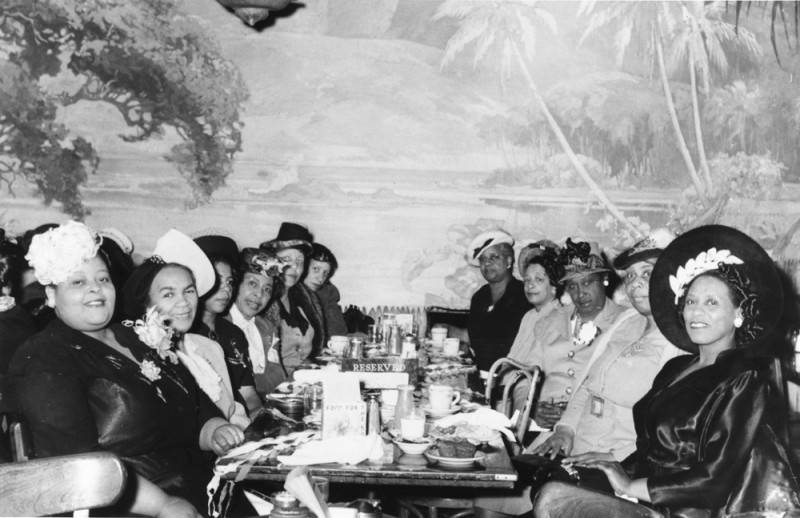
Clifton’s stood apart by serving customers regardless of race. Its original Olive Street location, Clinton’s flagship Clifton’s Pacific Seas, was even listed in The Negro Motorist Green Book — a guide that helped Black travelers identify places where they could safely obtain services during segregation.
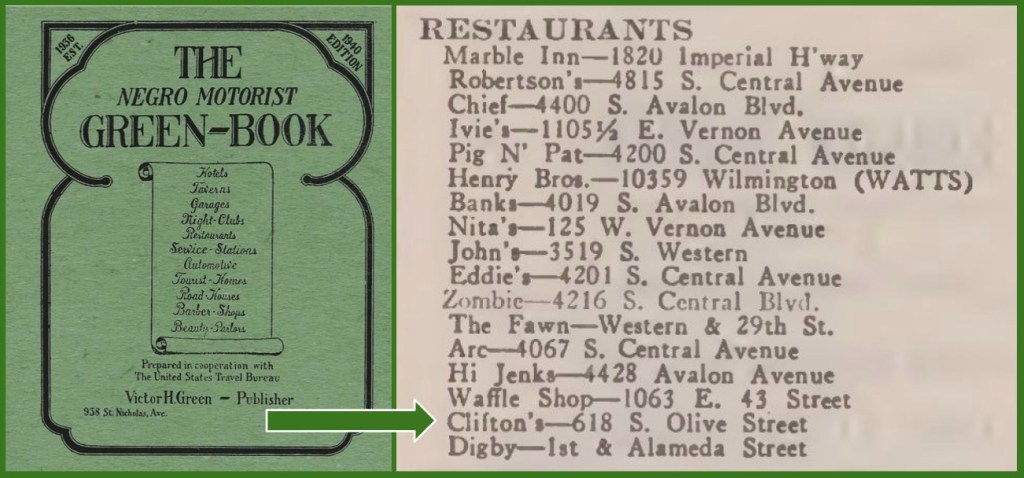
This made Clifton’s more than an affordable place to eat; it was a business where Black customers could dine alongside White customers at a time when many establishments refused them service.
Clinton publicly stood up to racist customers
One of the clearest examples comes from 1944, when a White customer complained after two Black diners sat at the customer’s table. The customer threatened to stop patronizing Clifton’s unless the restaurant excluded Black people.
Clifford Clinton responded in a publication distributed at his restaurants, The Guests Voice. Rather than apologize or promise to segregate diners, he defended the restaurant’s policy.
Clinton argued that democracy required people to accept the presence of others, even when they were uncomfortable with racial integration. He connected racial equality to American constitutional principles, Christian ethics, and the country’s wartime struggle against racist ideologies.
He concluded that Clifton’s had a duty to serve everyone who entered its doors. He even acknowledged that this principle might ruin his business, declaring that he would rather face that possibility than abandon his conscience.
The restaurant’s commitment to integration was not universally welcomed: people opposed to the Clinton family’s activism tried to frighten away White customers. In one incident, someone brought a busload of Black people from Central Avenue to Clifton’s, apparently hoping that White patrons would react negatively and stop coming.
The plan backfired. Many existing customers stayed, and the restaurant gained new customers. The family also faced other forms of pressure, including unexpected demands for costly repairs from health inspectors and smoke bombs being set off in its downtown cafeterias.
This matters because Clifton’s anti-racism was not simply a matter of welcoming diversity when it was easy or profitable. The family continued to operate according to its principles despite hostility and potential financial consequences.
Clifton’s anti-racism was connected to a broader philosophy of human dignity
Clinton’s approach to race was part of a wider commitment to helping people who were vulnerable or excluded.
- Economic inclusion: During the Great Depression, Clifton’s allowed customers to pay what they could afford, and those who could not pay could still eat.
- Equal treatment: Clinton believed that people of different races should receive the same welcome and service.
- Christian ethics: His philosophy drew on the Golden Rule — treating others as you would want to be treated.
- Community: The cafeterias provided a shared public space where people from different backgrounds could eat together.
These commitments were related. A restaurant that welcomed people regardless of income was challenging one kind of exclusion, while a restaurant that welcomed Black customers during an era of segregation challenged another.
Clifford Clinton might be great… but it’s not like he started a daycare, or a school, or an orphanage!
Because here’s where some of you will say “Sure yeah, but, Biddy Mason established a school, started a daycare for working mothers, founded an orphanage, and Clifford Clinton did none of those things!” … except neither did Biddy Mason. Click here.
In Summation:
Clifford Clinton deserves a place in the public landscape of Los Angeles because few individuals have done so much to nourish, inspire, and fundamentally change this city. He fed the hungry, often asking little or nothing in return. Through Clifton’s Cafeteria, he created a place where a person could find an inexpensive meal without sacrificing dignity, and where generosity was not an abstraction but a daily practice. His generosity also extended across the color line. At a time when racial prejudice was deeply ingrained in Los Angeles, Clinton was an outspoken opponent of discrimination and among the relatively few who offered African Americans refuge and a welcoming place when others would not. He believed that human dignity was not determined by the color of one’s skin. But Clinton understood that people needed more than food. He sought to feed the soul as well, filling his establishments with beauty, inspirational messages, religious imagery, and reminders of the better angels of human nature. He believed, sincerely and perhaps somewhat quixotically, that a restaurant could be an instrument of moral uplift.
And then there was his contribution to the civic life of Los Angeles. At a time when corruption had become deeply entrenched in City Hall, Clinton refused to accept that dishonesty and political patronage were simply the way things worked. He helped finance and organize the movement that brought down Mayor Frank L. Shaw in 1938, an extraordinary achievement that demonstrated that ordinary citizens, when organized and determined, could reclaim their city from those who had abused its trust. The recall of Shaw was a watershed in Los Angeles history, and Clinton was one of its indispensable figures.
Clifford Clinton did not merely feed Los Angeles. He helped give it a conscience. He understood that a city should care for its poorest residents, nourish the human spirit, extend compassion across racial boundaries, and hold its public officials accountable. These were not separate causes to him; they were different expressions of the same conviction that a community could, and should, be better than it was. Los Angeles owes him an enormous debt. Naming a park in his honor would be a fitting and lasting recognition of a man who fed its people, lifted their spirits, and helped change the course of its history.
Bonus Factoids:
While we’re on the subject of Clifton’s—I would be remiss in my duties if I didn’t mention some other fun facts about the place:
- Clifford Clinton may have helped inspire Disneyland. His fantastical Clifton’s Cafeterias, with their enchanted forests, waterfalls, exotic landscapes, and immersive environments, anticipated the very idea of the themed experience that Walt Disney would eventually perfect. Disney was a regular patron and admirer; Disney was a friend of Clinton’s, and a very good friend of Welton Becket, the architect who helped design Clifton’s Pacific Seas. It is not unreasonable to wonder whether, without Clinton’s extraordinary imagination, Disneyland might have looked very different—or perhaps never have existed in the form we know.
- Clifton’s Cafeteria played an unexpected role in the birth of rock ‘n’ roll. As a teenager, Jerry Leiber worked there as a busboy, and one day, carrying dishes into the kitchen, he heard a Filipino cook listening to blues singer Jimmy Witherspoon’s recording of “Ain’t Nobody’s Business.” Leiber had what he called a “mystical musical revelation.” Leiber would go on to form the legendary songwriting partnership Leiber & Stoller, writing such hits as “Hound Dog,” “Jailhouse Rock,” “Yakety Yak,” and “Stand by Me.”
- Clifton’s Cafeteria also occupies a place in American literary history. Jack Kerouac immortalized its fantastical atmosphere in On the Road, while Charles Bukowski remembered its generosity in Ham on Rye, recalling how the restaurant allowed the poor to eat even when they couldn’t pay. Bukowski returned to Clifton’s in his poem “Downtown,” portraying it as a microcosm of Los Angeles. Clinton had created something remarkable: a democratic refuge that fed both the hungry and, indirectly, the city’s literary imagination.
- Clifton’s Cafeteria became an unlikely birthplace of organized American science-fiction fandom. The Los Angeles Science Fiction League (LASFL), founded in 1934, began meeting regularly at Clifton’s Brookdale in 1936. Led by Forrest J. Ackerman, its members included Ray Bradbury, future special-effects wizard Ray Harryhausen, and other aspiring writers and dreamers. In 1940, the organization became the Los Angeles Science Fantasy Society (LASFS), one of the world’s oldest science-fiction fan organizations. Bradbury remembered Clifton’s generosity, where struggling young people could eat without money. Clifford Clinton was feeding the imaginations as well as the bodies of future cultural giants.
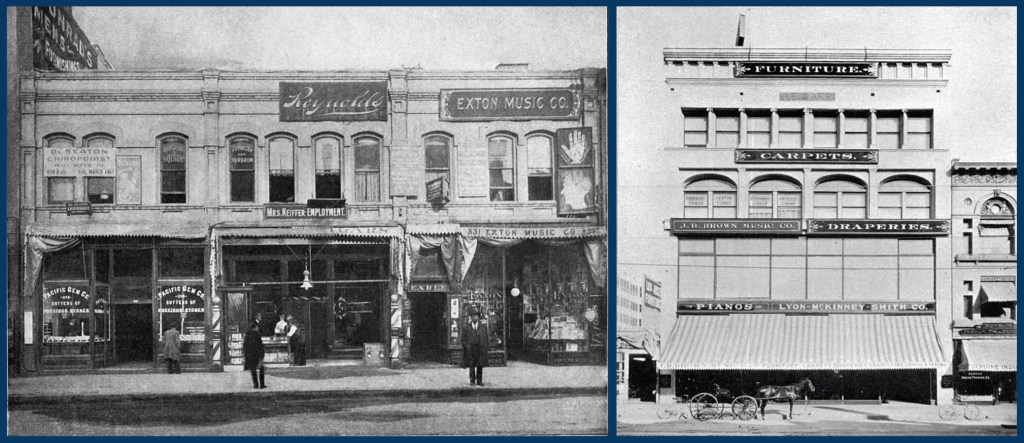
- Final factoid, an architectural coincidence: Biddy Mason’s Mason Block, and the building that houses Clifton’s, shared the same architect. In late 1885, when Biddy Mason decided to develop her property at 331-335 South Spring Street with a two-story brick mixed-use commercial/residential structure, she hired architect Robert Brown Young. In 1904, Joseph Elmer Carr, the prominent banker, merchant, and civic leader, built a four-story steel-reinforced business block at 648-654 South Broadway—and again, the architect was Robert Brown Young. The Carr Block is where Clifford Clinton would take over the Boos Brothers Cafeteria mid-1935. The Young-designed Mason Block was demolished for a parking lot in 1932, but the Carr Block remains.