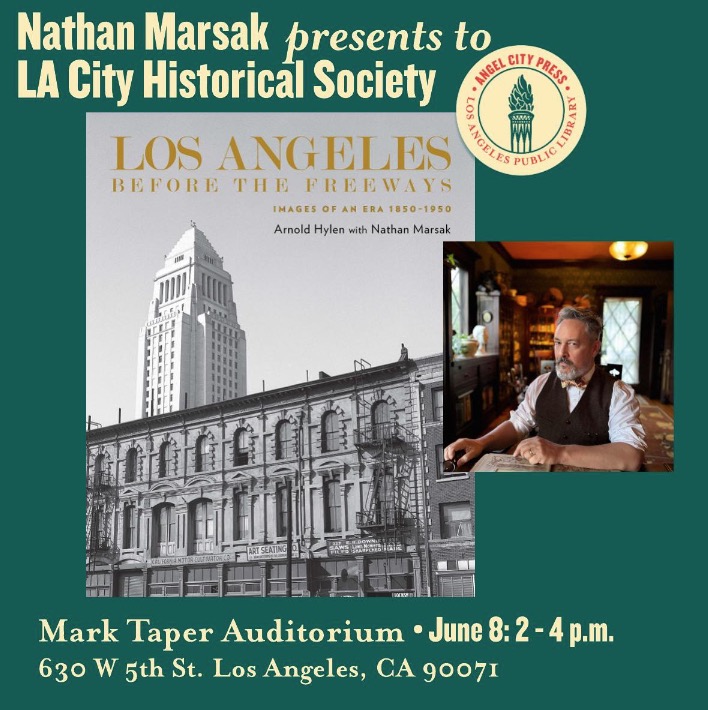
This Sunday! The Los Angeles City Historical Society presents yours truly, as part of the Marie Northrop Lecture Series; LACHS cosponsors with the History Department of Central Library.
I’ll be talking all about Arnold Hylen’s curious life, the process of chasing down lost archives, the genesis of America’s post-Panic of ’93 visual language, and much more! More importantly, so many pretty pictures on the big screen.
Don’t forget your library card — $1 flat rate all-day parking under the library! See you there!
I decided, therefore, to distill the salient points into one piece. As it’s a bit long I figured that rather than run it here, I’ll upload it elsewhere, so you may read it off-site.
I hope it answers any Cooper questions you might have. I devised it as such: what if you and I went to dinner and discussed the whole shebang? Sort of a My Dinner with Andre where you’re Wallace Shawn and I explain Cooper Do-Nuts Square to you. Now granted that might sound like the worst date ever, but you have to admit you’re curious about how our conversation goes.
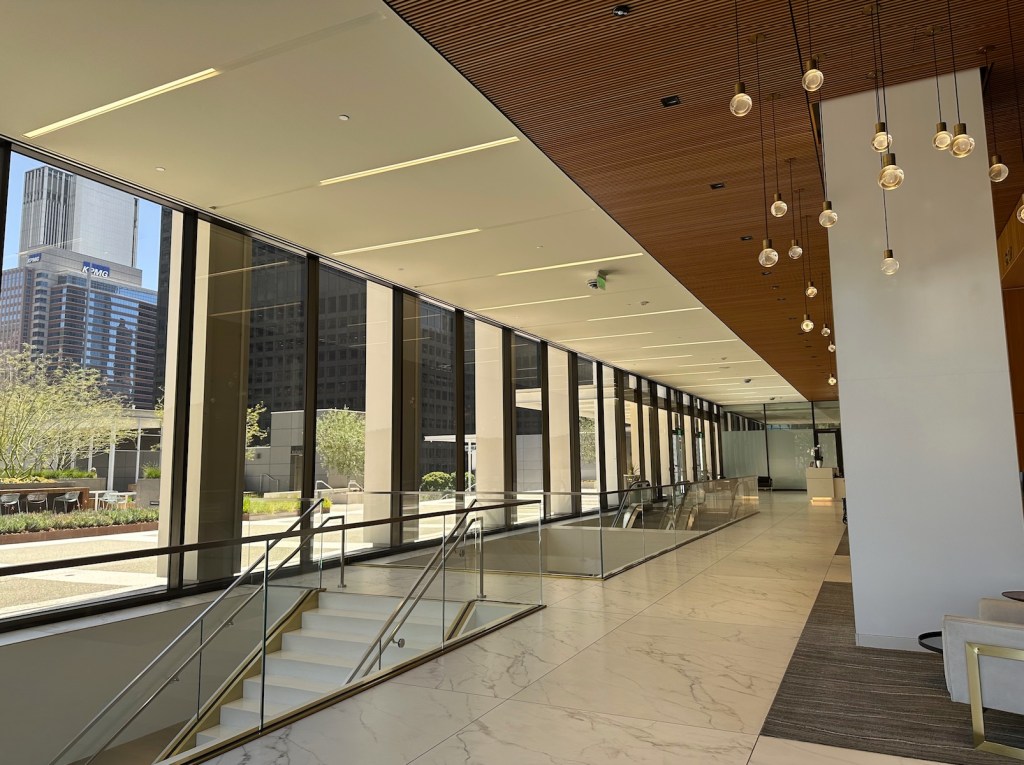
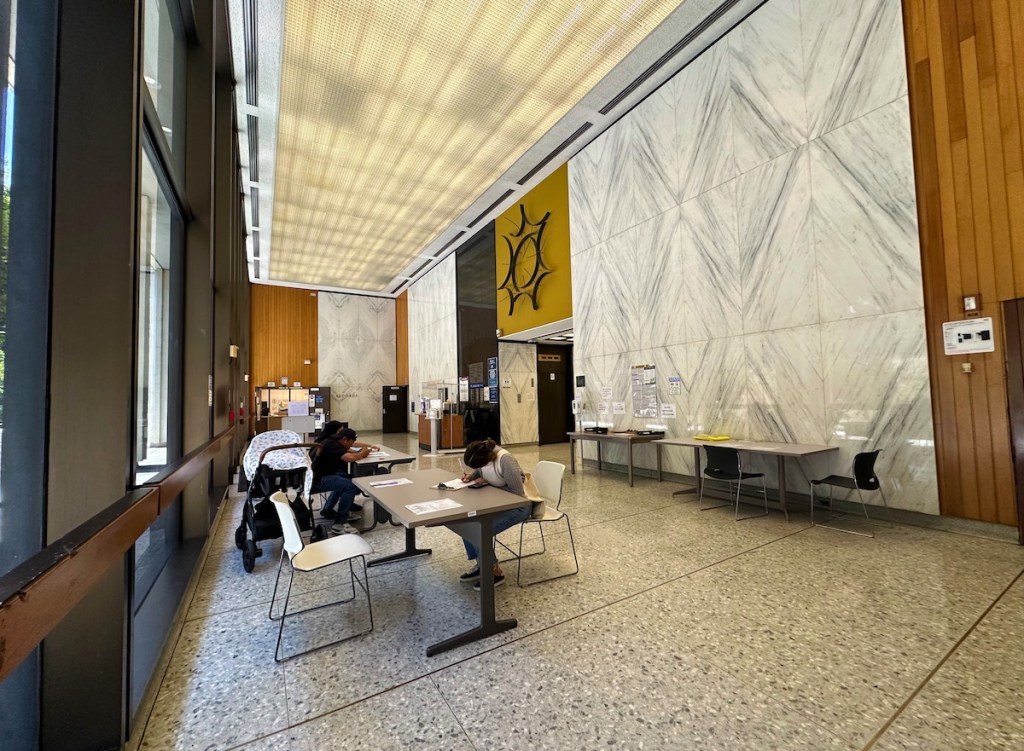
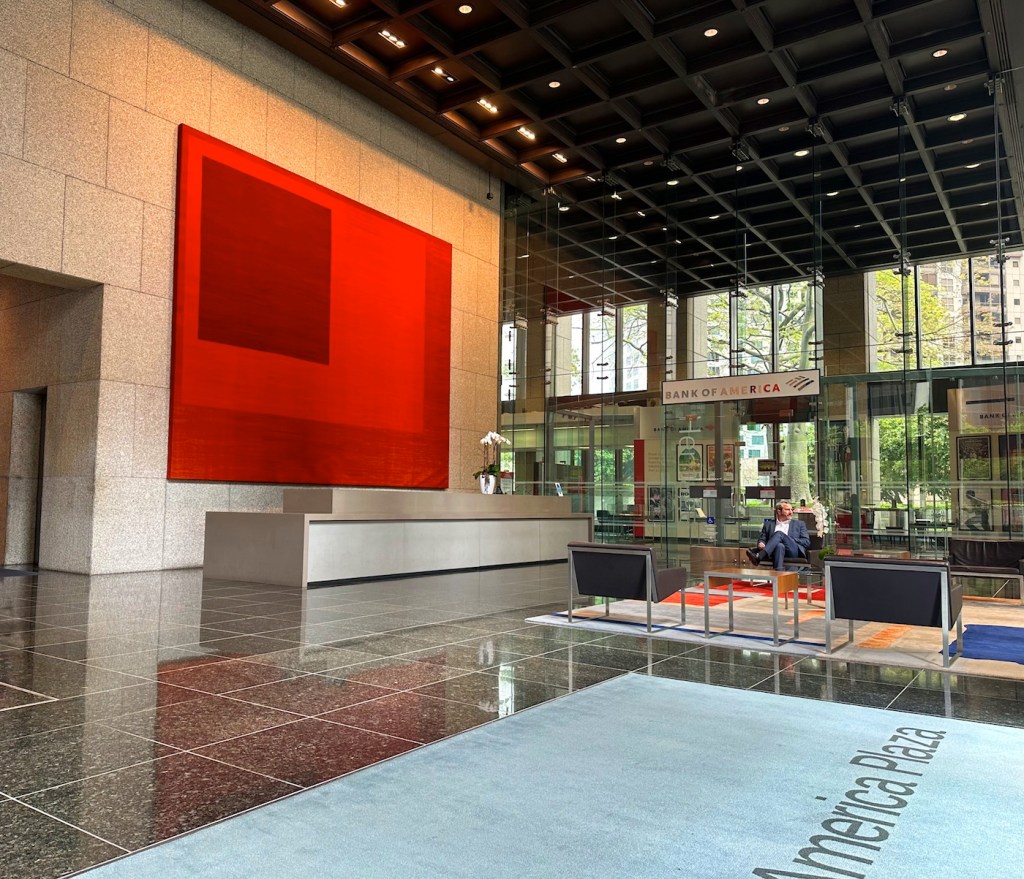
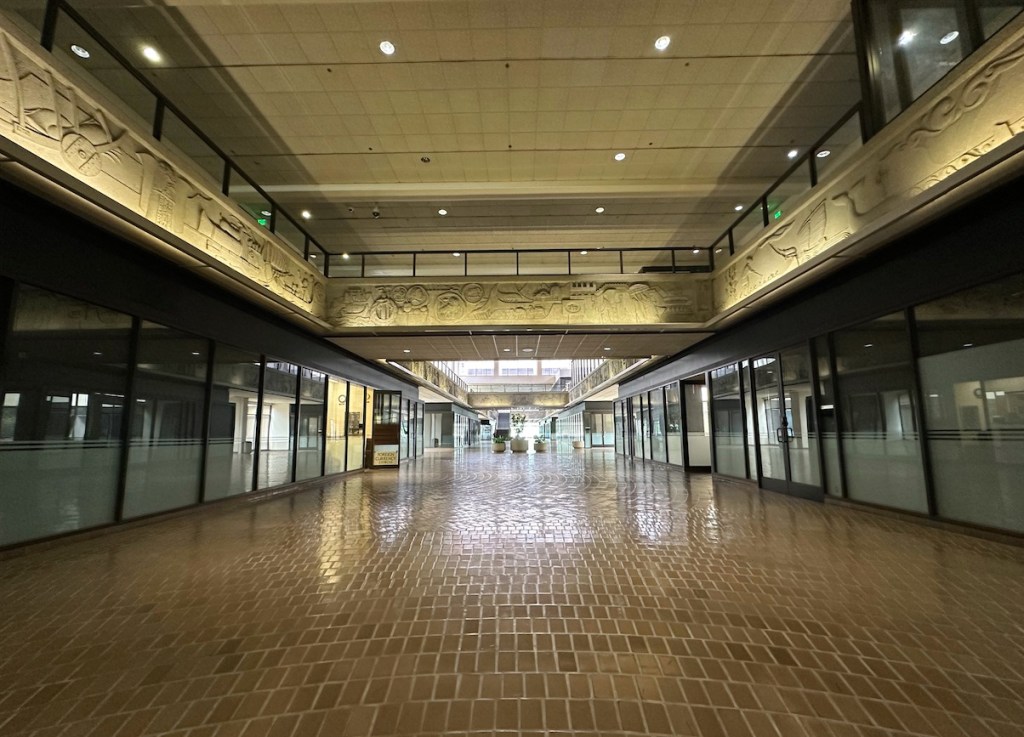
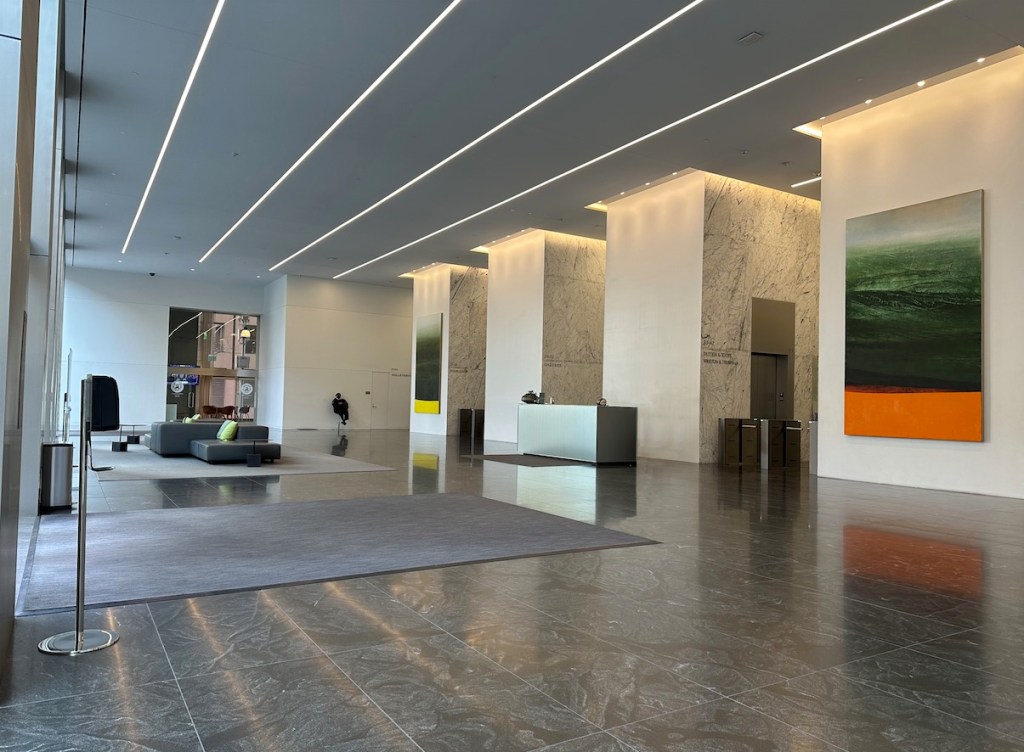
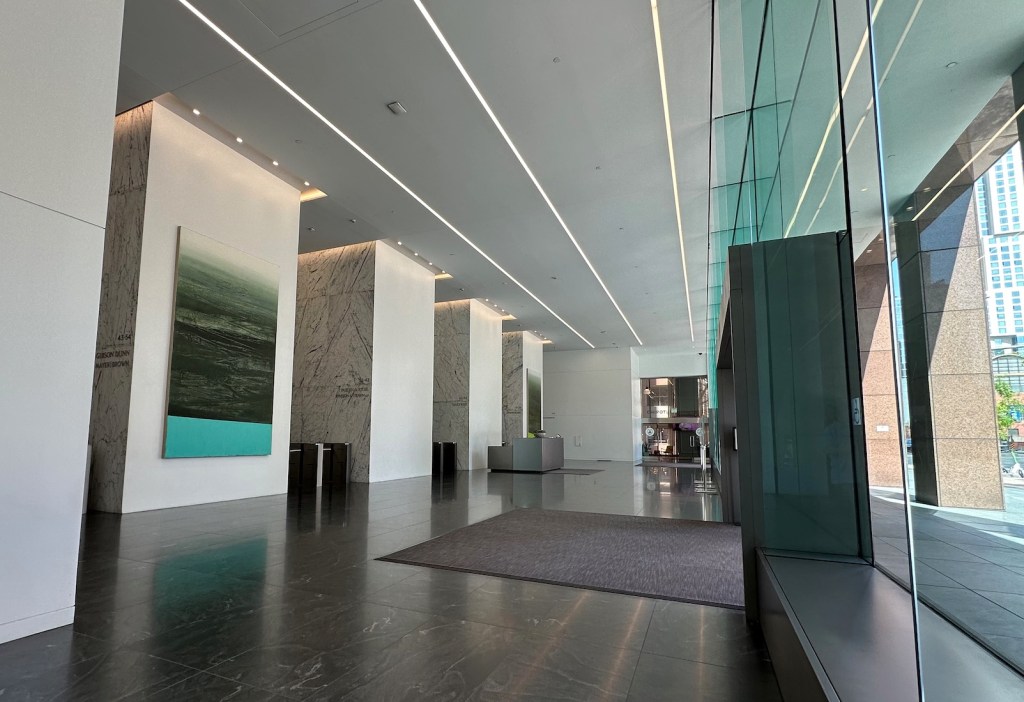
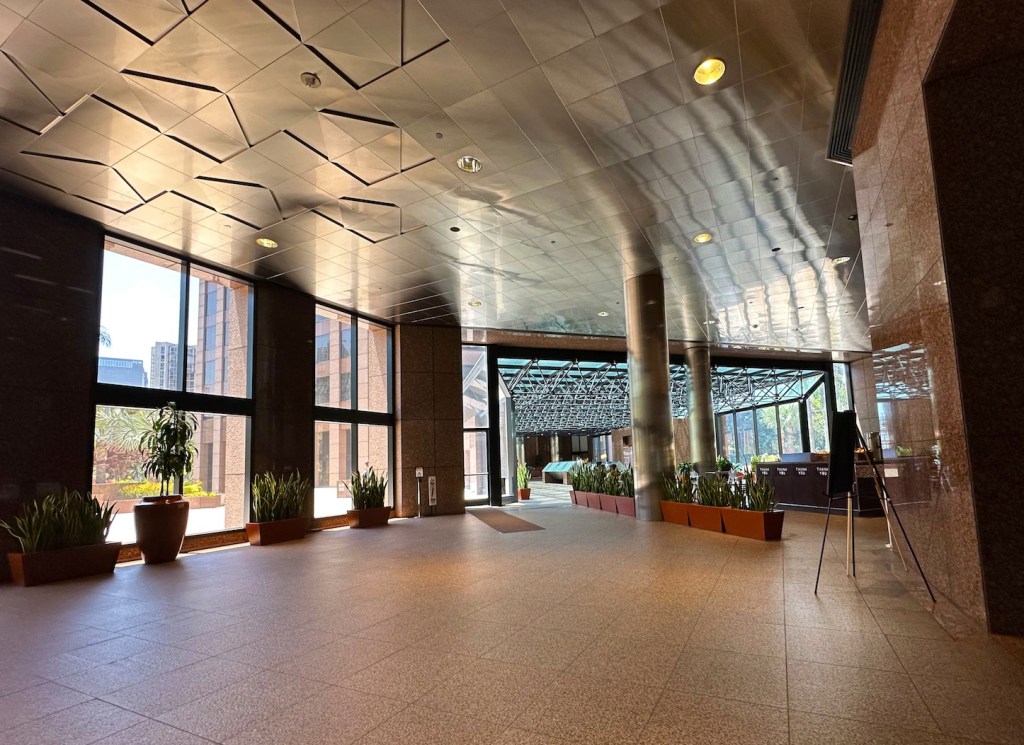
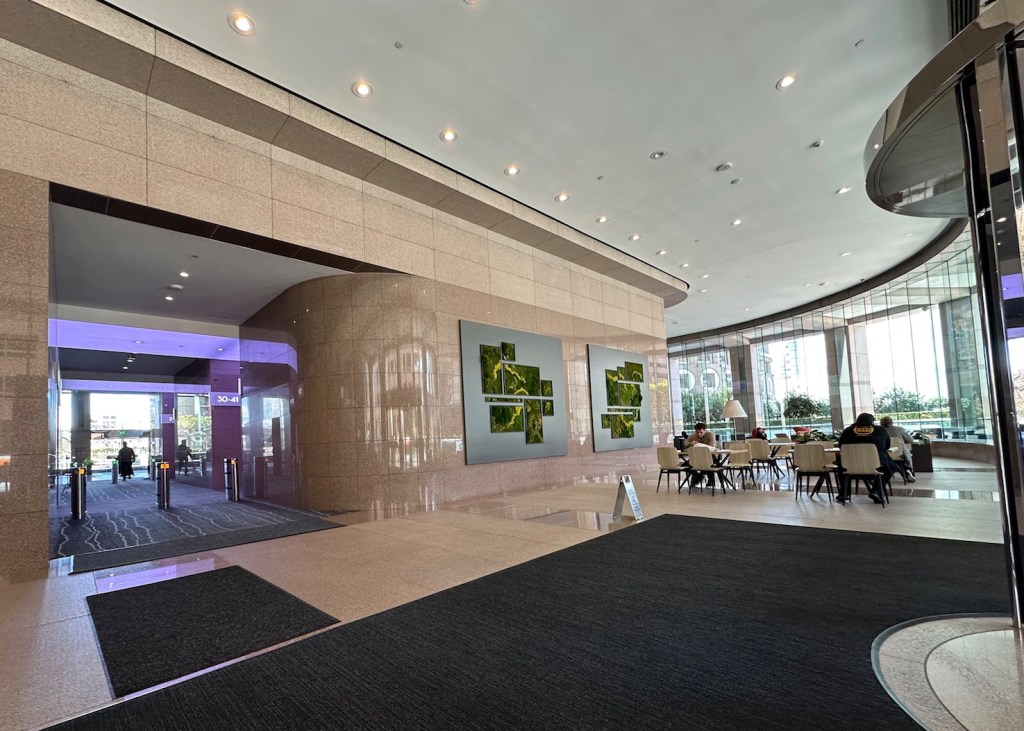
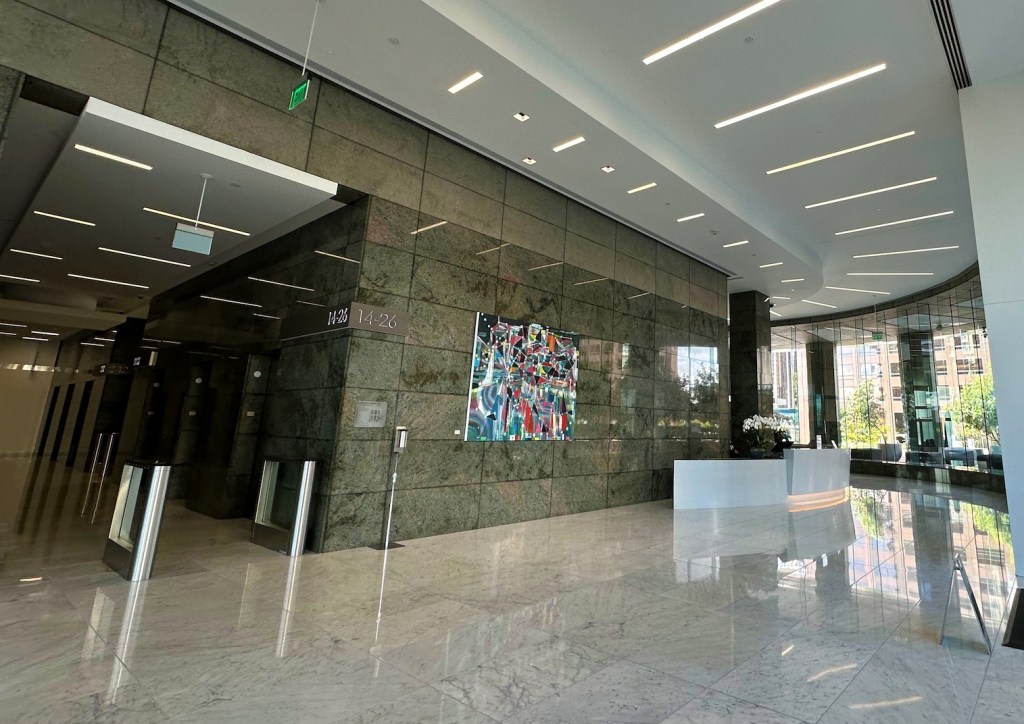
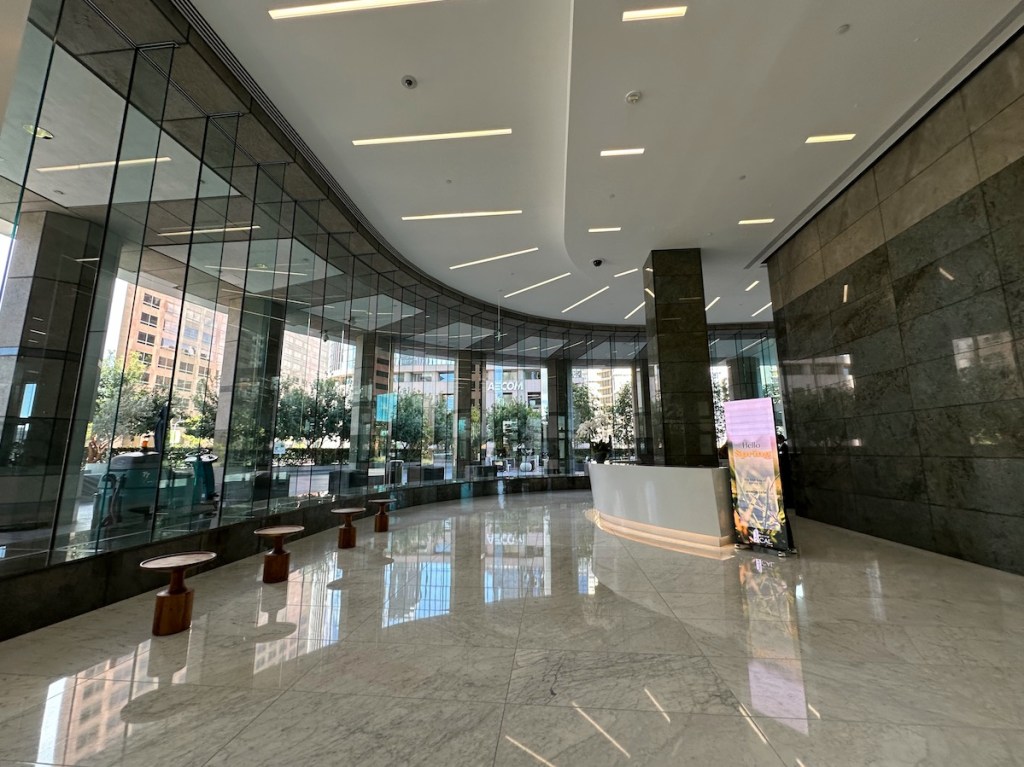
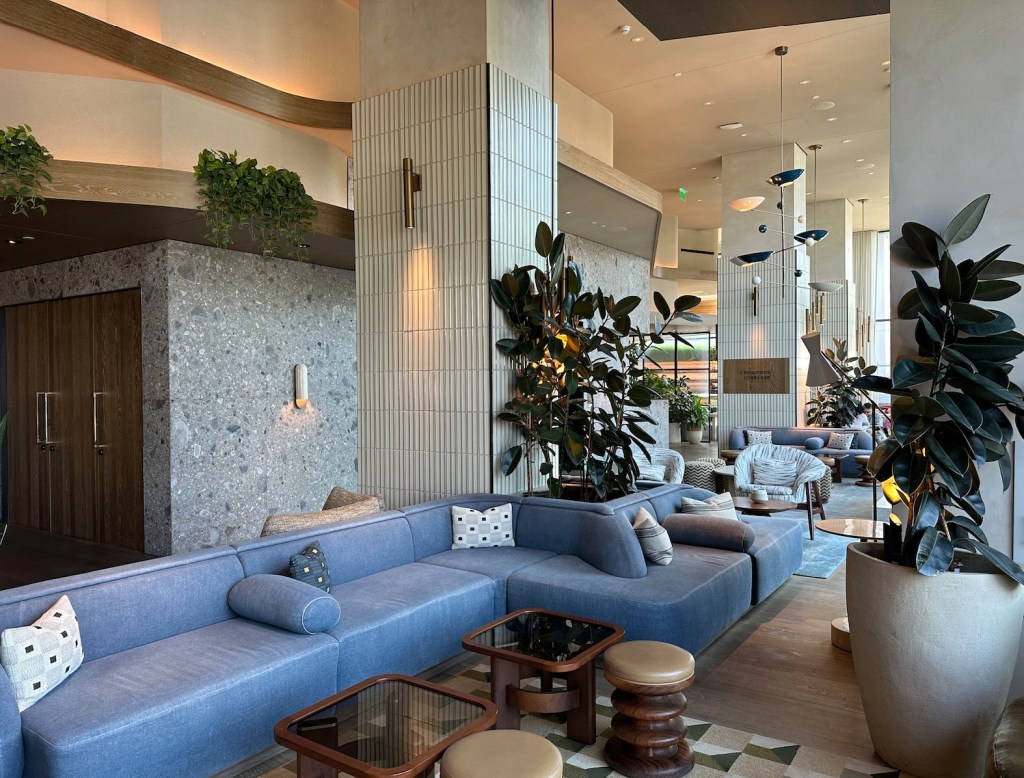
Let’s talk the lobbies of Bunker Hill! Of course there’s no returning to the Melrose or Trenton or Fremont, so you’ll have to content yourself with the modern lobbies of post-redevelopment Bunker Hill. You’ve likely been inside some of Bunker Hill’s more important and sublime interiors, like the Music Center; other lobbies are well-documented online, like the Bonaventure; or were one of the few to appear in Marsak’s Guide to Bunker Hill (e.g., the O’Melveny & Myers Tower).
But as you sit with your copy of Marsak’s Guide to Bunker Hill and gaze upon the Hill’s contemporary structures do you not often think I should actually go in there, and see what those granite-clad 1980s corporate lobbies look like!
Ok, maybe you’ve never thought that, but, I would be remiss in my duties as the purveyor of all things Bunker Hill to not show you what you were missing. Of course nothing can replace the actual educational and inspirational opportunity of visiting a space yourself, basking in its grandeur and engaging all your senses in the physical environment…but you know what, until that time, here are some photographs:
Union Bank Tower 445 South Figueroa Street, Harrison & Abramowitz/ Albert C. Martin & Associates, 1967 (Marsak’s Guide, p. 26)County Health Department Central Administrative Offices 313 North Figueroa Street, Arthur Froehlich & Associates, 1970 (Marsak’s Guide, p. 28)Security Pacific Bank 333 South Hope Street, Albert C. Martin & Associates, 1974 (Marsak’s Guide, p. 31)World Trade Center 350 South Figueroa Street, Conrad Associates Architects, 1975 (Marsak’s Guide, p. 32)Wells Fargo Bank Tower 444 South Flower Street, Albert C. Martin & Associates, 1982 (Marsak’s Guide, p. 38)Crocker Center 333/355 South Grand Avenue, Skidmore, Owings, and Merrill, 1982/1985 (first two images: south tower/333; third image: north tower/355) (Marsak’s Guide, p. 40)Figueroa Plaza 201/221 North Figueroa Street, Welton Becket & Associates, 1985 (Marsak’s Guide, p. 42)One California Plaza 300 South Grand Avenue, Arthur Erickson Architects, 1985 (Marsak’s Guide, p. 43)Two California Plaza 350 South Grand Avenue, Arthur Erickson Associates, 1992 (Marsak’s Guide, p. 50)Grand Promenade Apartments 255 South Grand Avenue, Kamnitzer & Cotton/Abraham Shapiro Associates, 1989 (Marsak’s Guide, p. 47)Emerson Residential Tower 225 South Grand Avenue, Arquitectonica, 2014 (Marsak’s Guide, p. 58)The Grand 201 South Grand Avenue, Frank Gehry, 2022 (Marsak’s Guide, p. 62)
Now with all this talk about visiting lobbies, and the mentions made of Marsak’s Guide to Bunker Hill, perhaps you should get a copy of MGtBH to use as your guidebook for L.A.’s Museum of Modernism—
Hello again! After last Friday’s blogpost about Channel 5’s Chavez Ravine video, blog reader janey_dlh asked “did you listen to the new Tinseltown Ghost Stories podcast?” so, here’s a rather similar investigation (though, good news, much shorter than last Friday’s post) into the claims made on the Tinseltown podcast.Granted, I was moved to pick apart Channel 5’s video because it had had so many views, so I feel a little bad picking on a podcast that has had significantly fewer. But, we put out the fires we find.
Also, while my Channel 5 takedown was lengthy and thus may seem comprehensive, be advised that this podcast contains a whole host of absolutely different mistaken assertions! Yes, like Channel 5, Tinseltown Ghost Stories repeats the ol’ “buried school” myth, but TSG goes off on all sorts of other wild flights of fancy like “there were no paved streets” and “Chavez Ravine residents banded together to shut down the local brick factories.” Read on!
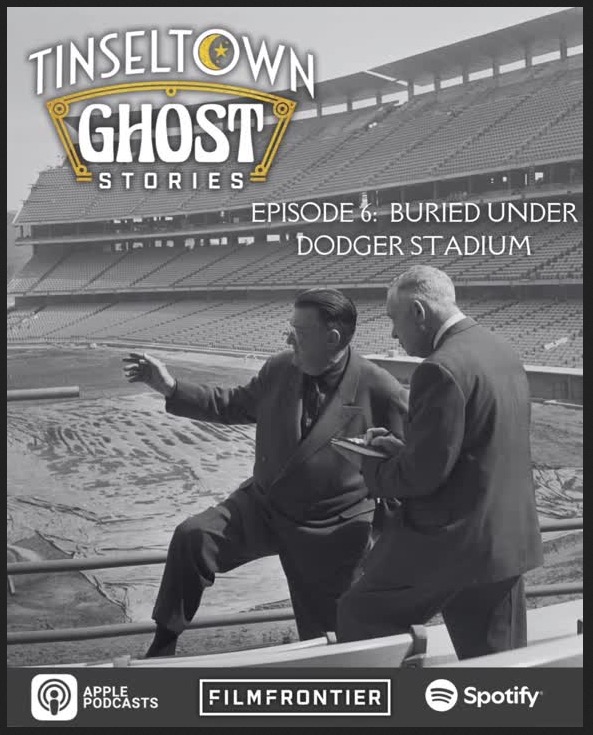
There’s a new episode of the podcast Tinseltown Ghost Stories: apparently, if you’re a security guard at Dodger Stadium, you spend as much time dealing with unquiet specters as you do unruly spectators. Ragged dust-covered children laugh and run about and then disappear into solid concrete walls. I can’t speak to the veracity of those claims, but, the majority of the podcast concerns the history of the land upon which Dodger Stadium is built, and because I have a keen interest in how and why do people believe what they believe about Dodger Stadium? it is my duty to address the podcast’s litany of spurious claims.
Sure, I get it, a podcast is not “real” journalism, and I shouldn’t expect the kind of fact-checking employed by, say, the Los Angeles Times or KCRW. (Oh, wait, those guys’ve published dozens of specious claims about Chavez Ravine, so, never mind.)
And honestly, I’m not trying to be a total asshat on the subject — the podcast’s author Kyle F. Andrews obviously likes spooky stuff, and is thus one of my kinsmen, and I certainly wish him no ill will — but it’s beyond my abilities to not nitpick a new piece of fable-peddling Chaveziana when it hits the market…so:
Note that the episode is titled “Buried Under Dodger Stadium” and in its description, we learn its daaark history is “buried underneath its seats” … yeahhhh I understand the obvious benefits of employing Chavez Ravine’s most famous romantic trope. But it is, of course, factually speaking, an annoying lie: the partially-parking lot land to the north of the stadium is where many of Chavez Ravine’s residents once lived, true, but, not a single home—not one—ever existed underneath what is now the stadium footprint. Details matter.
Let’s look at some of TGS‘s contentions, following (clickable) timestamps from the YouTube upload.
9:20“the City enticed O’Malley by practically giving away land it already owned.”Nope. The city and O’Malley did an even swap. Walter O’Malley had, in 1957, purchased Wrigley Field, bounded by Avalon, 41st, San Pedro, and 42nd. It was valued at $2.25 million. O’Malley transferred that land to the city in exchange for the Chavez land, which was valued at $2.2 million. (Cue someone yelling “but the Chavez land should have been worth more, because it was bigger“, but the Wrigley Field land was flat, in a developed urban area, and fitted with modern infrastructure; the Chavez land would require a princely sum before ground could be broken for anything — in fact, an argument could be made that the city got the better end of the deal, rather than O’Malley.) The even swap was made with the proviso that O’Malley fund construction of the ballpark out of his own pocket; the city didn’t have an extra $23 million ($2.65 billion USD2025) in their coffers to spend building a ballpark, a major city improvement that cost the city nothing (and has since generated nearly a billion dollars in property taxes, to say nothing of the jobs and other tax revenue it has provided).
Ms. Lopez goes on to say “not much is known what Chavez did with his ravine…” Yeah, cuz, you know, he didn’t own the ravine.
Oh, and strictly speaking, since Mariano Chavez’s land was nearer the westernmost ravine that became Chavez Ravine, logically, Chavez Ravine is named after Mariano Chavez, not Julian Chavez. Right? Because, consider: no-one has ever asked WHY we associate Julian Chavez, specifically, with Chavez Ravine. Though Wikipedia authoritatively instructs us Julian “is the namesake of Chavez Ravine,” the first person to ever connect Julian to the ravine was an unnamed city employee in a 1957 issue of the city employee magazine El Pueblo, and that writer went on to say Julian owned the land that held the cemetery and pest house, which is absolutely untrue, thus the spew of our-friend-the-1950s-city-employee is to be rejected in toto. The Los Angeles Mirror, however, repeated the assertion in April 1957 and it has stuck ever since. I’m not saying it’s not true, necessarily, but we also can’t say we have proof that it is.
If you must nitpick, since the ravine-in-question-called-Chavez Ravine (ostensibly named for Mariano and/or Julián Cháves), which subsequently lent its name to the area as a whole, actually ran up to property owned by Jean Bouet (see here), really the ravine-and-thus-greater-area should be called Bouet Ravine…but, you know, I wonder if people would care as much if the whole place was named after some guy from the Nouvelle-Aquitaine.
13:27“after Chavez died of a heart attack in 1879…the rural communities…soon moved in to take up residence.”Nope. Apart from two industrial brick yards, the area was empty until 1913; thirty-five years is hardly “soon.” Settlement began after 1913, and the majority of CR residents didn’t arrive there till the mid-late 1920s.
13:44“Palo Verde, La Loma, and Bishop represented thousands of people on land that had been discarded.” Nope. The communities of Palo Verde and La Loma contained a few hundred people, and the community of Bishop barely existed before 1930. At the height of Chavez Ravine’s population, in 1950, the three communities contained a sum total of about 1,100 people.
And the land had never been “discarded.” The land where the Palo Verde and La Loma were established, were on tracts owned by George Hansen and Isaias Wolf Hellman, subdivided by developer James Richard Riggins, with many lots purchased and subsequently sold to early residents by lawyer Marshall Stimson. Exactly the opposite of “discarded.” The small community of Bishop, to the south of Palo Verde, was owned and developed by the father-son team of Joseph and Giovanni Garibaldi. It’s hard to imagine a less likely scenario than Los Angeles, a continuously burgeoning community where property was always at a premium, containing “discarded” land.
And as far as there being no public transportation—that’s true, there was no public transportation, but also and more importantly, of course there wasn’t. “Public transportation” at that time didn’t exist, at least in the sense that the busses and streetcars that served the public were not publicly owned. All transportation that shuttled the public was privately owned and run, and if a bus or streetcar line didn’t turn a profit, it was shut down. If a proposed new bus or streetcar line was likely not going to turn a profit, you didn’t add that line. Government can afford to subsidize, and charities can afford to give away money, but public transportation during the time of Chavez Ravine was neither, because LA’s busses and streetcars were privately-owned companies. Believe it or not, private companies are in the business of making money — not losing money — and if they ran busses into areas that subsequently incurred financial losses, you can bet the shareholders would oust the board, or the board would oust management, and businesses really, really like to avoid that sort of thing. In short, Chavez Ravine got its death notice in 1950, was depopulated and demolished by the end of 1953, but there existed no taxpayer-funded/city-run bus line in Los Angeles until March 1958. So no, there was no public transportation to Chavez Ravine, and for good reason.
14:46“the city was more than willing to move people into the ravine, as they did in 1913, after a flood”Nope. The city never moved a single person into the ravine. Private developers had bought tracts and subdivided (e.g., when the aforementioned James Riggins bought the Palo Verde Tract and portioned it up into individual lots). Then, from 1913 on, a man named Marshall Stimson—an attorney, and a bigwig in Republican politics—purchased individual plots and marketed them to some of the river-dwelling people who had recently crossed the border, fleeing the Mexican Revolution.
15:00“they fought for themselves…when the pollution of the nearby brick factory became unmanageable, they took the owners to court…got the factory shut down” Absolutely not. The actual name of the case, heard Monday morning January 4, 1926, was People of North Broadway, College Street, North Figueroa St., White Knoll Drive, Marview Ave., Lookout Dr., Elysian Park Ave., VS The Los Angeles And Western Brick Co. The suit contended that blasting and dynamiting had ruined the plaster and foundations of houses in “the district bounded by North Broadway, College Street, Bishop Road, and Figueroa Street.” And, I might add, Municipal Court judge James Harlan Pope did not rule in favor of the plaintiffs. However, by the summer of 1926, the North Civic Center Improvement Association, located in the Alpine area south of Chavez Ravine (and headed by White Knoll Drive resident George Strong, who had brought the court suit in January), successfully campaigned City Council to pass a resolution shutting down the factories. What do you not notice in all this? The presence of any Chavez Ravine residents.
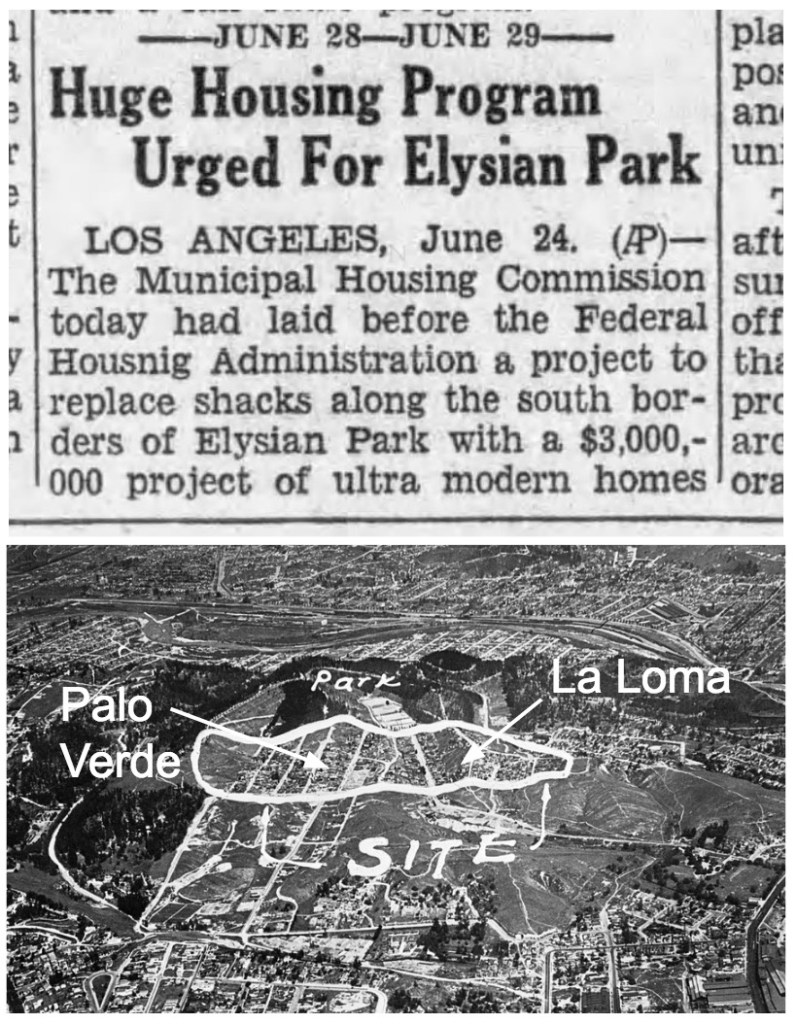
15:26“the city turned its eye to the land and what it could mean to developers”Nope. “Developers” weren’t involved after the initial tract layout and plot sales, which, after about 1910, is the last time developers were involved in the process. Forty-some years after those developers had moved on, the city—specifically, a city agency called the Housing Authority—”turned its eye to the land” as a place to build a massive housing project. “Developers” connotes private, for-profit entities. The Housing Authority was taxpayer-funded progressives doing some social engineering, precisely the exact opposite of “developers.”
15:30“But rather than work with the people, now numbering over 1,800 households, the city sneered at the community, labeling it blight and a slum” Nope. First of all, 1,800 households? The three communities contained no more than a sum total of 275 residential structures; the vast majority of which being small single family homes. At the height of its density, La Loma/Palo Verde/Bishop contained only about 1,100 individuals.
Also, the city labeled it blight and a slum because it was, or, at least, they had reason to believe it was. Hey don’t yell at me, I’m just saying: The American Public Health Association had a very strict rubric as to what defined blighted slums. LA’s Public Health Department followed these federal guidelines in ascertaining Chavez Ravine’s designation. Were there some excellent, well-maintained homes in Chavez Ravine? Of course there were. That said, in the area as a whole, more than one-third lacked indoor toilets, and one-quarter had no running water. Disease rates were off the charts: tuberculosis, diphtheria, scarlet fever, many times higher the city average. There were many makeshift structures, built of substandard building material. The area had a large amount of public dumping. And as has been noted, there were some inadequate streets, but more importantly, streets at grades too steep for emergency vehicles. The Municipal Housing Commission declared the area a blighted slum in 1935, fifteen years before the Housing Authority got to work redeveloping the area. (To see some images of Chavez Ravine housing, click here.)
And, the city “sneered” at the community? Nah. LA’s city government is famous for being moralistic and condescending, but it doesn’t sneer. The city, rather, patted the community on the head like it was a sick child and, in its paternalistic way, said “don’t worry, this is in your own best interests.” That’s not sneering, that’s being progressive.
15:45“in the wake of war, the city would get its hands back on that land, no matter the cost”Huh? None of that even makes sense. How did the city not have its hands on the land? It’s not like Chavez Ravine’s residents seceded from the Union, refusing to pay property taxes and rejecting municipally-provided water or electricity. Even if they did, what did WWII have to do with it?
16:38“legendary architect Richard J. Neutra”NOO-tra? Ok, fine, I don’t expect everybody to be able to pronounce German. Still, there was what, ten people who worked on this podcast? Nobody could pronounce Neutra, or thought to Google it, or watch any one of a million videos about him? Yeah, it’s not the end of the world, but if I went around pronouncing “Chavez” like “Chay-veez”, I’d never hear the damn end of it, would I?
16:51“(Neutra was chosen because he designed) city projects, including Baldwin Hills Village”Noooooooooo. The chief architect of Baldwin Hills Village was Reginald Davis Johnson, with the firm of Wilson, Merrill & Alexander, in collaboration with consulting architect Clarence S. Stein. And in what universe was it a “city project?” It was privately developed and owned. Yes, the owners benefited via Depression-era federal funding through the Federal Housing Administration’s (FHA) Section 207 loan program, but that doesn’t make this government housing.
17:27“(Elysian Park Heights was going to have)…schools, churches, and community centers.”Nope. ‘Twas not going to have any of that. In May 1950, EPH architect Richard Neutra suggested the plan could have three churches, three schools, nurseries, kindergartens, a community hall, and a 1,500-person auditorium; this was months before any actual drawings were made. Those lofty ideas never made it past the planning stage, and the actual project-as-developed contained no schools or such whatnot. Unfortunately, in his popular 2005 book Making a Better World, Don Parson wrote “incorporated within the project were to be sites for three churches, three schools…” etc. etc. which has forever cemented the mistaken idea that the subsequent actual plans included any of these amenities.
17:56“and while much of the headstrong community had initially supported the idea of better housing, they soon realized that the city was intent on cutting them out of the deal entirely”Huh? How? The city made it very clear that the residents of Chavez Ravine would have the first spots in the new housing development. Of course, whether anyone would want to move from a rural village into a high-rise concrete filing cabinet is up for debate, but that still doesn’t mean the city “cut them out of the deal.” And there’s no evidence that residents had “initially supported the idea of better housing,” in fact, all evidence points to the opposite.
18:13“city officials offered money to residents who agreed to move. Some took the payment, but it was barely enough to find a new home, much less uproot an entire family from land they had lived on for generations”Nope. 97% of the homeowners took the money, and that money was both legal and more than adequate. It was enough to buy new houses because that was the law. The monies being given to residents were under the strictures of federal, state, and local law, and continuously scrutinized by the courts. Each Chavez Ravine house to be purchased required multiple appraisals, and the law required a homeowner, thereafter, had to be paid the highest of all the appraisals. Thus, most homeowners got paid over the value of their homes. And, the city worked to find them new homes (and, new apartments were found for renters). And if you didn’t think they city was giving you enough money? You filed an appeal. Lots of people did and…got more money.
Also…land they had “lived on for generations?” A generation is twenty-five years. Most people built there in the mid-late 1920s and were gone by the early 50s; that’s one generation. When the very-earliest-circa-1913-colonizers departed, they hadn’t been there long enough to count as even two generations.
18:23:“as a result, a majority of residents remained where they were, holding out for a better deal” Nope. The majority were gone by 1953, having relocated elsewhere; they may not have liked it (contradicting 17:56 above, where we are told they “initially supported” the idea) but they did accept it. Compare the Sanborn maps from the summer of 1950 with the summer of 1953 (do so here): there were 311 structures in 1950, and 80 in 1953, indicating that 75% of Chavez Ravine was demolished. The ones who held out for a better deal? They got it, cashed their checks, and departed. Those families who held out to the very end — i.e., the Contreras, de Leon, Hanson, Nava, Scott, Chaffino, Lopez, Caranza, Carrillo, Longoria, and Nila clans (FWIW, here’s the Scott house, and where it was located) — worked with the system, and made out like bandits. The Arechigas, of course, are a whole ‘nother story; we’ll get to them.
18:30:“the city pushed its weight around, and gave Chavez Ravine residents an ultimatum: either accept cash for the residents now much lower than it was initially…”Nope.For the millionth time, that never happened. There’s this popular story that there was a “descending tier” of payments, to panic residents into selling. I won’t bother to recount why that’s a stupid fantasy, but if you really want to read about it, click here. Or here.
19:07 “however, just as soon as Neutra was prepared to break ground, another force came out against the housing project…the red scare…fears of secret communists…people who hated public service that smacked of socialism…” Okay, “Nootra” again, but, whatever. There’s a grain of truth to this part, but to be accurate, anticommunists didn’t come out against Elysian Park Heights in particular; they rebuked public housing in general. We’d built a whole lot of public housing but the time had come to say enough was enough. The City Council voted to end the federal contract. Then, the people of LA voted to end the federal contract.
The use of “red scare” and “fears of secret communists” winks at us “oh weren’t those red scare people silly and stupid” — because of course you were taught (as was I) that the Cold War was manufactured as a political tool, so that we could be repressive at home and aggressive abroad; everybody knows it was concocted by conservatives who ginned up a ridiculous fear-mongering narrative in order to control the populace. However, surprise surprise, that regime narrative is bullshit; and if you’re interested in the subject I go on about it here. (At the end of the day, all you really need to know about Communists, is they hate dogs, and delight in killing them.)
19:26“Citizens Against Socialist Housing, or ‘CASH’…led the charge against public housing projects…with an assist from new anti-housing mayor Norris Poulson” Ehhhh, yes but mostly no: yes there was a thing called CASH, but only briefly, and it disappeared before Norris Poulson was on the scene.
First of all, it was the Committee Against Socialist Housing (though its full and proper was, apparently, actually the “Citizens Committee Against Socialist Housing” — but what fun is that since CCASH doesn’t acronym as “CASH”). CASH only existed between March and August of 1952, to help sway the voters against the public housing referendum Proposition B, as voted upon on June 3, 1952; CASH disbanded after the voters of Los Angeles did in fact reject public housing. Norris Poulson wouldn’t be elected for another year, so, no, there was no “assist” on his part. When Poulson formally nullified the housing contract in July 1953, he was just following the will of the people, and the directions of City Council; by that time, “CASH” had long since evaporated.
19:54 “eventually, the land was traded to the Dodgers, and William O’Malley and his team’s vision for a stadium won public approval” Who the hell is William O’Malley? Let’s move on.
20:02 “as for the families that were still living there, the city was done playing games. Sheriff’s deputies arrived in 1958 and forcibly evicted the remaining residents in an event still known as the Battle of Chavez Ravine.” 1958? Do you mean the deputies who showed up in May 1959 to remove the Arechiga family? That’s like the most famous part of the whole story, and you get that wrong?
20:27 “houses built higher on the hill were torn down, while those in the ravine itself were simply buried underneath all the displaced rubble. That includes Palo Verde Elementary, where neighborhood students once learned, sang, or played, now buried dozens of feet beneath the stadium complex” Auuuuuugh this again. First of all, there were hills and valleys among the five ravines in the greater Chavez Ravine area, so you can’t speak of “the ravine itself”. More importantly, no house was buried, least of all the damn elementary school. Here, take a look.
“But…but…SINGING CHILDREN!!!” At 21:55 Ms. Lopez continues that while we don’t know how the dead children who haunt Dodger Stadium died, we should not be at all surprised they wander the area, because there’s that whole buried elementary school down there! Damn, this is like the annoying cousin of the Kamloops Grave Hoax.
Then there’s talk about the mysterious Lady in White, a spectral apparition who haunts the grounds, because she is:
22:56“expressing her displeasure at the city’s lack of empathy for its poorest residents”Uhhhhhh….that’s actually completely backwards. The poor folk of Chavez Ravine were displaced because of too much empathy. Every single person who lost their home did so because progressives were hell-bent on expressing empathy, sympathy, and compassion. The fact that patronizing, paternalistic do-gooders screwed the pooch on the whole shebang shouldn’t surprise anyone — but you can’t deny they were lacking empathy. You’ve heard of the road to hell?
And it goes on for a bit more (the Chavez Ravine kerfuffle is referred to as “one of the city’s original sins,” which indicates a complete misunderstanding of foundational acts) and then it’s over.
************
The nonsense of it all gave me a headache, but don’t get me wrong, I still kinda liked it. I dig anything involving spookiness, and Bianca Lopez has a wonderful voice. But, I mean, come on. If y’all had dug into the subject past the first page of Google, you might have seen my posts on the subject from a year ago, and therefore avoided some of the more embarrassing gaffes. But that wouldn’t have been nearly as much fun to podcast about, would it?
Honestly, after last May’s Chavez-o-thon, I thought I was done with the subject. Of course with baseball season upon us, and the Arechiga eviction anniversary nearing, I assumed we’d be exposed to a bit more Chavez Ravine chatter, sure, but — behold! what is likely Chavez Ravine’s most-seen media concoction ever, a product of such shameless fabrication and falsehood I could not let it go unremarked upon.
***************
TL;DR: A web series does a video about Chavez Ravine, in which everything is untrue, so of course it has like a million views
***************
There’s a web series called Channel 5 with Andrew Callaghan; it can be pretty amusing, and I’ve watched more than a few. They do a vox-pop/gonzo journalism thing, and have amassed more than three million YouTube subscribers.
Couple months ago Channel 5 posted a video titled LA Dodgers Victory Celebration, which begins with nine exuberant of minutes of man-on-the-street interviews, and some commentary.
Then it shifts gears and becomes a ten-minute documentary about the history of Chavez Ravine. Spoiler alert: it’s a huge steaming load of horseshit. The video is replete with nonsense, and thus has had 887,000 views, with 1,800 comments. Who knows how many of those 887,000 actually watched the documentary part, but still. Entered into the purported canon of “Chavez Ravine’s Story,” it likely has more views than all those dreadful history-falsifying articles by Vox, LAist, and the Times put together. By contrast, this post will be lucky to get 100 views, but, I couldn’t sleep knowing I hadn’t done my part to disseminate truth, no matter how futile an enterprise.
For our purposes Channel 5’s video begins about nine minutes in, as host Andrew Callaghan introduces Vincent Montalvo and Melissa Arechiga, co-founders of Buried Under the Blue. Along with them is Montalvo’s mother Adela Montalvo, who had “lived in Palo Verde as a child.”
Very much not in Palo Verde: on the steps of 2017 Echo Park Avenue in October 1952; arrows point to the neighboring house, 2023 Echo ParkAve.
There’s this whole thing about how we have to “listen to the elders” …what, you think they won’t lie to you too?
Anyway, prepare to be lied to — a lot:
10:44 (about Mexican Americans) “when they arrived, they weren’t allowed to live in the nice parts of town. Racially restrictive housing covenants imposed by the Home Owner’s Loan Corporation made it so they could only buy property in areas marked red”Nope. This is conflating two completely different things: redlining, and restrictive covenants.
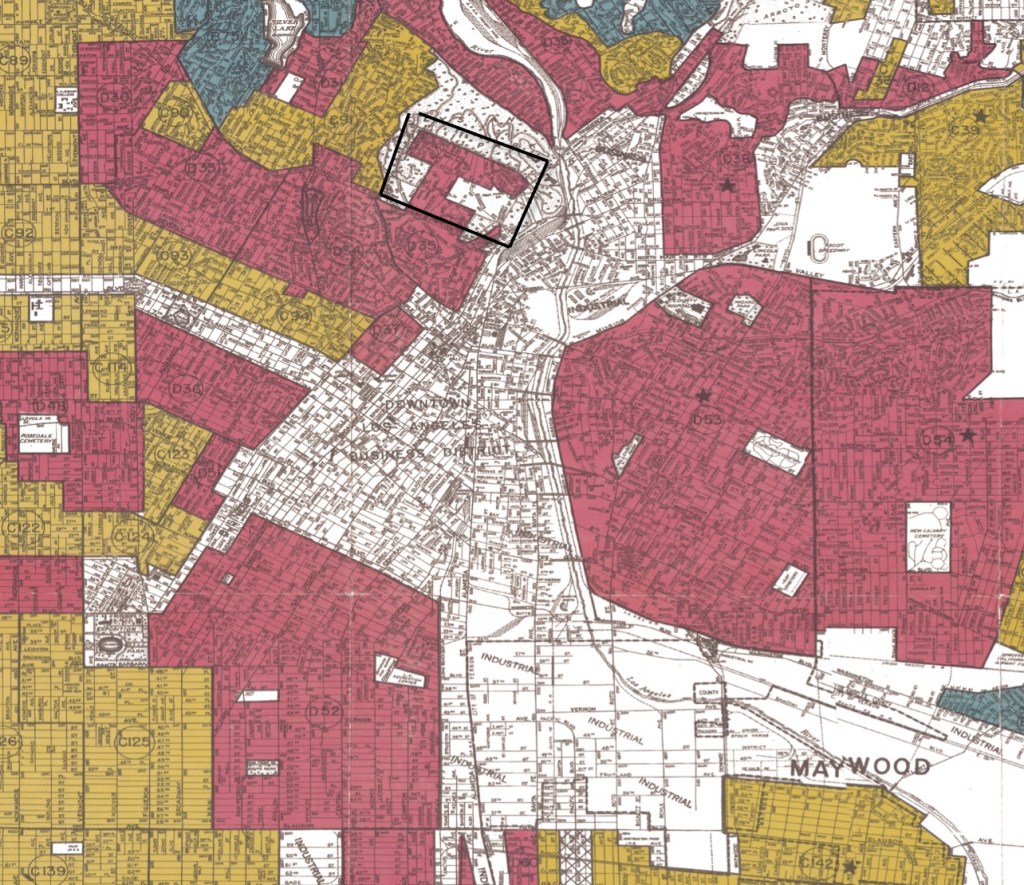
First of all, by implicating the Home Owners Loan Corporation, Callaghan is attempting to talk about redlining. However, the HOLC in no way ever said “you aren’t allowed to live in the nice parts of town” or “you can only buy property in areas marked red.” The famous HOLC maps, made between 1935 and 1940 as a government project courtesy Franklin Roosevelt, were produced to gauge lending risk and creditworthiness. These maps indicated to the HOLC where it would, or wouldn’t, be prudent to refinance loans or issue insurance. Let’s look at one:
The area with the black square is Chavez Ravine. The white area represents mostly apartments, or commercial, so, not applicable. The red area is “risky” and yellow “declining” ergo, marked as risky for loan refinance. And while the notes in the government maps sometimes contained racist language (“subject area declining due to preponderance of foreign families” etc.) note that Bunker Hill, majority Caucasian, is redlined (in fact, the vast majority of US citizens “redlined” were white). Also, while redlining assessed lending risk and creditworthiness, evidence shows the HOLC did in fact loan heavily in red-shaded areas.
A common claim about the Chavez Ravine evictions is “when Chavez Residents lost their homes in the early 1950s they had no where to go and couldn’t buy anywhere because of redlining” but that’s not true: the HOLC ceased operations in early 1949. Ironically, the major effect of redlining was—due to the difficulty securing financing in “depressed” areas—those areas were unable to gentrify. So now, when someone says gentrification is evil, tell them they’d benefit from some Roosevelt-style redlining!
Restrictive covenants, on the other hand, were exclusionary CCR (Covenants, Conditions, & Restrictions) agreements either added by developers to subdivisions, or added by residents to their neighborhoods, which limited home sales to white-race only. No-one has ever made a map of where these were, or when they expired (the majority of these CCRs were established about 1905, and had a twenty-year sunset period). These absolutely existed in some Los Angeles neighborhoods (I have material relating to them in my collection) and as odious as they were, it’s important to remember CCRs applied to a small number of people, in a large city where the vast majority of its neighborhoods was unencumbered by color restrictions. So, until someone can produce a map of where the covenants were and what their respective CCRs said, the assertion that People of Color (who made up only about 10% of the population of Los Angeles in the interbellum period) were forced into ghettos because of exclusionary subdivision language is an unproven allegation. (I am aware of Laura Redford’s work, and her contention that “half” of Los Angeles was under racial deed covenants, but have yet to study her data.)
And similar to the claim about Chavez Ravine and redlining, a common claim about the Chavez Ravine evictions is “when Chavez Residents lost their homes in the early 1950s they had no where to go and couldn’t buy anywhere because of restrictions” it’s important to remember, covenants were made locally illegal in 1945, and federally illegal in 1948.
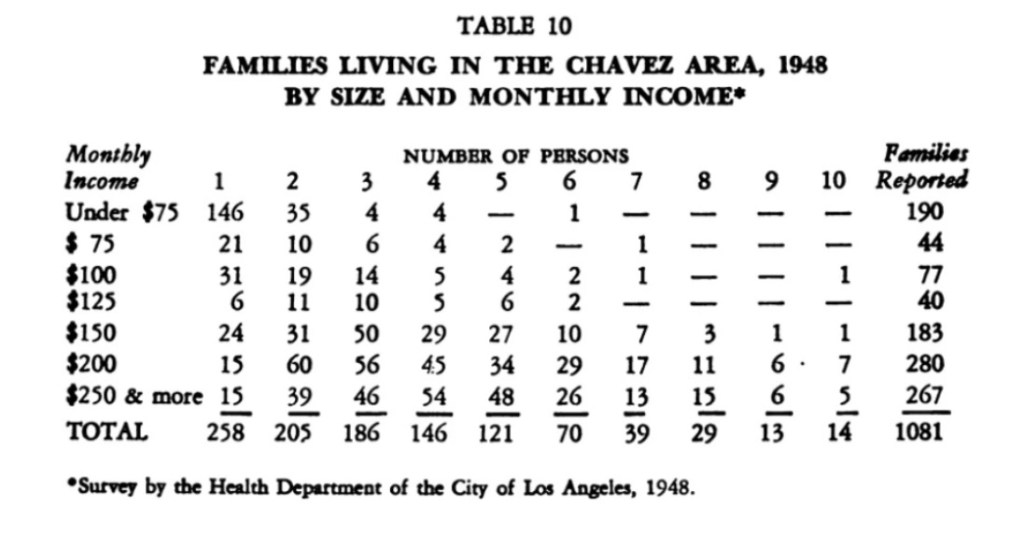
11:27“by 1950, 1,100 families called the area home”Nope. The famous “1,100 families” concept comes from this Health Department graph:
As seen on page 47 of Rebuilding a City: A Study of Redevelopment Problems in Los Angeles, 1951
What’s at issue here is, what do they mean by “the Chavez Area?” This Health Department survey was 372 acres. However, the number of acres for the post-1950 Chavez Ravine redevelopment area was 315. The other 57 acres included Solano Canyon, which was densely populated (and still exists) and, as I understand it, the Alpine neighborhood (also extant). Therefore, the 1,081 number is very much inflated with neighborhoods and families that were never threatened by redevelopment.
Because if you actually count the number of structures (aerial views, insurance maps, etc.) in La Loma, Palo Verde, and Bishop? There’s about 250 residential structures, the vast majority of which being single family homes. Thus, the traditional referral to Chavez Ravine having 300 households is likely accurate (“household” including single people too) thus making the actual number of displaced people perhaps as high as 1,100 — but not, under any circumstances “1,100 families.” (What’s funny is, even with “1,100 families” a vast overstatement, you’ve got people like Councilmember Wendy Carrillo telling you it was “more than 1,800 families” which is patently ludicrous.)
12:27 “(Men going to war) lead to mild structural decay like plant overgrowth. That was enough for the Housing Authority to declare these three communities blighted” What?Ha ha ha, that’s an instant classic, “mild structural decay like plant overgrowth.“
Now let’s get to the “mild structural decay like plant overgrowth” (that’s so precious I can’t stop repeating it). First of all, the Health Department was not the Housing Authority. You apostles of Regime Narrative will screech “the Housing Authority invented all this stuff about blight, to steal the land!” but that determination was made by the Health Department, who didn’t have a dog in the fight. Let’s look at some of the things the Department of Health found, when they did a door-to-door study in 1948:
Though 2/3rds of Chavez Ravine’s structures had been built after 1920, 55% were of legally substandard construction, and considerably deteriorated. Most structures built on steep hillsides had inadequate foundations. Many of the dwellings were borderline habitations, with people living in tiny one room shacks, chicken coops, sheds not meant for human habitation, tents, and shelters made of packing boxes. 390 units were without a toilet, 377 had neither toilet nor bath, and almost half lacked any bathing facilities. There was no running water in 174 units. Wood was used for cooking and heating in many units. Tuberculosis cases were twice the city average. Hey, tell me again about mild structural decay like plant overgrowth!
12:56“in 1951 they received notices, threatening them, if you don’t sell your home, we’ll condemn it and you’ll get nothing” WOW. No, that’s literally completely made up. As regards “receiving notices,” Mr. Montalvo is referring to the July 1950 letter delivered to every household:
Notice what you don’t see—threats saying “if you don’t sell your home, we’ll condemn it and you’ll get nothing.”
“Let‘s be needlessly, brazenly cruel, and openly cheat the poor” is a bizarre fantasy because the Housing Authority was a progressive leftist group, that had had a ton of federal money dropped in their lap. So the narrative is, these leftists want to screw impoverished homeowners? By withholding lots of taxpayer money they were legally bound to disperse? Consider: the guy who signed the letter, Sidney Green, was a Communist Party member. The man who delivered the letter, Frank Wilkinson, was a Communist Party member. (Green and Wilkinson were both fired for being Party members, two years later.) Communist Party members who worked hard to take your Chavez homes included Housing Authority employees Adena J. Williamson, Jack Naiditch, and Elizabeth L. Smith; other likely but unproven Party members in the Housing Authority were Sarah Fefferman, Ruth Johnson, Jessie L. Perry, Fay Kovner, Hy L. Sunshine, Dorothy Foster, and Carol Andree.
Anyway, leaving aside the improbability of leftists, people of color, and Peoples World-reading Hebrews (by the way, wanna see some of the actual people who took the Chavez homes? wanna see the actual face(s) of L.A. Housing Authority’s “white settler colonial imperialism?” well here you go) feeling an overpowering need to screw the poor, it would have been impossible to do so by law. Los Angeles had previously removed large groups of people — dozens of times — for housing projects, and each time, there were federal, state, and city laws that had to be adhered to. The courts were involved every step of the way. When a property is taken from a person, they are paid “the highest price the land can bring if exposed for sale in the open market.”
Daily News, August 9, 1950
In short, redevelopment law is very clear cut and redevelopment agencies were under intense scrutiny, up to and including the May 1953 month-long investigation of LA public housing by a House of Representatives Subcommittee, where none of the Ravine resident testimony mentioned anything about “threatening notices saying you’ll get nothing.” If there had been any funny business withholding federal funds, that would have brought the FBI down on the Housing Authority. And that didn’t happen, did it?
13:10“at least 75% of the community resisted for the next three years” Well of course some people did, so would I and so would you. I only want to comment on this because it’s important to remember why they resisted. Residents wanted to keep their homes and have fresh air and chickens, and not be put into a concrete filing cabinet, that’s obvious, but remember, too: in 1951 the attorney for the Chavez Ravine families, at a hearing before the City Planning commissioners, attacked the Elysian Park Heights housing proposal as the “cancer of socialism.” Manuel and Agnes Cerda, who lived on Effie and ran the information office for other Chavez Ravine residents fighting the City, denounced the Housing Authority as un-American, and, said Manuel, “they didn’t want to be socialized.” The people of Chavez Ravine proudly spat squarely in the face of progressive-left Mexican-American civic organizations, like the Asociación Nacional México-Americana, and El Congresso, who were pro-public housing.
This underscores a fundamental fact in the tale of Chavez Ravine: the conservatives are the good guys. That statement makes folk clutch their pearls, but it’s absolutely true. Consider: many residents of Chavez Ravine had abandoned their home nations in search of America, yearning for Americanism. They were conservatives because they wanted to conserve their way of life, and felt pride in American homeownership. The bad guys are, however, were the liberal progressives: public housing was pure New Deal social engineering. Left-technocrat “planners” have always been eager to blueprint top-down collectivism and, then as now, forever demonize the singe-family home.
13:34“somehow, someway, a real estate company hired a PR firm to run negative stories about the Elysian Park Heights building, calling it a ‘socialist communist experiment'” This is stupidly untrue. If it’s not, go ahead and name the real estate company, or name the PR firm. Better yet, just show me one of these “negative stories” — because the only time anyone in the 1950s called something a “socialist communist experiment,” it was New York Congressman Ralph Gwinn in 1954, referring to the TVA.
13:50-14:50 Here Callaghan talks about the incoming Dodgers. Something about how the Dodgers were in a rivalry with the Yankees, which might be true, but has no bearing on the story of Chavez Ravine. Why did they move out of Brooklyn? After all, the Dodgers owner Walter O’Malley attempted, valiantly, for years, to stay in Brooklyn. O’Malley was, however, opposed by master builder/power broker Robert Moses.
Callaghan then links the Dodgers to Chavez Ravine. In doing so, of course, Callaghan neglects to mention that the Elysian Park Heights housing project was cancelled because the City Council, and then the voters of Los Angeles, and then the Mayor, in that order, told the federal government they wanted no more of any public housing project. Callaghan further neglects to mention that then the land sat empty for five years, while the city tried to find a use for it — music center? cemetery? zoo? lake? until presented with the opportunity to have a rich guy build a 56,000 seat stadium on his own dime.
Lastly, when Callaghan says, at 14:40, “intoxicated by the idea of MLB investment, the city of LA decided to extend its eminent domain notices over the ravine,” that’s absolute nonsense. Not one single new eminent domain notice was ever sent because of the Dodgers. Every single Chavez “we’re taking your home!” notice was sent during the administration of liberal pro-housing mayor Fletcher Bowron; neither mayor Norris Poulson (shown in the video at 14:43 when Callaghan states, falsely, “LAdecided to extend its eminent domain notices“) nor the Dodgers are to blame for that.
14:51 “and it was only until 1959, when they forced most of the families out, there were probably about twenty families left in 1959 when they came in, that they call today now Black Friday, where they were forcefully displaced by the sheriffs” Nope. On May 8, 1959, there was one family forcibly removed, not twenty, hell, not even two. With all the photographers and reporters and TV cameramen there, how is it the only family we see removed is the Arechiga family? Incredibly, no-one (especially journalists) has ever thought to ask “hey, how come there’s no documentation regarding all the other people whose homes were demolished on Black Friday, but there’s a million photographs and articles about the Arechigas?“
Despite no-one ever having asked this question, I’m going to answer it anyway. Let’s look at exactly who was still in Chavez Ravine in May 1959.
First let’s tackle the tale of “Most Famous Chavez Residents of May 1959” Mr. & Mrs. Manuel and Abrana Arechiga. Their story, in brief — Manuel Arecghiga owned two houses: 1771 Malvina Ave. (450sf, built in the 1930s, where he and Abrana lived), and 1767 Malvina Ave. (784sf, built in 1923, where daughter Victoria lived with her husband Mike) and, despite what you are told, Manuel built neither structure. The Arechigas had owned another house, at 1801 Malvina, which they tore down themselves for reasons unknown.
After the famous HACLA letter of July 1950, Manuel was offered $10,050 for the property. But someone, we don’t know who, told the Arechigas their property was worth $17,500. The Arechigas were more than willing to leave; they just wanted that extra seven grand (they even made signs that said so). Here’s the thing: if you didn’t like the remuneration you were offered by the court, you filed an appeal. Lots of Arechiga neighbors filed appeals and got more money. But the Arechigas just decided not to, and the appeal window closed in February 1953, thereby indicating a tacit and legal acceptance of the city’s offer, which meant the Authority now owned their property free and clear.
But eight months later, in October 1953, Manuel Arechiga filed suit in Superior Court against the Housing Authority. In return the Housing Authority obtained a Writ of Possession, which meant that not only did the city own the houses legally, a court order existed directing law enforcement to evict residents there and then. However, the Arechiga attorney secured the Arechigas a 30-day stay, which stretched out for years of legal battling. Ultimately the District Court of Appeals ruled against the Arechigas in 1957. The Sheriff Deputies finally arrived in August 1957 and hauled out all their belongings. But Councilman Roybal intervened, and everything got put back; this two-week stay on the eviction stretched out into a couple more years. Manuel Arechiga keeps battling in court, but the case is struck down once and for all by the appellate court in April 1958. In March 1959 the Arechigas are told pack up your stuff, we will be there to remove you—from the house you have not legally owned for six years—on April 10th. Of course, their lawyer gets another delay, so the new date was set for May 08. Which became the famous Black Friday we now hear so much about (people often mention how the city was cruel to do this on Mother’s Day weekend, but, that was completely orchestrated by the Arechigas, or at least by their lawyer).
People get some funny ideas about who the Arechigas were, how many of them lived in Chavez Ravine, and how they become “homeless” in 1959. So, I made y’all this:
Besides the Arechiga family, there were three women who walked away from Chavez Ravine on May 8th 1959: Alice Martin, 1456 Davis, whose house, built by her husband John G. Martin in 1924, she bought back from the city for $2500 on condition it be moved, and Alice departed that day without incident. Sally Ramirez, 1850 Reposa, is a mystery — despite the dozens of newspaper articles printed about the event, there’s only a single newspaper mention of her, and 1850 Reposa left no paper trail at Department of Building and Safety, and as such was likely illegal, and in any event, she also left without incident. Film and television actress Glen Forestine Walters, of 1853 Reposa, left her home on her own terms, though she was charged with obstruction in the Arechiga removal. Walters is an interesting character: like the Arechigas, she also owned multiple homes around town. In 1951, for example, she moved her house at 2601 Riverside to 2429 Forney Street, and opened a trailer park. She moved another of her houses, from 2902 Worthen, to the Forney Street trailer park in 1953. (This was a RESTRICTED trailer park. Gasp! you say, restricted to exclude who?? In a world where residential complexes often had a “no pets allowed” policy, you were not able to take up residence in Glen Walter’s trailer park unless you had a pet! Glen Walters is my spirit animal.) Walters had a string of bad luck with her homes; her house at 534 Fenn Street was heavily damaged when struck by lightning in 1967, and then it burned to the ground in 1975. (Oh, and see Glenn Walters act in a 60s western by clicking here.)
Then there were the other folk who owned houses during (and after) the Arechiga removal: Ramon Contreras, Francisco de Leon, Charlotte Hansen, Regugio Nava, Francis Scott, John Chaffino, Luis Lopez, Manuel Corronza, Regina Carrillo, Louis Longoria, and Remigo Nila. They were still there in May 1959. Why didn’t the deputies kick down their doors? Because unlike the Arechigas, those folk actually followed the appeals process. All those houses were still standing in February 1960 when the Dodgers paid those homeowners quite handsomely for them, many times more than the City condemnation offers had been. Why didn’t the Arechigas just go that route? We’ll never know.
15:02“from the stories that my mother has shared with me, who was there, and a young kid, she shared that she was very frightened, that it was scary, that they had put her on a little chair, on the backside of the door, with a little cup of hot chocolate. My grandfather had told her don’t move, sit there, and so they’re kicking in the door, all the cops and everything, everyone is coming in, the cameramen, and so they drag them out, they drag out my aunt, my mom ends up being in the police car with my aunt, they take them up to the hill to kind of separate everybody, to kind of calm things down, because it had gotten kind of crazy, with my grandmother throwing rocks. My mom shared with me that when they took her up to the hill with my tía, that they ended up beating my tía in front of my mother, so she watched, as the cops beat my aunt.”Ugh. Okay, there’s a lot to unpack here. First, let’s delineate our cast of characters: this is Melissa Arechiga speaking, co-founder of Buried Under the Blue. Her mother is Jeannie Arechiga, daughter of Juan and Nellie Arechiga; Juan is the son of Manuel and Abrana. Jeannie’s tía is Aurora Arechiga Vargas, daughter of Manuel and Abrana. Got it?
So: Juan and Nellie didn’t live in Chavez Ravine. They lived three miles away, on Benedict Street. Their daughter Jeannie — born on September 21, 1955 — was 3+½ years old in May 1959. Her parents decided it was a good idea to pick up a preschool-age girl, drive her to her grandparent’s house, and plop her into the middle of a violent confrontation. Not only that, they put her in front of the door they knew deputies were going to kick in. She was told “don’t move, sit there” as the door splintered open and yelling cops and cameramen came thundering in. In the Buried Under the Blue bio (see a snippet here) they write “This experience left a lasting impression on Jeannie’s young mind and continues to affect her mental health and well being.” Yeah, do ya think? Funny, that could have been avoided if you’d let the 3+½ year-old girl stay at home and watch Romper Room instead of picking her up and taking her into the maelstrom just so she could be photographed:
“Jeannie Arechiga was at Eviction Day” is a fact — it’s disturbing child abuse, sure, but at least it’s fact. But then, the obvious untruths creep up: according to Melissa Arechiga, her then-three-year-old mother ends up in the police car with her aunt, Aurora “Lola” Vargas (the one made famous as the woman who drove from her home miles away, to go to Chavez Ravine — arriving after the deputies and TV cameras had in Chavez Ravine — and ran up into her parents’ house, just so she could be carried out). However, because of the massive media presence, we actually know who was put in the car with Aurora Vargas: the aforementioned Glenn Walters, whom you’ll remember I said was charged with obstruction.
Lincoln Heights Bulletin-News, May 10 1959
Soooooooo, this was an exceptionally, heavily documented event. If the cops had tossed a three-year-old-little-girl into a police car, then that would have been the photo plastered all over the newspapers and television, not the carrying out of Aurora. Oh, and then — we’re now told — the cops beat Aurora in front of the preschool-age girl, which the newsmen didn’t think was newsworthy, and which neither Aurora nor her lawyers mentioned at trial, nor has it ever been mentioned…ever…in the last 65 years. Huh. Usually Melissa Arechiga just tells the sandwich story. Cops beating a war widow in front of a little girl is something the Arechigas have omitted from the tale the last 1,000 tellings—heck, they failed to mention it to the New York Times—I guess NYT aren’t mainstream media enough for Buried Under the Blue, and were waiting for the outlet that would guarantee them nearly one million views.
16:19“after the forced evictions, most residents either became homeless or had to move to other parts of LA with pennies to their name” Except that’s not true. Assuming Callaghan is talking about the forced evictions of May 1959, when the “most residents” were just the Arechiga family, guess what, they simply moved into all the other houses they owned. Manuel and Abrana, who owned both Chavez Ravine houses that were seized that day, at first attempted to pretend they were homeless, and when it was discovered they owned two houses outside of Chavez Ravine, they gave up pretending and just went to one of their other houses.
Sometimes people will say “no, they didn’t really own a house, it was owned by, like, a cousin or something,” but that’s bullshit. Manuel Arechiga, patriarch of the clan, had purchased a just-constructed house in 1956, 3649 Ramboz Drive in City Terrace. It cost $8,500, and by May 1959 the Arechigas had already paid off more than half their mortgage; that’s where they went in 1959, ergo, here they are there in the 1960 phonebook. Then also owned outright another house at 2410 Glover Place, where Abrana’s daughter Delphina lived. I won’t even go into the fact that Aurora owned two houses, John owned two houses, and Victoria owned three houses! Heck, even daughter Celia, whom you never hear about, owned her own house.
At which point you say “yeah well the Arechigas owned lots of houses not in Chavez Ravine, but…what about all the other people in Chavez Ravine! They were totally made penniless and homeless!”No. The courts mandated you had to be paid and paid well, and to boot, there was a relocation office set up in Chavez Ravine. If you were a renter, you didn’t leave until they’d found you new digs (the woman who ran the relocation office, Victoria Alonzo, was fresh off of relocating all the people removed for the Civic Center expansion north of Bunker Hill). If you’d sold your home, the relocation office helped find a new one. That was, after all, the law. Los Angeles had been removing people for decades to build public housing projects, civic structures, freeways, etc. — we were quite well versed in just compensation and relocation assistance. It’s not rocket science, and yet, people always argue the Chavez Ravine project was somehow the onlyone where, for some absolutely unknown reason, we decided to cheat the poor, beat them, and disperse them into a void of misery, poverty, and death.
16:36“in a sadistic act of 5D chess, not all of the homes were demolished…some were physically moved to more affluent areas and marketed for their rustic charm” Um, source? While there are a couple of instances of homeowners moving their own homes onto lots in other areas of the city…there was no subsequent “marketing,” least of all “sadistic” marketing. But then it goes on to say:
16:45“or sold to movie studios in the Valley… Universal Studios also has some on their set…they used, what was that movie, To Kill a Mockingbird? To Kill a Mockingbird. The house that Finch was in, that was from Palo Verde.”Nope. This is one of most oft-repeated fantasies (Buried Under the Blue has also claimed that film was shot in Chavez Ravine). I mean, aren’t we constantly told that the “last houses in Chavez Ravine” were demolished in May 1959? To Kill a Mockingbird, the book, didn’t even come out until July 1960!
Fact is, there were other houses still in the Ravine post-May 1959, for which the Dodgers paid handsomely. Those houses were demolished in February 1960, still well before the publication of To Kill a Mockingbird. Preproduction for the movie version of TKaM began in October 1961—long after every last home had vanished from Chavez Ravine, making it impossible for them to source houses from the ravine in advance of the start of filming in April 1962 (coincidentally, the same month Dodger Stadium had its opening day).
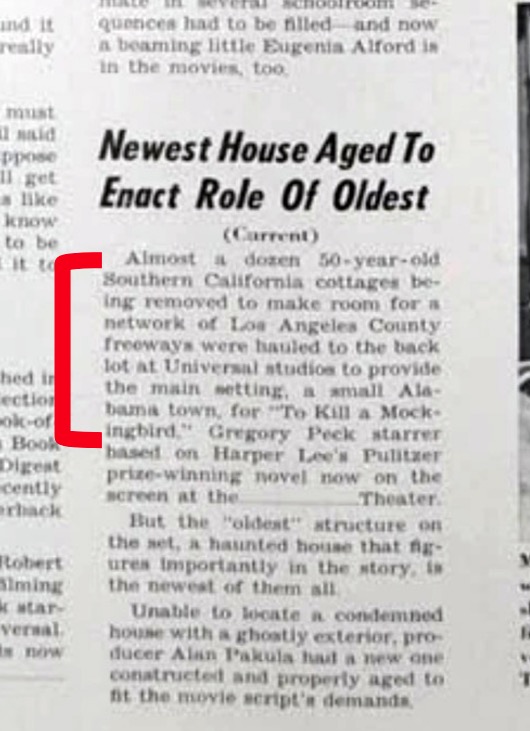
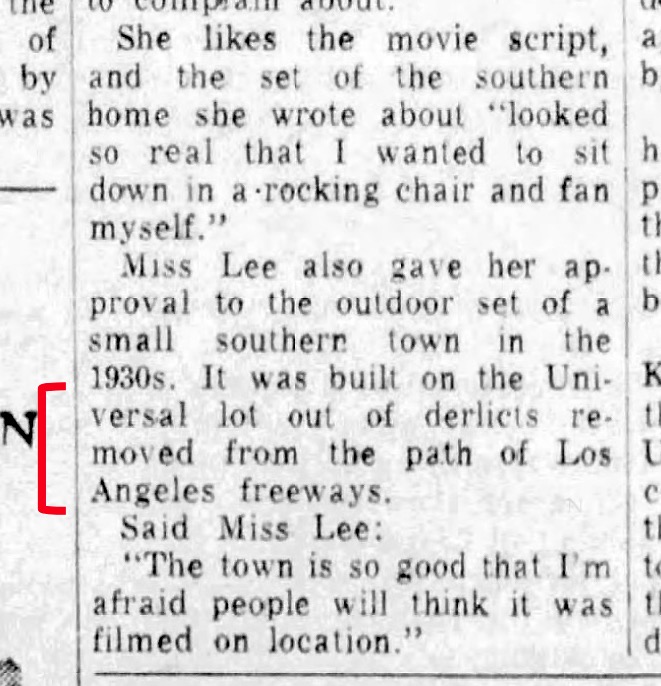
Sure, we have a couple internet randos claiming Chavez Ravine homes were moved to the Mockingbird set, but when that’s claimed, there’s never a citation, no actual primary source, no attribution, no evidence. That’s because it never happened. TKaM’s production designer Henry Bumstead did get some old L.A. houses, to be sure…houses that had been condemned, being in the path of freeway construction.
Let’s take a look at some Mockingbird presskits, issued for the December 1962 movie release, which state the houses were sourced via freeway construction:
Here’s another presskit article stating, again, that the houses had been sourced from freeway construction:
Hell, it even made the newspapers:
The Sun Times, February 09, 1962
Remember, the construction of Dodger Stadium was a huge deal, and an enormous source of civic pride. Leaving aside the actual physical impossibility of Universal getting “Palo Verde houses” in late 1961, had they actually magically done so, it would have been a nifty human interest story in the papers and for the presskits to talk about houses sourced from the Dodger Stadium site.
Not only that, but production designer Henry Bumstead himself said in Andrew Horton’s Henry Bumstead and the World of Hollywood Art Direction:
The Bumstead papers are at the Margaret Herrick Library, and in one of his letters to Mockingbird‘s producer Allan J. Pakula, he refers to the structures they had sourced as “the freeway houses”—
What’s annoying is that here we have some people just making up stuff, and nearly a million people have been taken in by this poorly-concocted twaddle. Among the 180,000 comments are lots like this one:
This is why people tell lies — to get these people worked up. Sigh
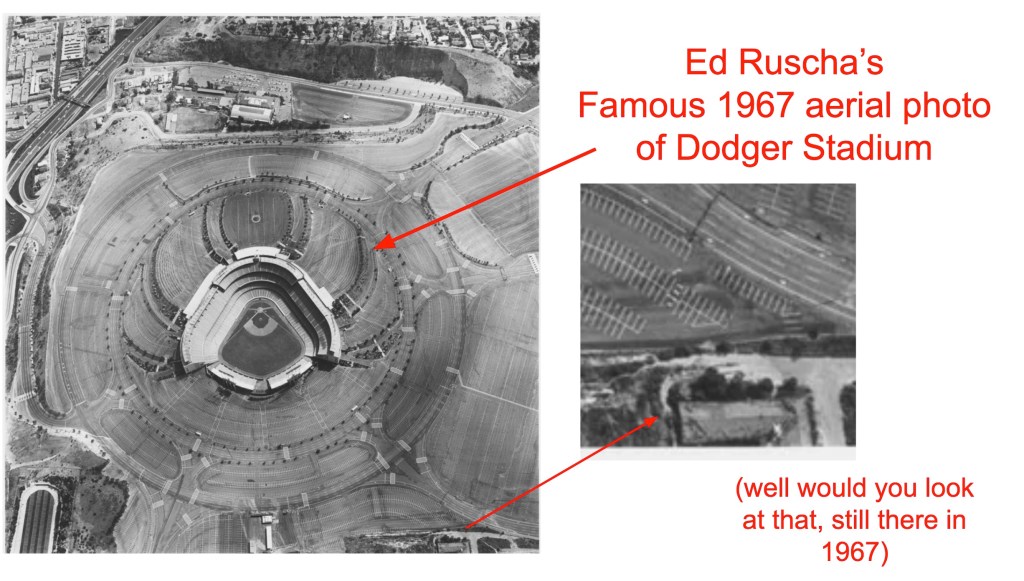
17:08“as far as the homes that remained, most were replaced by mounds of dirt, but others were replaced by the baseball field itself”Nope. Not a single home is under the baseball field. Not one. Zero. This is not an arguable point. If anyone ever says this to you, remember, nothing they say afterwards is worth listening to. For the millionth time, people, the baseball field was built on the old site of a brick factory. Click here. See where it says “closed brick factory?”That’s where the stadium was built. (Click here and here.) Were Palo Verde and La Loma demolished? Did about half their former site become parking lot? Sure, nobody’s arguing that. It might seem like splitting hairs — because one way or another, the communities are gone — but the point is, the continual drumbeat of “houses were where third base is now!” is a consciously deceitful lie attempting to mislead and emotionalize people.
17:10 “from third base on, the school was there. And then from third base to second all the way to the pavilion seats there were houses going up the ridge there…that was a school on third base? Yeah that was a school on third base, all they did was take the roof off and they threw the dirt in, its still there today.” Oh lord, this again. It’s so easily disprovable it’s kind of embarrassing. I have no idea who first made up this story but it’s super annoying, because it’s so very, very stupid.
The Palo Verde School at 1029 Effie was built in 1923, designed by Pierpont & Davis in Institutional Spanish Colonial. It looked like this:
Then, if you believe the dominant narrative, it was “buried.” It was buried, according to Melissa Arechiga, because we were hoping to bury your people, be done with you, so you’d forget who you were because that’s just our colonizer corporation legacy behavior.:
Uh-huuuh.
Only (apart from the obvious fact there’s no alternate universe where Building & Safety’s civil engineers would allow anyone to backfill into standing walls) the school wasn’t buried. It wasn’t buried because the Dodgers wanted to keep it. They used it, mostly for storage, all the way until about 1967, when it was demolished. Look:
Above, there’s the school in 1962 co-existing with the stadium. At right, an aerial from 1972. Look closely: notice the sloping dirt rising up on three sides of the school in 1962, and all that dirt is in exactly the same place in 1972; there’s no-where for dirt to have come from to bury the school. Notice the level of the roadways and parking lot in front of the school in 1962, and, its site is at the same damn topographical level in 1972.
Pay attention: the land on which the school sat, from 1923 till the mid-60s, was at 535 feet above sea level. The present parking lot site — where the school stood — is at…535 feet above sea level. Therefore, not buried. Seriously, if one more person mentions this absolutely idiotic “buried school” crap I’m gonna throw something. (Amusingly, Buried Under the Blue literally named themselves after something ridiculously false.)
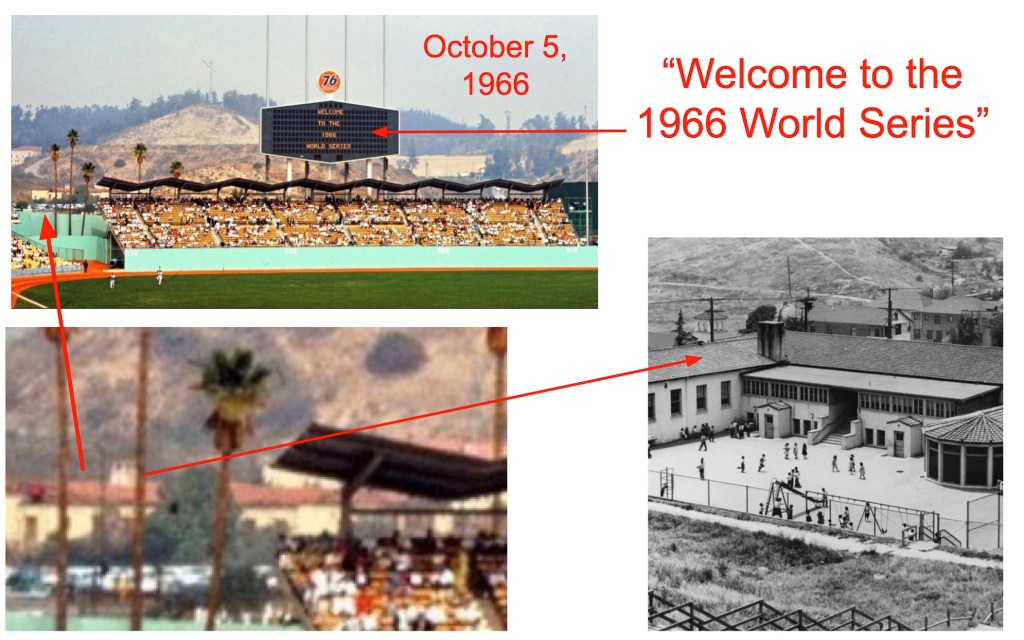
Though I’m uncertain as to when, exactly, the school was demolished, we do know that it exists in a mid-1964 aerial and is gone in another from early 1968.
Well, and look at that, not anywhere near “third base”.Framefinder flights C_5040B, C-24801, and TG_2400Left, 1964; center, 1968; right, today. Note that the school is on level with the parking lot, and that land is still level with the parking lot. Case closed.Well look, you can literally see it from the stadium in late 1966. From here.Golly, there in 1967.
17:32 “there was a cemetery too, that’s why they say Dodger Stadium is haunted” NO. Just, god, you think you’d quit while you’re behind, but you just had to add one more thing…
First of all there were two cemeteries nearby…but neither were near Palo Verde/Bishop/La Loma and neither were near nor impacted by the construction of Dodger Stadium. Calvary Cemetery, to the southeast of Chavez Ravine, had its dead disinterred, and then reinterred at New Calvary, in 1896; old Calvary is now the site of Cathedral High School (which is why they are called The Phantoms). And a Jewish cemetery was south of Chavez Ravine, the other side of Lilac Terrace—but the Hebrew Benevolent Society removed their dead (reinterred at Home of Peace in Whittier) by 1910, which is before the communities of Chavez Ravine even existed.
***************
And that, my friends, is my long n’ involved point-by-point debunking of so many silly stories told by Big Media.
You might be asking, dude, why do you care, and more importantly, why should I care? Well, because truth is important. More to the point, telling untruths is bad, and snowballs into more bad things. Let me give you a recent example:
In May 2021, up in Canada, the Tk’emlúps te Secwépemc First Nation band announced it had discovered a mass grave — specifically, 215 unmarked graves of children— at the site of the former Kamloops Indian Residential School. This was repeated, unquestioned, by the media, most notably on the front page of the New York Times. The shocking announcement sparked international attention, prompting riots, memorials, and much government funding. The tribal band, which numbers 1,500 people, were given $8million, and another $3million for a death register, and $242million was given to an indigenous Residential Schools Missing Children Community Support Fund, with another $200million handed out to reconciliation initiatives, investigations, and activist groups. Almost immediately, many other tribes discovered their own mass graves of children. Indigenous organizations received further settlements, land deals, and political concessions based on the allegations. Statues were toppled across Canada (e.g. Queen Victoria, Egerton Ryerson, John Macdonald, etc.). Most notable was the rash of church burnings, and wave of hate crimes against Christians, including a 260% increase in hate crimes against Catholics. The church burnings (70+, with another 100 or so vandalized and desecrated) were called “understandable” by Trudeau, and the domestic terror wave against churches and Christians was treated as “justice”; church burnings were commonly cheered on by the media (e.g., here and here).
There’s just one problem, of course. It was a moral panic built on lies. It was a hoax: a financially and politically motivated scam. The last four years of searching have uncovered zero human remains, and the graves that were “definitely found” were only underground anomalies detected by ground-penetrating radar, later revealed to be the odd tree root or sewer line. Now, I don’t fault the Canadian government for paying out untold millions in “reconciliation” based on unverified and ultimately false claims, because governments love to do performative justice bows to extremist demands all the damn time. But I’m an architectural historian, and love old structures, and so it breaks my heart when lies result in the burning of, for example, St. Jean Baptiste in Morinville (1907); Sacred Heart, Penticton (1911); St. Paul’s Anglican, Gitwangak (1893); and Holy Trinity, Orlow (1898).
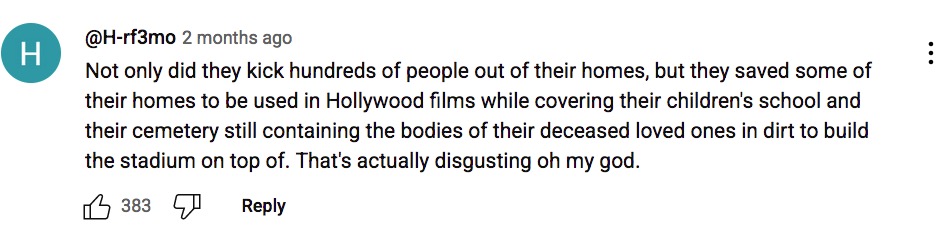
Which is ultimately the issue with the dominant Chavez Ravine narrative. You can get 887,000+ views if you peddle deceptive sophistry, which results in folks in full fits of righteous indignation, like this YouTube enjoyer:
— and it’s frustrating because everything “H-rf3mo” is upset about didn’t happen. This is how your birth people marching with torches, hot to “burn it all down.”
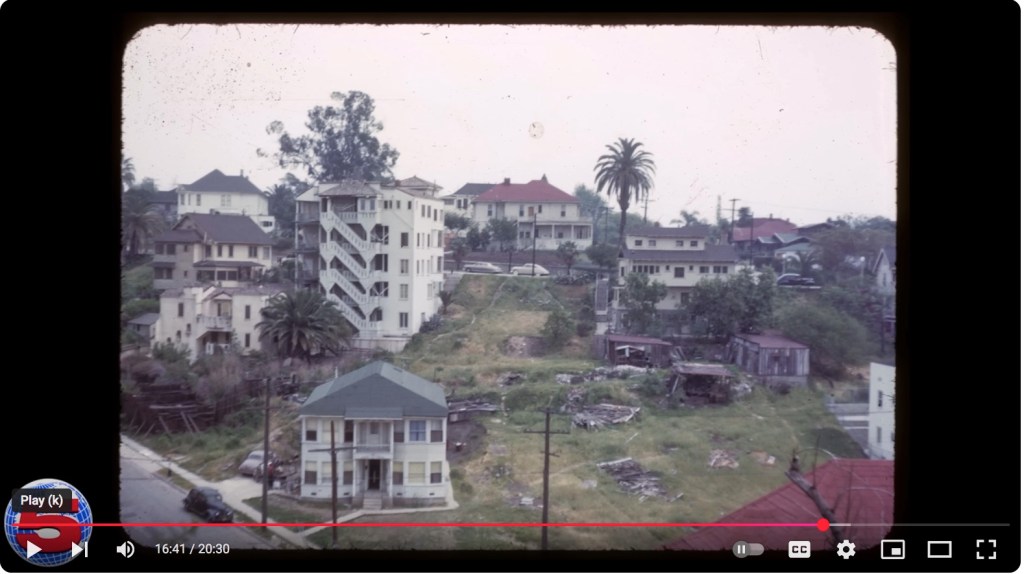
Damn, Channel 5, this isn’t even a photo of Chavez Ravine! That’s Angeleno Heights (click here)
************
Oh. One more thing.
Everything in Channel 5’s video is debunked nonsense, and you might say well, they had no way of knowing the truth, because who reads your meagerly-read blog posts anyway but, guess what, they knew my work well.
Channel 5 contacted me in December 2024 to ask if I’d be interested in being filmed for a piece about Dodger Stadium. I said count me in! and we set up the interview for a Saturday morning in Chavez Ravine — but they sent me a text the Friday afternoon before saying “sorry for the short notice but we have to cancel.”
I kind of forgot about the whole thing until their video was posted, and, wouldn’t you know it, they stole from me:
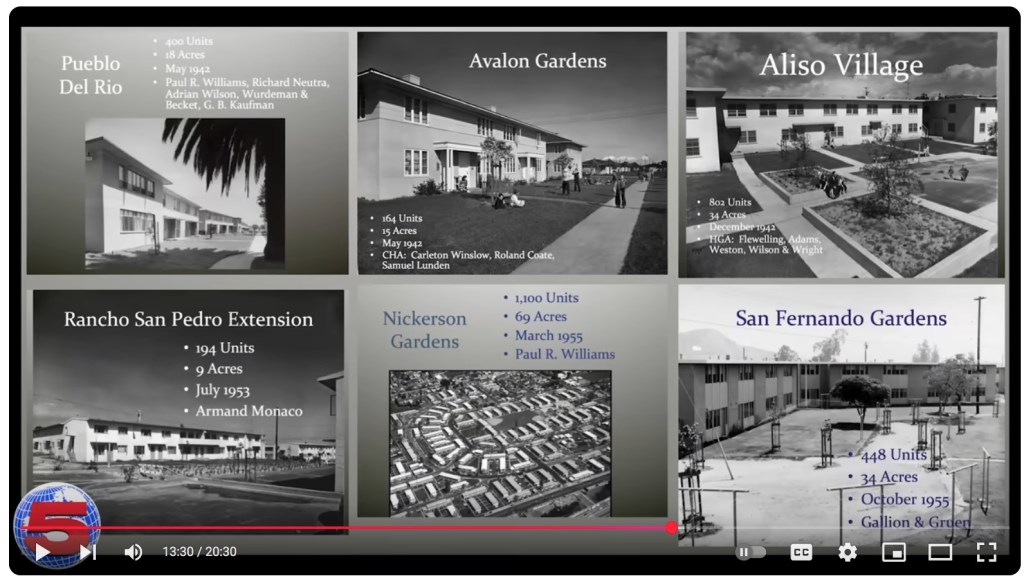
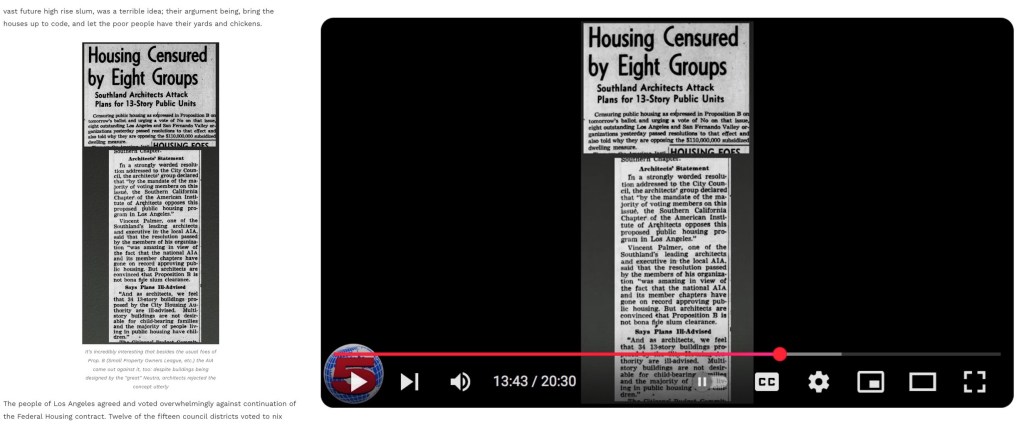
I put not a small amount of effort sourcing these images, putting them into Powerpoint, adding the text, making this image and posting it into this posta year agoAlso from this post…do I so much as get a thank you? You’re so very welcome, Channel 5!At left, I discuss how architects were against Proposition B. My work was screengrabbed and used, at right, as Callaghan is talking about how Elysian Park Heights was labeled communistic. So it’s doubly amusing that they stole my work, but then used screengrabs that didn’t even match to the stuff they were talking about. That…that takes talent.
Which is fascinating, because it means they’d read my work, and consciously, purposely decided to ignore everything I’d written, favoring instead a bunch of deceptive, misleading, specious tripe.
Authors on Architecture: Marsak on LA Before the Freeways SAH/SCC Zoom Presentation Sunday, May 04,2025, 01:00 PM
Join me via zoom this Sunday, as I talk the lost architectural landscape of our Victorian downtown. Click here!
LA Before the Freeways—Sunday, May 4, 2025; 1-2:30 PM Pacific; $5. Go to www.sahscc.org and pay via PayPal; or mail in order form on Page 6 with check; Zoom link sent upon registration. NOTE: Included is a link to the recording to view at your leisure.
************
The LAPL blog interviewed me all about the process involved in getting Hylen’s book into your hands, and along the way we discuss John Fante, Hunter S. Thompson, the Germs, and children’s book Andrew Henry’s Meadow. Check it out!
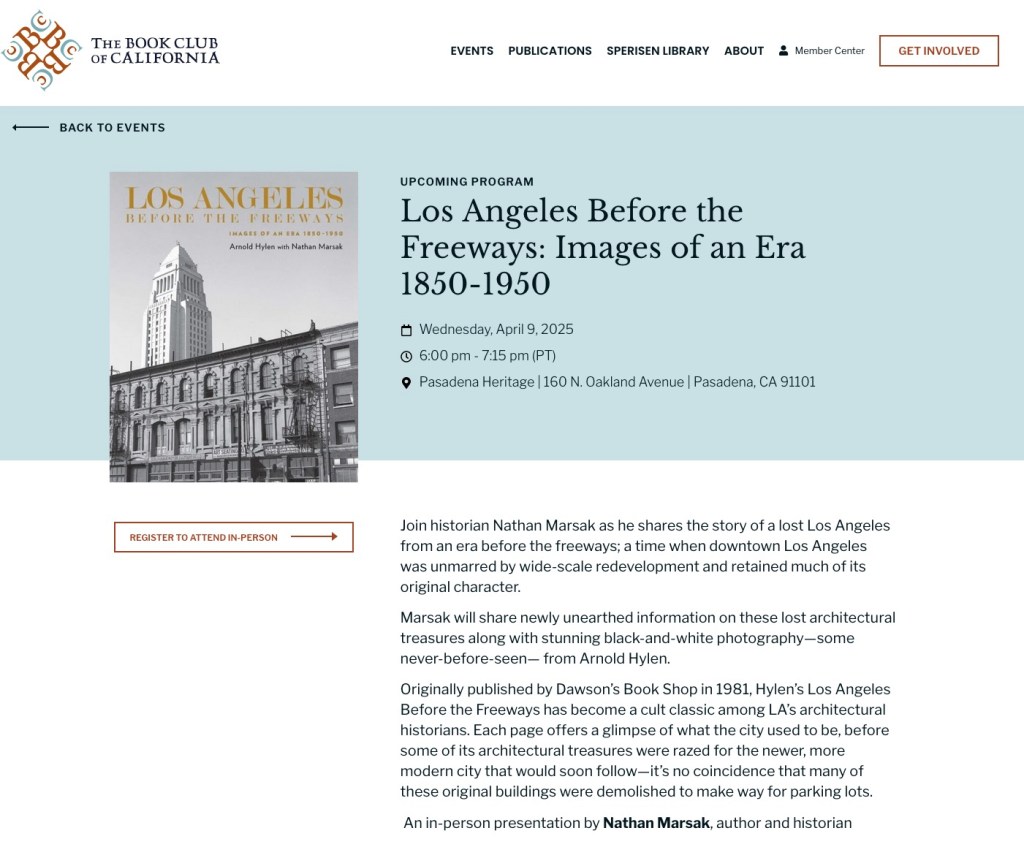
Postscript: we had a GREAT turnout! I want to heartily thank the Book Club of California, and the good folks at Pasadena Heritage.
Yammerin’ on about the influence of John Plant Gaynor’s Palace Hotel
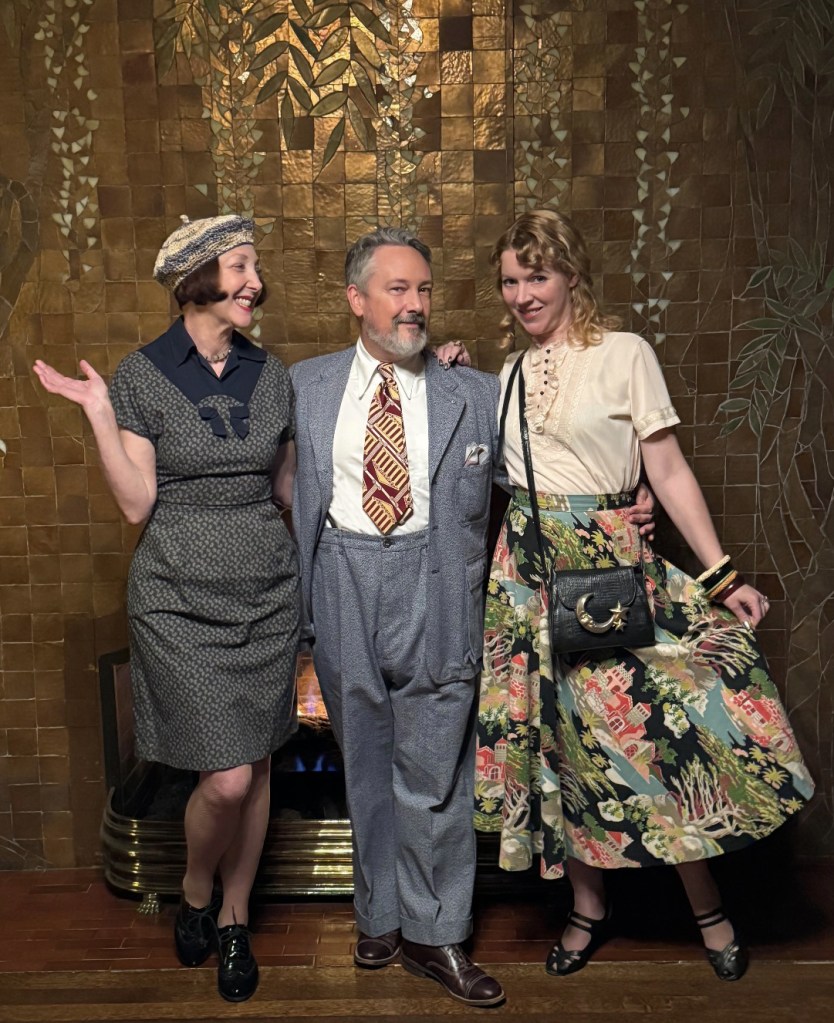
My lovely wife, and me, and the incredible Janet Klein, in front of the Blinn’s iridescent glass-tiled fireplace, designed by Orlando Gianinni of Chicago firm Giannini & Hilgart
I’ll be delivering an illustrated lecture about Arnold Hylen, his books, how I came to reprint Freeways, and take you on a visual tour of the architectural styles Hylen encountered on his long walks downtown (not to be confused with William Reagh’s long walks downtown, about which there is a wonderful book, appropriately titled A Long Walk Downtown, coincidentally published by…the Book Club of California).
Anyway, even if you’ve no interest in seeing me ramble excitedly about downtown’s few-that-survived-into-the-1950s Romanesque Revival structures, you should at least attend just to hang out in the Edmund Blinn house — recent article and video about the house, here and here — which is National Register, California Register of Historic Resources, and a Pasadena Cultural Landmark.
So you’re flipping through your copy of Los Angeles Before the Freewaysand thinking well, that’sa great old building, I wonder what’s there now?
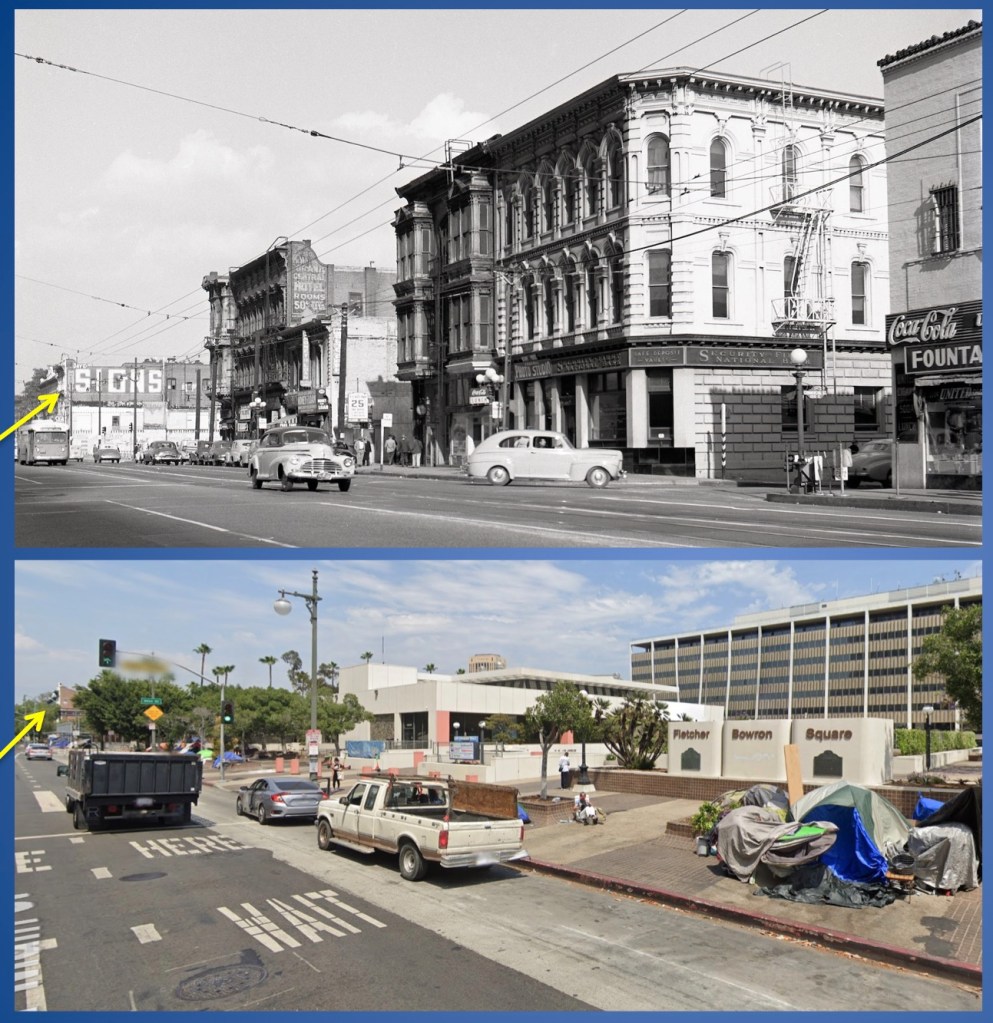
So, just for fun (if your idea of fun is a hefty dose of hiraeth) here are ten shots from Freeways, paired with a contemporary view:
Yellow arrow points to the Merced Theater at 420 North Main
ABOVE: Looking north on Main; most prominent is the Ducommon Block (Ezra Kysor, 1874) at Commercial Street. Security First demolished the structure in mid-1951 and replaced it with a modernist bank building by Austin, Field & Fry. That building was demolished in mid-1970, as was this stretch of Commercial Street, wiped away for the Los Angeles Mall. The Mall, best known for its Triforium, was designed by Stanton & Stockwell in 1968 and opened in December 1975.
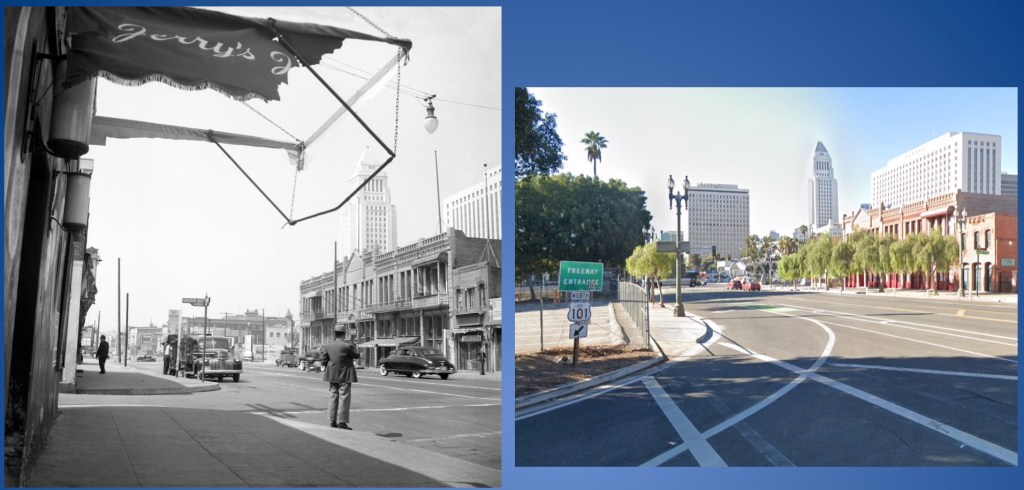
The signpost points east into Ferguson Alley, which is very much no more
The torn awning indicates Jerry’s Joynt (home of the world-famous Jade Lounge) — see views toward it by clicking here and here — now wiped away by a freeway entrance. Look closely and you can see how the south end of the Garnier Block was removed for freeway construction.
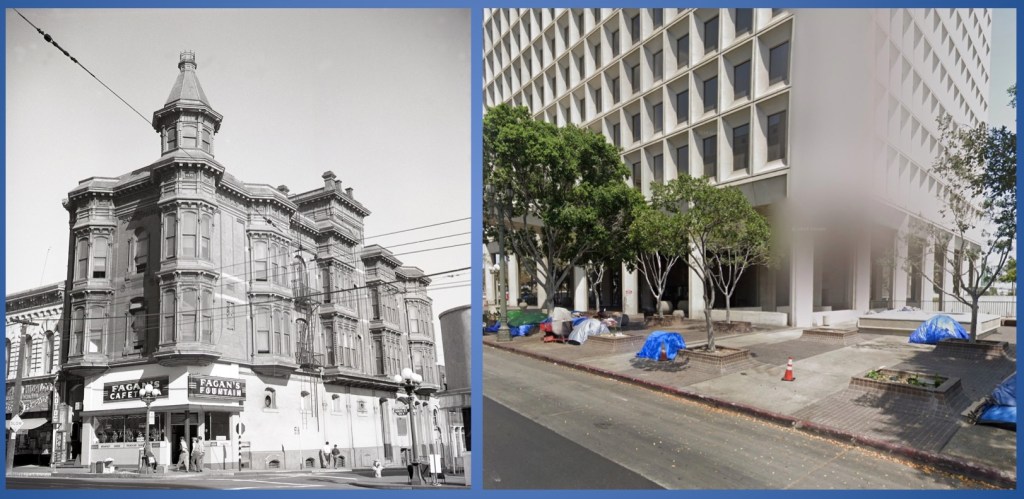
Looking at the northeast corner of Main and Market streets; the Amestoy Block (Adolph Charles Lutgens, 1888) was made a parking lot by the city in late 1958. Market Street was then wiped away in favor of Stanton and Stockwell’s City Hall East (1972).
Demolished by Benjamin C. Norton, who with his brother Melville ran Norton Bros. clothing manufacturers
Behold the Robarts Block (John Hall, 1888) at the corner of Seventh and Main, in 1950. It was demolished in 1958. Note how its neighbor the Cecil has reworked its sign from “$1.50 Monthly” to “Low Daily.” This is of course the signage that existed for decades before nogoodnik Matthew Baron painted it over.
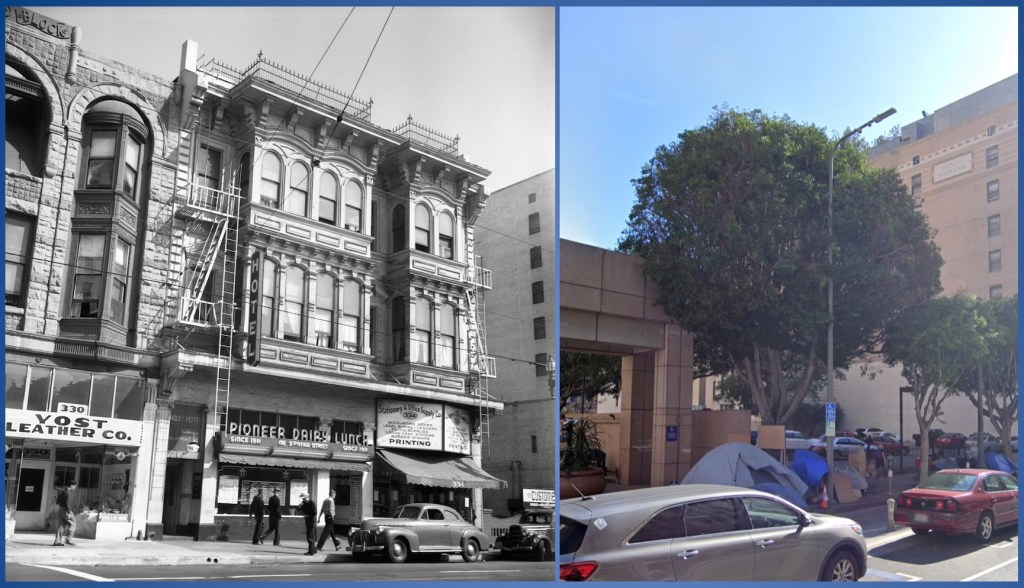
Want to know something embarrassing? In Freeways, the Cohen Block has no architect listed. Well, you read it here first: its architect was Harvey Reid Leonard. Guess that’ll have to go into the second edition!
Center, the 1888 Cohen Block, 334 South Spring. At left, a bit of the Willard Block (Carroll Herkimer Brown, 1893). Both made into a parking lot, 1961. Note a corner of the Ronald Reagan State Office Building (Welton Becket + Associates, 1991) where the Willard Block once stood.
Note the same streetlamp in each shot. That’s one of Union Metal’s Model 1906 “Downtown Double,” installed in the late 1920s
213-221 South Spring Street. At right, the Polaski Block (Abram Edelman, 1895); at center, the Brode Block (Robert Brown Young, 1891); and at far left a Romanesque Revival commercial structure (architect unknown, 1889). Image shot in 1954; the Times-Mirror Company demolished the buildings for surface parking in early 1956, eventually building this parking garage in 1988. Note the Tony Sheets bas relief. The structure was designed by Conrad Associates, who are best known for its 1975 World Trade Center at 350 South Figueroa — which ALSO has monumental Tony Sheets bas reliefs.
The massive electric billboard for Camel cigarettes, designed by famed advertising executive Douglas Leigh, included a small steam plant that blew “smoke rings” from the man’s mouth.While there are plenty of photos of the “smoking” Camel man in Times Square, I’d give anything to see this guy exhaling at Fifth and Hill
The Bath Block (Robert Brown Young, 1898), at the southeast corner of Fifth and Hill streets, was developed by Albert Leander Bath, vice president of the Stowell Cement Pipe Company. The structure, with its nifty Venetian Gothic ogee arches, lasted all the way through the spring of 1980.
Note the same 1948 Dual-Lamp Teardrop CD-913 Electrolier with GE Form 81 globes in each shot. Look closely and you’ll see its original 1919 Keystone Broadway Rose base!
At far right, the eight-story Merchants Bank and Trust (Dennis & Farwell, 1905) with the “Water & Power” neon still stands today, though it was reclad with a modern façade in 1968, designed by William Hirsch Architects + Associates. At left, note the towering Million Dollar Theater down Broadway. Between the two, we’ve lost the Romanesque-facaded Potomac Block (Curlett & Eisen, 1890), demolished for surface parking in 1953, and Bicknell Block (Morgan & Walls, 1892), demolished for surface parking in 1958. Both the Boston Dry Goods building (Eisen & Hunt, 1895), and the Newmark Block, (Abram Edelman, 1898) — the two structures seen at left in this image — are still with us, sort of, having been cut down to one story and fitted with new fronts.
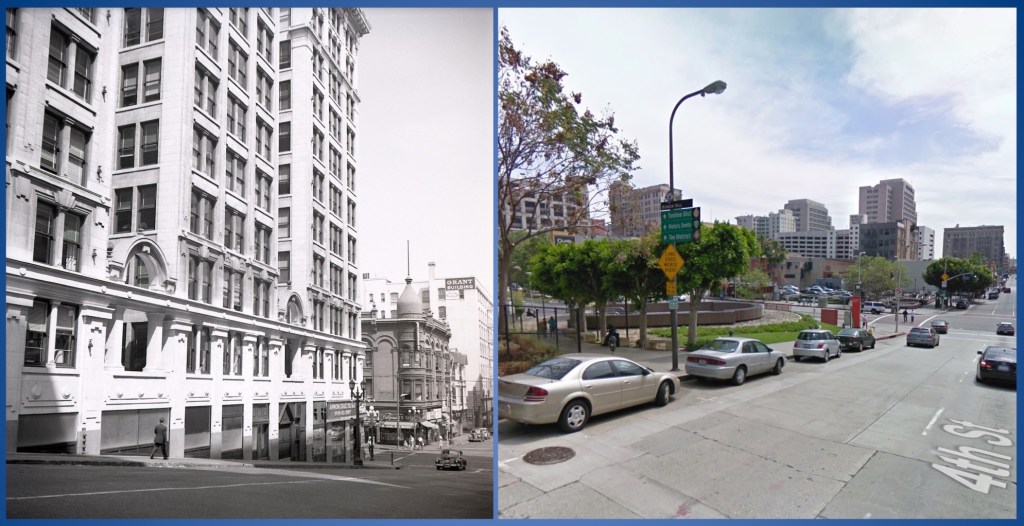
The Black Building, left, was demolished by the Community Redevelopment Agency in January 1967. The domed Strong Block was taken for a parking lot in July 1956. The Grant Block was taken down to two stories in the summer of 1987.
For a site called “BunkerHillLosAngeles” this post hasn’t had much Bunker Hill in it, so, here y’all are! At left, the gleaming-white Black Building (as seen in the book Bunker Hill, Los Angeles on page 133), a 1913 office building by Edelman & Barnett, for George and Julius Black, at 361 South Hill Street. Across Hill, the late-Victorian Strong Block (also known as the Stanford Hotel and the Brighton Hotel), Frederick Rice Dorn, 1895. Further on is the backside of the Grant Block (seen here with painted signage Grant Building), at Fourth and Broadway, which looked like this; it was originally a three-story structure (Frank Sawyer van Trees, 1898) until enlarged with four more stories (John Parkinson, 1902).
The Stimson was demolished by Howard Fox and Harry Quinn. Who were they? They opened Henn’s Restaurant on Sepulveda in 1957, which became Dinah’s in 1959.
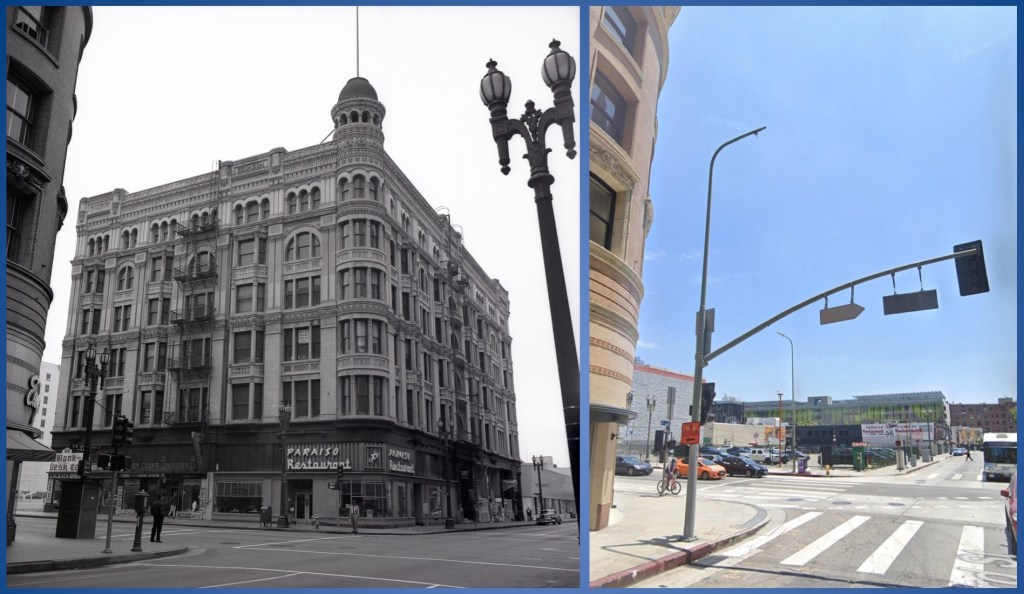
The Stimson Block was an outrageously important structure, designed in skyscraper-meets-Romanesque by Carroll Herkimer Brown in 1892. The man who built it, Thomas Douglas Stimson, used Brown to build an incredible Romanesque Revival house, which you likely know. Downtown’s Stimson Block was demolished in 1963, just because. It’s remained a surface lot these past sixty+ years.
Oh, one last thing about the Stimson Block, that neon sign in the Hylen image at left? Take a close look at the modern image on the right, on the wall of the building across Harlem Place. There it is:
The sign was fabricated by Leon Neon on East Fourth Street, and installed at Third & Spring in April 1958. (Before 1958, Paraiso had been at 400 W Sunset, in what became the space for La Colima)
If you liked these ten old images of vanished downtown, be sure to pick up a copy of the book—it has another 130!
If this post does well, I’ll do another; shoot me a note (see “contact” at upper right of this page) with the building of which you most want to see a then-n-now!



























 Bunker Hill, Los Angeles