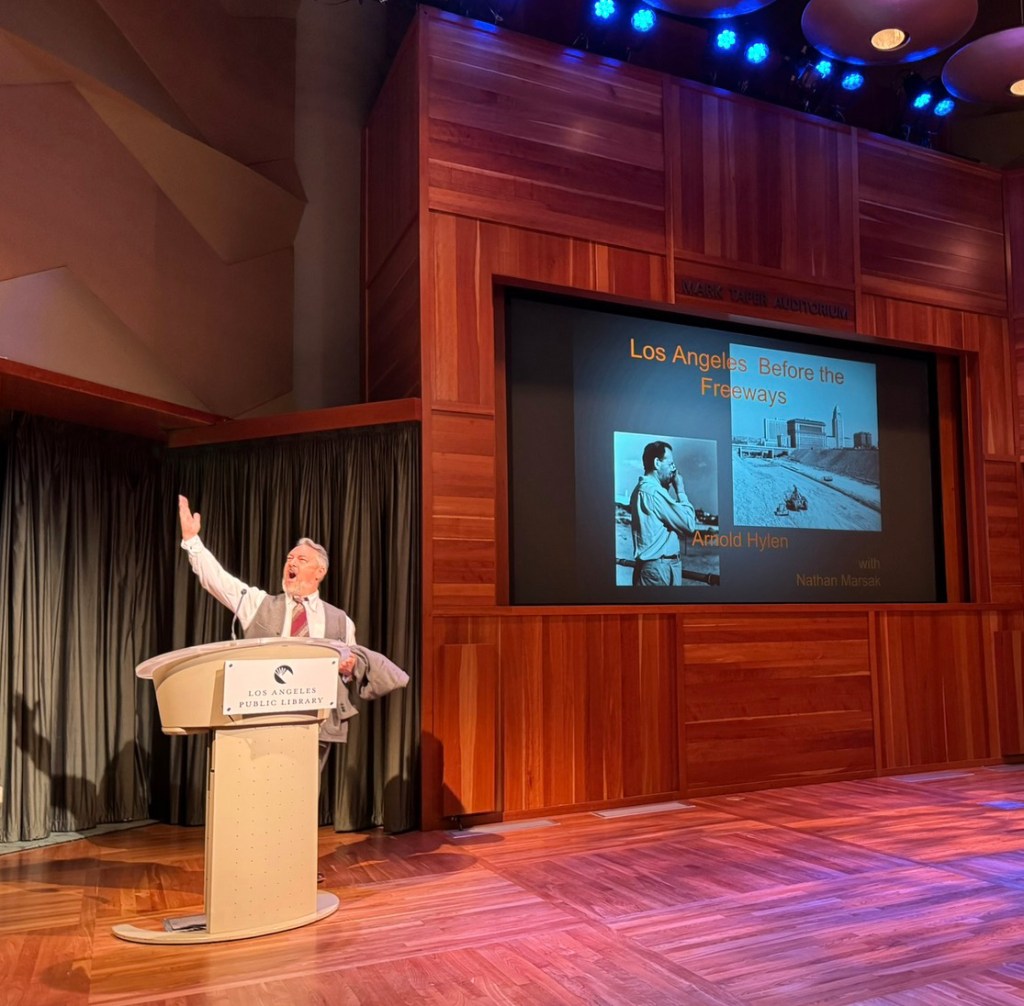
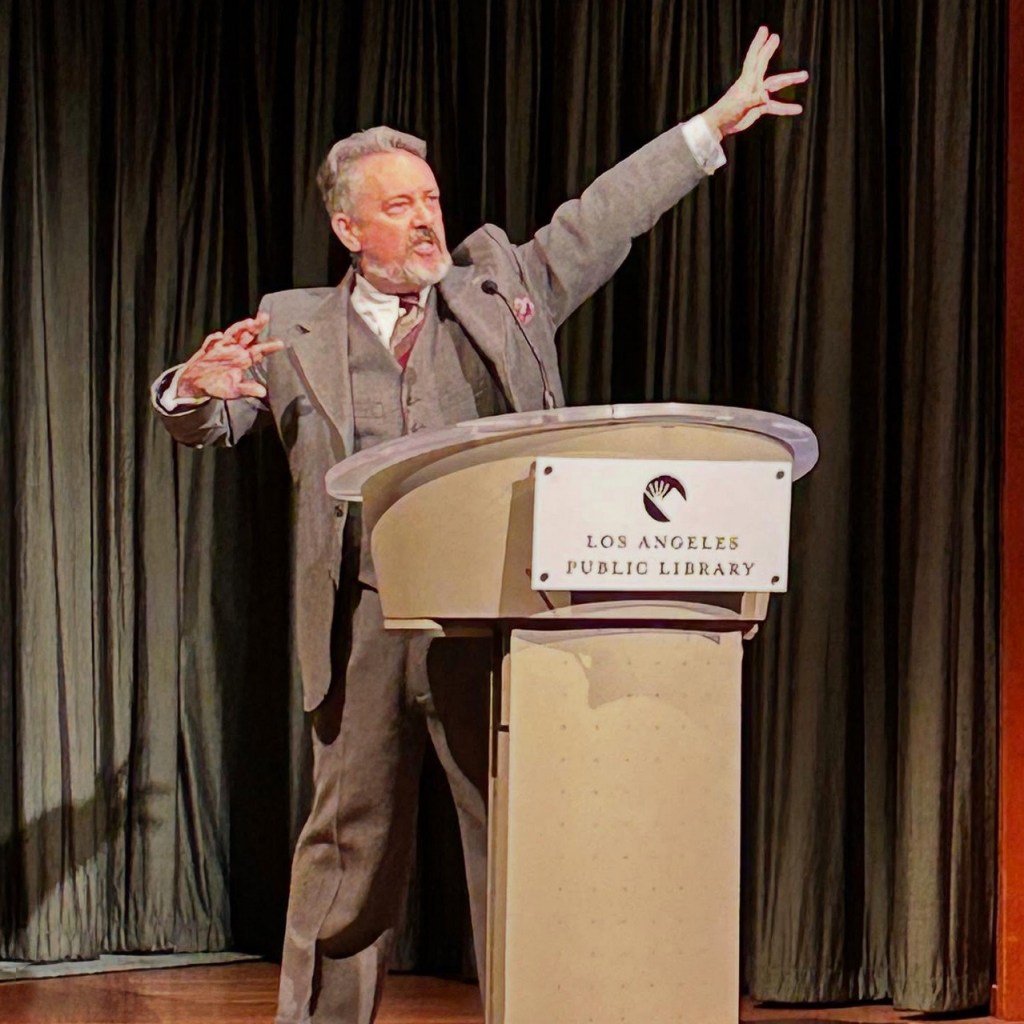
Postscript: we had a GREAT turnout! I want to heartily thank the Book Club of California, and the good folks at Pasadena Heritage.
Yammerin’ on about the influence of John Plant Gaynor’s Palace Hotel
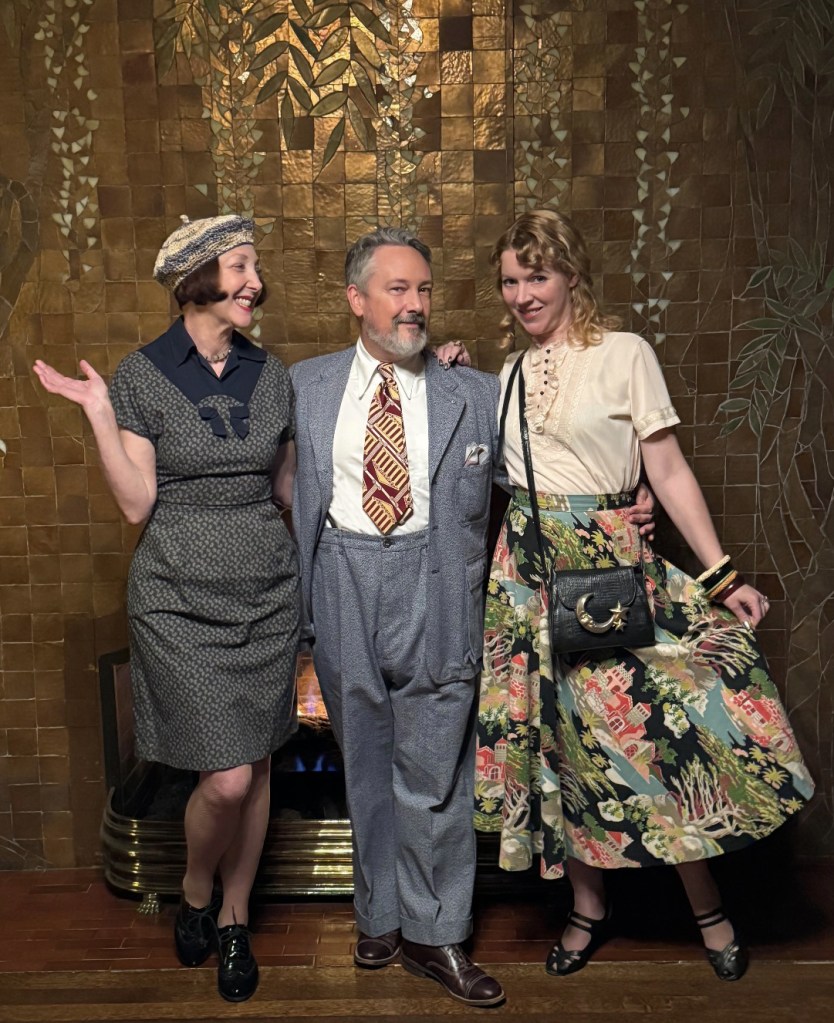
My lovely wife, and me, and the incredible Janet Klein, in front of the Blinn’s iridescent glass-tiled fireplace, designed by Orlando Gianinni of Chicago firm Giannini & Hilgart
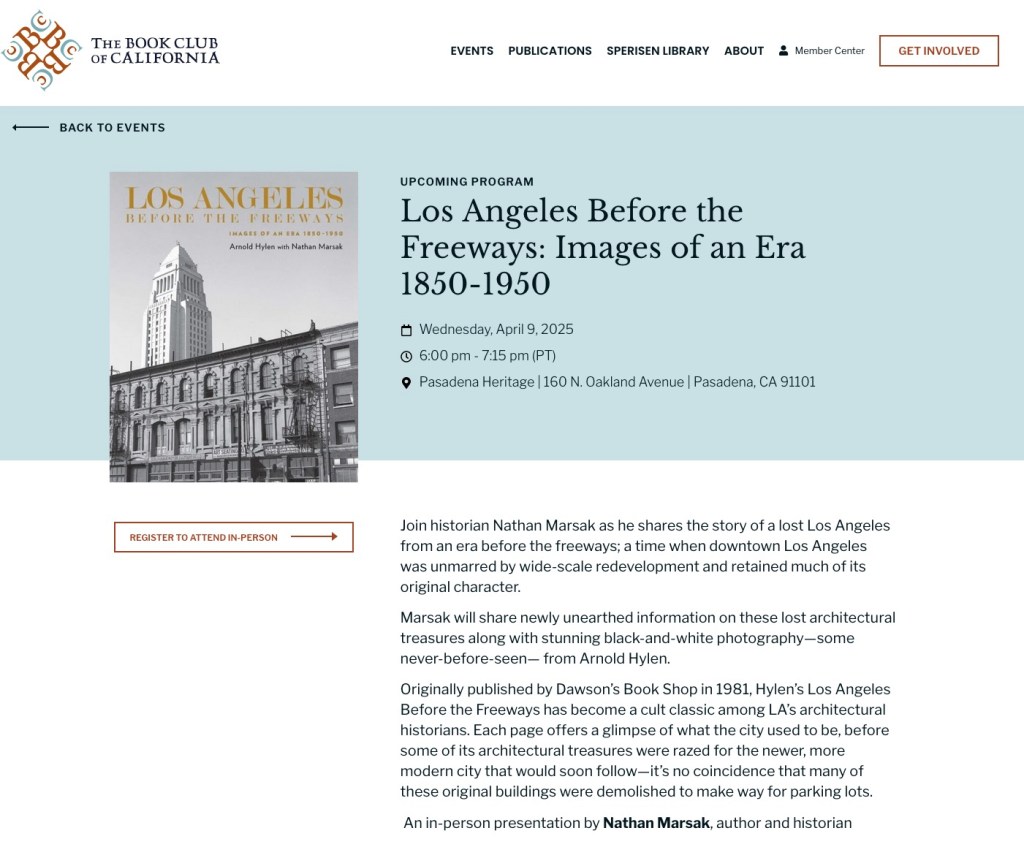
I’ll be delivering an illustrated lecture about Arnold Hylen, his books, how I came to reprint Freeways, and take you on a visual tour of the architectural styles Hylen encountered on his long walks downtown (not to be confused with William Reagh’s long walks downtown, about which there is a wonderful book, appropriately titled A Long Walk Downtown, coincidentally published by…the Book Club of California).
Anyway, even if you’ve no interest in seeing me ramble excitedly about downtown’s few-that-survived-into-the-1950s Romanesque Revival structures, you should at least attend just to hang out in the Edmund Blinn house — recent article and video about the house, here and here — which is National Register, California Register of Historic Resources, and a Pasadena Cultural Landmark.
So you’re flipping through your copy of Los Angeles Before the Freewaysand thinking well, that’sa great old building, I wonder what’s there now?
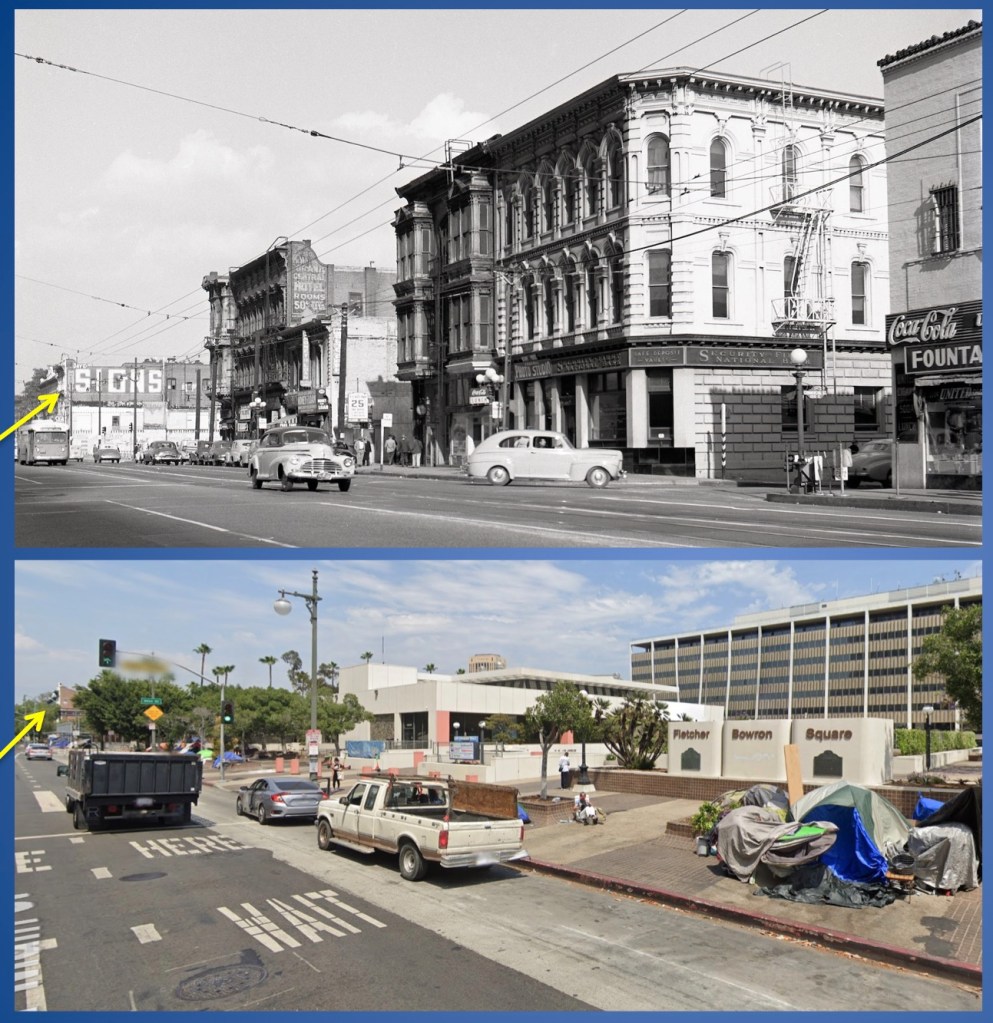
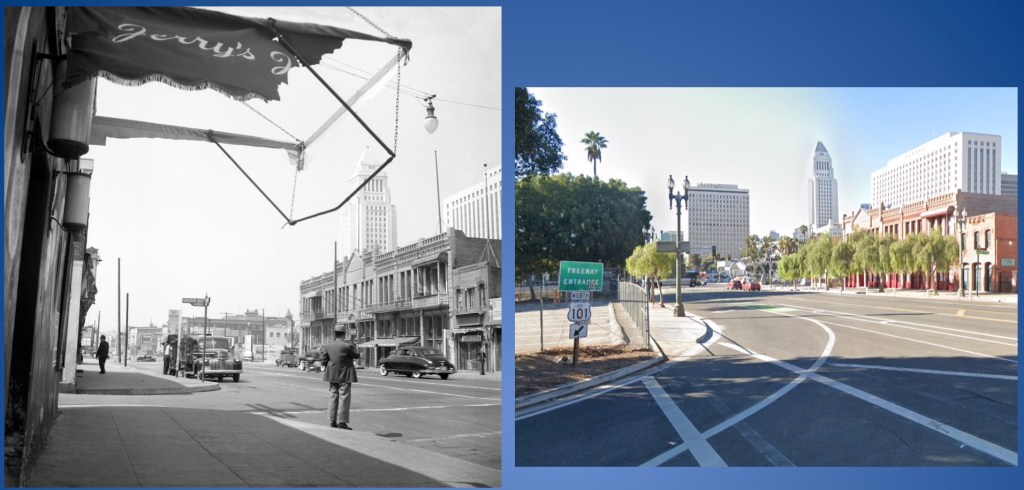
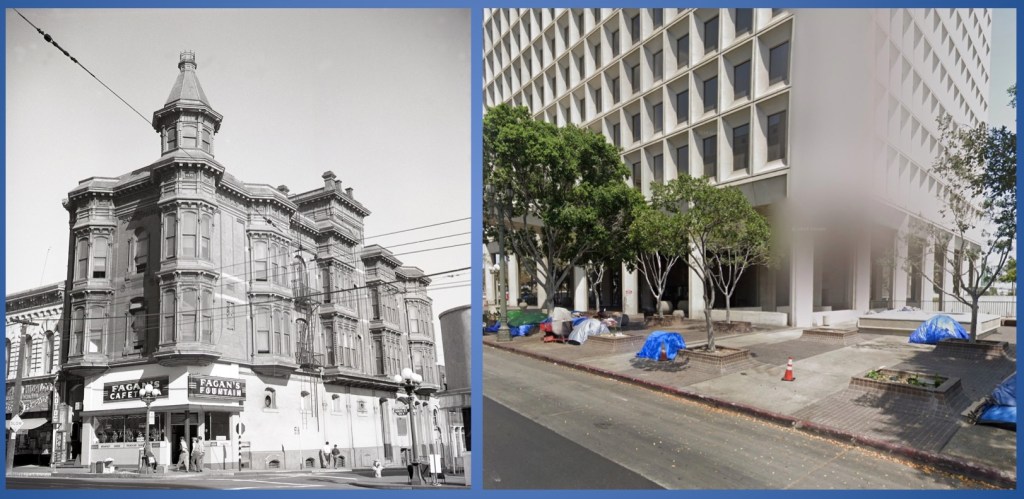
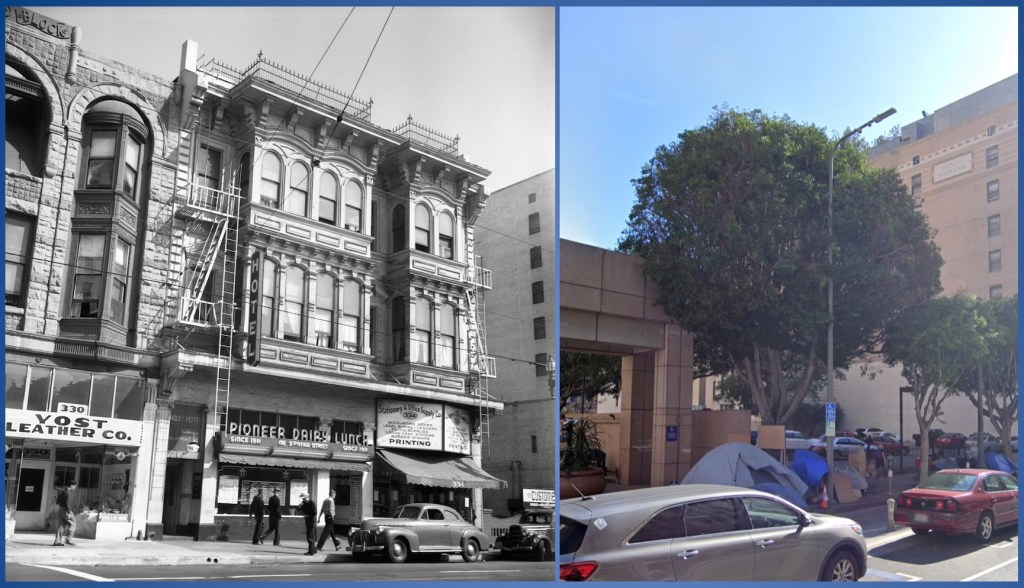
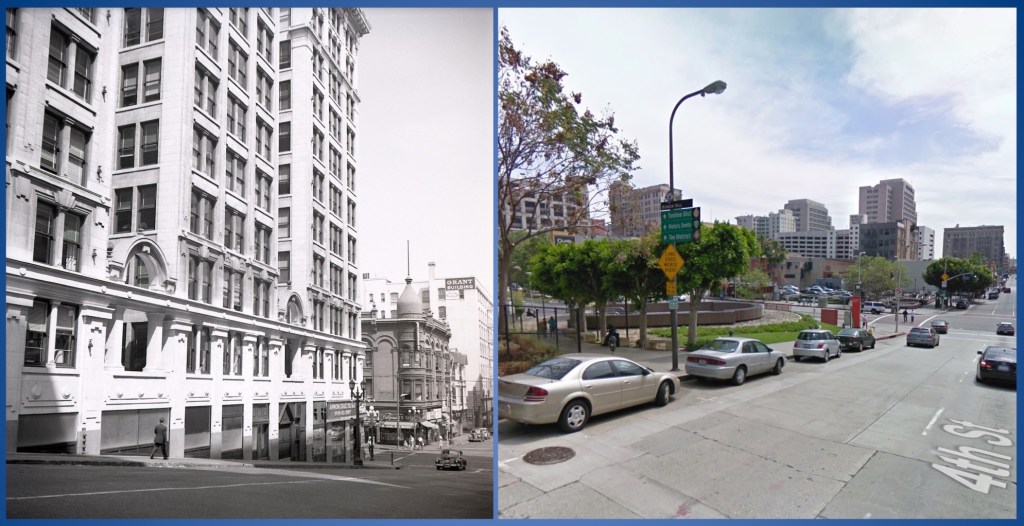
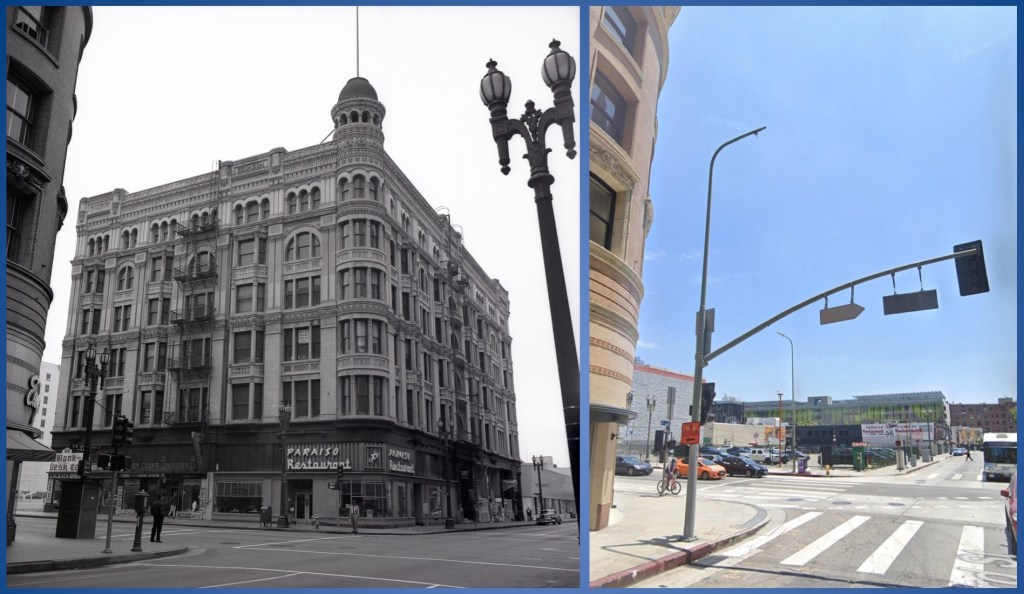
So, just for fun (if your idea of fun is a hefty dose of hiraeth) here are ten shots from Freeways, paired with a contemporary view:
Yellow arrow points to the Merced Theater at 420 North Main
ABOVE: Looking north on Main; most prominent is the Ducommon Block (Ezra Kysor, 1874) at Commercial Street. Security First demolished the structure in mid-1951 and replaced it with a modernist bank building by Austin, Field & Fry. That building was demolished in mid-1970, as was this stretch of Commercial Street, wiped away for the Los Angeles Mall. The Mall, best known for its Triforium, was designed by Stanton & Stockwell in 1968 and opened in December 1975.
The signpost points east into Ferguson Alley, which is very much no more
The torn awning indicates Jerry’s Joynt (home of the world-famous Jade Lounge) — see views toward it by clicking here and here — now wiped away by a freeway entrance. Look closely and you can see how the south end of the Garnier Block was removed for freeway construction.
Looking at the northeast corner of Main and Market streets; the Amestoy Block (Adolph Charles Lutgens, 1888) was made a parking lot by the city in late 1958. Market Street was then wiped away in favor of Stanton and Stockwell’s City Hall East (1972).
Demolished by Benjamin C. Norton, who with his brother Melville ran Norton Bros. clothing manufacturers
Behold the Robarts Block (John Hall, 1888) at the corner of Seventh and Main, in 1950. It was demolished in 1958. Note how its neighbor the Cecil has reworked its sign from “$1.50 Monthly” to “Low Daily.” This is of course the signage that existed for decades before nogoodnik Matthew Baron painted it over.
Want to know something embarrassing? In Freeways, the Cohen Block has no architect listed. Well, you read it here first: its architect was Harvey Reid Leonard. Guess that’ll have to go into the second edition!
Center, the 1888 Cohen Block, 334 South Spring. At left, a bit of the Willard Block (Carroll Herkimer Brown, 1893). Both made into a parking lot, 1961. Note a corner of the Ronald Reagan State Office Building (Welton Becket + Associates, 1991) where the Willard Block once stood.
Note the same streetlamp in each shot. That’s one of Union Metal’s Model 1906 “Downtown Double,” installed in the late 1920s
213-221 South Spring Street. At right, the Polaski Block (Abram Edelman, 1895); at center, the Brode Block (Robert Brown Young, 1891); and at far left a Romanesque Revival commercial structure (architect unknown, 1889). Image shot in 1954; the Times-Mirror Company demolished the buildings for surface parking in early 1956, eventually building this parking garage in 1988. Note the Tony Sheets bas relief. The structure was designed by Conrad Associates, who are best known for its 1975 World Trade Center at 350 South Figueroa — which ALSO has monumental Tony Sheets bas reliefs.
The massive electric billboard for Camel cigarettes, designed by famed advertising executive Douglas Leigh, included a small steam plant that blew “smoke rings” from the man’s mouth.While there are plenty of photos of the “smoking” Camel man in Times Square, I’d give anything to see this guy exhaling at Fifth and Hill
The Bath Block (Robert Brown Young, 1898), at the southeast corner of Fifth and Hill streets, was developed by Albert Leander Bath, vice president of the Stowell Cement Pipe Company. The structure, with its nifty Venetian Gothic ogee arches, lasted all the way through the spring of 1980.
Note the same 1948 Dual-Lamp Teardrop CD-913 Electrolier with GE Form 81 globes in each shot. Look closely and you’ll see its original 1919 Keystone Broadway Rose base!
At far right, the eight-story Merchants Bank and Trust (Dennis & Farwell, 1905) with the “Water & Power” neon still stands today, though it was reclad with a modern façade in 1968, designed by William Hirsch Architects + Associates. At left, note the towering Million Dollar Theater down Broadway. Between the two, we’ve lost the Romanesque-facaded Potomac Block (Curlett & Eisen, 1890), demolished for surface parking in 1953, and Bicknell Block (Morgan & Walls, 1892), demolished for surface parking in 1958. Both the Boston Dry Goods building (Eisen & Hunt, 1895), and the Newmark Block, (Abram Edelman, 1898) — the two structures seen at left in this image — are still with us, sort of, having been cut down to one story and fitted with new fronts.
The Black Building, left, was demolished by the Community Redevelopment Agency in January 1967. The domed Strong Block was taken for a parking lot in July 1956. The Grant Block was taken down to two stories in the summer of 1987.
For a site called “BunkerHillLosAngeles” this post hasn’t had much Bunker Hill in it, so, here y’all are! At left, the gleaming-white Black Building (as seen in the book Bunker Hill, Los Angeles on page 133), a 1913 office building by Edelman & Barnett, for George and Julius Black, at 361 South Hill Street. Across Hill, the late-Victorian Strong Block (also known as the Stanford Hotel and the Brighton Hotel), Frederick Rice Dorn, 1895. Further on is the backside of the Grant Block (seen here with painted signage Grant Building), at Fourth and Broadway, which looked like this; it was originally a three-story structure (Frank Sawyer van Trees, 1898) until enlarged with four more stories (John Parkinson, 1902).
The Stimson was demolished by Howard Fox and Harry Quinn. Who were they? They opened Henn’s Restaurant on Sepulveda in 1957, which became Dinah’s in 1959.
The Stimson Block was an outrageously important structure, designed in skyscraper-meets-Romanesque by Carroll Herkimer Brown in 1892. The man who built it, Thomas Douglas Stimson, used Brown to build an incredible Romanesque Revival house, which you likely know. Downtown’s Stimson Block was demolished in 1963, just because. It’s remained a surface lot these past sixty+ years.
Oh, one last thing about the Stimson Block, that neon sign in the Hylen image at left? Take a close look at the modern image on the right, on the wall of the building across Harlem Place. There it is:
The sign was fabricated by Leon Neon on East Fourth Street, and installed at Third & Spring in April 1958. (Before 1958, Paraiso had been at 400 W Sunset, in what became the space for La Colima)
If you liked these ten old images of vanished downtown, be sure to pick up a copy of the book—it has another 130!
If this post does well, I’ll do another; shoot me a note (see “contact” at upper right of this page) with the building of which you most want to see a then-n-now!
And if you want to know more about Bunker Hill — specifically, its less savory aspects — might I suggest you pick up the quaint and colorful compendium of crime that is Bunker Noir!
And should you wish to know what structures exist on the Hill at this very moment, I heartily advise you pick up Marsak’s Guide to Bunker Hill!
If you want to buy both? Get both for $40. That’s like a $10 savings! And remember, if you send me money through Venmo, be sure to include your mailing address.
There will be snacks! The invite reads “light refreshments” (I have no idea what that means, though I assume LAPL has rejected my suggestion of étouffée paired with a good Spätlese) so you won’t go hungry.
Be the first to get the book, fresh out of the shrinkwrap and signedto you no less. (And if you need to pick up a copy of the Bunker Hill book, there are signed copies at the library gift shop.)
Parking is easy and cheap. I’m sure you’re thinking ugh, if I go downtown I’ll have to pay $18 to stackpark in some surface lot but no! Parking in the structure under the library is a snap, and Saturday parking is a one dollar flat rate. (Provided you have a library card, which, of course, you do. But if not, go here; you’ve got two weeks.)
Last but not least, there will be me, presenting a nifty slideshow all about Hylen, his book, and the architectural styles contained therein, which you may watch from the plush confines of the Mark Taper Auditorium.
…and if there were a sixth reason, it would be that you could make a day of it downtown, taking in the area’s other wonders, like Angels Flight, Grand Central Market, the Bradbury Building, the Beaux-Arts marvels of Spring and Broadway, etc. Heck, bring along your copy of Before the Freeways as some sort of phantom Thomas Guide of lost L.A.! Then go have drinks in the revolving Bonaventure bar—you know the drill.
At this point you exclaim where do I sign?! Right here, is where:
I began this blog in advance of the 2020 publication of Bunker Hill, Los Angeles. Since then I’ve self-published a couple more books about Bunker Hill — Bunker Noir! and Marsak’s Guide to Bunker Hill — and now it’s time to announce the new book from Angel City Press! (And believe it or not, it’s not about Bunker Hill! …though y’know, it does have vintage Bunker Hill in it…)
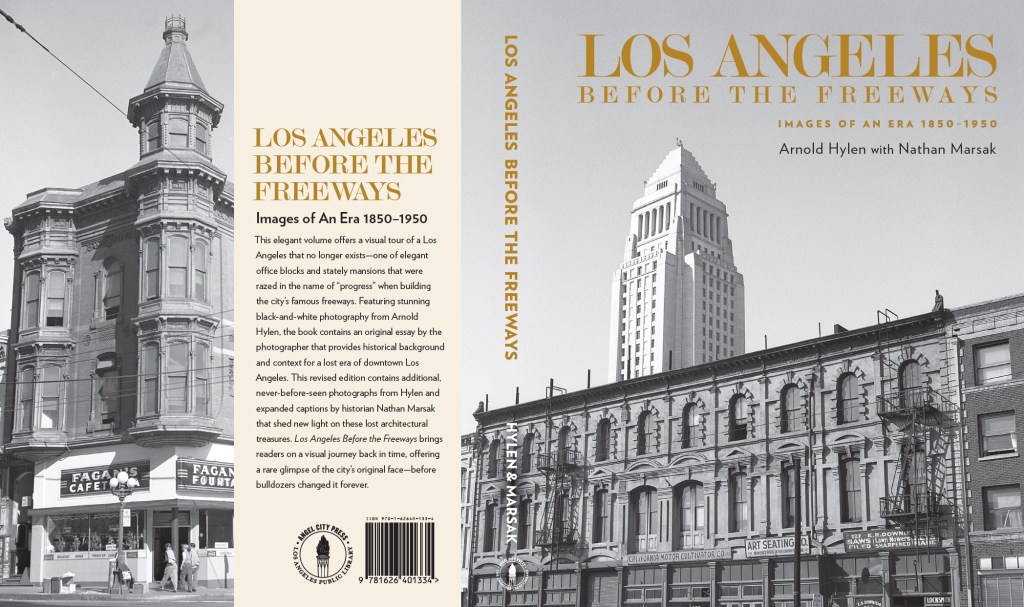
Announcing Los Angeles Before the Freeways!
Though strictly speaking it’s not my book: it was written by a fellow named Arnold Hylen. Hylen had taken a lot of pictures downtown in the 1950s and 60s, compiling his images and research into his 1976 Bunker Hill, A Los Angeles Landmark and 1981’s Los Angeles Before the Freeways: 1850-1950 Images of an Era, both published by Dawson’s Books.
Bunker Hill and Freeways had very limited press runs — 500 and 600 copies, respectively — so finding them can be tough and paying for them even worse:
So I thought it would be a cool idea to ferret out Hylen’s remaining family, acquire the negatives and publishing rights, and get these books in the hands of hungry historians. The Bunker Hillbook turned into something larger, of course, but Freeways…that is being republished now as a standalone, and I won’t be modest on this point: this new version is amazing.
********
So, how does this new edition differ from the 1981 original? A few standouts—
It’s larger!
Which means the images are bigger…a LOT bigger
And because I scanned the original negatives, there’s greater visual information included in the images
Recognize these images? No you do not! There’s a bunch of Hylen shots, not included in the original, that you’ve never seen before
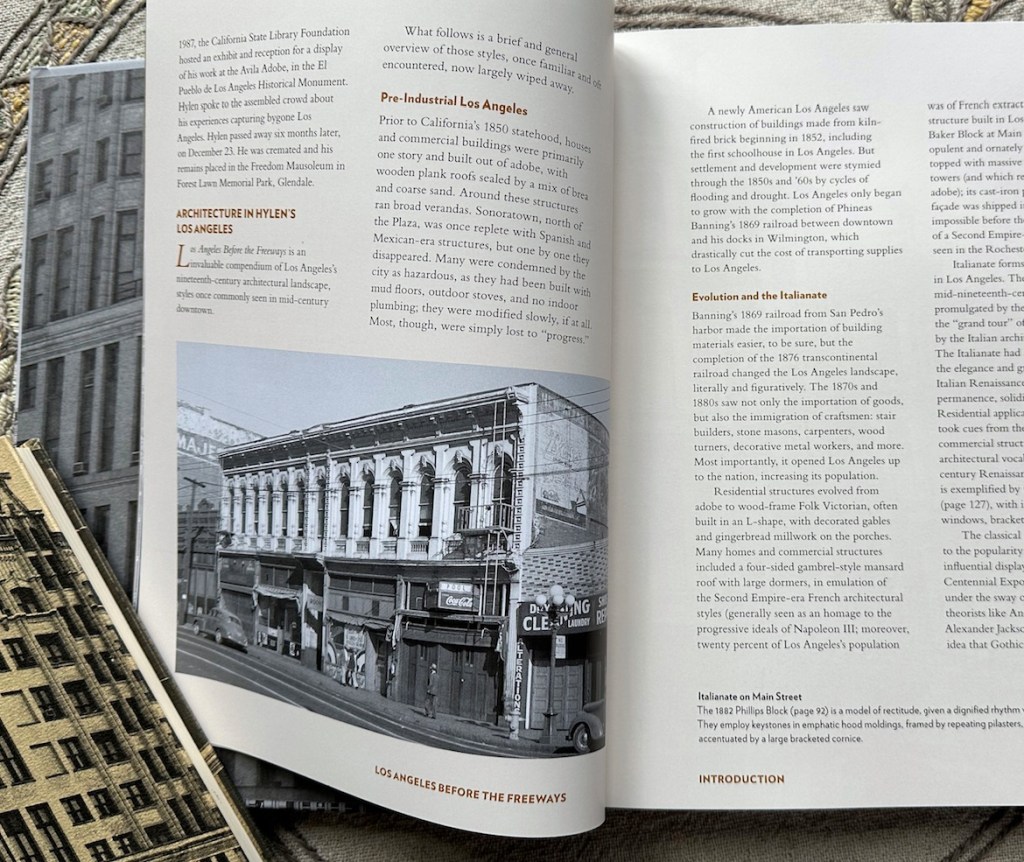
Including a biography of the man
And an essay about the architectural styles you’ll encounter in the book (and yep, you’ve never seen that shot of Reeve’s Phillips Block before now [not to be confused with Reeve’s other, far more famous Phillips Block one block west])
********
The book will be out, officially, on March 25th. We’re having a big launch party at Central Library on March 22nd, so….COME TO THE LAUNCH PARTY! There will be books there, and snacks, and presentations, and it’s free! Click here!
In the meantime, should you wish to preorder the book, please do so here!
********
One last thing — I asked Pumpkin Patch what her favorite image was, and she turned to this one:
Today’s topic: the Samuel Weller House, 211 South Bunker Hill Avenue
Everyone loves the boom-era mansions of Bunker Hill, which we know primarily through images shot as they neared their demolition, photographed in the 1950s and 60s by the likes of Hylen, Reagh, Conner, et al.
More rare and important are those images captured of a house in its early years. Luckily, many of the most important homes were photographed soon after completion, e.g. these shots of the Crocker, Rose, Melrose, Castle, and Bradbury—
But those shots have been in the public view a long time; many were used in 1977’s Bunker Hill: Last of the Lofty Mansions, and a lot of the shot-within-a-few-years-of-their-completion house pictures, captured from 1888-1900, were some of the first “old Bunker Hill” images to be put online in the mid-1990s. (I should mention as well all the above shots were indeed used in Bunker Hill, Los Angeles.)
So, when a new-to-us image of an early Bunker Hill house is uncovered, it’s big news.
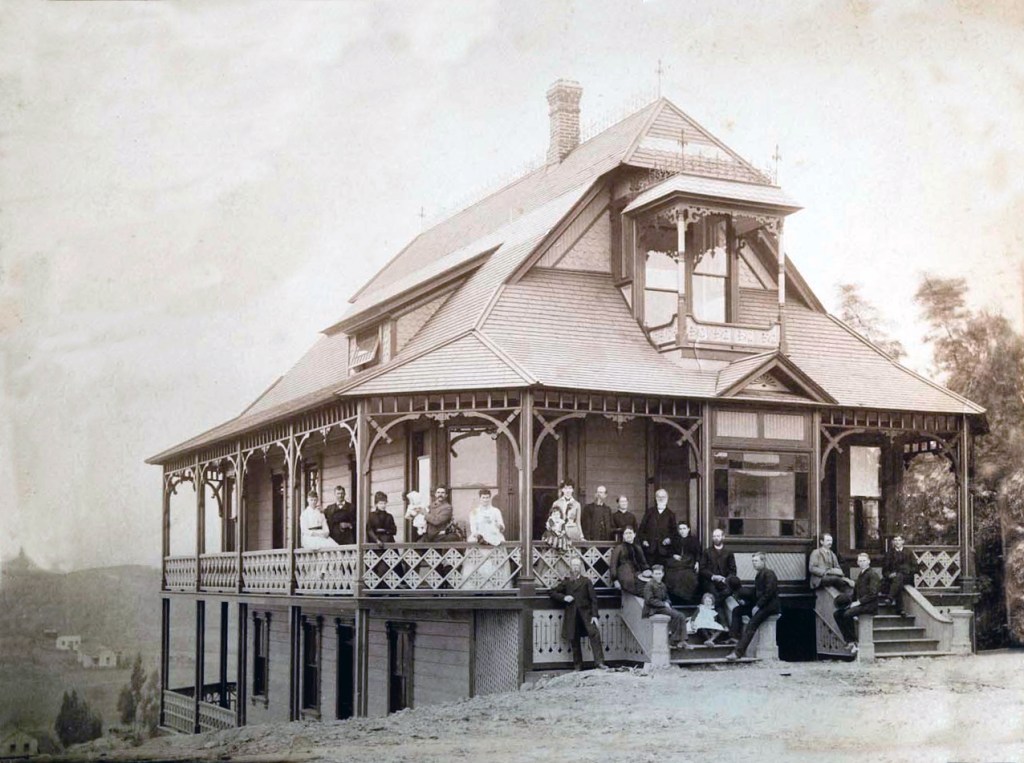
The other day I was contacted by a descendant of Samuel Weller, founding president of Occidental College. Said descendant wondered if I knew about Weller’s house on Bunker Hill, and, was it in my book? I said that no, 211 South Bunker Hill Avenue, built by Weller in 1886, was an important house, but, no decent images of it existed.
At which point she sent me this:
And my jaw dropped. That’s an incredible image of an important house!
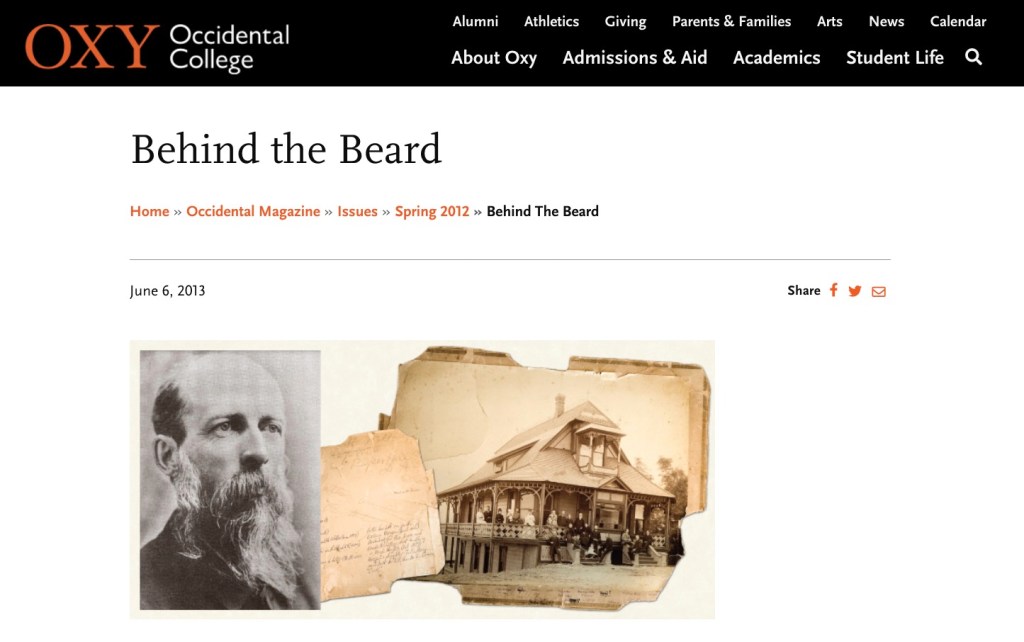
The descendant said that the original of this image lay with Occidental, whom I contacted, and they said no, they had received it from the family, when they included it in this, ten-something years ago:
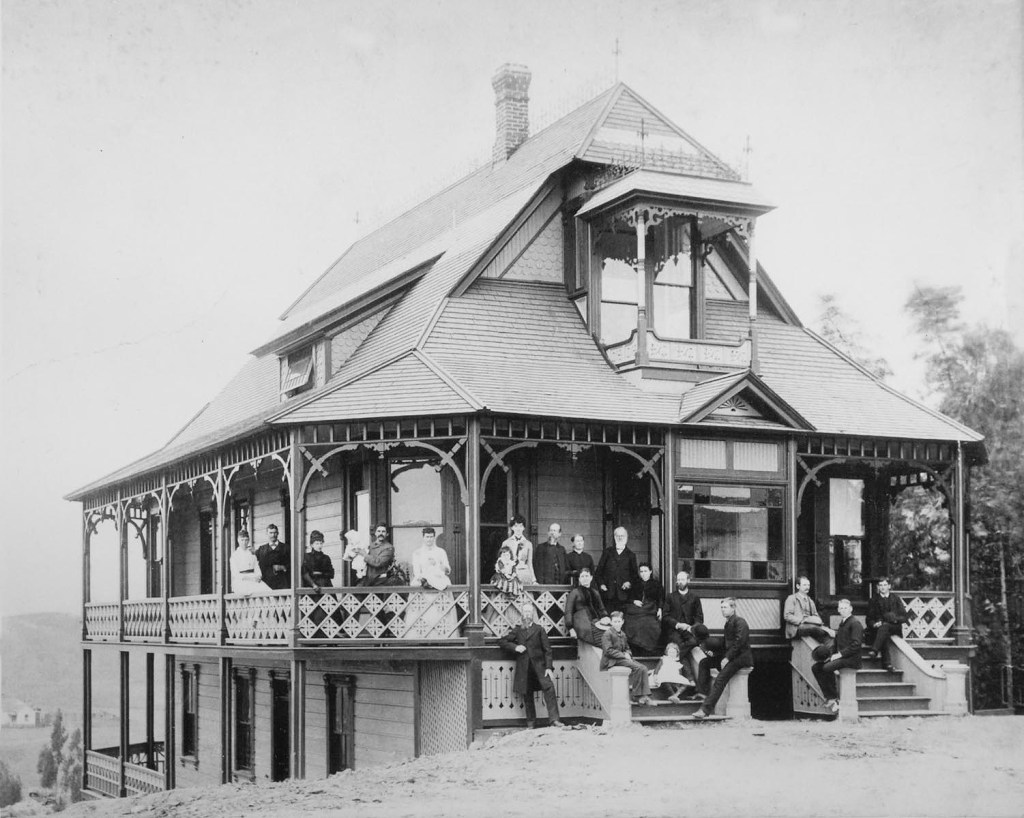
So the family says Occidental has the original and Occidental says the family has it, and while I still have no idea who is in actual physical possession of the original, I did get this (decent-sized, but I wish it were much larger) scan:
Which has on its verso—
Great information here, but, much of it a bit off. It was certainly not the “first house on Bunker Hill.” Samuel’s father was not named John (you’ll note someone scribbled “Tobias” in pencil to correct this). And it refers to “Samuel Higgins Weller” when his middle name was Harold (understandable, since Samuel’s mother’s maiden name was Higgins). “Octave” Morgan would refer to Octavius Morgan—of the firm Kysor & Morgan (becoming Kysor, Morgan & Walls in late-October 1886)—who certainly may have designed this house, but I do not believe designed “Occidental College’s first building,” which by all evidence was product of the Newsom boys. Of Morgan it goes on to say his “daughter Julia Morgan” designed Hearst Castle, which is a nice thought, but Julia Morgan’s father was Charles Bill Morgan, no relation.
Note, in pencil, “his fathers anniversary birthday” in pencil across: as June 18, 1886 was Tobias Weller’s 85th birthday, it’s not unreasonable to conjecture that that was the day of this photograph.
As I understand it, this would be Samuel at left, and his father Tobias, right
This being architect Octavius Morgan, holding wee Octavius Morgan Jr., born Jan. 1886
A bit about the Weller house construction—the house may have been built/owned not by Samuel Weller, but by the Rev. Oliver Clinton Weller (Samuel’s younger brother), or at least, that’s what the 1886-87 City Directory would indicate:
207? But wasn’t the address 211? Yes but the neighbor to the north was 205, and 207 crops up as an alternate address later…sort of…all will be explained
Nevertheless, come the 1887 directory, we have Samuel H. Weller in residence:
And in the 1887-88 Maxwells’ Directory:
But with the 1888 directory, Weller has already moved to Boyle Heights, site of his new school:
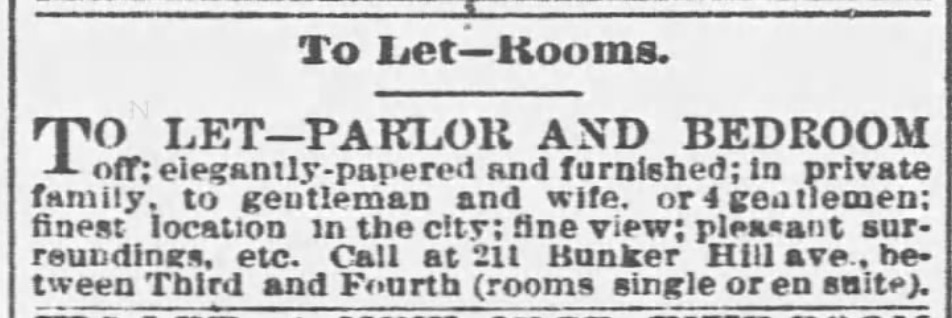
And the Weller house, thereafter, became rented rooms:
Los Angeles Times, April 29, 1888
The 1888 directory shows it’s now the residence of a wood turner, a capitalist, and a lady
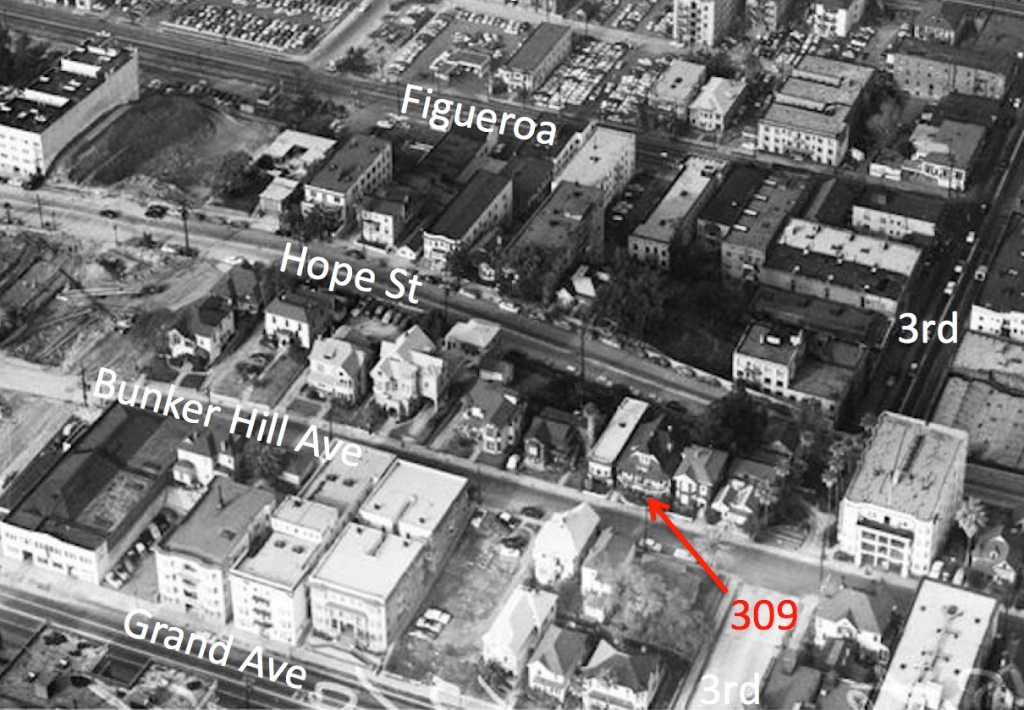
Let’s get you acquainted as to where 211 South Bunker Hill was—which gets tricky because of course it doesn’t retain “211” as its address for very long. Los Angeles went through street renumbering in December 1889, and 211 became 309.
1888 and 1894 Sanborn Maps.Note how 211 becomes 309. 1906 and 1950. Note the use of 307, which suggests 207 was a valid pre-December ’89 address before the renumbering, hence the use of 207 as an address for O. C. Weller in the ’87-88 directory1955. USC
Here’s a shot looking east at Bunker Hill from Figueroa—
Another view looking up at the backside of the house CalStateLibrary
Now let’s look at the house again, and see what we see:
Yes, I hate colorized images and so do you. But there are times I find colorization brings out detail, as is the case here, and since it’s the only known vintage image of this house, I’m gonna play with it in every way possible
Two-story wraparound porches! Now that’s California living. That most of the detailing is reserved for the porch scrollwork and balustrade panels gives it a Folk Victorian flair, albeit not of the “gablefront and wing” configuration most commonly seen in the Folk styles of pre-Queen Anne Bunker Hill. Despite all its picturesque elements — a scrollwork’d balcony and a shed dormer and bicolor variegated shingle, this is a transitional house; had it been built two years later, we’d have seen a proliferation of gables and dormers and likely a turret. Instead, our massing is more sedate, but the Dutch Gable-Jerkinhead roofline is still pretty nutty. Note the stained glass window on the porch, flanked by the matching entrance stairs.
How rare is this image of the Weller house? Exceedingly; it’s basically the only decent image of the house we have. By comparison, we have well-known shots of the Castle near both its birth and death:
And yet virtually none of 309 South Bunker Hill (a scant three doors down from the Castle at 325). For example:
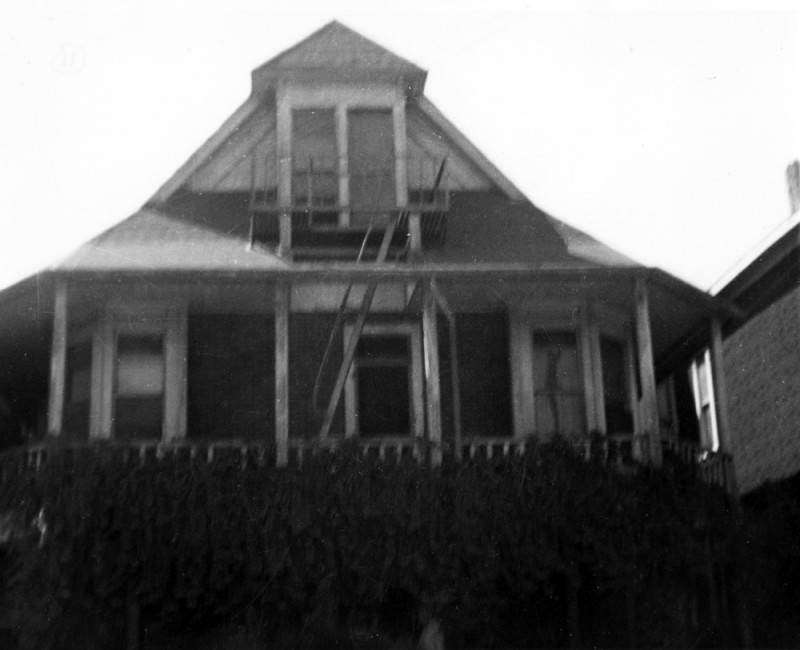
A shot from 1932. Note the upper porch still has its gingerbread and iron cresting, but its lower half has been converted to a fire escape (as done in May 1923 by owner N. J. Crawford). The lower porch appears to have lost its gable and its large piece of art glass.
Note, though, a significant difference: the house as originally built was, at street level, one story (two, if you count the marvelous roof-balcony). Some time later, either the grade was lowered on Bunker Hill Avenue, or the house was raised to bring its lower floor up to the street.
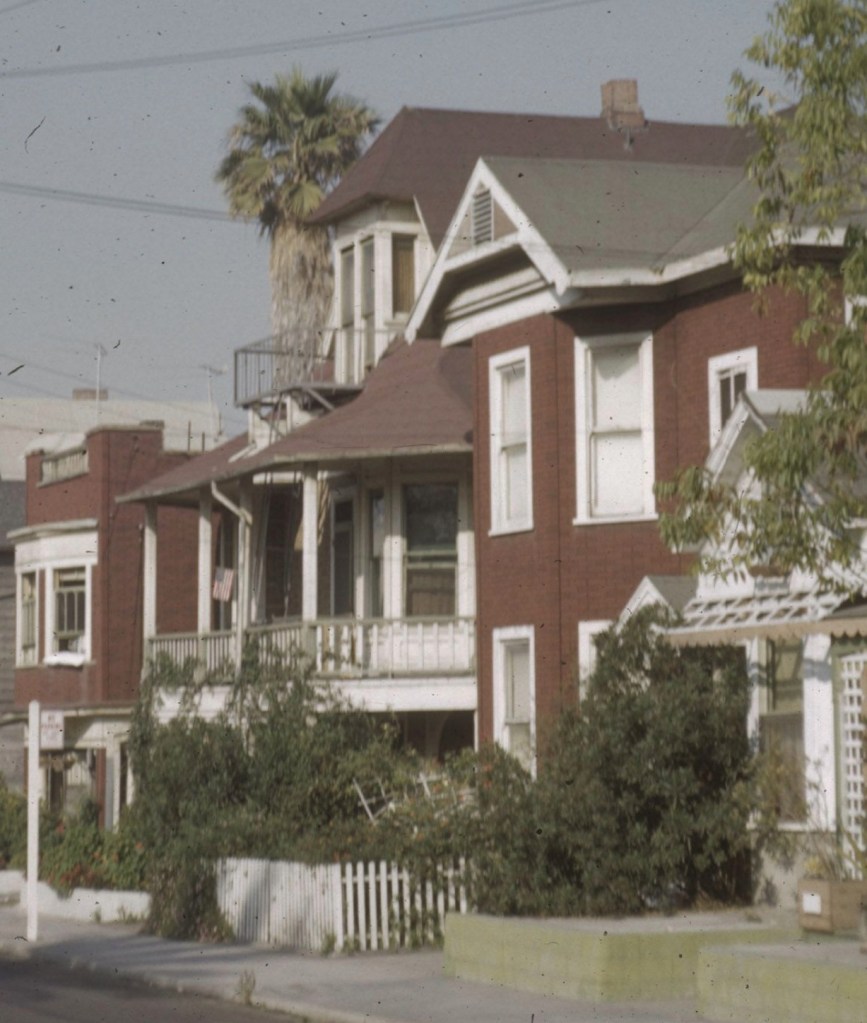
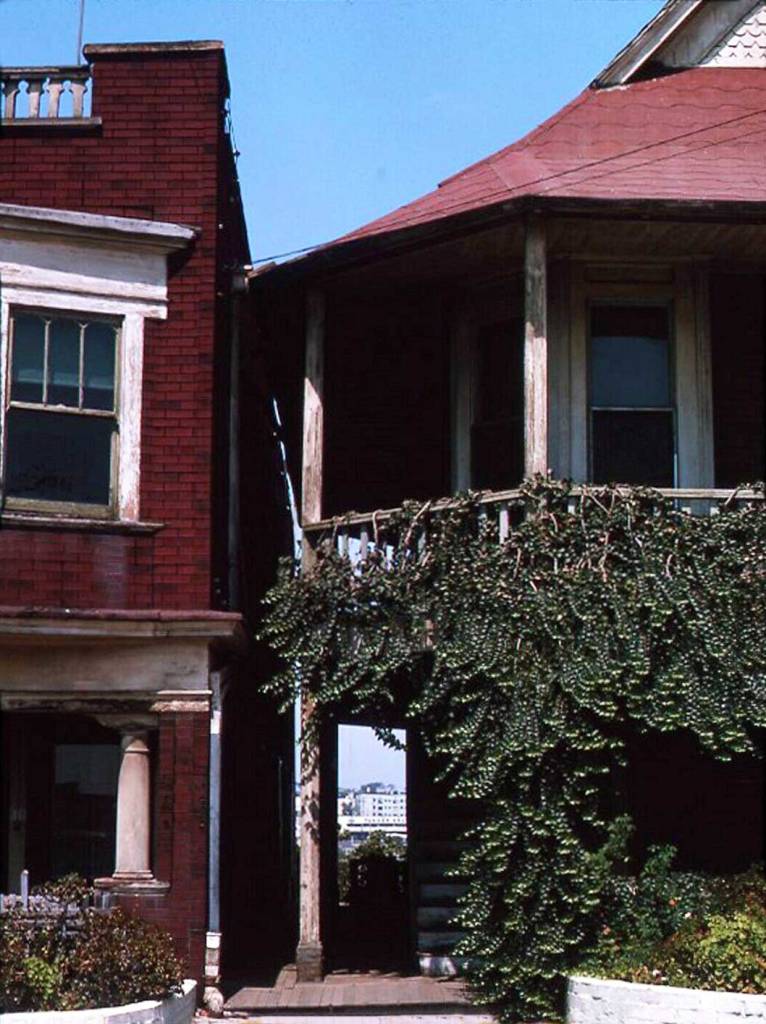
I’ve done some digging to uncover what exactly happened, but am yet to arrive at a satisfactory conclusion. But note in the Sanborn maps above, how between 1894 and 1906 the structure has moved a bit to the north, so as to accommodate 311, which was built, as far as I can tell, in 1899.309 with 311 at left and 305 at right, in June 1954. 309’s upper and lower porches have lost all their decorative elements. This is why it’s so important to have early images of buildings, especially given LABC Section 91.8114, that is, our 1949 “Parapet Ordinance,” which stripped so many buildings of character defining features. HuntingtonJune 1961. A very similar image to the 1954 shot above. HuntingtonHere’s an Arnold Hylen shot you’ve never seen before, ca. 1955, showing some old fellas outside 311 South Bunker Hill with a bit of the former Weller house at right. Note the absence of spandrels, drops, and brackets above, and lack of sawn balustrade panels below.
This image, shot about 1955, ain’t so hot either. LAPL
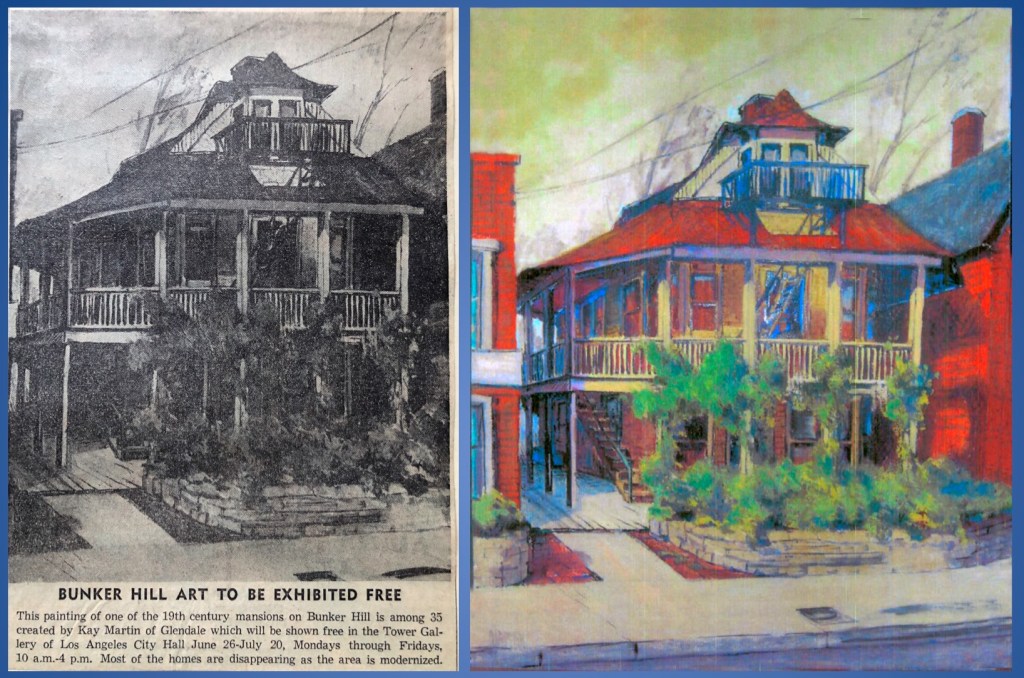
The best capture of the house in its late years is a Kay Martin painting. (To read about Kay Martin, click here.) Left, Los Angeles Times, June 18, 1956And naturally there’s a wonderfulLeo Politi
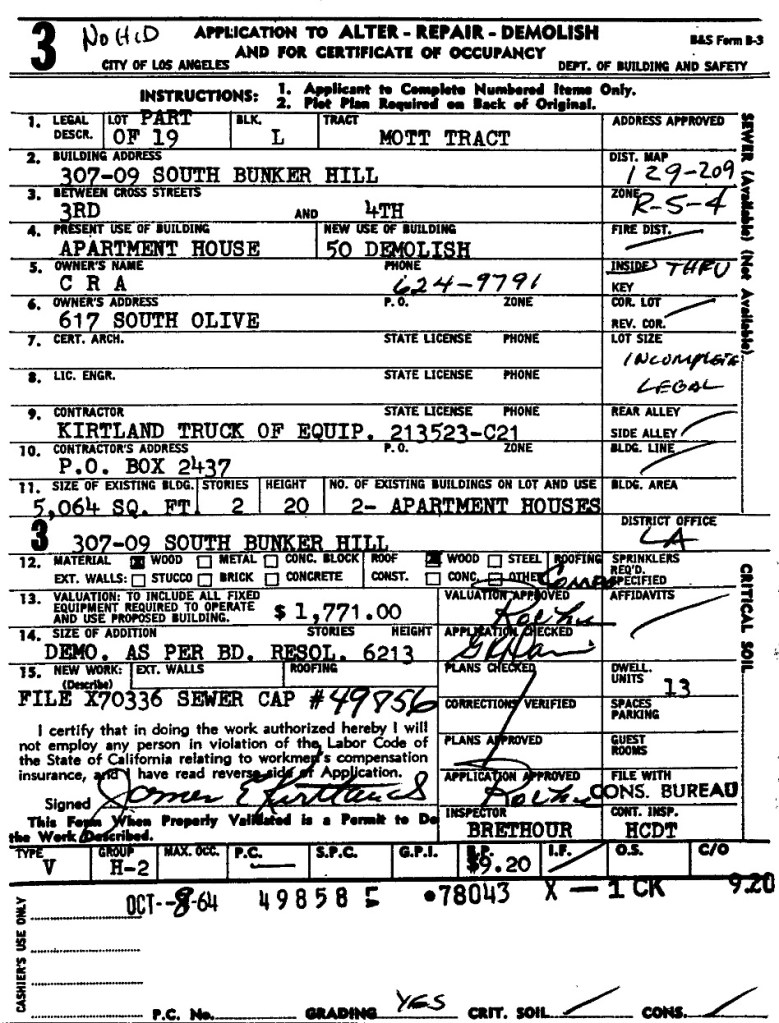
I don’t have to tell you what happened to the house—but I will anyway—it gets eminent domain’d by the CRA and receives its bye-bye papers in October 1964.
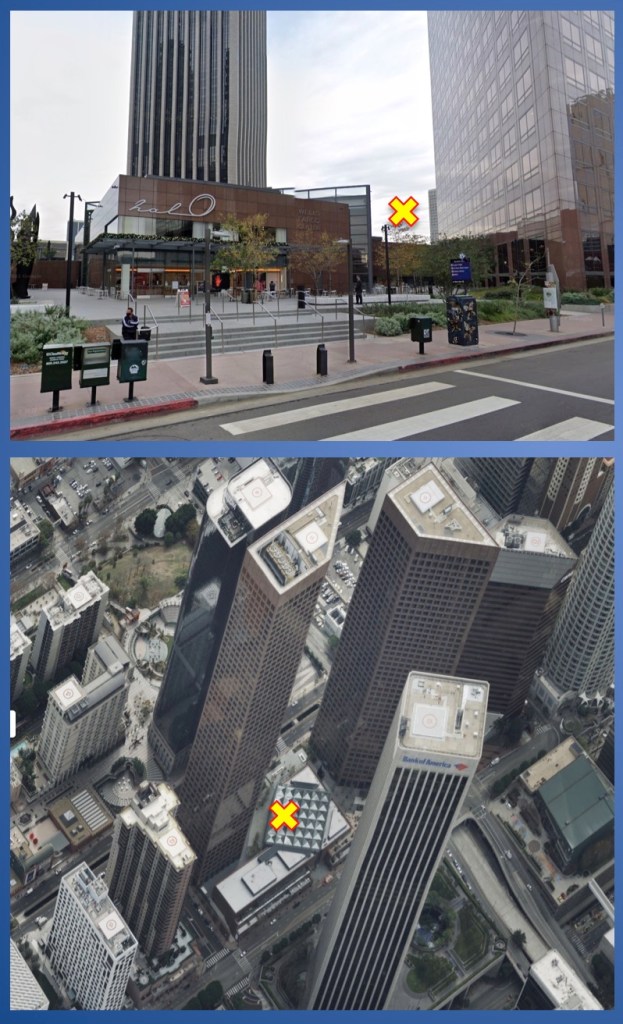
And in case you’re wondering about the former site of Weller’s house: since Bunker Hill Avenue between Third and Fourth has been wiped out, and the hill on which it ran was shaved down about forty feel, next time you’re at the Wells Fargo Center, picture the Weller house as floating over the north side of the Halo foodcourt, or thereabouts…