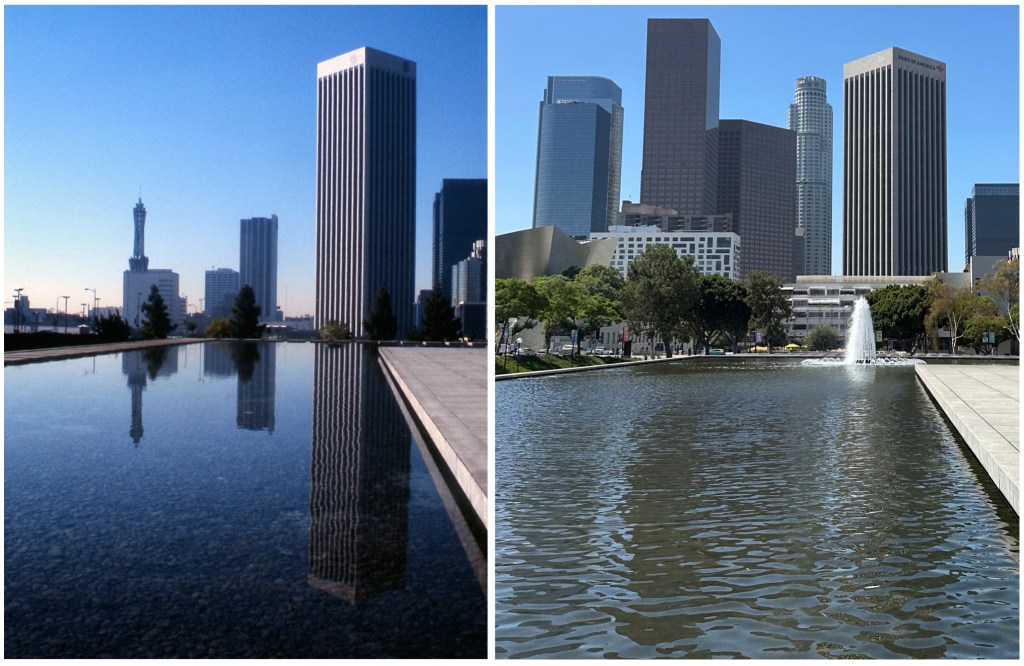
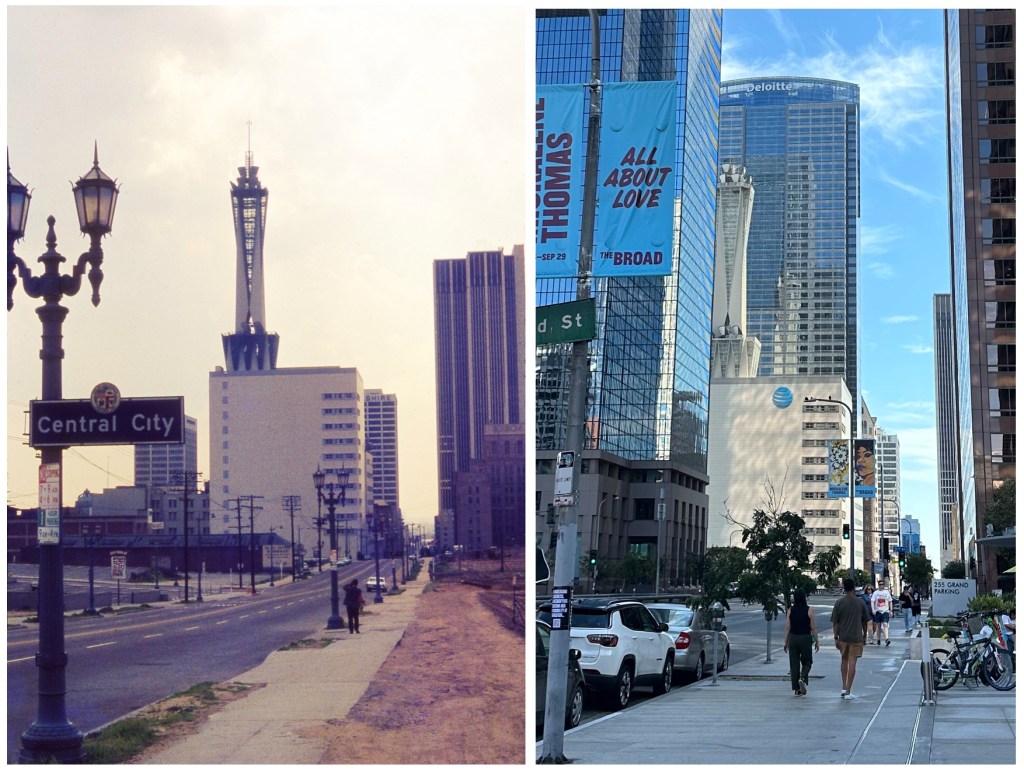
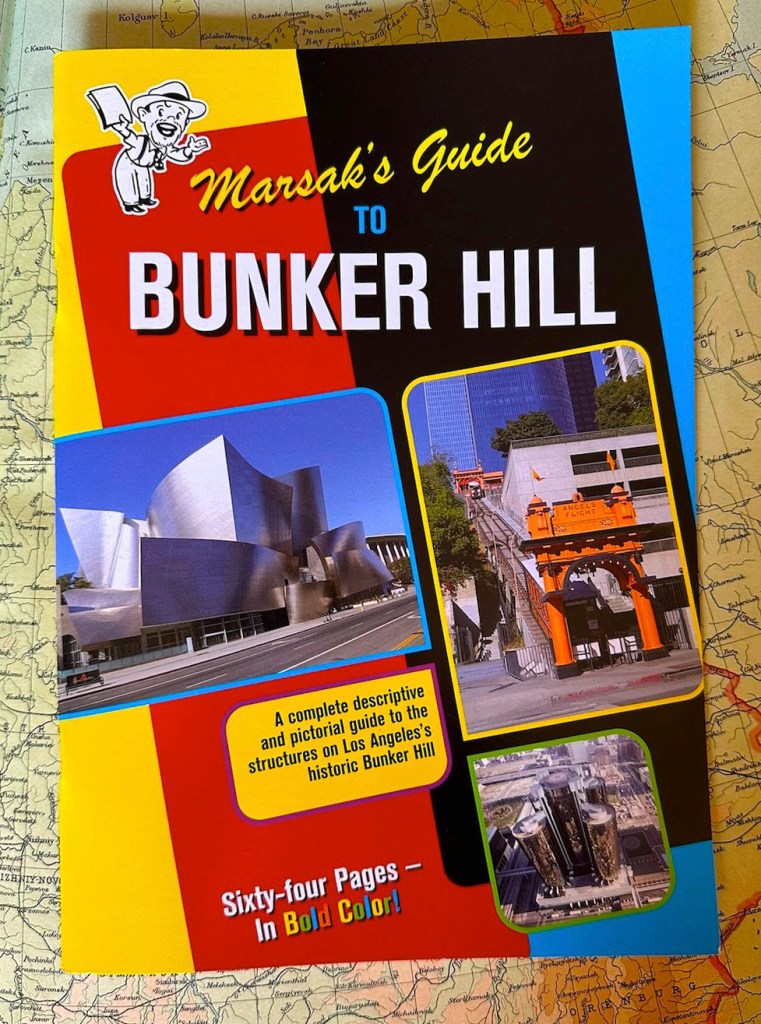
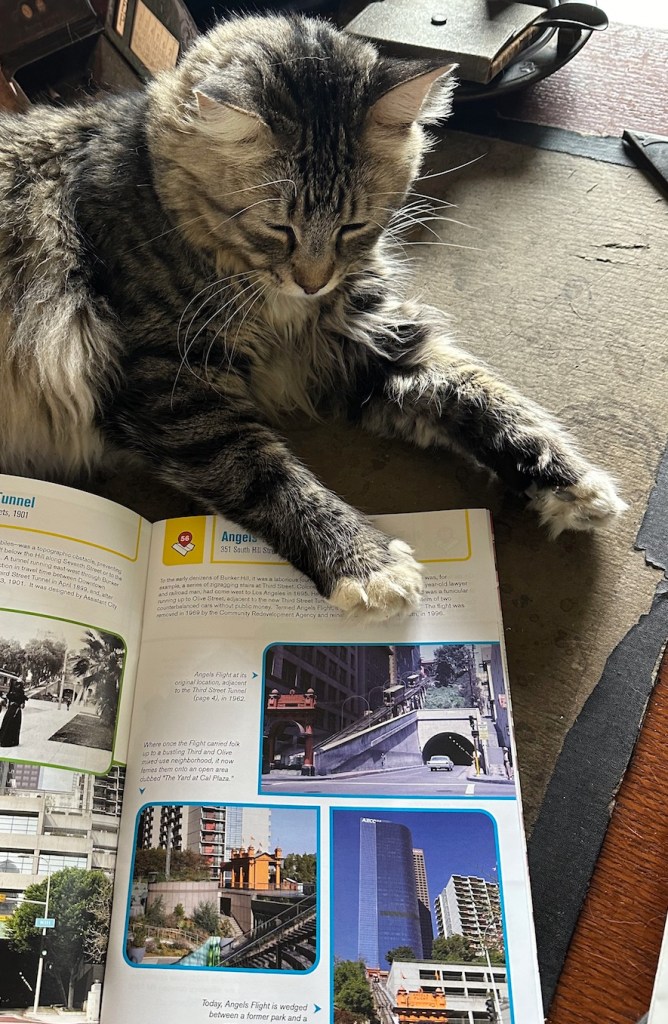
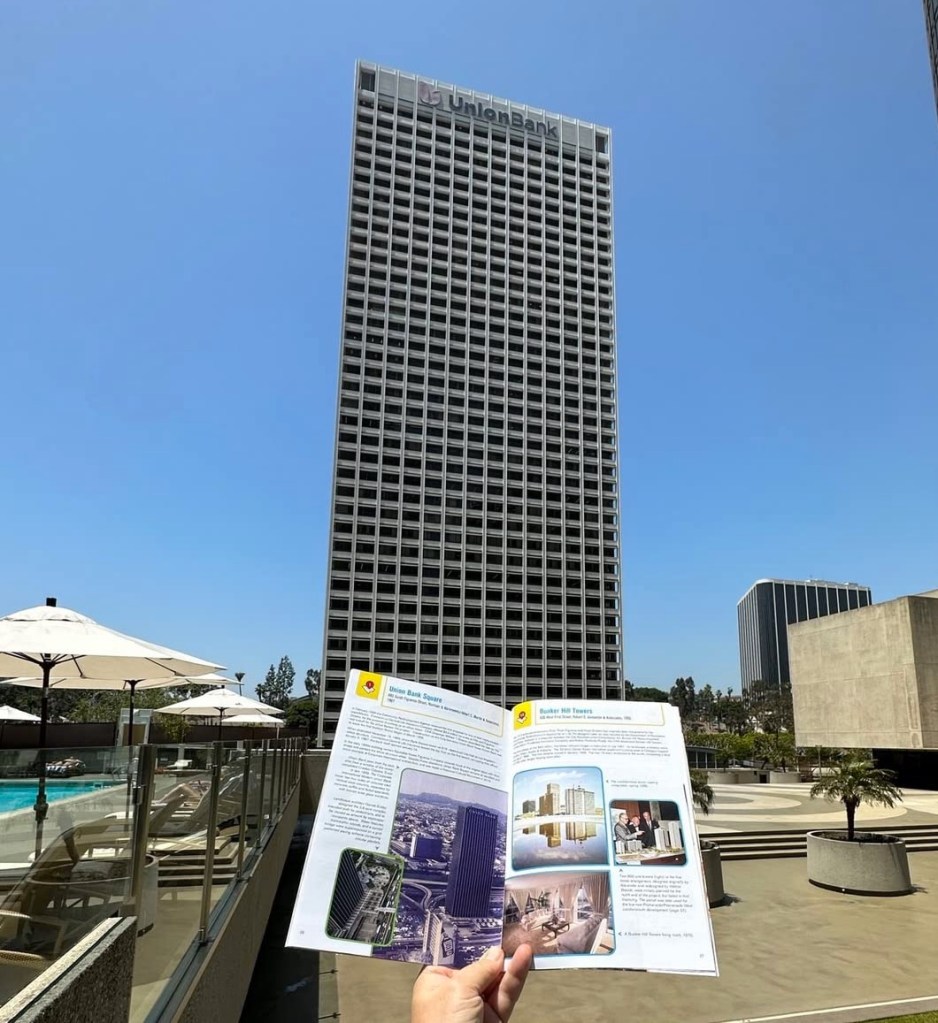
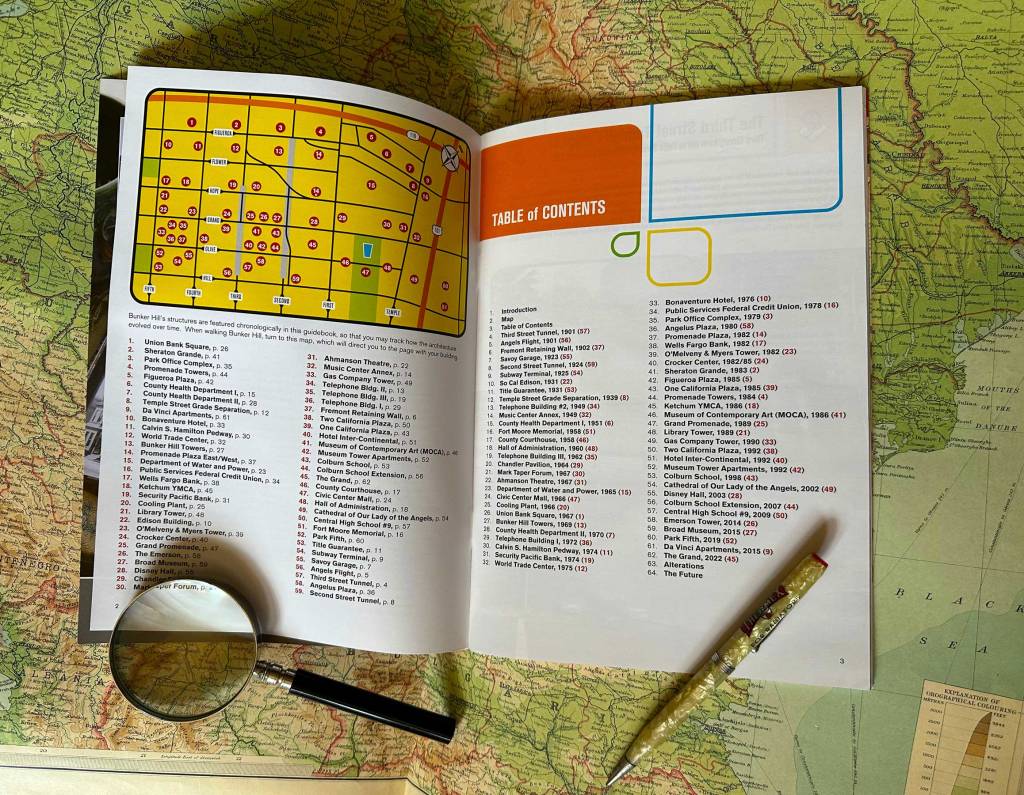
And now, for your edification and delectation (and as a shameless plug for Marsak’s Guideto Bunker Hill, on sale!) may I present the third and final installment of Bunker Hill Then-and-Nows: The Modern Years—
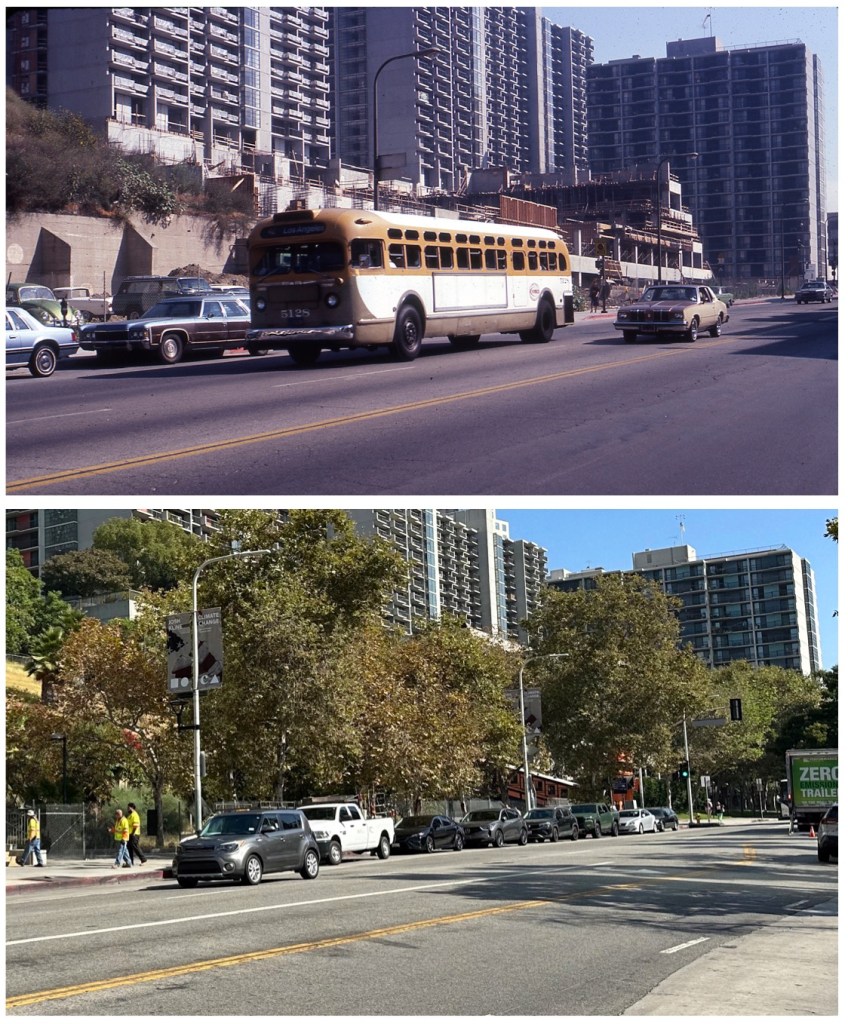
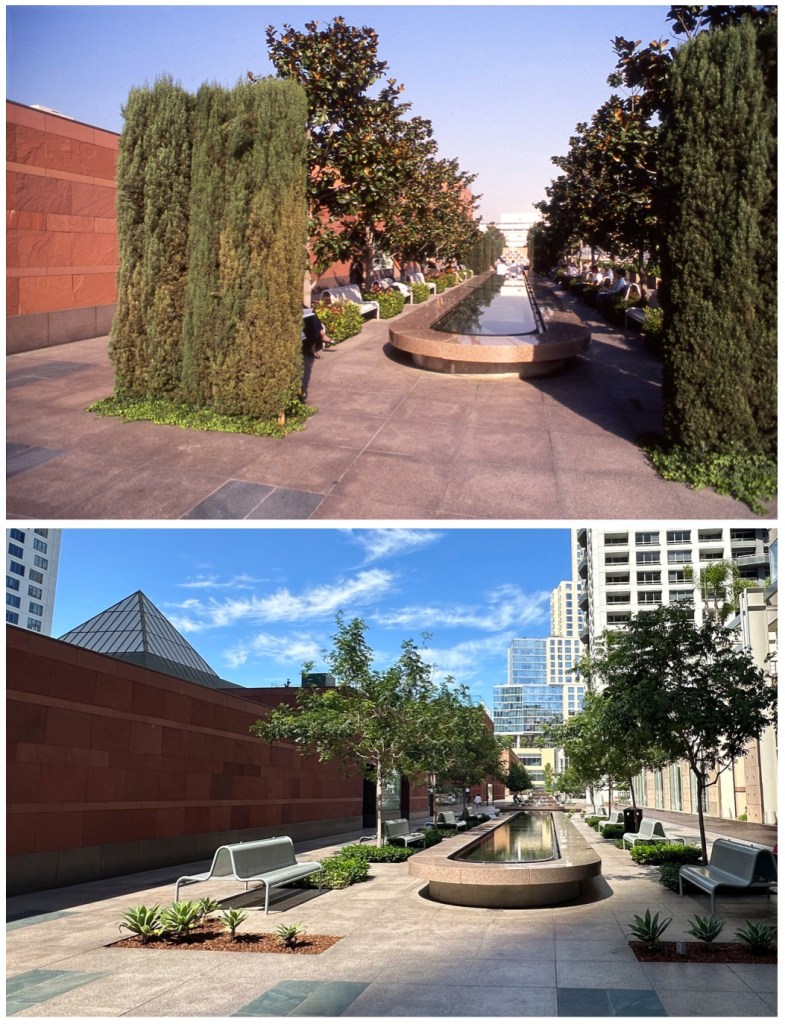
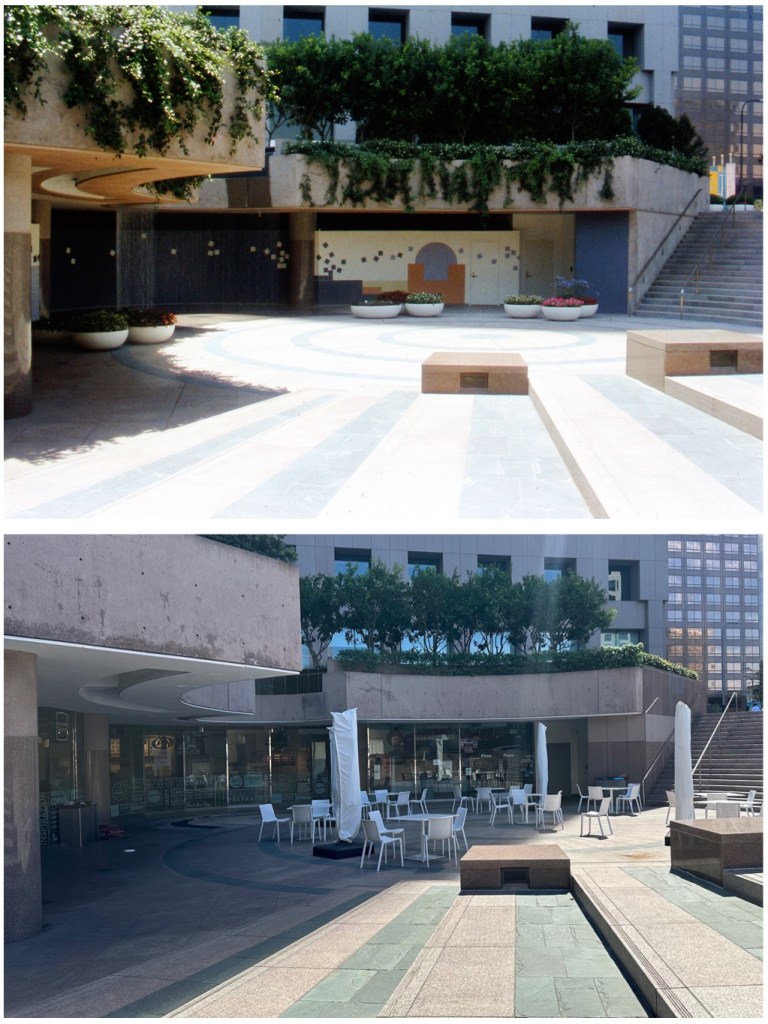
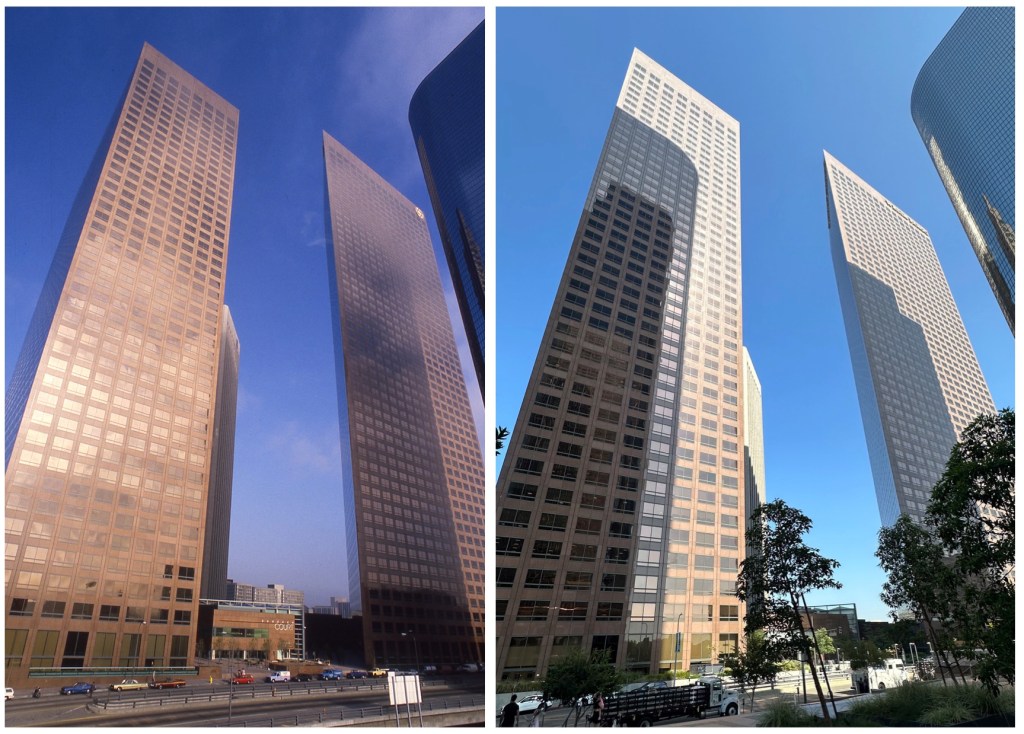
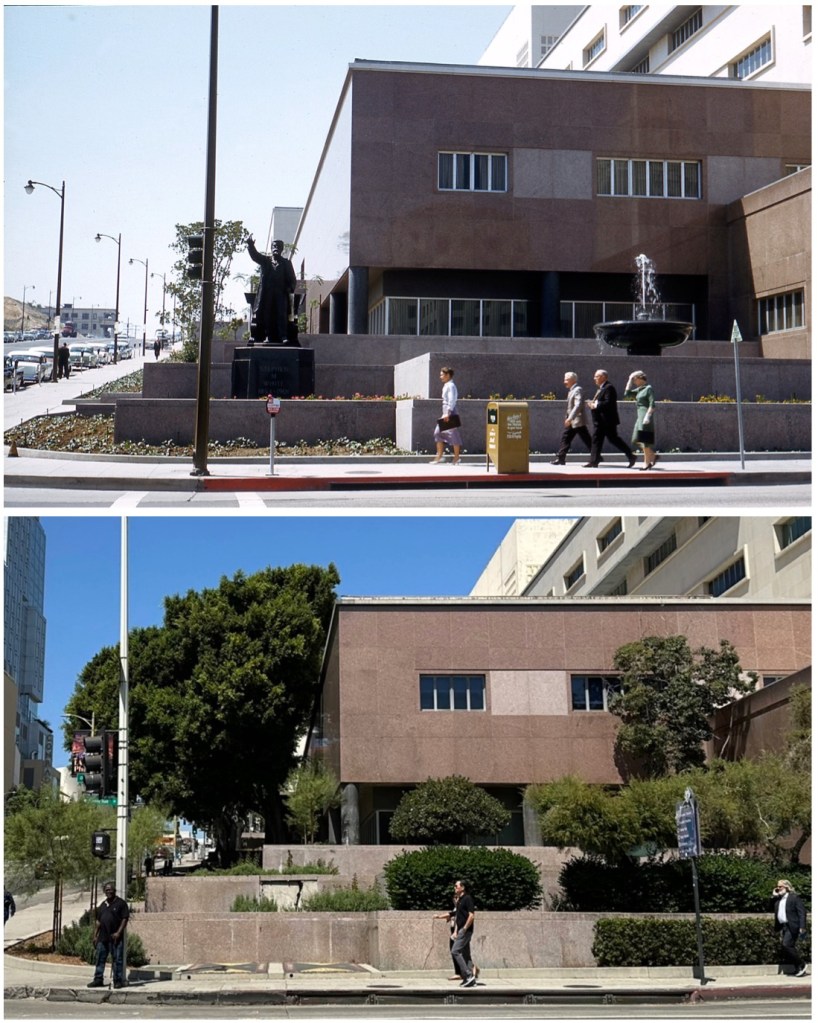
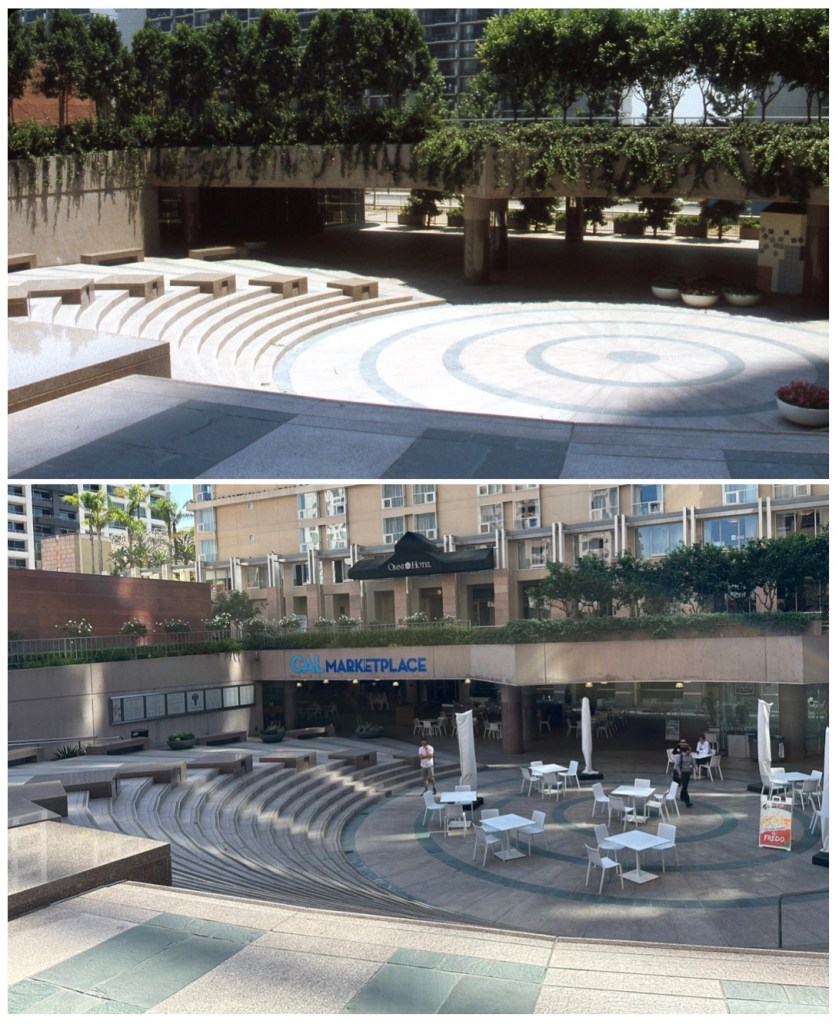
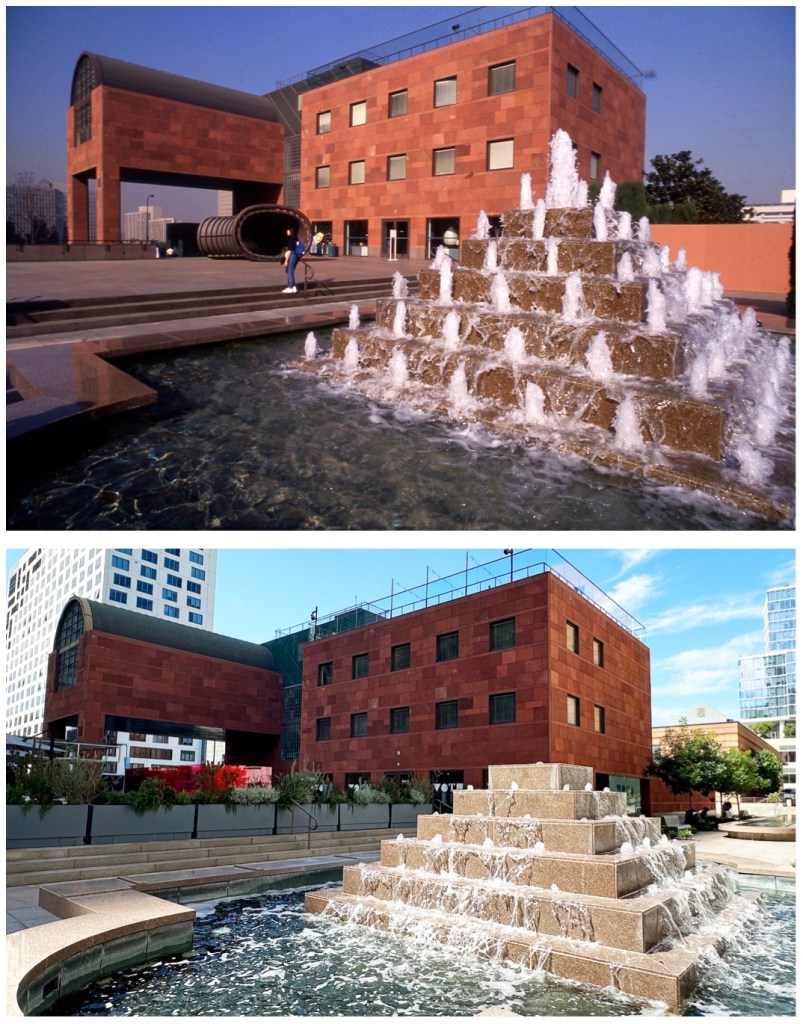
Looking west across the Music Center Plaza, August 1965. The view on the once-sunken plaza originally framed the neighboring DWP, flanked on either side by the Chandler and Taper. It is now however the scene of mass rallies in front of huge television screens (oft destroyed by blonde ladies flinging sledgehammers). The sculpture is Jacques Lipchitz’ Peace on Earth, dedicated May 1969, initially placed at the center of the plaza (since shunted off to the side in the recent Rios Clementi Hale reconfigure). At the dedication, Lipchitz stated “if peace does not come, it’s a bad sculpture.” Well… Looking north on Hill from near Fourth Street, July 1980. Behold the famed retaining walls, adjacent the slot where Angels Flight would be returned in 1996. Rising above, Angelus Plaza nears completion. Looking north inside California Plaza, ca. 1987. The reflecting pond (leading to the fountain) and original seating remains. It took vision and dedication to plant mature magnolias and cypress, which have since been replaced. The view west on Fourth Street from Grand Avenue, April 1981. At left, under construction, is the Manulife Plaza, a project of Manufacturer’s Life Insurance Co. (Albert C. Martin & Associates, 1982); that view is now blocked by the Ketchum YMCA (also AC Martin, 1986). Inside the Security Pacific Bank plaza, looking west, March 1984. Security Pacific’s 1974 gardens, by Sasaki, Walker & Associates, included an orchard of evergreen pears, with fountains cascading to a lower pool (intended to connote a Mayan cenote). The whole was ringed in jacaranda above and willows below, with masses of flowering plants throughout. The narrow fountain pools are based on Spain’s Alhambra and, though they are dry in our Sunday-shot “now” image, they do run on weekdays. “Most clients ask us for a plaza,” said principal Peter Walker in November 1975, “but Security Pacific asked us for a park, and that makes all the difference.” The gardens at Security Pacific are arguably the best spot in Los Angeles; owner Brookfield (the Toronto megacorp famous for demolishing Bunker Hill’s Halprin atrium at Crocker Court) intends to put a tower there. Looking south on Grand Avenue, ca. 1983. This image shows the O’Melveny & Myers Tower (Robert Tyler for Welton Becket Associates, 1982) with some of its original sixty-eight Italian cypress that ringed the structure (along with runnels and other water features, also lost). Dallas-based CBRE Group bought the tower in 2012, and while it retains that name on its facade, CBRE sold the building in 2016 to a partnership of Pittsburgh’s PNC Realty and Munich’s GLL Real Estate. Behind, the Library Tower looms o’er grandly. Inside California Plaza, looking south with Grand Avenue at right, July 1986. Above and behind the trees, the lower portion of skyscraper One California Plaza, which opened in December 1985; the plaza is oh so very, very Arthur Erickson. Though it has lost its planter pots and they’ve trimmed away the charm of hanging vines, the property remains remarkably intact. Less intact are crucial elements of Erickson’s Cal Plaza design, including the water features in neighboring parts of the plaza, now lost (e.g. this and this).
Looking southwest from near Temple at Hope, August 1967. This grouping of Inyo County boulders, at the northeast corner of the Department of Water and Power campus, are a significant, and fairly unknown, element of the DWP landscape. (For another nifty vintage pic of the grouping, check out this 1965 Shulman.) In doing this then-n-now, I discovered to my horror that one of the rocks (the smallest at center-left) was missing! The plaque in the modern photo (left) reads “These ancient granite boulders were brought from picturesque Alabama Hills in Owens Valley. The rocks are estimated to be 200 million years old. Owens Valley is the source of a large portion of the water service for the City of Los Angeles.” I don’t have to tell you, of course, that that plaque leaves out a lot of…stuff.
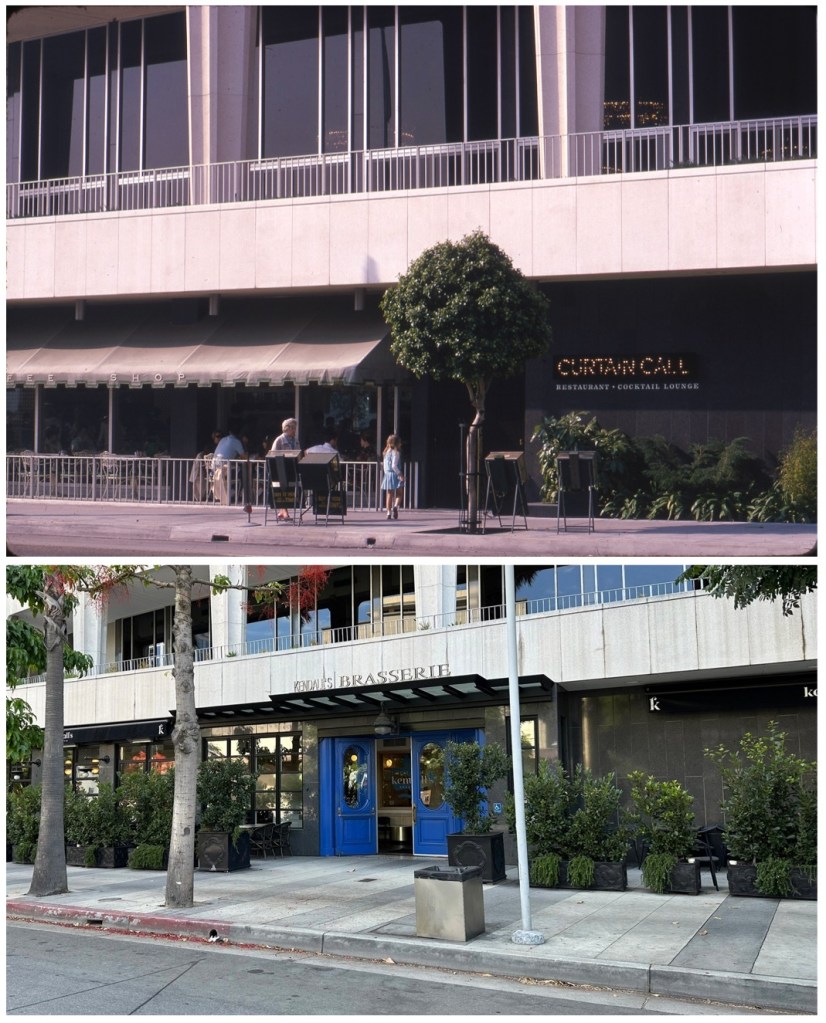
Looking southwest on Grand Avenue toward the Music Center, January 1967. When have you ever seen a shot of the Curtain Call? (If you have one, I showed you mine, you show me yours!) The fifth floor of the Dorothy Chandler Pavilion contained the large and elegant Pavilion Restaurant; downstairs was its smaller, warmer neighbor, the Curtain Call. Curtain Call was decorated with mementos of early Los Angeles theatrical life. Note that the bulb signage in the 1967 shot was used in its advertising, like this matchbook; as a Fred Harvey, with a penchant of vintage LA theater, it had an “olde-tyme” feel to its branding. The Curtain Call became a Hungry Tiger in 1980, which became Otto Rothschild’s Bar and Grill in late 1986. The space has housed Kendall’s Brasserie since November 2003.
I trust you have enjoyed these last three weekends full of Bunker Hill Then-and-Now photography.
If you’ve found these investigations of modern Bunker Hill interesting, might I suggest you buy the book! And again, I thank you for your attention.
As promised, more then-and-nows!Part I of our three-part then-and-now extravaganza can be enjoyed by clicking here (and there’s a Part III as well).
I’ll admit, these then-and-now posts serve a twofold purpose: to broaden the discussion regarding contemporary Bunker Hill, certainly, but also to whet your appetite for exploring modern Bunker Hill’s structures, which is best done by buying a copy of Marsak’s Guide to Bunker Hill. (It would be extremely prudent to so this month, given as they are on massive sale, about which you may learn everything by simply clicking here.)
Now, on with the show!
Looking south on Figueroa across Third Street, ca. 1985. Shot from the pedway connecting Bunker Hill Towers to The Park (a pedway in the distance connects the World Trade Center to the Sheraton Grande). Note the two-way Figueroa traffic; Figueroa became one-way northbound from Olympic to Third in December 1986. Also note Union Bank, upper right, has been painted white, in an early-90s remuddling by owners Equitable-Nissei. South of Bunker Hill, a number of towers have sprung up; most eye-catching is a glimpse of the curious Châteauesque roofline of the Home Savings Tower (Tim Vreeland/AC Martin, 1988).Looking south on the west side of the DWP “moat,” circa 1966. Prominent in the vintage image, the mighty Union Bank, still unmolested by white paint-slathering morons. At far left the Richfield Building and behind the fountain, the Architects Building, both replaced, now, by the ARCO Towers (seen poking out, just a bit, behind the 1968 Bunker Hill Towers, at left in modern image). The view to the southwest, where once we saw the Union Oil Center, is now blocked by the Promenande Towers, with 333 Beaudry behind—the Beaudry Center is by the now-forgotten William Rockhold, of Nadel Partners, the group who reached the absolute nadir (or would it be zenith?) of 1980s Los Angeles vacuity.Looking north on the hill near Hope and Third Streets, August 1968. The contemporary view is lower, since the hill was cut down for the Security Pacific Bank plaza. The structure at right is the 1966 cooling plant. Under construction is Bunker Hill Towers.Looking east across Grand Avenue toward the Crocker Center, July 1987. Note the Crocker Court, which once contained the Halprin atrium, as mentioned last week.The view north on Grand Avenue from near Third Street, ca. late 1986-early 1987. Behind, now, the Grand, the Colburn Expansion, and Museum Tower. And hey! Say what you will about our descent into barbarism, at least now we have trees.Looking west up First from Hill Street, May 1959. If the statue of Stephen White were still there, its pedestal would obscure the missing broken panel on the Courthouse. Look closely up First and you’ll see the Majestic/Lima/Rossmere at First and Hope Streets, two years prior to its July 1961 demolition.Looking east near Grand Avenue and Third Street, into California Plaza, circa 1988. Note that once you could look straight through at Angelus Plaza, fronting Olive Street, before the construction of Cal Plaza’s Hotel Inter-Continental.
The view south on Grand, November 1965. The Pacific Telephone Communications Center main entrance is marked with a mosaic mural by Anthony Heinsbergen, dedicated in May 1961. On the mural Heinsbergen attached coin box chutes and capacitors and other telephone components. The figure at center holds aloft tranatlantic cables and a satellite transmitter, and above, Echo One, the first Bell communications satellite, relays a radio transmission beamed to Russia. Heinsbergen’s vision also featured an odd placement of the continents, including an upside-down Australia. Los Angeles Times columnist Jack Smith launched a (tongue in cheek) crusade through the 1970s to have Australia righted, involving telephone company executives and the Australian consulate. Smith may or may not have had a hand in righting the continent, but at some point it was in fact removed, turned right side up, and reattached.
That’s it for today! Tune in next weekend for Part III! And remember, you can’t tell the players without a program!
Who doesn’t love a good then-and-now photo comparison? (If you hang around this blog, I’m gonna say you do at least). When I moved to Los Angeles thirty years ago, one of my first windows into Old LA was Gernot Kuehn’s Views of Los Angeles, an incredible then-and-now photobook published in 1978 (another reason you should get a copy is the 1970s “now” photographs are themselves amazing, and Kuehn’s Views deserves a contemporary “then and now and now” updating).
As regards Bunker Hill, of course, one issue with comparing past to present is the absolute obliteration of the landscape (e.g. this and this from Brian Hsu’s Urban Diachrony). A tangled nest of Victorian wooden buildings compared with some modern concrete behemoth isn’t nuanced; it’s just jarring.
So, I thought it would be interesting to compare modern Bunker Hill with…slightly more modern Bunker Hill. To this you may exclaim “what’s the point of comparing the Security Pacific Bank with…the Security Pacific Bank? It still looks the same!” and you’d basically be right. In any event, I’m going to compare some relatively recent shots of postredevelopment Bunker Hill with how it looks at present, just to gauge its changes, no matter how minor. This I do because it’s fun and interesting, but also underscores how much of “new” Bunker Hill is itself reaching its dotage—much of postredevelopment Bunker Hill is actually older than much of “vintage” Bunker Hill was when demolished in the 1960s—and as such, we’re in for preservation concerns among the modern landscape (a theme touched on in the last few paragraphs of this post).
Also, it occurred to me that I will likely go to my grave without anyone seeing even a fraction of my collection, including all those binders stuffed full of delightful (though less-desirable-to-the-masses) ’70s snapshots and ’80s Kodachromes. So, why not do a post that features some of ’em, just for kicks? Let’s go!
Looking south on Grand Avenue across Temple Street, March 1985. Note at left, the Crocker logo (Peter Graef, 1970), and at right, the Security Pacific logo (Saul Bass & Assoc., 1966), and between the two, the 1962 Wells Fargo “diamond” logo, designed by Walter Landor Associates, which WF ditched about 1995. Bottom image, post-1985 additions to the landscape include the Library Tower, the Wilshire Grand Center, and Disney Hall, glimpsed behind the Chandler Pavilion. Looking north on Hill across Fourth Street, January 1976. Today that hill maintains it basic contours (though the shape of old Clay Street has mostly disappeared), and is now known as Angels Knoll, or maybe Angels Landing, in any event, it’s totally fenced off, to the consternation of those wishing to recreate 500 Days of Summer. The bits of retaining wall glimpsed behind the bus I covered at length, here. That tree is of course of enormous importance, and lives to this day in the forecourt of Angelus Plaza, where it was moved in 1981. We’re told that, someday, this area—site of an unrealized third Cal Plaza tower—will look like this, but I wouldn’t hold my breath. Looking north across the Music Center Plaza toward the Mark Taper Forum, September 1967; in this image, the Taper had been open five months. The coolly elegant sunken plaza was designed by Cornell, Bridgers, & Troller, whose municipal projects included the nearby Civic Center Mall and the Department of Water and Power. Five years ago, the Music Center was “reimagined” by Rios Clementi Hale Studios, removing the sunken element so that mass rallies could be had in front of giant television screens. The area has since been renamed Jerry Moss Plaza; Moss was the “M” in A&M Records. Check out another nice vintage shot of the Taper and plaza on p. 21 of Marsak’s Guide.(Did I mention Marsak’s Guide to Bunker Hillis on sale?)Looking west from California Plaza toward the Museum of Contemporary Art, ca. 1987. Ah, MOCA, the World’s Worst Designed Museum™ (as discussed on p. 46 of Marsak’s Guide). Time was, you could stroll straight up onto MOCA’s forecourt from Cal Plaza, but the museum has since controlled that entrance. I’m thrilled the fountain is still there (water features are always the first to go) but its jets have gone a bit limp. The two major structures in the bottom image are the goofy-windowed Emerson Tower, left, and The Grand, right. Fun fact: my time at MOCA helped kickstart a fascination with Bunker Hill, so, I very much owe them that.
Crocker Court, July 1986 (known as Well Fargo Court after November 1987). In 1980, Crocker Bank commissioned famed landscape designer Lawrence Halprin to create an atrium filled with gardens, water features, and sculptures, as the centerpiece of the Crocker Center project, The $20million atrium was conceived of as “an urban, indoor Garden of Eden,” later described by Halprin as “a psychologically restoring haven.” Brookfield Properties bought Wells Fargo Center and demolished Halprin’s work in its entirety, replacing it with this inspiring laminate-covered food court. I discuss Crocker Court a bit in this video and, of course, in Marsak’s Guide.
Looking north on Grand Avenue across Fifth Street, February 1978. The mighty Edison Building—as seen on p. 10 of Marsak’s Guide—stands proud and relatively unaltered: when ownership group Rising Realty/Lionstone/Hermes bought the building ten years ago, they pledged to rip off all those 1980s “greenhouse” additions; while they did replace the fourth-floor balcony greenhouses with canopy structures, the upper story greenhouses remain. The new owners also renamed the building CalEdison, which is all fine and good, but why can’t the neon lettering (as seen, for example, on p. 149 of the Big Book) be returned to its roof? At far left, note venerable survivor the Engstrum (BHLA, p. 169) which was finally replaced, of course, by the Library Tower. Note in left foreground, the low wall, enclosing Central Library’s east lawn at the southwest corner of Fifth and Grand, until replaced by this (Hardy Holzman Pfeiffer Associates, 1993).Looking south across the east side of the reflecting pool at the Department of Water and Power, ca. 1976. There are few things I love more than the incredible “moat” that encircles the DWP building. (The fountain seen in the contemporary image is original to the DWP; it just wasn’t running when the earlier image was shot.) Look closely and you’ll note the pool was once lined in Mexican pebble. Also, if you look very closely, left, you’ll see the pool once had a border of rectangular aggregate panels, raised above the water’s surface on supporting members. Of course, in the distance, a whole host of new towers block some of the structures (Crocker-Citizens Bank, Pacific Telephone) that appear in the earlier view. Security Pacific is dwarfed by new neighbors, and Promenade East now obscures its bottom. Note that at far right, the ARCO towers—once, matching twins of Miesian grandeur—have had their bilateral symmetry ruined when A C Martin’s facade was bastardized (which I talk about, a bit, here). The view south on Grand Avenue from Third Street, April 1969. Most prominent is PacTel at 420 South Grand Ave., with its signature microwave tower. Also prominent in the 1969 shot is Crocker-Citizens, right, now obscured by the Wells Fargo (née Crocker) Center. Hey, if you really want to geek out on Hill minutiae—this building is the garage at 318-322 South Grand (seen here in 1962 and 1950). It was demolished by the CRA in June 1969, two months after the image at left was captured. And do you know who designed that garage in 1917? Albert C. Martin! And the “new” Bunker Hill has AC Martin represented via a number of structures including the DWP, Union Bank Square, Security Pacific Bank, Wells Fargo Bank, and Ketchum YMCA.
Ok! Well that’s some of the then-and-nows I have on hand. Come back next Sunday, when I’ll post another gaggle of these!
Well good thing for you Marsak’s Guide to Bunker Hill is now 25% OFF!
That’s right, what was once $20 is now only $15. Marsak’s Guide to Bunker Hill is available on eBay and naturally on Amazon, sure, but:
…you’ll end up paying a few extra bucks for shipping should you go the eBay/Amazon route, which is fine; although, if you Paypal/Venmo me directly, it’s FIFTEEN EVEN and I’LL COVER THE PACKING AND POSTING!
****Get yours now, because when they’re gone, they’re gone!****
(no seriously, the cost of printing has skyrocketed in the last couple years, and if I reprinted these I’d have to charge $40 a pop, and no-one wants that)
as is the Venmo: eckener@kingpix.com AKA @Hugo-Eckener
Still on the fence? Read more about Marsak’s Guide to Bunker Hillhere, and see what local felines have to say on the matter here, and view a helpful instructional video here.
OH! And come back to this blog tomorrow, Sunday Sept. 1, when I will present a then-and-now post involving modern/contemporary Bunker Hill that shall fill you with wonder, and absolutely convince you to buy two copies.
“And once you have your copy, you too can gaze languidly, and confidently, into a future replete with greatness and intrigue.” —Boris
Time to check in on the bunk! Now, bunk is not a word you hear often—bunk being short for bunkum. Bunkum means foolish claptrap and lemme tellya, our silly world of Los Angeles is all-fire replete with that.
Plus, you know, bunk, Bunker Hill, it all ties together. Lately I’ve taken to task the bunk-ridden establishment narratives about Bunker Hill-related topics like Cooper Donuts, Chavez Ravine, and Pershing Square, and I thought it would be fun to “check in” on these subjects and see how the ruling class is conducting itself of late.
Why do I care? Some of you might say “well, you’re an old meanie, just trying to tear down the stories of marginalized people!” and of course the opposite is true. I’m all for the stories of marginalized people, but those stories have to be accurate. Inaccuracy makes me angry and offended in general, but particularly when it bleeds into Los Angeles history. Don’t believe me? I once played LA Noire for an hour and the next day wrote five thousand words about its inaccuracies. I saw Ask the Dust and nitpicked the living hell out of it. And those are fictional/fictionalized depictions—stuff like Coopers/Chavez/Pershing is the government and other unethical folk telling us “we now provide you the true version of actual historical events, which you know to be true because…we say so” when they are, knowingly or not (spoiler alert: knowingly) peddling blatant untruths.
So! Without further ado, let’s poke our noses into what’s new around town—
***COOPER DONUTS***
As you are undoubtedly aware, it has been conclusively proven that there was never a Cooper Donuts riot (the only person who ever claimed an unverifiable kerfuffle even happened and/or was a witness to said event, stated it did not happen at a Cooper’s) AND it has been conclusively proven there was never, as the only telling of the tale asserts, a Cooper Donuts between the famed gay bars on the 500 block of Main Street (e.g., Harold’s at 555 South Main…and no, before you say “well it happened at Second and Main which is nearby and has to be true because Kevin de León put a plaque there” be advised that is, as well, false, because there was no Cooper Donuts anywhere near that corner in either the spring of 1958 or 1959, when said lone witness claimed the event occurred).
And yet, these simple facts didn’t stop muralist Judy Baca, who depicted the myth on a mural at LACMA.
In her cynically dishonest artwork, Cooper’s—represented as sited adjacent Harold’s—was the location where trans POC battered LAPD with pink donuts. Let’s agree it’s a nice picture and is uplifting for the LGBTQ+ community, and isn’t that the point, stories that fill us with pride? In which case it’s no different from, say, a grand salon painting of Napoleon’s triumph at Waterloo. Let’s pretend for a moment that a monumental nineteenth-century canvas called Napoleon’s Triumph at Waterloo hangs in the Louvre, and that picture is a magnificent source of emotional and spiritual uplift for the citizens of France, I suppose, despite it being based on absolute horseshit. A French reverence for that painting wouldn’t make the French look strong and proud; it would make them look foolish.
Any mention of Baca’s work will tell you she consulted historians and scholars, but of course I don’t have to tell you, painting a fanciful image of something that didn’t happen is the opposite of history. It’s ironic that what she is painting is assuredly not history, despite the mural’s official title being The History of California.
Buried Under the Blue, who triumphantly exclaimed “we did it!” when the bill was announced, have since become really cranky about the bill, and critical of the bill’s author, Councilmember Wendy Carrillo. Apparently all BUtB really wanted to do is go after the Dodgers (guess they figure it’s better optics to go after the deep pockets of a corporation, than the deep pockets of taxpayers). But, to Carrillo’s credit, since the Dodgers had nothing to do with the depopulation of Chavez Ravine, Carrillo left them out of the bill. BUtB’s frothing hatred of the Dodgers being so pronounced, they have since, therefore, branded Carrillo a traitor to La Raza.
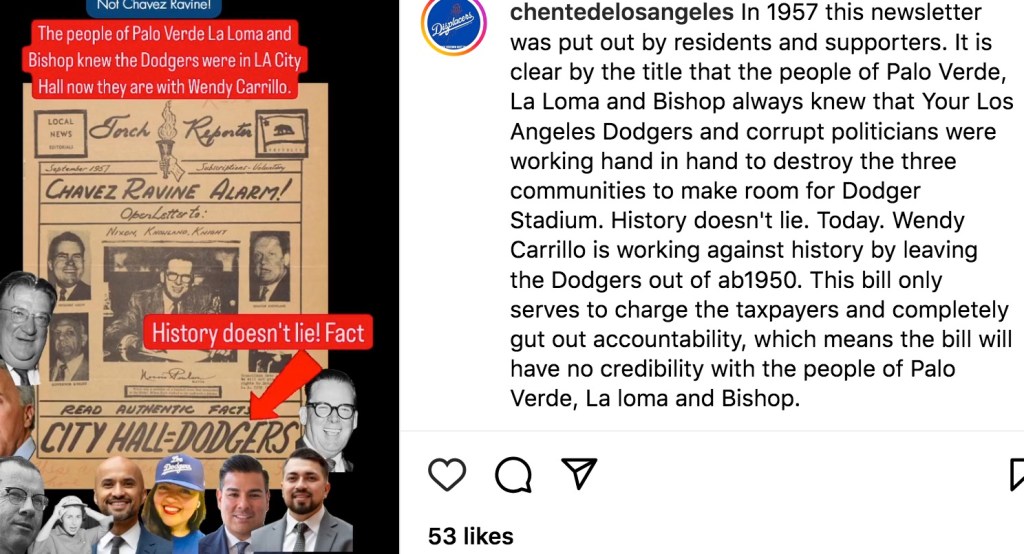
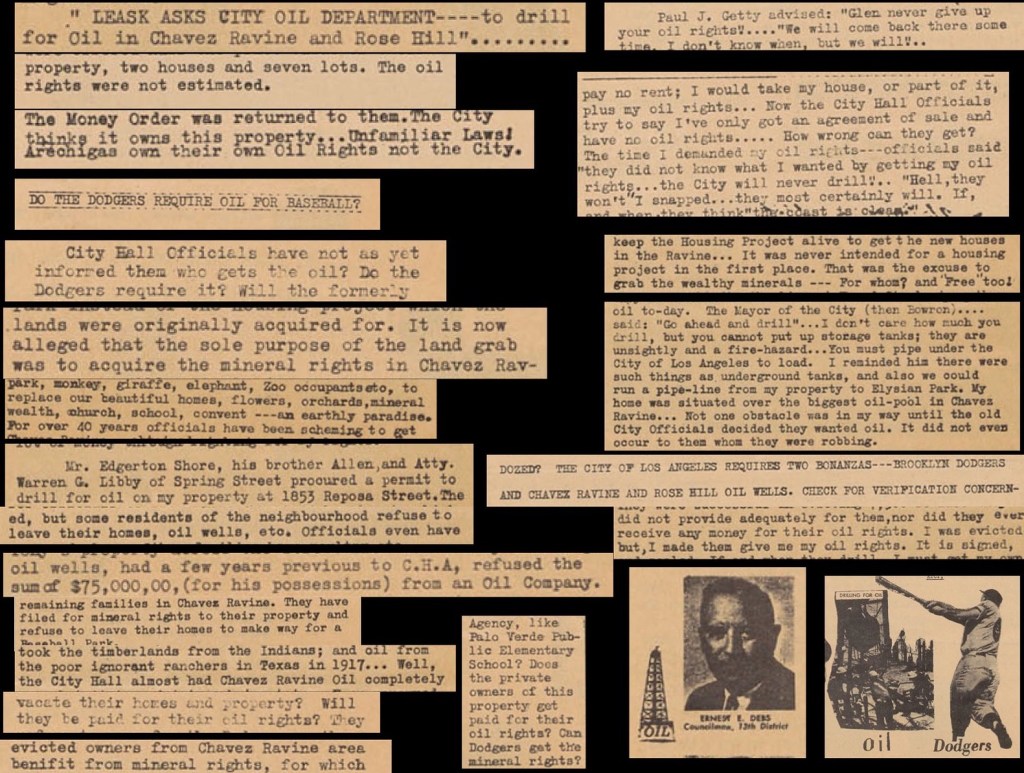
In other news, BUtB has recently posted a couple shots of an anomalous 1950s self-published newsletter that’s online at UCLA. BUtB again attempts some gaslighty slight-of-hand by putting a screengrab on social media and then claiming “look! This archival document PROVES all sorts of malicious Dodger forethought and diabolical political activity!” when, of course, a study of the actual material doesn’t bear that out at all. (BUtB has done this sort of thing before, like when they posted a shot of a letter and said “look! Here’s PROOF the Dodgers knew about La Loma, Palo Verde and Bishop years before they came to Los Angeles and were working actively to destroy the communities!” when of course should you actually read the letter, it says nothing of the sort.)
In this case BUtB at last discovered the 14-page newsletter (in my day we’d have called it a ‘zine) online at UCLA, called the Torch Reporter, printed in September 1957. According to BUtB, it was put out by “residents and supporters.”
True, it was put out by a supporter—a lone woman named Tara Joyce, who lived in Hollywood. The September ’57 Torch Reporter is full of Chavez Ravine (Joyce subsequently dropped Chavez Ravine and turned her attention, in the next issue, to the question should West Hollywood incorporate as a municipality?) and exists as a minor, but interesting, piece of Chavez curiosa: Joyce was all worked into a froth, especially, because she worried about oil. Yes, back in the day, the big question was who was getting the mineral rights? According to the Torch Reporter, there was never a plan to build public housing; that was all misdirection in the greater scheme to steal Chavez residents’ precious oil—which only residents of Chavez Ravine should be allowed to drill. Drill, baby, drill!
Twenty-plus mentions of oil rights in a mere fourteen pages. Apparently, Buried Under the Blue are yelling about “land back” so they can start fracking…
In any event, BUtB discovered the Torch Reporter online and said “this proves” City Hall and the Dodgers were at work to knowingly and specifically destroy La Loma, Palo Verde, and Bishop.
Note top right it says they’re “collecting archival documents.” As someone whopainstakingly maintains a climate-controlled archive, you taking screengrabs does not count as “collecting archival documents.”
See the Instagram screengrab above, claiming here exists “proof” the mayor was working to “take our homes”? Yeahhhh, so, if you actually read this page of the Torch Reporter, it only discusses how that, during one of Mayor Poulson’s speeches, Poulson didn’t mention Chavez Ravine, and Tara Joyce is irked because she thinks he should have. (A similar conversation— Joe: “Did you know Eisenhower used ray guns to kill all the Portuguese? I have proof!” Bob: “How do you have proof of that?” Joe: “Because Eisenhower gave a speech, and made no mention of it!”)
Besides being largely about retaining mineral rights, Joyce’s Torch Reporter contains all sorts of wild claims: for example, that 7,500 families were removed (um, nooooo). It claims the Church of Santo Niño, at 1034 Effie, was “built by the evicted families of Chavez Ravine” (it was built by the Diocese). And so forth. The first-person accounts by Glenn Walters and Alice Martin are exceptionally interesting and valuable, though. Read it all for yourself by clicking here.
***PERSHING SQUARE***
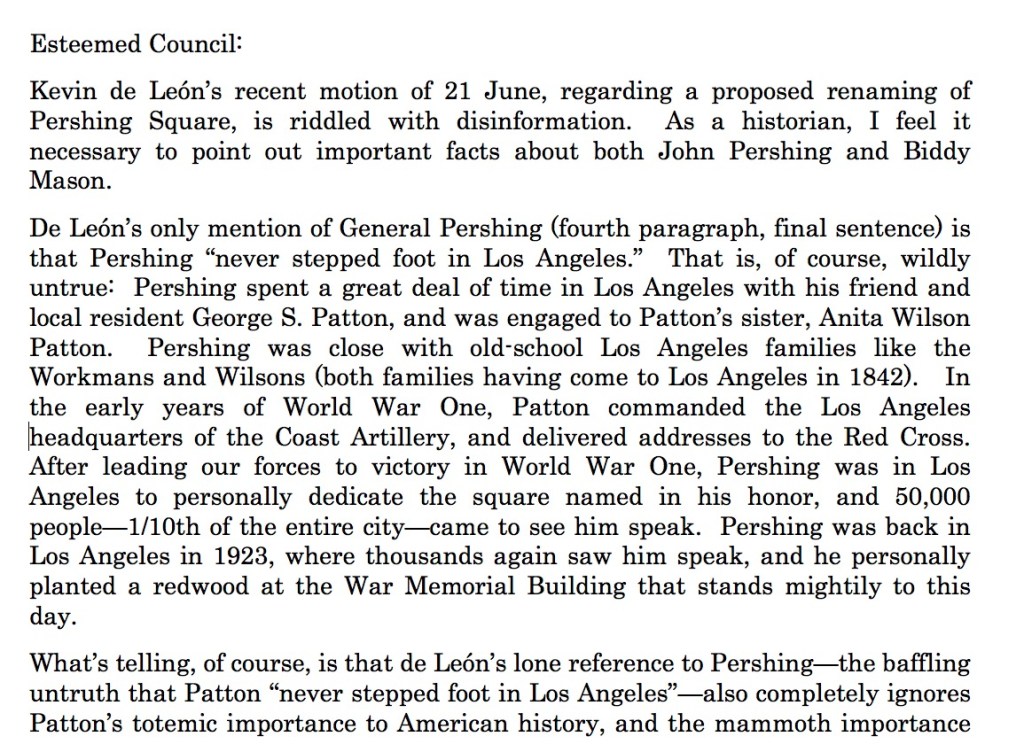
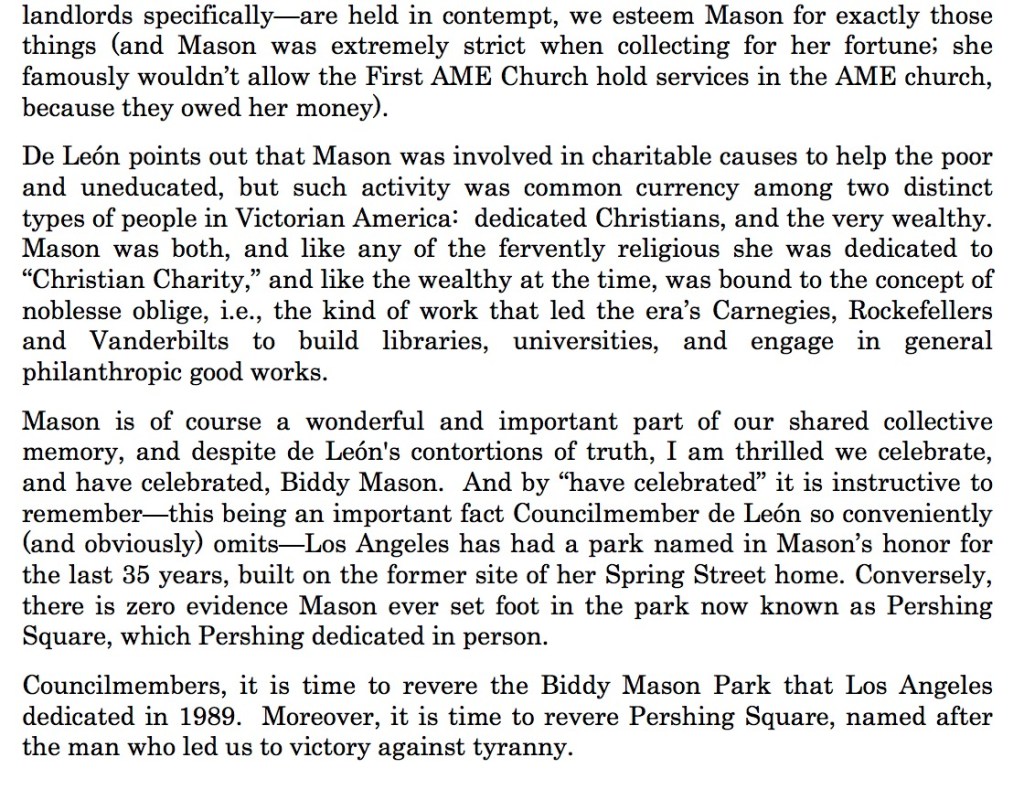
Not a lot going on with the renaming of Pershing Square; it’s still pending in committee (the Neighborhoods and Community Enrichment Committee, to be precise). I submitted a comment to the City Clerk, which you may read here, but it’s annoying that when one submits, their bot converts your message to a single paragraph. I’m not smart enough to figure out attaching PDFs, as Bob Wolfe did in his excellent “Communication from Public.” Therefore, here are my comments with the proper paragraph breaks:
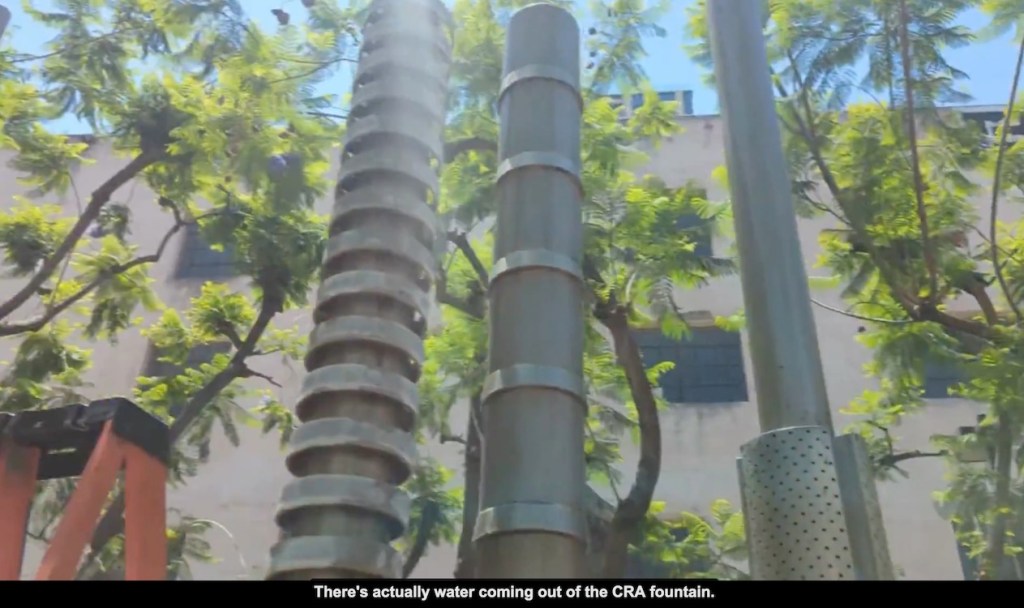
The big news, though, about Biddy Mason Memorial Park, is that the water features have been restored—
Those being the updates on that which falls under the “debunking Bunker” umbrella. One of these days I’ll tuck into some of the other juicy Los Angeles stories that so desperately need to be disproven…until then, then!
We all love great painters, especially those who depicted Los Angeles, right? And, subset of subset, specifically those who gravitated to Bunker Hill, capturing its picturesque charm.
Some favorites: the enchanting Leo Politi and his watercolors of Bunker Hill (there are libraries and schools and public squares named after the man, not to mention this exhibit). Ben Abril is well-loved for his picturesque California scenes, often focusing on old Los Angeles and Bunker Hill in particular. Emil Kosa Jr. is one of the great California scene painters and remembered for having captured Bunker Hill on his canvases; same with Victor Czerkas. And of course Millard Sheets, titan of Southern California regionalist scene painting, is best known for his masterpiece Angel’s Flight, a noirish tour de force about Bunker Hill, which hangs at LACMA.
And yet one of the greats is almost utterly unknown. Her name is Kay Martin—I love her, and you should too.
I. The Early Years
Eva Katherine Whittenberg is born in Springfield, Illinois, July 14 1910, to Eva (née Rice) and Alonzo Lindolf Whittenberg. Eva Katherine is the youngest of six girls born to Eva and Alonzo; Alonzo is a government secretary to the state of Illinois there in Springfield.
Eva Katherine grows up, and she goes by Kay. So it’s 1931, she’s 21 years old, and living in Bloomington, about sixty miles north of her native Springfield, attending Illinois Wesleyan University. There she meets a nice young fellow named Lowell Beckwith Martin—he goes by Beck. Beck is in the insurance game (his father Lester is the president of the Great States Insurance Company). Beck and Kay get married in September of ’31, lovely affair at St. Mathews Episcopal.
Kay has developed as an artist; her artistic training includes the Illinois State Normal School, where she took crafts and design, and the aforementioned Illinois Wesleyan University, where she excelled in her fine arts studies, and dug deep into the history of art and design. Kay and Beck had been married a decade and change when in 1943 they lit out for California, Glendale specifically: Lowell becomes an insurance man for Forest Lawn. Kay becomes a student of the great California landscape artist Ralph Holmes, and a student of famed English transplant California landscapist Dorothy Baugh, and a student of the unbelievably important “King of the Eucalyptus School” Sam Hyde Harris.
But she didn’t go that way, artistically, with all that plein-air painting among the trees of the arroyo, no. Back when Kay was attending Bloomington’s Illinois Wesleyan she began to developer her own style as a staunch urbanist. She depicted day workers, and WPA scenes, but once in Los Angeles her interest in the urban landscape would take her, though, down a different road from the Social Realists. Her aim was to capture the vanishing built environment, and have fun doing it.
II. The Productive Years
Kay’s living with Beck in Glendale, it’s 1955, and something catches her eye: Bunker Hill.
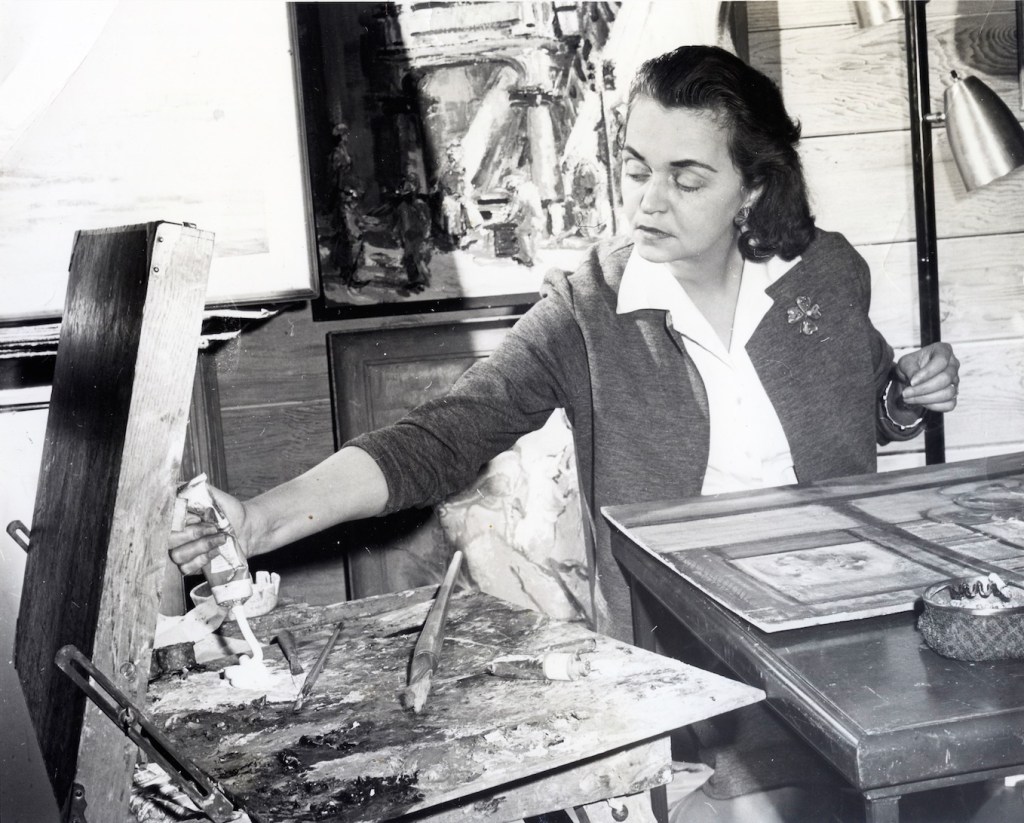
The vast swaths of Victorian buildings had been earmarked for demolition by the government and so, she set out for the Hill and began sketching. She would sketch and paint and sketch some more, and finish her paintings at home, and go back to the Hill and repeat the process. She became known as “The Vagabond of Bunker Hill.” The folks on the Hill came to know her well, and know her baby “Dreamboat,” the big white station wagon/rolling studio that came to visit the Hill near daily.
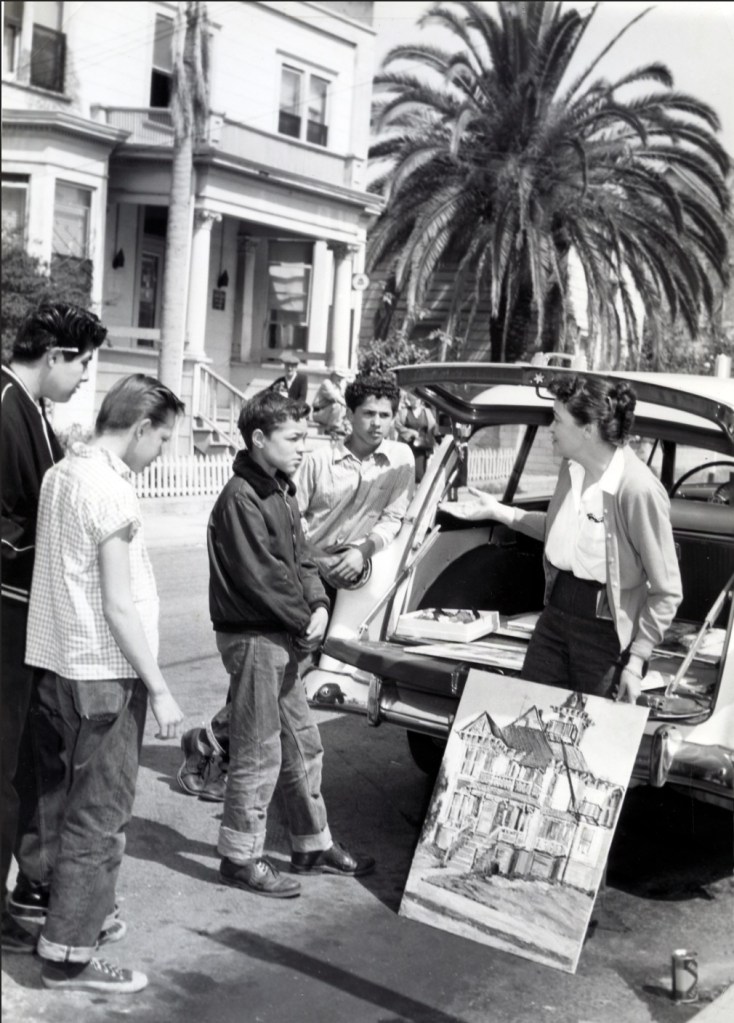
Kay’s parked across from the Earlcliff Apartments, at 231 South Bunker Hill Avenue. True to Los Angeles, there’s a Canary Island Date palm, king of palms. There’s her car, the Dreamboat, a 1952 Ford Ranch Wagon. She’s chatting up a bunch of straight-out-of-central-casting 50s teens, with their rolled-up Levis and pomade-slathered ducktail hairdos. She’s working on a painting of the Brousseau mansion which was on the south side of the street at 238, that is, out of frame foreground right.
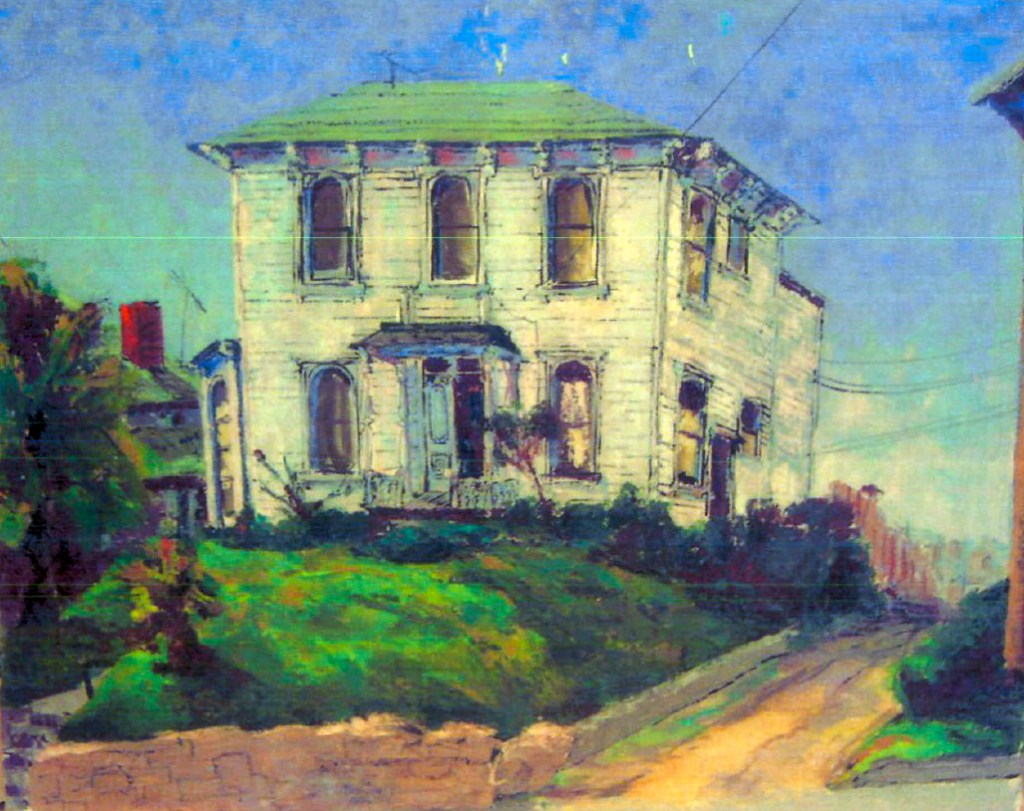
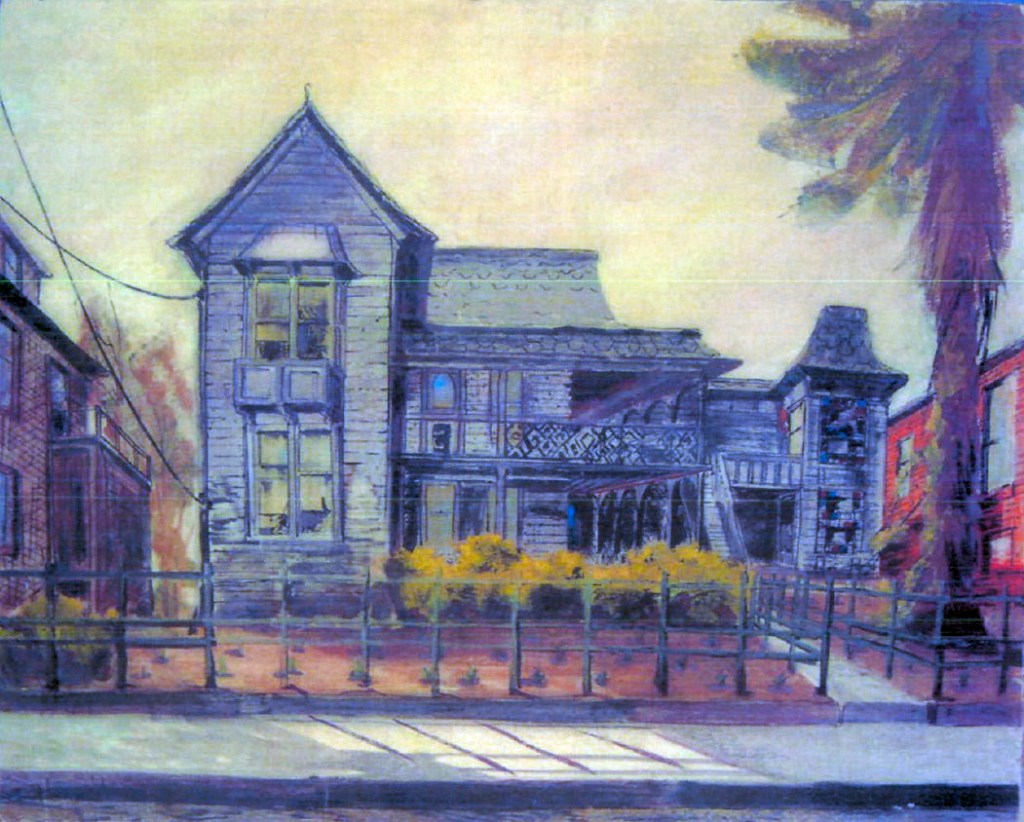
Let’s take a look at some of Kay’s pictures.
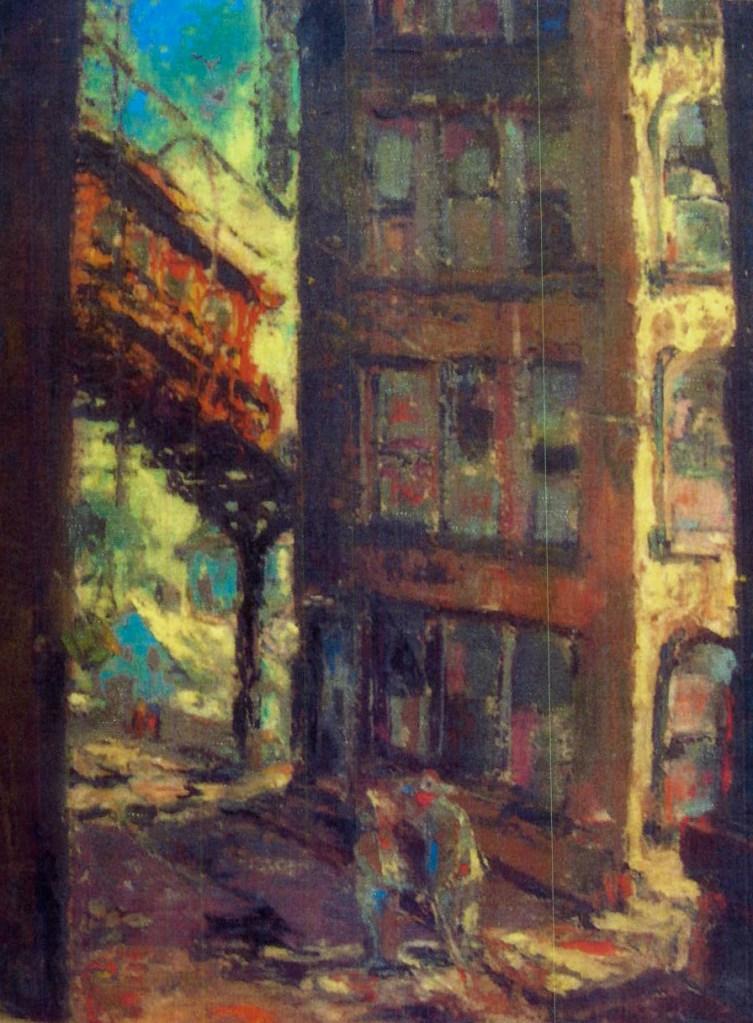
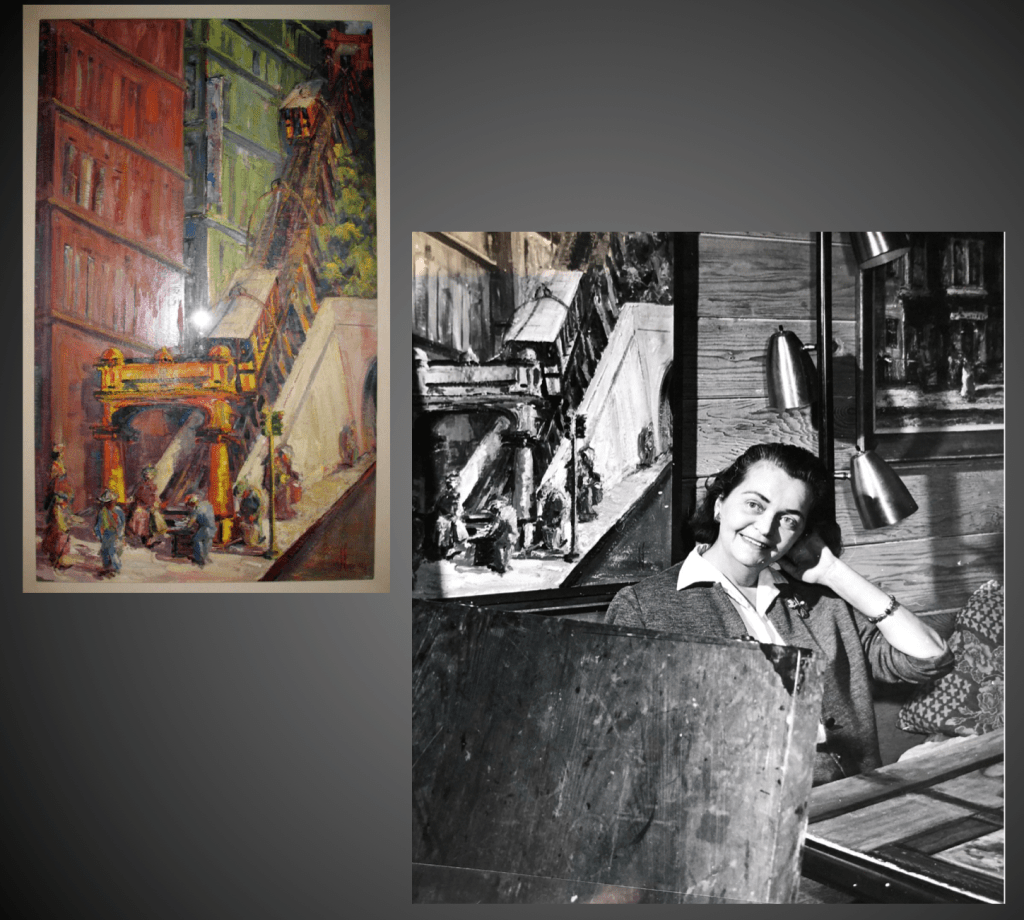
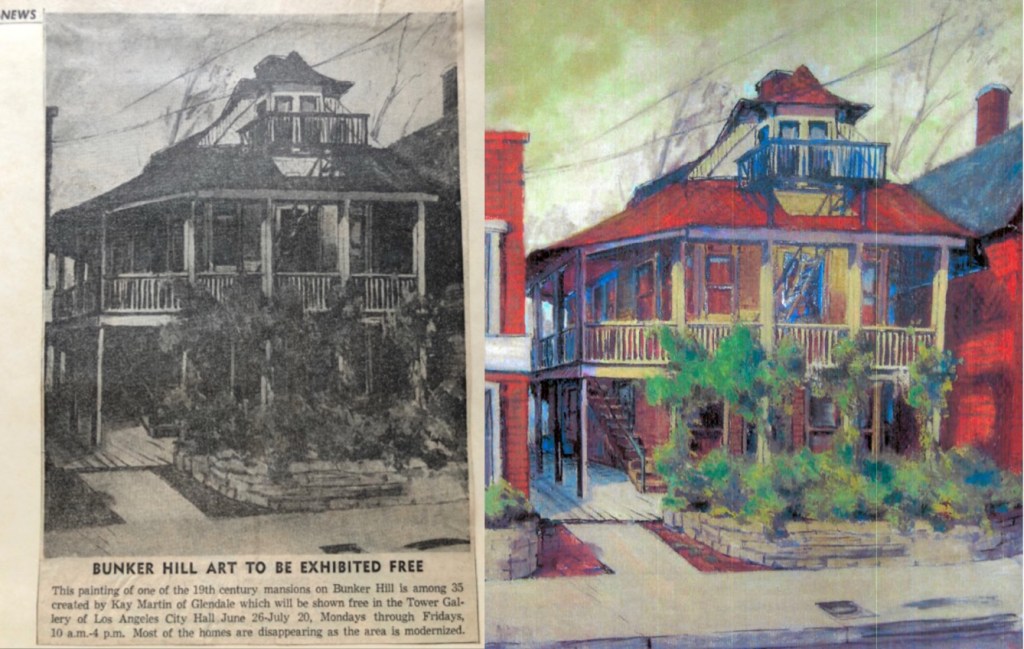
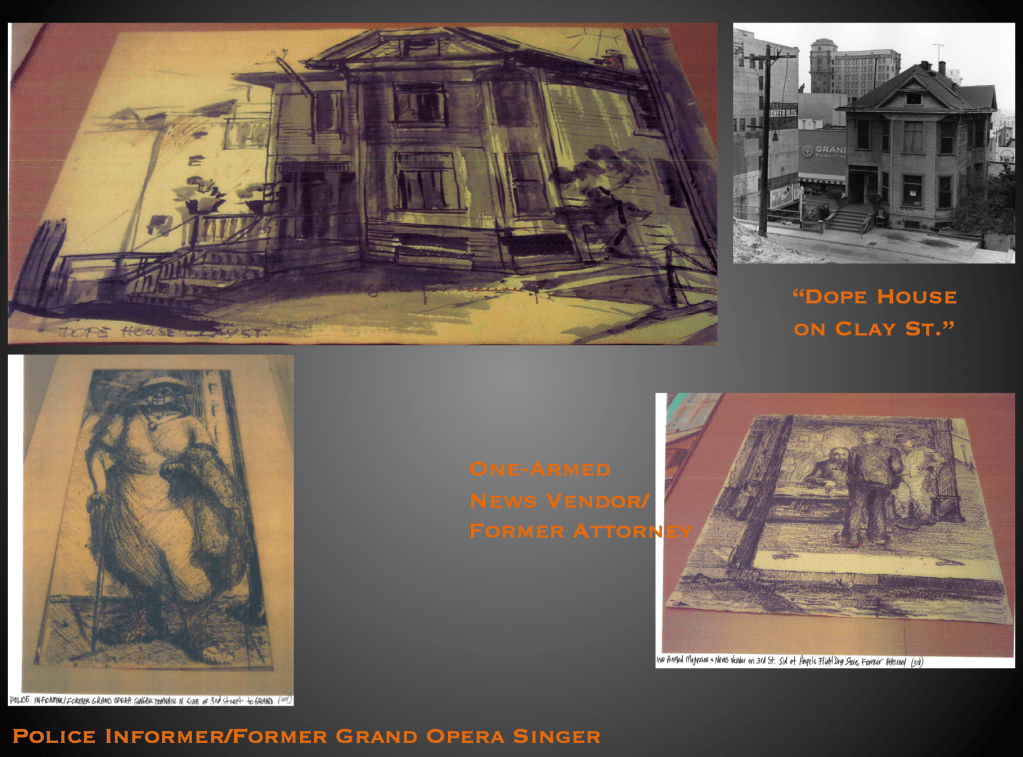
The Castle, 325 South Bunker Hill AvenueThe Salt Box, 339 South Bunker Hill AvenueThe Foss-Heindel House, 315 South Bunker Hill Avenue240-242 South Hope StreetThe benches, where Third Street dead-ended into Bunker Hill Avenue; 301 South Bunker Hill at leftLila Adele Hummel Foth was a noted silkscreen artist, designing mid-century linens for department stores. She was half the husband-and-wife painting team of Forrest and Lila Foth, and Lila had plans to produce a line of printed fabric with designs based on Bunker Hill houses. Needless to say, if that happened, I need some of it real bad.
The view north on Clay Street toward Angels Flight
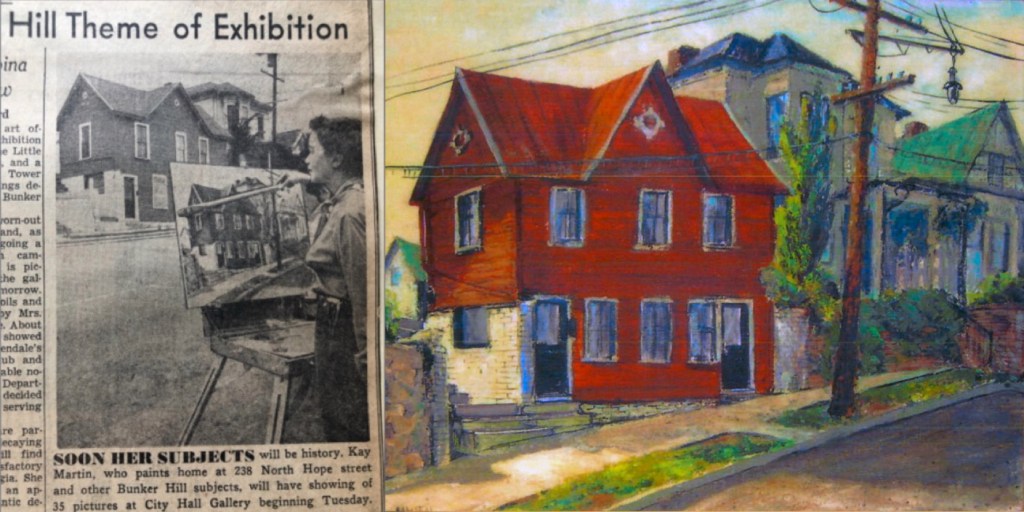
238 North Hope Street239 South Bunker Hill AvenueThe view south on Clay Street toward Fourth309 South Bunker Hill AvenueThe photograph of Kay’s “Dope House” (328 Clay Street) is from the LAPL
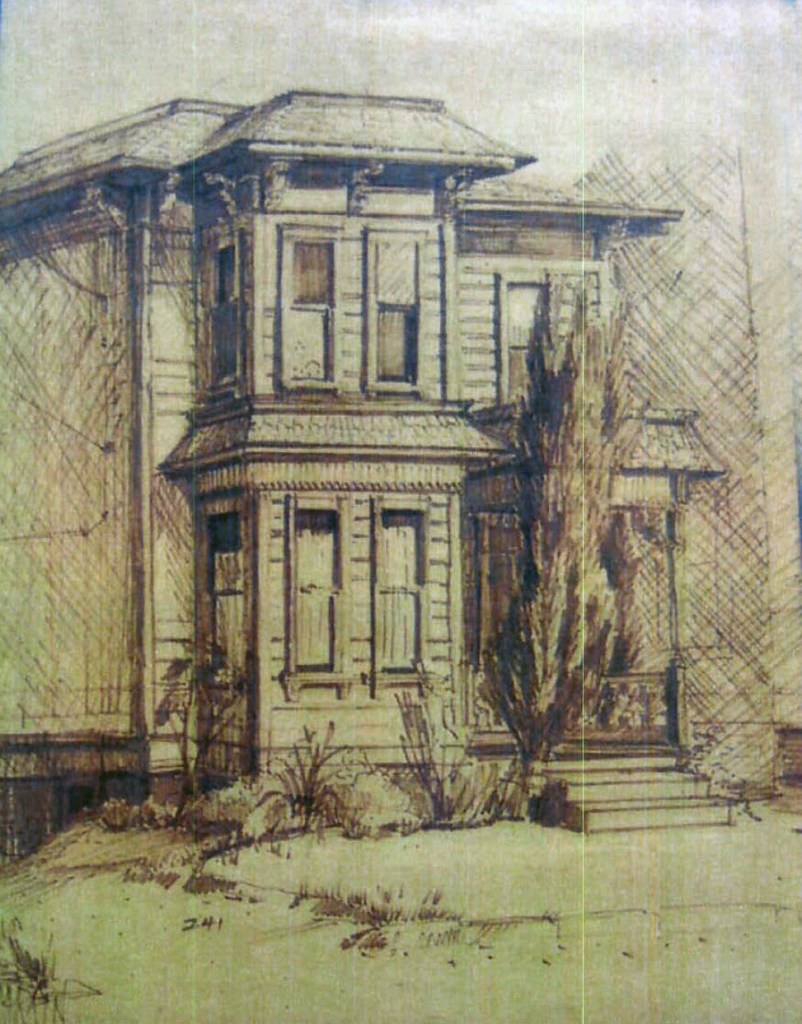
Sketch of 241 South Bunker Hill Avenue
III. Kay Martin: Exhibition, Reception, Awards, Etc.
Now you’ve seen some of her great paintings. You might wonder, were they shown anywhere? Did anyone care? Short answer: they were quite popular. They were exhibited often, won scads of awards, and received dozens of press notices.
Kay Martin’s work was exhibited at the Greek Theater, the Ebell Club, the Tropico Branch Library, and the Casa Verdugo Library. She had shows at Panorama City’s Security First National Bank, and the Bank of America in La Canada, the Glendale Mutual Savings and Loan, and Security Pacific Bank-Prudential Square.
Her most towering achievement was the show in the Tower Gallery atop City Hall. It ran from June 26-July 20 1956 and featured thirty-five oils. To have a one-man show in the Tower Galley was unprecedented; that this “one-man show” was the work of a woman was absolutely groundbreaking. The show was an enormous success, garnering nearly 8,000 visitors.
Kay Martin served as director of the Glendale Art Association, and was a bigwig in the Laguna Beach Art Association, California Art Club, Foothill Artists Group, Foothill Painters, and the group Women Painters of the West. She sat on the board of the Tuesday Afternoon Club. She lectured widely, to every art association in the southland, and spoke to a variety of civic groups and fraternal organizations about old Los Angeles.
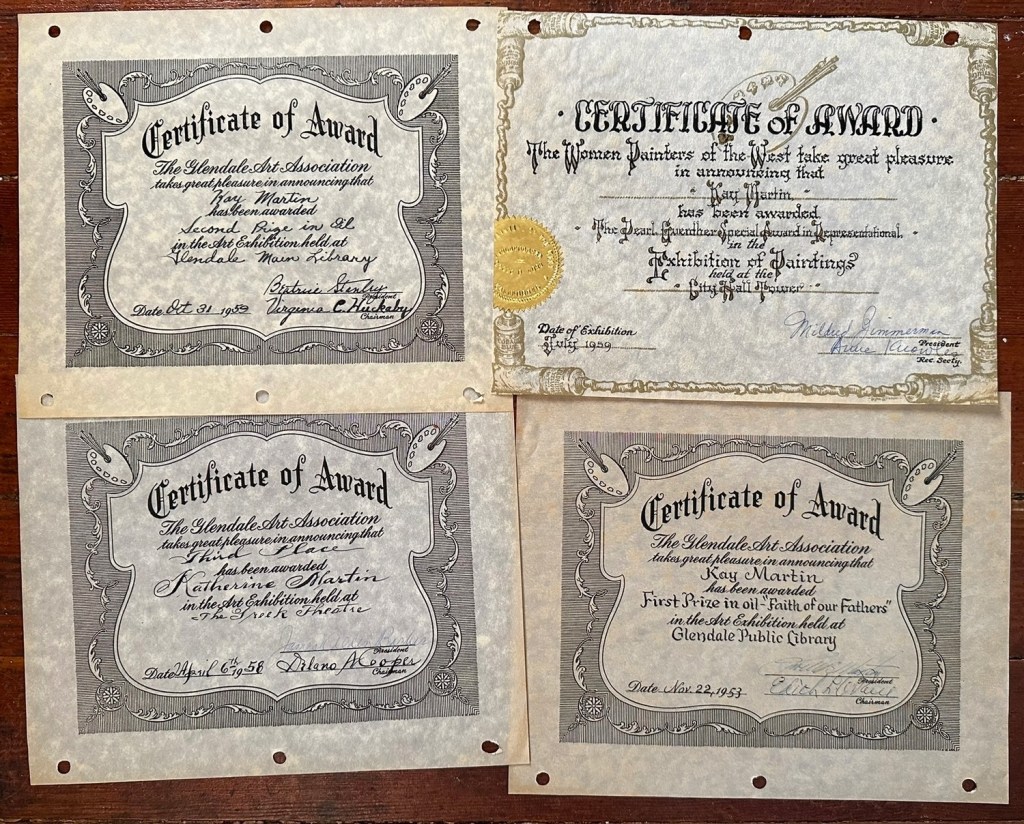
Martin won many local and three statewide awards.
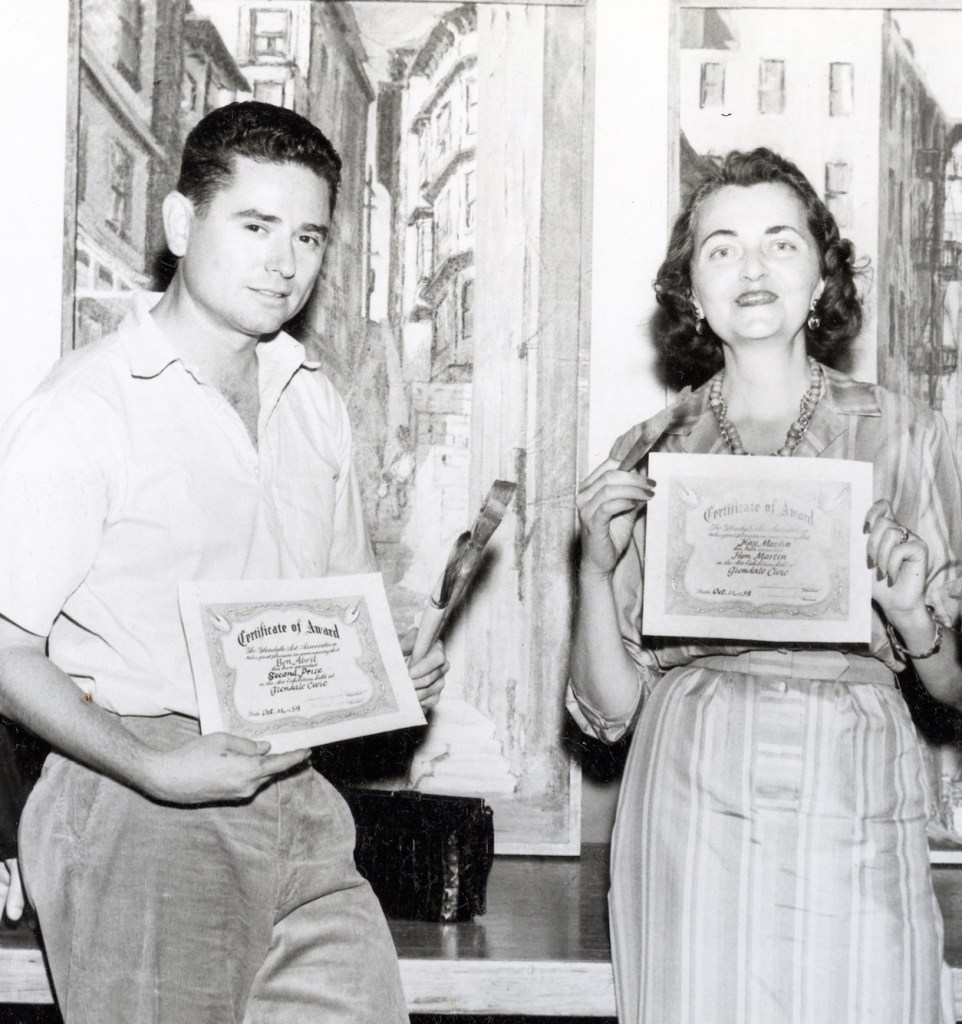
Kay and Ben Abril with their awards at the Glendale Civic, October 1959
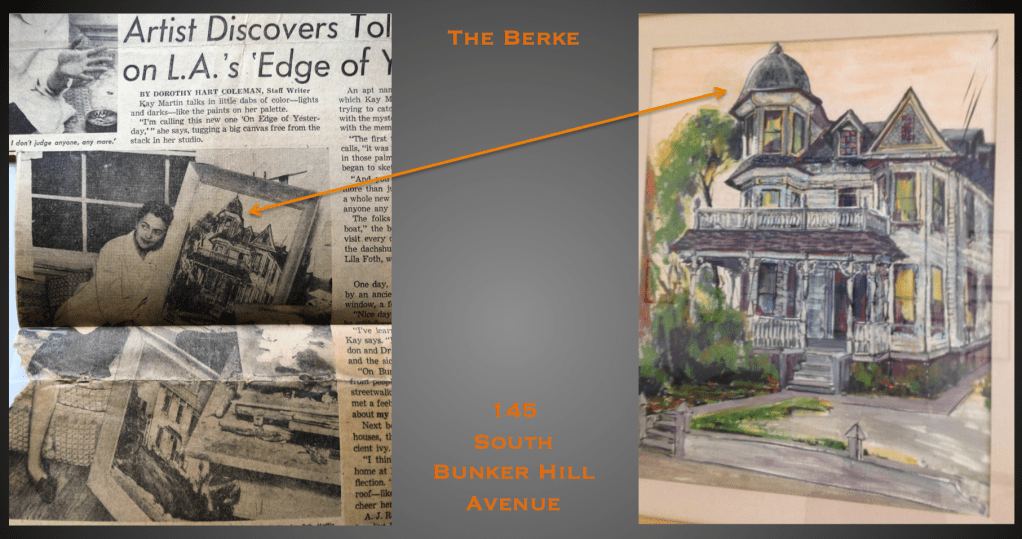
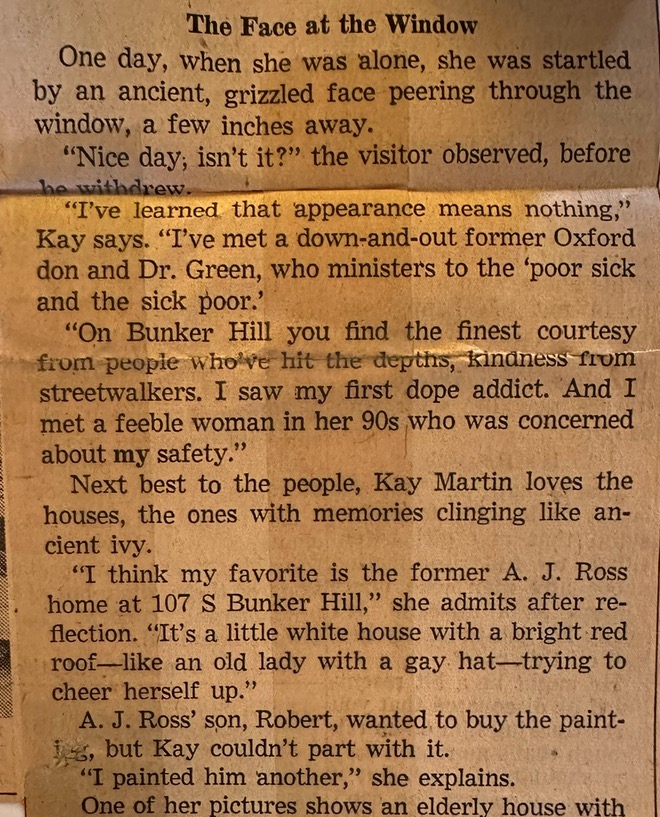
Kay had some interesting notices in the newspapers. There’s an especially charming piece about Kay in the January 15, 1958 issue of the Los Angeles Mirror, titled “Artist Discovers Tolerance on L.A.’s ‘Edge of Yesterday'” in which she describes the way visiting Bunker Hill changed her core:
With all my many articles and photographs, this is the sole mention of Wilhelmina. Perhaps it was Lila’s dog? I must have more Wilhelmina information!
Her painting of 107 South Bunker Hill Ave. is here
Her fondness for old houses is mirrored in her proclivity toward playing dress-up, and reliving the bygone days:
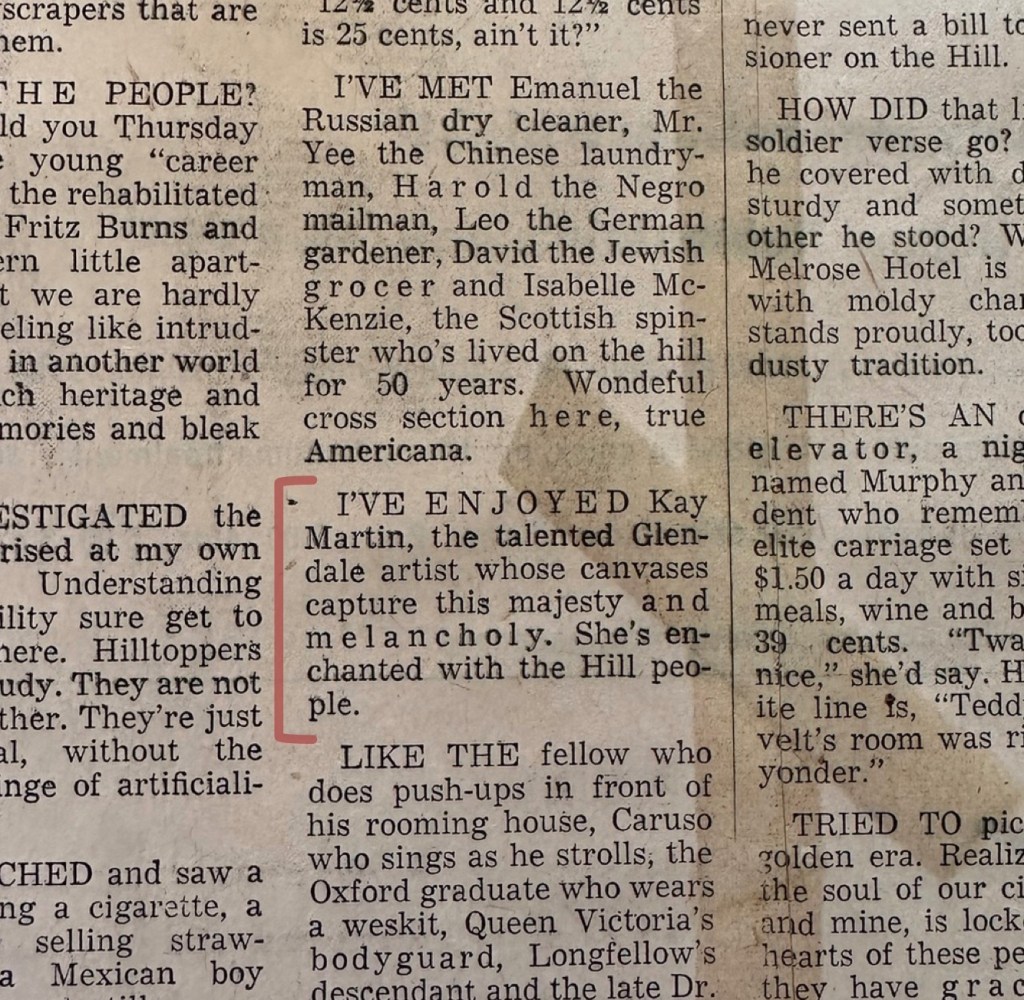
The gals of Kappa Kappa Gamma clown around in their olde-tyme garb on a Tin Lizzie—Kay on the running board—as part of a fundraiser: Oakmont Country Club, May 1957. Kay presented and narrated a costume tableaux…did she collect vintage clothes, too? Kay Martin gets a neat mention, among colorful depictions of the Hill and its denizens, in one of Joan Winchell’s columns, Los Angeles Times, June 10, 1956
IV. Later Years
With City Council’s 1959 passage of the Bunker Hill Urban Renewal Project, the 1960s began with a new under-demolition Bunker Hill, one replete with the sounds of jackhammers and splintering wood, its air full of plaster dust. Kay Martin turned her attention elsewhere.
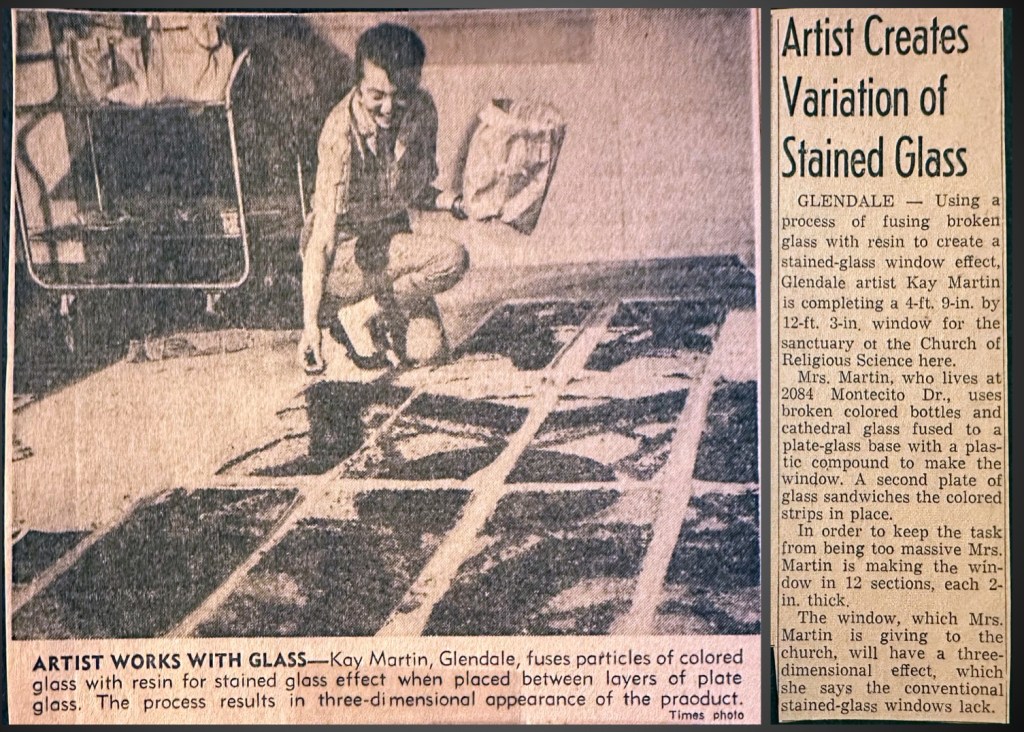
In early 1961, Martin reinvented stained glass:
Los Angeles Times, January 22, 1961
In the autumn of 1962, Kay and her pal Helen Wilkes made a sketching tour through Europe; Kay sold her works at the Independent Gallery, 112 South Maryland Avenue.
Kay also turned her eye to Glendale. Here she is—
Today the Victorian house at 221 North Belmont looks like this, and the rest of the block (the article notes this is “one of Glendale’s most historic streets”) has of course been sadly similarly redeveloped
—painting 221 North Belmont, the little white wooden home where Edith Nourse invited ten friends over for an 1898 birthday tea honoring Mittie Parker; so began the Tuesday Afternoon Club (which disbanded in 1998).
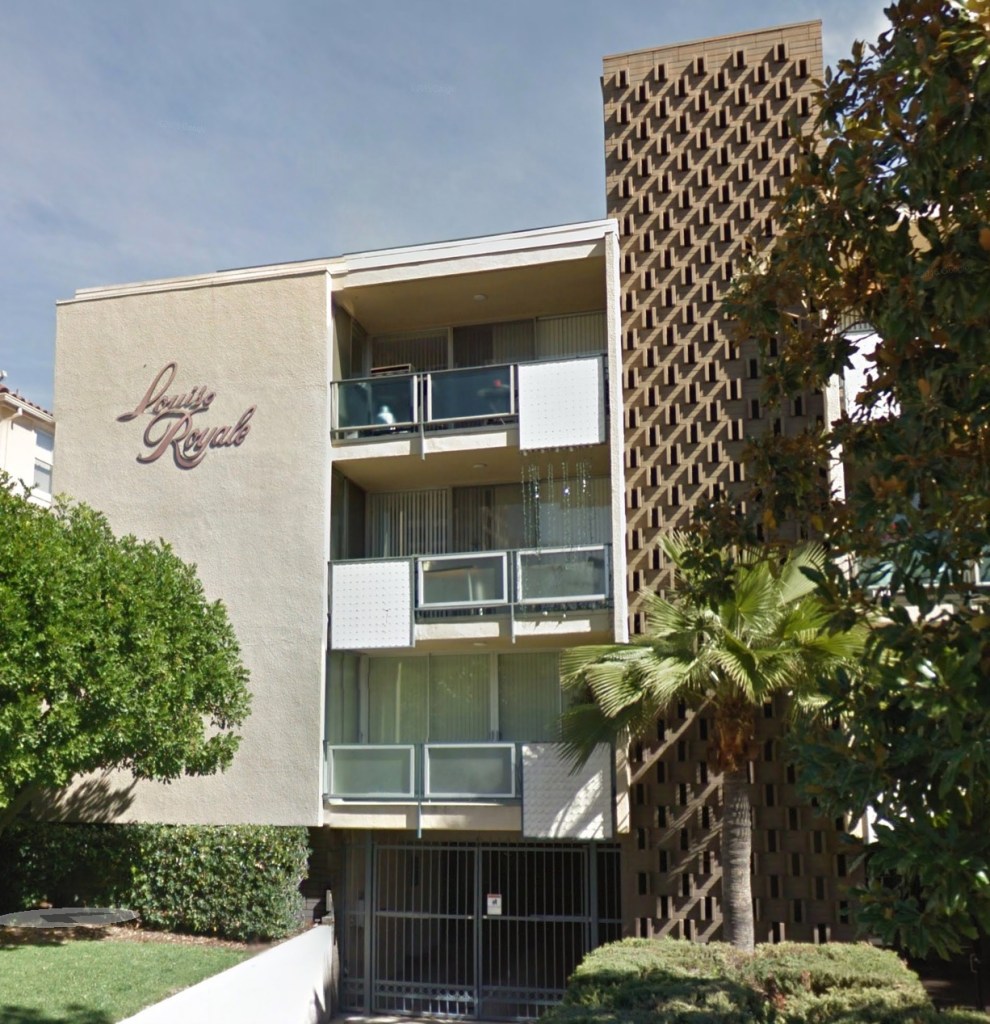
After the early 1960s, there’s little about Kay and Beck. We do know that about 1964, they lost their home to Eminent Domain, ironic, since Kay’s beloved Bunker Hill went that way, too. Their house at 2084 Montecito Drive, in the Montecito Park section of Glendale, about halfway between Oakmont Country Club on the west and Descanso Gardens on the east, was lost when the 2 freeway cut through. Kay and Beck moved into a brand-new apartment complex down in the flats, at 420 North Louise, Apt# 25.
The “Louise Royale,” with its bold script and 1960s styling, was the height of swank.
They were both in their mid-50s at this point, and presumably retired. Kay dies January 17 1978, and Beck follows the following August. While we’d expect them to be interred at Forest Lawn in their beloved Glendale, they both go back to Illinois.
Wiley Cemetery in Colfax, Illinois. Colfax is about 25 miles east of Bloomington, Beck’s hometown
And that, my friends, is the tale of Kay Martin.
V: But What Happened to Her Pictures?
At this point, fellow Bunker wonk, you are suitably frustrated by these subpar reproductions of her paintings I have shared, and wish to immediately go view the originals wherever they hang, be it in a museum or private collection, and I would say yesyou must, adding I will meet you there and docent the living hell out of your experience. But, that’s not going to happen. Not today, probably not for a very long time. There’s a story here:
Kay Martin exhibited her pictures and they received great accolades, but unlike 99% of artists, she didn’t sell them. She kept the entire collection intact, because she had a very special plan for it, a vision. It was her stated intention that the entire collection be returned to Bunker Hill, to be hung in one of the “grand new hotels” destined to be built atop the new, modernized, post-redevelopment world there. Her paintings could act as a teaching aid, instructing and reminding people as to what the old, Victorian, lost world of Bunker Hill looked like.
Kay passes in 1978 and her estate is willed to sister Marjorie Reed, who lives back in Illinois. Marjorie lives another 14 years and dies in 1992, so all the paintings go to her son William E. Reed. At which point Kay’s nephew William, and wife Angela Reed, say dang, our house is now totally filled with these paintings, we need to deal with this, and more importantly we need to fulfill Kay’s wishes.
In 1994 Mickey Gustin, the Arts Planner for the Community Redevelopment Agency, starts getting letters. Like this one, saying, we want to donate this huge art collection to the CRA. The CRA, the Reeds figured, were the ones who could fulfill Kay’s wishes and place the pictures all together in one of “the new super hotels.”
The CRA says, ok, we’ll take ’em, and they’re packed up and sent back to Los Angeles whence they came. The CRA, now in possession of the pictures, requires eleven years to figure out where to display them. Apparently someone was walking through Angelus Plaza—America’s largest federally subsidized retirement community, on Bunker Hill at Third & Olive—and says wow, this place has got a lotta empty walls. And this place chock full of, you know, old people who actually like things like paintings, and who might actually remember Bunker Hill. So in 2005 Kay Martin’s pictures finally go on display up on the walls of Bunker Hill, at long last, in accordance with Kay’s wishes.
At this point, everything is copacetic: Kay’s pictures have been returned to Bunker Hill, and the old folks get to look at them wistfully, and those of us with a passion for old Bunker Hill get to visit and tour them:
Gordon Pattison, right, enjoys Kay’s picture of his family’s former home. Left, Kay sits on the tailgate of the Dreamboat, talking to Ollie Harp, the Castle’s manager and Gordon’s dear childhood friend
Until…one day in 2014. Story goes, someone at Angelus Plaza says let’s paint the walls. AP workers take down all the pictures, paint the walls, and then realize they have to rehang the pictues…which is just more work, so you can see the problem right there. Angelus Plaza figures it’s easier just to get rid of the damn things. They call up William Estrada, in the California History Department at the Natural History Museum and say you want em? and Dr. Estrada says hey, free stuff, why not. That’s the way I heard it, anyway; I’m sure the reality is much more nuanced, certainly more complicated, or perhaps completely different.
In any event, lawyers draw up a deed of gift that irrevocably and unconditionally assigns and transfers all legal title to the paintings from Angelus Plaza to the Natural History Museum. In January 2015 a couple of guys from LA Packing at $135 an hour show up, pack the stuff, haul it off to the Natural History warehouse in Carson.
Four years go by, and I’m working on my Bunker Hill book, so throughout 2019 I would on occasion attempt to contact William Estrada, Chief Curator and Chair of the History Department, about getting an image of one of the Kay Martin pictures. I never hear from him, which is disappointing, since I’d helped Bill when NHM was restoring their 1940 WPA model of downtown, but, whatever. So in January 2020 I turn my attention to collections manager Beth Werling. We discuss getting one of the paintings shot—they hadn’t even been photographed for in-house documentation purposes—for my book. But it doesn’t happen (hence, for the book, I used one of my black-and-white images alongside color pics of Sheets and Politi). NHM’s inability to photograph a painting was due to their losing the lease on their offsite warehouse in Carson, after which the entirety of NHM’s 3D/Material Culture collections was carted off to a new warehouse in Vernon, where all remains unpacked to this day, as the warehouse slogs through the process of upgrades, and the resulting City inspections.
And that’s that: ten years in, and the Natural History Museum has yet to so much as uncrate the paintings for cataloging. In the preparation of this post, curatorial questions regarding their future were again directed to Bill Estrada, who again, remains disinterested in speaking on the subject.
I hope however I have whet your appetite for Kay Martin and her works, and will, with me, look forward to some forthcoming exhibition.
*********
While I have you here: though there’s scant chance you’ll see Kay Martin’s paintings any time soon, I can at least share with you some of Kay’s sketches from my personal collection. Most of the work in my Kay Martin archive is from her 1962 European trip, but I do have a few nice Los Angeles examples:
*********
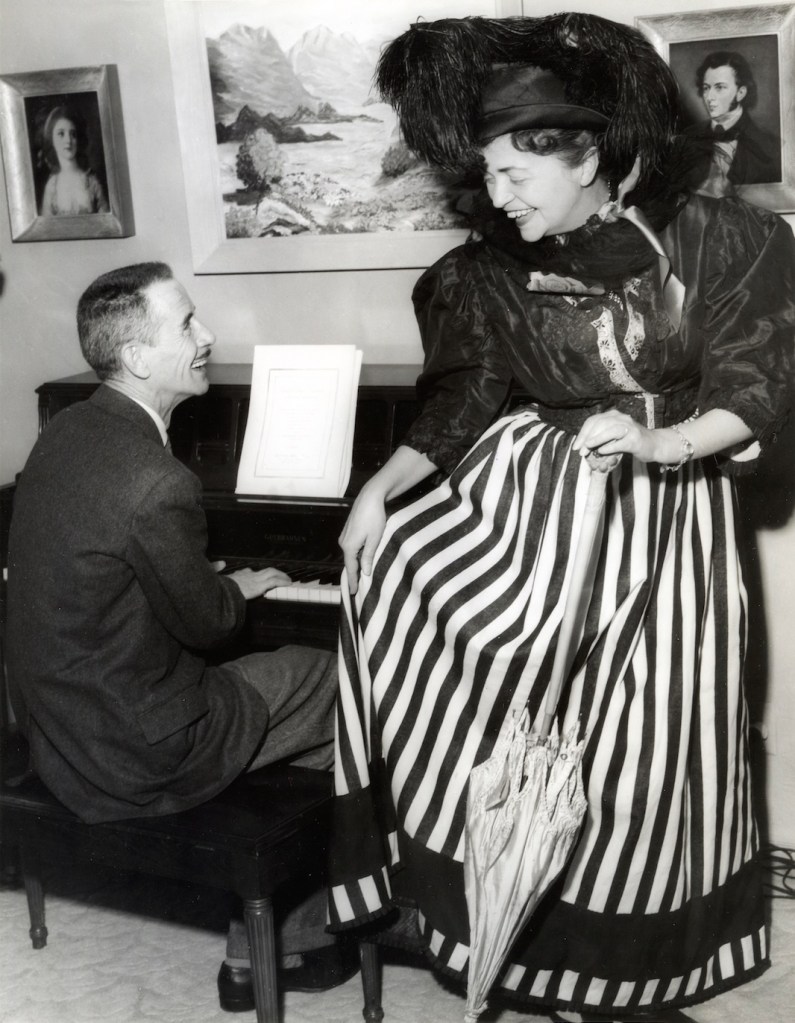
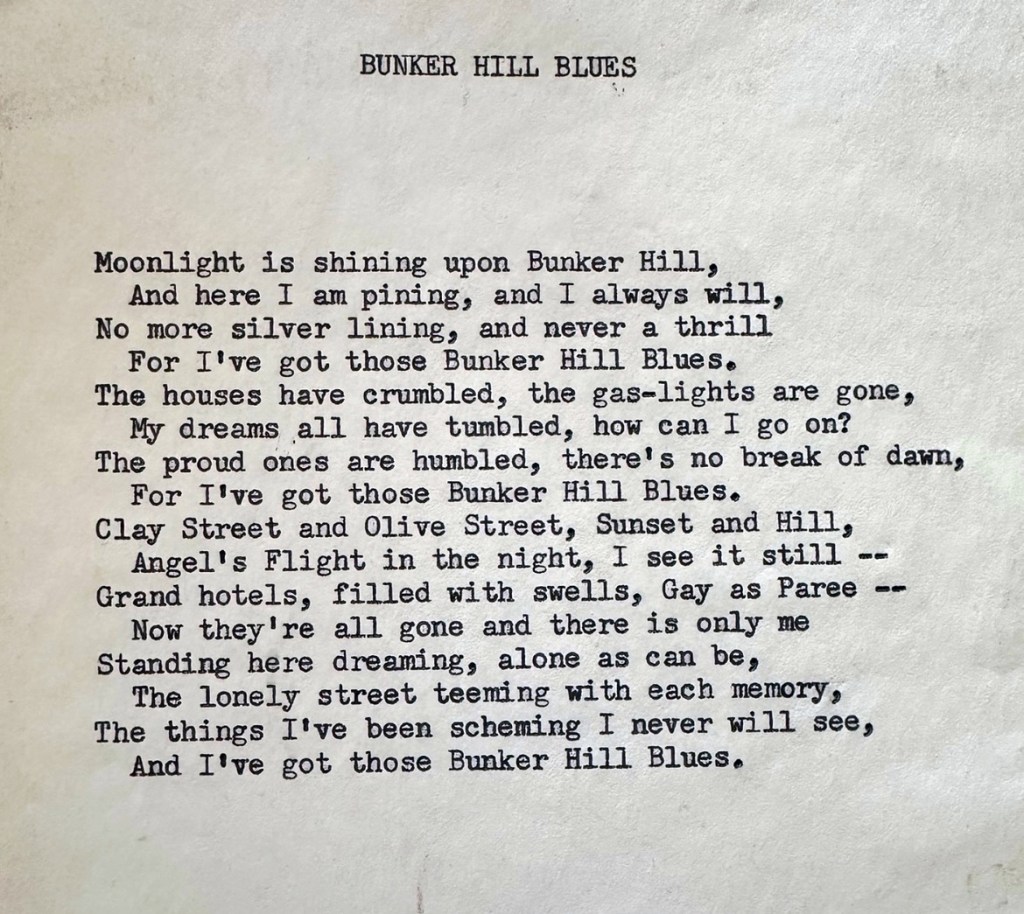
One last thing. April 11, 1958: at the Glendale Art Association’s “April Antics” held in the Tuesday Afternoon Clubhouse, Kay sang a ditty called Bunker Hill Blues. Here’s a shot of her performing it, with Association president James Alden Barber at the piano.
I’ve no idea what the music was. Judging by her garb it had a certain Gay Nineties jauntiness to it. Barber was composer, and I have his typewritten lyrics; the takeaway is neither gay nor jaunty, rather, I find the lyrics quite dark. I’m loath to call them mere lyrics—this is poetry, more to the point, the greatest poem ever written.
Today we talk about Pershing Square. Perhaps it’s not Bunker Hill proper—bordering the Hill’s southern edge—but I consider it an essential part of the Hill story. It is, after all, where so many of the Hill’s elderly residents spent their days (for example, go to 11:11 in the great 1956 documentary about Bunker Hill to witness a Pershing Square chat between an old fellow and William S. Burroughs’ doppelgänger). We’re also going to talk about Biddy Mason, who has a Bunker Hill connection: she owned the land on which African Methodist Episcopal had its church, at Fourth and Charity (now Grand, site of the Wells Fargo tower). She wouldn’t let the parishioners meet there, because the faithful owed her back taxes!
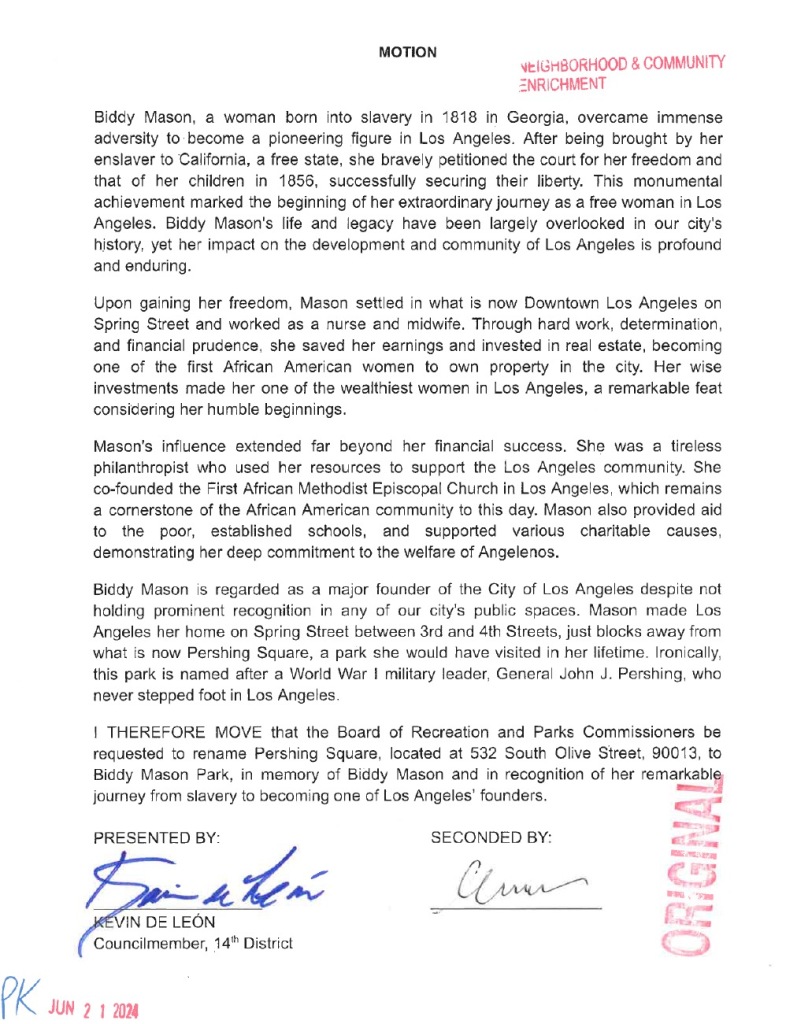
So, I deal today with Pershing Square and Biddy Mason, because there is a motion before Council to rename Pershing Square to Biddy Mason Park.
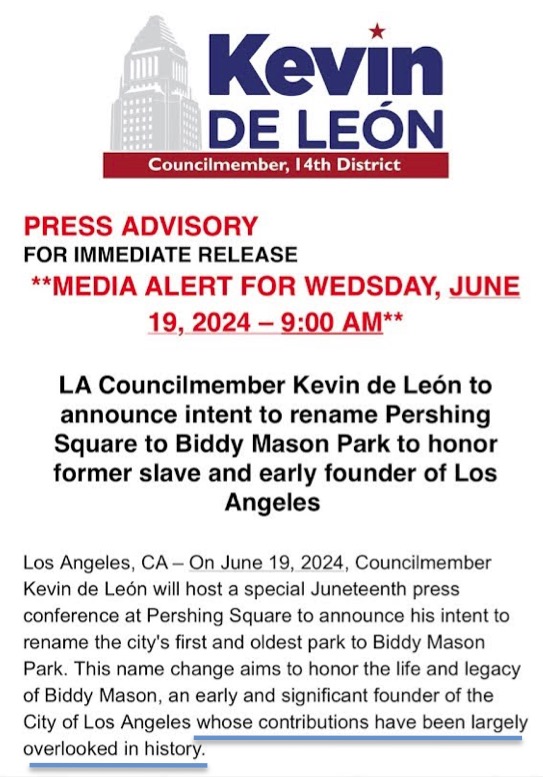
Biddy Mason is, unquestionably, a fantastic and important part of LA, but the present narrative raises eyebrows. First of all, it comes from Kevin de León. It was de León’s office that pushed through the counterfactual Cooper Donut embarrassment, so, anything from that office involving “history” should be doubly scrutinized.
Right off the bat, in yesterday’s Council motion de León’s sole mention of Pershing is an absolute and ridiculous falsehood, stating “well, maybe Biddy Mason went to the park, but we know for a fact that Pershing certainly never did, because he never visited Los Angeles even once!”—
For the love of God, Kevin de León, if you’re going to LIE ABOUT EVERYTHING, at least do it WELL. Seriously, attempt some semblance of veracity.
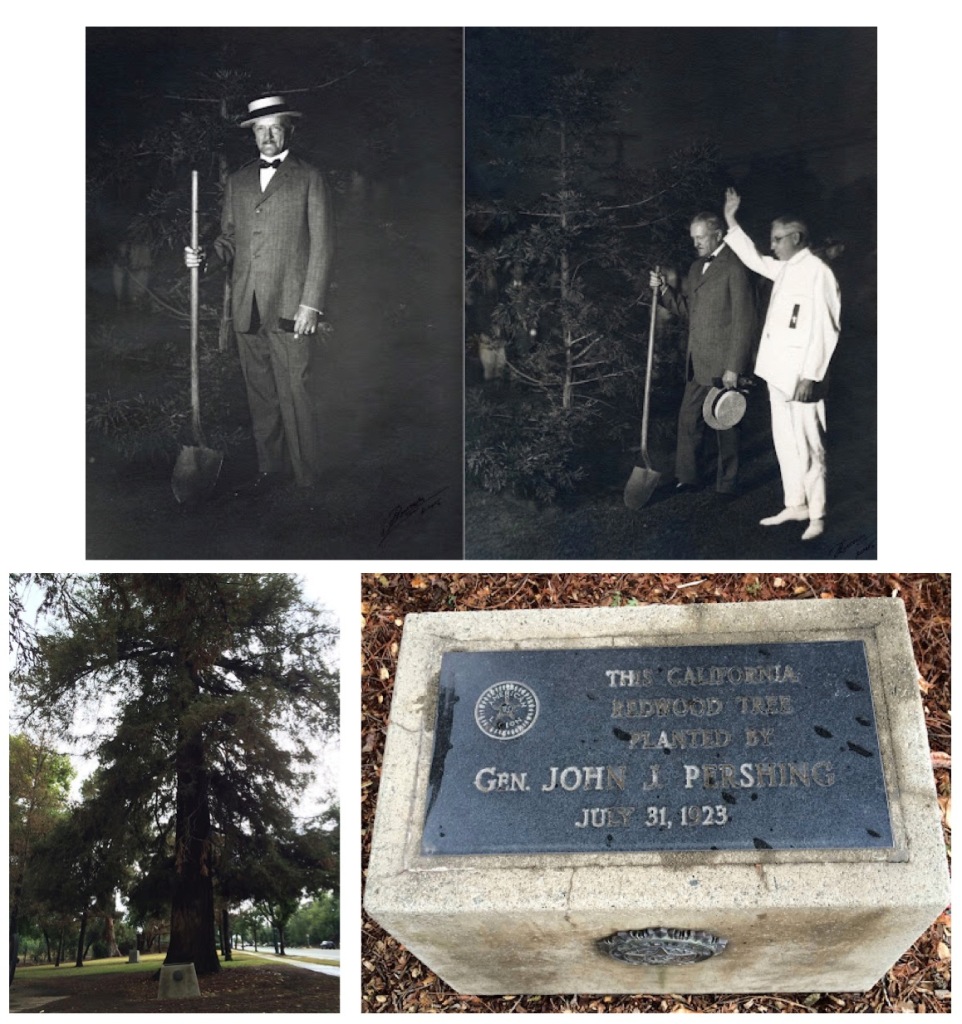
For the record: Pershing spent a LOT of time in Los Angeles: during World War One he was involved with our Coast Artillery, and visited our Red Cross, AND Pershing was forever cavorting with his L.A. pal George S. Patton, Jr. while romancing George’s sister Anne at the Patton home in San Marino…which is where Pershing and Anne got engaged. Pershing was also pals with important old Los Angeles families like the Wilsons and the Workmans.
THEN in January 1920, when Pershing personally dedicated the square named in his honor, 50,000 people—1/10th of the entire city—came to see him speak.
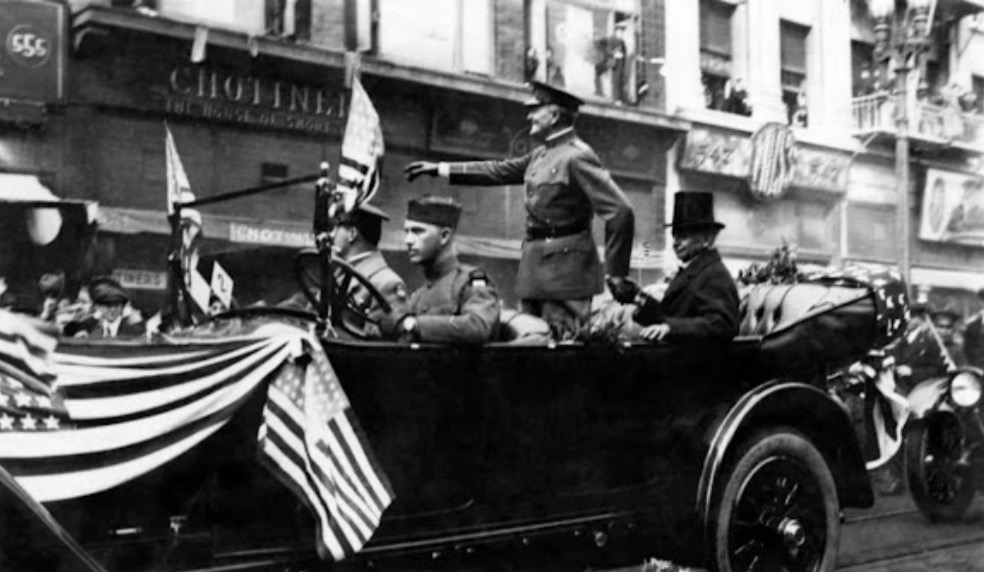
Here’s Pershing, who KdL insists never set foot in Los Angeles, cruising down Broadway. Homestead Museum
Pershing is of course titanically important, and we’ll end this post with a bit more on him. But now, let’s grapple with de León’s need to have the park renamed.
One might contend that de León is only attempting the Biddy Mason rename because he got caught being a racist. He famously laughed along with casual racism (City Council president calling a Black child a monkey), and denigrated Black children as mere “props” like “handbags” (statements so egregious even Biden himself told de León to resign, a command de León simply ignored), and went on to say that the problem with Blacks is that when 25 of them yell, they sound like 250. No surprise, then, de León proffers some performative activism during his reelection campaign.
It’s important, therefore, to look critically at the claims being made about why we need a Biddy Mason park:
We need a Biddy Mason park!
We already have a Biddy Mason park. Granted, it’s not five acres like Pershing Square, however, it’s still important to point out we’ve had a permanent tribute to Biddy Mason in Los Angeles for the last 35 years.
But the Biddy Mason park we have is terrible!
No, it’s really, really not. I work downtown and know every inch of that part of the world, and Biddy Mason Park is one of the few truly pleasant places in the central city. It’s away from the madness, it’s quiet, the birds chirp in the trees.
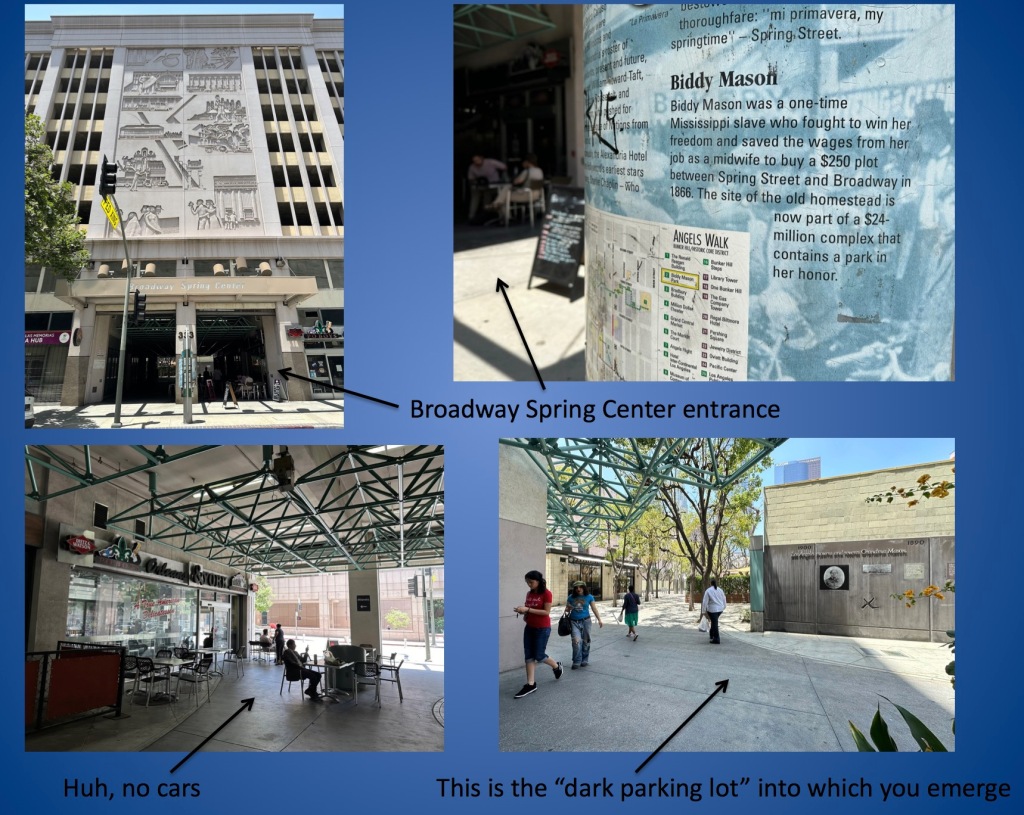
In the video above, shot in Pershing Square during the Juneteenth press conference, de León says “I do recall, the day, a few years ago, we were walking there, and I did actually ask you, wha-whe where are we going? And you said (unintelligible) and I said I know, but, we’re going to a parking lot right now. That’s where it is. A parking lot right now. It’s dark over there. You can not see the plaque on the wall, the memorial wall.”
Remember above, where I said if you’re going to just lie, be better at it? Because this is just some dumb-ass lyin’. Here’s a video I shot walking to the “dark, unseeable” Biddy Mason Memorial in “the parking lot” that is Biddy Mason Park:
Walk past Maccheroni Republic, through the park’s trees and benches, to the sunlit memorial wall, to more trees and benches and tables, and look! There’s the back of the Bradbury Building! (Ok maybe I’m a nerd for this sort of thing but viewing the little-seen backside of a Victorian masterpiece is an incredible bonus)
There are five major entrances to the park, from Fourth, Spring, Third, and Broadway. If we’re going to be extremely charitable, de León, in stating he went to a “dark parking lot” is perhaps attempting to refer to the Spring Street entrance, which goes through a parking structure, via a pedestrian mall.
Ok fine we have a nice park in her honor, but still,Biddy Mason is unknown and unsung!
Let’s examine the claim that Biddy Mason is overlooked, unknown, and unsung.
Video ofKevin de León, announcing the renaming, stating “despite her extraordinary contributions, Biddy Mason’s legacy, quite frankly and honestly, has been largely overlooked”
Biddy Mason is an American hero; so is John J. Pershing. So I thought I’d do a quick (admittedly unscientific) comparison as to who’s actually more “unsung.” I went into the newspapers.com newspaper archive, to see how many times our southland newspapers mentioned Biddy Mason or General Pershing, since 1990. Turns out, in the last 34 years you’re more likely to read about Biddy Mason, than General Pershing. I even used multiple variations of ways Pershing might be mentioned, just to make certain I got them all. Still, Biddy beat John, 228 to 207 (I should mention as well, that because I used multiple variations of Pershing to cover all potential bases, the tally also therefore included repeats of single articles that referred to Pershing in multiple ways; the number of unique Pershing-mentioning articles is actually closer 125, revealing that Biddy Mason is mentioned more generally than Pershing by nearly 2-to-1).
So that’s it in a nutshell. Maybe Biddy Mason deserves more recognition, but at the expense of General Pershing? Can we not put a statue of her in Pershing Square?
And did I mention Kevin de León is not only going to rename Pershing Square, but also rename Spring Street? Yes, besides now having two parks named after Biddy Mason, we’ll also have 1.6 miles of Spring Street renamed to Biddy Mason Way. This includes the Spring Street Financial District, which is on the National Register of Historic Places. Pretty fitting, since Mason’s major claim to fame after achieving her freedom was becoming rich by being a capitalist landlord. (Hey, I thought we weren’t supposed to like capitalist landlords!)
************
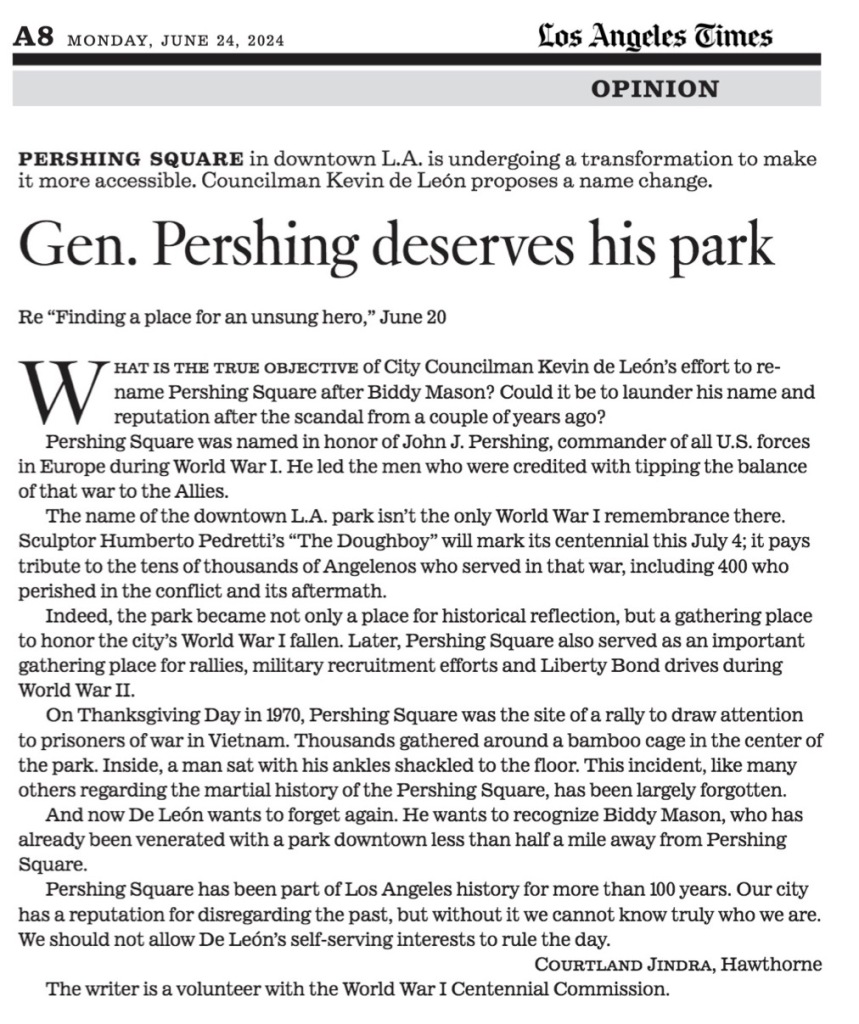
I will leave you with someone else’s words—Courtland Jindra, historian of the Great War—who can speak to Pershing’s importance better than I, and did so in a letter recently submitted to the editor of the Times, which said:
On June 19th, 2024 at Pershing Square, City Councilman Kevin de León announced his intention to push for the renaming of Pershing Square. I find this an unfortunate, but sadly expected, event in this city often accused of throwing out its history.
On the morning of November 15th, 1918 the City Council of Los Angeles renamed Central Square to Pershing Square, after the overall commander of the American Expeditionary Forces, John J, Pershing. He was the hero who had led the “boys” that had tipped the balance of the World War to the Allies and was nearly canonized at the time. Talk of renaming several things after him was also discussed, but what stuck was the park. The LA Times recorded that at the same meeting, a committee was formed to place a monument in the park “in honor of Gen Pershing and the American soldiers and sailors who participated in the war.”
This piece of history, like many others regarding the Square, has been largely forgotten. Even the park’s own website does not mention the date of the rededication, only that it was in 1918 – one has to track it down in archives. For many years, before and after the new name, Pershing Square was a place of historical reflection – especially for the military. A memorial to those lost in the 7th California Infantry, today’s 160th Infantry Regiment, in the Spanish American War, what is widely considered to be the first piece of public art in the city, was erected there in 1900. The previous Thanksgiving, a captured cannon from the same conflict was set in the park (this gun unfortunately was removed during the 1950’s redesign and has yet to be returned – today it resides in the Maritime Museum of San Pedro). Another cannon that had briefly been on the USS Constitution was brought to the city in the 1930s and resides in Pershing Square.
The park also served as places for two large outdoor funeral services for fallen soldiers from the war. Morris Lynchick’s 1921 ceremonial rites stopped the city in its tracks. He was the first soldier buried in Los Angeles and all the stops were pulled out as Lynchick seemed to symbolize all the men from the city who died in the war. Thousands came to bow their heads and pay their respects. A couple of years later the son of the former Mayor was likewise venerated. Ross Snyder was a decorated officer who gave his life in July of 1918 in an action that earned him the Silver Star. Again, the city honored him with a huge martial display in Pershing Square. Snyder is still remembered by a park bearing his name in South Los Angeles.
The World War memorial discussed back in 1918 did eventually come to fruition. There were tens of thousands of Angelenos that served in the First World War with over 400 perishing in the conflict and its pandemic fueled aftermath. Humberto Pedretti’s Doughboy, which will mark its centennial on the 4th of July this year, pays tribute to them. Its dedication was a massive deal and it is still, arguably, the most impressive element in the park. One might contend this is as it should be given its WWI connection. Doughboy towers roughly 25 feet from its base to the top of the flag that he strides to battle with. It’s a heroic depiction that seeks to evoke respect. The sides of the pedestal all have inscriptions that add to the effect. Dedicated “To the Sons and Daughters of Los Angeles who Participated in the World War” it has fallen into some disrepair in the time since it was put up, but when one stands in front of it, it does not fail to move you. Certainly, the Councilman could use some city funds to help restore this piece to its former glory.
It’s no surprise that given the large number of military tributes at Pershing Square, that during WWII, it was the city mecca for rallies, recruitment, and liberty bond drives. What is most interesting and depressing to me, as an amateur historian, is how all of this has been forgotten. Up until the latest design of the park, which we must remember is so disliked they’ve been working on redoing for at least a decade at this point, the war monuments and other memorial features (like Beethoven) all had prime real estate in the park. They were sprinkled around at entrances or centered. In other words, you couldn’t miss them. There were even large-scale Memorial Day services at the 7th California Infantry monument for decades at the Square, and at least a couple of pictures I’ve found indicate events at Doughboy on the 4th of July as well. Now the monuments and plaques are all ignored and largely hidden with low visibility. And now, with this proposed name change they’re certainly about to be even more forgotten.
Again on a Thanksgiving Day in 1970, Pershing Square took center stage to bring attention to the military. The park was specifically chosen to draw attention to Prisoners of War from the conflict in Vietnam. Thousands gathered around a bamboo cage in the center of the park. Inside, sat a bearded, ragged man, his ankles were shackled to the floor. He used chopsticks to slurp a sad holiday supper of pig fat, soupy rice and pumpkin. The ‘stunt’ garnered nationwide press at the time.
Even though other memorials to The Great War exist in this city, Pershing Square was the first. I understand that the park is not going to be 5 acres of history lessons, but to simply ignore this history because a City Councilman is trying to launder his name after the scandal from a couple of years ago is predictable but kind of unfortunate. Biddy Mason was a legendary figure in the early pioneer days as this former slave traveled west and built a life in the fledgling African American Community. However, as worthy of plaudits as she is, Mason already has a park named after her. Black Jack Pershing (who actually received his sobriquet from commanding Black troops in his early years as an officer) is not just the name of some city founder type, that people typically shrug off at localities all across the country. There was a reason that city officials renamed the park in the first place. It was to honor a man, and the amazing individuals under his command, that helped turn the tide of the largest struggle of history.
POSTSCRIPT
Jindra’s letter to the editor was published today, in an abbreviated form:
There were as well two other letters to the editor.
A woman named Ellen Switkes contends that renaming the park for Mason is not enough—for example, LAUSD should teach the story (except, as I’ve shown above, Mason is already part of the LAUSD curriculum) and there should be a “major biographical film” about Mason (this ignores the fact that biopics are frequently terrible [Blonde, All Eyez on Me, Gotti, Wired, Stardust, Beyond the Sea, ad nauseam] so be careful what you wish for; moreover, just because Mason gets a biopic doesn’t mean anyone will actually see it [the recent Till would have a similar audience, and despite good reviews, was ignored by audiences, failing to recoup most of its budget]).
After a couple of solid weeks out in Chavez Ravine, let’s get back to Bunker Hill.
And do you know what was on Bunker Hill? Fire Stations!
There were two engine companies on Bunker Hill, and images of neither made the book Bunker Hill, Los Angeles (though there is a passing mention of the Hope Street station on pp. 16-17). So, in the interest of covering all things Bunker Hill, we’re going to take a look at these stations. (I won’t got into the whole history of the LAFD; to learn more about the noble institution, click here, and don’t forget to go to their museums!)
I. Engine Companies No. 3 & 8, 354 South Hill St.(1896-1900)
We begin our consideration of Bunker Hill fire stations on Hill near Fourth Street, specifically, on the east, even-numbered side of Hill Street. You might ask, is across the street still Bunker Hill? I say yes indeed (or at least I made that assertion when I posted about the Hotel Clark).
Engine Company No. 3 was founded in 1887. They had a couple of locations, on Main Street and West Third, before they moved into this structure, at 352-58 South Hill St.:
Robert Brown Young designed some odd buildings, but this one takes the cake. That parapet is really something. And note the classic “horn and helmet” heraldic badges and bas relief of a fireman, surrounded by Sullivanesque ornament.
LAPL (This was also company 8; in 1896Company 8 moved from its quarters on Third Street into the station house formerly occupied by Company 6 on Ninth near Main, but then moved into the Hill-near-Fourth for a spell, before relocating to 1839 South Hoover. Most images of this building, though, show it as Company 3, when the number on its facade was a three.)
Aloise Reithmuller built the Hill Street station in 1896 for the Los Angeles Fire Department; Robert Brown Young, architect. LAFD leased the facility, and kept it as its headquarters, until 1900, when they could move into their own purpose-built fire station. The Young-designed firehouse then became a commercial structure:
II. Engine Company No. 3, 217 South Hill St. (1901-1923)
In late 1901, Engine Company 3 moves across and up the street, to 217 South Hill St.:
The heavy rusticated stonework and round arches evoke the Romanesque, but the vaguely-Palladian window groupings, symmetry, and dentiled string course place this firmly in Renaissance Revival
Frank Dale Hudson designed Engine No. 3, in 1901, at 217 South Hill St.; it is one of his final solo projects before the October 1901 partnership with William Munsell. Hudson’s relationship to Bunker Hill is probably best known through the Hudson & Munsell Elk’s Lodge.
Los Angeles Times, 17 December 1901
Here is an incredible shot from the Homestead Museum:
It shows the Dorn-designed cafeteria that was built in front of the Hotel Lincoln; the Lincoln, behind, was demolished in April 1919. Locke House and the Moore Cliff (turn to page 126 in your copy of Bunker Hill, Los Angeles) across Second, above. Homestead Museum
III. Engine Company No. 3 and Dept. HQ, 217 South Hill St. (1924-1980)
The 1901 structure is razed in the spring of 1923, and in its place rose a mighty Fire Department HQ, dedicated July 30, 1924:
With its rusticated stonework around massive arched entries, double string course, quoins, and ornate cornice, it made every firefighter feel like he was a 16th-century Florentine banker and art patron
Hoooo boy, it is hard for me to love a shot more. This is from LAPL’s Mildred Harris collection, captured in November 1958. Wonderful Bunker Hill architectural juxtaposition: at left is the Vendome, 231 South Hill St. (Charles H. Brinkhoff for the Barr Realty Company; 1900, demol. 1963). Next door, the 1950 addition, designed by none other than Albert C. Martin & Assoc., and the 1924 Meier HQ, and the small structure adjacent is the Fred Dorn-designed auto park and office/shops that became a county garage, built 1910 in the front yard of the Hotel Lincoln at 207 South Hill St. (read about the Lincoln on p. 127 of Bunker Hill, Los Angeles). Then in the distance across West Second St., is everybody’s favorite dirt patch, with the brand-new County Courthouse looming o’er, and the skeleton of the Hall of Administration behind.
In 1973, LAFD HQ had relocated into City Hall East. In September 1980 Fire Station No. 3 had moved to a new facility at 108 North Fremont Ave. The Hill Street structures were demolished by the Community Redevelopment Agency in early 1981.
Today:
The area is now site of a Wells Fargo Parking Garage, developed by Macquire Partners and opened in 1983. Like the Angelus Plaza facility that wraps “L”-like around it, it was designed by Dworsky Associates. This garage is currently managed by megaparker ABM.
IV. Engine Company No. 16, 139 North Hope St. (1904-1960)
Engine Company No. 3 down on Hill Street—Bunker Hill’s eastern edge—is all fine and good, but what about a station actually up on the Hill?
Nineteenth-century folks living atop Bunker Hill were served by various fire stations nearby, but nevertheless felt it necessary to have their own. Judge Julius Brousseau, of 238 South Bunker Hill fame, led the charge:
Los Angeles Times, 28 June 1900
The Fire Commission agreed, and, after a few years, 1904 saw the opening of Engine Company No. 16, at 139 North Hope St.:
Are those crescent moons on the windows? Someone explain that to me.
It was originally supposed to be Engine Company No. 13, but the firemen figured they had enough problems without adding a “hoodoo number” to the mix.
This station was designed by none other than John C. Austin. Austin’s best-known Bunker Hill building is of course the Fremont Hotel, and he had his hand in a couple of structures down on the Hill’s eastern Hill Street flank, which I discuss here.
Los Angeles Times, 17 January 1904 Quoining! Rusticated stonework! Doric columns! Bilateral symmetry! It’s fun to fight fires when you live in a Renaissance palazzo.
In early 1912, when LAFD added Truck Company No. 6, the station had this 15 x 76′ addition built on to its south side. It was designed by Dennis & Farwell. Obviously, there wasn’t that much for D&F to do, given as their mission was to match the original structure:
Yes, I am aware that in the book Bunker Hill, Los Angeles, I state the 1904 structure (at right) was designed by Dennis & Farwell. That is incorrect, as it was designed by Austin, and then D&F did the addition eight years later. Consider this the corrigendum; it is a mistake to be corrected in the next edition of the book.
An incredible color image from 1960. Note the original building has had its parapet removed, standard stuff after the Parapet Ordinance of 1949. Also, the addition just reads “TRUCK,” since Truck 6 transferred to Engine 4 in 1917. LAPL
Where was this structure, you ask? Well, when you see shots—as you invariably do—taken from atop City Hall’s 27th-floor observation deck, looking west over Bunker Hill:
Let your eye travel up Court Street (near the right in the above image) and then, there, up there near the corner of Court and Hope—
The demolition permit, dated February 7 1961, lists the owner as the Department of Water and Power. As such:
So the next time you’re walking on Hope between the Music Center and DWP, take a moment to think about our long-lost A. C. Martin-designed fire station. (FYI, Station 16 is now in this 1962 structure at 2011 North Eastern.)
V. More Fire-Themed Snaps of Bunker Hill
The vast majority of the images in this post are from LAFire.com — if you click that link and hit the sidebar, the two Bunker Hill-related stations are “Fire Station 3” and “Fire Station 16.” I would heartily recommend you taking a look, though, at all the fire stations. So many incredible early LA structures (with a majority replaced by quintessential postwar structures, and in both cases, a whole host of interesting architects involved—fun fact: Station No. 9 was designed by Robert Brown Young, with requisite Youngian corner tower, though Young designed No. 11 in Mission Revival!).
There are lots of neat shots of equipment-in-action on the LAFire site, so, let’s look at a handful of other images shot by and of LAFD as they ran about the Hill.
Looking south on Hill Street. The area at right, with Locke House and a bit of the Albert Stephens mansion, would be dug out to form the fabled dirt patch of Second and Hill. In the distance, the ornate Victorian towers of the Lincoln (Costerisan & Forsyth, 1888); the 1901 LAFD No. 3 is to its left.
Looking south on Hill Street. Left to right, 235 South Hill; the Hotel Vendome, 231 South Hill; 229 South Hill; and 225 South Hill. The structures at right would later be the site of the 1950 station annex.Outiside Station 16, looking north on Hope Street. The large building at the corner is the Court Apartments, at the NE corner of Court and Hope.
Looking west on Fifth, across Hill St. A bit of the Bath Block at left. Center, in the distance, the Normal School (now site of Central Library). Behind the firemen, note Temple Baptist under construction, and the California Club. At right, the structure with the conical tower and bay windows is the Spinks Block, AKA the Broxburn Hotel (Robert Brown Young, 1888). Center, that’s 137 North Hope St., and at left, is 127 North Hope. Note the lady in 137 who’s wondering what’s going on. Early images of this part of the world are pretty rare. Here’s a shot of those two houses about 1955. 127 N Hope at right; center is 121-123 (seen here in 1955).Looking directly out the station bay at 134-36 North Hope St.Shot standing in the street across from the station—134-36 North Hope St., with the back of 141 North Bunker Hill Ave., center.Andhere’s that house boarded up, in anticipation of demolition.Lastly, this one’s not exactly Bunker Hill, but it’s pretty close, and it’s too great not to share. Looking south on Olive, from near Fifth, toward Sixth. The two matching structures in the foreground are 513-517 South Olive. The conical tower juts from the roof of the Hamilton Apts., 521 South Olive. The tower behind that tower belongs to St. Pauls Episcopal (Burgess J. Reeve, 1882). This is all the site, now, of the Biltmore Hotel.
And now you know more than you ever thought you’d know about Engine Companies Three and Sixteen, and their once-upon-a-time locations on Bunker Hill. You’re welcome!
The story so far: we introduced our subject in Part I by detailing how Chavez Ravine’s Master Narrative, from which came the Reparations Bill, is equal parts unsupportable claims and outlandish disinformation. Part II made sure you knew Chavez Ravine’s history. Part III provided a snapshot of life in Palo Verde, La Loma and Bishop during the 1940s, before it was forever changed. Part IV ran us through the story of the ill-fated Elysian Park Heights project, for which the Housing Authority removed all the residents and demolished the structures. Part Vtold the tale of how and why the Brooklyn Dodgers moved to Los Angeles.Part VI detailed that First Family of Chavez Ravine, the Arechiga clan, in all their complexity.
Today! We wrap up our seven-part series with a few more odds & ends that didn’t make it into the previous posts, serving to underscore that everything you hear about Chavez Ravine is tainted by agendas and incompetence, so, take it with a grain of salt. With that in mind, we review a few of the key takeaways from our study here.
*********
What’s at issue with Chavez Ravine is that just about everything you hear, or read, is wrong.
Just to hammer home that point, here are a couple more tidbits that I couldn’t fit in to the preceding six posts.
Tidbit 1:No, no part of To Kill a Mockingbird was filmed in Chavez Ravine
The book was published in July 1960, when Dodger Stadium was already under heavy construction, so, no.
Then people will backpedal and say “well, houses from Chavez Ravine were moved to the Universal Studios lot for the movie!” Again, impossible: TKaM production began in the spring of 1962, so, houses would have had to have been moved three years previous, in 1959, when a handful of houses still existed. Didn’t happen.
Moreover, Mockingbird’s art director Henry Bumstead was quite clear when he stated that while the studio did purchase some old condemned houses for scenery, those structures were sourced in 1962 from areas in the path of freeway construction, not Chavez Ravine.
See here and here for the press kits. Here for a newspaper account. Here are Bumstead’s own words, again.
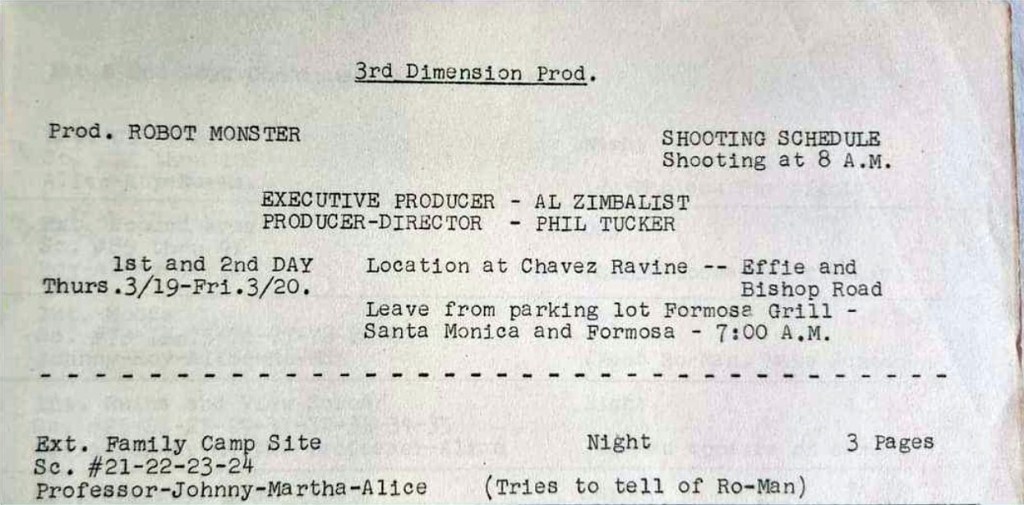
HOWEVER! Wanna know about a movie that was filmed in Chavez Ravine? The incredible Robot Monster! Take a look at the Call Sheet—
—which is attached to George Nader’s personal annotated copy of the script, that you may see for yourself on display at the 3-D SPACE museum in Echo Park!
As you can see, the crew met up at the Formosa on March 19 & 20, 1953, and then lit out for the corner of Effie & Bishop. Why? Because they needed a post-apocalyptic landscape:
The corner of Bishop and Effie; this was shot April 23, 1950; the Housing Authority would soon bring the apocalypse. Nadel/Getty
More often than not, when people talk about Robot Monster’s shooting locations, they’ll mention the famous Bronson Canyon caves:
However, most of the picture is shot in the springtime fields of Chavez Ravine, looks to be just above Effie, on the La Loma side of Bishop.
Of course, you may watch Robot Monster streaming online if you poke around for it, but might I suggest you actually watch it in 3-D? Get it here!
(I am deeply indebted to Eric Kurland, CEO and President of 3-D SPACE, for sharing with me the Chavez Ravine/Robot Monster connection)
Tidbit 2:No, Christine Sterling was not evicted from Chavez Ravine
Because anything Chavez Ravine touches turns to lies, we have this whole story about how Christine Sterling was one of the removed. You see this repeated in her Wiki page:
As we know, all residents had left by 1959 and the totality of residents they “began evicting” that May numbered about ten. (Of course “but there’s a footnote! It must be true!” and, like all Wikipedia footnotes, the article it links to doesn’t make any mention whatsoever of this nonsense.)
Though little remembered today, Christine Sterling was a huge presence in Los Angeles. Consider: while she’s now remembered (if at all) for something she did in 1930—the year of the opening of her pet project, Olvera Street—after the 1930s, she still made it into the newspapers over 400 times. If a public figure like Sterling had been ejected for redevelopment, that would have been a major story.
Of course, everyone loves to repeat this patently fictional tale, e.g. PBS, KCRW, the LA Weekly, et al.
Now, no surprise that Wikipedia is rife, as it generally is, with nonsense, but one would expect PBS or KCRW or maybe the Weekly to do even the bare minimum of fact-checking, which believe it or not used to be a “thing” in journalism.
This is from the LA Times, who at this point we absolutely expect to be wrong about everything, so, whatever
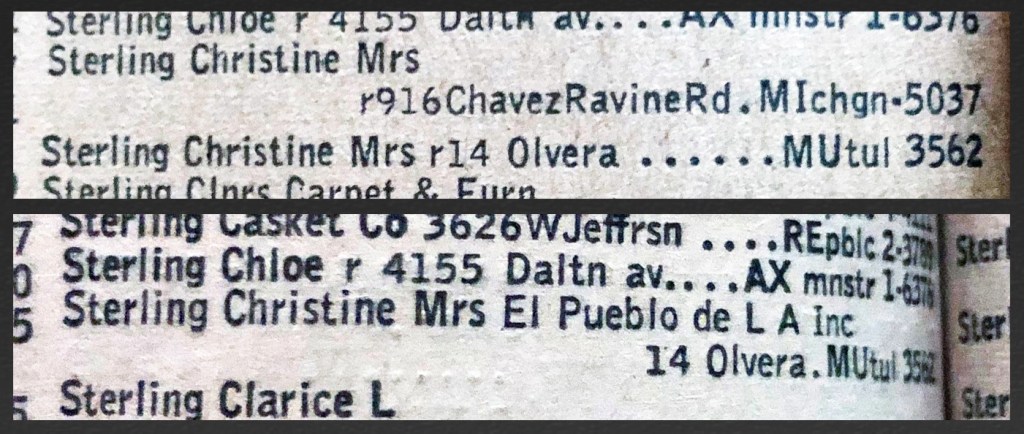
Five minutes looking into the story would have told them: Sterling lived for a short time at 935 Chavez Ravine Road, until the early 1940s, when Sterling, now in her sixties, then moved in with her daughter June Park. (Née Rix: June was married to John Park, an engineer; June’s maiden name was Rix; Christine Sterling’s birth surname was Rix.) John and June Park owned a home at 916 Chavez Ravine Road. Chavez Ravine Road was far to the south of the action, away from the neighborhoods of La Loma, Palo Verde and Bishop, etc. Incidentally, her daughter’s house, the other side of the Naval Armory, was lost not to the Elysian Park Heights project, but to Pasadena Freeway construction.
Let’s look at the phone books from 1951 and 1955:
1951 phone book, top, she’s at 14 Olvera, but also at her daughter’s; 1955, bottom, solely ensconced at the Avila on Olvera
Early 1950s, Christine Sterling is dividing her time between the Avila Adobe and her daughter’s house by the Naval Armory; by the mid-50s Sterling is now domiciled wholly on Olvera Street. Even the newspapers mention, in the mid-50s, that Sterling had moved onto Olvera Street and into the Avila Adobe:
Los Angeles Times, February 14, 1956
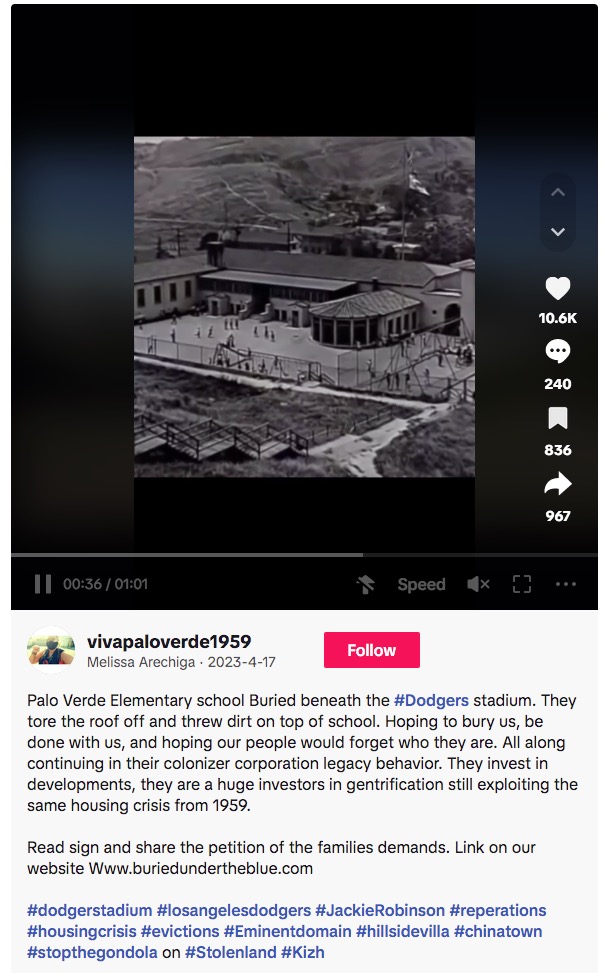
Tidbit 3: No, there was never a school buried in Chavez Ravine
Note how this post has nearly 11,000 likes, whereas my post here will be lucky to get 100 views. Behold, the magical role of social media in spreading disinformation!
The story concerns Palo Verde elementary, built in 1925, at Effie and Paducah (A structure I discussed a bit back in Part II).
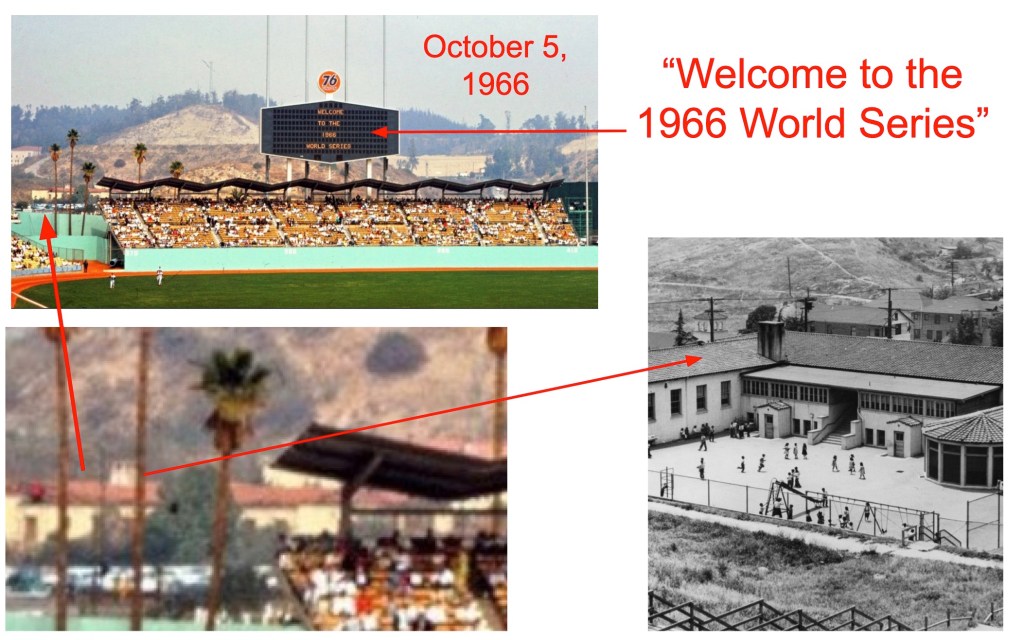
No. What’s important to understand is that the stadium and the school co-existed for at least five years; Dodger Corp. used the school for storage until about 1967. Here’s a shot from 1962 next to one from 1972:
See the red arrows? That’s the site of the school. Note that there’s nowhere for dirt to come from, to bury the school. More importantly and most obviously, the topographic level at which the school once sat is the same. It was the same when built in 1925, and it remains the same now. Ergo, it was not buried. It was demolished. (The idea that the civil engineers at LADBS would allow anyone to backfill a structure like this is ludicrous.)
Note how next to the school, to its east, there is a hill (which had Davis Street running atop it). That hill is still there. Still in its same height and configuration and topography. It still has the flat land next to it where the school was built in 1925.
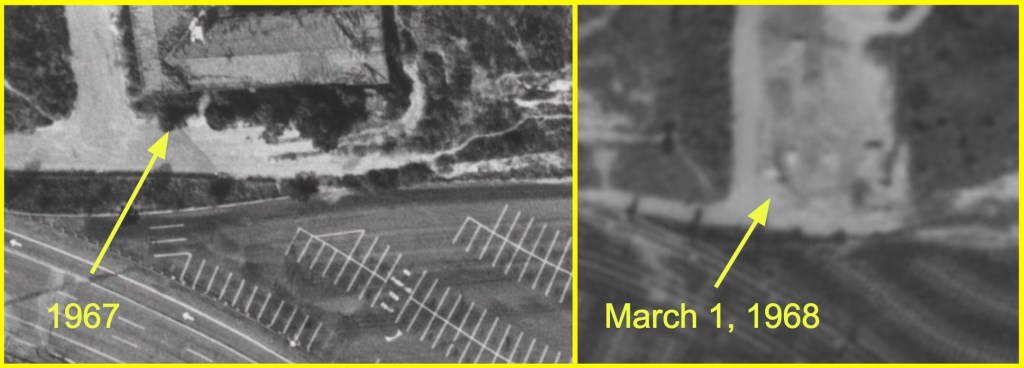
The school was demolished in 1967-68:
Note how in the 1964 image, left, the school is level with the parking lot; in the 1968 image, center, that cleared land is still level with the parking lot, and the asending banks of dirt to the west, north and east are still in the same place. In the present shot, right, the embankment to the west has been removed, but everything else remains the same.Still there in 1966…Still there in 1967…In summation, good people, Palo Verde Elementary is there in 1967 and the lot cleared by March ’68. This recounting is especially colorful, since the school was closed by the district in 1955, and was used for storage, and stood there very much unburied for thirteen more years. From here.
Interestingly, Buried Under the Blue literally named themselves after this fiction:
(Big thank you to researcher Malcolm Gafton, who was the first to debunk this myth, and to Zhando Atosl, who graciously informed me as to the existence of the aerial photos, 1966 WS image, and Ruscha picture)
Tidbit 4: No, the Queen of Elysian Heights house doesn’t have a relationship to Chavez Ravine
I touched on this in Part VI, but, it bears fleshing out a bit, since the topic has made recent news.
There is a house in Echo Park at 1553 Ewing Street, which was made a Los Angeles Historic-Cultural Monument (courtesy Paul Bowers, of the Silver Lake Heritage Trust, using Charles J. Fisher as monument application author). It is a classic Queen Anne, built about 1888, at the corner of Echo Park and Ewing. It’s a great house: I love the gable with the shingle-clad pediment, the clapboard siding, the two-story bay, decorative brackets, the multi-light fixed transom windows, and that eight-light porthole window just slays me. Needless to say, I am thrilled it has become an HCM.
The two-story stucco addition at left was added by owner Floyd Wood in 1946
The house made the news recently, as there was concern about evicting an elderly renter, who had moved there in 1962. I won’t comment on the legality of new owner NELA Homes removing the renter, which is outside the scope of this post. Rather, let’s examine the claim that the house is where the all the Arechigas fled after the May 08 1959 demolition of the Malvina houses.
Don’t get me wrong, I’m all for Lupe staying in place, and I’m glad she got some money. But, let’s look at some of the reasons people gave her money: contrary to what you were told, Lupe didn’t designate the house; the designation began back in 2020, and was the work of the Silver Lake Heritage Trust. And no, nothing was ever under threat of demolition.
And, to *our* Chavez-related point, the house-losing Chavez Arechigas, contrary to what you have been told one million times, didn’t live there.
It is true, the Ewing house was owned by an Arechiga. An Arechiga who didn’t live in Chavez Ravine, and who owned the house for all of five years. But, no-one who had a Chavez Ravine house destroyed, or lived in a Chavez Ravine tent, ever lived at Ewing: it’s a made-up and easily disprovable fantasy. And yet here’s a typical response after the November 9, 2022 designation of the house as HCM #1272:
This is an extremely odd statement, since the tract it’s on was laid out by a Scot named Maltman, and the long list of the house’s owners (names like Rudolph, Garfield, Murray, Champion, Staub, Wood, Shely, Runyon, etc.) reads like a “who’s who” of “Let’s Be Anglos.” It’s a victory for Mexican Los Angeles because, why? It had one Hispanic owner for five years? (Who then sold it to another Anglo named Maurice Eubanks.) No, it’s a victory because—as we are told in every single news story on the subject—the fabled Chavez Arechigas “fled there,” settling in the house because they’d lost their home in Chavez Ravine.
But that’s not even remotely true. Here’s what actually happened:
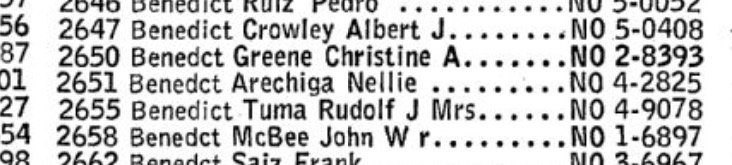
During the latter half of the 1950s, when time grew short for the Arechigas in Palo Verde (e.g., the eviction of August 1957, the eviction notice of March 1959), Manuel and Abrana’s only son Juan was already living elsewhere. Juan and wife Nellie lived in a house at 2651 Benedict Street, which they purchased in the spring of 1955 for $10,250 (they are in the phone books at that address through the rest of the 1950s).
In March 1959, without selling his Benedict Street house, Juan Arechiga purchased the house in question at 1553 West Ewing Street, which we are told became the “refuge for the Arechiga Family.” However, when Juan’s parents’ Chavez house on Malvina was famously demolished that May, his folks did not move into Juan’s house, but rather, Manuel and Abrana relocated into one of the two homes they owned outright, specifically, into the house they had owned, for some years, at 3649 Ramboz (see their 1960 phonebook listing here).
Did anyone “displaced” from Chavez Ravine ever go to the Ewing house? No. Juan’s sister Victoria lived in the house she owned on Allison. Aurora Vargas, the daughter famously carried out of “her” house in Chavez Ravine, was already living in one of the two houses she owned on Simmons Avenue. Again, the Ewing house was owned by Juan Arechiga, who lived miles away from Chavez Ravine, and who only owned the Ewing place for a short time; he sells the property in March 1964.
When you are told Lupe Breard “lived alongside the Arechiga family” remember this: Lupe moved there in 1962, when she was two years old. The Ewing-owning Juan and Nellie, with daughters Helen and Jeannie—who, again, were absolutely and positively not displaced from Chavez Ravine—were the ones with whom toddler Lupe lived alongside, before the Arechigas sold the place and left in early 1964, not long after Lupe turned four.
I’m not even sold that Juan ever lived in the house; three-year-old Lupe might remember them being there now and then, but probably as owners, not residents. Consider: Juan also owned the house on Benedict, in which he and his family had lived since 1955, during this entire time. Juan, it seems, bought Ewing as an investment property: the 1960, ’61, ’62, and 1963 telephone directories list Esperanza T. Marquez at the property, not an Arechiga.
“The home that harbored the Arechigas…” I’ve been involved with the Conservancy in one way or another for thirty years. So it pains me to see them repeat such easily disprovable twaddle.
Here’s Buried Under the Blue demanding the historical name of the house be changed to “The Arechiga Home” for no other reason than…one Arechiga, who lived two miles away from Chavez Ravine, bought and owned the place for five years, 65 years ago. And to reiterate: indisputably, no-one removed from Palo Verde, La Loma or Bishop ever lived there…well, that seems like a reasonable reason to use their favorite phrase “we demand“:
So, having run through a few odds & ends, let’s recap!
**********
The Top Dozen Dumb Myths about Chavez Ravine
In no particular order:
Removing the people from Chavez Ravine was a racist act.
The only logic or reasoning behind this assertion being “because everything was racist in the past, what happened must have been racist!” However: The Health Department chose Chavez Ravine as a redevelopment site involving metrics that existed outside of ideology (e.g., the American Public Health Association’s rubric regarding blighted neighborhoods vis-à-vis lack of toilets, high disease rates, public dumping, makeshift structures, streets inadequate and grades too steep for emergency vehicles, etc.); their intention was to better the living conditions of the poor.
Then the Housing Authority went through depopulating Chavez Ravine based on slum-clearance ideology, but consider, that organization was replete with Jews and Communists (Wilkinson, Jack Naiditch, Frances Eisenberg, etc.; Sidney Green, who signed the infamous 1950 “Wilkinson Letter,” was among the group of Communists dismissed from the CHA in the fall of 1952). Jews and Communists spent their time writing for the People’s World, fighting for civil rights, and working to secure a just and equitable society for all peoples. Those are the racists you’re talking about.
The other player besides the health and housing departments was the mayor. Fletcher Bowron was a liberal pro-housing mayor, and although the left’s paternalistic, patronizing anti-poverty policies via social welfare legislation can arguably be deemed racist, it’s hardly the rabid White Supremacy critics describe it as.
The handful of Chavez Ravine residents who were actually evicted, were evicted illegally.
Not only was the process legal, it had been hashed out by the courts endlessly. It was the same kind of eviction that had been done—legally—hundreds if not thousands of times in Los Angeles. There are lots of reasons not to like it, but, just calling it illegal doesn’t magically make it so.
No, they were evicted on a Friday, and Mother’s Day was on Sunday. “Well, then, it’s just mean they were evicted on Mother’s Day weekend.” That is true, but note: The Arechigas were duly notified, on March 11, they had 30 days until eviction, and that said eviction was scheduled for April 10. It was the Arechiga lawyer who got the April 10 eviction delayed another 30 days, thus, it was the Arechigas who made the whole thing go down on Mother’s Day weekend.
Dodger Stadium is on top of the communities of Palo Verde, La Loma and Bishop/the communities of PV, LL and B are buried beneath Dodger Stadium.
The stadium, specifically, is on land that had had a brick factory. If you’re referring to one of the parking lots, though, the stadium’s parking lot to the north is on land that had had those neighborhoods (and again, the neighborhoods were demolished years before the parking lot was even a gleam in someone’s eye, ergo, nothing is “buried”).
They do not. The City of Los Angeles had one job: deliver an empty plot of land. The city, being the city, in the grand tradition of bureaucracies, of course did a poor job of this. Then the city had to play mop-up at the 11th hour. The Dodger corporation was in no way involved in removing people who had lost their homes years before (yes, that includes the Arechigas).
We are told we must “hold the Dodgers accountable for their part in destroying Palo Verde, La Loma and Bishop!” But no…we don’t. Because DodgerCorp. were not “complicit” with the city in destroying one single house. If they were, then, when and how? Exactly: didn’t happen.
What is redlining? As part of Roosevelt’s New Deal, the government began something called the Home Owners’ Loan Corporation. The HOLC produced color-coded “Residential Security” maps that gauged areas where they could or should refinance existing loans. The ones coded “red” were deemed high-risk (“hazardous”); and yellow indicated “declining areas.” Any Mexican-American was more than welcome in either area. Now let’s look at one of their maps:
The area inside the black square, that’s Chavez Ravine. And what do you notice? The entire surrounding area is by and large red or yellow. It’s hard to believe that the residents of the sparsely populated Ravine area couldn’t find a house in Los Angeles, which was mostly red and yellow. (The white areas were parks, industrial, business, and areas that had mostly apartments. Remember, despite the prevailing narrative, most of Chavez Ravine’s residents were renters. They would have gone to any the majority areas.) Note that, for example, nearby Bunker Hill (majority Caucasian) is redlined. Most people believe that redlining was done largely or primarily on the basis of race, which is untrue: the vast majority of US citizens “redlined” were white.
And remember, HOLC went out of business in 1951, so, these maps would not have applied to the people of Chavez Ravine.
“But the HOLC shared their maps with private banks!” No, that was a wishful claim made years ago that has been debunked. “But the HOLC shared their maps with the Federal Housing Administration!” Maybe, but the FHA had their own maps (which they did on a block-by-block basis, and guess what, they burned all their maps in 1969 when a lawsuit came after them), but yes, the New Deal feds at the FHA and their hateful-of-Blacks Fannie Mae lapdogs were super racist, no doubt. “But okay even though the HOLC maps had nothing to do with mortgage refinance after the eminent domain in Chavez Ravine, it still made things really bad for Chavez Ravine in the 1940s!” Actually, evidence shows the HOLC did in fact loan heavily in red-shaded areas.
Oh, and I shouldn’t have to remind you, but no one had to flee or scramble, since in Chavez Ravine there was (in accordance with the law) an office to assist in finding people new homes, be they rental or purchase. The lady who ran the office was Vicki Alonzo.
BUtB repeats this one a lot, but no-one ever indicates what that law was. Because it didn’t exist. (In fact, it’s especially funny the Arechiga family say it was illegal for Mexican-Americans to own houses, when they owned 11 houses…13, if you count the two in Chavez Ravine.)
Some residents of Chavez Ravine may have moved to Chavez Ravine because there was a covenant against their purchasing a house in, say, Brentwood. But, restrictive covenants were de facto done away with in Los Angeles in 1945, and declared Federally unlawful in 1948. Ergo, the people of Chavez Ravine displaced in 1950-1953 would have had no problem with them.
Moreover, most of Los Angeles’s restrictive covenants, written into subdivision title deed language ca. 1903, had expired by the 1940s. You know what I’ve never seen? A map of these restrictive covenants. Try and Google it—you’ll get a lot of pictures of the infamous HOLC “redlining” maps, but, no: maps that evaluate mortgage lending risk are not the same thing as the exclusionary language of a title covenant.
Except, they were compensated at or above market rate. Each property had multiple appraisals, and the court awarded the highest appraisal, in accordance with the law.
Residents were forced to sell cheap, because the city caused a panic through a tiered buying system.
Some say this fiction was concocted by Mike Davis, but there’s no evidence of that. There’s actually no evidence the “tiered buying system” happened at all in any way shape or form: if such a flagrant violation of law were to happen during the very publicized and public workings of a highly-scrutinized public agency, it would have left a mark. Had there been unhappy homeowners because such a thing happened, it would have left a mark. There was an entire month-long investigation of LA public housing by a House of Representatives Subcommittee, in hearings that lasted through May of 1953, where residents aired their grievances in no uncertain terms, up to and including every last thing they didn’t like about how they were treated by the Housing Authority, and not a single person mentioned this? Copious interviews with residents, in the 1950s and beyond (with anger directed at length in, say, the 1957 issue of The Torch Reporter) and it was never mentioned? The Los Angeles Housing Authority were accepting Federal money, and as such were under Federal oversight; HACLA were, moreover, bound by the strictures of the Court, who directed and oversaw appraisals and payments; and as a public local agency were, again, under scrutiny, and yet we’re to believe HACLA went totally rogue, running roughshod over laws, to create community panic because…why? To save money? (Yeah, those government agencies given absurd amounts of other people’s money to play with suddenly becoming prudent and frugal…that’s a first.) HACLA was going to get all the property through eminent domain, as they had countless times before in the very commonplace and workaday performance of their tasks; why would they suddenly turn full-eeevil in this one particular case?
No. Equating the two reveals a jejune understanding of both Los Angeles and the Middle East.
**********
As long as we’re on the subject of picking apart what people have said about Chavez Ravine…the Los Angeles Times published this opinion piece a couple weeks ago.
I’ll run through some of its contentions, quickly: people lived in Chavez Ravine because they legally weren’t allowed to live anywhere else (absolutely untrue); Frank Wilkinson came up with the Elysian Heights project (not by a long shot—he was the Director of HACLA’s Office of Information); the city offered people below-market monies for their homes (a debunked lie); the unjust treatment of the residents is a blight on LA history (were the residents treated more unjustly than other residents removed for projects? No, so how is CR in particular a blight?); the property was unjustly taken (though the process was in the courts for years…I’m going to need a breakdown of the judges’ decisions detailing exactly how they made purposely unjust decisions from the bench); taking of homes resulted an inability to build wealth (it can be argued the opposite is true: the people, compensated for their homes, bought homes elsewhere, which were in an area that had actual city services, and would therefore be worth much more today than the CR homes could ever have achieved); “some got nothing” (um, source?); the CR project was racist because the substandard neighborhood happened to have Mexican-Americans living in it (see my paragraph on CR and racism, above); the baseball stadium is not a “public good” (though it was deemed by the courts to be); the Dodgers should “give back” to the residents who were removed 73 years ago (the Times doesn’t say what they should be giving to these people, of course…they also neglect to mention that it was five years between the cancellation of the public housing project, and the Dodgers being offered the land).
Point being, the Times editorializes, based on a whole host of “alternative facts.” I decided to write about Chavez Ravine after I read the Reparations Bill (everything is racist! there was below-market compensation! the Dodgers got the land for an insignificant amount! schools were buried! it was all fraudulent! and we use terms like redlining without knowing what redlining is!) because it contained a plethora of similar falsehoods and delusions. So, I hope you have found these seven posts edifying, as I have attempted in them to correct the record.
********
Now then, I will reiterate what I said in Part I: Hey, City of Los Angeles!
Hire me as part of the task force to establish a database. I will be absolutely fastidious and singleminded in my dedication to producing a database of all former residents with every house catalogued (and, ideally, pictured) up to and including dates of construction and demolition. I’ll dig into City records and find what the houses were valued at, what the residents were paid, where they relocated, the whole magilla. Of course that will depend on what records were actually retained and maintained, but if the preceding 26,914 words over the last two weeks have indicated anything, it’s that I’m obsessively thorough, and will get to the truth.
And here’s something else I think we should do. A number of the houses were moved.
Moved houses would have their destination listed in DBS records. If I find a survivor (roughly akin to this one, say) I suggest the city buy a relocated house, and return it to Chavez Ravine. There’s a lot of empty land up there north of the parking lot, put the house there, looking down over Dodger Stadium. The house can be turned into an interpretive center. Now that’s living history. Isn’t that a great idea? I think so too.
That’s my pitch, Councilmember Carrillo, so drop me a line at oldbunkerhill@gmail.com. I look forward to hearing from you, and thanks!
************
This is seven-part series. Its component parts being:
A snapshot of life in the area in the 1940s. The mythos of small-town life; Normark’s documentary work; a study of the people of Chavez Ravine; churches, markets, bus lines, etc. Published Tuesday, May 14.
A history of public housing; Neutra’s Elysian Park Heights project; its proponents and opponents; the area’s demolition; the downfall of public housing, and its relationship to anticommunism; land use after the demolition and nullification of the contract. Published Thursday, May 16.
The Arechiga family history to 1950; eviction from Malvina Street; eventual removal in May 1959; the multiple Arechiga houses; life after Malvina; the next generation of Arechigas. Published Thursday, May 23.
Part VII: In Summation, plus Odds and Ends
Key takeaways; plus a collection of *other* commonly-held beliefs about Chavez Ravine, conclusively debunked. Published Monday, May 27.
If you have comments or corrections, please don’t hesitate to write me at oldbunkerhill@gmail.com.
The story so far: we introduced our subject in Part I by detailing how Chavez Ravine’s Master Narrative, from which came the Reparations Bill, is equal parts unsupportable claims and outlandish disinformation. Part II made sure you knew Chavez Ravine’s history. Part III provided a snapshot of life in Palo Verde, La Loma and Bishop during the 1940s, before it was forever changed. Part IV ran us through the story of the ill-fated Elysian Park Heights project, for which the Housing Authority removed all the residents and demolished the structures. Part Vtold the tale of how and why the Brooklyn Dodgers moved to Los Angeles.
Today! We have arrived at the most famous story of all. That of the Arechiga Family.
To say that this photo gets used, a lot (←click link), might be something of an understatement. You know what not one of those articles mentions? SHE DIDN’T LIVE THERE. Despite all the thousands of times you will be told it was “her home,” she didn’t live there and in fact never lived there (click here).
I. The Most Famous Photo of All
On May 8, 1959, after years of court battles and multiple eviction notices, LASD deputies finally removed the Arechigas from the two houses they occupied.
The mere mention of the Arechiga family—just the sight of this one solitary image—is all you need to prove that racist Dodgers AKA the Displacers attacked and violently and illegally evicted hundreds of families from their legal homes in May 1959.
Of course, the actual facts behind the matter are more…nuanced. Claims of racism are just that, claims. Despite being popularly renamed “Displacers,” the Dodgers literally displaced no-one. And, despite what you’re told by the ruling chronicle, of Chavez Ravine’s “many families expelled” the sum total number of families dislodged by deputies was…one. The number of people actually forcibly removed was…one. Oh, and there was nothing illegal done to them.
Yes, to be strictly accurate—again, let me be clear, I do not approve of the taking of people’s property, but a thoughtful discussion requires we begin with legal clarity—the Arechiga family hadn’t owned their home for seven years, paying neither rent nor property tax, and had used the courts to stall multiple evictions over the course of years, until the day finally came when there was no other recourse but to remove them by force.
At which point (we are often told) they became homeless. That is, of course, not true either. They simply moved nearby, into one of the many other houses they owned.
The greater Arechiga tale, when factually observed, is actually not much of a story. However, the Arechiga narrative has garnered enormous weight and influence: they are, in fact, talked about more now than when they hit the limelight in 1959-1960, back when they were front page news of every major newspaper from coast to coast.
Their tale underscores why iconic photos are so important—were it not incredibly easy to use the shot of deputies carrying Aurora Vargas, the story would be no more or less important than a recounting of any other people removed, say, from Bunker Hill (or from the sites of countless other projects in Los Angeles involving eminent domain). Don’t get me wrong: the people removed from Bunker Hill were and remain enormously important, as were/are the people of Chavez Ravine; it’s just that the Arechiga family aren’t more important. Regardless, they have since become the go-to hallmark of the story because they so deftly worked the media, and continue to do so, as we’ll see.
II. The Arechiga Story to 1950
Abrana Cabral was born in Monte Escobedo, a municipality in the southwest portion of Zacatecas, a landlocked state on the Sierra Made mountain range of central Mexico, in 1897. In 1916 Abrana, pregnant, marries one Nicholas Ybarra, and together they cross the Rio Grande into Texas in October of that year. In April 1917 Abrana births daughter Delphina in Morenci, Arizona. Nicholas died of syphilis in August 1918.
Manuel Arechiga, born June 1889, was also from Monte Escobedo. He too had fled Mexico for Arizona; he weds the widow Abrana in 1920. They have daughter Aurora Arechiga in Morenci in June 1921.
Manuel worked at the Phelps Dodge Copper concern, but the cessation of World War One resulted in plummeting copper prices; many smelters were closed and jobs lost. Manuel and Abrana, seeking greener pastures, head west to Los Angeles, in 1922. They settle in the westernmost part of Chavez Ravine, on Malvina at the edge of the Palo Verde Tract. They have a son, Juan, in February 1923; daughter Celia in April 1924; Manuel Jr. in October 1926; and Victoria in November 1929.
Manuel and Abrana on either side of youngest child Victoria, 14 May 1959. USC
III. Their Houses
The famous houses for which they are known are 1767, 1771, and 1801 Malvina (it is from 1771 that Aurora Vargas is famously carried, making it arguably one of the most famous houses in Los Angeles history). These three are the houses it is said the Arechigas built, because they owned them in 1959 (although by 1959, the Arechigas had already demolished 1801 themselves). In all likelihood they built none of the three, but rather purchased them over time.
In the 1930 census the whole family are shown as residing at 1813 Malvina, and they’re in the 1934 phone book at 1813 Malvina. There’s no record of the construction of 1771 in DBS filings; but Arechiga is shown as its owner in 1940.
1767 was built by a man named Jose Rodrigquez in late 1923, though Manuel Arechiga is listed as its owner on Building & Safety permits in 1946.
In 1940 they’re renting a house at 1801 Malvina (the family numbering only seven now, since Manuel Jr. died, age eight, of tuberculosis), and Manuel’s 1942 draft card shows him living at 1801 Malvina. At some point Manuel purchases 1801 after 1940.
Though they own 1771 in 1940, they’re not seen living at 1771 until a 1943 newspaper mention (seen below). In the 1950 Census, Manuel and Abrana live at 1771 with their son Juan, and his wife Nellie and their daughter Helen, along with Victoria. Aurora, Celia and Delphina have since moved on to start their own lives (Aurora lived on Hyde Park Boulevard).
IV. Living their Lives
From the 1920s through to the 1950s, the family lived their lives in Palo Verde—which we might expect to be uneventful—but they made the papers now and then. For example, teenage Victoria Arechiga turned her back on her pet goat, who butted her down the hill, sending her to hospital for X-rays.
The Los Angeles Daily News, 28 September 1943
Less “human interest story” was the car-crash killing done by Porfidio Vargas, an Arechiga family member.
Jose Ambrosio Barboza Vargas was born in 1897 in Irapuato, Mexico. He, his father and mother, Jose Gregorio and Maria, and five siblings, crossed into Texas in 1907. Ambrosio and Jose Gregorio made their way to Los Angeles and were one of the first families to build in Chavez Ravine, in 1913, as part of Stimson’s settlement program. In 1915 Ambrosio, 18, married Tiburcia Gonzalez, age 16. They had nine children (of whom Porfidio was third born, birthed in March of 1919). Ambrosio became an American citizen in Los Angeles in 1932. Their house was at 1767 Gabriel, a stone’s throw from Malvina.
Porfidio met Aurora Vargas, who lived one block over at 1801 Malvina. They were married in 1938; she was 17.
In June 1941 Porfidio was 22 years old and a member of the Palo Verde gang. He and his gang crashed a party being held in Rose Hill gang territory on Boundary Avenue. A brawl ensued, and Palo Verde gang member Juan C. Flores, of 1738 Gabriel Ave., was stabbed, near fatally. After that, Porfidio got into a game of chicken with a Rose Hills gang member, Ramon Araujo. Neither budged, and the cars crashed head on, at the corner of Boundary and Roberta (which converged, once, before eminent domain came and took out huge swaths of houses for Rose Hill Park). Remarkably, both Vargas and Araujo survived, but both of Araujo’s passengers—Peter Barraras, 16, and Peter Del Gado, 18, were killed. Porfidio Vargas fled the scene, but was arrested the next day.
Vargas and Araujo went before the Municipal Judge for felony negligent homicide, but were set free because gang members threatened all the witnesses.
Daily News, August 21, 1941
Porfidio was inducted into the US Army in June 1943, and sent to Europe. In December 1944 he was one of the very first to die in the Battle of the Bulge, which would claim 20,000 American lives in the Ardennes that winter, leaving Aurora a widow.
New Calvary Catholic Cemetery, Whittier Blvd.
Another sobering story involves Juan (AKA John) Cabral Arechiga, Manuel and Abrana’s only living son. In December 1942 Juan, 19, gets married to Nellie Tavison, also 19, and have daughter Helen in September 1943.
Then, on March 18th, 1944, Juan Arechiga kidnapped and raped an underage schoolgirl. Juan abducted Mary Louise Fernandez, 17, of 622 North Broadway, a junior at Lincoln High, whom he grabbed on Ord near Broadway as she walked home after school. After abducting her, Arechiga beat her, threatened her if she made noise, and drove her into Chavez Ravine and raped her in the dirt. Fernandez immediately turned him in and it goes to trial, where Juan is found guilty. People will say well, of course they found him guilty, poor people only get some terrible public defender who doesn’t even care about him because the system is broken, etc.
No. His parents Manuel and Abrana hired the famed trial lawyer Rosalind Goodrich Bates, but despite top-tier defense, the jury still found him quite guilty. Juan goes to San Quentin in December 1944, and serves four years for kidnap and rape.
Los Angeles Daily News, 02 November 1944
Other than those instances, the Arechigas led a quiet life. Until that fateful day…
V. The 1950s
July 1950, everybody gets the letter saying your days are numbered: we, the City Housing Authority, are coming for your house, which we are taking through condemnation. This includes the Arechiga properties, which stand at 1767, 1771 and 1801 Malvina.
Curtis Street (bottom, where it says “36”) dead ends into Malvina.
Red lines, upper left, mark the location of the three Arechiga properties, at the far western edge of Palo Verde
Remuneration was fixed at $10,050 by the Superior Court of California, wherein, for their property, the Superior Court looked at three appraisals of their property, and then picked the appraisal with the highest value.
They are given $10,050 for the three lots, which doesn’t sound like much, but the going rate for a house were you to buy one in Chavez Ravine in 1951, was $2000.
But, you say, that can’t be right! But it is: the average cost of a home in 1950 in Chavez Ravine was $2000. Here, for example, are some random home values from very nearby, via the 1940 Federal Census.
1766 Malvina, $700; 1767 Gabriel, $1500, 1722 Malvina, $1500; 1255 and 1259 Effie, $900 and $1600. Unfortunately, come the 1950 census, the US Department of Commerce Bureau of the Census discontinued providing home valuation. But, let’s say that home values doubled in the decade 1940-1950. That puts us right there with the $2000 average 1950 valuation. Bear in mind, the average cost of a home in 1950 was $7,354 in the United States; that the Chavez homes were only 30% of the national average is completely understandable, given all we know about their general construction, the neighborhood services, etc.
Bear in mind as well, the average value of three homes in Chavez Ravine, at $2k per, $6,000. The $10,050 appraisal on the three Arechiga properties is nearly double the average going price in the area.
If you don’t agree with the amount of money they award you, you file an appeal. The people who filed appeals got more money; many of the Arechiga neighbors did. The Arechiga family, however, for whatever reason, did not feel the need to file an appeal.
A couple years go by, and they never file an appeal, and eventually the appeal window closed in February 1953, and that is that.
Ooops, not yet. Come October 1953, the Arechigas file suit in Superior Court against the Housing Authority. The Housing Authority asked for a writ of possession, which would have dispossessed the family immediately. The Arechiga lawyer, George Gailliard Bauman (attorney, hardcore Republican, and president of the conservative Small Property Owner’s League) blocked the move and obtained a 30-day stay of execution from Superior Court Judge Samuel L. Blake.
Los Angeles Times, October 05, 1953
That 30-day stay of execution lasted five and a half years.
The Arechiga’s argument was someone told us our property was worth $17,500. You only deposited $10,050 in our account. Give us the extra $7,450, and we’ll pack up everything and go.
Problem is, they had two years to file an appeal, as many neighbors had. The Arechigas didn’t, so, the judgement became final. In court, the judge realized that if people were to sidestep procedure and insist on setting their own price in eminent domain proceedings, nothing—no roads, no schools, no court houses, no public housing—would ever be built. The Arechigas were told sorry.
1953 ends. 1954 goes by. So does 1955, and then 1956. The Arechigas live in the cleared-out Ravine. (Of course I shouldn’t have to repeat this, but no, during this entire time there exists not the slightest inkling of anything related whatsoever to the Dodgers.)
In 1957, the Arechigas, after waiting four years to get evicted, finally get evicted. But I thought they didn’t get evicted until 1959! you say.
The Arechigas didn’t own their house from 1953-1957, while they battled in court. The matter goes to the District Court of Appeal in 1957, and the presiding judge said “when the judgement in the condemnation case became final, they were divested of all interest in the property regardless of the purpose for which it might later be used.”
Now you may not like it, but, fact is, when the State takes your home for eminent domain, you don’t get to keep it. If you think it only happens to poor people of color, consider the hundreds of homes in southwest Pasadena, taken by Caltrans, for the 710 project. That never got built, and those homes aren’t going back to the owners, are they.
Fact is, the Arechiga place on Malvina, was legally not their home. They lived there for years without paying rent or property taxes. The City could have very easily said well this is our home not yours, we’re turning off the water and power, but they didn’t do that, did they.
And at this point, in the spring of 1957, we finally have some mention of the Dodgers! In May the National League owners granted permission for the Dodgers to move to Los Angeles if certain conditions were met.
After the Arechigas lost their court case (again) in 1957, they were served an official eviction notice and on the 21st of August, 1957, deputies showed up with a Writ of Possession and evicted them, and began hauling out their belongings.
Posing for the papers, reading their eviction notice, August 1957LAPL
The Witchita Beacon, 23 August, 1957
Daughter Victoria Angustain (Victoria Arechiga had married Miguel “Mike” Angustain, an employee of the Department of Recreation and Parks) punched and bit officers removing the furniture, but hey—if deputies are such fascists (as we are so often reminded), they’d beat Victoria with truncheons, right? No, instead the Arechigas were granted a two-week stay on the eviction order (Councilman Roybal intervened), so the deputies had to haul all their belongings back into the house, and that two-week stay turned into another two years of squatting.
It was wrong to turn them out, Victoria stated, because (besides wanting their oil rights!) they had no place to go:
Los Angeles Mirror, August 21, 1957
Which, you are going to find out, was a big fat lie.
1957 turns to 1958 to 1959, with the Arechigas waiting patiently for the next eviction order. (They had had their final appeal denied in April 1958—read the judgement here.)
The subsequent order to vacate comes on March 9, 1959: they are served a 30-day eviction notice: you are going to be out on April 10, 1959, no ifs ands or buts. Abrana looks at the notice on April 10th:
Another eviction notice? She must be getting awfully tired of these by now.USC
April 10 was the day the Arechigas were supposed to be out, but they stalled further, and were granted another 30-day-stay.
April 14, 1959: at left, 1767 Malvina. Right, 1771 Malvina. Note the plethora of signage along their stone wall, decrying the forthcoming demolitionsLAT
May 8th, therefore, became, after nearly a decade of stalling, the day they were supposed to be out (you will hear “the City was mean and evil and evicted them on Mother’s Day weekend!” but for accuracy’s sake, their eviction occurring on Mother’s Day weekend…was entirely the work of the Arechigas and their lawyer).
VI. The Big Day
Friday, May 8th, 1959: at 11:30 in the morning, eight male and three female LASD deputies arrived to enforce the March 11 Superior Court Writ; they were led by Capt. Joe Brady. They were joined by fifteen cars full of television reporters and the press. Three moving vans had already arrived. It was the deputies’ intent to take possession of 1771 Malvina (home of Manuel and Abrana) and 1767 Malvina (home of Victoria and Miguel Angustain). 1801 Malvina had already been demolished by the Arechigas, for reasons unknown. (Alice Martin, 1456 Davis; Sally Ramirez, 1850 Reposa; and Glenn Walters, of 1853 Reposa, also left that day, without incident, although Walters was detained for obstruction during the Arechiga dust-up. Martin had bought back her house from the City, for $2,500, with the proviso that it be moved, but was then found to be not structurally sound enough to be moved.)
Deputies entered, then engaged in discussion with Victoria and Abrana about leaving (Manuel remained outside; Aurora wasn’t there). Workmen began to remove personal items into moving vans.
Aurora Vargas arrived on the scene. She ran past the deputies, and announced to the reporters, they’ll have to carry me out! And with that she ran up into the house.
A deputy speaks with Abrana; Aurora Vargas at right. USC
Remember, the only people that lived in the 450sf house were Manuel and Abrana. Aurora lived miles away, and only showed up to be on TV: the deputies complied with Aurora’s demand, and it has become one of the most famous images in Los Angeles history—
Aurora kicked the officers and punched them, and was arrested for battery. (Though Victoria Angustain left peacefully, she later fought and struggled with police, but they let it go.) Released on bail, Aurora’s alleged battery went to trial: a jury of ten women and two men found her unanimously guilty, three counts of battery and one for obstruction, which was easy to do since there was so much film of her kicking and punching officers.
The cameras rolled and rolled—
Aurora carried down the stairs; the demolition of 1767 Malvina; Victoria, holding infant, struggles with female deputies
—it was the perfect media circus. It made the news coast-to-coast. Of course, as is their way, the media “helped” a little; here for example is the aforementioned Alice Martin and her roommate, Ruth Rayford, of 1456 Davis:
Ventura County Star/Wilmington Daily Press-Journal, 15 May 1959
At the end of the day, eight years after the Arechigas lost their house, they finally lost their house. Their belongings were loaded into three moving vans—
USC
And the houses were demolished.
In foreground, the wreckage of 1767. The more-famous 1771, from which Aurora Vargas was carried, at left. In the distance, the Police Academy up Malvina.USC
But the Arechigas did not depart. They were prepared with their tents and cookware and set up camp. The removal and demolition was a huge national story, covered coast to coast, and Los Angeles was a national, in fact, international embarrassment.
The City Council granted them the opportunity to speak at a public hearing, which they did on May 11.
BristhPathéScreen-grabs from the above video. You will be told that “it’s wrong to call it Chavez Ravine,” hence the oft-used Instagram/TikTok hashtag #notchavezravine. But the area containing La Loma, Palo Verde and Bishop was commonly called Chavez Ravine all the way back to the 1920s, and more importantly—as evidenced above (and here)—the people of Chavez Ravine, including the Arechigas, called it Chavez Ravine, so…
Victoria Angustain, left; Juan Arechiga, right. USC
Victoria Angustain addresses City Council
300 people packed council chambers, loudly denouncing the thugs who made innocent people homeless. The Arechigas agreed: they had been set upon without warning, impoverished, and now had nowhere to go. The newspapers reported that they were homeless:
Homeless, they lived in a tent:
Victoria and Miguel Angustain flank Abrana, May 09, 1959.LAPL
Of course, they weren’t homeless. Not by a long shot.
VII. The Arechiga Homes
That is correct: despite what you’re constantly told, they were not made homeless. Not even remotely so. And we’ll set aside the fact that not one person in Chavez Ravine was made homeless, not one, because the Housing Authority worked diligently to relocate and find new homes for every single Ravine resident, as per the law. No, what made the Arechiga family interesting and unique is that…they could have just gone to one of their many, many other homes.
The Arechigas, however, just didn’t feel like going to any of the many houses owned by them, or houses owned by their son, or the homes owned by their daughters; between the folks and John and Aurora and Victoria, ten houses, eleven if you count the one daughter Celia owed and lived in out in Santa Fe Springs. Rather, they liked living in donated housing in Chavez Ravine, eating donated food, yelling at councilmembers, and getting in the papers.
The day after the big Council hearing, May 12, 1959, somebody thought to look at the tax rolls, and well look at that, they own eleven homes.
Victoria (who owned three of the eleven) said, basically, “well we never denied owning eleven houses, it’s your fault you never asked us if we did”—
You will be told “they didn’t REALLY own all those homes!” Here is that claim, for example, in the “Battle of Chavez Ravine” Wikipedia page—
Aaaaand of course that footnote? In the great tradition of Wikipedia, it doesn’t actually link to anything remotely related to what it is referencing. Wiki
Sigh. I hate to have to do this, but because you’re being fed b.s., I’m now forced to detail all the homes they owned.
The home of Manuel and Abrana Arechiga:
Yes, they and they alone owned it outright. It is located at 3649 Ramboz Drive in City Terrace, and was brand new when Manuel and Abrana bought it in 1956.
…and by 1959 they’d already paid off more than half the mortgage (they had purchased it for $8,500 in 1956, and in May 1959 only owed $3,700 on the mortgage). At the time of the Malvina eviction, they were renting it to their cousin, Estella Moldanado. It was to this house Manuel and Abrana moved in 1959, immediately after leaving their “homeless tent” in Chavez Ravine. Here they are, in the 1960 Los Angeles telephone directory:
And this is the OTHER home legally purchased and owned by Manuel and Abrana Arechiga:
This house is at 2410 Glover Place. Three bedroom, built in 1925. They had their 42-year-old daughter Delphina Hernandez (Abrana’s daughter from Nicholas Ybarra) living in it.
Daughter Victoria was also not made homeless, she and her husband Miguel Angustain Jr. owned property at 1430-32 Allison Avenue, a stone’s throw from Chavez Ravine.
Strictly speaking this is THREE houses, since there are three separate standalone structures on the lot. Two houses in front running down the sloped site, this being the house in back:
In fact here’s a shot of the family hauling the furniture from Chavez Ravine up to their house:
What of daughter Aurora Vargas, the one famously carried by force from “her” home at 1771 Malvina? She owned both these homes:
These are two houses at 659 and 657 Simmons Avenue, for which Aurora Vargas had paid $8,500 and $5,600, respectively. She made this purchase on September 26, 1952.
In 1959 son Juan Arechiga owned a house at 2651 Benedict Street — classic Spanish Revival, built in 1929 — which he had purchased in the spring of 1955. You will be told that it was being taken by eminent domain, and Juan was forcefully made to sell his home, in order to build a stretch of the Golden State Freeway (a story repeated in Eric Nusbaum’s book Stealing Home, for example). But that’s not true: Juan sells it himself, in October 1964, to an outfit called Quality Bilt Homes. QBH tear it down, and erect an apartment building on the site (which opened in 1967, and still stands). Juan’s house on Benedict:
Juan Arechiga also owned another house. It was this two-unit at Ewing Street & Echo Park Avenue:
You will be told that this house is important because it’s where the Arechiga family “fled” after the Malvina demolition. But as is the case with so much Chavez Lore, you are being lied to. Juan (who did not live in Chavez Ravine) bought this house in March 1959. In May of that year his parents were evicted from Malvina, and they moved to their house on Ramboz. NO-ONE removed from Chavez Ravine ever lived in this house; this house has no relationship with or to the Arechiga/Palo Verde tale. Juan owns it for all of five years, and sells it to a man named Maurice Owen Eubanks in March 1964. (FYI, 1553 Ewing St./2004 Echo Park Ave., AKA the “Queen of Elysian Heights” made the news recently, and I’ll cover that in the next installment, Part VII.)
And lastly, here’s the home of daughter Celia, which sort of counts but sort of doesn’t. Like Delphina, Celia didn’t muck about with the Chavez Ravine doings much.
Also, it was out at 9112 Arlee Ave., Santa Fe Springs, seventeen miles southeast of Chavez Ravine, so it doesn’t really fall under the umbrella of the Los Angeles Arechigas…but still.
Just to give you an ironclad understanding of the eviction-involved Arechigas:
Manuel and Abrana live the rest of their lives in their house on Ramboz; they pass in 1971 and 1972, respectively. Juan and Nellie pass in 2010 and 2018; Aurora in 2006.
Juan and Nellie’s daughter Jeannie, born in 1955, gives birth to Melissa, in 1975. And with that, comes a whole new era of Arechigas vis-à-vis Chavez Ravine.
VIII. Arechigas: The Next Generation
Manuel and Abrana’s great-granddaughter Melissa Arechiga takes on the Chavez Ravine mantle in 2017 when she begins “Buried Under the Blue,” her activist group for reparations to descendants of residents. BUtB get their 501(c)3 in July 2019. In May 2022 she wrote this petition which directly led to the Reparations Bill.
It’s an interesting petition. If you’ve read this post, and the preceding five, you’ll see that BUtB’s assertions are…creative, so much so, I feel no need to address them point-by-point.
Couple things I will point out, though: first, it’s curious to see that paragraph five, concerning Judge Praeger, is a cut-and-paste (with a sentence added at the end) from this pamphlet. Melissa Arechiga snatched the paragraph from a pamphlet published by the Small Property Owners League of Los Angeles, who were right-leaning conservatives, which is rather ironic. Ultimately, of course, Praeger’s judgement is a minor footnote in the greater tale, since it was immediately and unanimously overruled by the State Supreme Court and the Chief Justice.
Secondly, what’s important to note is the meat of the matter, their demands:
As I mentioned in the very first post of this series, historical monuments and community centers, awesome (and I’ll be interested to see how HACLA words their apology). The fundamental essence of Arechiga’s demands lays, of course, in a demand for reparations.
Now, were I a cynical man, I might raise an eyebrow. After all, a demand for money was the entirety of the Arechiga kerfuffle in the first place.
York Dispatch, May 12, 1959
And now, the same family wants more money…again.
A friend of mine likened this to a grift, which I thought was a bit strong; it’s more a strong-arm guilting, I said. He said if BUtB had actual truth and facts, it would be a guilting; but without those, it’s just a con. I’ll leave it for you folks to decide that.
Here’s what may be the most important point. Buried Under the Blue is run by Melissa and her mother Jeannie Arechiga; the acorn that grew this oak is the oft-repeated assertion that Jeannie, three-and-a-half years old, lost her home that fateful day in May 1959. That is mentioned in their BUtB bio, and is therefore repeated in the mainstream press. But it’s baloney. Jeannie didn’t live in Chavez Ravine, and never lived in Chavez Ravine. Jeannie lived with her family in their house on Benedict (pictured above), about three miles northwest.
LittleJeannie Arechiga’s family lived away from Chavez Ravine, as evidenced by the 1956 telephone directory
So when you read the BUtB bio about how Jeannie’s experience at the May 1959 eviction “continues to affect her mental health and well being” always remember: her parents took a 3½-year-old from her home, drove her to where there was sure to be commotion, and placed her in the way of deputies performing their duties, because there were television cameras there.
As long as we’re on the subject of BUtB provider-of-origin-story and co-founder Jeannie Arechiga, let’s look at the story that 3½-year-old Jeannie was tossed into the back of a police car next to her aunt Aurora, famously standing up to The Man by tossing their sandwich out the window—
In any event, Buried Under the Blue lobbied our elected representatives, and got their demand for reparations sent to Sacramento:
BUtB does much of its outreach on social media; for example, it has 17,000 followers on Instagram, and 23,000 likes on its TikTok. Here is Melissa Arechiga, the new face of Chavez Ravine, with a typical Instagram post:
Also, apparently, Chavez Ravine = Palestine
And that is the tale of the Arechigas! Come back in a couple days when we wrap up our whole tale in Part VII, a breakdown of the main myths about Chavez Ravine. See you there!
**************
This is seven-part series. Its component parts being:
A snapshot of life in the area in the 1940s. The mythos of small-town life; Normark’s documentary work; a study of the people of Chavez Ravine; churches, markets, bus lines, etc. Published Tuesday, May 14.
A history of public housing; Neutra’s Elysian Park Heights project; its proponents and opponents; the area’s demolition; the downfall of public housing, and its relationship to anticommunism; land use after the demolition and nullification of the contract. Published Thursday, May 16.
About the Dodgers; what constitutes public purpose; an illegal backroom deal? Published Monday, May 20.
Part VI: The Arechiga Family
The Arechiga family history to 1950; eviction from Malvina Street; eventual removal in May 1959; the multiple Arechiga houses; life after Malvina; the next generation of Arechigas. Published today, Thursday, May 23.
Part VII: In Summation, plus Odds and Ends
Key takeaways; plus a collection of *other* commonly-held beliefs about Chavez Ravine, conclusively debunked. To be published Monday, May 27.
If you have comments or corrections, please don’t hesitate to write me at oldbunkerhill@gmail.com.