Yes, I know—the last piece I wrote about the subject, fifteen months ago, was literally titled My Final Words on Cooper Donuts. But the other day a journalist called out of the blue to talk CDN, which meant I glanced at the Cooper Do-nut website for the first time in a long while...and…yeahhhhh. The site has added a piece of breakthrough news, albeit buried in an ill-conceived jumble of claptrap. My final words were evidently anything but, for while I certainly tried to ignore these new developments, they were too juicy to withhold comment. Plus I was repeatedly mentioned by name, so, can’t not pick up that gauntlet. And here we are.
********
The Evans descendants—heirs to and gatekeepers of the Cooper Donut legacy—revamped their website recently. The new version contains a revelation: there was a Cooper Donuts in the 500 block of South Main!
This is a significant discovery. My very first post about the subject five years ago contended that Rechy’s account—already improbable on several levels—was particularly suspect given his assertion that a Cooper’s existed in the 500 block of South Main Street. I had researched photos, maps, phonebooks, directories, DBS records, etc., to conclude and counter-assert that no such shop existed on that block, nor nearby.
Lo and behold, Jacqueline and Keith Evans have uncovered evidence from two separate sources of a Cooper’s at 517 South Main Street. Not only that, but despite my only recently stumbling upon this via their website, they revealed this data all the way back in March! And nobody told me? Jacquie Evans could have at least shot me an email (a triumphant ha! added to boot). After all, for the last five years and change, the closing comment in my initial Cooper post has read:

Point being, the Evanses’ discovery is the first major building block in retelling the Cooper story, and I am happy to report it here.
That said, the Evanses’ new website doesn’t just report on the 517 South Main unearthing; it proceeds to take my entire body of research to task in a point-by-point refutation. And their claims, theses, and postulates? Good grief. I should leave it be, but that’s not how I’m wired.
*********
I assume you’re up to speed (having read all my work on the subject!), but to recap:
There are two separate but connected stories: one is that John Rechy — pioneering chronicler of LGBTQ+ life since his breakthrough autobiographical novel, 1963’s City of Night — was present at a late-1950s riot on South Main Street. The story goes that a group of gay doughnut shop patrons beat back the harassing LAPD by pelting them with trash and rocking police cars, leading to a massive police response that cordoned off Main Street till morning.
The second story involves the Cooper Donut chain more broadly, including Nancy Valverde—the trailblazing Chicana cross-dressing lesbian whose legal acumen dismantled long-standing homophobic laws.
Because I’ve poked holes in these narratives, the Evans clan has whipped up a ten-point refutation of my work in a new section of their website called THE EVIDENCE.
We’ll begin with a brief investigation into 517 South Main Street (#3 on their list) and then we’ll take a look at the rest of….THE EVIDENCE.
********
#3 on the Evanses’ List — THE LOCATION ARGUMENT (←this is a link, click it)
As mentioned, the discovery of a Cooper Donuts at 517 is major news. Rechy has stated that the doughnut donnybrook didn’t happen at a Cooper’s, but, whatever: a CDN at 517 at least jibes with one of his accounts, in which the fracas happened “between Harold’s and the Waldorf” and while 517 is definitely not between Harold’s and the Waldorf, it is, at least… close? Anyway, let’s look at the site.
As we now know, 517 appears as a Cooper Donuts in this 1962 guide:
And as well here:
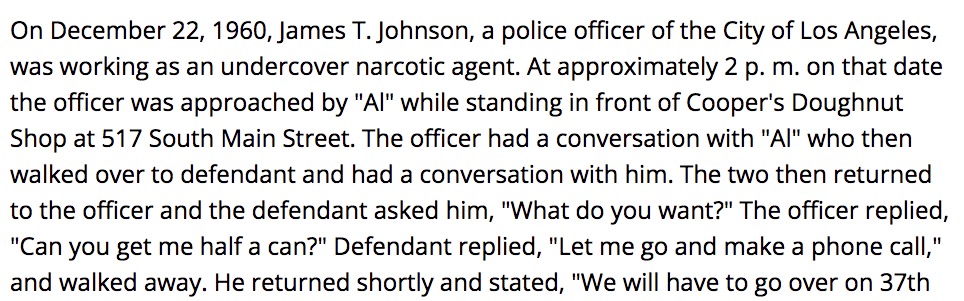
Naturally, we now have to know all we can about 517, and any further when/where/how that might emerge.
517 is an address in the Kalisher Block, 513-519 South Main Street. Louisa Kalisher— recent widow of prosperous Prussian-born dry-goods merchant Wolf Kalisher—hired architect Abram Edelman to design this two story brick commercial block in 1889.


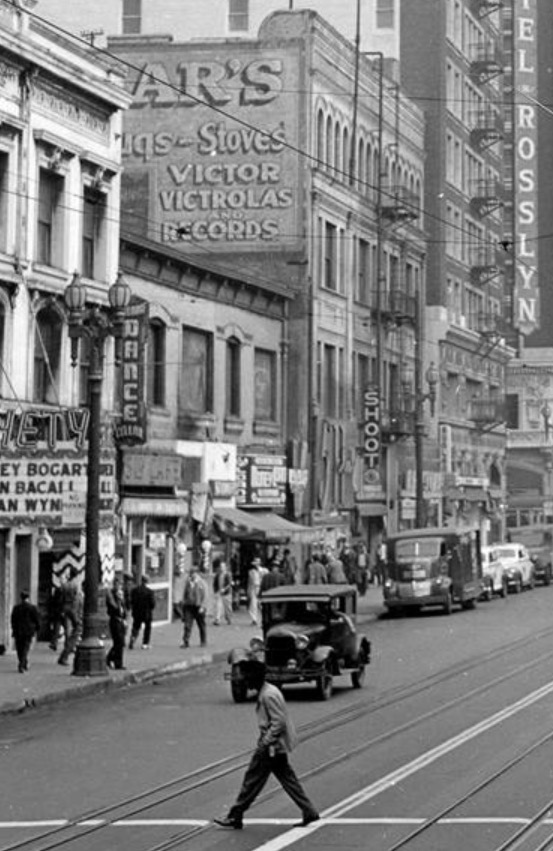
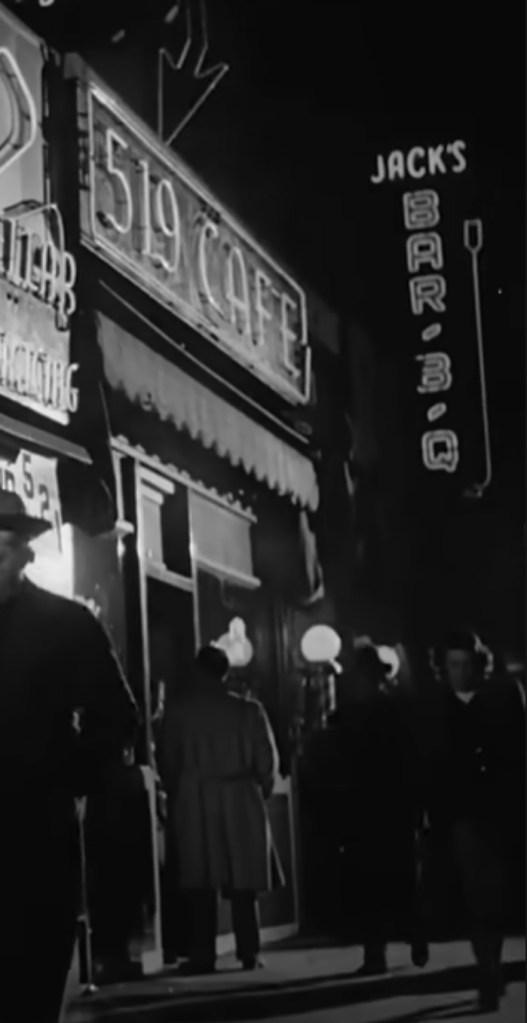
Jack’s BBQ occupied 517 until at least 1956. By 1960/61 (per the Frommer guide and People v. Shepherd) it had become a Cooper’s. By the time the 1963 directories were published, it had morphed into Angelo’s Pizzeria.
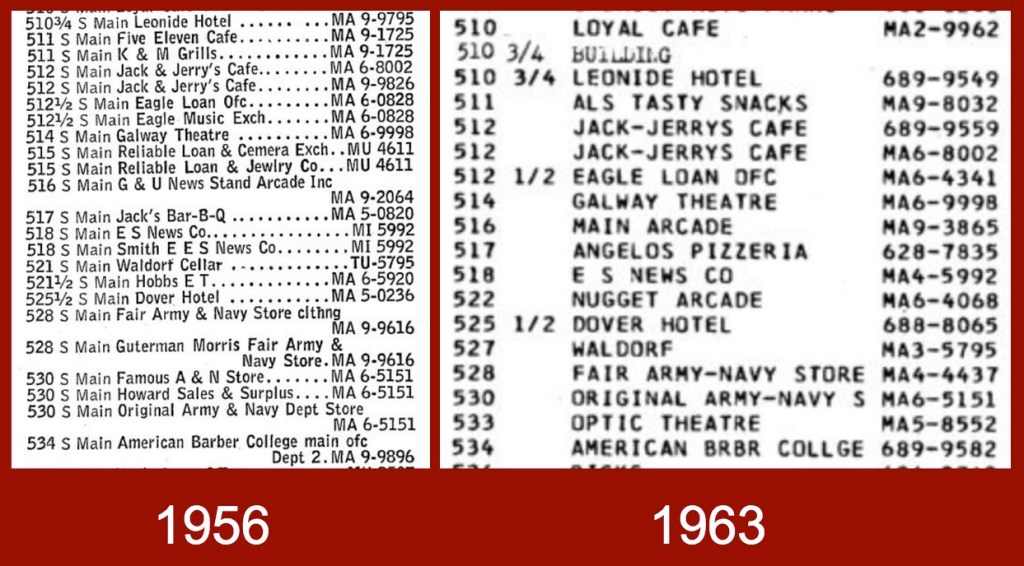
Frustratingly, no Cooper Do-nuts at 517 appears in the directories during the precise window of the Shepherd arrest or the Frommer mention:

It isn’t as if CDN went out of their way to avoid directories; here are their yellow page listings from August 1959 and August 1962:

What else can I say about the Kalisher Block, possible/probable home of a Cooper Donuts? It had its second story removed in the spring of 1959, and the building was demolished for a parking lot in late 1967.
Again, this is an excellent find, and kudos to Jacquie and Keith Evans for locating it. With enough of these building blocks, perhaps we can eventually erect a mighty edifice of proof regarding the purported riot.
But now it’s time we move on to the rest of —
********
“THE EVIDENCE”
First things first, Rechy at the Riot:
#1 on the Evanses’ list — THE SOURCING QUESTION (←this is a link, click it)
From the outset, I had noted it was curious that Rechy failed to include a seminal, late-1950s gay riot in his seminal book about late-1950s gay life; instead, he waited forty-five years to tell the tale. The Evanses’ retort? That “the absence of an event in a novel is not evidence that the event didn’t occur.” Look, I understand the principle of non-falsifiability. I can’t “prove” it didn’t happen. I am simply pointing out that it is passing strange that the man who made a career of chronicling gay Los Angeles never mentioned the “super-important-uprising-that-predated-Stonewall”—not in that book, not in any subsequent book, not to a journalist, not anywhere—for half a century.

What also truly irked me is the ubiquitous false claim that “the Rechy-riot is obviously true because he immediately wrote about it in his 1963 book!” argument. This falsehood has achieved the status of urban legend—and is naturally, therefore, part of the Rechy wiki page. It is of course a feature of the City of Night wiki page:

And if you doubt that I am in fact the only person to have ever read the book, click here.
The Evanses go on to say that “oral testimony of lived events is a recognized and methodologically sound form of historical evidence. The timing of its disclosure does not determine its validity.” To which I say, no, the timing is strikingly suspect, but more to the point: while oral histories are not without value, they sit at the very bottom of the historian’s evidentiary ladder—well below physical artifacts, contemporary documents, and even written memoirs. I have far too much to say on the limitations of oral history to pack it all into this post, so I’ll make my argument here.
#2 on the Evanses’ list—THE CONSISTENCY ARGUMENT:
I noted previously that Rechy’s account was plagued by inconsistencies. I never claimed this disproved a riot; I simply noted it as “grist for the mill” (especially given that the first time he told the story, forty-five years after the fact, was during the same period he was making up fake reviews of his own books). The Evanses counter that because the riot was “traumatic,” we should expect the details to shift. To support this, they cite a 2023 Philosophy of Science article. It’s a textbook example of “standpoint epistemology”—a methodology I won’t dismantle on this page, though you can gauge my critique of the article here.
Then, they invoke Alessandro Portelli. That’s a name I haven’t heard in a while! For the uninitiated, Portelli—a literature professor, emphatically not a historian—is the patron saint of the “my truth” school of historiography, a man who mistook his own inability to fact-check for a profound literary insight. He took the basic human propensity for misremembering, rebranded it as “subversive memory,” and invited us to marvel at the depth of the deception. It’s an elegant grift: if the archive contradicts your subject, simply declare the archive a tool of oppression and the error a masterpiece of folklore. It is creative, certainly, but it is not history; it is a curated collection of comforting fictions for the terminally sentimental.
The Evanses go on to contend:
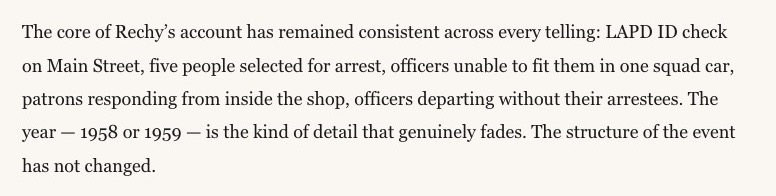
This is a bold claim, considering Rechy’s own “consistency” is nonexistent. Rechy’s primary accounts of the event include, for example: Rechy and four others were hauled out of the shop (2019); Rechy and two other men are detained (2005); Rechy and one other man (“Chuck”) are the focus (2019, 2021); or four men are involved, and Rechy wasn’t even one of them (2006).
If you’ve never read Rechy’s actual quadruply-told-tale, here you go:
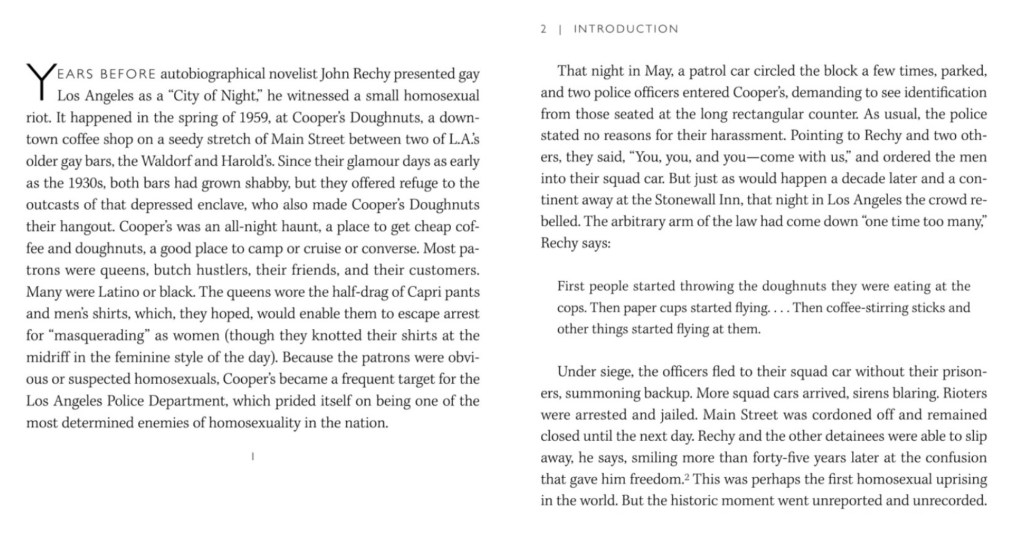

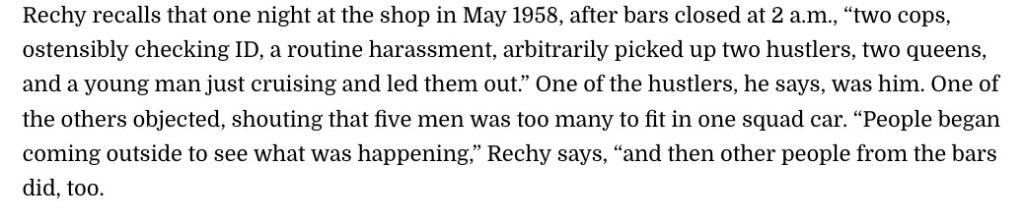
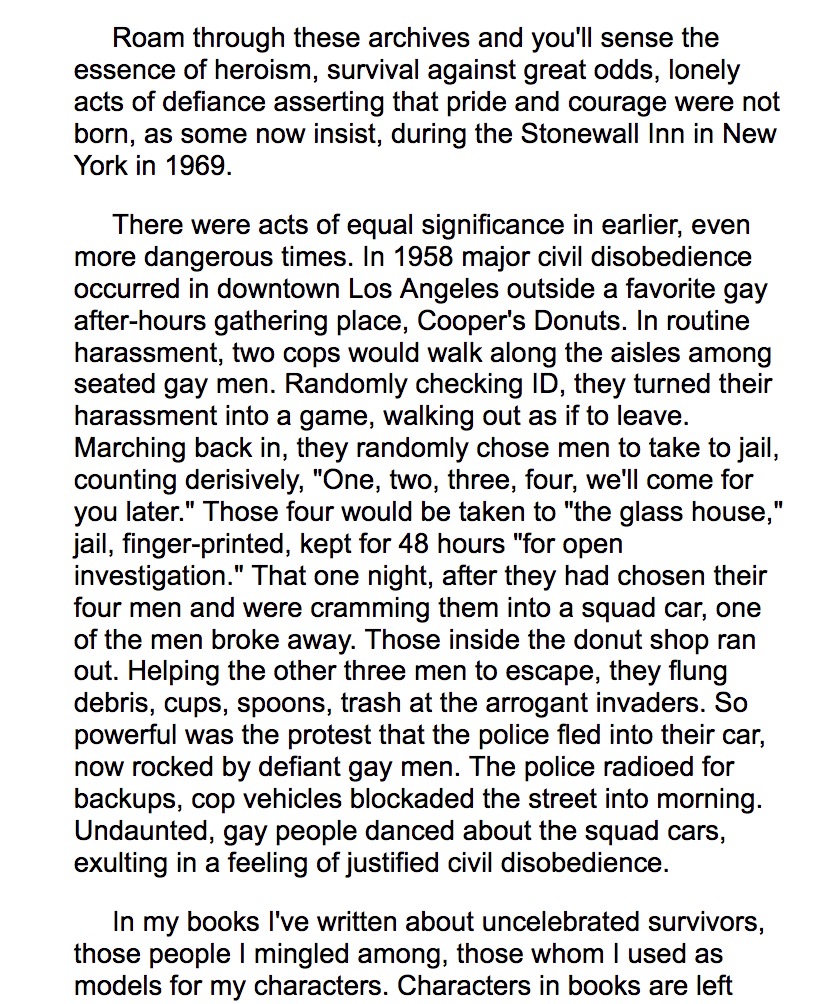
#4 on the Evanses List — THE NEWSPAPER ARGUMENT
I have oft asserted that had there been a riot—men pelting police with trash, rioters rocking black-and-whites, and the blockading of Main Street until dawn—it would have left a mark on the historical record. For reasons known only to history, this gay uprising went unmentioned in ONE magazine (whose offices were blocks away on Hill Street) and appears in zero oral histories for forty-five years. But setting that aside, I maintain that a riot of that scale would have been in the papers. I’ve combed the Times, the Herald-Express, the Examiner, and the Mirror-News, as well as local papers, including the weeks spent reviewing unpublished issues on microfilm. Nothing.
The Evanses counter that this massive event—witnessed by hundreds just a stone’s throw from the major newsrooms—was ignored because LAPD Chief William Parker enforced a “media blackout.” They claim there exists “specific documented action restricting press access,” arguing that because reporters were denied access to after-the-fact arrest ledgers, they would have been incapable of knowing a riot occurred. The Evanses’ proof is in the form of two articles documenting how the City Council, over Parker’s objection, eventually forced him to restore the freedom of the press.
Pardon the testiness, but, that’s all horseshit, all of it. The Evanses apparently assume you’ll never dig up the original articles but of course I have them (and a dozen others on precisely this subject, since there’s a heavy Chavez Ravine angle) and I can state emphatically and without fear of contradiction that their narrative is the literal opposite of the truth.
The facts: In the spring of 1959 there was a huge kerfuffle surrounding the chaotic evictions of the Arechiga family in Chavez Ravine (read about them here). A beat reporter for City News Service trawled through past police records to find prior arrests and thus smear the family’s character. An angry Chief Parker, siding with the Arechigas (yes you read that right, Parker went to bat for the Arechiga family) temporarily suspended the press’s access to historical arrest records until the City Council could formalize a policy. Bear in mind, there was no legal requirement that the LAPD hand over past arrest records to the press; it was merely a tradition of professional courtesy that had, in Parker’s view, gotten out of hand, since — despite these being public records — there was a confidential nature to old arrest records, now being willfully misused. Past arrest records could be used to blackmail people and Parker was worried that innocent people might be adversely affected (remember, a simple arrest record contains no indication about whether there was a conviction).
So Parker said “hey, City Council, come up with an actual policy, and we’ll follow that.” And then that’s what happened. And the best part is, Parker was very much IN FAVOR OF letting newsmen have access to records; he just said there should be some sort of policy so it wasn’t abused by bad actors. At first, Council refused to draft an ordinance, allowing media access; Parker made a personal appearance before the lawmakers to urge that the press be given access to arrest records. So, the Evanses characterize Parker’s sixteen-year tenure as a “media blackout” based on a short window of bureaucratic policy-making. (I shouldn’t have to remind you that having old booking ledgers is not what being a newsman is about, which I will touch on here.)
In short, the Evanses’ “villain,” Parker, was actually against the restriction. The primary figures pushing to keep arrest records private (and therefore “the bad guys”) were progressive Latino Democrat Edward R. Roybal—who feared records would be used to ruin rehabilitated ex-convicts—and the ACLU. Yes, the same ACLU that stood as the institutional defender of gay rights at the time; they opposed the measure, arguing media access infringed upon an individual’s right to privacy.


But for the sake of the argument, let’s just say the riot happened exactly during that window in 1959 when the restriction was in place (which again, wasn’t Parker’s idea, but was made necessary temporary policy because of criticism from a beleaguered Mexican family). Even if we indulge the Evanses and pretend the riot occurred during that window it wouldn’t have mattered. Reporters don’t need access to archived booking ledgers to report on a riot that shuts down Main Street. In 1959, Main Street was teeming with life, and every bar in the vicinity was crawling with grizzled reporters (the Hearst papers were a few blocks south and the Chandler HQ a few blocks north) angling for a scoop. Are we to believe a riot of this magnitude happened, yet not a single reporter—or a single wire service—heard the sirens?
Now, you and I, from our world-weary tower atop 2026, don’t blink an eye when a major street is shut down for a basketball riot or a street takeover. In 1959, this would have been the biggest news of the year—dwarfing the Chavez Ravine evictions, the Jack Whalen murder, or the death of Bunker Hill. Other instances of civil disobedience seen in the streets of Los Angeles (e.g., the 1943 Zoot Suit Riots, the 1923 longshoreman demonstrations, the 1913 IWW riot in the Plaza) had consumed reams of newsprint. Somehow, though, a riot in the literal ground zero of Los Angeles (it’s called Main Street for a reason) evaporated like morning mist. That dog don’t hunt.
Also, the Evanses claim newspapers didn’t report on gay arrests anyway, because they only covered homosexuality through “abstract social commentary,” which is quite possibly the most ludicrous thing I’ve ever read (click here for a reality check).
Finally, as for their claim that Nancy Valverde read about the Main Street pastry pandemonium in the paper the next morning? I recall no such Valverde statement. To my knowledge, she only mentioned a “Cooper uprising” once—sixty years after the fact, while in hospice at age 87, and only after being pressured to “recall,” specifically, that she’d heard about something second hand. (Which raises the question, if there does exist documentation of her saying she read about it in a newspaper, why did she change her story?)
#5 on the Evanses List — THE RECHY RETRACTION ARGUMENT
I was also saying that the brouhaha about Cooper Donuts was ironic, in that the mighty oak of tattoos and t-shirts grows from the Cooper riot acorn — but though Rechy initially claimed the riot happened at a CDN, but then retracted that, and said it didn’t happen at a Cooper’s. The Evanses manage this contradiction by claiming that when Rechy was told no Cooper’s existed between Harold’s and the Waldorf—which, of course, it didn’t—he merely “adjusted his account accordingly” because he was “pressured into doubt.” Now, call me old-fashioned, but when I tell the story of my life, I don’t change my story (“adjust my account”) just because someone pokes holes in it.
#6 on the Evanses List — THE CHARACTER ARGUMENT
And here we shift gears, leaving the purported riot behind, and move into Evans family territory.
The Evanses take issue with “my” argument that Jack Evans was “simply a capitalist who took everyone’s money” and that he ran Cooper Donuts as just a place that “takes everyone’s money” despite my never having said that. What I did say, in this article, in reaction to repeatedly being told Evans was a trailblazing trans ally who went out of his way to serve the gender-nonconforming, was: “I believe Jack Evans didn’t turn away customers if they had money. That doesn’t make him an ally, that makes him a capitalist.”
I stand by that. The Evanses predictably misunderstood me. To them—and to the average Angeleno—”capitalist” is a slur, the foulest epithet in the urban lexicon. I consider it the ultimate compliment. It means Evans believed in the creation of value and the freedom of enterprise, imbued with a builder’s spirit that favored merit and innovation over some state-dependent malaise. But I’ll never expect normies to grasp that.
You pearl-clutch at the label, but let’s talk about Jack Chester Evans. He had a business model—the bedrock of capitalism. His model was the engine that directed his capital and resources. It required the allocation of risk and the stewardship of money to provide a small luxury—donuts and coffee—at modest prices in underserved neighborhoods that corporate entities habitually bypassed. Operating in an economically depressed area demands operational excellence, consistency, and volume; you don’t survive on price-gouging, you survive on efficiency. More than that, Evans was a local entrepreneur building social capital; he became a familiar face and a source of order. He maintained his independence, treated his employees like community members, and kept his gaze fixed on building a sustainable, profitable reality rather than chasing government subsidies. In short, Jack Evans was a credit to the capitalist order.
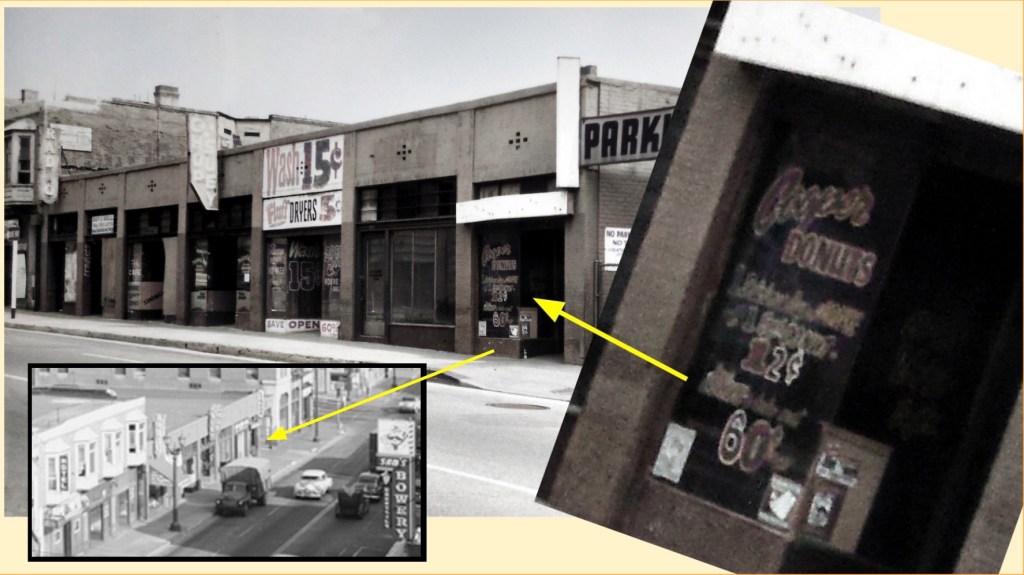
Evans did not get into the business of serving the disenfranchised with the intent of turning away his customers—that would be bad business, and that is why I said he was a capitalist. Was he a “trailblazing trans ally”? Who knows? I’m sure he was kind to his children and nice to dogs. But the family insists on canonizing him as a LGBTQIA2S+ saint, relying on testimonials that amount to little more than “he gave me a job” or “the donuts were yummy.”
A testimonial that “he hired people in need” is fine, but as someone who spent significant time in the Union Rescue Mission archives, I can tell you that “people in need” back in the day were overwhelmingly white male alcoholic veterans in early recovery, not trans POC. One patron of the early-60s downtown gay scene noted (in an anonymous online comment) that Cooper’s didn’t turn people away, but that falls under basic commerce, not the old debunked chestnut of “you’d be arrested because of MC5022.” Furthermore, relying on anonymous online comment sections is the verbum ex nihilo school of historiography—the “trust me, bro” method of citation.
They even suggest there is “proof” that to Jack Evans, inclusion outweighed the profit motive—

— and yet, curiously, they couldn’t manage to provide a photo of that page in the archive, or even a transcription of the sentence that apparently reads “we must dismantle systemic power structures to center intersectional voices, ensuring radical inclusion and equity for every marginalized, diverse lived experience” or whatever.
#7 on the Evanses List — ADMINISTRATIVE ERRORS ON THE CITY MOTION
In this post, I dismantled the motion penned by Tony Hoover—bolstered by his impassioned pleas, convinced the City Council to make Second and Main “Cooper Donut/Nancy Valverde Square.” Click here to read a breakdown of the hallucinations contained in Hoover’s motion, and here for the speech he delivered to Council.
Hoover’s narrative is replete with ahistorical hokum, which Council swallowed hook, line, and sinker. The Evanses, though, reframe this travesty as “an administrative error” and “a bureaucratic error” and state “the ordinance reference error is a citation mistake in a government document,” a spin so nauseatingly disingenuous it caused me to syntax-error-stare until my eyes shriveled into sun-dried grapes of intellectual frustration.
Oh, and they write —

#8 on the Evanses List — THE VALVERDE LEGAL TIMELINE
Half of Hoover’s motion deals with Nancy Valverde; naturally, I dissected that, which has in turn irked the Evanses. Because everyone since the dawn of time has uncritically accepted the greater Nancy Valverde story, I poked a few holes in it, their response being “wait just a damn minute, you’re conflating two different things!“
Except, no. Anthony Hoover — a City official acting in an official capacity — conflated those two things. And since I certainly never conflated them, the Evanses must be talking about Hoover, or some other bungler..oh, wait—no, look at that! They are talking about me:
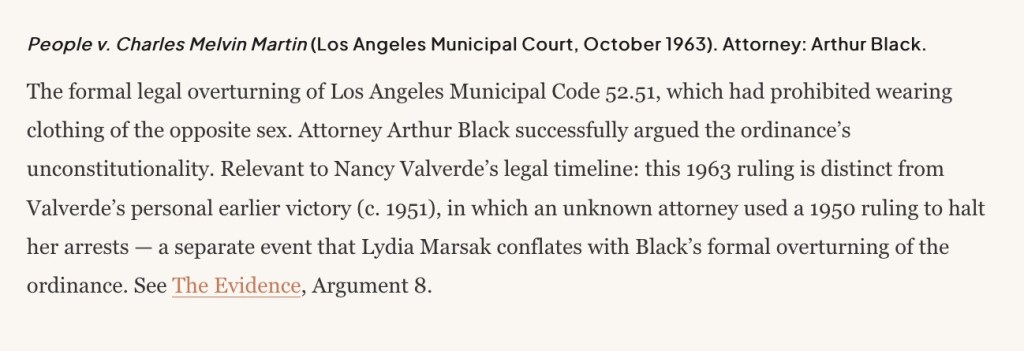
Let me be clear: not to blow my own horn, but literally everyone conflated the two events until I came along, the first and only person to untangle this mess. My jumping off point came via the Community Impact Statement from the Downtown LA Neighborhood Council, and the subsequent motion before Council—which read:
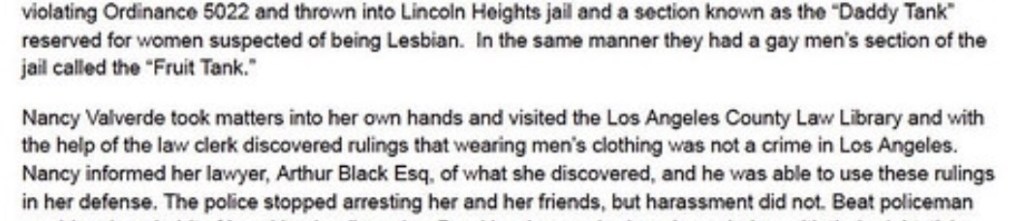
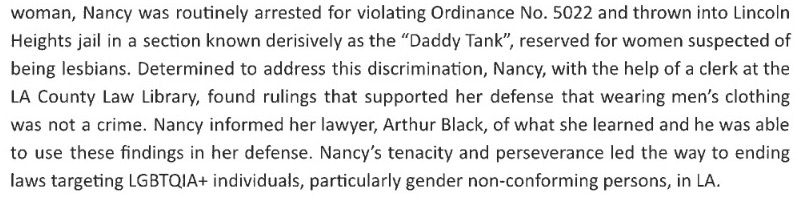
The idea that Valverde got a lawyer and reversed her harassment comes from Gay L.A. (which the Evanses cite in “Sources,” as “the authoritative scholarly history of LGBTQ life in Los Angeles”) in which Valverde herself provides the date as 1959, via a November 2004 interview of her by Lillian Faderman.

Yet, the Evanses assert that in 1951 she “discovered” a 1950 ruling that ended her harassment. This is historical nonsense: that ruling was on the front page of the Los Angeles Times (and in every other newspaper) in 1950. (Think of it this way: imagine a guy named Bob Smith who claimed in 1937 that the Hindenburg exploded, but no one believed him. A year later, in 1938, he “fearlessly uncovers” a widely circulated news report proving the Hindenburg exploded, and suddenly, everyone believes him. It’s that dumb.) The timeline only makes even a modicum of sense if we accept the 1959 date—perhaps in nine years people simply forgot the landmark ruling—but even then, it’s a stretch. The notion that she “provided her lawyer with that information” is equally absurd, as even the world’s most incompetent attorney would be aware of basic, publicized case law.
So, instead of lazily claiming “Lydia Marsak is wrong to conflate the two,” the Evanses should simply admit the truth: in the face of the unbearably sloppy “research” produced by Tony Hoover, Lydia Marsak is the first person to treat the Valverde tale as a story worthy of actual study and the first researcher to decouple the two conflated narratives. (And I’m still not sure why you’re calling me Lydia; is this an attempt to deadname me?)
#9 on the Evanses List — THE UNDERLYING LOGICAL PROBLEM
This brings us to the “absence of evidence is not the evidence of absence” bit—though they’re misusing Sagan to blur argumentum ad ignorantiam with a quote from geologist Thomas Shepherd, who was expressing that absence of evidence is not necessarily evidence of absence. It’s a cute phrase with a grain of truth, as historians don’t work with random samples; we work with sources produced by specific institutions, conventions, and scribal habits. That makes silence interpretable. The “argument from silence” is only a fallacy if you skip the step of asking whether the evidence should be there in the first place.
But the Evanses argue that the evidence is there because it isn’t, claiming the record-keepers were corrupt. They insist we know why the records are missing: the LAPD destroyed their records from the late 1950s! They purged them! To which I say, so what? There isn’t a police force in the nation that retains records that old. Be advised, there is zero reason for LAPD to have its records from back then. I sure as hell wish they did, because I could solve a thousand other mysteries that plague me. But LAPD doesn’t have their records, and I’ll tell you why (click here). Oh, and on a related note, here’s a fun fact they’ll never tell you: Chief Parker, during the time of the supposed riot (when he was busy arguing for media access into arrest records, see #4 above) spoke out against the destruction of records:

Then the Evanses repeat the whole “Chief Parker restricted access to criminal records” which, again, I debunked above.
And that’s it. Well, except the final section, which consists of statements so irrefutable that I’ve decided to refute them anyway.
#10 on the Evanses’ list — WHAT NO ARGUMENT HAS SUCCESSFULLY CHALLENGED (don’t forget this is a clickable link)
This is just a list of … stuff. Six statements which are more or less true—some more than others—but which they label “The Solid Ground.” Briefly:
- Cooper Donuts was a real business and it started in 1952. Fine, no-one doubts that.
- There was a Cooper Donuts at 517 South Main. Yes! And this is the exciting news I came here to repeat! (Though the Evanses write that Cooper’s was “next to Harold’s and the Waldorf, precisely where Rechy has always located the event.” To be strictly factual, Rechy only mentioned Harold’s and the Waldorf in one of his repeated tellings, and he did not indicate it was “next to” them, but between them … but now I’m just splitting hairs.)
- LAPD harrassment of LGBT people was systematic. That may be, but Los Angeles was nothing special in this regard. It was a routine enforcement of the social order that existed in 1950s America—a post-WWII period, particularly following the 1947 federal “Red Scare” and the subsequent moral panic regarding subversives (including the “Lavender Scare” figures like Sumner Welles, Nils Skavang, and Charles Thayer), that saw a massive push across all American cities to cleanse urban centers of “deviants”. Specifically, the Evanses assert “under Chief Parker, LGBTQ arrests increased 86.5% over the prior decade. This is established by multiple historians,” etc. Except: nope. Notice they don’t provide a citation, despite writing at the top of the page “A number of specific arguments have been raised against the Cooper Do-nuts story. This page addresses them directly — with citations.” Shockingly, the 86.5% number is bullshit. Don’t believe me? Click here.
- Cooper Donuts was a “place of genuine welcome.” Ok, cool.
- John Rechy still says something happened on Main Street. Ok, and? Yep, Rechy hasn’t retracted the story and never will, which surprises precisely no-one.
- There’s a Cooper Donuts/Nancy Valverde Square at Second and Main. Yes, we know. That’s all fine and good, but the Evanses mysteriously add “The City’s Historic Cultural Monument process requires independent research and review” (click here). This is true — I’ve worked on a few, and HCM noms require a formal application, field surveys, evaluation by the Office of Historic Resources, and consideration by the Cultural Heritage Commission, and recommendation by the Planning and Land Use Management Committee. But the Evanses adding this statement is pretty funny, as the naming of the square had absolutely nothing to do with the Historic Cultural Monument process. Square Naming triggers zero reviews by Office of Historic Resources, or the Cultural Heritage Commission, or, to be accurate, anyone — there is no oversight panel, no historic evaluation, no nothing. All you need is a narrative and one councilmember to sponsor the thing, and it’s done. Let me be clear: when they assert the process “requires independent research and review” I’d reply yeah I effing wish, because Cooper Donuts/Nancy Valverde Square entailed zero independent research and precisely zero review.
*******
Ok, and that, I hope, will be my final words on Cooper Donuts.
One last thing, again,
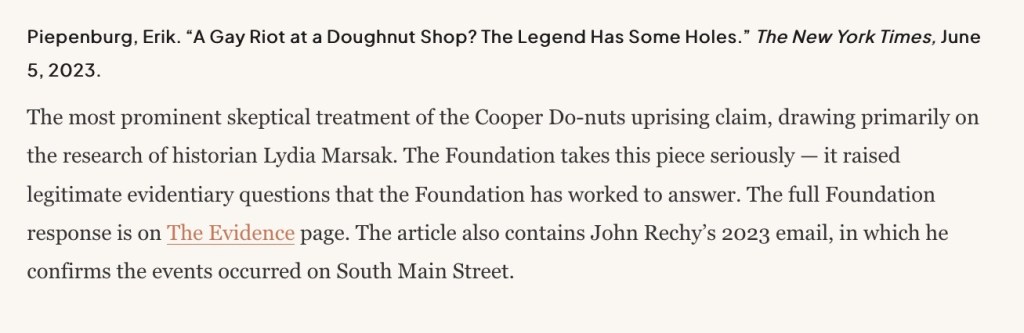
…who the hell is Lydia Marsak?


Magnificent, work, as always!
I knew nothing of the Cooper Donuts lies perpetuated under the guise of “LGBT progress” or whatever the moniker du jour is for social justice these days. Regardless, your writing and research are unmatched, biting and funny as Hell. These sacred cows may take themselves ridiculously seriously but I’m glad that you don’t.
Although….it IS now tempting to refer to you as “Lydia”. 😉
Well done, sir. Well done.
LikeLike
Lydia Marsak, you have been absorbed by the LGBTQ+ collective.
That was about as entertaining and thorough a beat down as I have ever witnessed. Your thought processes are masterful and educational.
But face it: they have a nice website with a mini documentary that’s every bit as good as what you find on PBS (for what that’s worth). And like they say in the documentary, it’s not important whether a riot actually happened or not but that Cooper donuts provided a ray of shining light in a dreary world.
They tapped out with that documentary. Let them have their “historia.” I think they’ve admitted that not all stories are history. Did you see all the different styles and colors of donuts in that box all getting along together? Why can’t we be like those donuts?
I look forward to seeing an Evans family food truck serving free Cooper’s donuts at 517 Main Street for an annual reenactment of the donut riot, truth be damned!
LikeLike
There was aCooper’s donuts
LikeLike
Wow Nathan! I was spending a quiet afternoon when unexpectedly the smoldering Cooper’s Donuts riots controversy flared ablaze once again demanding my attention. It seems you have done your part to contain it, but I suspect it remains a hot spot and could flare up again. Really, though, I applaud your efforts as a conscientious historian pursuing objective truth to the extent it can be known. Now, I am going back to follow all the threads you laid out. Thanks for an interesting afternoon read.
LikeLike