Today we talk about Biddy Mason — and by extension Pershing Square. I have covered this topic previously in June 2024, and September 2026.
I am not here in any way, shape, or form, to disparage Biddy Mason, who was certifiably great and justifiably important. What I *am* here to do is investigate not what we know about Biddy Mason, but how we know what we do.
******
TL;DR — The Biddy Mason narrative is full of untruths and half-truths.
This post runs 10,000 words, so if you’ve only got two minutes, click here.
******
Recently, our City Council voted unanimously to strip the Pershing name from our central square, so that we could have two separate parks named for Biddy Mason.
Have you wondered why this happened? Spoiler: it had nothing to do with the merits of Biddy Mason; it had everything to do with Ysabel Jurado and Eunisses Hernandez being DSA.
One might argue that that’s not the reason at all; rather, naming two parks after Biddy Mason is objectively reasonable, because Biddy Mason was so significant that she requires two parks within blocks of each other.
Pardon me for asking, but what exactly is so important about Biddy Mason? Because seriously, I’m asking you. At this point you’ll tell me about how she was forced to walk across the continent, then bravely sued for her freedom, and her impassioned testimony to the judge secured liberty from slavery for her and thirteen family members; she emerged as an innovative healer, respected nurse, and revolutionary midwife; that she founded schools and nurseries and orphanages, and founded a Black church when none existed, and in fact was a founder of Los Angeles and instrumental to the development of our downtown…Oh! and can you believe that even after all this, she was dumped in an unmarked grave! Biddy Mason remained absolutely forgotten, until recently rediscovered by fearless folk who have now told you Biddy Mason’s history, and thus we need a park to share the good news with the world.
I understand the utility of believing those things. They imbue Angelenos with moral uplift. They allow Angelenos to feel comfortably on the “right side of history.” But have you ever paused to ask how you came to know these things? Of course not. Nobody has.
So, just for fun, let us examine the fifteen primary tenets of the Biddy Mason mythos, because why wouldn’t you believe them? You believe them because you have been told by a cadre of “truth-tellers” that these elements are unimpeachable. The reality, however, is far less settled.
Let me say out the outset, though, I’m not an authority on the matter — but apparently no-one is, given that our current experts repeat unchecked, incomplete, and frequently false claims. The only books that exist about Mason are children’s books, which might explain the infantile level of discourse. There exists no scholarly biography of Mason, but one is slated for publication next month in the form of Kevin Waite’s The Boundless Biddy Mason, to be published by the University of California Press. I look forward to reading it, praying it serves as genuine historiography rather than mere hagiography.
As I have said innumerable times: I welcome to be proven wrong. If you possess primary evidence contradicting my analysis, contact me at oldbunkerhill@gmail.com — and by evidence, I mean verifiable, documented sources, and not the typical anecdotes or unsubstantiated claims that define this modern civic religion.
Here is a roadmap of what we will dissect today:
Biddy Mason walked all the way from Mississippi to California
Biddy Mason petitioned for her freedom
Biddy Mason testified to Judge Hayes in his private quarters
Biddy Mason was a midwife
Biddy Mason was a nurse
Biddy Mason was an herbalist healer
Biddy Mason founded FAME, our first Black church
Biddy Mason founded the first Black school
Biddy Mason fed the poor
Biddy Mason said the “Open Hand” quote
Biddy Mason was a founder of Los Angeles
Biddy Mason was important to downtown city-building
Biddy Mason was an entrepreneur
Biddy Mason was a capitalist
Biddy Mason was buried in an unmarked grave
Ok? Let’s begin!
“She walked all the way from Mississippi to California”
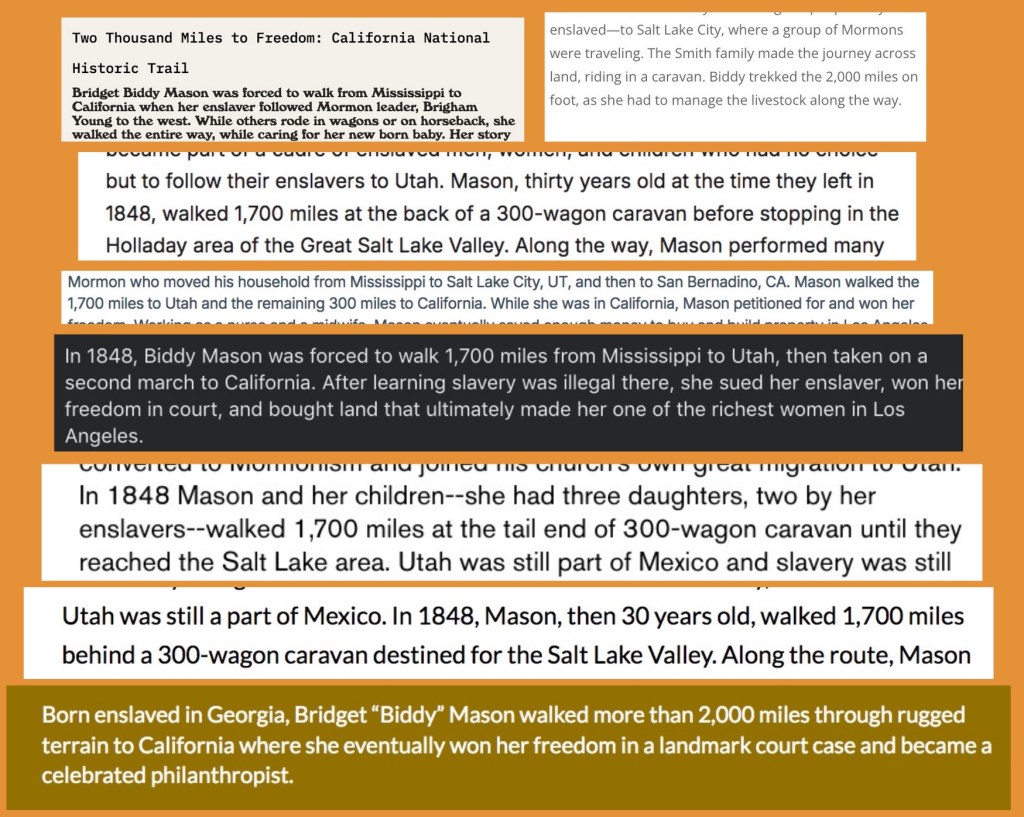
Regarding the claim that she “walked 1,700 miles on foot,” there exists no contemporary account. The narrative first emerges in the 1909 Los Angeles Times feature by Kate Bradley Stovall, “The Negro Woman in Los Angeles and Vicinity – Some Notable Characters.” Stovall writes of Biddy it “was her especial work to care for the sheep which were to be brought across the desert, and during the greater part of the six months’ journey she trudged patiently behind them, ever mindful of her charge.”
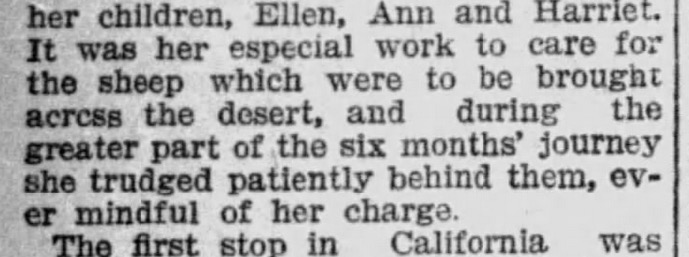
So, the claim was originally “the greater part,” not the entire journey. Do not mistake my skepticism for a lack of empathy: even if one were to trudge behind livestock for 51% of a six-month trek, the experience would be grueling and dehumanizing.
However, context matters. Stovall’s use of the verb “trudge”—implying slow, laborious movement—likely describes the progress of a mounted drover. Historically, livestock were managed by riders; managing a herd alongside a wagon train from the back of a horse or mule was standard. One “trudges” while mounted if the animal is moving slowly. In short: there is no evidence Biddy Mason walked, and logic dictates that she rode.
The notion that Biddy personally drove the livestock does not surface again until 1919, in Delilah L. Beasley’s The Negro Trail-Blazers of California. Beasley cites Biddy’s daughter claiming her mother had “drove the livestock across the plains into California.” Notably, the daughter makes no mention of her mother walking. Beasley further embellishes: “But think of this slave woman coming to California in 1851 by ox-team… at the end of these wagons, Biddy Mason driving the cattle across the plains, notwithstanding she had her own three little girls to care for en route!”
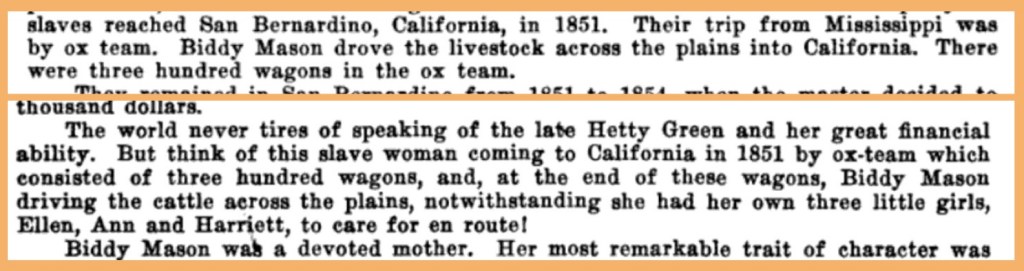
The first explicit claim that she walked behind the wagons did not appear until 1959 — 108 years after the event:
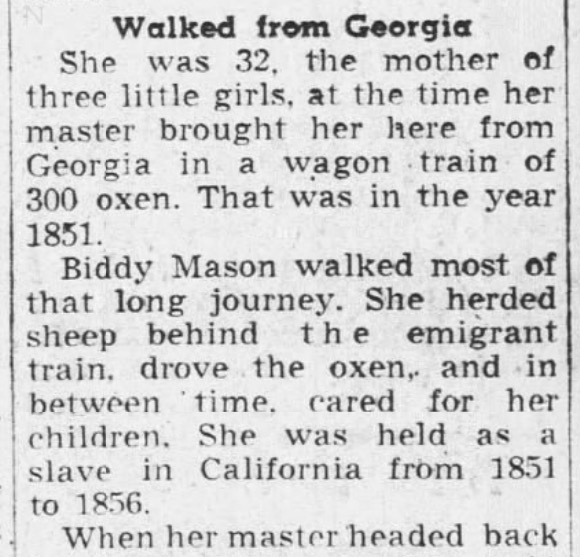
That is extrapolated upon in 1971:
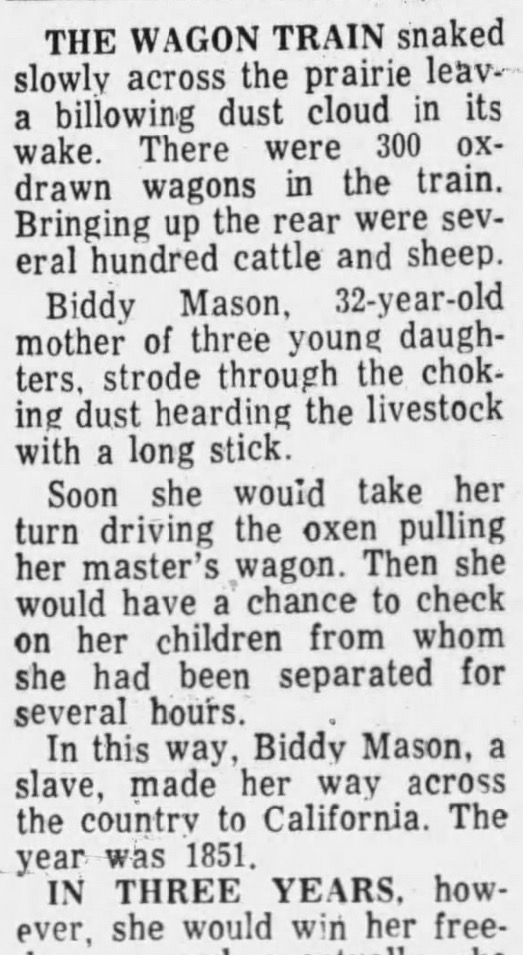
Reasons’ article describes two distinct and separate roles: driving loose livestock behind the wagon train (a “drover”), and handling yoked oxen pulling the wagon (a “teamster”). When you transition between the two, the entire logistical requirement changes. If you are a drover tasked with trailing a mixed herd of sheep and loose oxen behind a wagon train, you would undoubtedly, by necessity, be mounted (I go into this more, here).
However, if and when you are at the front of the train driving a yoked ox, there are mechanical and logistical reasons to be on foot. While driving yoked oxen often requires one to be on foot, especially in rough terrain, the assumption that she was on foot for the duration of a two-thousand-mile journey is an unsubstantiated leap.
“She petitioned for her freedom”
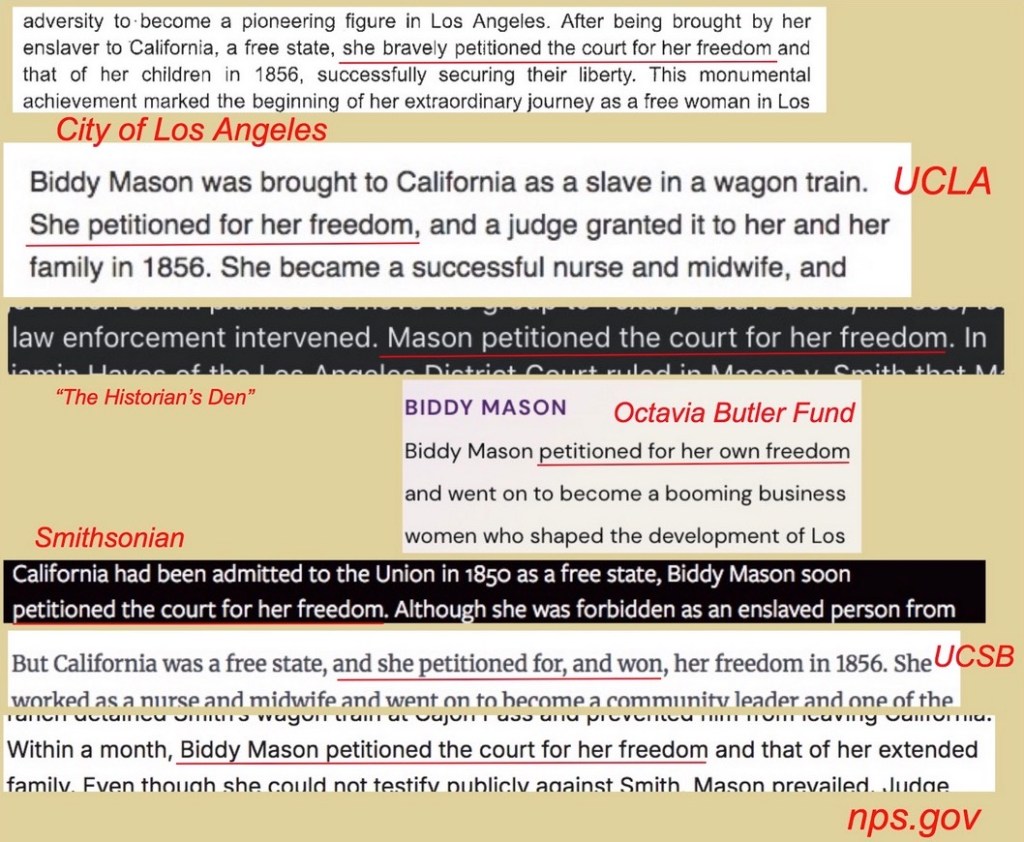
Countless government and university sources—along with folk who claim the title of “historian”—persistently assert that Biddy Mason “petitioned the court” for her freedom. This is a fabrication.
The reality of the 1856 proceedings is a matter of record. Robert Owens, a free Black man, discovered that the slaveholder Robert Smith was attempting to flee California with fourteen enslaved people. Owens organized a posse, intercepted the party, and brought them to Los Angeles. Owens then filed a writ of habeas corpus, and Judge Benjamin Ignatius Hayes presided over the case, ultimately ruling that all fourteen individuals were free.
If I am to be exceptionally generous, I might suggest that those repeating the “she petitioned the court” error are merely illiterate in legal terminology. To the modern layperson, the title “petitioner” implies an active verb—that she herself drafted and filed a petition. This is categorically false. “Petitioner” is a legal noun designating the subject of the writ, the person whose liberty is the object of the court’s inquiry.
While Mason and thirteen others—ten of whom were not her kin—were named as petitioners in the proceeding, the historical evidence confirms she was neither the architect nor the initiator of the filing. Robert Owens and, quite likely, Elizabeth Rowan, mobilized the intervention. Mason and the others were the beneficiaries of an action taken by others; she possessed zero agency in the construction or execution of the legal filing itself. To credit her with the legal maneuver is to engage in a deliberate distortion of the historical record, elevating the status of the “petitioner” to that of a modern activist, when in fact, she was the passive subject of a rescue operation.
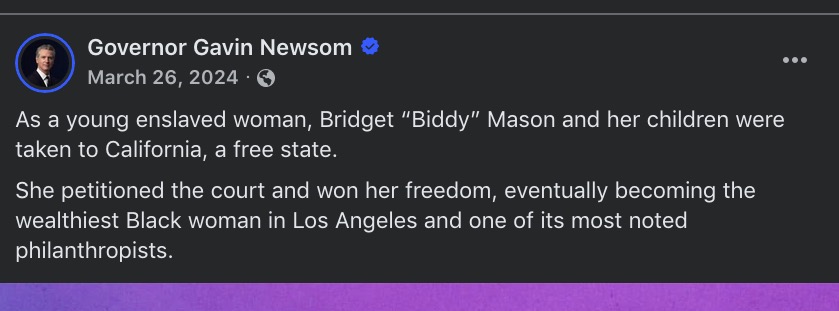
Another detail warrants scrutiny: the pervasive claim—found in over 2,000 online instances—that Biddy Mason “sued” for her freedom.

First, to reiterate: Mason performed no legal labor to secure the freedom of the fourteen enslaved individuals. However, if you were to assert that it was Robert Owens who sued (on her behalf), you are wrong asserting such, for that is a gross mischaracterization of the legal process. Filing a petition for a writ of habeas corpus is a specific judicial procedure through which a petitioner invokes the court’s authority to challenge the legality of state or private custody. It is not a “lawsuit,” and no one is “suing” in the colloquial sense of a civil trial.
This may seem like a minor semantic quibble, but it is fundamentally important. It exposes the infuriating “la-dee-da, close enough” attitude that characterizes the modern hagiography surrounding Biddy Mason. When history is reduced to soundbytes for the sake of moral signaling, the truth is sacrificed to satisfy the contemporary urge to cast historical figures as modern activist-litigants. Precision is the enemy of myth, which is precisely why the standard Biddy Mason narrative so aggressively avoids it.
So, no, Biddy neither petitioned nor sued for her freedom, so for the love of God stop repeating that. But while we’re on the subject, here’s something else that irks me:
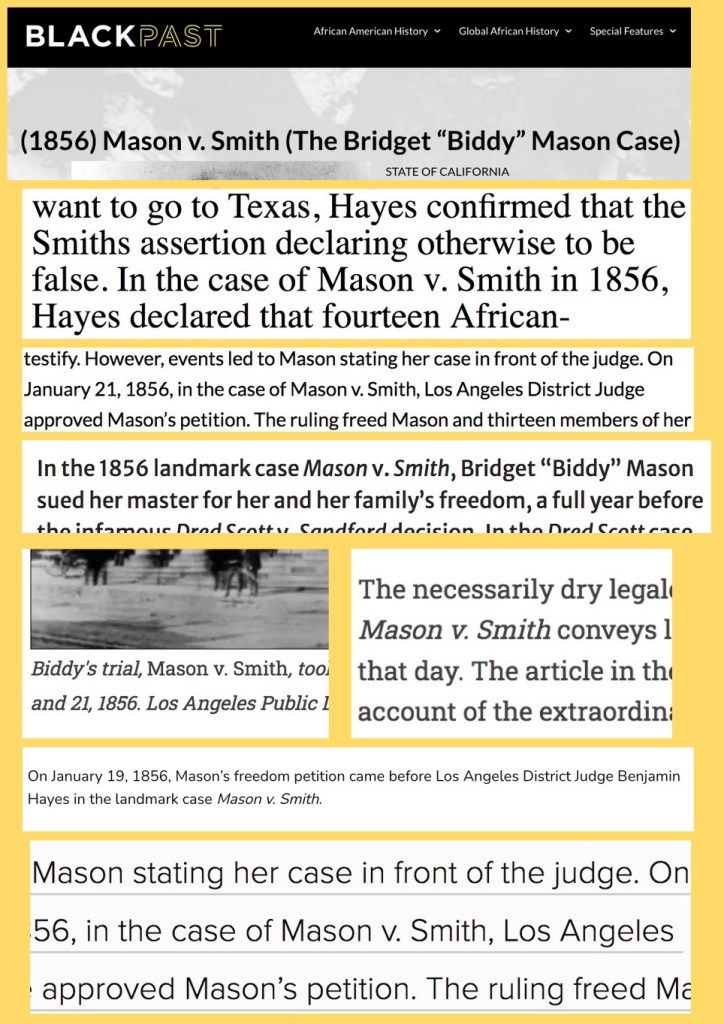
“Ok so maybe she didn’t petition for her freedom, but, she marched in to Judge Hayes’ private chambers and she testified and that convinced him and that’s what freed them all!”
Yeah, about that. The slaveowner Robert Smith was saying “hey, don’t worry about it, they all want to go with me to Texas!” And Judge Hayes was obviously like “(X) doubt“. While Hayes sought to ascertain the truth, California law at the time strictly prohibited Black individuals from testifying against white people in open court. Judge Hayes said, ok, I got a workaround. He convened an informal inquiry, questioning the three adult women—Hannah, Biddy, and Ann—to determine if they truly consented to the journey. While Hannah initially acquiesced, she later confessed to the San Bernardino sheriff that she had misgivings.
You will frequently encounter the romanticized claim that Biddy “bravely stated her case in his private chambers” but the record tells a more grounded story. Judge Hayes called Biddy into his chambers (accompanied by no less than Abel Stearns and James Brown Winston) “for the purpose of testing the state of her mind, a question was framed” which asked about the forthcoming move to the slave state of Texas, to which Biddy replied, “I have always done what I have been told to do; I always feared this trip to Texas, since I first heard of it.”
The judicial outcome hinged on the depth of Smith’s undue influence. Hayes concluded that, given the circumstances of their bondage, these women were incapable of providing meaningful, binding consent. Thus, they were declared free. To be precise: Biddy never filed for freedom; she was interrogated regarding her willingness to enter a slave state, and she indicated her fear of doing so.
Much digital ink has been wasted asserting that Biddy “testified.” This is historically and legally illiterate. There were no oaths, no penalty of perjury, and no formal rules of evidence. It was an informal judicial inquiry. Furthermore, Hayes questioned several members of the group; his finding of duress relied on the broader pattern of evidence, not merely a single statement from Biddy.
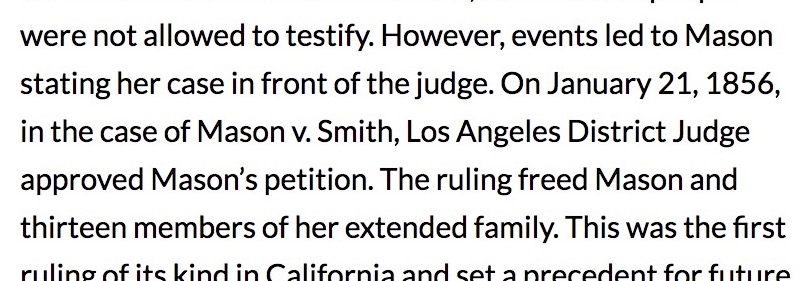
Consider the typical caliber of “professional” history: this is from freedomcenter.org —an institution with forty employees and a multi-million-dollar budget—which manages to pack a staggering amount of misinformation into three sentences. When they say “events led to Mason stating her case in front of the judge,” the “events” were simply the judge asking her to come in and answer a question, and she didn’t “state her case;” she answered the question. They then invent a fictitious case, Mason v. Smith — as I mentioned above, the matter was titled In the Matter of Hannah and Biddy and their Children, on Petition for Habeas Corpus (and there was no-one named “Mason” involved at the time, anyway). They then claim the court “approved Mason’s petition,” a complete fabrication, as she filed no such document. Finally, they assert that the ruling “freed Mason and thirteen members of her extended family.” This is a distortion; of the fourteen, only three were Biddy’s kin. The others, including Hannah Embers and her nine children, were not her family. For those who point to Dolores Hayden’s Power of Place and her claim—allegedly sourced from a February 1856 Los Angeles Star article—that Biddy and Hannah were sisters, I suggest you consult the primary source itself. If you actually read the cited 1856 article, you will find that no such familial connection is mentioned. Modern “historians” are apparently more interested in constructing a specific narrative than in consulting the archival record (it should be mentioned that Dolores Hayden—whose 1989 Power of Place was a hostile takeover of the historical record and which provides the bedrock and template of all modern Biddy Mason narratives—was not a historian, but a feminist landscape theorist).
If you want to read lots more about the case, here is the case decision, and Judge Hayes’ opinion.
“Biddy Mason was a midwife”
She was indeed a midwife, and perhaps a highly proficient one. However, the modern attempt to brand midwifery as a counter-cultural aesthetic—an act of rebellion against a “medical-industrial complex”—is a total historical reversal of its status in mid-Victorian Los Angeles.
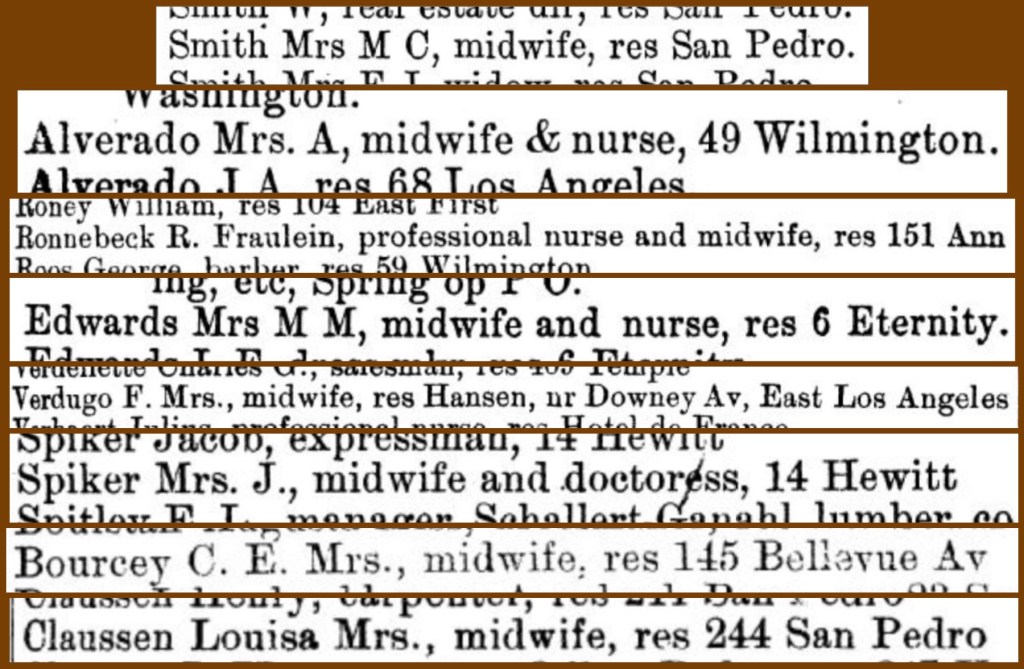
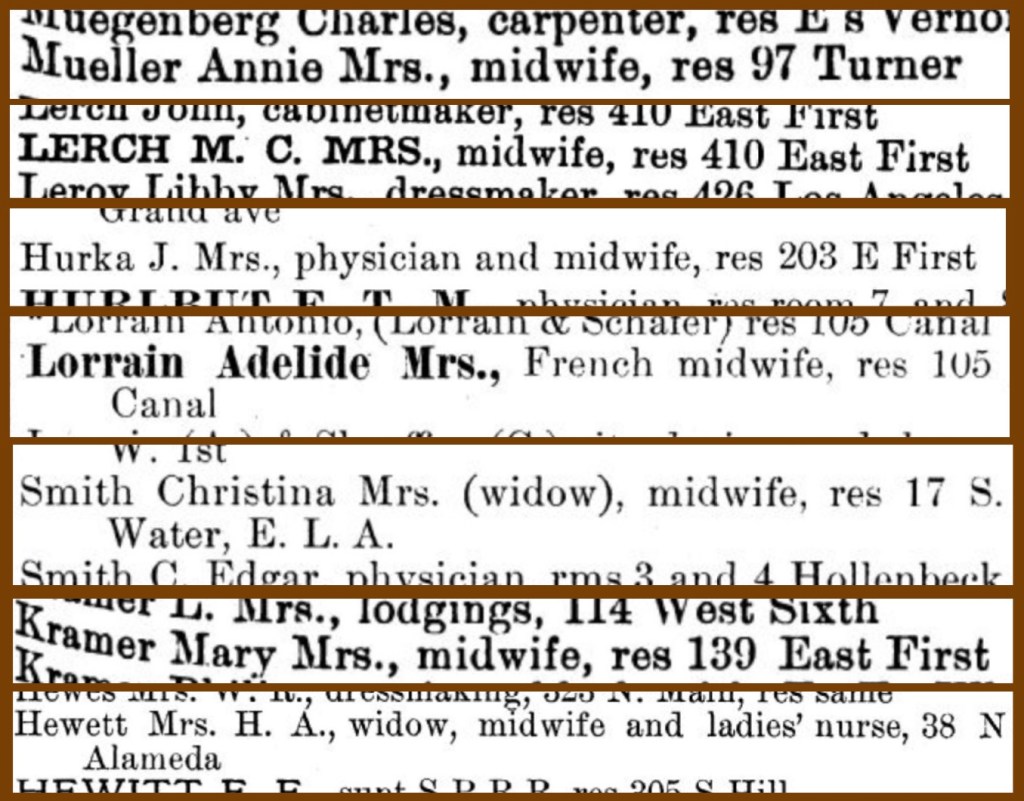
In Los Angeles from the 1850s through the 1880s, midwifery was the baseline. It was entirely anodyne, essentially invisible, and absolutely essential. In that era, calling a physician for a standard birth was often the “alternative” choice—and usually a poor one.
Here, for example, are some of the midwives in Los Angeles during part of the time Biddy Mason worked, from the mid 1870s to the late 1880s:
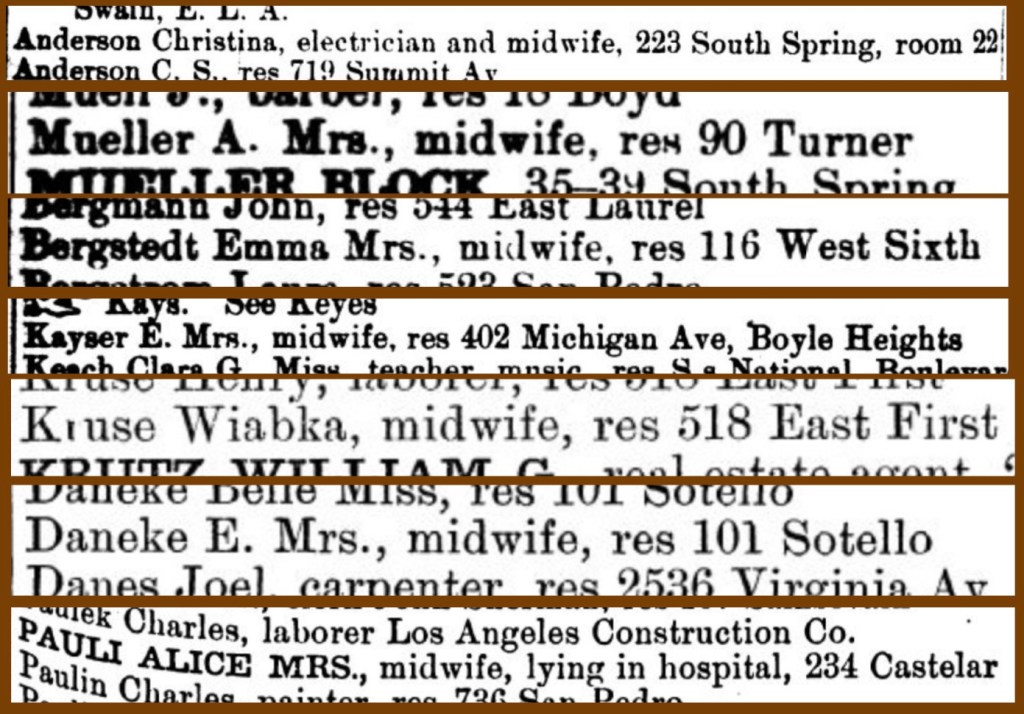
Furthermore, the tale that she was trained by “wise plantation elders” in the South is supposition, and contradicted by the historical record. In June 1887, while testifying under oath in the Horace Bell libel suit, Biddy Mason stated, “I have been a midwife for thirty-seven years.” By her own account, she began her practice in 1850 in the Salt Lake Valley, not in Georgia. She was thirty-two years old and far removed from any Southern plantation when she began her medical work.
“Biddy Mason was a nurse”
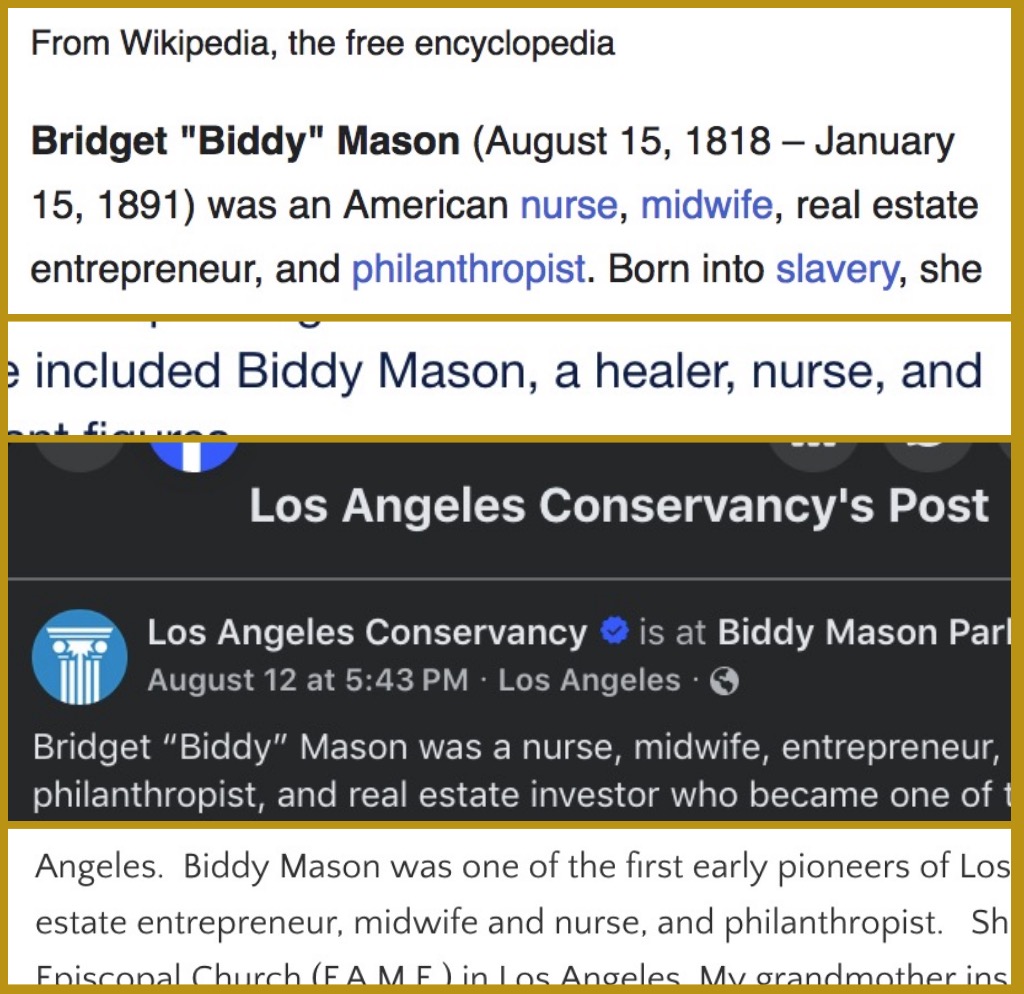
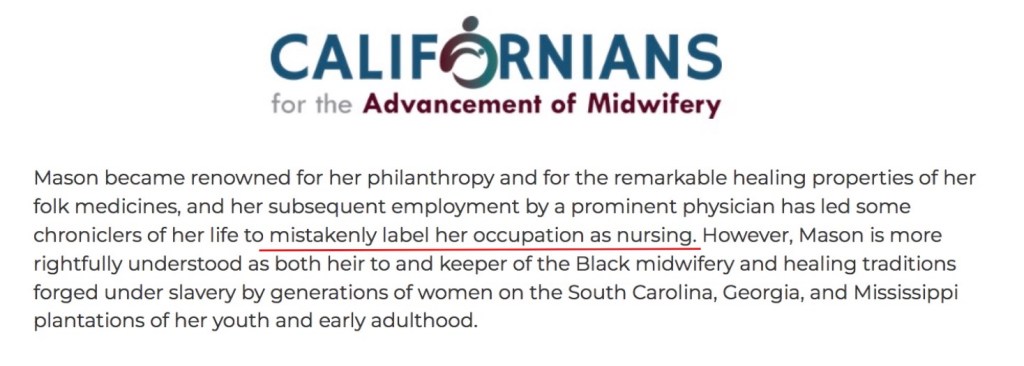
Biddy Mason was not a nurse—at least not in the sense we imagine today. She was a confinement nurse, and while the title shares a root, she walked in an entirely different world than, say, Clara Barton. Before insisting that the word alone defines the trade (“it has nurse in the name, that makes her a nurse!” I already hear everyone yell at me), consider the house painter and the portraitist: both share the title of painter, yet one coats siding while the other renders the human face. To mistake a sovereign domestic matron of the lying-in chamber for a clinical sick-watcher is an error just as vast.
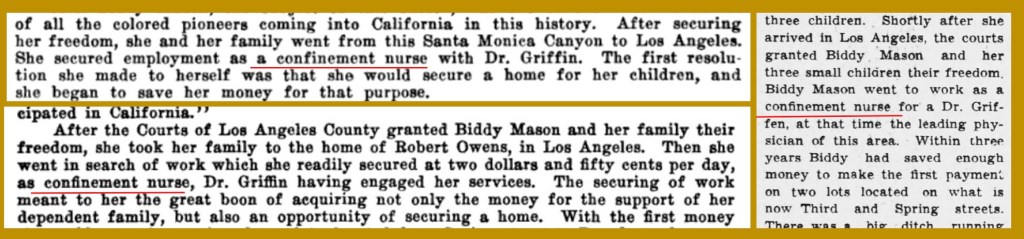
In nineteenth-century America, a general nurse and a confinement nurse occupied entirely different spheres. General nurses were custodial laborers—often hospital subordinates—who managed disease, injury, and dying patients under strict physician oversight. By contrast, a confinement nurse was an autonomous matron hired to preside over the private lying-in chamber. She governed a healthy physiological threshold rather than pathology, managing two interdependent patients—mother and infant—through labor, lactation, cord care, and recovery. She held domestic sovereignty, often defying male doctors until clinical medicine dismantled her traditional, woman-led authority. (More about the subject, here.)
“Biddy Mason was an herbalist healer”
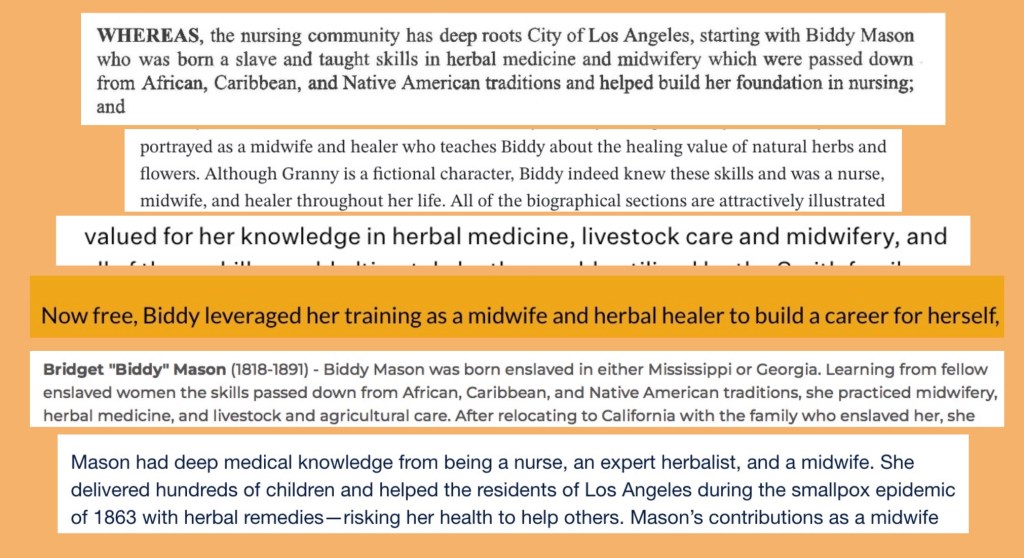
Yes, she used herbs, but this was a necessity in an era before the pharmaceutical-industrial complex, when “druggists” primarily distributed patent medicines containing dubious mixtures of alcohol, opium, and arsenic.
The standard narrative insists her methods were “root doctor” traditions imported from the South. However, as noted, she did not become a midwife until she reached the Utah Territory and later California. While she may have absorbed some botanical knowledge in Mississippi, her practice matured in the Victorian-era melting pot of Los Angeles.
There, the partera traditions of the Mexican population, the botanical wisdom of the indigenous peoples, and the folk traditions of American pioneers collided. Crucially, Mason’s practice evolved through rigorous exposure to formal Western medicine. Working alongside Dr. John Strother Griffin—an elite, university-trained physician—Mason absorbed obstetrical scholarship. She mastered European materia medica, dosage protocols, and clinical standards. To credit her efficacy solely to “Southern folklore” is to strip her of the professional development she achieved by operating at the highest levels of medical practice available in the nineteenth-century American West.
“She founded the first Black church in Los Angeles”
The narrative rests on two pillars: first, that Biddy Mason founded the First African Methodist Episcopal (FAME) Church in Los Angeles, and second, that prior to its construction, no other Black church existed in the city.
Second things first: I’m not convinced there wasn’t another church already. We know that the First AME congregation purchased land at the corner of Fourth and Charity on Bunker Hill in March 1869, proceeding to raise capital for a structure that opened in the spring of 1871.
And yet, there’s earlier mention of a “colored church,” recently built, on Third Street, in September 1870:
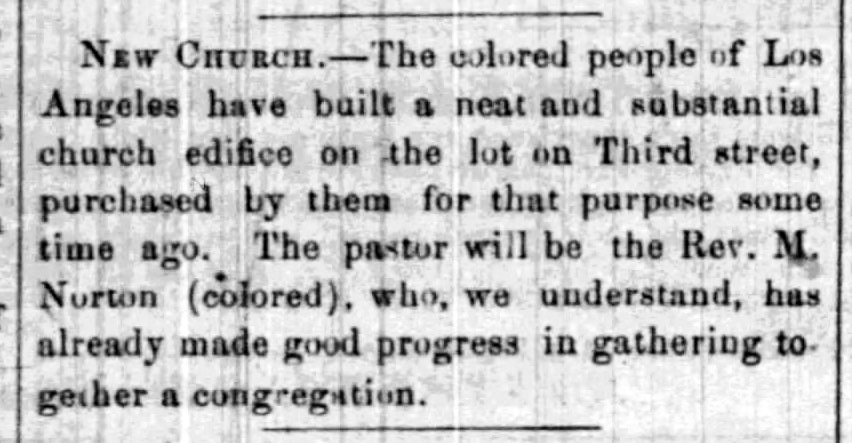
The Biddy Mason church was not on Third Street. Moreover, the Biddy Mason FAME church did not have Norton as a pastor; the African ME pastor in Los Angeles was Jesse Hamilton.
Moving on: the claim that Biddy Mason founded the First African Methodist Episcopal Church in Los Angeles.
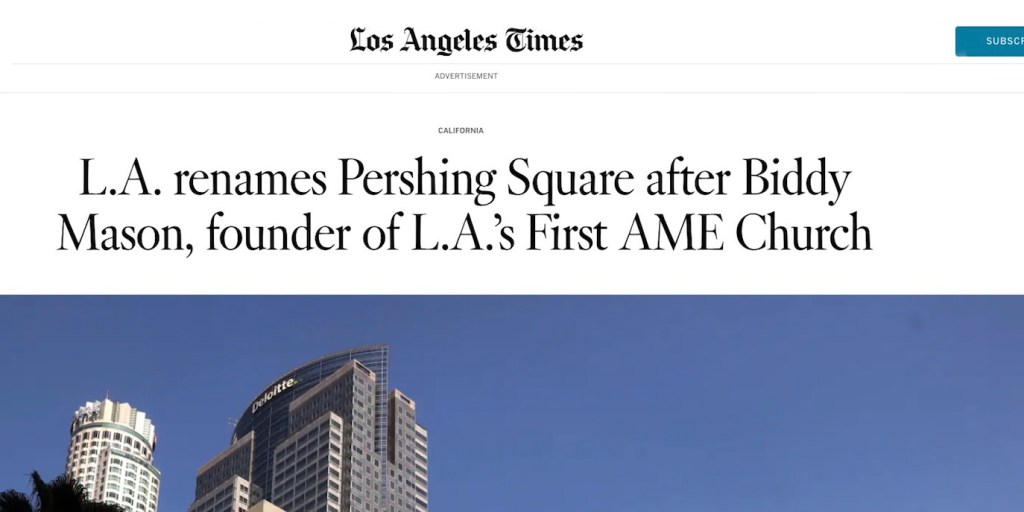
The African Methodist Episcopal (AME) Church originated in Philadelphia in 1816. Following the Civil War, the congregation-planting movement accelerated across the nation; membership rolls surged from approximately 70,000 in 1866 to over 207,000 by 1876. The Reconstruction era witnessed the most explosive religious expansion in American history, making the establishment of an AME presence in Los Angeles an entirely natural—and largely inevitable—development.
It is crucial to distinguish between being the founder and being a founder. According to the Eagle, Biddy Mason was one of 12 founders:
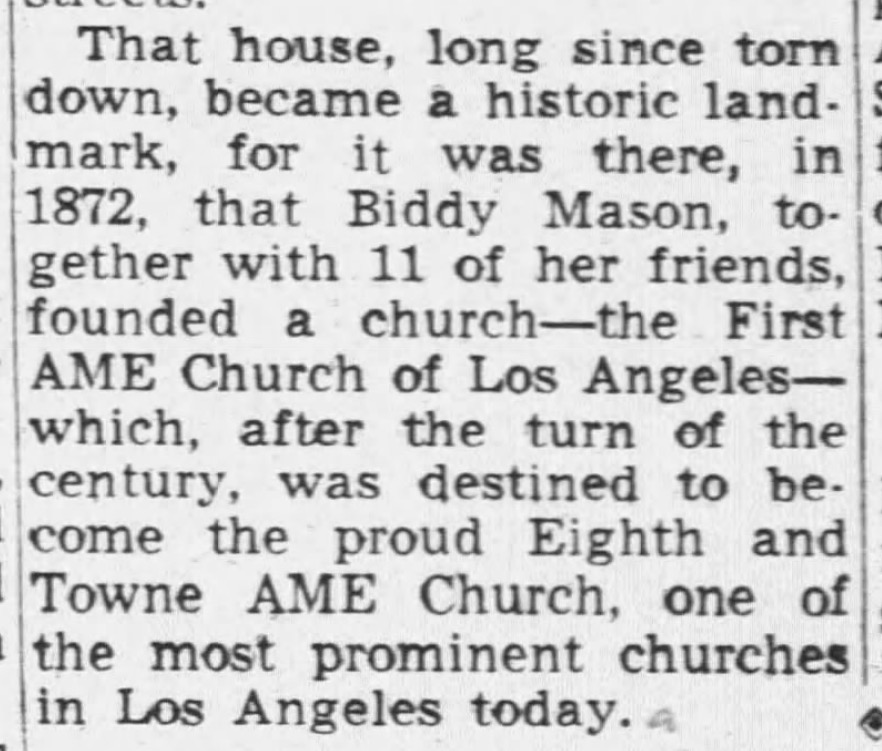
The California Eagle states above Mason was one of twelve founders. Despite the Eagle saying that, documentation for Mason’s role as even a co-founder is conspicuously absent. In 1868, Mason was a charter member of the predominantly white Methodist church on Fort Street; that we know. But when the First AME church was legally established in March 1869, the list of trustees included Charles Owens, John Ballard, Jeremiah M. Redding, Lewis Green, George Smith, John Hall, and Samuel Johns. Mason’s name does not appear among the administrative architects.
What early documented sources attribute the founding, or even co-founding, to Biddy Mason? We’ve got Thompson and West’s History of Los Angeles County, California (1880) which listed Winnie Owens, Bridget Mason, and Alice Coleman as the church’s first members — membership, however, is not synonymous with founding.
It’s tricky, because the term “founder” is malleable. There is a divide between the “Ideational Founder” (the primordial group) and the “Incorporating Founder” (the administrative architect). Biddy Mason did nothing a traditional administrative “founder” would do, in the sense of navigating legal bureaucracy—securing the deed, filing the articles of incorporation, or establishing a financial infrastructure. Rather, she was a founder in the vein of the primordial group, where she and eleven others — the “Twelve Apostles,” coalesced around a core doctrine and vision, providing the spiritual or ideological impetus.
Now you say “maybe she was or wasn’t a founder, but she definitely donated the land and paid for the church!” Well, who told you that? Because there’s no evidence for that either. After the church bought the undeveloped Bunker Hill land in March 1869, they then went on a funding campaign.
In late August of ’69, the Bishop of the AME Church, T. M. D. Ward, had visited Los Angeles and wrote about Los Angeles’s AME church-building efforts in an issue of The Elevator. He listed in his piece those members of the Roll of Honor:
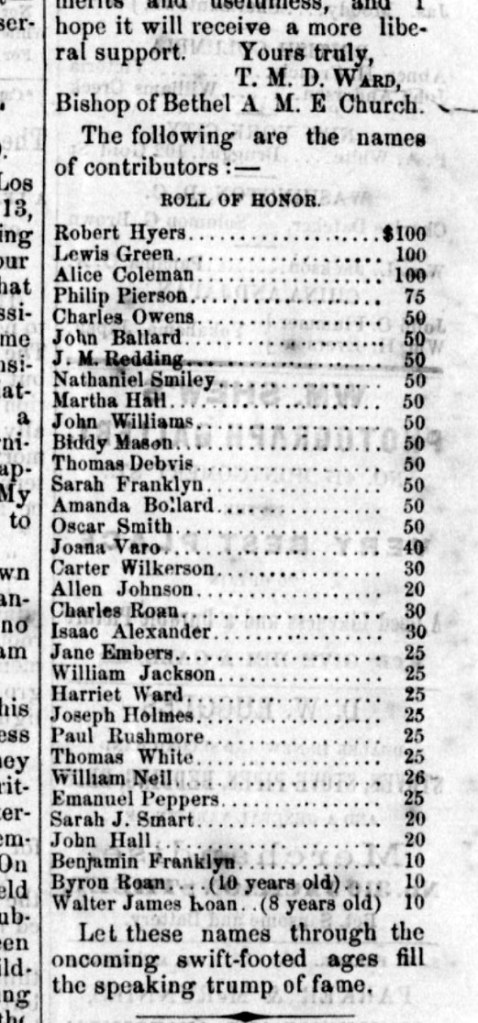
What do you notice? Did Biddy Mason give a thousand dollars? Did she at least give more than anyone else? Uh, no.
By the end of the month, they were still looking for money to build a church —
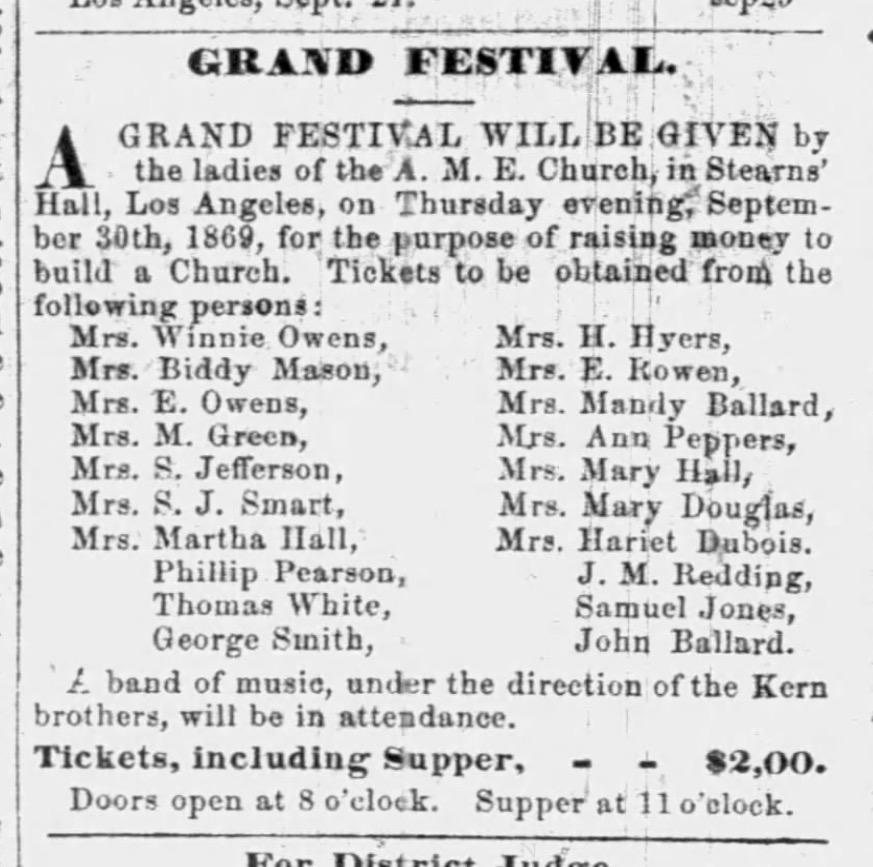
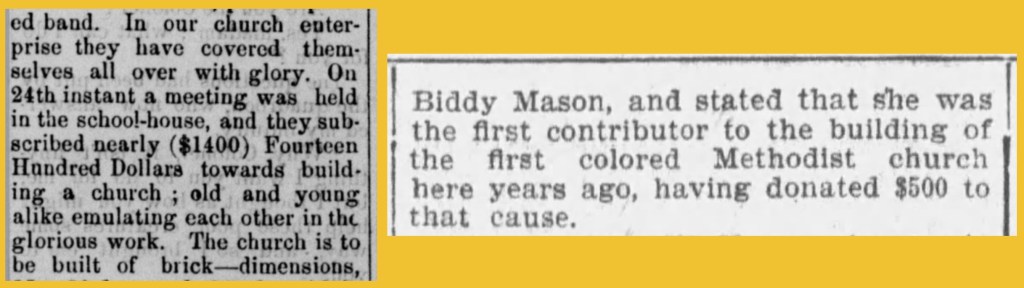
As usual, the first mention of Biddy Mason’s greater-than-average role in something comes from Stovall’s 1909 piece in the Times…
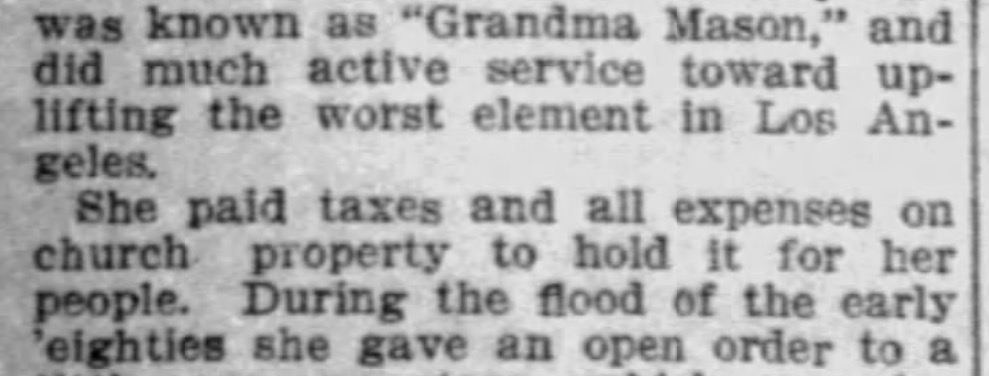
…in which all she says is that Biddy paid the taxes and expenses on the property (ten years later, Negro Trail Blazers adds nothing to this story). But don’t forget how that turned out:
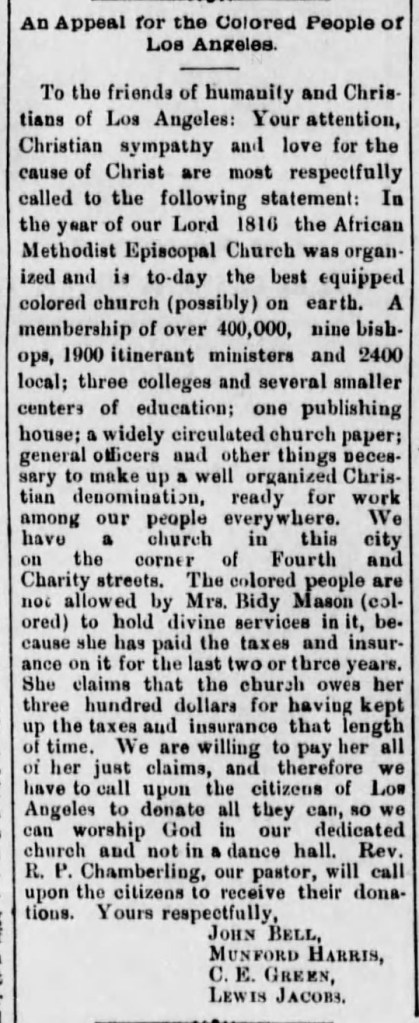
So how and why do people believe the idea that she was the founder? The Los Angeles Times, of course. They first came up with the idea in 1990:
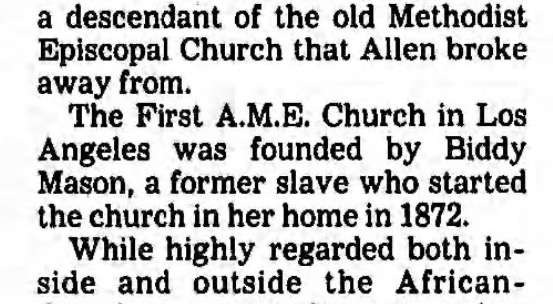
…and it’s been off to the races ever since.
“She founded the first school for Black children”
Ha! If you say so. This claim collapses under the slightest archival scrutiny.
The 1909 Kate Bradley Stovall article is the earliest historical narrative about Mason. But Stovall’s lengthy account of Mason (February 12, 1909 Los Angeles Times) conspicuously omits any mention of her founding a school. That’s important because Stovall was writing only 18 years after Mason’s death and was documenting the memories of the older Black Los Angeles community. Similarly, Delilah Beasley’s 1919 The Negro Trail Blazers of California—which drew directly from interviews with Mason’s daughter, Ellen Owens Huddleston—remains silent on the matter.
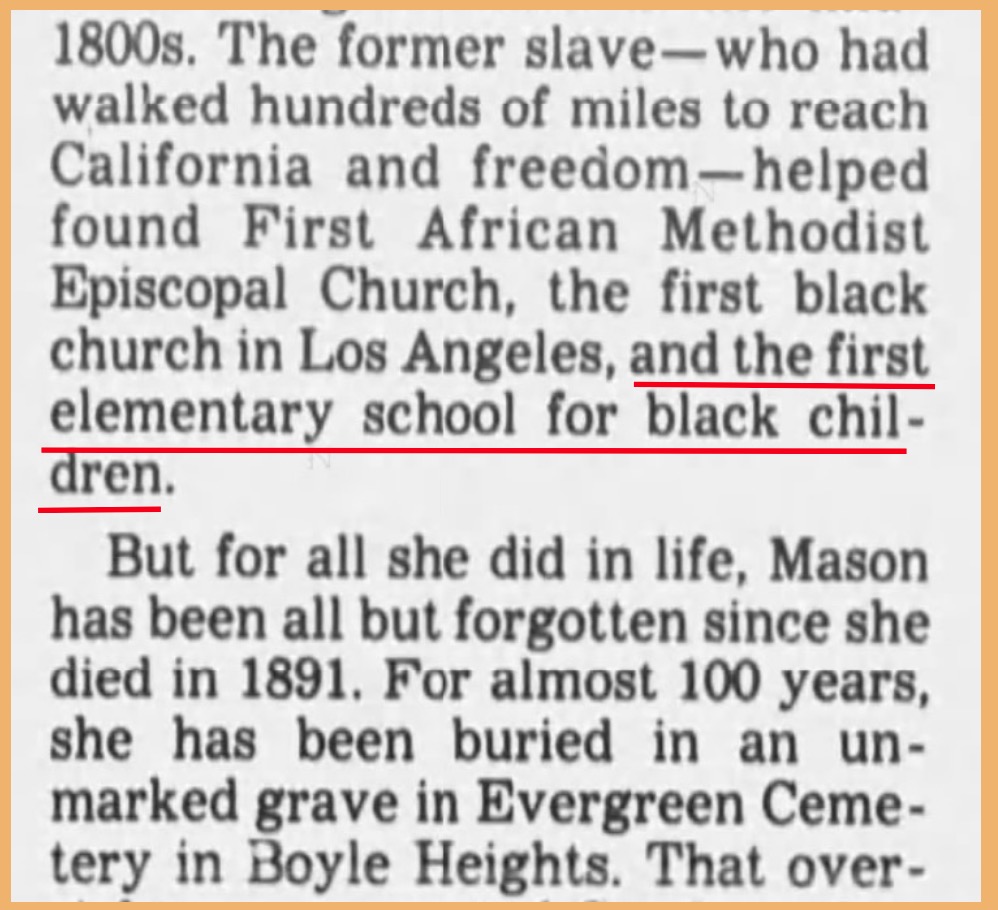
The myth is a modern fabrication, birthed in the pages of the Los Angeles Times. On March 28, 1988, writer Gregory Couch simply hallucinated the claim into existence (the same article, tellingly, that popularized the fictional narrative of her “unmarked grave” — we’ll get to that in due course).
Paul R. Spitzzeri, a diligent historian of Los Angeles, wrote an excellent piece about Black schools in LA up to 1875. You know who it doesn’t mention? Biddy Mason.
While the Board of Education leased the “colored people’s church” from 1875 to 1880, fitting it with desks and chalkboards for the purpose, this was a municipal arrangement, not a private philanthropic endeavor by Mason.
At the end of the day, if Biddy Mason did start, or at least partially fund, a school, it must not have been much. Her grandchildren were sent all the way to Oakland for their schooling!
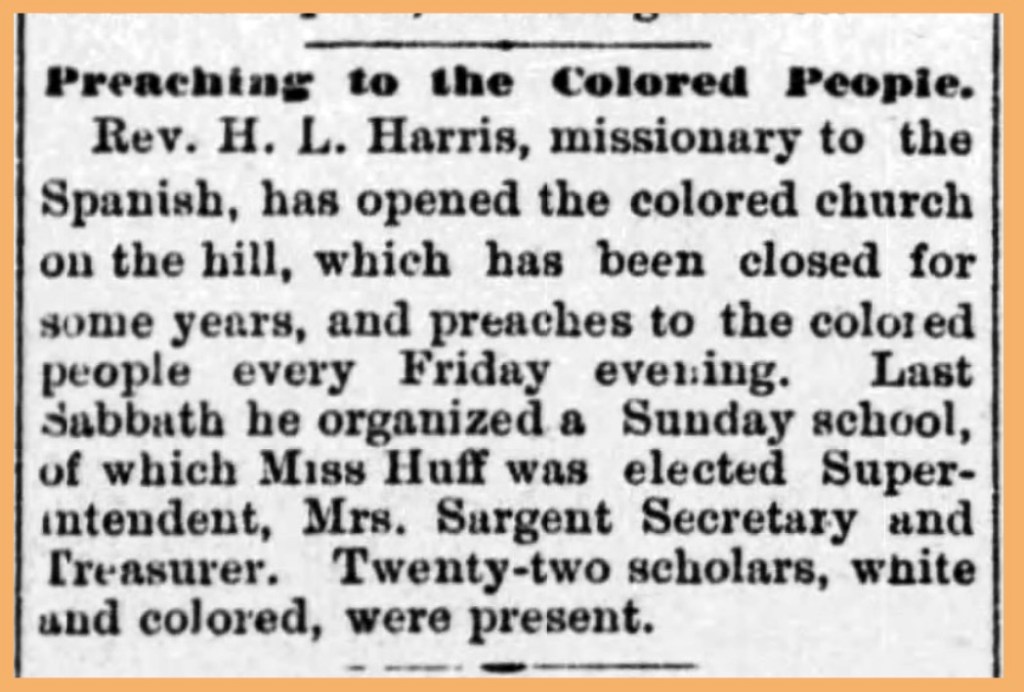
To be fair, there is one school we can actually link to Mason. The First AME fell apart in the mid-1870s. She helped it get back on its feet in 1882 when she paid the back taxes (she then closed the church two years later, because the church wouldn’t reimburse her). Anyway, during the reopening of the church, First AME started a Sunday School.
“But,” I hear you say, “she started a nursery! And started a home for orphans!” These claims, repeated by no less than the LA Conservancy and the LA City Historical Society, are entirely devoid of historical legitimacy. The nursery myth was made up by the Los Angeles Times in 1989; it existed in no form whatsoever before that.
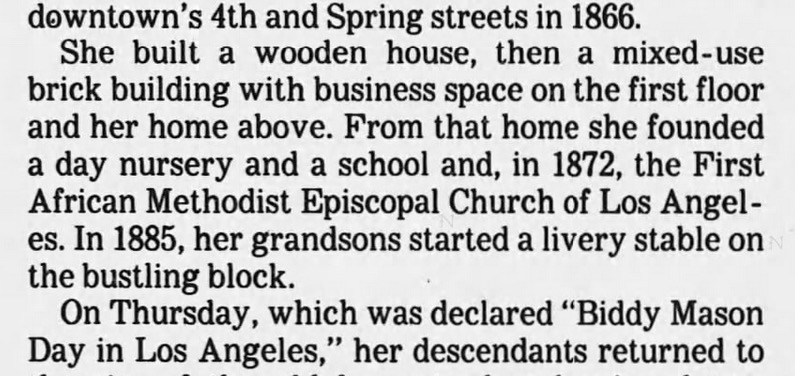
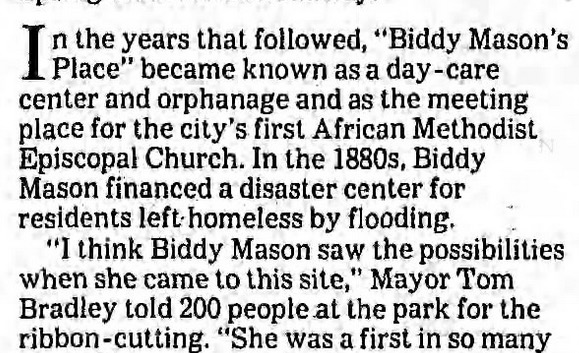
And, surprising absolutely no-one, the “orphanage” fabrication was also made up out of thin air by the Los Angeles Times. It existed in no form whatsoever before 1991.
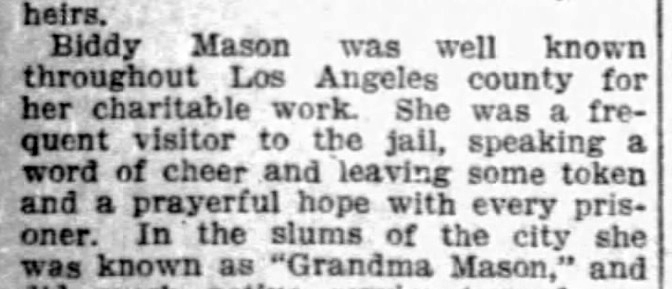
Since we’re discussing stuff that didn’t happen, let’s talk about how Biddy Mason visited prisoners. Don’t get me wrong, she did, in fact, visit prisoners, to give them a cheery prayer! This story exists in no contemporary account, but is a part of the famous 1909 Stovall article:
But let’s move on to one of my absolute all-time very favorite Masonisms, which was penned by the esteemed Dr. Kelly Lytle Hernández in City of Inmates (2017), in which Hernández writes:
Biddy soon found work as a nurse and a midwife. One of her jobs was back at the county jail, because the white doctor selected by the county government to service the county’s imprisoned population preferred not to do the work and, instead, subcontracted it to Biddy. As a paid nurse, Biddy tended to all who ailed in the county jail. When the contracts expired, she kept going, volunteering her healing hands to all those incarcerated in the L.A. County Jail.
In the great tradition of academic frauds, the good professor just made it up. Doesn’t even have a footnote! The “white doctor” to whom she refers is John Strother Griffin, who in May 1859 had been appointed as Physician to the County Hospital and Jail; also, in 1859, Biddy Mason went to work for Griffin as a midwife. It’s a baseless and absurd premise: an elite physician, after having been tasked by the Board of Supervisors to be the city’s jail physician, then delegated his clinical responsibilities to a non-physician contractor. Now, unless there’s a Griffin diary out there that literally says “dang, I prefer not to do this work at the prison! I’m gonna sub this out to that new midwife hire!” then I say Hernández is a fraud, because she is knowingly fabricating evidence, by presenting something as documented when she knows it isn’t. I don’t know if that gets me sued for slander, or what, so I’ll do her a professional courtesy and rephrase it as “what we currently have is evidence of a potentially unsupported or inadequately sourced historical assertion.”
I am more than willing to retract that criticism if and when Dr. Waite’s book comes out and he repeats this claim, but with the verifiable evidence, that is, with a source other than the 1909 Stovall report that Biddy visited the jail to “speak a word of cheer and leave a token and a prayer.” Hey, maybe Waite got his hand on that juicy diary of prison-hating Griffin, who knows!
“She fed the poor“
She likely did. We do have one contemporary report of such activity:
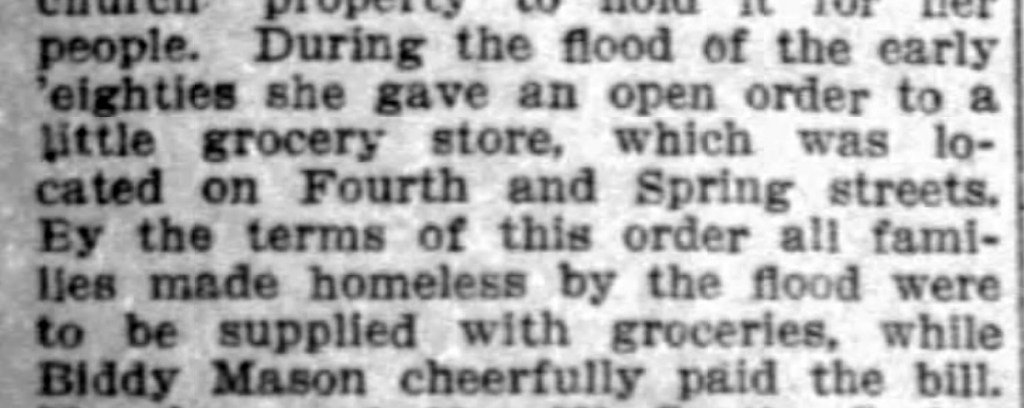
This is great, and I accept it as fact, despite it being reported “only” twenty-five years after the event (because conversely, many frequently-repeated Biddy Mason “truths” came into being a full hundred years after her death).
The 1909 Mason revival narrative goes on to say:
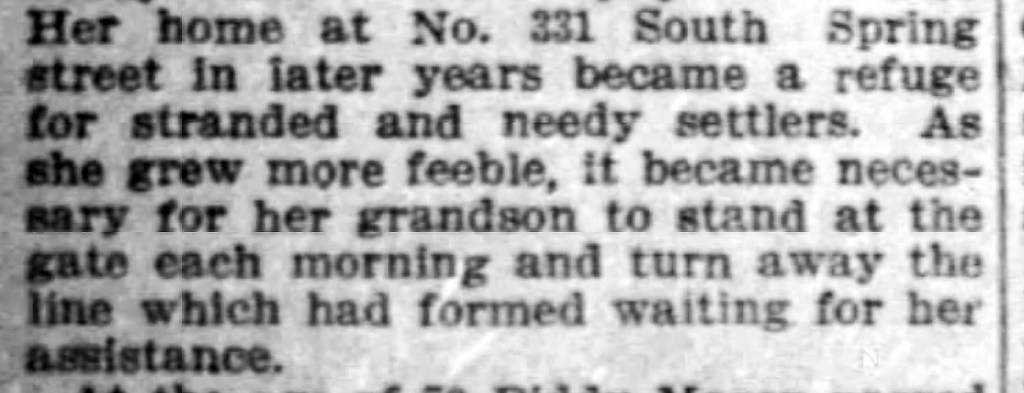
Again, likely true. Eighteen years is close enough that Stovall’s account deserves substantial evidentiary weight, especially because she was writing about a living memory of the Black Los Angeles community. Of course “likely true” isn’t the same as “verified” — though you and I may accept the story of “in later years Mason’s home became a refuge for settlers,” let us never forget this crucial methodological point: proximity in time doesn’t automatically authenticate an anecdote. Stovall was only repeating oral tradition, thus possibly relying on an unreliable informant; or perhaps misunderstanding something; or simply embellishing. (And no, it’s not something Stovall herself would have recalled, since she was a child, likely still in Texas, during Mason’s “later years.”)
Biddy Mason is never, during her lifetime, described as philanthropic. Her obituary alludes to her philanthropy, though (mentioning her “good works”).
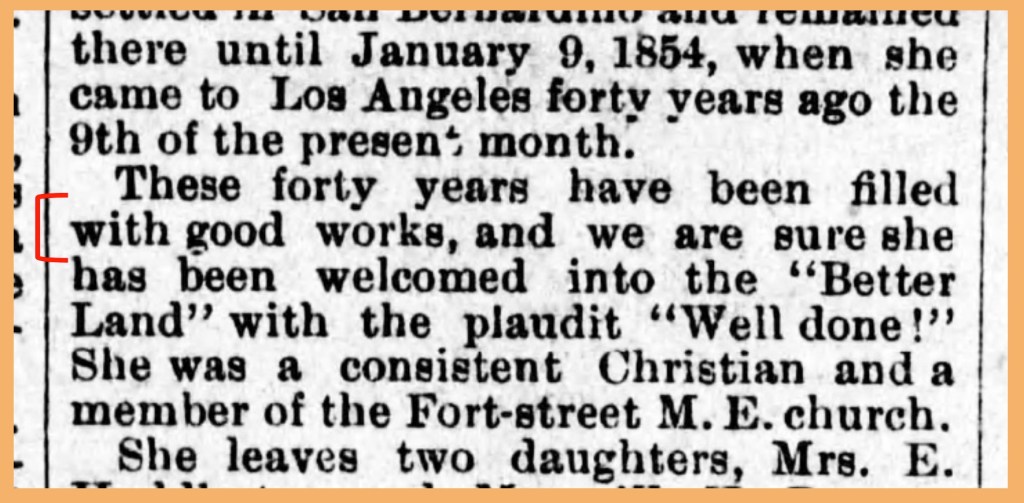
The best account of her philanthropy was the piece on her Christian efforts, published the day after a memorial window was dedicated in her honor. On Sunday, March 6, 1904, two windows were dedicated at the new First African Methodist Episcopal Church at Eighth and Towne. One window was of the Good Shepherd, and another was of Biddy Mason (depicting her? or not? I’ve never seen a photo of it though it presumably existed until the church burned in 1972 — I’m sure there will be an image of it in Dr. Waite’s forthcoming book).
The following day, the Liberator reported on the ceremony, where Mayor Meredith P. Snyder and others praised her “life of good deeds” and her contributions to the construction of the original Bunker Hill edifice.
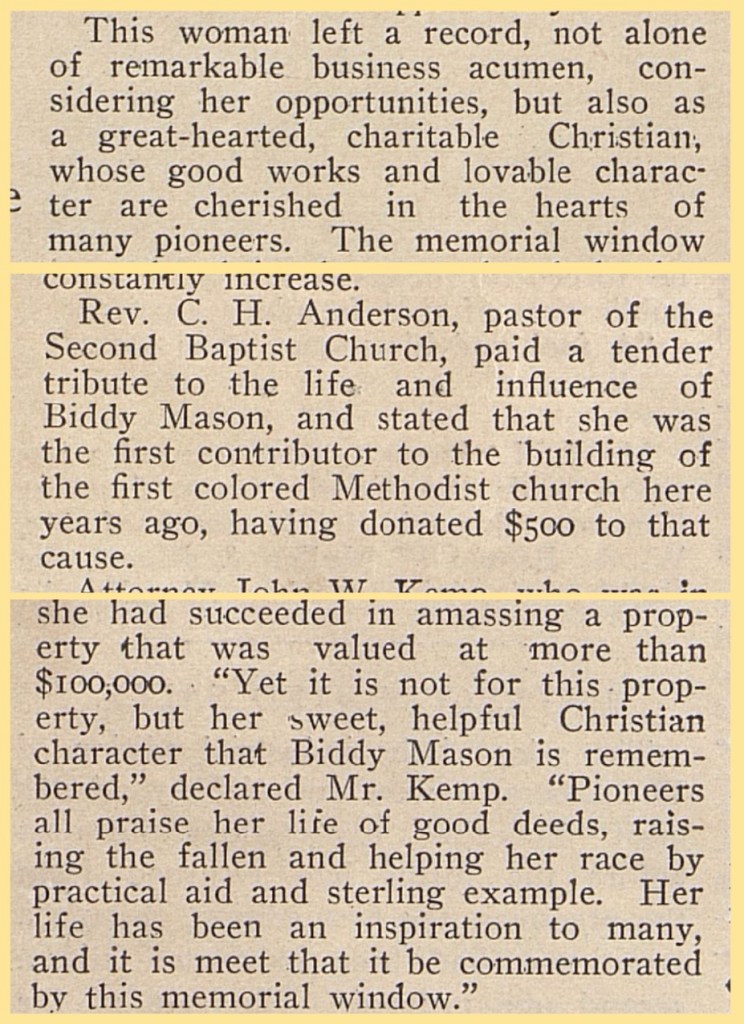
Here is the inconvenient truth about Biddy Mason’s philanthropy: it was neither exceptional nor uniquely significant.
The modern caricature of the Victorian capitalist as a rapacious miser is a myth. In Victorian America, charity was compulsory, not optional. Before the advent of the federal income tax (1913) or welfare state, the poor had no state backstop; the church and private purse were all that stood between need and starvation. A Christian property holder who gave nothing defied the plainest scriptural mandate — the Good Samaritan, “unto whomsoever much is given,” stewardship of wealth — and the era’s governing creed, noblesse oblige. If Biddy Mason did not give freely, she (as would have been true with any rich man) would have been read as spiritually bankrupt and socially dangerous: stingy, selfish, unfit for trust. Carnegie made it doctrine in The Gospel of Wealth (1889): the rich man who dies rich “dies disgraced.” Newspapers, clergy, and peers policed this norm relentlessly. To withhold was to confess you had no honor to spend. Giving was therefore predictable, not exceptional — the expected rent on privilege.
Furthermore, we must emphasize the Christian dimension of this giving. Whether Mason acted out of pure altruism or a sense of social duty, she remained bound by the scriptural imperative: “Whoever is generous to the poor lends to the Lord” (Proverbs 19:17), while Jesus teaches, “Give to the one who asks you” (Matthew 5:42). Likewise, 1 John 3:17 condemns withholding compassion from those in need. Motive mattered, but obedience to God demanded generosity regardless of motive. (For more on these topics, see what I wrote about her life vis-à-vis noblesse oblige, and Christian stewardship.)
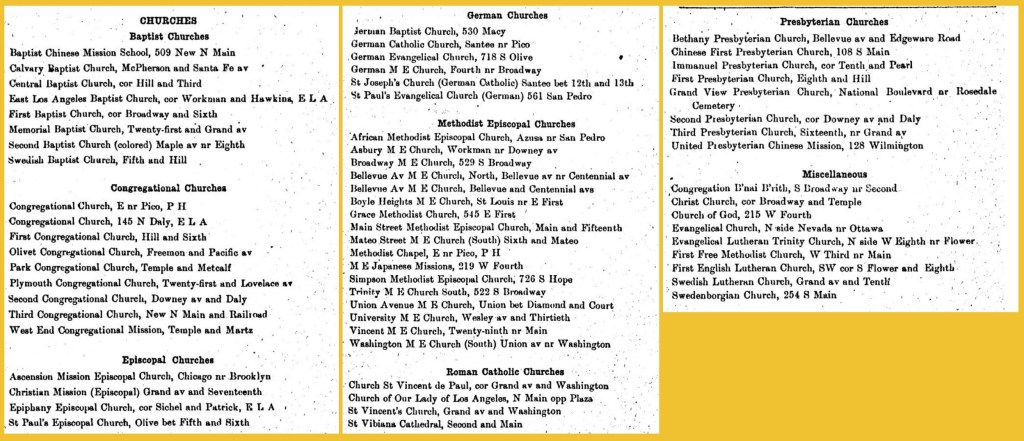
Finally, consider the sixty-five religious institutions listed in the Los Angeles City Directory just before Mason’s death. Every one of these organizations relied on founders, benefactors, and donors, and yet, you do not know their names. Why? Because they were part of a functioning society where fulfilling one’s duty to the community and the faith was the expected baseline, not a cause for secular beatification.
“She said the open hand quote!”
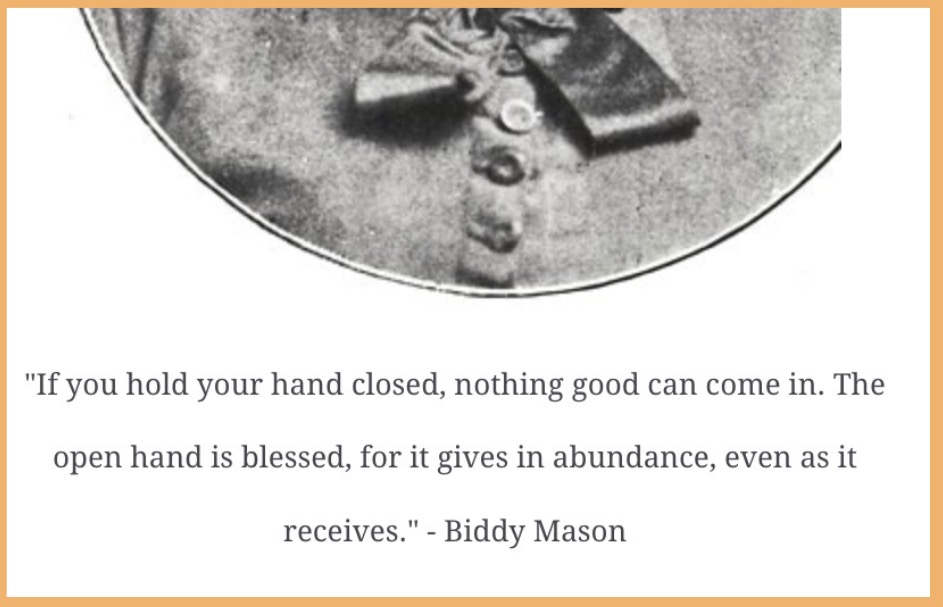
The “open hand” quotation is now inextricably linked to Biddy Mason, appearing in titles ranging from Open Hands, Open Heart and With Open Hands and Biddy Mason: The Open Hand. There’s artwork like Biddy Mason’s House of the Open Hand and The Open Hand is Blessed. A Google search yields over 5,500 hits.
Of course, there’s no account of her ever having said it, nor is it even mentioned for a full sixty years after her death. In 1951, Sue Bailey Thurman interviewed Gladys Owens Smith—Mason’s great-granddaughter, who was born after Mason’s death and could not have heard the phrase firsthand. Smith claimed the aphorism had been a Biddy saying and a popular family legacy, which Thurman subsequently repeated in her Pioneers of Negro Origin in California. The quote likely would have faded into obscurity had Dolores Hayden not elevated it to the centerpiece of her Power of Place project in 1989.
The aphorism itself is a vernacular synthesis of standard Methodist theology, drawing on the biblical mandates of Deuteronomy 15:7–8, Proverbs 11, and Acts 20:35. It is a palatable, generic moral sentiment that renders Mason’s life legible and emotionally resonant to a secular contemporary audience.
So why, then, did Gladys Owens Smith only mention the Mason creed, embodied in a core maxim, only once? The suspicious nature of this “Biddy/family motto” is laid bare by its total absence from the historical record. Smith was, after all, the public face of the Mason legacy (e.g., Smith was there when they unveiled the Biddy Mason mural at the Golden State Mutual Insurance Building in 1949; and in attendance when the Biddy Mason sculpture was unveiled at Zion Hill Baptist in 1950; and at the dedication of the Biddy Mason Plaque at the County Museum in 1957; and then there’s Smith’s interview in the television program “Black Angelenos: The True Story” which aired on KCOP Channel 13 in 1988) yet she managed to recount this “family dictation” to Thurman just that single time.
If this were truly the reigning ethos of the Mason family, why did none of the other family members or heirs—Manila, Robert, Winnie, or Martha Owens, daughters Ellen Huddleston or Harriett Washington—ever record it? For nearly a century, between Mason’s death in 1891 and the popularization of the quote by Hayden in 1989, this supposed “defining family ethos” was apparently kept in complete silence.
“Biddy Mason was a founder of Los Angeles“
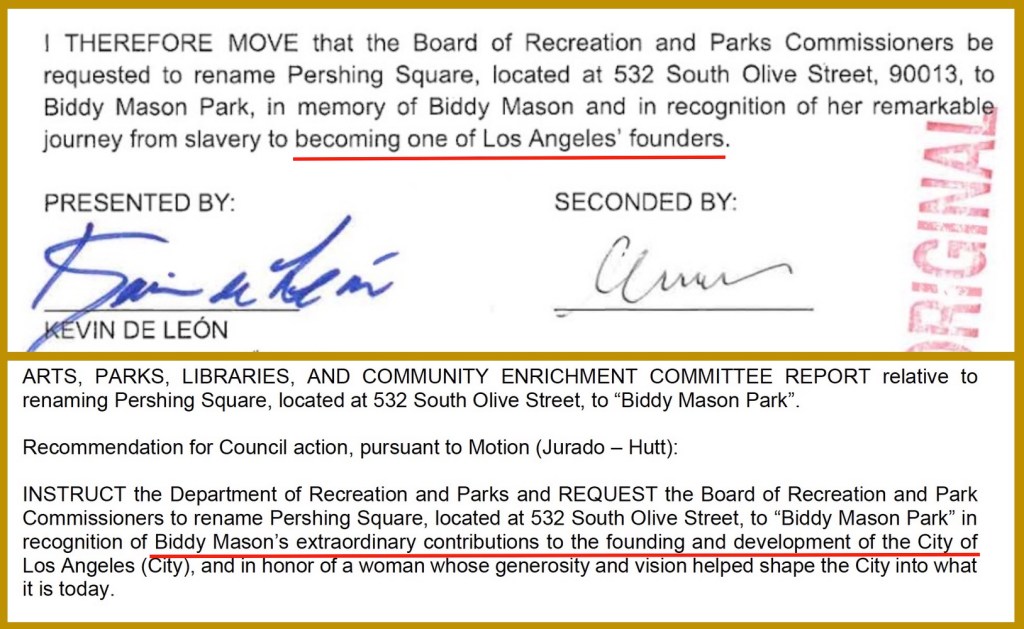
Biddy Mason was a founder of Los Angeles? No. Categorically, no.
I do not say this to diminish her; Biddy Mason was an objectively remarkable individual. However, we must adhere to the definitions of words. There is no historical reality—alternate or otherwise—in which she can be classified as a founder. You are free to use the term, of course; it is a free country, and you are welcome to be wrong. However, when government entities—as seen in the documents stripping Pershing Square of its name—codify this claim, it ceases to be a mere “mistake.” It is a lie.
Despite the assertions made by the state, the facts remain stubborn. The city was founded by the Pobladores in 1781, under the specific direction of the Spanish Governor of Alta California, Felipe de Neve. If one wishes to expand the definition of “founder” to include those who built the city’s early power structures, one might point to figures like José Vicente Féliz, Pío Pico, Abel Stearns, or Juan Bandini.
Mason, however, arrived long after the city’s inception. Her proponents often retreat to what I call the “Refounder Fallacy”— (AKA the Metamorphic Stretch). This occurs when a settlement undergoes such a radical transformation that the modern city bears no resemblance to the original. In this context, folks often retroactively label the architects of that change as the “real” founders. We see this with figures like Harrison Gray Otis, Henry Huntington, or William Mulholland; without their railroads, aqueducts, and press, Los Angeles might have remained a stagnant outpost. But was Mason a catalyst for such structural transformation? Does she belong in the pantheon of industrialists like Phineas Banning, without whom a deep-water port—and thus the modern city—would not exist? The answer is a resounding no.
“But she was a founder of Black Los Angeles!” the rejoinder inevitably exclaims. Perhaps so. But even that claim is debatable; one could argue she was less central to Black civic infrastructure than the Owens family, the Ballards, Lewis Green, Peter Biggs, or Jessie Hamilton. More importantly, the city’s official proclamations do not specify “Black Los Angeles.” They identify her, quite explicitly and quite erroneously, as a founder of Los Angeles itself.
“Biddy Mason was vital to the development of Los Angeles”
Let us dispense with this fantasy immediately. In the political resolutions mentioned earlier, Mason is characterized as a foundational figure in the city’s development. This is objectively false. We must distinguish between a life that is extraordinary and a life that is historically transformative on a municipal scale.
Mason’s story is undoubtedly remarkable: she was a Black woman who navigated a hostile era to accumulate significant wealth. In 1880, Los Angeles had a total population of 33,381; the Black population was a mere 188 (0.56%). Her financial success was an anomaly, and her philanthropy was commendable. However, to translate her personal resilience into a narrative of city-building is to commit a category error.
To claim she “built” or “helped build” Los Angeles is to ignore the actual engines of the city’s growth. The development of Victorian Los Angeles was driven by massive capital infusion, large-scale land speculation, and structural engineering. The men who actually transformed the downtown core were the land barons—the Temples, the Workmans, the Picos, and the Stearns—and the financiers who supplied the capital, such as Hellman, Downey, Hollenbeck, Childs, and Baldwin—and the commercial block and residential tract developers like Baker, Roeder, Kerckhoff, Newmark, Cohn, Haas, and, most crucially, Prudent Beaudry.
These figures operated on a scale of millions; they redirected geography, financed massive infrastructure projects, and determined the physical trajectory of the city. Mason, while a property owner, was a participant in this landscape, not an architect of it. She did not direct the growth of Los Angeles; she occupied a small piece of the terrain they cleared.
“Development” is an elastic term, but we must use it with precision. Yes, she contributed to a church, and built a single commercial/residential building. If you are under the impression that Mason’s real estate holdings allowed her to steer the municipal growth of the city, you are simply incorrect. I am really, really hoping someone will try and argue this point with me, because I find the history of downtown’s Victorian development far more compelling than the modern political fables being substituted for it. (I would suggest, of course, before we engage in this spar, you read this book!)
“Biddy Mason was an entrepreneur”
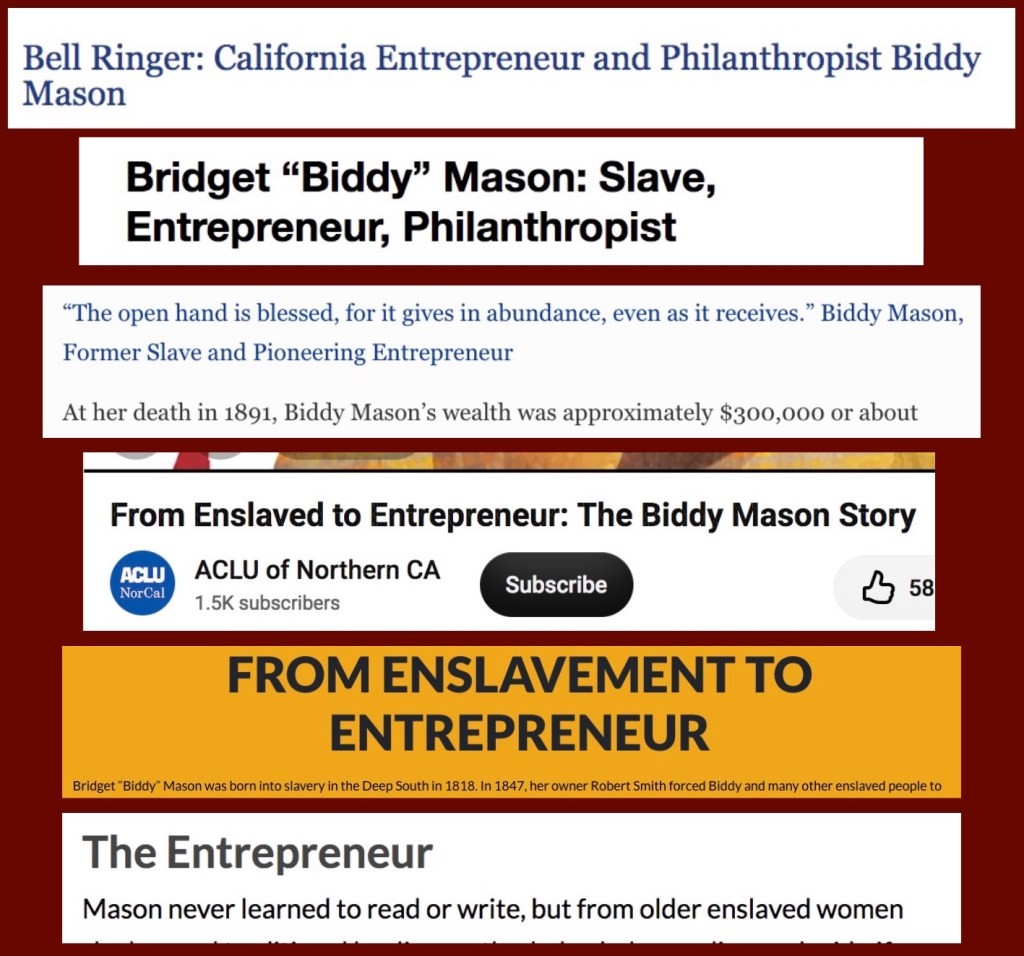
The term entrepreneur has a particular meaning and carries a specific weight: it denotes the creative drive to organize land, labor, and capital to produce something novel—an industry, a service, or a tangible product. Biddy Mason was not an entrepreneur; she was a capitalist. There is a fundamental distinction.
Capital is a tool, not a culture. A pure capitalist seeks to maximize the return on investment, largely indifferent to the source of that profit or the broader impact on the national body. Mason’s wealth was primarily the result of real estate accumulation and rent collection. She did not innovate new industries or organize complex systems of production; she participated in the land market, a vehicle that rewarded those with the capital to enter it.
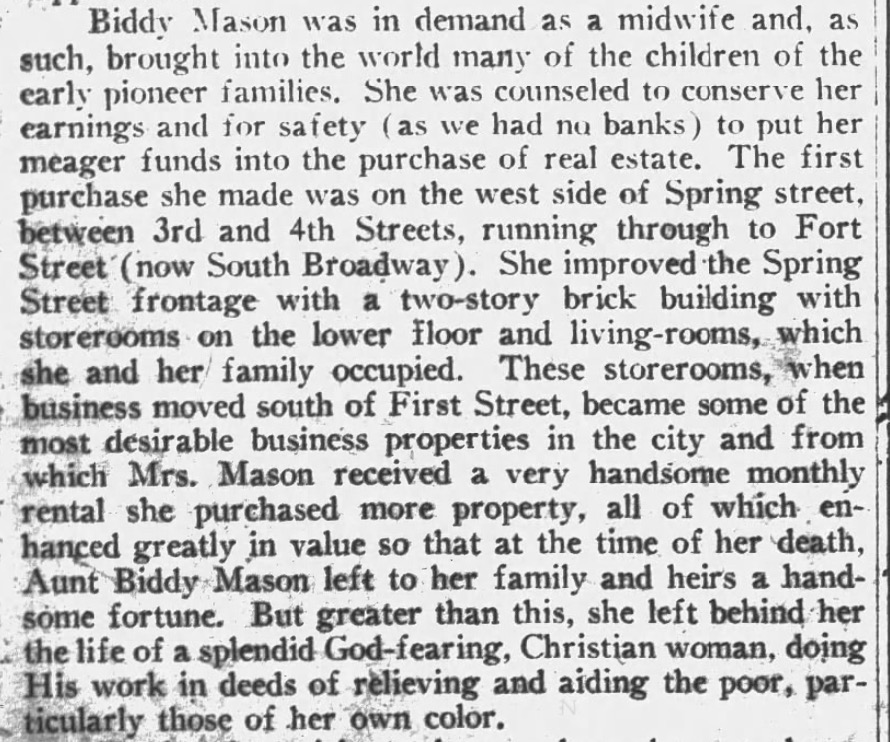
A 1939 California Eagle article provides a clear account of Mason’s financial life, detailing her real estate acquisitions. Whether she was an exceptionally savvy investor or merely the beneficiary of fortunate timing is a matter of speculation. It would have been difficult not to profit in Los Angeles during the late nineteenth century; had the commercial center not shifted south of First Street, her property would not have appreciated with such velocity.
To label her an “entrepreneur” is a post-hoc attempt to retroactively assign a narrative of industrious ingenuity to what was, in reality, the pursuit of capital gains in a rapidly expanding land market. Capital accumulation in a bubble economy is a skill, certainly, but it is not the same as entrepreneurship. We do her a disservice by mythologizing her as a heroic business visionary when the record simply reflects the standard behavior of a nineteenth-century property owner navigating a period of unprecedented urban growth.
Which brings us to…
“Biddy Mason was a capitalist!”
Ok, this one is very different. It’s literally the opposite of the point of this post, since no-one has ever said Biddy was capitalist —
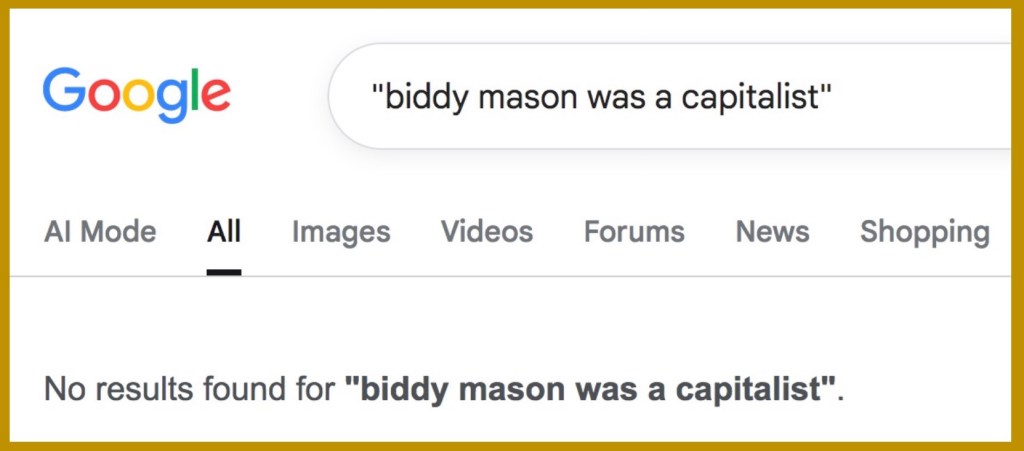
Ergo, this penultimate entry in our Biddyfest is not “here’s something everyone says, that isn’t true,” but “here’s something no-one says, that is true.” (I have covered this a bit in this post.)
Biddy Mason earned a steady income as a midwife and confinement nurse in the employ of Dr. John Strother Griffin. At a wage of $2.50 per day, with disciplined and frugal spending, it would have taken only a few years to accumulate the $250 necessary to purchase her first property. Having begun her employment with Griffin in 1859, she reached this savings milestone by 1866, leading to the acquisition of her first real estate holdings.
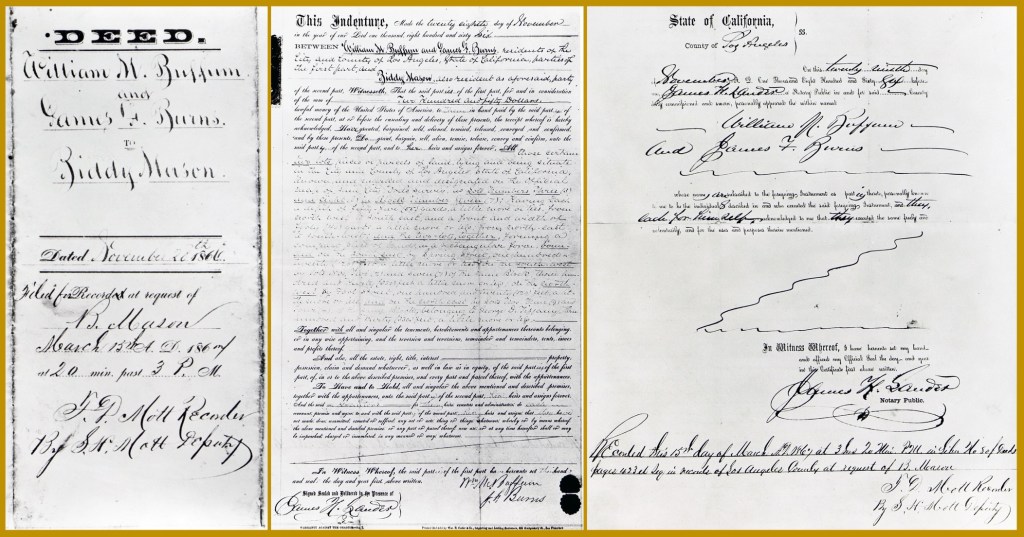
This point is critical. Without that 1866 land purchase, Biddy Mason would be forgotten, or at best an obscure footnote. Her midwifery would be unremembered, as it was a common trade; her philanthropy, if any, would have remained unrecorded. While the 1856 habeas corpus ruling stands as a landmark in enforcing California’s free-state status, Mason would have remained as historically invisible as Hannah Embers, who shared that same legal victory yet lacks a city park—let alone two—named in her honor.
One must ask why she chose to invest in real estate. It was, in truth, the only logical path in an era before Los Angeles possessed a functioning banking system. It was natural that she looked to land, given that Robert Owens—the man who catalyzed her legal liberation—was an established property holder, and her employer, Dr. Griffin, was among the city’s preeminent real estate magnates.
Furthermore, Mason was a congregant of the Fort Street Methodist Episcopal Church. Established in 1853, it was one of the few predominantly white Protestant institutions that permitted Black congregants. Within those pews, she rubbed shoulders with the city’s most influential developers, men like Robert and Joseph Widney, Charles Maclay, Marion Bovard, and Asahel Hough.
The property she acquired in 1866—a parcel nestled in the block bounded by Third, Spring, Fourth, and Fort (later Broadway)—was inexpensive, reflecting the depressed state of the Los Angeles market following years of drought, catastrophic cattle losses, and smallpox epidemics. The sellers, William M. Buffum and James F. Burns, were not merely offloading land; the record suggests that Burns actually doubted Mason’s sanity, questioning whether she might be “deranged” for wishing to purchase that particular plot.
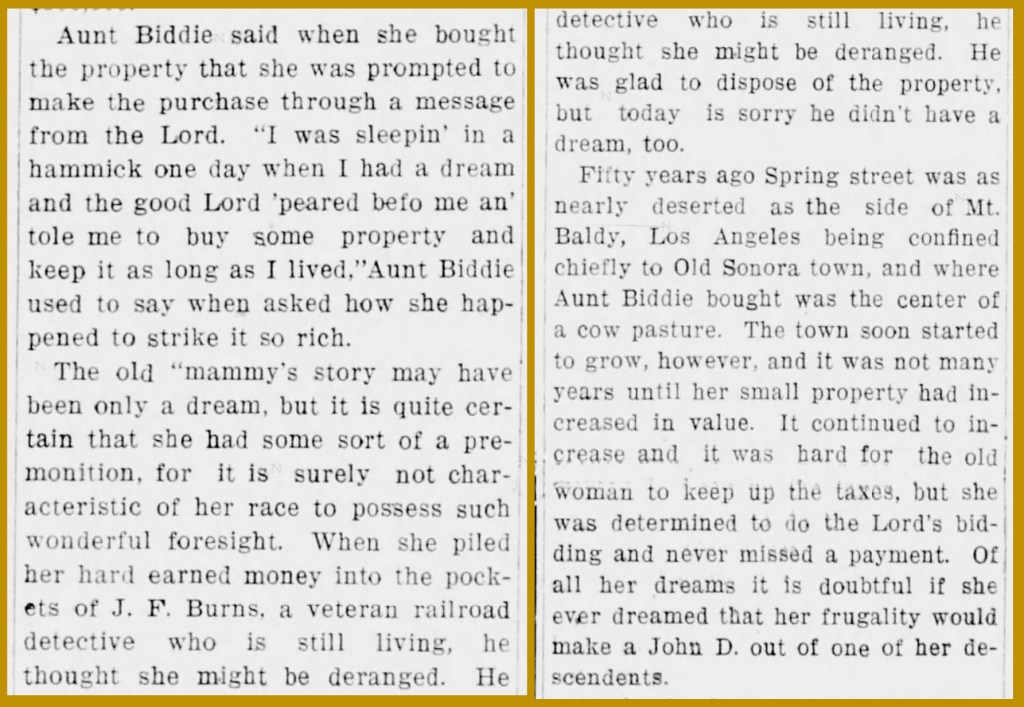
Let’s look at that land, shall we.
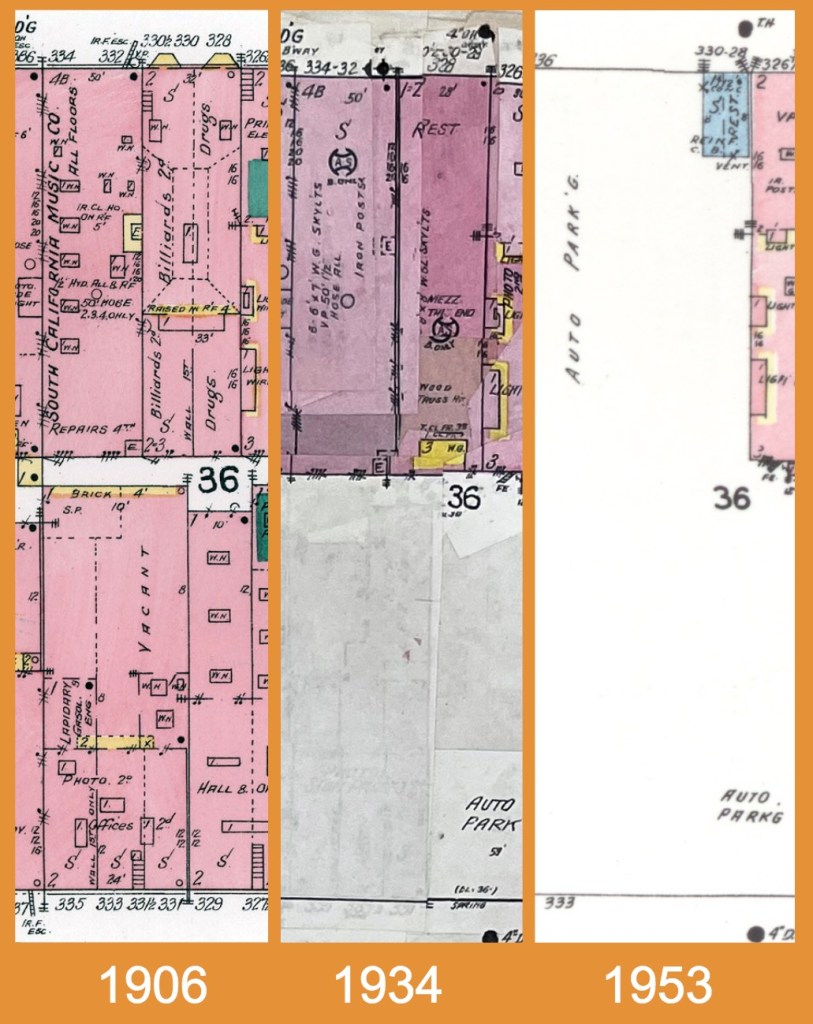
First of all, I hear all the time that Biddy Mason developed some vast swaths of downtown. Well, here is her purchase, in a map bounded by Second, Fourth, Hill, and Main, in 1888:
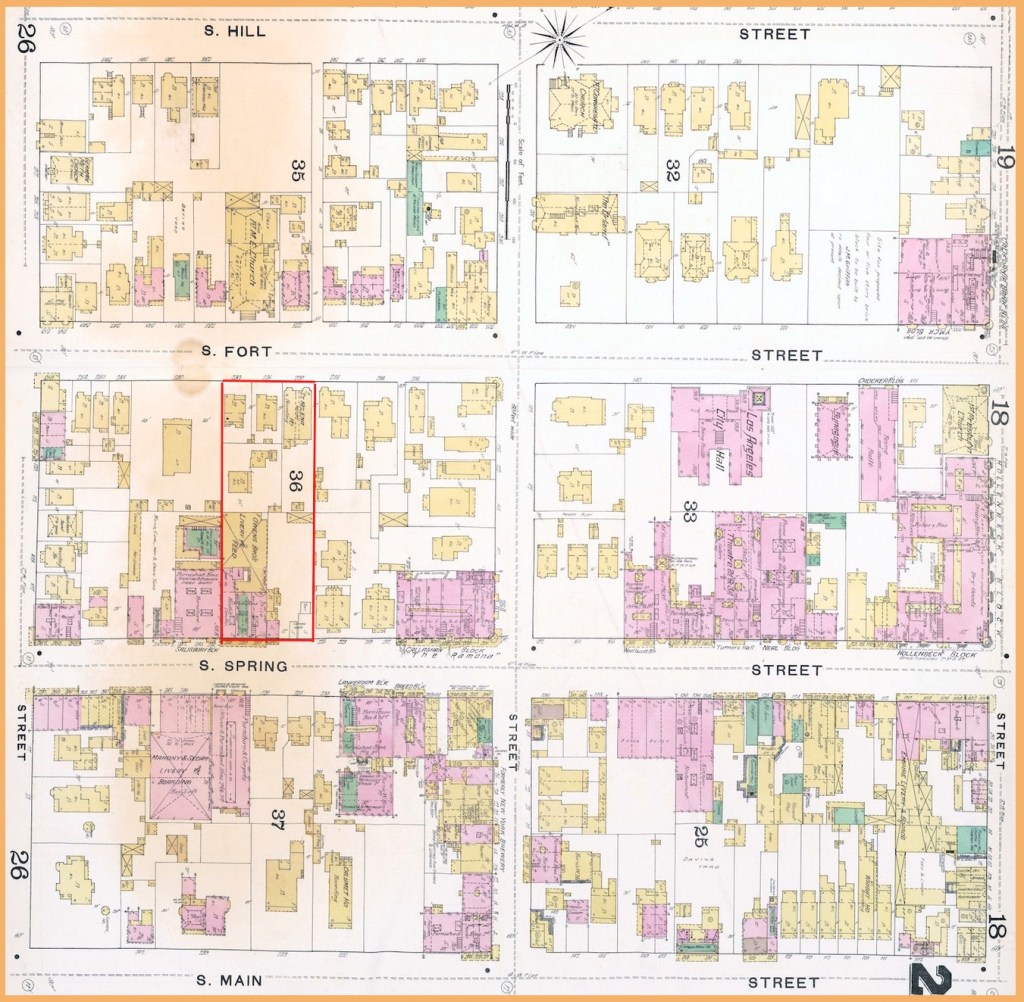
See that green area? That’s what she owned; that’s lots Three and Eight of Block Seven. In the comments sent in to the City Clerk, the aforementioned Dr. Waite shared a map from his forthcoming book The Boundless Biddy Mason:
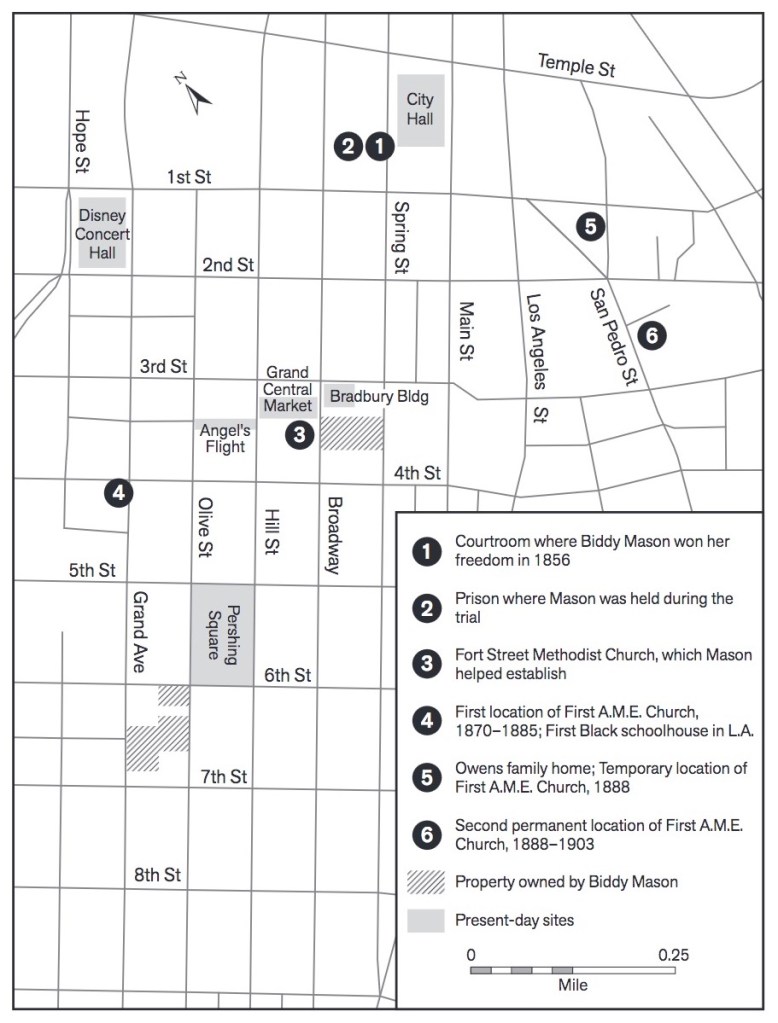
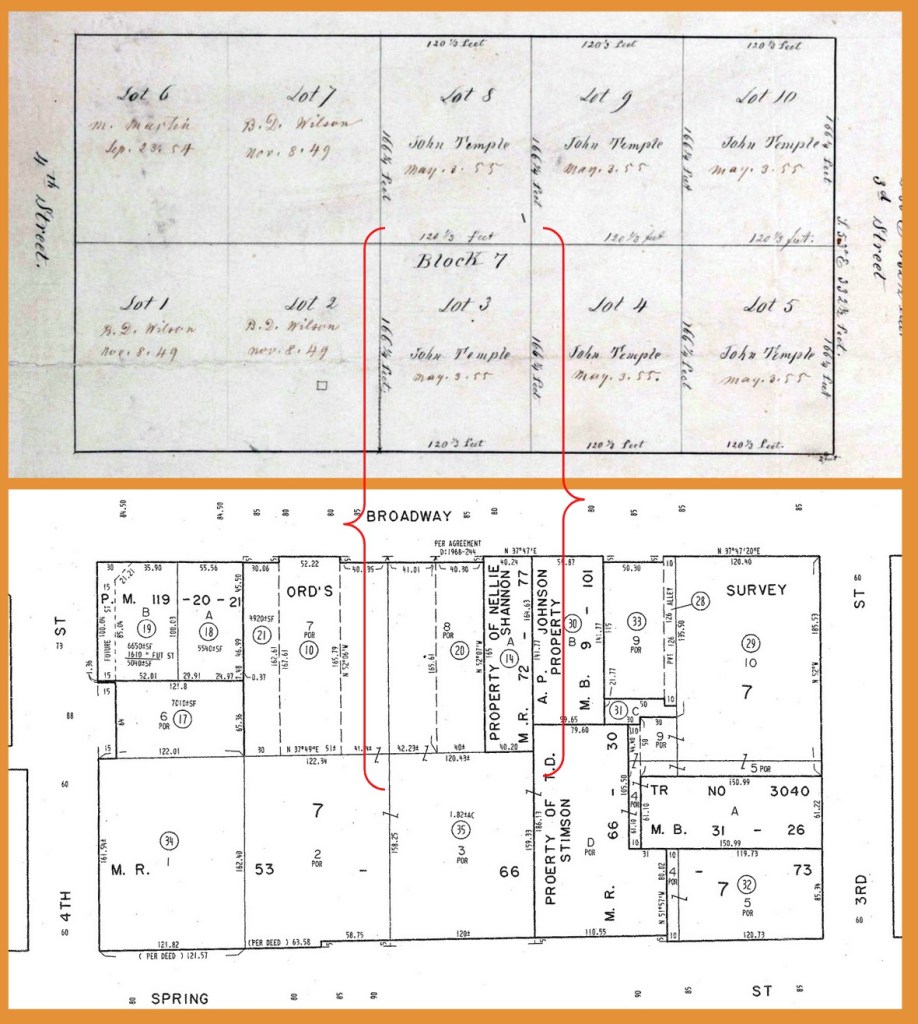
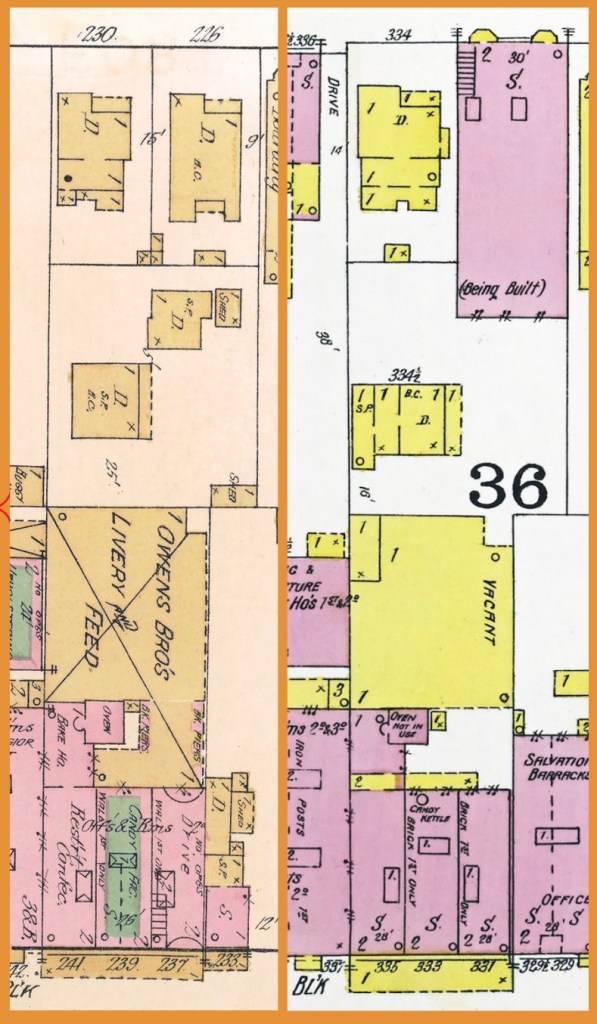
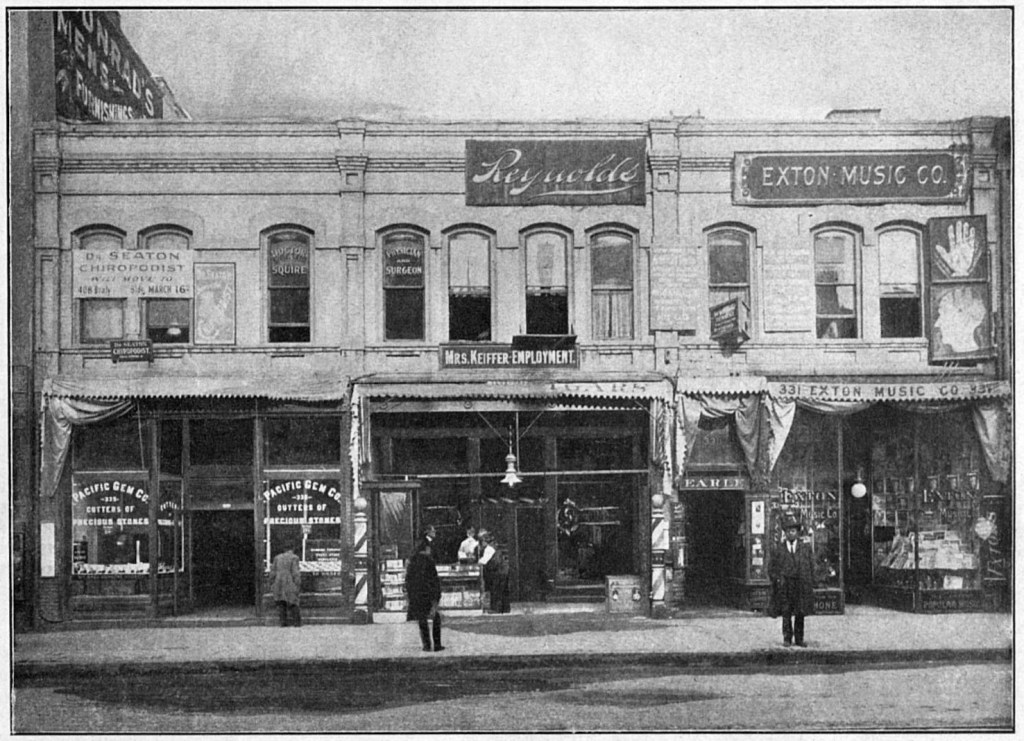
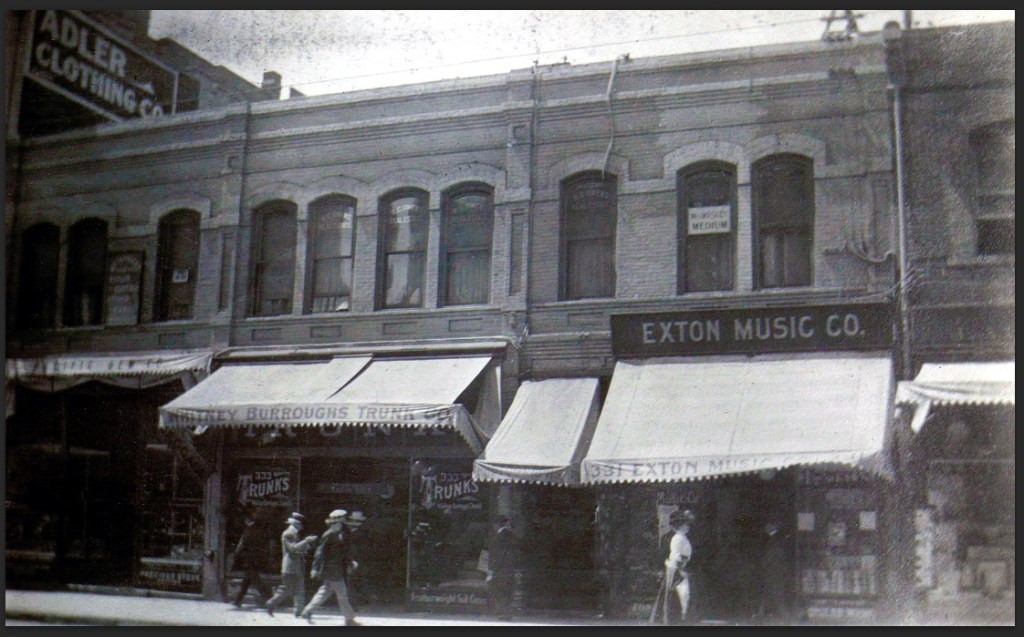
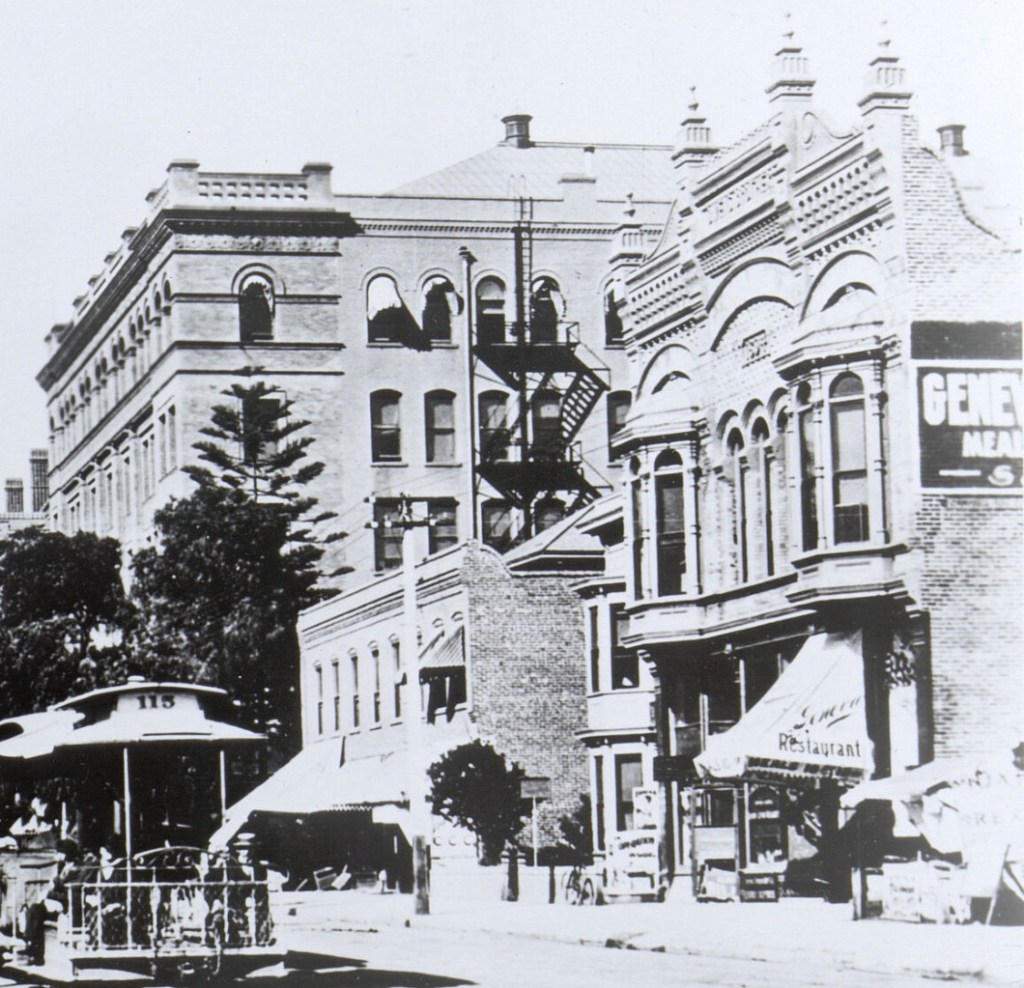
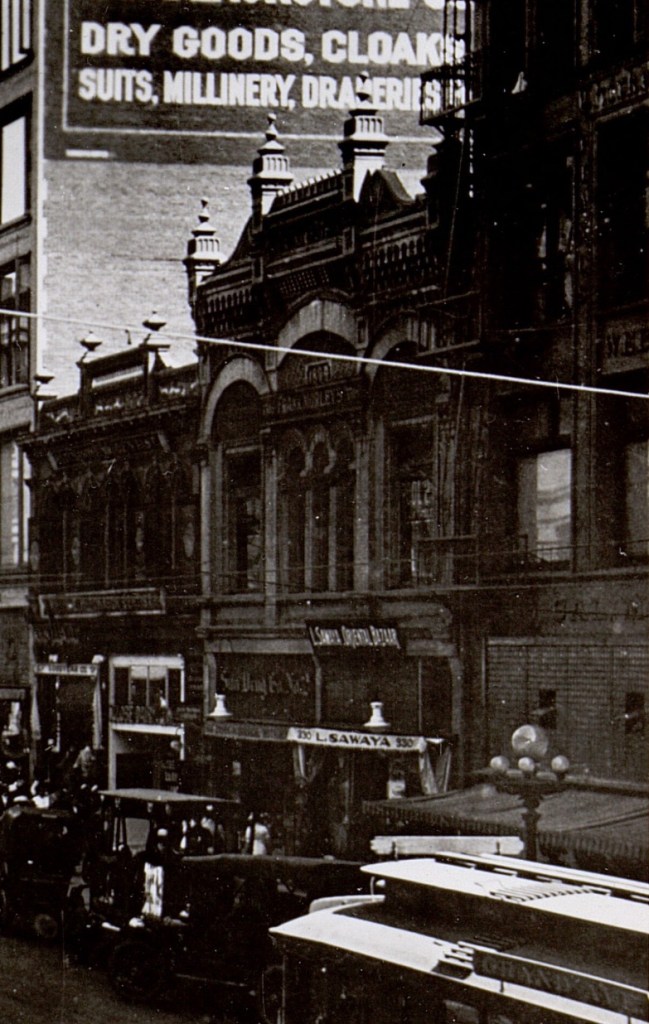
Mason’s home burned on July 31, 1885; she used her money to build a two-story brick mixed-use commercial building, the Mason Block, in 1885.
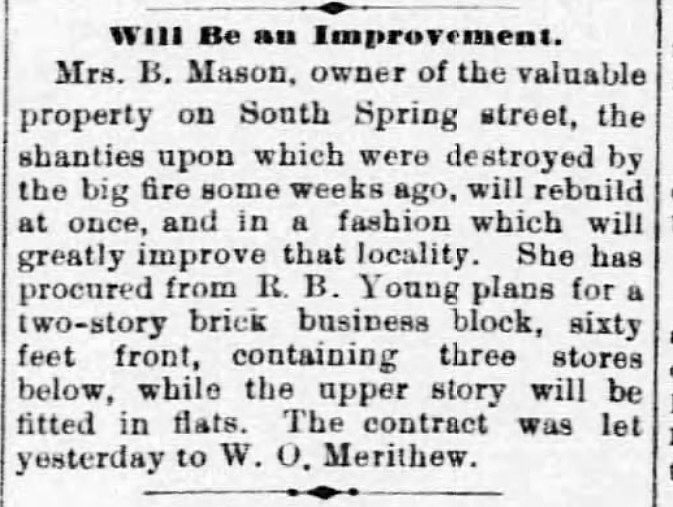
Here it is:
One last thing — Horace Bell Jr. was interviewed about his mother’s hospitalization during her madness (Georgia Herrick Bell suffered from, in all likelihood, postpartum depression) and Biddy Mason had cared for Georgia in 1870. The interview was done in 1887, after Biddy had retired from pretty much everything. Note how Harriet has taken up the family mantle and was still going strong!
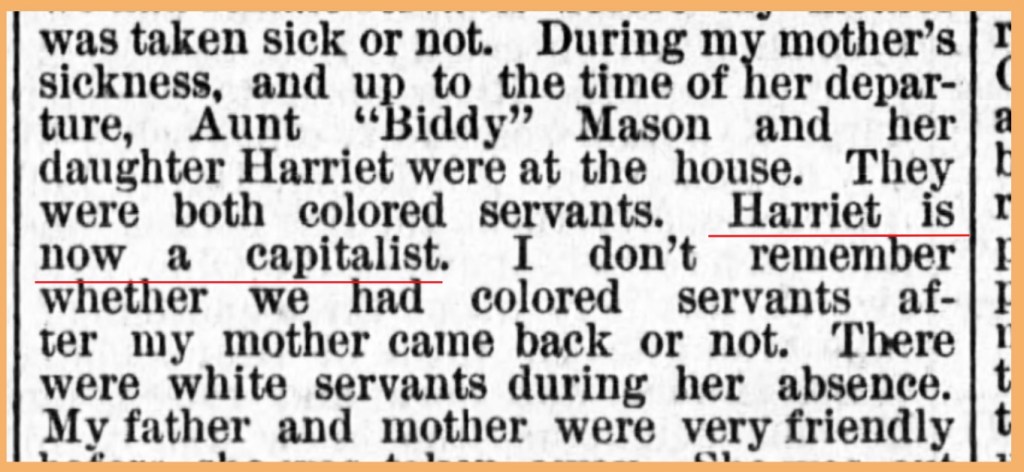
In summation: there is a strong historical argument that Biddy Mason’s transformation from an enslaved woman into a successful capitalist/property owner is the central story—and that her philanthropy, church involvement, and community work become more intelligible once you put her economic independence at the center.
This is the reason I find Biddy Mason so spectacularly interesting: to any consistent modern leftist, Biddy Mason represents everything their ideology despises. Rather than resisting the capitalist system, she eagerly assimilated into it. She became a real estate speculator and a private landlord, hoarding scarce land to extract unearned rent from working people. Her massive personal fortune derived directly from capitalist exploitation and urban development. Furthermore, her celebrated philanthropy was simply paternalistic charity that reinforced church authority and pacified unrest instead of dismantling oppressive class structures. By choosing personal enrichment and private property over collective liberation, Mason abandoned revolutionary solidarity to join the ranks of the propertied oppressor class.
And so on. Which is why her supporters jump through so many hoops to pretend that she didn’t “act white.” For the modern identity-politics framework, her behavior is indistinguishable from the “pioneer” or “settler” archetype they are conditioned to revile. To admit she was essentially a local version of a standard 19th-century real estate entrepreneur would be to admit that her values were indistinguishable from the very American heritage these same activists work to dismantle.
But me, I love 19th-century downtown real estate developers, every single one of them, especially those who made something from nothing.
Viva Biddy Mason!
and lastly … “She was buried in an unmarked grave“
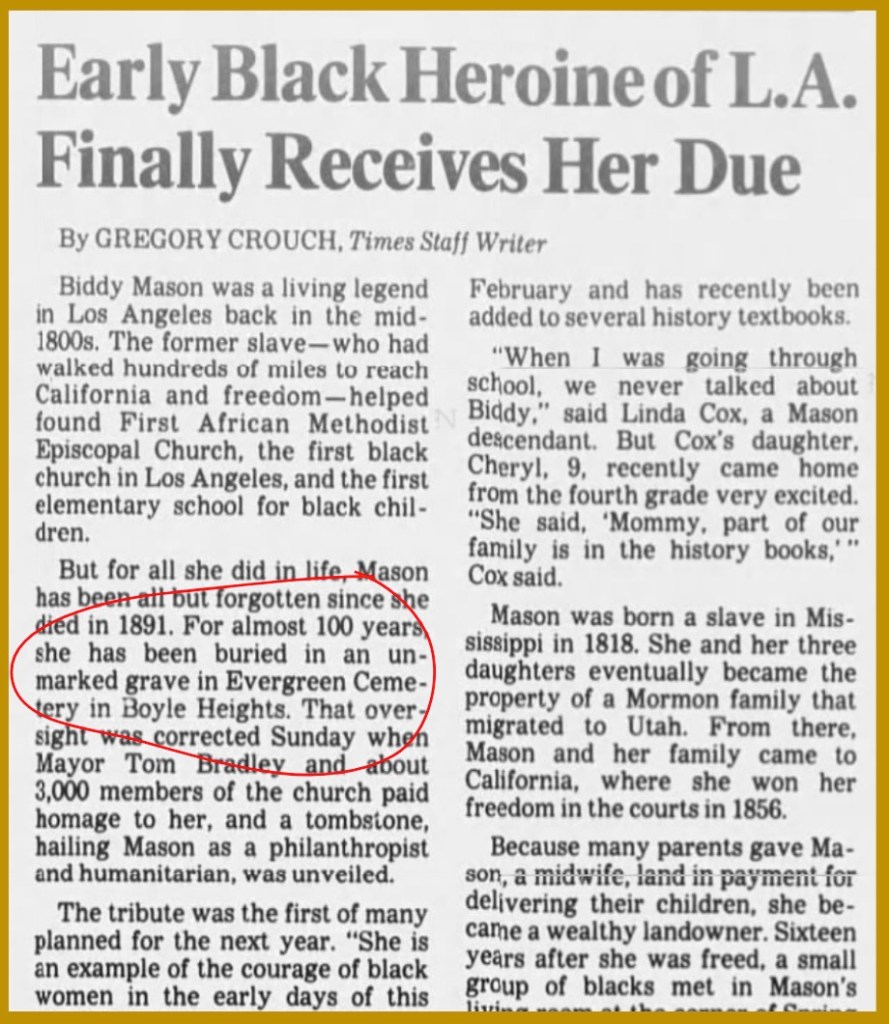
In 1988, the Los Angeles Times asserted that Biddy Mason was buried in an unmarked grave. Since then, the claim has taken flight; a search yields over 2,000 results, including entries from the National Park Service, the LA Conservancy, and FindAGrave. As recently as June 20, 2024, the Times repeated their fabrication as established fact.
What these chroniclers fail to grasp is the magnitude of the insult they are leveling against the Mason and Owens families. Biddy Mason left her heirs as some of the wealthiest individuals in the city—not to mention her in-laws, the Owens family, who were wealthier still. The implication that such a prosperous, prominent, and cohesive family would allow their matriarch to be consigned to an “unmarked hole” is not only historically illiterate but deeply offensive. If one were to believe the Times, one would have to conclude that Mason’s descendants were utterly derelict in their duty and indifferent to their own kin.
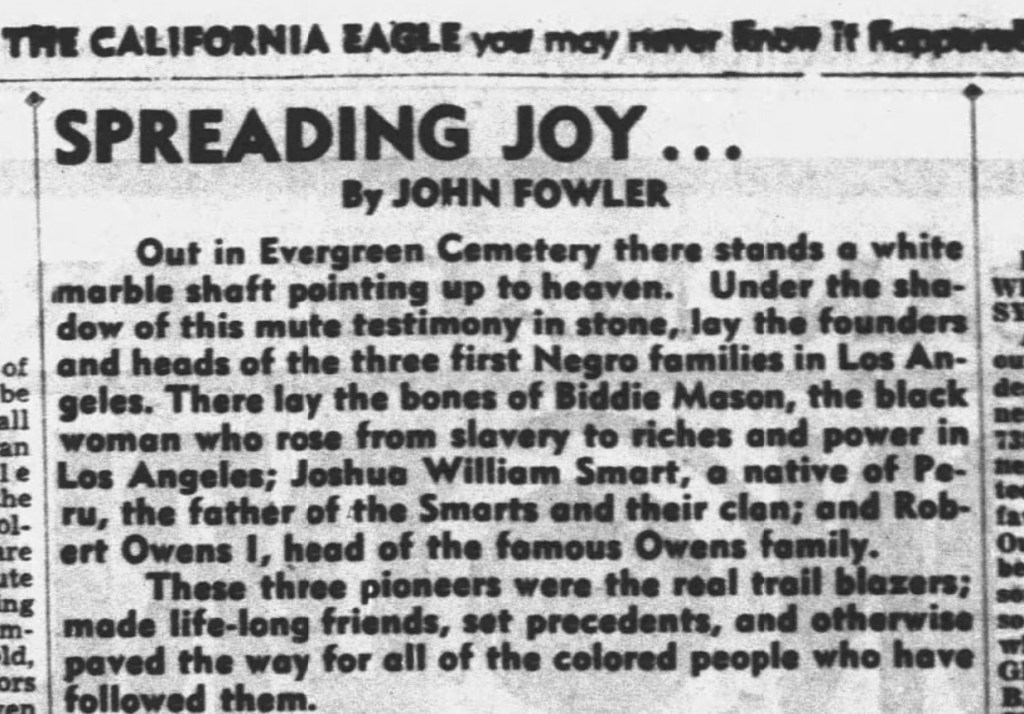
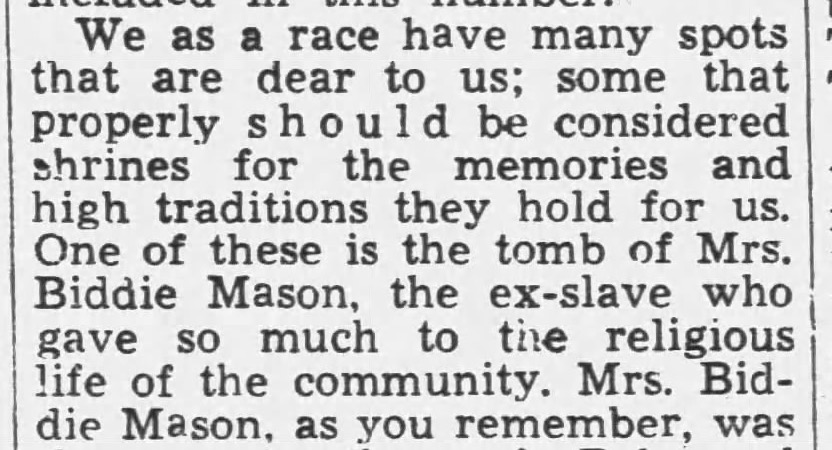
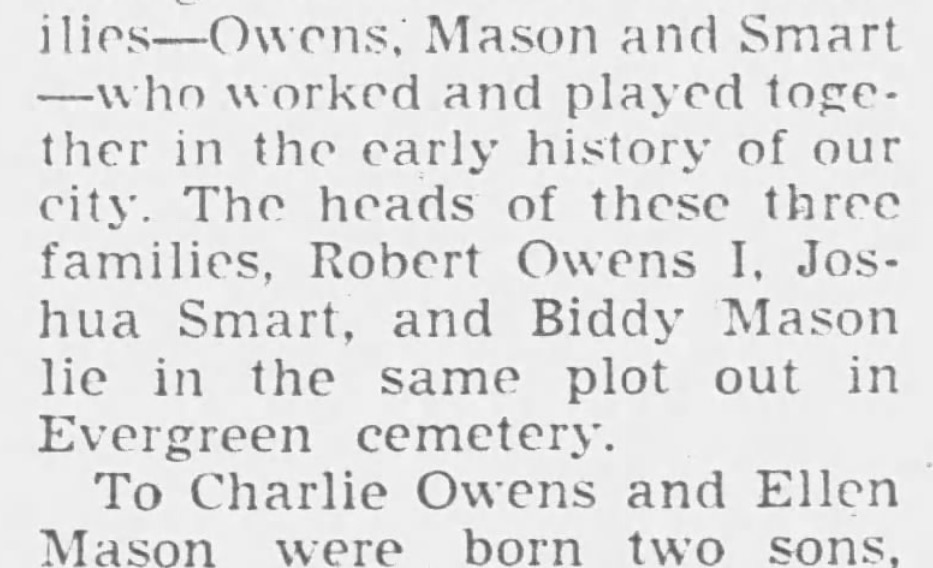
This tomb and obelisk erected at Biddy Mason’s grave was in the Mason family plot at Evergreen Cemetery, Lot 320. Biddy’s daughter Ellen Mason Owens had purchased the family plot for $100 in 1887, at the time Evergreen opened.
The question, then, is what happened to the Mason monument between 1943 and 1988? Apparently no-one knows. Ok, to indulge in some speculation: perhaps the 1971 earthquake toppled the obelisk—that “white marble shaft pointing to heaven”—crushing the surrounding markers, and the cemetery authorities simply…cleared the rubble? Perhaps the family was not notified; perhaps they were notified and remained indifferent? Or, considering the long, contentious history of the Mason-Owens lineage, perhaps the monument fell victim to some internal family score-settling? (I will refrain from diving into that particular rabbit hole of intergenerational discord.)
It is a genuine mystery. One hopes that Kevin Waite’s forthcoming biography provides the archival evidence we currently lack, rather than relying on the same lazy conjecture that has defined this narrative for decades. We shall have our answer in October!
*******
So that’s it in a nutshell. Again, I love Biddy Mason, but the actual house of cards upon which Jurado builds her case for stripping Pershing’s name — and giving us a redundant Biddy Mason park — is a sickly stew of unsourced assumptions and assertions.
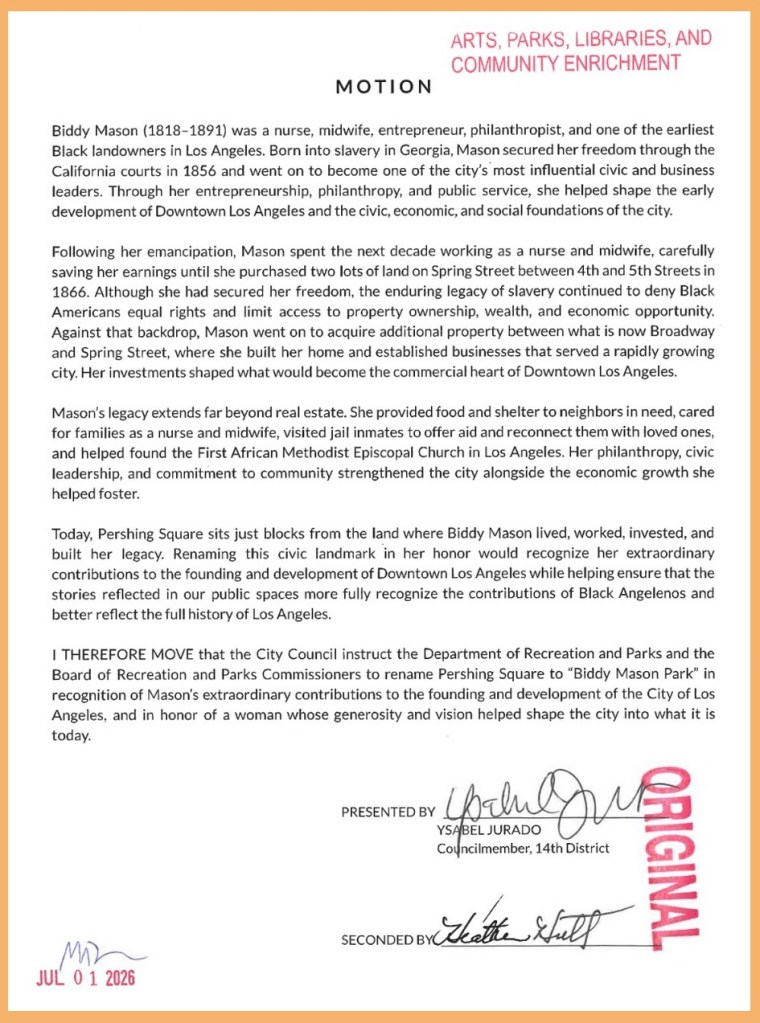
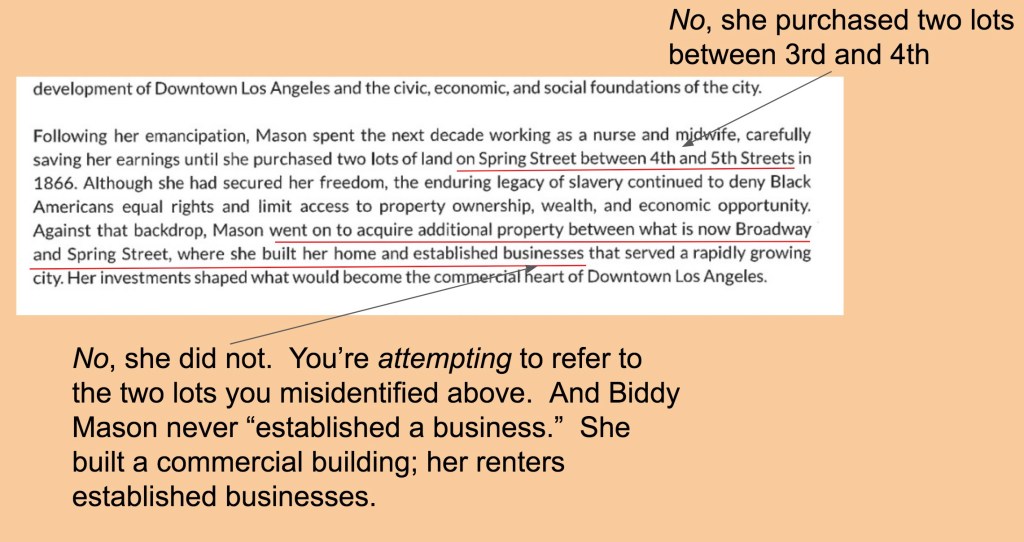
Jurado and her ilk are revisionists. It’s not just “whoops! we let our confirmation bias run away with us!“, it’s a masterclass in the conscious — not negligent — exclusion of evidence and recrafting of fact. Their hagiography rewrites history (in what’s often termed “narrative forcing”) to serve their political and ideological agenda; it is a tactical distortion of the past to legitimize steamrolling us with their doctrine and dogma.
Or maybe they’re just sloppy and stupid, and too excited by the childish psychological comforts of their Manichean Fairy Tale to care.
Honestly, I don’t know which.
All that said, I’ll just end with one more thing about this, and get a little John J. Pershing in here, too:
Right before Council voted to rename the park, Jurado reiterated in chambers that “Pershing never set foot in Los Angeles.” See her say that, here. She is reading from someone’s letter to Council, because God forbid she have an original thought (after all, her motion is just a rehash of a dead two-year-old proposal from de León). But although the letters to Council were overwhelmingly against the renaming, she gleefully read one that included the stupid falsehood regarding “Pershing never set foot in Los Angeles.” Jurado, in theory, could have read or considered all the communications from the public regarding the renaming. But why should she listen to the peons, those unenlightened lumpenproletariat?
I bring it up, of course, because I made that topic a specific part of the letter I sent in to Council:
Wait, you say, she’s not a tyrannical autocrat with a diaper full of dogma, she’s a very important and busy woman! She doesn’t have time to read everything the dumb public says! It’s not her job!
I’m just going to have to disagree. She only has to go to work three days a week, (though she voted to make that once a week). And for that, she gets paid $245,000 a year (our councilmembers are the highest-paid local legislators in the nation, raking in more than double what the same job pays in New York or Chicago; and that $245k number is actually $400k+ per annum when you factor in the fat stacks funneled into their retirement plan, and the Cadillac-tier health insurance plan, plus the city-funded vehicles, and generous stipends for travel and “official business,” ad nauseam).
I mean, someone in her staff could have taught her some history as she soaked in a bubble bath — someone FROM HER STAFF OF TWENTY. As in, literally a staff of twenty people who help her work those three days a week. A staff of twenty that costs taxpayers $3,000,000 a year. Who still put out an Official Government Document that said Biddy Mason bought lots south of Fourth Street!
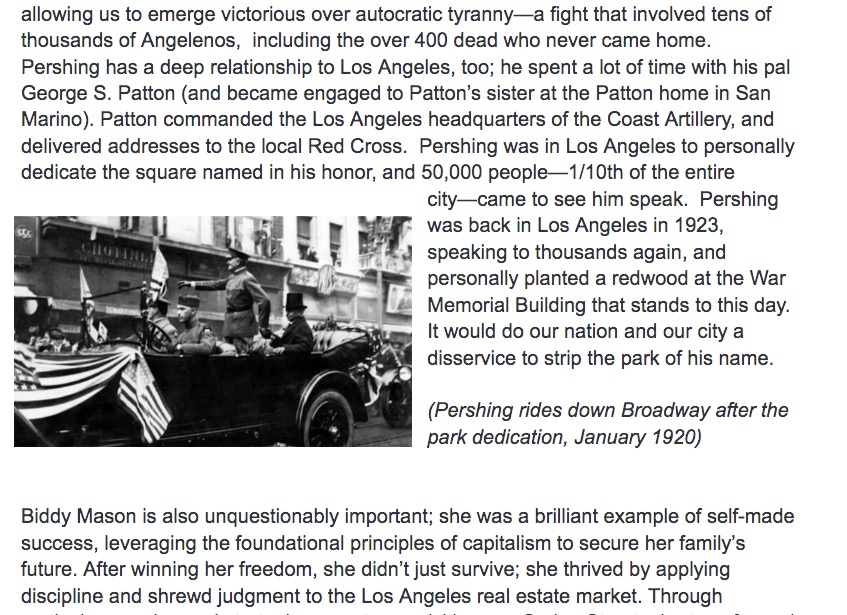
Therefore, yes, it irks me that she just stands in front of Council and repeats long-debunked lies like “Pershing was never in Los Angeles.” Damn, Jurado, do you need to see film of Pershing cruising through Los Angeles??? Ok, here you go:
Pershing heads down Broadway, January 26, 1920: first six seconds, headed south from First toward Second Street; the Tajo Block can be glimpsed at upper right. He then passes through the intersection of Third Street, the Irvine-Byrne in the background (CriticalPast).
Pershingphobes have tossed John J. Pershing into an ever-widening gyre of fabrication and deceit, and if you’re interested in what they say, click here.
And that’s it for today! Enjoy your superfluous Biddy Mason Park! I will certainly eat crow if naming the park for Biddy Mason magically transforms it into someplace welcoming and comforting, instead of being a sun-bleached hardscape of ugly architecture designed to make you nervous, where postmodern purple towers loom over a urine-soaked wasteland of open drug use and despair. But hey, new name!

