Hard to believe eighteen years have passed since I first wrote about the WPA model at the Natural History Museum for On Bunker Hill. There may be some of you who have yet to see the model in the flesh, and if you’re interested in Bunker Hill, be advised it’s top of your bucket list. Because the model has been restored and changed locations since my Bush-era OBH post, and advances in blog technology now allow for higher-resolution imagery, it’s only right I do another, updated post about our beloved model.
There’s very little I can tell you about the model that isn’t covered in this amazing post by Mike Callahan, at his Substack, The Dusty Archive (click here and give it a follow immediately).
Briefly, though: during the Great Depression, the federal government introduced the Works Progress Administration. The WPA marked a significant shift in the role of our government, transitioning from a limited, representative protector of Constitutional rights to a central provider of welfare and director of the national economy. By nationalizing the labor market, the state funneled taxpayer funds into make-work projects that would never have survived under the discipline of a free market. While these programs prolonged the Depression by many years, the silver lining? Cool model!
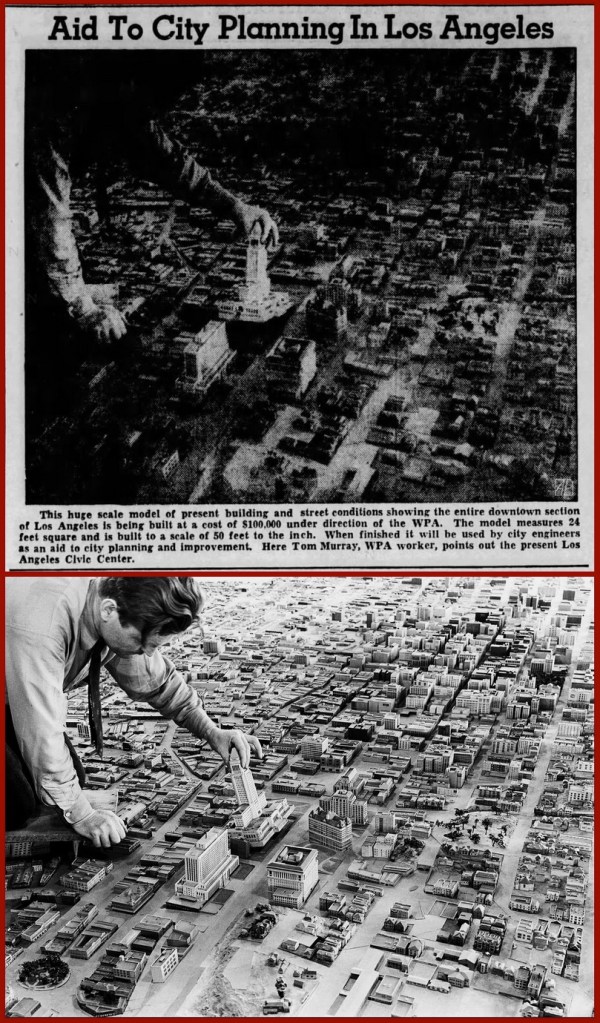
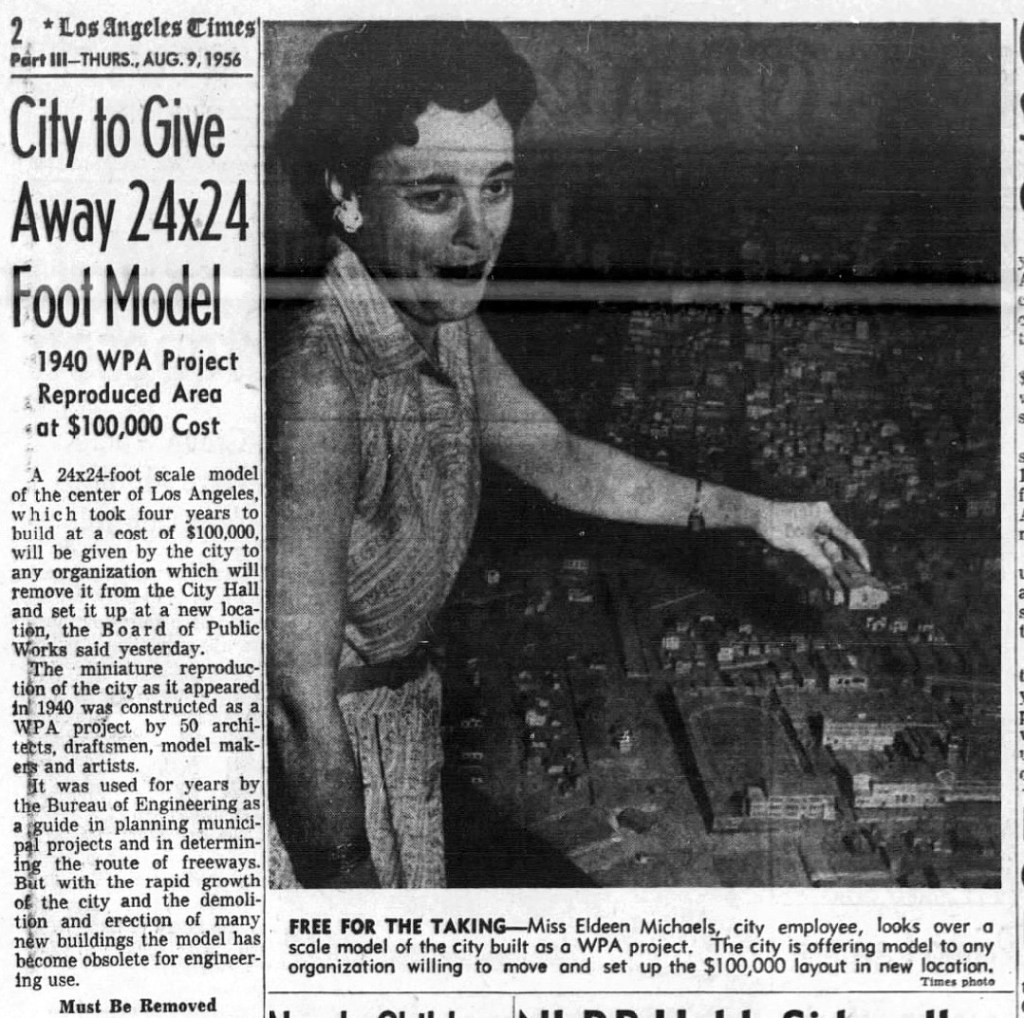
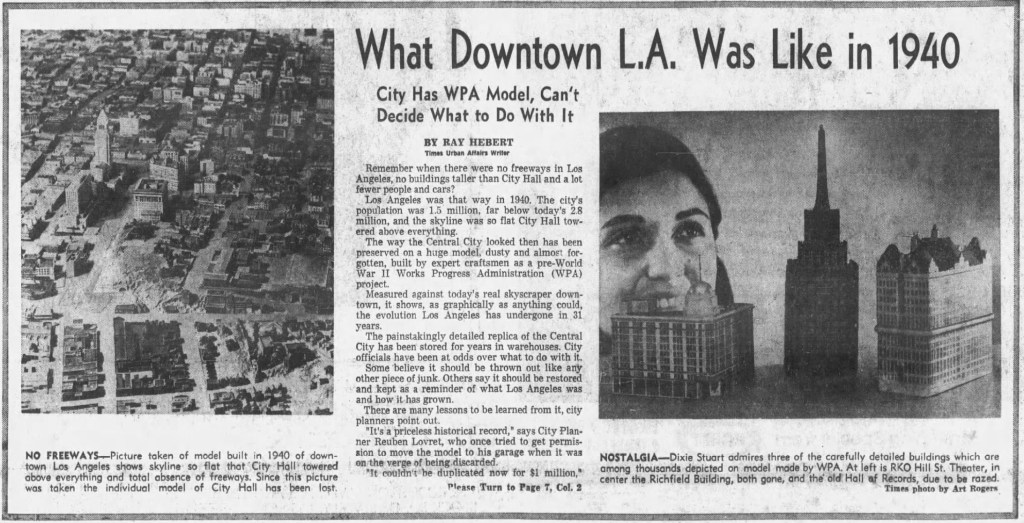
Los Angeles Times, Nov. 07, 1971. Note the Richfield; that’s one of the buildings now missing.
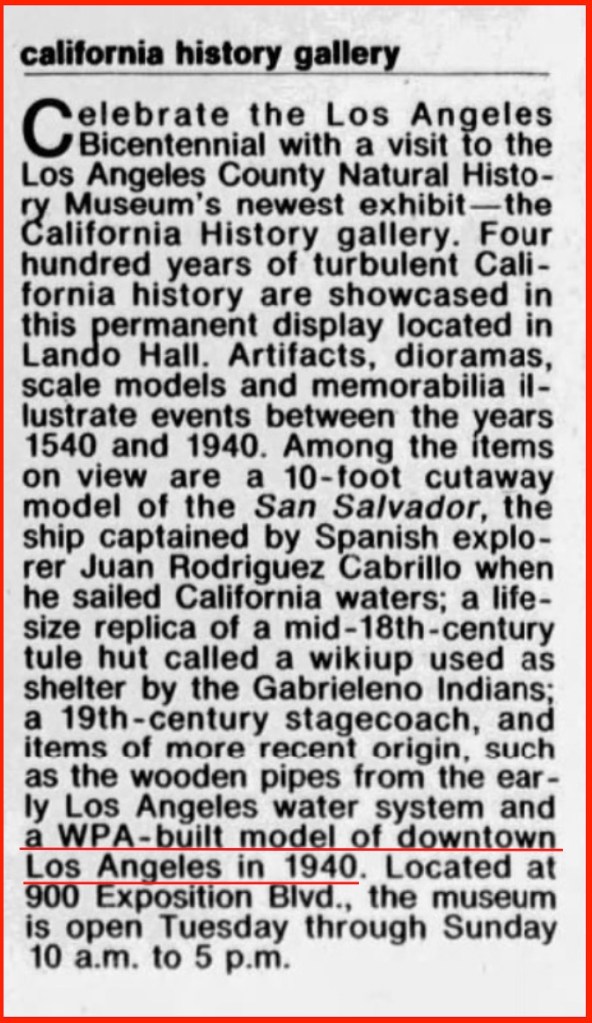
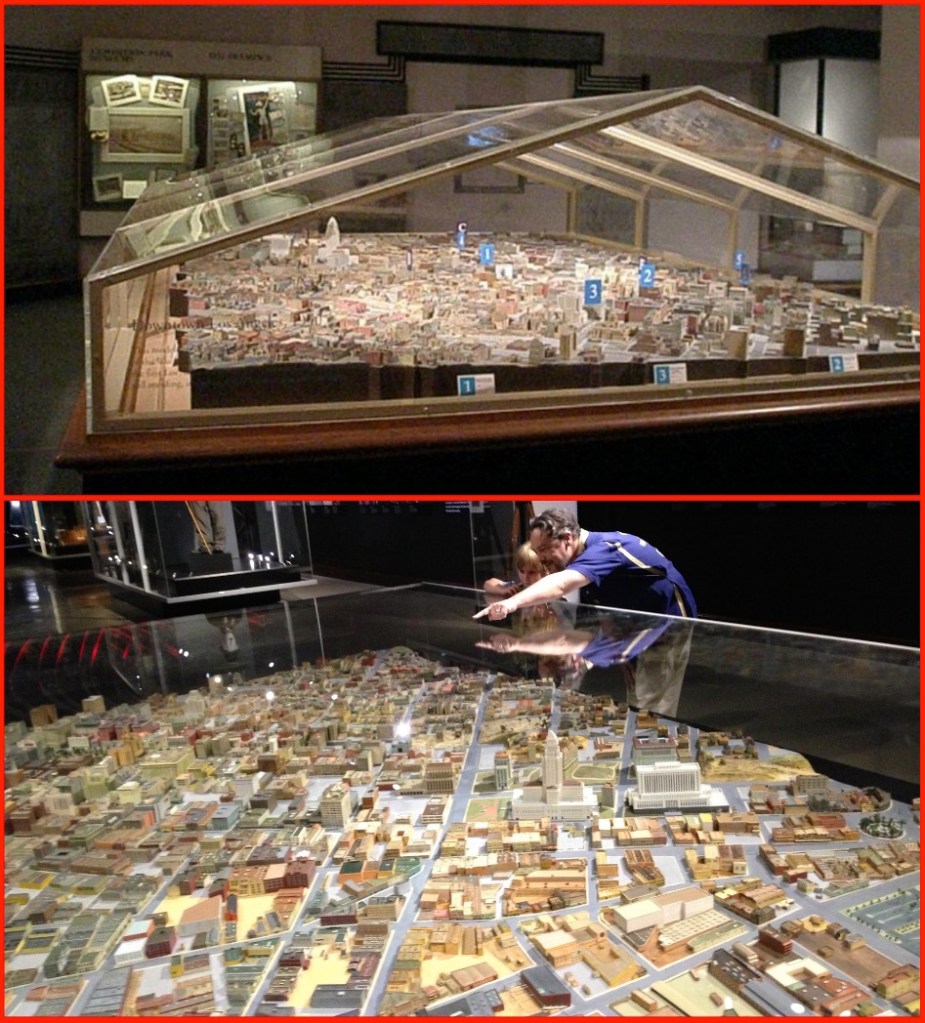
Just to prove to you that you need to visit—or revisit—this model at the NHM’s Becoming Los Angeles exhibit, here are some juicy pics:
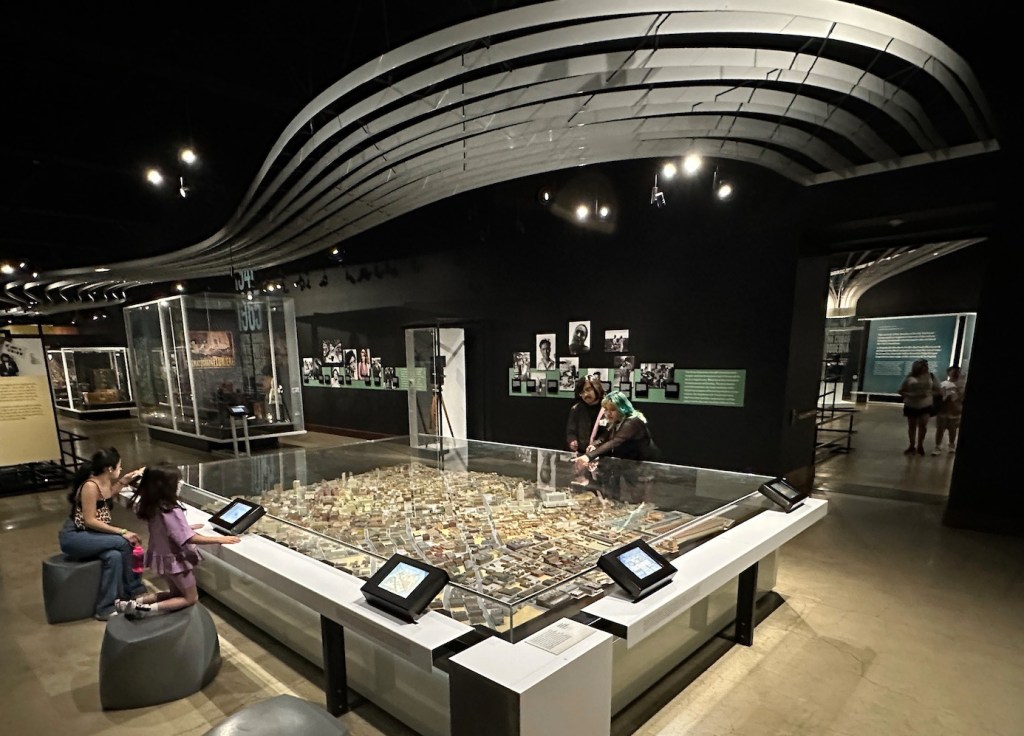
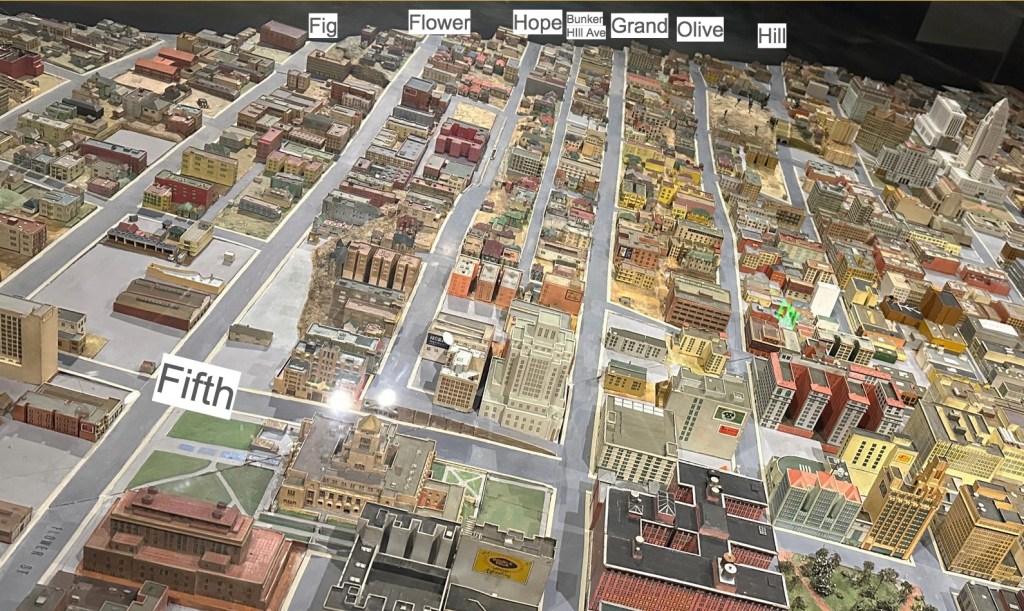
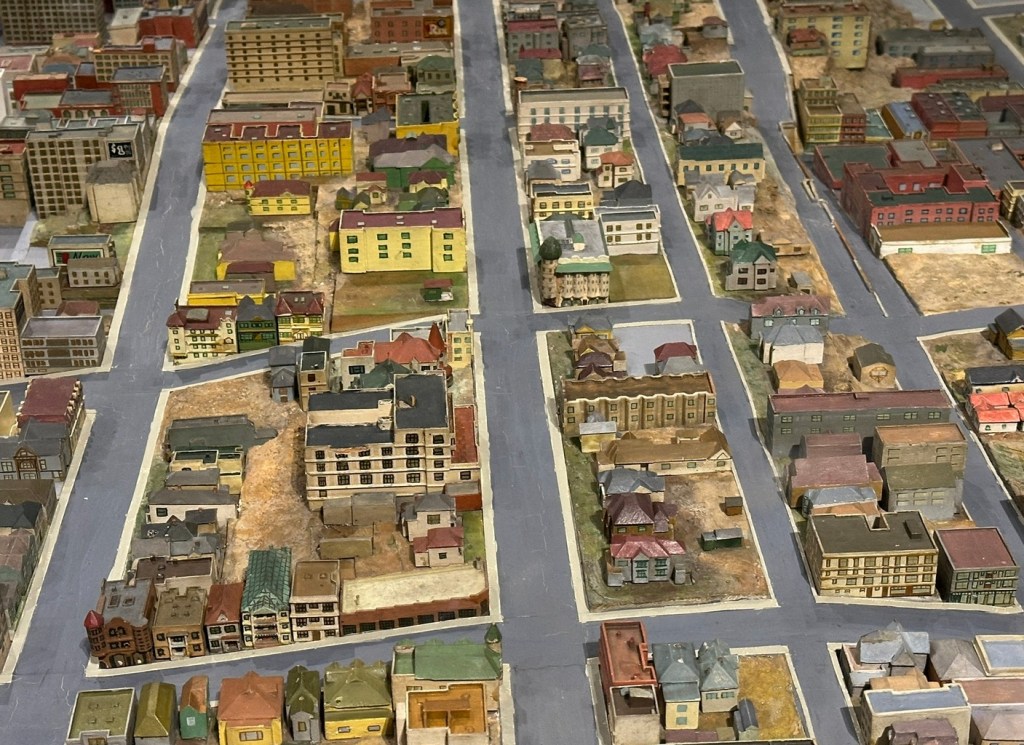
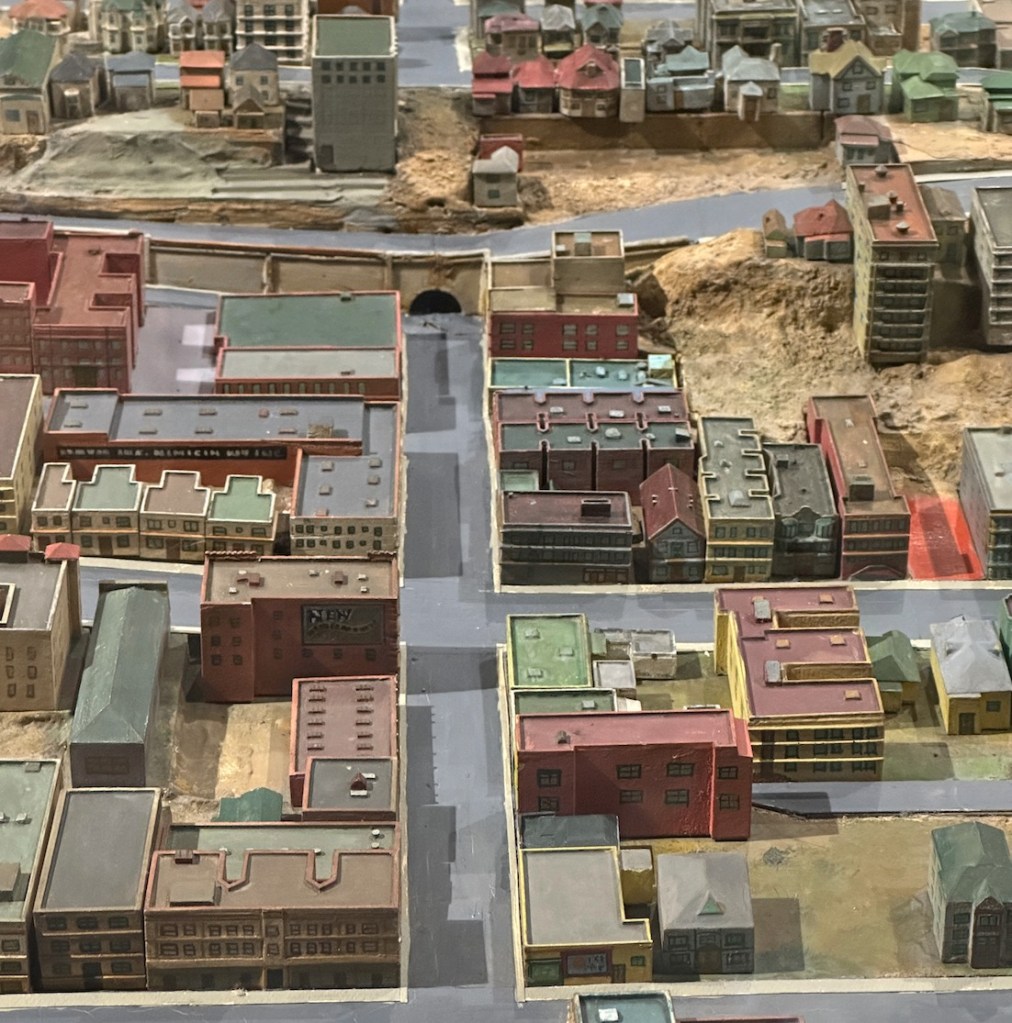
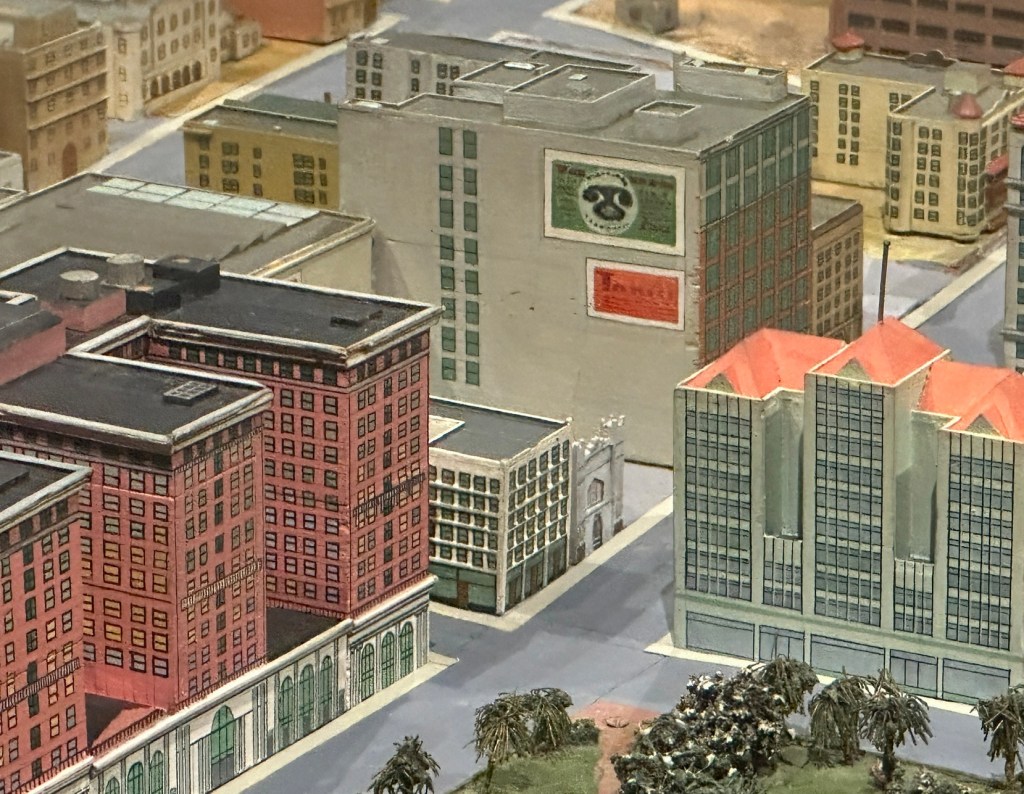
So there you go! But don’t just glance at my photos, head down there today and check it out for yourself!
********
As long as I’ve got you here (and since you’re obviously on your way to the museum at this very moment) … I hate to be that guy, but, as a debunker of bunk, hooooo-weeeee there’s a lot of goofy nonsense on the walls of Becoming Los Angeles.
Don’t get me wrong, it’s a worthwhile exhibit with some genuinely important L.A. artifacts on display. But the didactic panels are…flawed. Yes, I know, the wall text was written by experts…with degrees! But as we are too well aware, credentialed experts are frequently fact-challenged.
I hadn’t remembered the exhibit being quite this replete with errors, but I also haven’t been there in ten years: originally curated by Dr. Margaret Hardin, Becoming Los Angeles was given a full “re-imagining” in 2018 by Dr. William Estrada (whom you may remember from this post as the fellow who refused to answer my questions about Kay Martin).
Seriously, I wasn’t intending to make critiques of the greater exhibit. But I was innocently walking along and said “oh look! A picture of Julián Chávez!” after which I read the text:
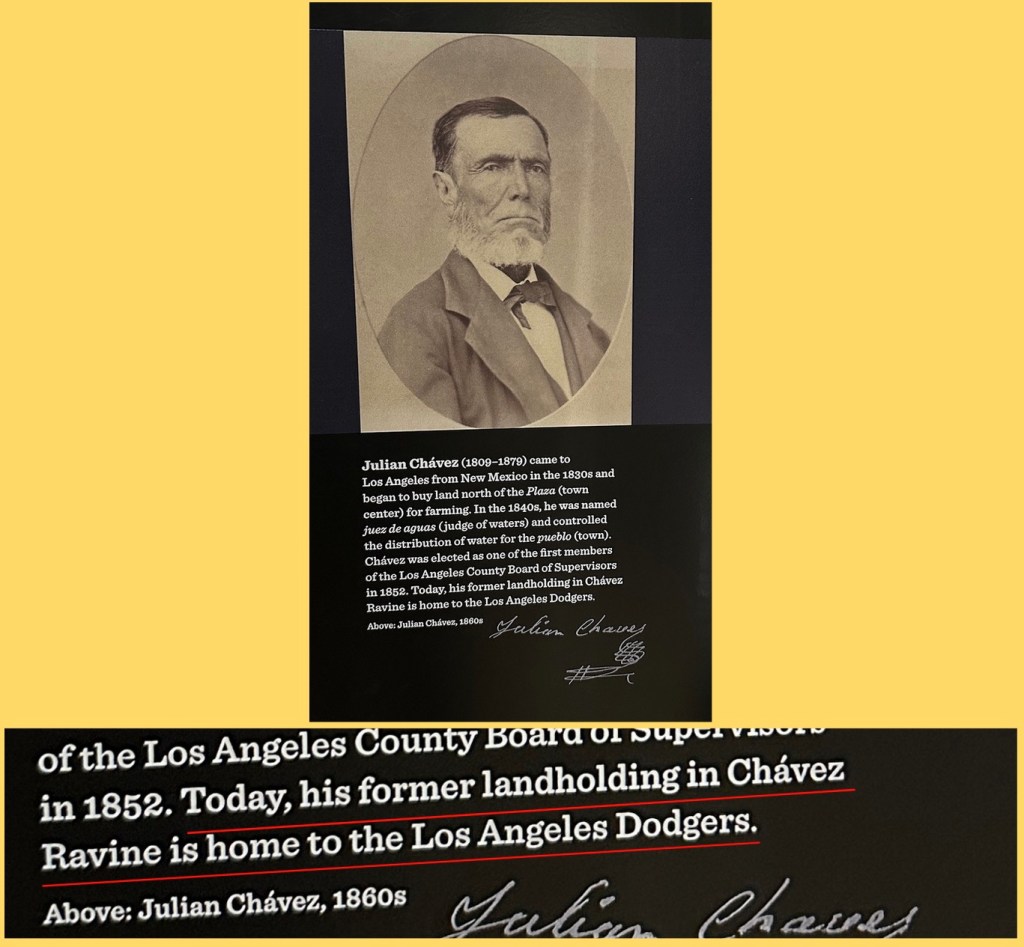
Ugh. No, zero Chávez landholdings became home to the Dodgers. In fact, not one inch of his land became even part of the La Loma/Palo Verde/Bishop neighborhoods, much less home to the Dodgers (nope, not even the parking lots). Rather, his former property is located in what’s now commonly called Frogtown, north of the 5. And hey! fun fact: the land on which Dodger Stadium sits was actually purchased by the City from Henry Workman Keller. HW had inherited the land his father Matthew Keller in 1890 — but nobody ever mentions County Cork-born Keller in the greater Chavez Ravine tale, because lowly Irish lineage kills the interest of any modern Angeleno.
Because I’ve written so much about Chavez Ravine on this here blog, I figured I better point that out to you. I took a picture of the wall and figured that was that, but then all of a sudden I turn the corner and oh look:
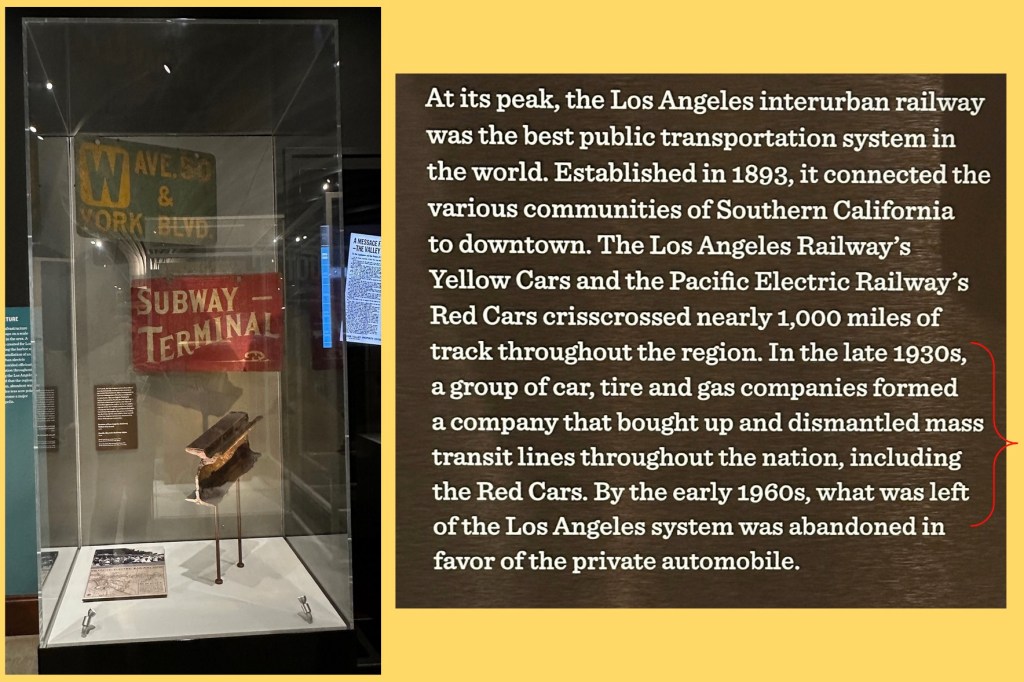
Having written at length about the “Streetcar Conspiracy,” allow me to say, no, NHM, your narrative is a tendentious fairytale. There was no company formed by “car, tire and gas companies” to dismantle transit, and your language regarding some petroleum-soaked consortium that destroyed transit “including the Red Cars” should instead read, “and absolutely not the Red Car, which was dismantled by taxpayer-funded government do-gooders.” Ok? We clear now? I cover all this in detail, here.
It is no surprise I get persnickety about Chavez Ravine, and the streetcars, having written extensively on those topics. I am accustomed to blithely impugning the gaslighting claptrap posted by The Times or LAist, though we expect those outlets to be peddlers of nonsense.
But this — this is a museum.
I grew up believing museums were sacred places, and that a curatorial position is one of immense gravity, requiring a profound, objective intellect—a bulwark of truth, above reproach.
I am willing to shrug off a few minor mistakes on museum walls, despite the bitter taste they leave (no surprise, but the Biddy Mason text leaves a particularly brackish tang). However, there were a couple massive wall didactics making claims I cannot let go unaddressed; claims regarding the fundamental building blocks of “becoming Los Angeles.”
For example, we are told that the Gabrieleño/Tongva (not the preferred nomenclature, to quote Walter Sobchak—they are more commonly known today as Kizh Nation) are the region’s “first” people.
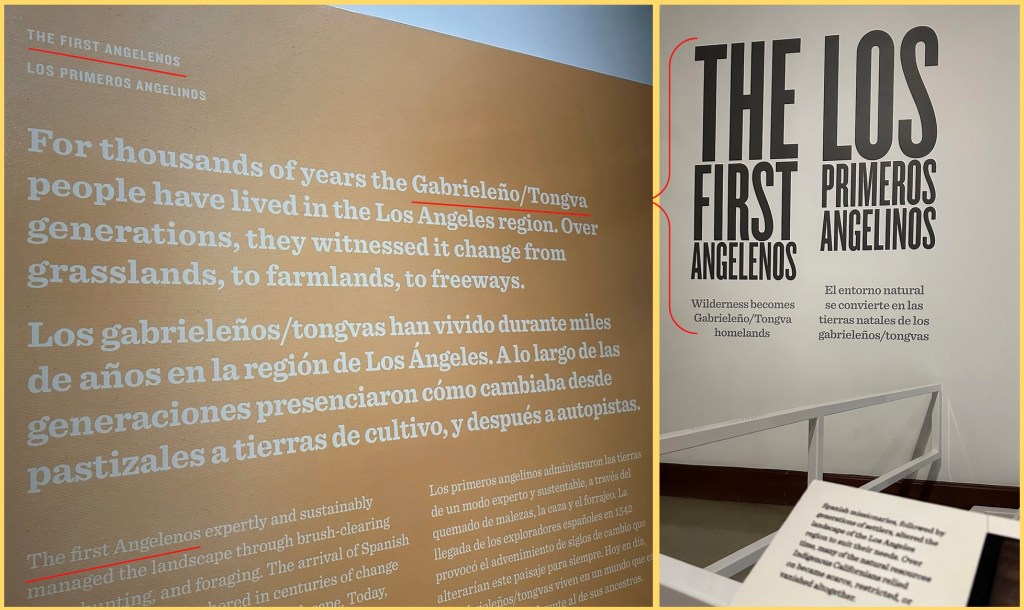
And yet, that is not true. The Gabrieleño/Tongva/Kizh were not the first—to be clear, they are neither native nor indigenous—rather, they were in fact settler-displacers. There’s a reason why the indigenous populations to the north and south of Los Angeles speak a Hokan languages, while the purported “native” people of Los Angeles speak an Uto-Aztecan tongue. The indigenous Hokan-stock Milling Stone Culture people occupied this region for millennia — likely as long as eight thousand years — before an Uto-Aztecan tribe migrated from what is now Nevada roughly two thousand years ago. These ancestors of the Tongva erased the existing population, a transition evidenced by archaeological findings of cranial and projectile trauma, which confirm that this territorial shift was achieved through sustained warfare. Don’t get me wrong, the Tongva have been here a pretty long time, but the next time you hear they have been here “since time immemorial,” remember, their tenure is the result of their impulse for expansion, demographic erasure, and the displacement of those who came before them.
Then I turn the corner—
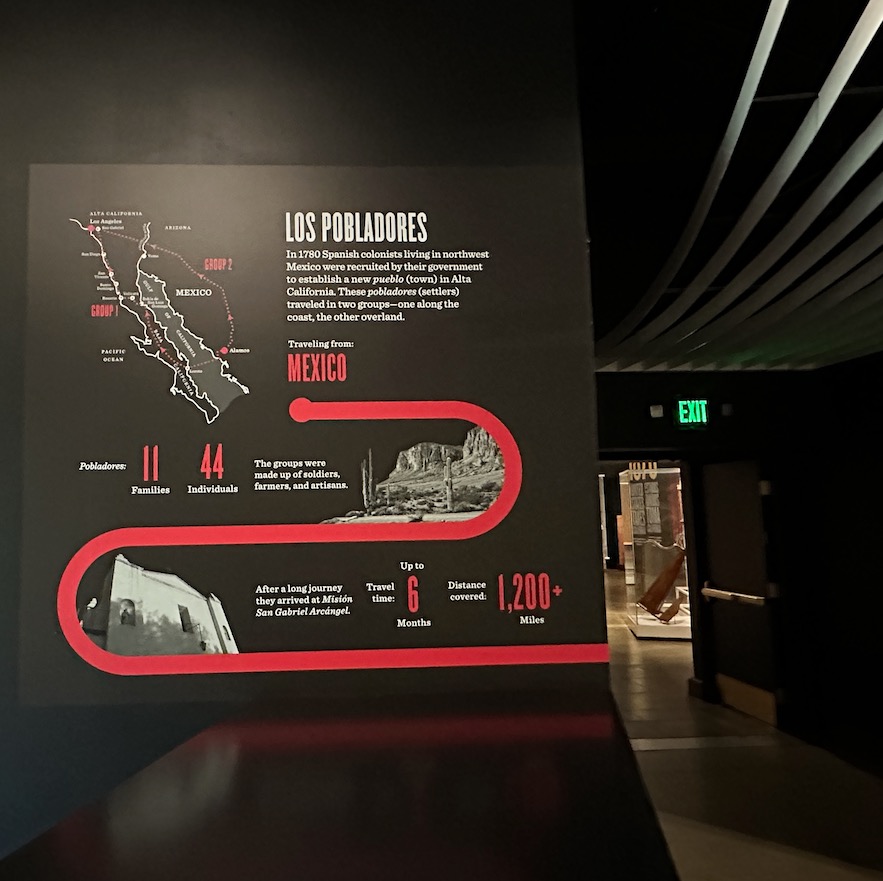
— and there’s this massive wall sign claiming the pobladores were from “Mexico.” I had to blink a few times. Certainly it read they “were from what is now present-day Mexico,” or language to that effect, because after all Mexico would not exist for another forty years. Nope; it said they were “living in northwest Mexico” and “traveling from Mexico.” Except as anyone with a basic grasp of history knows (except for museum curators, apparently), that is false.
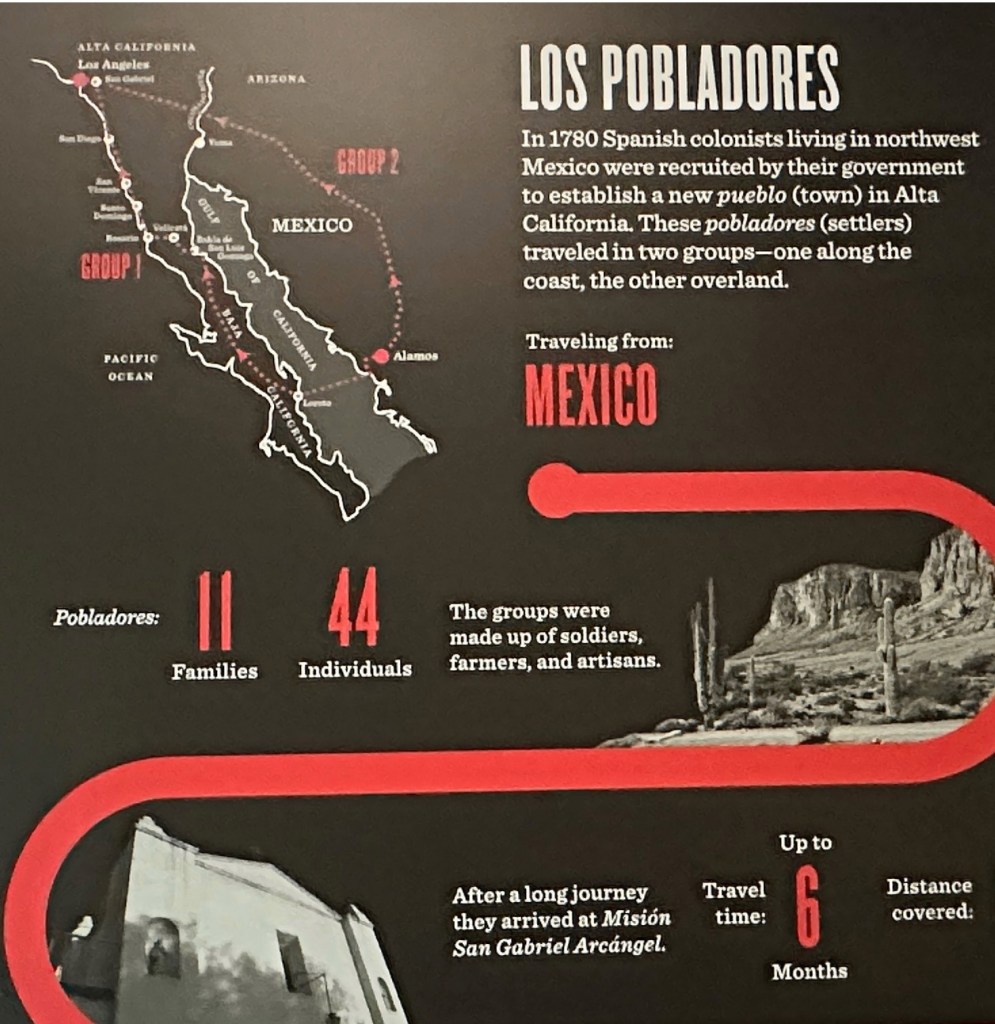
Mexico did not exist in 1780; it would not exist until 1821. To argue one can retroactively apply a future name to a past population is a logical absurdity that erases history rather than describing it. The pobladores were from the Viceroyalty of New Spain, subjects of the Spanish Crown and vassals of King Charles III of the House of Bourbon.
Before the “but a part of New Spain was called Mexico” crowd chimes in: yes, New Spain was a massive, sprawling entity divided into roughly two dozen distinct jurisdictions—Reinos, Gobernaciones, and Provincias Internas. “Mexico” was merely one of these, and while it contained the seat of the Viceroy, the dispatch of pobladores into Alta California, and subsequent founding of Los Angeles, was a strategic imperial colonization project, a military-supply function of the Spanish Crown in the north. It was not a project of the central administration in the Reino of Mexico, and treating it as a “Mexico City” initiative is to misunderstand the very reason the Provincias Internas were established in the first place (the establishment of the Comandancia General de las Provincias Internas in 1776 was a deliberate effort by the Spanish Crown to bypass the viceregal bureaucracy in Mexico City; the goal was to centralize military and political authority over the northern frontier, creating a direct line of command from the King to the frontier leaders).
The pobladores were recruited directly from the Provincias Internas—specifically Sonora and Sinaloa, a full 1,300 miles from the central valley—under the oversight of the Comandancia General. Because these northern frontier territories were strategically separated from the Viceroyalty’s central authority to ensure rapid defense against foreign encroachment, the Reino of Mexico played no substantive role. To claim someone from the northern frontier in 1781 was “from Mexico” is like claiming a colonist in the Massachusetts Bay Colony in 1700 was “from Virginia.” They existed under the same imperial umbrella, but they occupied vastly different geographic, social, and economic zones.
While the term mexicano occasionally referred to Nahuatl speakers from the central valley, the frontier settlers would never have identified as such. They were vasallos del Rey; naturales of Sonora or Sinaloa; cristianos within the República de Españoles; and identified by their casta—español, mestizo, mulato, or indio—legal classifications that determined their status and obligations under the Crown. They were not Mexicans.
You might argue saying they “came from Mexico” is “just shorthand,” but I have heard this argument enough to know better. Labeling 1781 pobladores as “from Mexico” is not a harmless simplification; it is ideological grooming designed to manufacture historical legitimacy for modern demographic narratives. Whether the museum is intentionally pushing an agenda or is simply historically illiterate, the result is the same. Writing a falsehood on a museum wall does not make it true. These settlers were frontier subjects of the Spanish Crown, operating within a Christian imperial hierarchy decades before a secular Mexican republic existed. Retroactively slapping contemporary national labels onto colonial history intentionally erases the Spanish imperial and religious framework that actually built the West.
*********
And that’s how what began as an anodyne outing to view a Bunker Hill model for this blog transformed into sustained face-palm as I watched empirical reality succumb to the intellectual dishonesty of agenda-driven myth-makers. Or perhaps they are just inept and lazy. Who can really say?
In any event, go down and check out the awesome model! You’ll be glad you did!
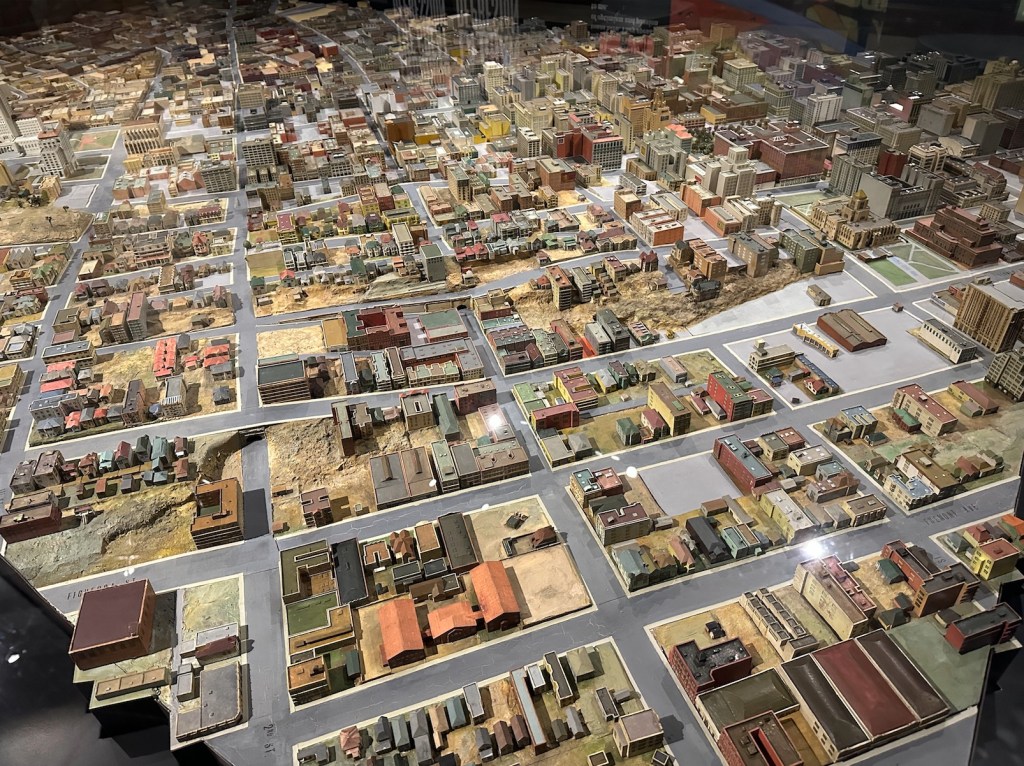


The model is indeed awesome and a treasure especially for those of us lucky enough to have actually walked these streets and populated the buildings. As Nathan says, do go and see it for yourself.
LikeLike
Do you have a source to share for this? I am interested in learning more about this, but my Google searches for Henry Workman Keller and Dodger Stadium and/or Chavez Ravine have only turned up your blog post. Would be happy to go visit a library if necessary.
LikeLike
Of course, Tom. Dodger Stadium (the physical stadium itself) is on the site of Lot 3, Block 45, of Tract 3201, of the Hancock Survey. Take a look at the 1921 Baist Atlas and you’ll see it’s owned by H W Keller, and was the site of the K&K Brick factory (the other “K” being C. J. Kubach).
The story gets complicated, though, because in the summer of 1926, the North Civic Center Improvement Association, located in the Alpine area south of Chavez Ravine, successfully campaigned City Council to pass a resolution shutting down nearby brick factories, but, while they name Los Angeles Brick on Chavez Ravine Road, they do not name K & K. I do think K & K may have shut down, though, after the 1929 passing of Kubach, because they seem to disappear from the newspapers.
Of course there’s an absolute possibility Keller’s land passed to someone else between 1930 and 1950. I’m not sure that happened because the area didn’t get redeveloped (aerials indicate it remained a sort of no-man’s land) and Keller lived till ’58 — he likely hung on to it knowing it would be an easy payout under eminent domain, since there were large-scale civic plans for the area beginning in 1935.
Is your interest Keller in particular? His papers are at the Huntington and I’ve been meaning to go through them for, like, forever.
LikeLike