TL;DR: Prominent, established voices inform us that Biddy Mason — besides making her famous 1866 purchase of two contiguous lots (three blocks away from Pershing Square), which became the site of her Spring Street home/commercial structure, and where the current Biddy Mason Park is located — also bought and held an extensive array of properties adjacent to what is now Pershing Square. The evidence, however, indicates this is false, as it appears Mason’s only stake remotely near the park was a single lot purchased in 1868, on which she made no improvements, and divested herself of it after four months.
*****
Read a condensed version of this post on my Substack, here.
*****
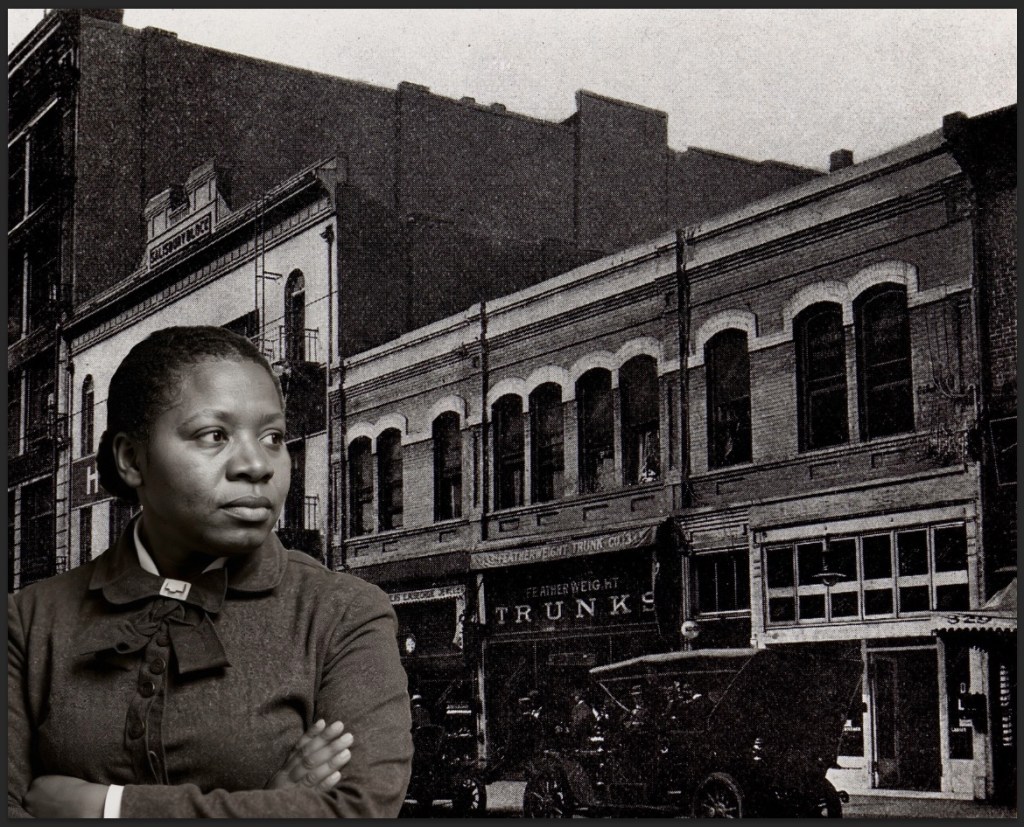
There’s a lot of talk lately about Biddy Mason, since the City Council decided to strip General Pershing’s name off of Pershing Square and rename it for Biddy Mason. This they do despite our having a fine Biddy Mason Park (right at the site of her homestead!) already, so that we may have two Biddy Mason parks.
This is necessary and understandable, we are told, because Biddy Mason is so important and incredible due to her widely cited (but overwhelmingly mythologized) humanitarian efforts (contentions I examined in this post).
Lately, a convenient new cornerstone has been wedged into the civic lore: the assertion that Biddy Mason once controlled an extensive footprint of real estate directly adjacent to Pershing Square. Promoted as a triumphant, archival revelation only recently brought to light, this claim has been used as a justification for the renaming crusade.
As you will see, this unassailable historical trump card wilts under examination.
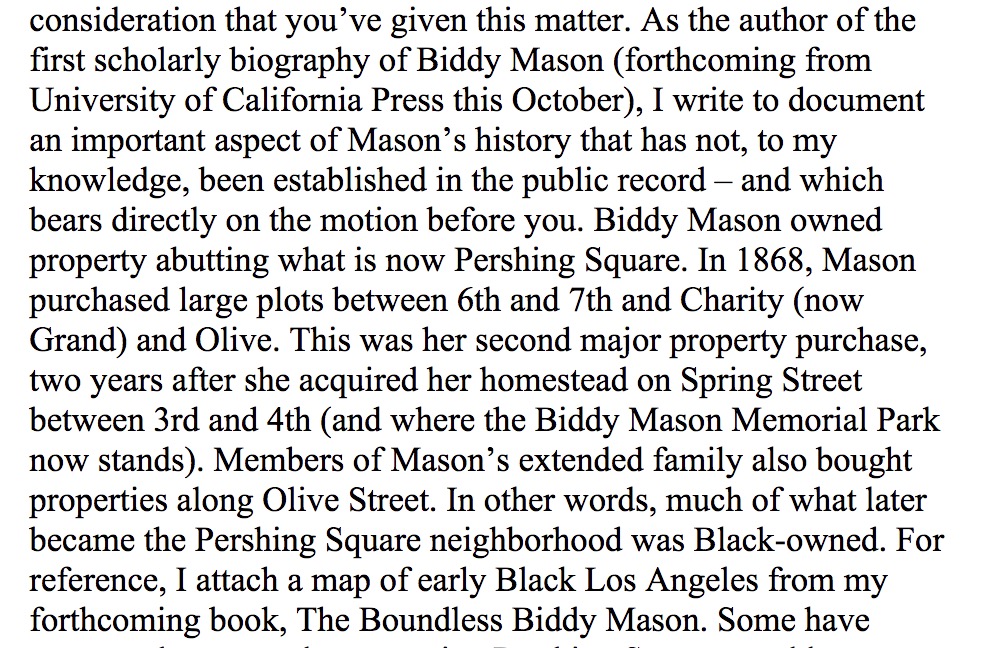
First let’s look at the claim: I initially got wind of it in the comments sent in to Council, specifically, this one from Dr. Kevin Waite, author of the forthcoming Boundless Biddy Mason. It reads in part:
According to Dr. Waite, Biddy Mason owned property — large plots — “abutting” Pershing Square. From his map:
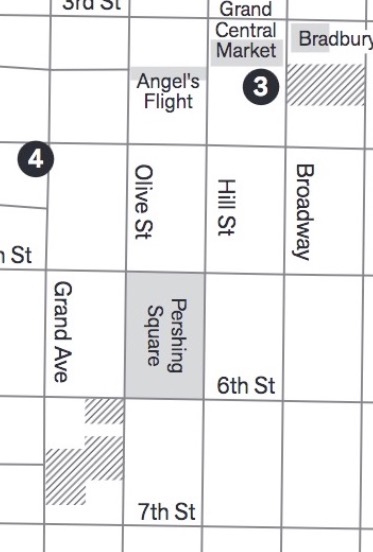
So, he’s saying that the cross-hatched portions of the map, kitty-corner to Pershing Square, were Mason’s. (Fanciful use of “abutting,” Dr. Waite—diagonally across and separated by an intersection, sharing neither boundary nor border, is not abutting—but let’s move on.)
We already know that Dr. Waite plays a little fast and loose with his use of cross-hatching, when you compare how much he cross-hatched in his map for Mason’s famous 1866 homestead purchase, versus how much Mason actually owned:
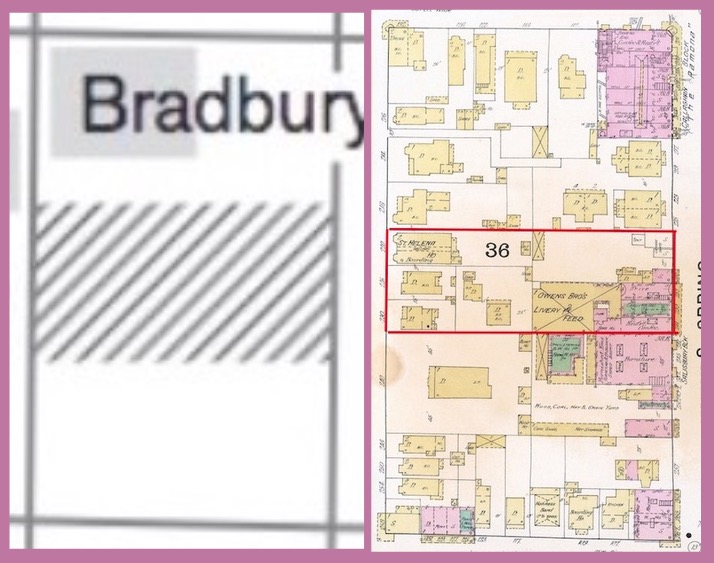
But, whatever. More to the point, even if Biddy Mason owned all the land southwest of Pershing Square as indicated in Waite’s map, it’s a pretty far cry from “In other words, much of what later became the Pershing Square neighborhood was Black-owned.”
Let’s look at a map of Pershing Square, and its adjoining blocks, highlighting the purported Biddy-owned property:
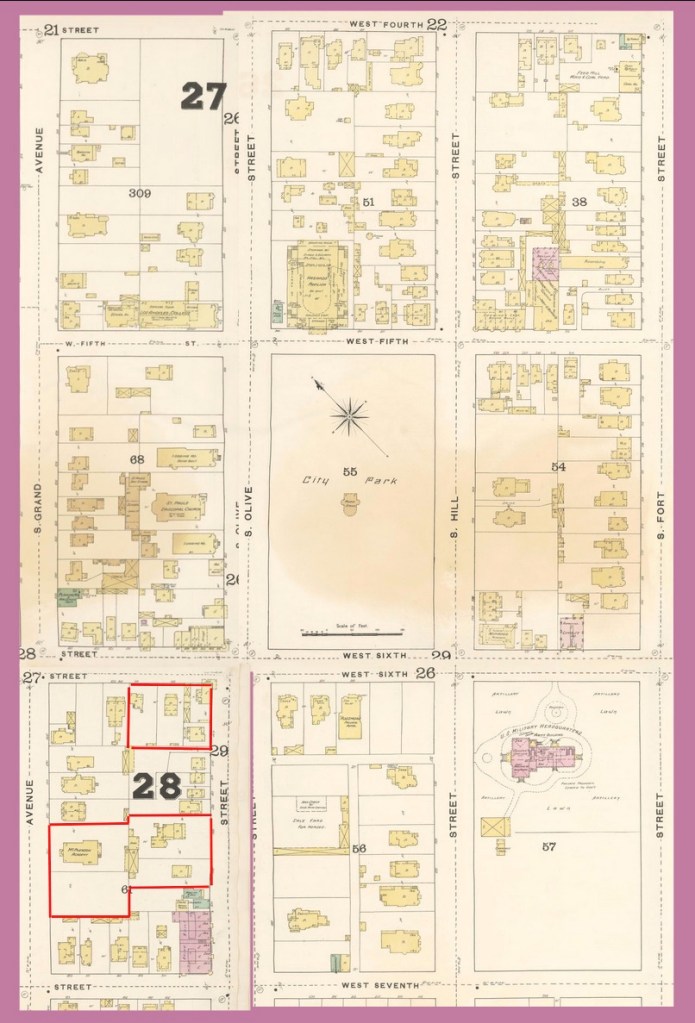
These are the blocks surrounding the park, in 1888, so, about three years before Biddy Mason died. Would you agree that “much of the neighborhood was Black-owned”? Much of would be a number nearing half, not … 1/3rd of 1/9th. (Though we’re also told “members of Mason’s family bought property along Olive Street” and, spoiler alert, we never find out where those were.)
At this point you exclaim “oh you’re being persnickity, it’s such a minor point, leave it alone!” and I would have … had I not just read this piece in the LA Downtown News. In it, Jackie Broxton, head of the Biddy Mason Charitable Foundation, says:
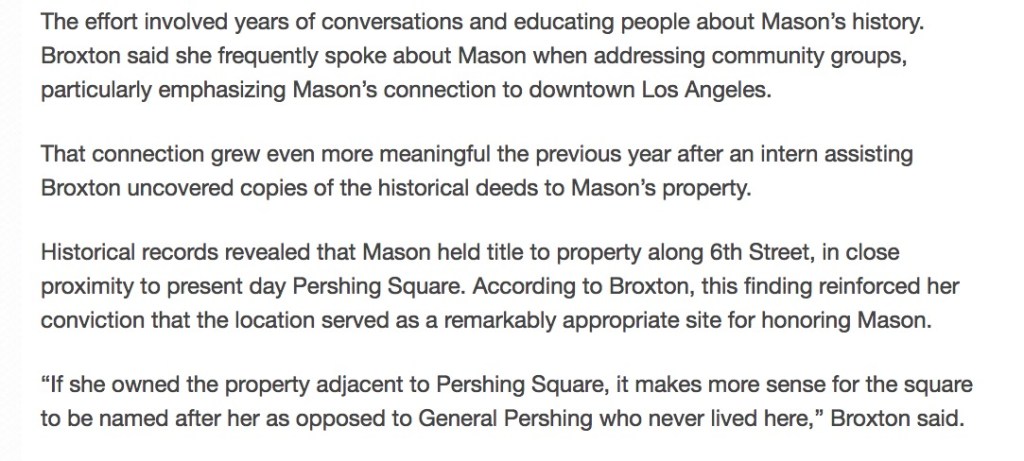
Ergo, this particular element of the tale — that Biddy Mason owned property adjacent Pershing Square — has now become an important and repeatable talking point, as a source of legitimacy for the renaming. It’s a point that Waite, in his letter to Council, underscores with a “see? additional evidence nobody knew till now! Vote to rename!”
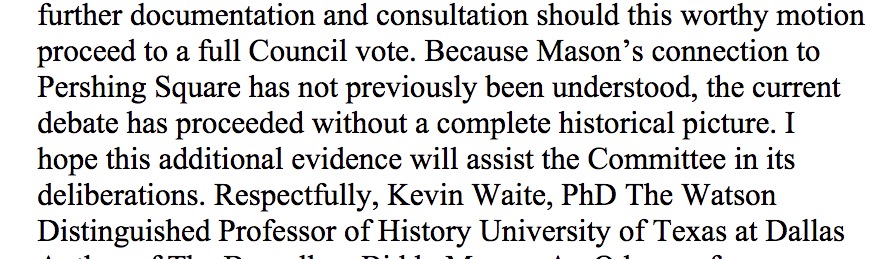
And with this “additional evidence” in hand, rename they did!
Afterward, Waite wrote more about the newly-discovered Pershing Square-adjacent Mason land, in an article on Zócalo:

So, in the above description Biddy Mason owned a single plot. And yet Waite’s map indicates she owned multiple lots in Block 20 of Ord’s Survey:
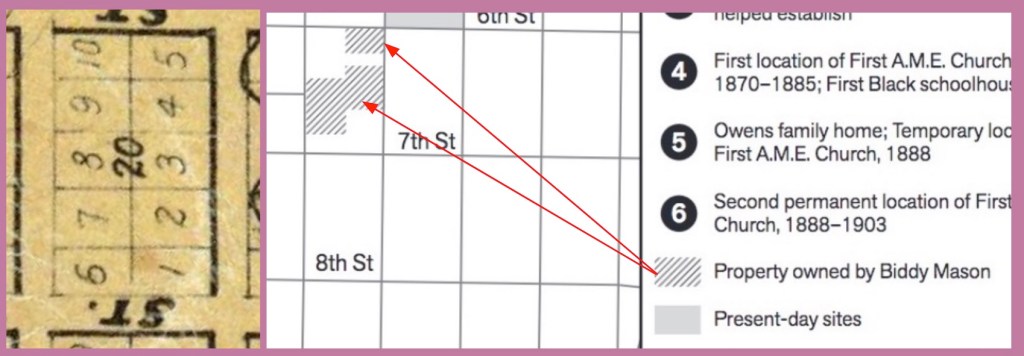
If the area “around the square” was Black-owned, where did her family own land? You say it was concentrated on Olive Street, but, was it part of the cross-hatched part? Or elsewhere?
You might remember in my post from two weeks ago I wondered about all this, but figured I would have the light of understanding shined upon me —

— when Waite’s Boundless Biddy Mason came out. Surely something as important as the other lands Biddy owned, including this newly-discovered evidence that absolutely cements her important place in Pershing Squ Biddy Mason Park, will be unraveled in all its glory in the soon-to-be-published exhaustive biography!
Aaaaaaand (drumroll) the big reveal! I got my hands on an advance copy of the book, and GUESS WHAT. Yeah, I bet you can guess.
So! PREPARE YOURSELF for the sum total of “it’s never been entered into the historic or public record before this moment, but, can you believe Biddy Mason owned substantial plots of land adjacent to and abutting the park, and the area surrounding the park was Black-owned!”
That claim reads, in toto, like so:
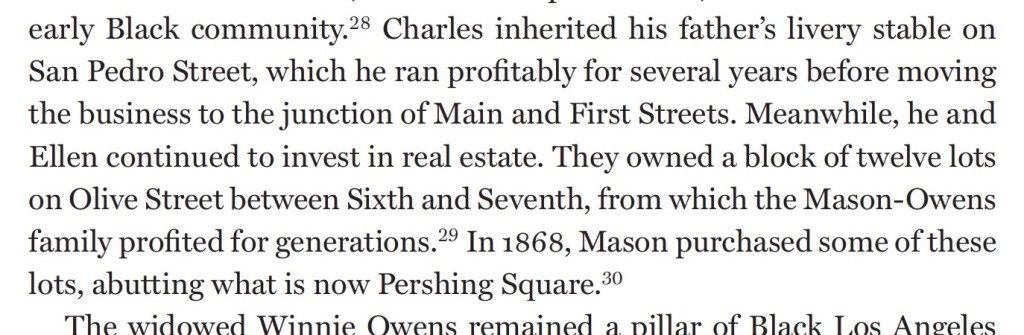
And that’s it. What I thought would have its own chapter merits one sentence.
Charles and Ellen Owens “owned a block of twelve lots on Olive between Sixth and Seventh.” First of all, you can’t own “twelve lots on Olive between Sixth and Seventh,” because there are only five:
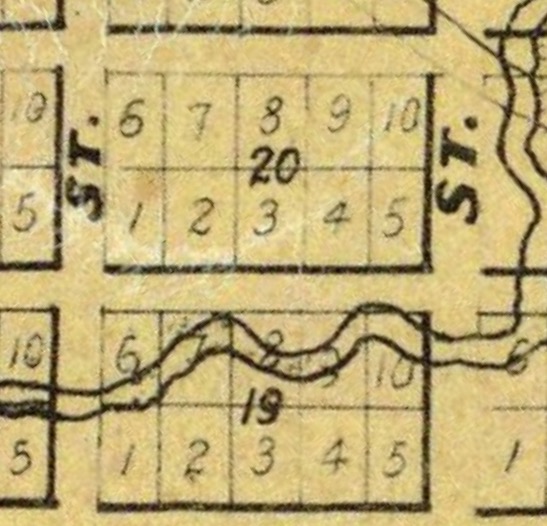
Needless to say, but the Owens family owning any number of lots on Olive south of Sixth does not make, contrary to Dr. Waite’s assertions to Council, “much of the Pershing Square neighborhood Black-owned.”
And then, Biddy Mason, in 1868, purchased “some of these lots” from her in-laws, including the one near Pershing Square which we can only assume is Lot 5, Block 20.
I am aware that Block 20 was carved into sublots; see, for example, my 1888 Sanborn image depicting the blocks surrounding the park (though those subdivisions had not yet happened in 1868, when we’re told these transactions occurred). Therefore it would be extremely helpful, if we are to believe any of the many versions of this, if we knew what lots she and/or her family owned.
But wait! There’s an endnote!
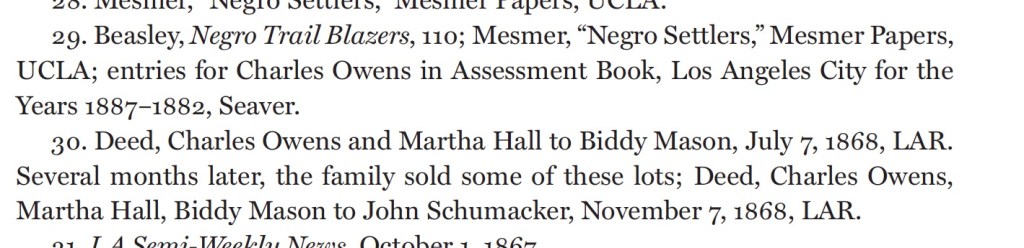
But said endnote clears up no mysteries. Biddy Mason bought property (one lot? more than one lot?) from her son-in-law Charles/his sister Martha, in July 1868. Then, the family, including Biddy Mason, sold some of “these lots” (Biddy’s lots? the family lots on Olive, but not Biddy’s?) to John Schumacker (I believe you mean Schumacher) that November.
So, via all the new information in Waite’s as-yet-unpublished Mason biography, here’s how I understand it: Biddy Mason owned a small part of Block 20—not adjacent to the park—for all of four months in 1868. And that differs considerably from, and pales in comparison to, Waite and Broxton telling us “check out this major discovery, Biddy Mason owned a substantial number of properties right next to the park.”
But hey, maybe I’ve got that all wrong. Ergo, I reached out to the only two people who would actually know, i.e., the ones who actually have seen the deeds. Last Monday, the 21st, I wrote very nice emails to Kevin Waite and Jackie Broxton (each of whom having stated were the discoverers of these heretofore-unknown Pershing-adjacent Biddy Mason properties) saying, basically, Hi, I’m a researcher very interested in Biddy Mason, and I read what you said here and here and here that Biddy Mason owned properties adjacent to Pershing Square, would you be so kind as to tell me where those were?
A week has passed with no answers (but in Dr. Waite’s defense, I did get an automatic reply saying he was on paternity leave).
Again, it may seem like I’m needlessly focusing on a trivial, inconsequential part of the Biddy Mason legacy. But hey, I’m not the one who manufactured the “Mason and family commanded a real estate portfolio surrounding Pershing Square” talking point. Those who invoke the authority of the archives to justify major civic rebrandings ought to be prepared for someone who wants to actually examine the evidence.
While some might consider questioning the prevailing hagiography an act of heresy — and I certainly went out on a limb to unravel her true story — untangling the granular realities of nineteenth-century Los Angeles land patents, subdivision maps, and tract transactions is precisely what I do: when modern myth-making leans on the dry mechanics of Victorian-era lot ownership, it walks directly onto my home turf. And I take my home turf very seriously.
Thus and therefore, when we’re told by the Biddy Mason Charitable Foundation that Mason had property “all over the city,” I say … sorry to be a jagweed about it, but, I need you to prove it.
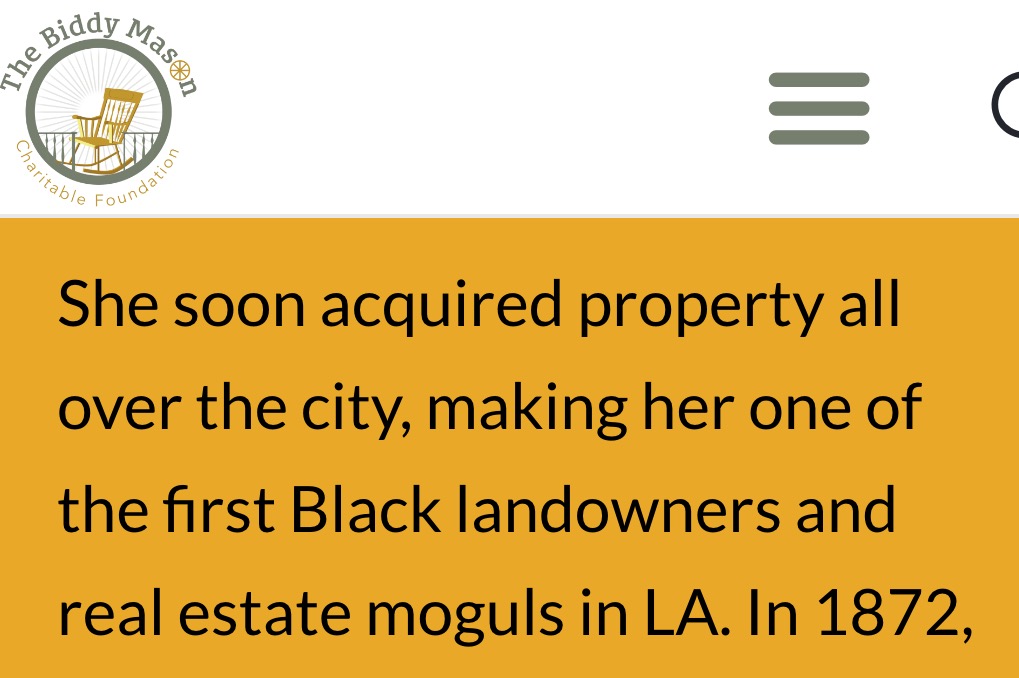
Jackie Broxton of BMCF has gone on to say, quite recently, that Mason owned all of Block 20:

That’s quite a claim. After all, no-one in post-Civil War Los Angeles owned an entire block—not a single top-hatted, frock coat-wearing, mustache-twirling capitalist owned an entire block, but Biddy Mason did, a fact that is never mentioned in any contemporary account. (But there is of course a chance I am wrong. Am I wrong? Prove me wrong! Remember, I’m just an email away — oldbunkerhill@gmail.com.) I find it disappointing that Jackie Broxton’s intern didn’t shoot some shots on her phone of those 1868 Block 20 deeds; seems like it wouldn’t take more than two minutes to cut and paste them into an email for me. Imagine me eating all that crow and humble pie and bitter pills all at once.
Honestly, I am very much looking forward to issuing a formal apology to y’all when you display to me that, in fact, Biddy Mason had property all over the city including next to Pershing Square; property that she improved upon greatly, and held on to for years; which she used to increase her wealth, thereby helping the incarcerated orphans; and proving that, as has been stated ad nauseam, including in the official city paperwork that convinced Council to approve Biddy Mason Park, that Biddy Mason was absolutely essential and instrumental to the development of downtown. I WANT TO BELIEVE, so help me out!
After all, here is a headline from Capital B:
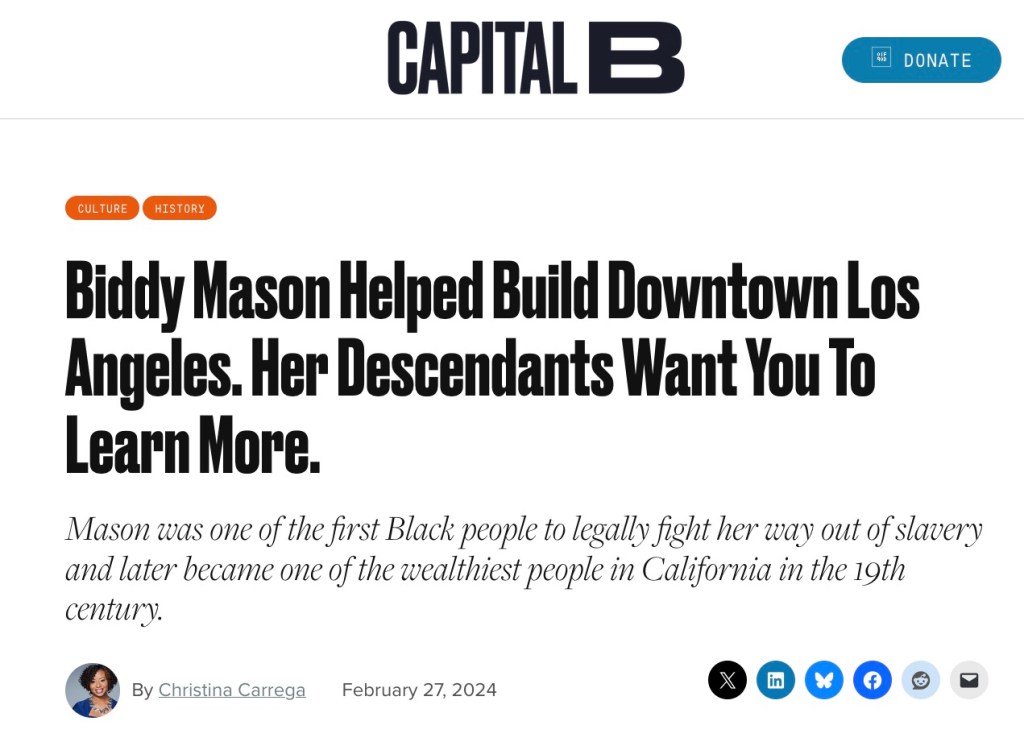
Ok, she helped build downtown Los Angeles. Her descendants want me to learn more. You want me to learn more? Teach me! I’m right here! Where were her properties?
Oh wait! At long last, I have found the answer:
Marne Campbell, an associate professor at Loyola-Marymount, in a paper for the Journal of African-American History, wrote:
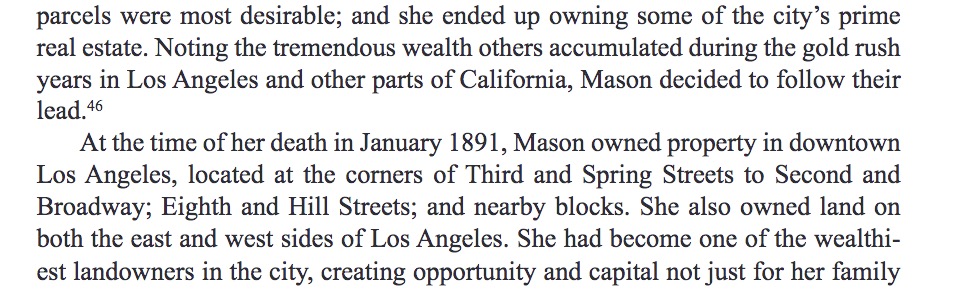
Welfare Activism in 19th Century Los Angeles
So, now I know where Biddy Mason’s properties were! At the time of her death, she owned property “at the corners of Third and Spring, to Second and Broadway” (zero idea what this means, but I assume she here attempts—and fails—to describe famed lots 3&8 in Block 7); as well as “Eighth and Hill”; plus she owned “nearby blocks” — and even had properties out in East Los and on the westside!
Campbell’s narrative is, quite frankly and demonstrably, historiographical poppycock. For example: if one consults the property assessments produced by the City Board of Equalization in mid-1889, Mason’s total taxable landholdings were valued at $39,750—a figure that aligns precisely with the market value of her two improved lots in Block 7; thus shattering the myth of a Biddy Mason property empire. And of course, contemporary accounts mention Mason’s Block 7 property constantly and consistently, yet somehow fail to mention any of these other purported investments.
Most importantly, when one examines her estate paperwork, the truth becomes even clearer: her famous mid-block “Lots 3 & 8 of Block 7,” which extend from Spring to Broadway and currently host her memorial park, are the only holdings referenced therein.
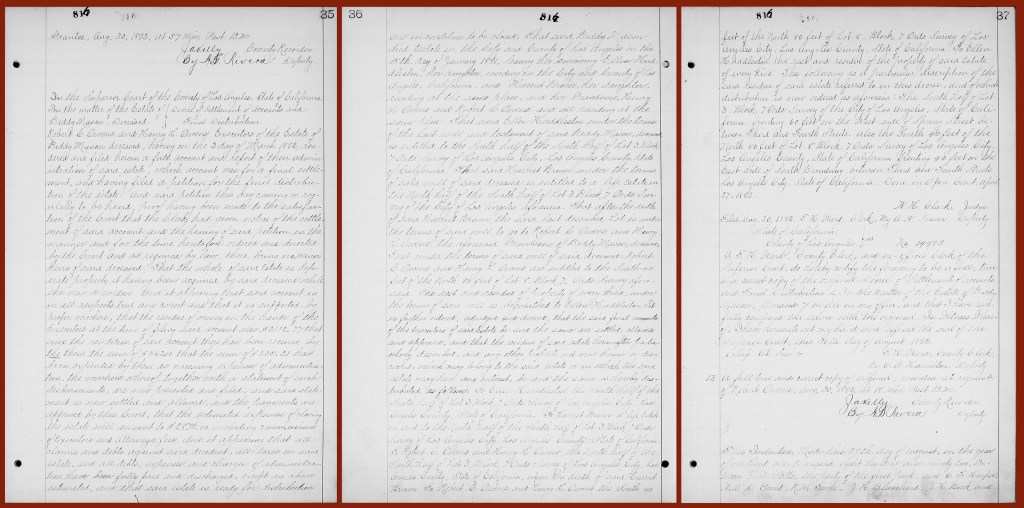
In fact, take a look at this link:
One hundred and fourteen Biddy Mason deeds, mortgages, leases…go ahead, read ’em all! I did!
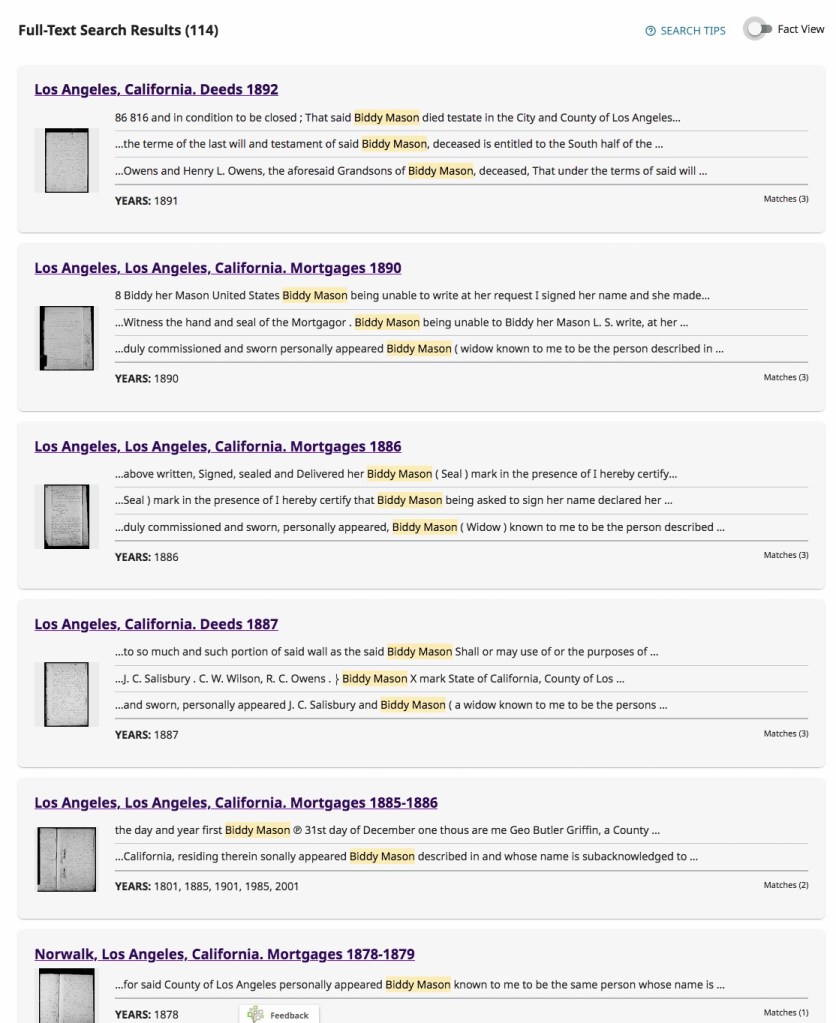
Needless to say, lots of paperwork dealing lots 3 & 8, Block 7; zero paperwork concerning anywhere else. (Special thanks to reader Mike Shawn for providing me with this missing link of the puzzle.)
Again, where Mason’s properties lay is an important part of the story, because the Powers That Be have made it one, especially and specifically by telling falsehoods (or, to be charitable, making mistakes). Don’t forget, the Motion that stripped Pershing and ushered in Mason was rife with pure fantasy (à la Biddy Mason made “extraordinary contributions to the founding and development of Los Angeles” and was “one of the most influential business leaders who helped shape the development of downtown and its civic foundations,” etc.) up to an including passages like this:
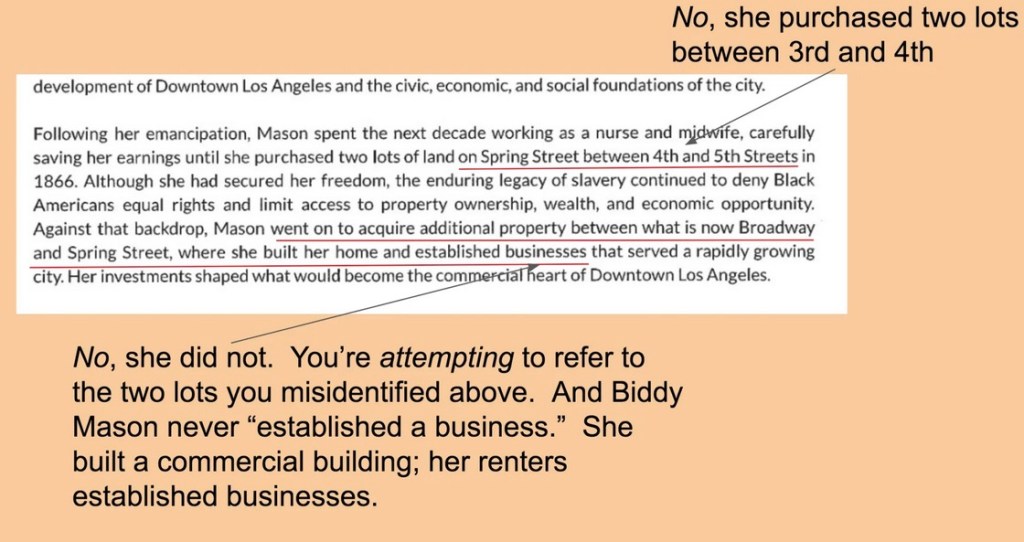
This sort of thing — Biddy owned here, Biddy owned there, source: trust me bro — has been a fundamental building block of the Official Biddy Mason Story. Hey, Powers That Be, and Gatekeepers: now that we know your traditional building blocks are bullshit, do us all a favor and hold up on adding new ones.
In summation, the myth of an expansive Mason real estate empire is untenable. Aside from the 1866 acquisition of her Block 7 homestead—an astute, albeit opportunistic, venture that established her as a capitalist player in a depressed market—she held only a minor parcel or two to the southwest, and only for a fleeting four months. To elevate such an infinitesimal transaction into a cornerstone of her legacy is not history; it is a desperate attempt to manufacture substance where none exists.
********
Postscript: Regarding Waite’s Book
People have asked for my take on Kevin Waite’s new biography, The Boundless Biddy Mason. Though I am frustrated by the absence of critical data regarding Mason’s actual property holdings, this is not a poorly researched book.
It is a competent work of scholarship, though it is not the book I would have written. While Dr. Waite and I draw from the same primary archival sources, our interpretations diverge sharply (e.g., extrapolating “walked thousands of miles” from “trudged behind the livestock,” or recasting Mason as a clinical nurse from her time spent as a confinement nurse; narratives I examine in my recent post).
It was not unreasonable to assume that when I picked up my copy of Boundless, I’d be smacked by a lot of bad history, replete with narrative forcing, revisionist polemics, presentism, mythopoeia, and the other calculated hallmarks of modern hagiography — there exists, after all, a surplus of “Bad History” currently circulating in public discourse (let me tell you about a few of the offenders, here).
Dr. Waite, by contrast, is a diligent historian, and his work is not bad history. What I find most revealing is that The Boundless Biddy Mason did not refute even one of my corrections to the popular Biddy Mason myth. I fully expected him to surface evidence confirming the claims of her starting a school/orphanage/nursery, feeding inmates, or Mason performing actual nursing duties, and so on; he did not. (Plus he and I share consternation regarding the “unmarked grave” myth and the absence of any photographic record of her monument at Evergreen.)
A representative divide between our approaches is best captured not in the biography itself, but in the final two paragraphs of Dr. Waite’s recent Zócalo article:
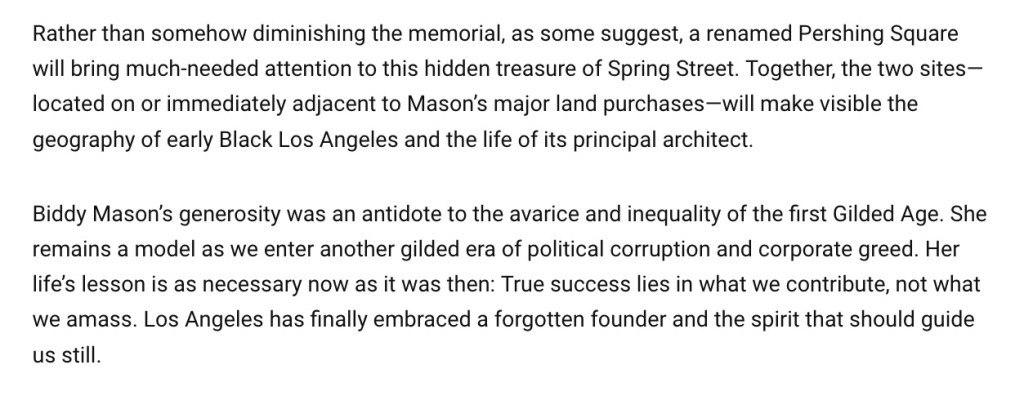
I remain unconvinced by the characterization of Mason’s Block 20 land purchase as “adjacent” to Pershing Square, nor can it be accurately described as a “major” acquisition. Furthermore, the label of “forgotten founder” is a categorical error: she was neither forgotten nor a founder. However, the fundamental divide between Dr. Waite’s analysis and my own lies in our interpretation of Mason’s place in the Gilded Age.
Waite frames Mason as an “antidote” to the Gilded Age; I would argue the opposite. She was entirely representative of it. To label her an “antidote” is merely sentimental hagiography. After accumulating wealth by successfully navigating and profiteering from the very mechanisms of land speculation that fueled the era’s economic expansion, she engaged in philanthropy. This was not a radical rejection of social norms, but a predictable adherence to them. The “Gospel of Wealth”—the belief that the successful were morally obligated to steward riches toward charitable ends—was a cornerstone of the 19th-century bourgeois class. Her benevolence was not a critique of the era; it was a hallmark of it.
I agree with Dr. Waite in principle, in that localized Christian charity acts as an antidote to institutional rot by operating beyond the reach of corrupt state bureaucracies and predatory corporate interests. By prioritizing neighbor-to-neighbor aid through parish and family networks, this model restores local sovereignty and material accountability. It rejects top-down, ideologically driven social engineering, empowering communities to care for their own while severing the shackles of dependence upon the current, captured regime. Though the Biddy Mason Charitable Foundation gets far too much of their own history wrong, I admire them very much, having began as a church ministry offshoot of First African Methodist Episcopal, before acquiring nonprofit status ten years ago.
That said, by casting Mason as a symbol of resistance to inequality, modern writers attempt to co-opt her as a precursor to contemporary ideology. I find this approach deeply problematic. Respecting her actual history requires acknowledging her as a product of her time—a shrewd, successful operator who thrived within a competitive capitalist framework and conformed to the religious and social structures of her day.
Whatever best intentions, calling her an “antidote” serves only to sanitize her image for modern consumption, effectively detaching her from the realities of the period she inhabited. We should instead acknowledge the documented record: she was a woman who mastered the tools of her age—capitalism and religious philanthropy—to secure her standing. Identifying her as a quintessential figure of the Gilded Age is not an insult; it is a recognition of her agency and a restoration of her true place in the historical record.
To hold up Biddy Mason as a unique antidote to modern civic decay relies on a nostalgic myth that genuine charity died with the frontier, ignoring the reality that Americans today give far more private wealth to philanthropic causes than they did in the 1870s. Adjusted for inflation and population, the modern philanthropic sector dwarfs the modest, highly localized mutual aid of the post-Civil War era.
Furthermore, the very engine driving modern generosity and giving contradicts the secular hagiography built around Mason. The vast majority of consistent, private charitable giving in America comes from Masonesque conservative people acting on traditional convictions of duty to neighbor and community (see here, here, here; one wonders if our DSA City Council would advocate so hard for Biddy Mason if they knew she bore the hallmarks of modern Conservatism). Mason herself operated within this exact framework: her benevolence was not a radical political statement, but the conventional, expected expression of Victorian Christian piety and localized church-based charity. I’m as big a fan of topping “political corruption and corporate greed” as Dr. Waite is, but it’s also important to place Mason within the grand tradition of Americans performing identical charitable works today; anything less would be an exercise in historical illiteracy.


That brick and concrete slab is an embarrassment to Pershing and to Mason and should not bear either of their names. It should be renamed Huizar / de Leon / Jurado / Waite Park.
LikeLike
The TL;DR framing serves this post well, because the question it isolates is deceptively simple: did Biddy Mason really hold an extensive array of properties adjacent to what is now Pershing Square, or has that detail accreted through repetition by prominent voices? What everyone agrees on is already remarkable — the famous 1866 purchase of two contiguous lots three blocks from Pershing Square, land that became the site of her Spring Street home and commercial structure, and where Biddy Mason Park sits today. If the broader adjacent-holdings claim doesn’t survive your evidence check, that’s worth knowing; a story this good doesn’t need embellishment. Thanks for doing the unglamorous work of separating the documented purchase from the legend that keeps growing around it.
LikeLike