My esteemed friend and Angels Flight co-operator Will, AKA saturdaystationagent, does great work on his Instagram regarding the Flight, like his timelapse photography (with longer vids of Life in the Station House uploaded to YouTube) as well as all manner of other Flight-flavored IG nuggets, one of my favorites being this. Plus, he documents the removal of tagging, which cannot be applauded enough (though we should remove hands along with the tags, as I have stated).
Anyway, lately Will’s been posting clips of the Flight from various classic pictures, like 1947’s The Unfaithful and 1949’s Criss Cross.
And that got me to thinking, hey, I seem to remember I put together an Angels Flight clip reel about ten years ago, projected onto the big screen at the Egyptian and then at the Million Dollar, but which has not been seen since.
So! Pop some corn, cast this onto your own big screen, and enjoy!
And be sure and follow Will’s page! He’s posted a number of rarely-seen examples in his “Angels Flight Plays Itself” series that I don’t have in my compilation, like M and Boston Blackie and Chicago Calling! and even modern stuff like City of Angels.
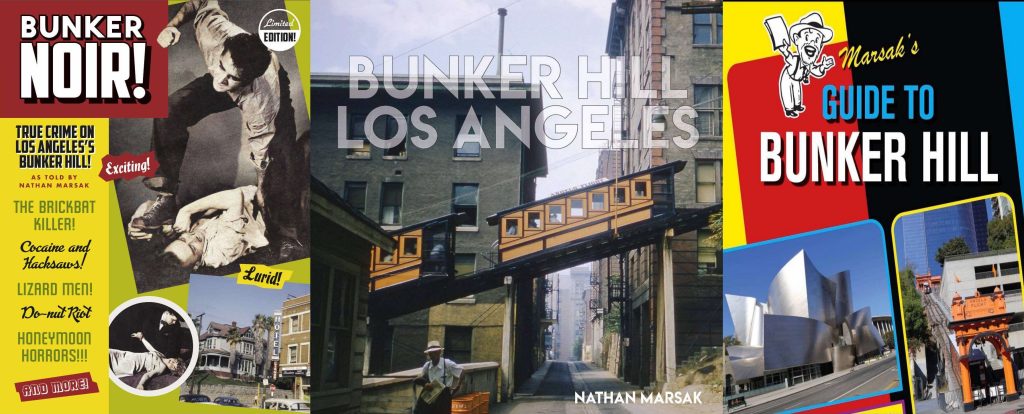
There are three books about Bunker Hill and you’re going to want to get all of them!
***********
MARSAK’S GUIDE TO BUNKER HILL
Bunker Hill is an open-air museum of modernism, showcasing sterling examples of all the major postwar building styles, including Corporate Modern, Postmodern, and today’s contemporary architecture. Incredibly, it also still contains touchstones of the early 20th century, uniting us with Bunker Hill’s famed pre-redevelopment era!
The only way to know “what’s what” on today’s Hill is to get a copy of Marsak’s Guide to Bunker Hill, a full-color, 6×10″, 64-page glossy guidebook, with all the maps and photos and explanatory text you will ever need to make you an expert on Bunker Hill!
It is available for $25 postpaid.
Paypal is marsakster@gmail.com, and Venmo is @Hugo-Eckener. Copies are also available on eBayand Amazon. Read more about it here!
***********
BUNKER NOIR!
Bunker Hill was portrayed in crime fiction, and cast in film noir movies, because its dark alleyways evoked mystery … and in real life, many dark and mysterious goings-on occurred on the Hill.
I compiled all the true crime you could ever want — and more! — into one handy-dandy, full-color, 12×9″, 56-page magazine called Bunker Noir!
They are priced at a mere $33 postpaid. Paypal is marsakster@gmail.com, and Venmo is @Hugo-Eckener. They are also available on eBay and Amazon. Watch a suitably noir video about it here!
***********
BUNKER HILL, LOS ANGELES
The Big Book of Bunker Hill, Los Angeles published by Angel City Press, is hardback, 176 pages, and covers the entire story of Bunker Hill, soup to nuts:
It is available at all fine bookstores, and directly from the publisher:
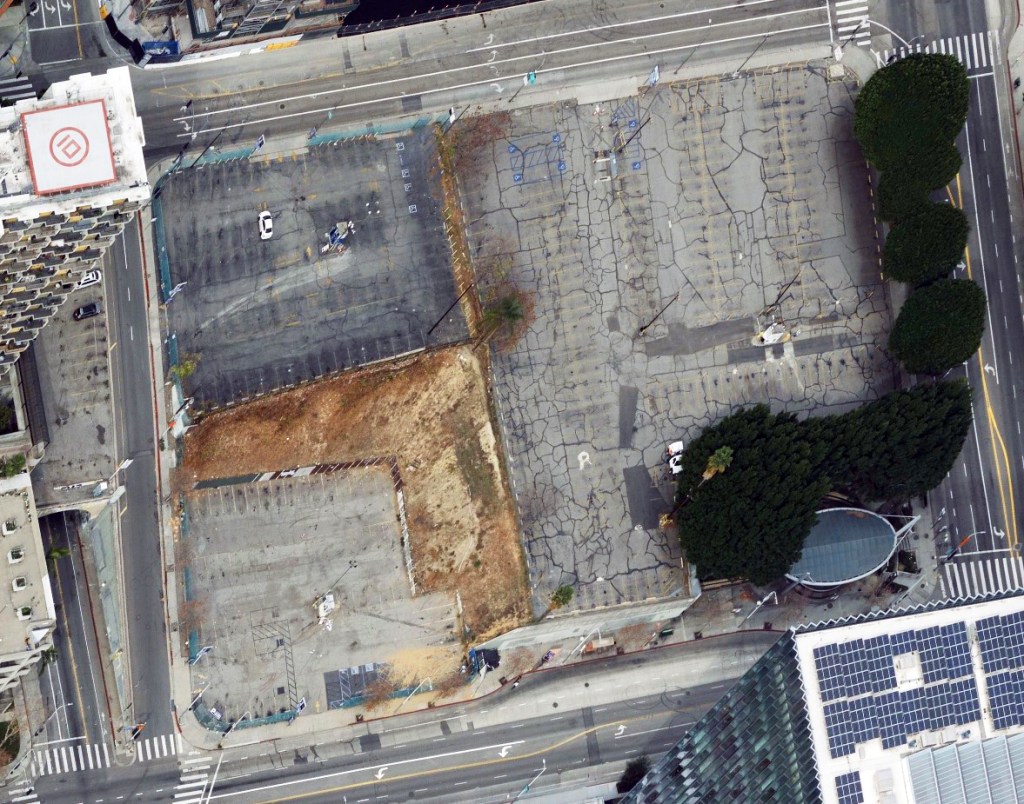
Alas, that particular plot of land and its pile of dirt is not long for this world.
Demo fencing spells the end of our friend
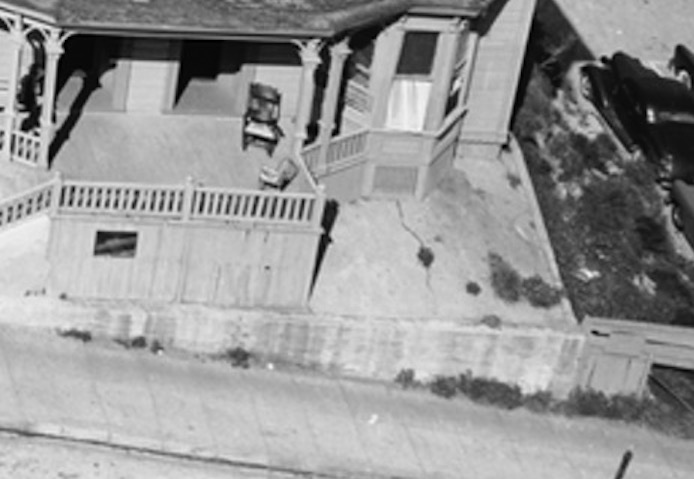
It’s all being removed, and remade. Interesting fragments of the old area shall disappear, for example—one of the remaining pieces of Preredevelopment Bunker Hill—this bit of retaining wall that once shored up 419-21 West Second Street:
The wall dates to mid-1921, when the whole structure was picked up and moved north 40 feet, due to widening of Second Street in conjunction with Second Street Tunnel construction
Though the double-flat structure was demolished in August 1955, that bit of wall remained
—she too has been removed from the landscape, ostensibly to be replanted…somewhere.
And so it goes, all soon to be flattened.
The question being, what’s replacing our parking-lot-of-the-past?
According to the CRA, once upon a time, the parcel bounded by Second, Hill, First and Olive was destined to become an “office complex.”
The 1981 conception shows two main structures, plaza between themCRA renderer Alvin Jenkins’ 1978 depiction illustrates a single structure running the length of Hill Street, with plaza to the north facing Olive
The block has, of course, remained a parking lot since the 1950s, with the early-90s addition of a metro stop at its northeast corner—
Just for kicks, here’s that block by air in 1941:
Anyway, the northern half(ish) of the block, AKA Parcel W2, with the Metro stop and trees, is owned by the County. The southern part, W1, where lies our dirtpatch, is ostensibly owned by the Times. Since the Times is basically defunct, no telling what’s going on with that.
And so, our wee bit of vintage Hill topography is going the way of this:
Behold, the expansion of the Colburn, designed by Frank Gehry, scheduled to open in 2027. You may read more about it here and here and here and here.
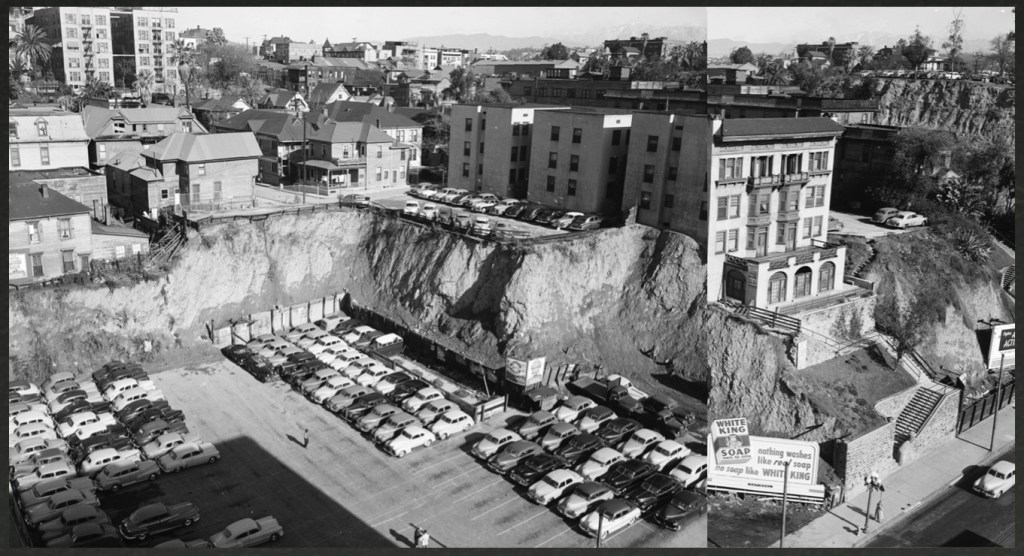
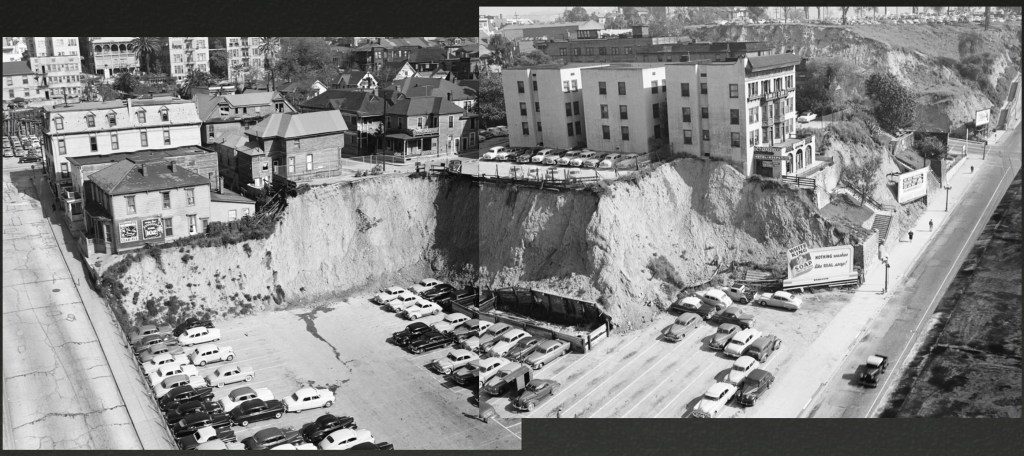
And so, as a way of wrapping up what I began writing back in 2008, some pictures of good ol’ Second and Hill.
Stitched together from two Nadel photos, March 1951And another couple stitched Nadels, April 1952Nadel on left, after the houses along Second were removed, November 1955Top image, from February 1952, Cushman Archives. Other shots in this post are Hylen from CSL, and Nadels from the Getty
Of course, if you’re really hankering for old Bunker Hill topography, you can go hang out at the retaining walls and former Clay Street contour two blocks south. Still, I’d advise you make a detour to watch some of the Second and Hill demolition, to be able to say you Saw It When.
John Soltes, journalist extraordinaire, spoke with me recently about Marsak’s Guide to Bunker Hill. He published said interview on his site Hollywood Soapbox…
So now, having read the interview, you’re doubtlessly intrigued by the provocative palimpsest that is Bunker Hill, thus I suggest you do two things:
a) buy a copy of Marsak’s Guide to Bunker Hill. It’s easy, shoot me twenty bucks and you’ll have it in your mailbox before you can say Bonaventure. All the information about how to get your copy you may find right here:
b) come with me this Saturday. I’ll be leading a charge up Bunker Hill, in search of architectural triumphs and failures, telling stories both divine and profane, and generally having a grand old time. Copies will be available there, naturally. (Plus according to all the weather prognosticators, Saturday will be our one day without rain in the next forty, so, get out while you can!) All the information can be had by clicking here:
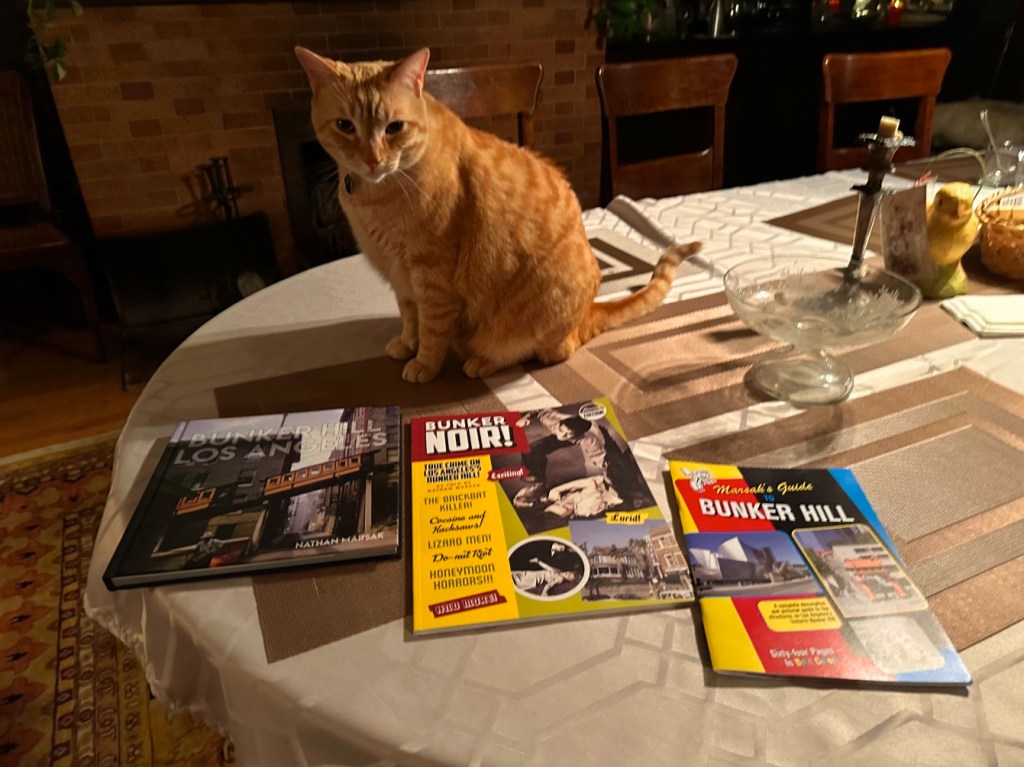
P.S. On a side note, if by some strange and unfortunate twist of fate you are allergic to cats, no, your copy will not have had felines lounging upon’t, rather, your Marsak’s Guide to Bunker Hill will come straight from the sealed box received from the publisher, then wrapped in archival tissue and posted in an unbendable cardboard mailer! (Copies covered in cat hair can be had for an extra charge.)
And when that sort of thing happens, if there’s Bunker Hill involved, I’ll comment upon it, naturally (e.g. when this trove popped up on Google Arts and Culture).
Let’s get into into it. Part I: The Bunker Hill Stuff
This one floored me. Suffice it to say I look at a lot of Bunker Hill, and it’s the first time I’ve seen something like this.
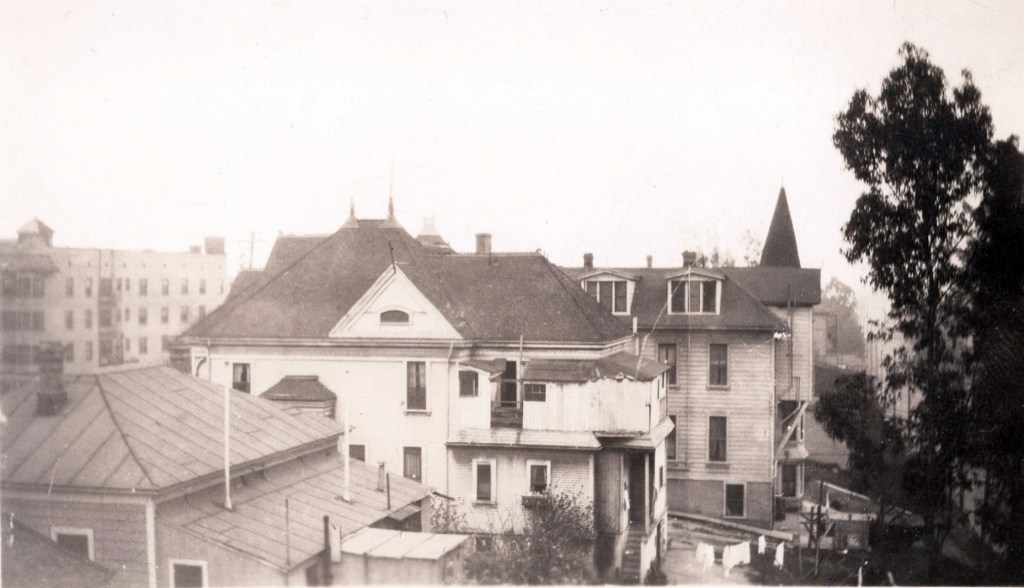
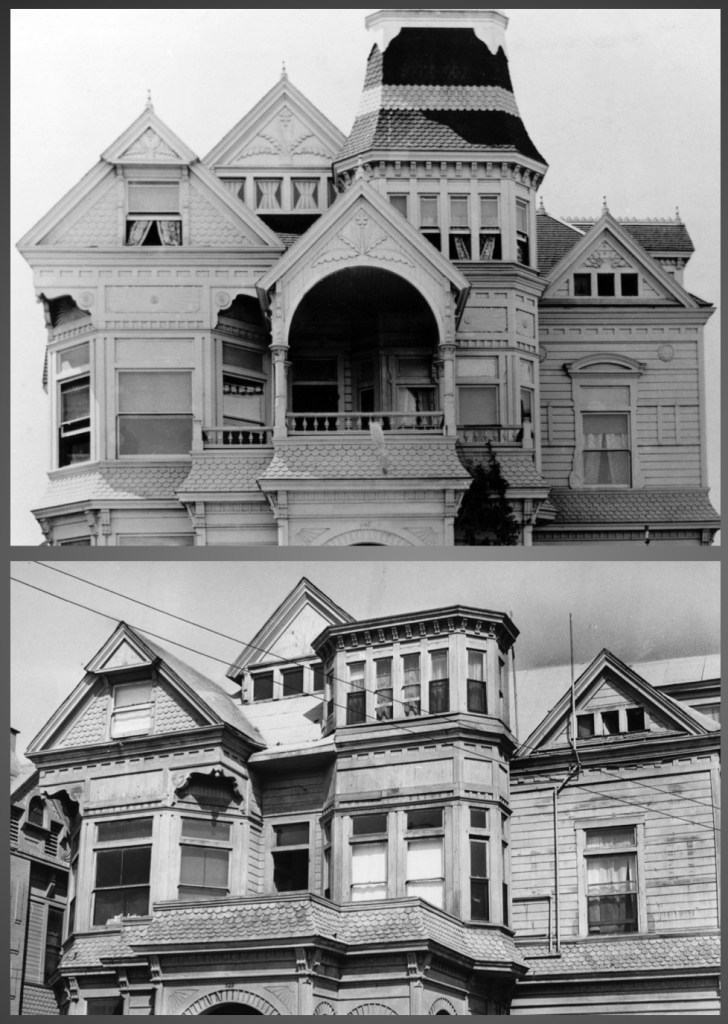
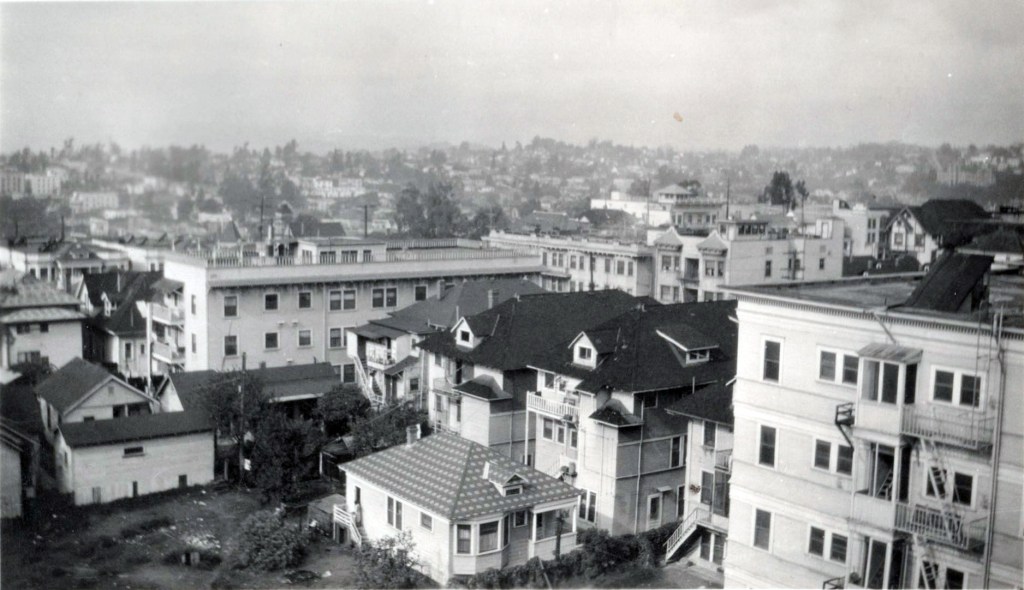
Above, we look south from atop the Rowan Apts, which fronted on 123 South Bunker Hill Avenue (and 116 South Hope Street below). Our photographer peers across the rooftops: bottom left we see a wee bit of the roof-corner of 125 SBHA, then 133 SBHA, and 137 SBHA (with laundry hanging to dry in the backyard) and most prominent, with its witch-hat tower sticking up, is the north facade of 145 South Bunker Hill Avenue, best known as the Berke Mansion. At far left, one can see the unadorned west facade of the Dome at Second and Grand, and a bit of its bay-windowed north facade. Just a really, really unusual view.
Now, WHY would such an unusual and particular shot be taken? Because it was captured by one Mr. James Daniel Horgan, a wholesale grocer, who lived at the Rowan.
Horgan came to Los Angeles from Wisconsin in 1904, and in the early 1920s lived at 1717 South Maple. Horgan moved onto Bunker Hill in 1923, living at 335 South Olive, where he stayed until 1927. He then moved into the Rowan, and remained through the 1930, ’40, and 1950 census. When he died in 1954, though, he was living at 3964 East Blvd, Culver City.
The south facade of the Berke, in a 1955 capture by William Reagh
The Berke, left, and at right, the front facade of the aforementioned laundry-hanging 137; ca. 1935, photographer unknown
Shots of The Rowan, Horgan’s home, are few and far between, but there is one in Bunker Noir!—
The tall structure is the Rowan, and Horgan faced to the right (north) for his shot. This image was captured in 1949, when Horgan was still living therein.
Now granted, that shot was unusual. Some of the shots of Bunker Hill are “usual suspects,” e.g. the Castle and the Melrose, arguably the most photographed of the Hill structures:
What’s up with the ladder on the roof?
This is the Castle, 325 South Bunker Hill Avenue. This was shot post-1937, because the earthquake-damaged balcony and tower were removed when Margaret Pattison purchased the property in ‘37. A before-and-after showing tower and balcony:
And now the Melrose—
This is about 1932, when the Melrose still had its original cupola tops intact. They were removed after the ’33 quake, in tandem with a 1934 reroofing.
Note how much taller that Canary Island Date Palm is, too
Note the entrance of the “Second Hill Street Tunnel” which ran trolley traffic from Temple under Fort Moore up to Sunset Blvd.
This is a pretty nifty shot, where Horgan stands at the north end of the Hill Street Tunnel and peers up to the Fort Moore area. The large structure at center-distance is the high school (Jasper Newton Preston, 1890), demolished 1936.
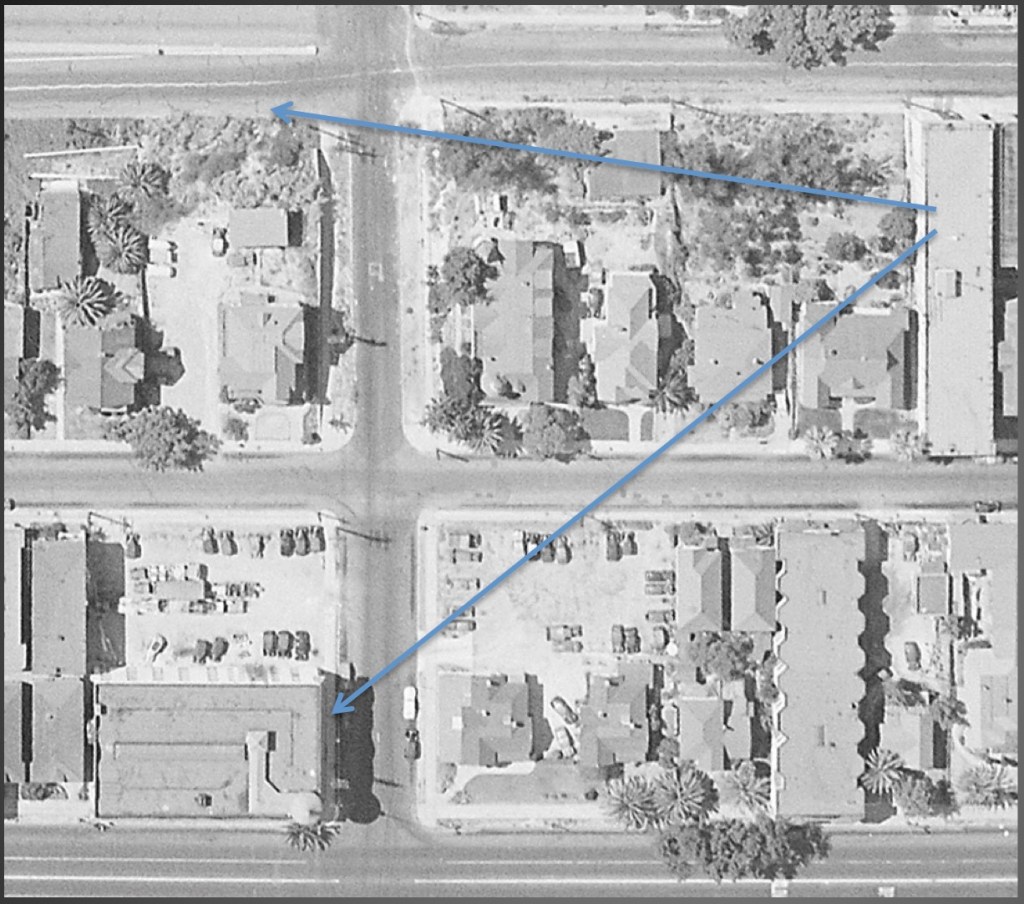
Because this aerial is from 1941 and thus postdates the demolition of the Romanesque high school, I’ve put an X to mark the former location
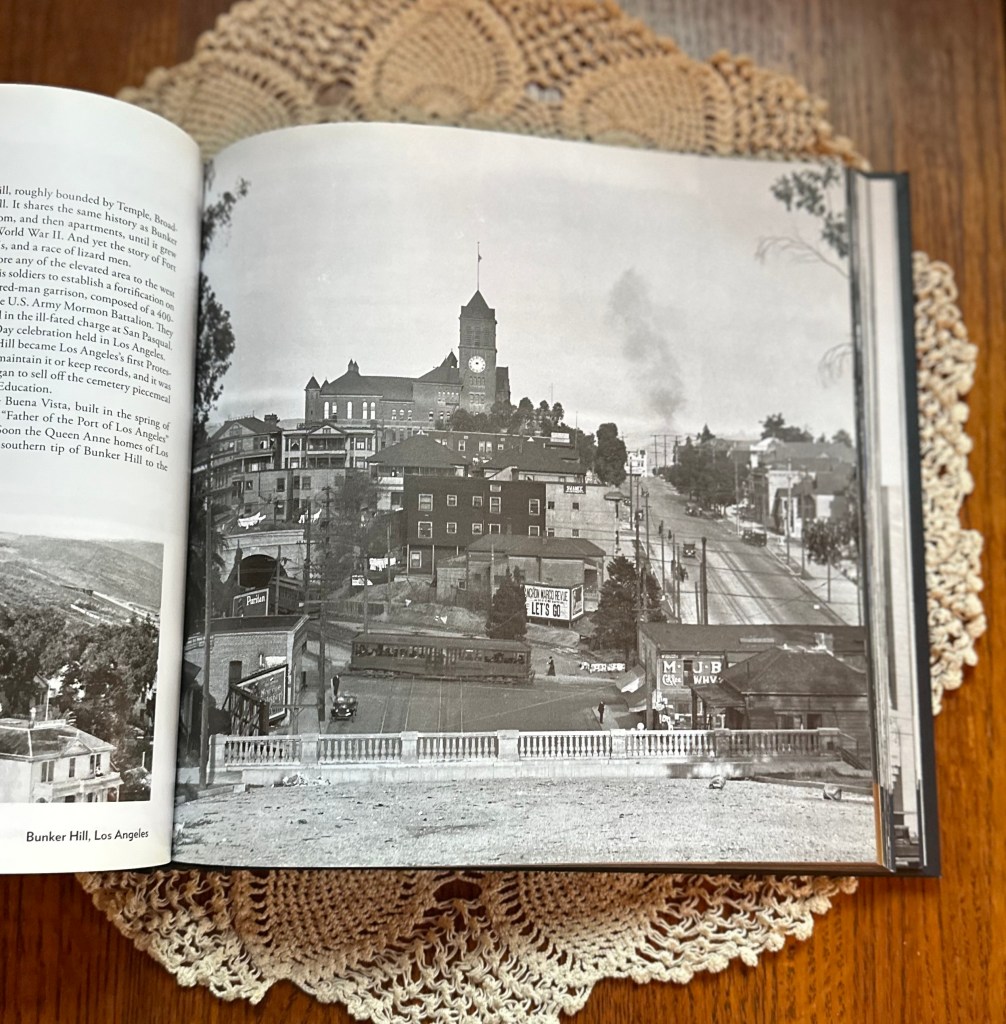
Horgan’s photo dates to about 1934. For a similar shot captured in 1919, turn to page 47 of Bunker Hill, Los Angeles:
I get the feeling that we’re situated somewhere in the criminally underphotographed Temple/Beaudry area, perhaps around Bixel at Court. Is that dark shape upper-right-distance the Sisters Hospital up on Sunset? This will take more study, but for the moment, we press on.
PART II — NOT BUNKER HILL
Not Bunker Hill, but pretty nifty nonetheless, with a lot from the adjacent Civic Center area.
One of my favorite structures in the whole of Los Angeles architectural history:
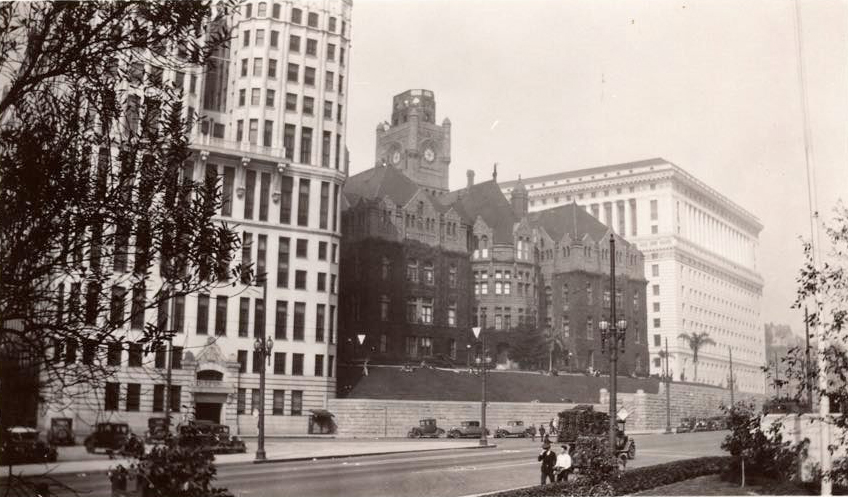
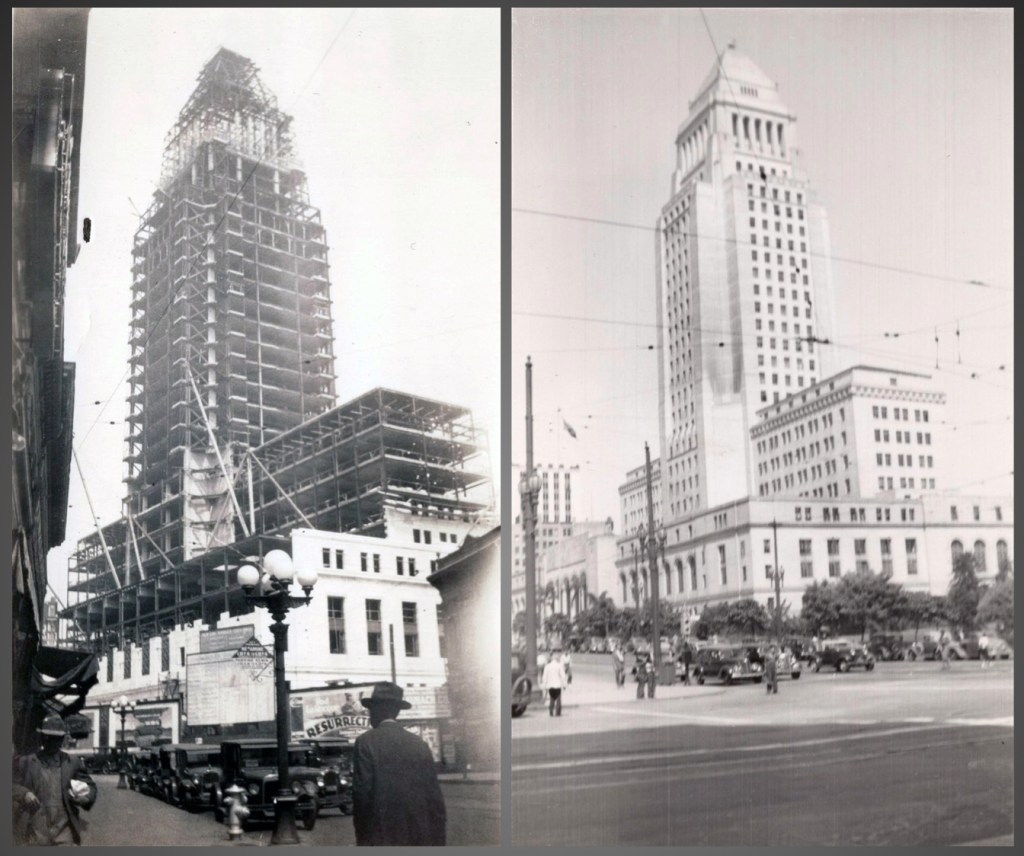
LAPD Central, at 318-24 West First St., built in 1896, designed by Charles Lincoln Strange as a Romanesque Revival fortress. Its facade was damaged in the Long Beach Quake, and so its front was rebuilt and modernized in the spring of 1934…but only the top two stories, which made for a curious amalgam indeed. The “architect” for the facade remodel was the City’s Bureau of Construction. Never thought I’d see this work under construction. This building is so important (and Bunker Hill Adjacent) it merited inclusion in Bunker Noir!—
Next door is the Hall of Records (Hudson & Munsell, 1911), which persevered all the way until 1973.
Here’s the Times building—we’re looking at the NE corner of First & Broadway:
The first Times on this site (Caukin & Haas, 1887) was, of course, famously blown up by organized labor, killing 21 workingmen, and destroying the building. This replacement (Kremple & Erkes, 1912) was made superfluous and dispensable with the construction of the new Times building across the street. Ergo, it became the site of the new State Building. Strangely, because of issues removing the 1912 Times building (it was commandeered by the City for CIvic Center improvement, but the City and the Times could not come to agreement on compensation for years, and then the City and County argued over title), it co-existed with the new State Building for years, before finally being demolished in early 1938.
This is looking up Weller Street. The Salvation Army at left was 129 Weller; the structure at the end of the block is the corner of First and Los Angeles.
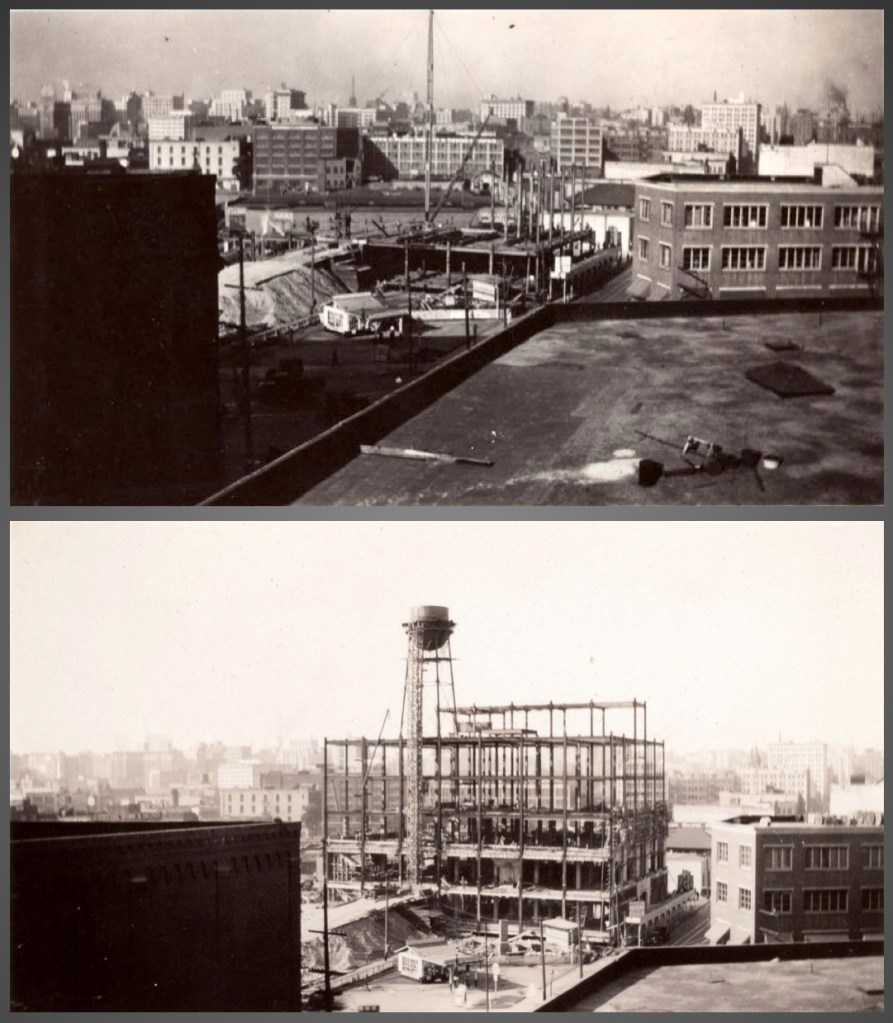
Here we are atop the roof of the hotel at the northeast corner of Second and San Pedro:
We look west on Second to Brunswig Drug’s excavation site at 360 East Second Street, late 1930, skeleton up in early-mid 1931.
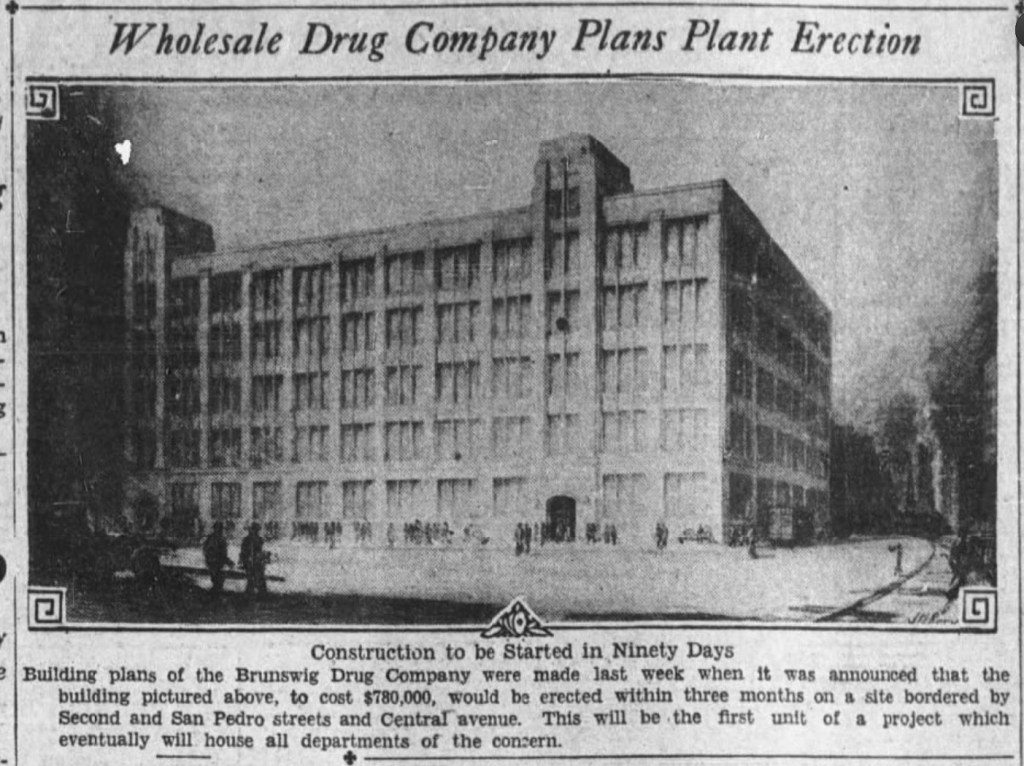
Brunswig Drug lost four buildings to the 1930 widening of Spring Street. Thus they moved operations from their historic 501 North Main Street location to here. This Art Deco wonder—a quintessential American interbellum daylight factory—was designed by the firm of Albert C. Martin.
Interestingly, as originally envisioned it was to stretch significantly further south toward Third Street; one suspects Brunswig’s/Martin’s plan was truncated due to deepening Depression-era economics
This structure is still there, sort of; it had three stories added and was reskinned by Reeves Associated Architects in 1985-86.
Here, we look south down Second; the intersection is Rose:
At bottom left we’re looking northeast: the soap company, far left, is at First and Hewitt, the gasometers behind at Jackson and Center.
A couple shots of County Hospital’s construction and completion:
Allied Architects, 1933
Lastly, some things much further afield—
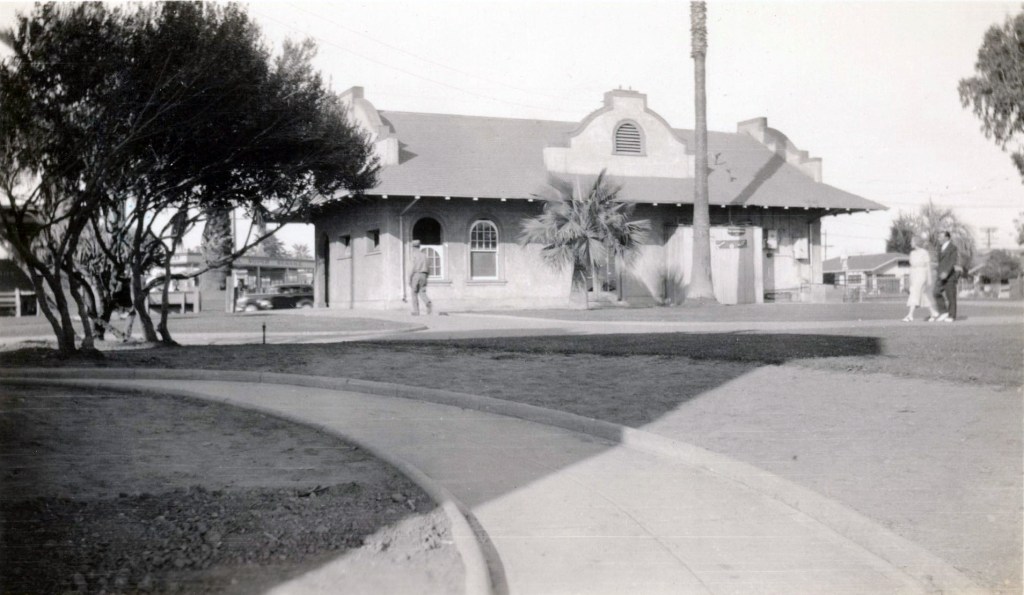
Cool shot in part because it’s the little-seen backside of the depot; traditionally the shot we get is like this and like so
This is the Pacific Electric depot, 1450 Ocean Avenue, Santa Monica.
And so goes my identification of—some of—those images posted by the Los Angeles CIty HIstorical Society. Their post contained sixty total, so there are plenty more for you to look at, including a handful that stumped me totally…your job is to identify those not featured here, and email me so I might update this post. Thanks in advance, you crazy kids you!
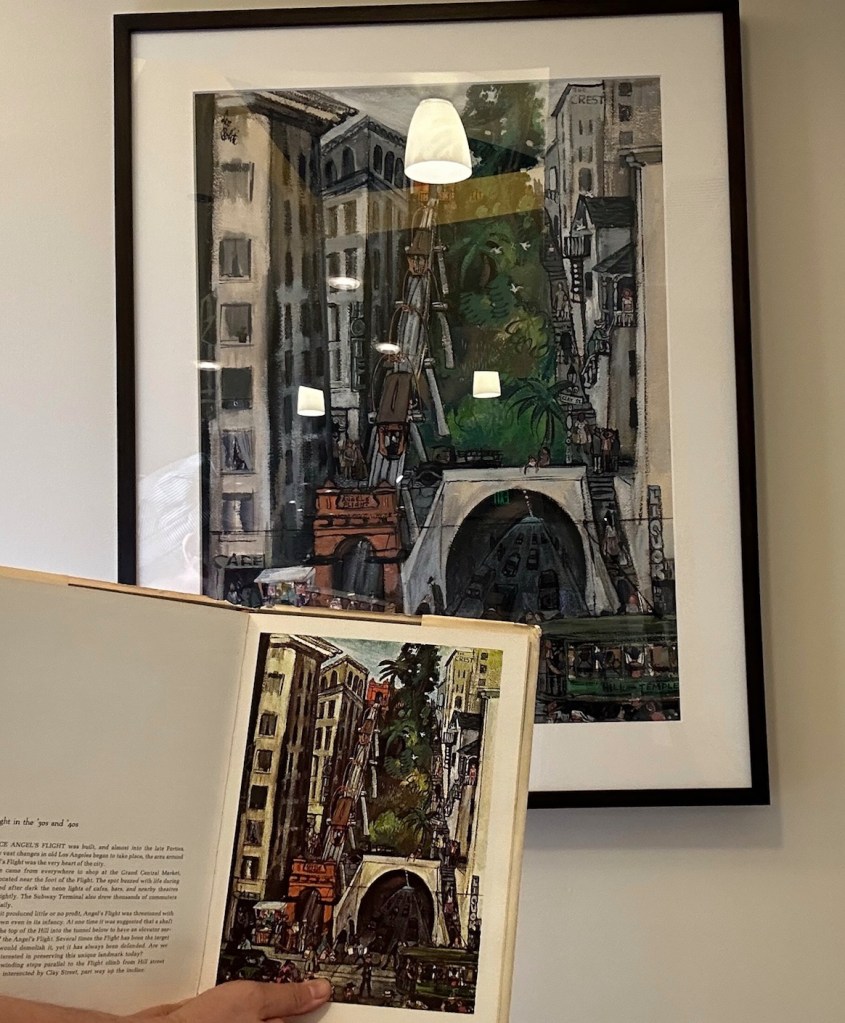
There’s a wonderful new exhibit up at the Central Library—a vaster collection of Leo Politi’s original paintings from his celebrated book Bunker Hill, Los Angeles: Reminiscences of Bygone Days (Desert-Southwest Publishers, 1964).
Since you’re on this site, you’re likely familiar with Politi’s work, up to and including his Bunker Hill book. Should you not have a copy, at any given time there’s usually a few on eBay. (My advice? Splurge and get one of the signed copies, which include some of his fanciful, colorful art as part of the inscription.) Politi’s book is especially important in that it served to humanize the Hill and tell its stories, adding depth to those photographers (Reagh, Hylen et al.) who so dutifully documented the disappearing landscape.
So, LAPL has framed and displayed a collection of Politi paintings, with didactic panels that include language from his book, and it’s a thrill to see the originals in the flesh. You might ask, what is the Library doing with this unparalleled collection of Politi pictures, anyway?
It’s 1965. Bunker Hill’s demolition had thundered along for years, a stone’s throw from Central, the librarians therein forced to contend with assorted wrecking crews’ constant clangor. Politi’s newly-published Bunker Hill images were immeasurably important (and just plain wonderful) so the librarians requested the Board of Library Commissioners help purchase a selection of Politi’s paintings for the library’s Special Collections Department. The Board wrote a check to Politi for $3,000 ($29,524 USD2023) to attain an assortment of his Hill pictures. Sadly, after accession, the pictures disappeared to the library basement for nearly sixty years.
How and why did the museum thus, then, arrive at the idea to finally mount this exhibition now? I have no idea. I do know that the good folks over at Esotouric called up John Szabo in the fall of ’22 and said hey, we’re putting together a Leo Politi tour with the Politi family, for a year from now—can we get our tour into Special Collections to see some of the original pictures? Library personnel were non-committal until, bang, a year later, Central opened the exhibit, three days before the Esotouric tour!
Again, one can only surmise regarding correlation and causation and all that; all I know for certain is that the tour was a huge success, and I’m proud to say I was in attendance to talk about Politi’s art as it related to Old Bunker Hill.
Image courtesy of Laura Kondourajian
Which got me to thinking, maybe I’ll take you on a little tour of the Politi exhibit. I grabbed my copy of Politi’s 1964 masterpiece and headed over to Central, to capture for y’all a bit of what’s there.
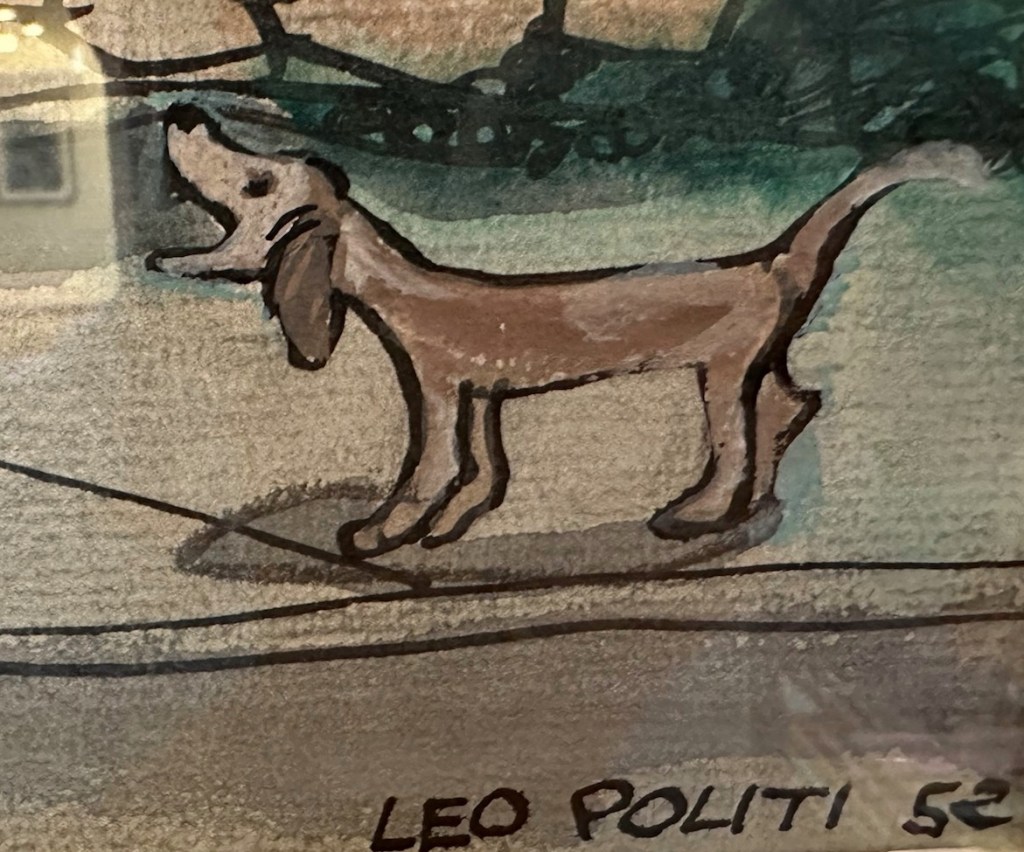
Yes, I paid homage to Politi by titling my book Bunker Hill, Los Angeles, if by homage you mean totally stoleOne of those aforementioned Politi-doodles. He often added a trumpet vine (a brugmansia?) in his inscription-paintings, which mimics the one featured on the coverThe famed endpapers make for some nifty wall art!
I can’t tell you what a thrill it is to get up close and personal with these works. The ability to get in there to examine the brushstrokes, and take in every little detail, is incredible.
There are surprises, too, like pictures that don’t appear in his Bunker Hill book:
One of a few previously unknown(-to-me-anyway) pictures on display. A depiction of the Castle’s full façade was published in his Bunker Hill book, rather than Politi’s incredible large picture featuring the Castle’s magnificent stained glass doors. Politi’s varied depictions of the Castle are all the more relevant as he was photographed in front of it, e.g. here and here
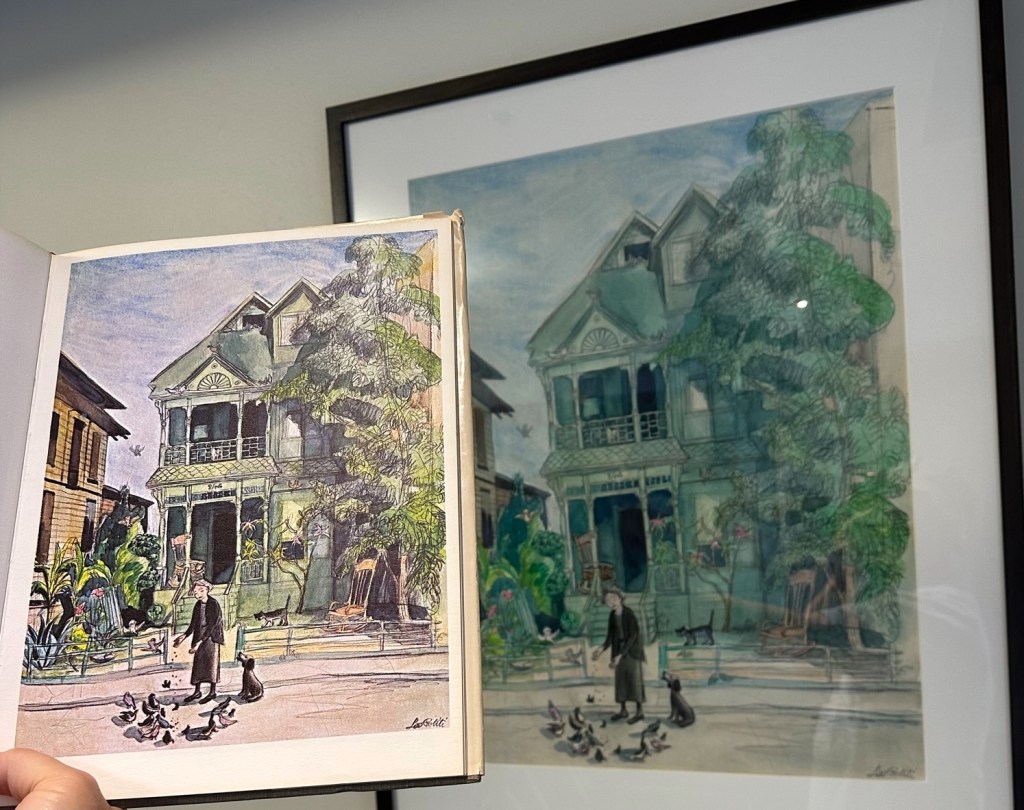
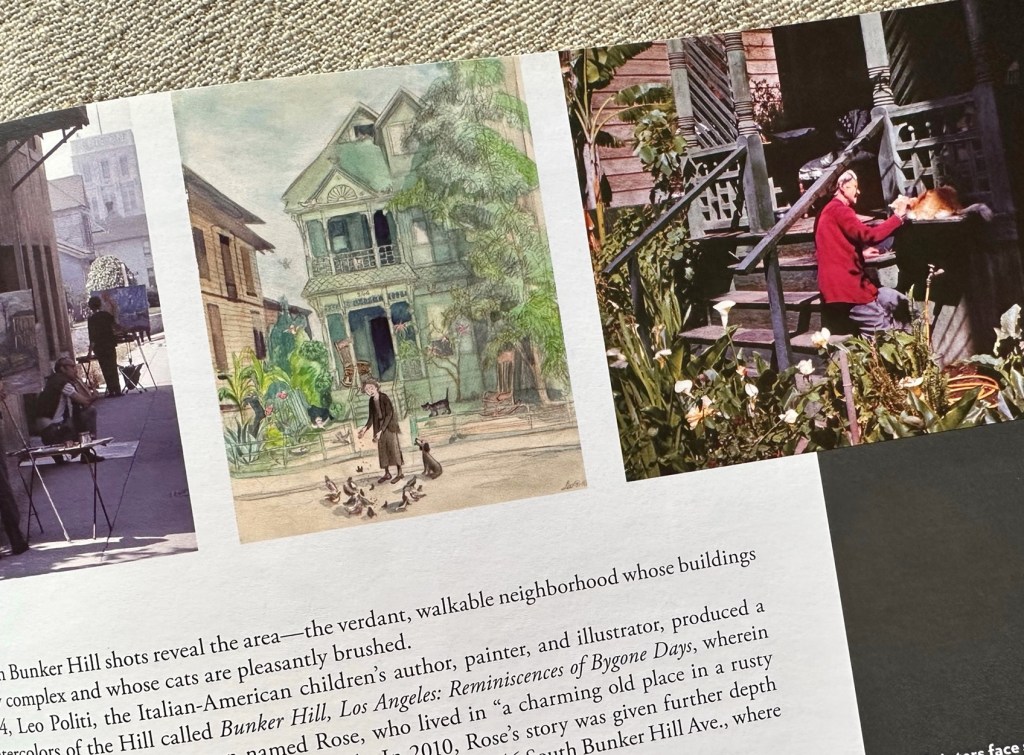
A Politi work I have always found especially endearing is his depiction of 246 South Bunker Hill Avenue, with its tenant, Rose.
Politi describes Rose: always accompanied by her faithful dog, always feeding the pigeons, always taking care of the neighborhood animals. Note what appears to be a big ol’ orange kitty snoozing on the porch rocker—
Well, I was thrilled to discover Rose appeared amongst the color images shot by George Mann, where she is—what else?—brushing said big ol’ orange kitty. Naturally, I paired the Politi and the Mann in my book:
At this point you’re saying Nathan! I’m sold! I’m rushing out the door to take in this wonder, where is this incredible display? Well, first you want to find the Central Library (and unlike the rest of downtown, library parking is super cheap, especially on weekends or after 3:00). From the Flower Street parking garage, I advise you go around and in through the Fifth Street entrance, so you can peer up at Bunker Hill. Here is what the library (and the Fifth Street entrance) looks like from Bunker Hill:
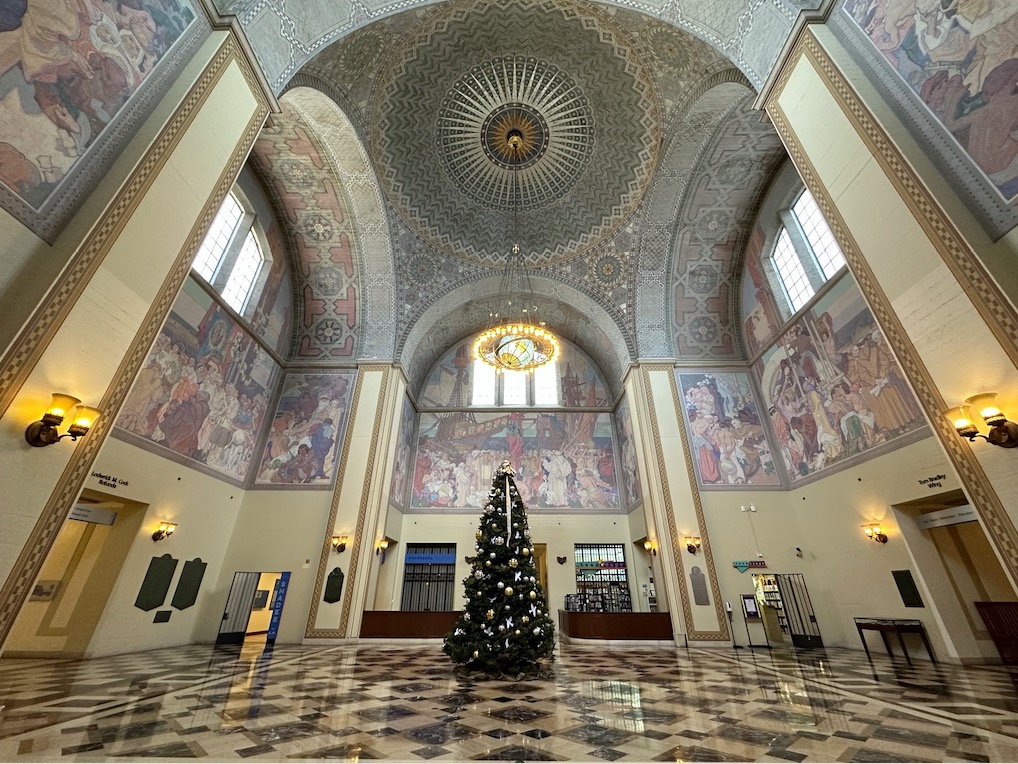
Bertram Goodhue designed Central Library, though Goodhue died early in its construction and the project was brought home by Carleton Winslow. It opened July 1926 (I’m expecting great things at the centennial). Head into the north entrance and up the stairs—
Yes, that’s a real tree—the whole rotunda smells marvelously of pine
—into one of the most sublime interior spaces in the world. The zodiac chandelier is by Lee Lawrie; the decorative work in the rotunda was painted by Julian Garnsey; the murals, oil on linen, are Dean Cornwell.
Then turn and head into the Children’s Room (originally the History Department) and marvel at one of the other most incredible interior spaces in the world.
Beams are again, by Garnsey, and the murals—originally located in the west entrance tunnels—are Albert Herter. Herter’s murals are neither as beloved nor as well known as Cornwell’s rotunda murals, but dear lord, they are incredible.
And then…on either end of the Children’s Reading Room…are the two rooms replete with Politis.
I hope you’ve enjoyed our little trip to LAPL Central. But again, please don’t think you’ve sated yourself with just this post. There’s more than a dozen pictures on display, so I’ve only just scratched the surface, and they must be seen up close to be appreciated—my photos do not do them justice.
And now, like Rose of Bunker Hill Avenue fame, I’m going to go give some love to a big ol’ orange kitty!
There is, as you are doubtlessly aware, a Marsak-penned Bunker Hill trilogy—
And while I am certain you own the best-selling, award-winning Bunker Hill, Los Angeles (makes a great Christmas gift! buy yours here!), it may just be you have neither Bunker Noir! nor Marsak’s Guide to Bunker Hill—or you do, but your architecture-loving cousin doesn’t…and neither does you mother, who has all sorts of weird stories about Bunker Hill from her time there in the 1950s (transcribe and forward those to me immediately, btw).
So, might I advise you take advantage of the wonderful HOLIDAY SAVINGS on Bunker Noir and Marsak’s Guide, both now 30% off! Marsak’s Guide, regularly $20, now $14! Bunker Noir, regularly $30, now $20! (I know, Noir! is thus actually more than 30% off, but what can I say, I like round numbers.)
Best thing to do is Paypal (eckener@kingpix.com) or Venmo (@Hugo-Eckener) me for one or both. You do that, and I’ll pay postage! You buy them from eBay/eBay or Amazon/Amazon, you’ll get the same incredible holiday discount price, but you’re on the hook for postage.
Order now, get them for your holiday gift-giving! Or just take advantage of this once-in-a-lifetime sale price—good till the end of the year!
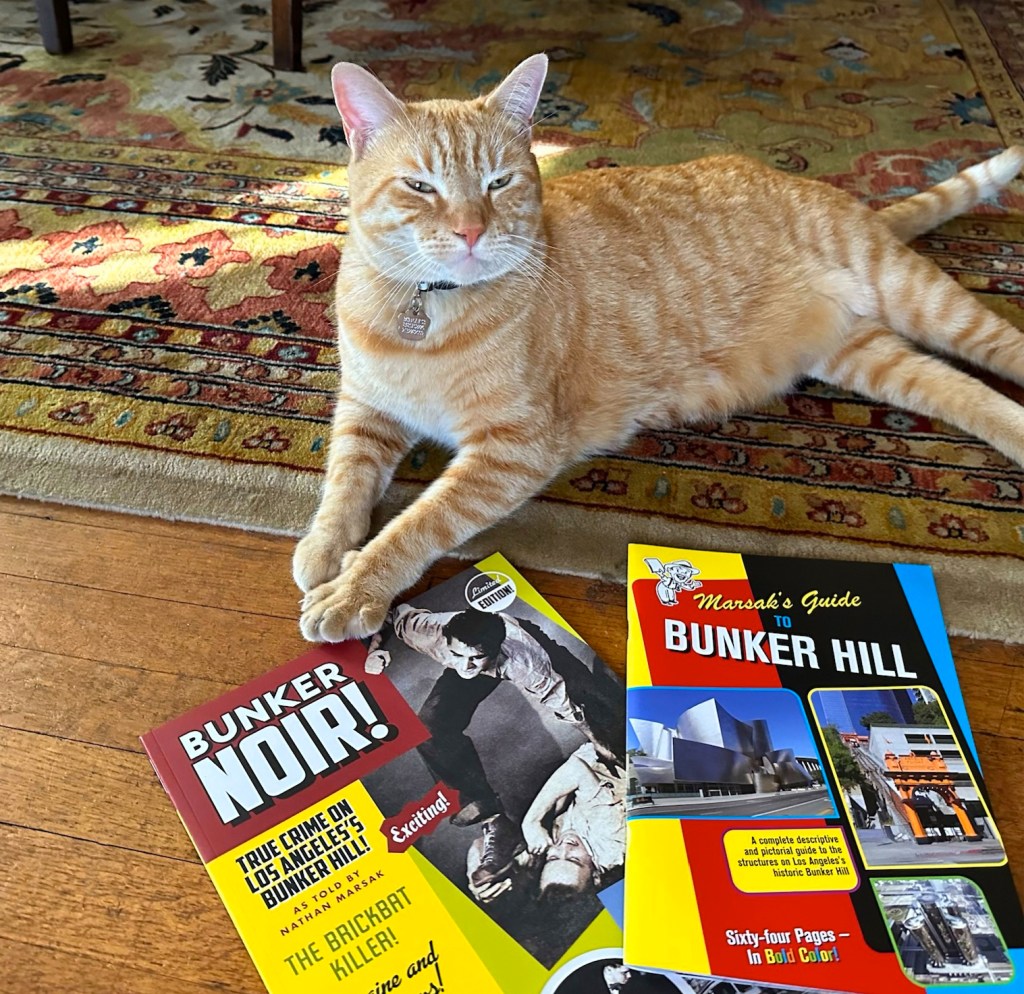
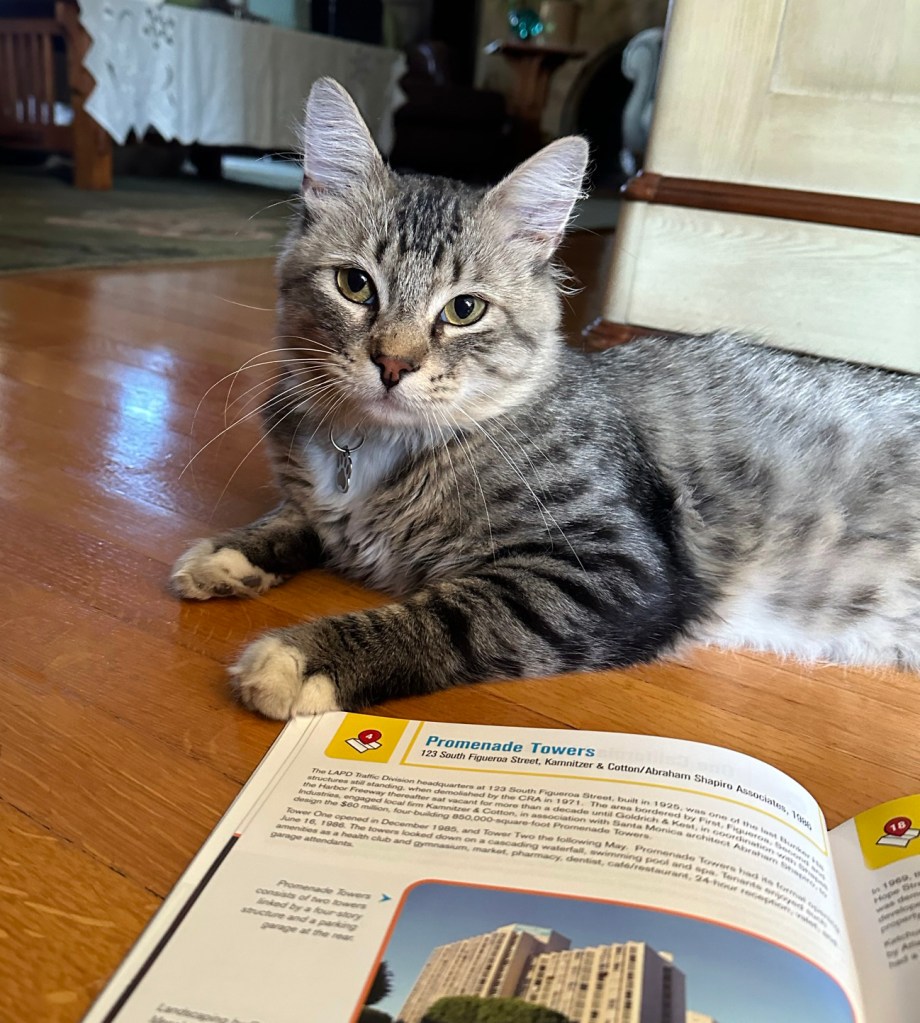
Mr. Pineapple, albeit world’s most languorous cat, woke up long enough to show off his personal copies and, via his typically keen discernment, pronounced them good.
I’ll be lecturing about the Bunker Hill book and the work that went into its production, in On Archives and Archivists: Building Bunker Hill, my overly-illustrated, terribly-talky talk about spelunking libraries, chasing private collections, and maintaining one’s own archive of rare ephemera.
All the talks, including mine, are FREE, though you do need to have a ticket to the event in general. (Oh nooooo, you must wander the high point of interbellum Los Angeles and peruse rare books and maps and paper from incredible dealers, my word, the hardships you endure.) Get your tickets to the Fair here.
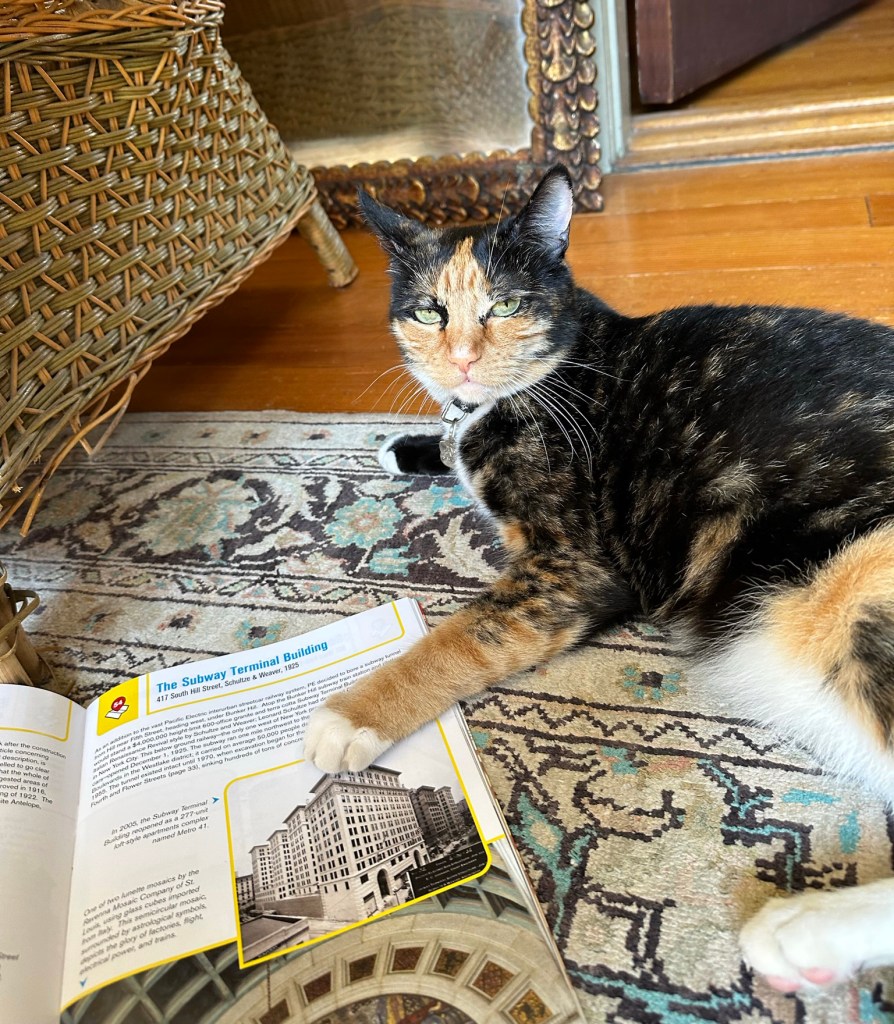
Each of Marsak Manor’s five felines is possessed of markedly distinct opinions and temperament. So, the kitties having perused our recently-published Marsak’s Guide to Bunker Hill, I asked them to discuss their favorite building. Read what they have to say, below:
PUMPKIN PATCH
“The Subway Terminal is my favorite, as its design references the glories of Europe, but was also built to facilitate interbellum technological prowess. I just purr over that sort of delicious interplay. That said, I’ve heard the structure has since lost its monumental rooftop urns, which hurts my heart. Please tell me that amongst your many endeavors, you are working on their restoration?”
GHOSTIE
“The Courthouse and Hall of Administration, obviously. They evoke the calm, confident charm of the Late Moderne, arguably the most elegant of Postwar building styles. Note the cool hand of Paul R. Williams. It’s a shame these two structures are so misunderstood.”
BORIS
“What’s funny is, it’s the worst buildings on Bunker Hill that intrigue me, which makes them my favorite, in an odd way. I mean, people make a lot of noise about the spiritual emptiness of those muscular granite-clad Reagan-era office towers, and those intrigue me too, but for my money it’s really the whole collection of Kamnitzer-Cotton projects on the Hill that are both insanely forgettable and yet burn themselves into your memory with a sort of aggressive vacuity. I see this guide covers Peter Kamnitzer’s bland Promenade condo complex and the goofy Grand Promenade Apartments, but the most egregious of his work has to be Promenade Towers. Which are great, if you dig jagged, angry concrete filing cabinets. Kind of our version of the khrushchevka yet somehow even worse. Like, it’s common to think of the eighties as just so much new wave-colored depthless giltz, but this perfect storm of overbearing ugliness typifies the true heart of 1980s America, wouldn’t you say?”
LARB
“Nathan, I have glanced at your book containing images and descriptions of Bunker Hill’s contemporary architecture. The very idea is, of course, distasteful, and the actual physical production of this little effort of yours is both garish and crass. While I have issues with your first book, Bunker Hill Los Angeles, at least therein you discussed Andrew Jackson Downing and Charles Eastlake. This product, though, is a gauche, gaudy delve into a debased modern world, to which I prefer not to be exposed, thank you.”
MR. PINEAPPLE
“I like this one cuz it’s funny!”
——————————————————————
Should you (or your cats) wish to gauge the worth and merit of Bunker Hill’s architectural offerings—from the 1901 Third Street Tunnel to the 2023 Regional Connector Station, and everything in between—be sure to pick up this nifty, 64-page guide! They are $25 postpaid, which you may remit via Paypal to marsakster@gmail.com or Venmo to eckener@kingpix.com, or send your cash/check to PO Box 412636, Los Angeles, CA 90041. They are as well available on Amazon and eBay.
This is a limited run, and when they’re gone, they’re gone!
I’ve written about Cooper Do-nuts for two years, but has anyone listened? Of course not, as simple truths are both unacceptable and unwelcome to fact-denying government ideologues and their gullible subjects. Oh well! See the previous posts: Parts 1, 2, 3, and 4.
Congratulations to Tony Hoover of DLANC and the Evans family for getting the “Cooper Do-nuts/Nancy Valverde Square” motion passed. On the day before the vote, I stated it would pass unanimously, and of course it did (be sure an attend the ceremonial plaque unveiling/Square dedication, on the LAPD lawn at Second & Main, Thursday, June 22, at 9am. The ceremony will be repeated Saturday, June 24, at 11am).
Naturally, City Council passed the motion despite every word of said motion being untrue. I’m not being hyperbolic, or “challenging,” or whatever, I’m just stating fact. Are the Council corrupt, or inept? You might argue it’s equal measure of both, and who would I be argue with you.
All of the motion is fanciful? Really, Nathan? Yes, really. It is composed largely of outright fabrication, sprinkled with assertions and suppositions unsupported by facts or logic. Don’t believe me? I’ll tell you what, let’s go through the motion now, line by line. (This I do at the risk of becoming “late Lenny Bruce.” That reference being: Lenny Bruce made history as an acerbic, insightful commenter on society, but at the end of his career he had been cancelled by The Man so many times he spent his time on stage tediously reading from legal documents. So, shall we wade into similarly tedious waters? Let’s go!)
First, a bit of background on how the “Cooper-Valverde Square” motion came to be. It began a year +½ ago, with Tony Hoover’s December 2021 DLANC letter to Council, which asserted “The first recorded instance in the LGBTQIA+ community of gender-transgressive persons resisting arbitrary police arrest occurred at Cooper’s Do-nuts at 215 S. Main Street in Downtown LA in 1959” thus let’s have a big memorial square there.
Mr. Hoover and his brethren-in-government were then disabused of this notion, having learned no such thing happened at Cooper’s in general, and particularly not at Second and Main. Thus a year and change later, de León’s subsequent new & improved motion to Council alludes to the purported uprising only in passing. They’ve shifted focus to a new concept, that Cooper’s was the place Los Angeles’s gender nonconforming found sanctuary, oh and by the way, an important woman named Nancy Valverde ate donuts there.
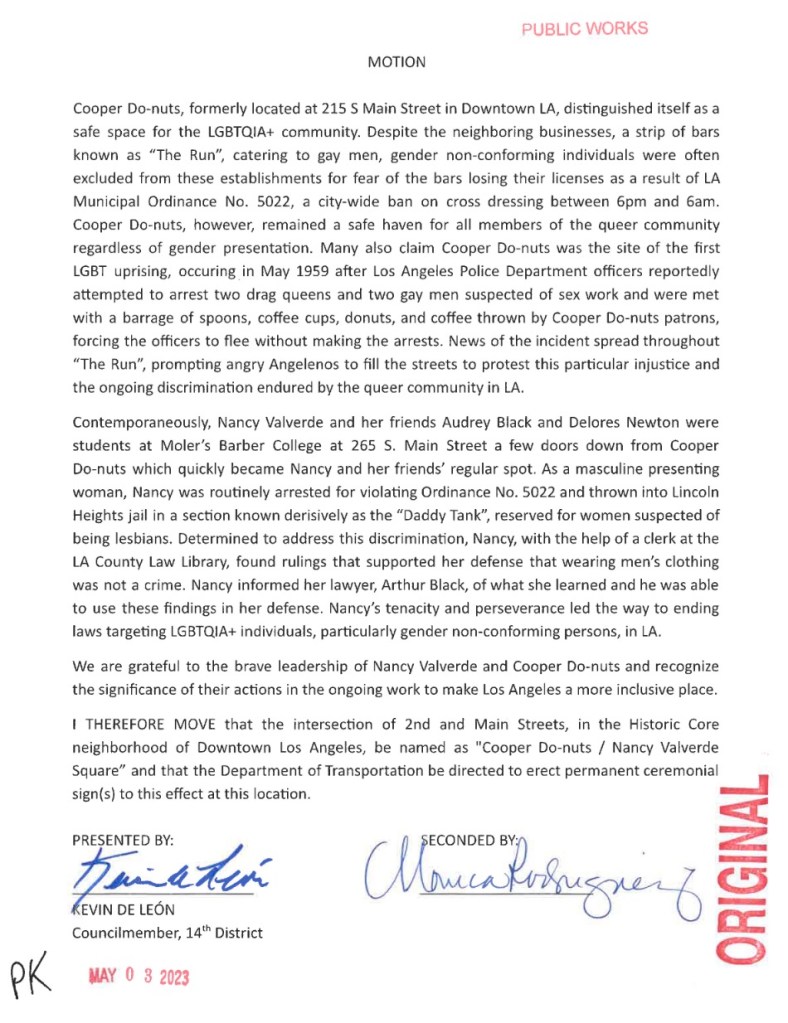
This is the motion that passed Wednesday June 7:
The motion consists of two main paragraphs. As you can see, the first is about Cooper Do-nuts; this paragraph is comprised of unsupportable claims and fanciful untruths.
Its second paragraph, concerning Nancy Valverde, is similarly composed of untruths, which I hesitate to call lies, because the author may have honestly thought the stories contained therein were truths. I’m being diplomatic when I say these four sentences are, at best, highly inaccurate statements regarding improbable events of dubious background.
So! Let’s do this, line-by-freakin’-line:
PARAGRAPH I.
Sentence 1.“Cooper Do-nuts, formerly located at 215 S Main Street in Downtown LA, distinguished itself as a safe space for the LGBTQIA+ community.”
Distinguished itself when and how and according to whom? We have one account of Nancy Valverde and her betrousered ladyfriends hanging out there because it was near her barber school. Otherwise, there are zero accounts of Coopers having any sort of relation to the LGTBQIA2S+ community, save for some unsupported assertions, sixty years after the fact, by a grandson.
Go read the guidebooks to gay-friendly LA from the 1960s—e.g., Bob Damron’s Address Book—and tell me, in the multitude of listings, is Cooper’s there?
Of all the Cooper Do-nuts locations, I’m willing to believe the one at 441 South Hill may have been frequented by gay men, given its proximity to Pershing Square. Perhaps, as well, the one at 628 South Olive, for the same reason. But 215 South Main? Away from The Run and across from the Archdiocese and the Union Rescue Mission? Nope, I reject that totally. Similarly, the Cooper’s locations at 316 E 5th and 807 W 3rd, no, never happened.
2.“Despite the neighboring businesses, a strip of bars known as ‘The Run’, catering to gay men, gender non-conforming individuals were often excluded from these establishments for fear of the bars losing their licenses as a result of LA Municipal Ordinance No. 5022, a city-wide ban on cross dressing between 6pm and 6am.”
First of all, Cooper Do-nuts didn’t “neighbor” The Run. The Run didn’t extend nearly that far north.
Also—as I pointed out publicly before the Council vote—there WAS NO Municipal Ordinance No. 5022. MC 5022 hadn’t existed since 1936. (How is it that you work for the City and know nothing about your own damn laws?)
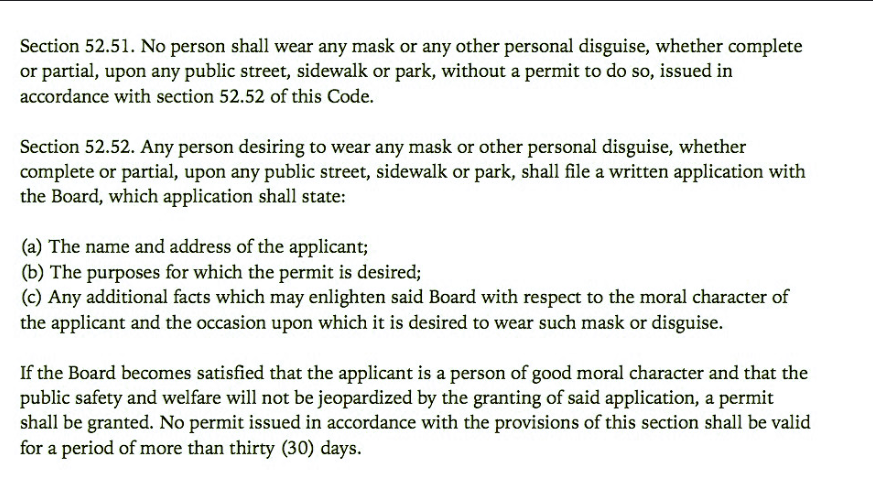
De León’s Hoover-penned motion is attempting to refer to MC 52.51, the section of Municipal Code that stipulated against masquerading. Yes, under MC 52.51 an individual could be charged with cross-dressing without a permit, which neither constitutes a city-wide ban (“between 6pm and 6am” or any other time), nor involved businesses being punished. Have you wondered what the law actually said? Let’s read it now:
3.“Cooper Do-nuts, however, remained a safe haven for all members of the queer community regardless of gender presentation.”
As I said with Line 1, there’s no evidence of this, save for a) an Evans grandson just, you know, says so, and b) Nancy Valverde said she enjoyed being a patron there during her stint in barber school, at a time when women were thrown in prison without due process for wearing slacks, and c) John Rechy’s contentions that “gay people got together at Cooper’s Do-nuts” (and when he stated that, he was specifically referring to the Cooper’s on Main near Sixth, which after it was proven that location did not exist, Rechy then stated things didn’t happen at Cooper Do-nuts). To be clear, no transwoman, MtF, cross-dressing man, or AMAB person has ever come out and claimed Cooper Do-nuts was a “safe haven.”
4.“Many also claim Cooper Do-nuts was the site of the first LGBT uprising, occuring [sic] in May 1959 after Los Angeles Police Department officers reportedly attempted to arrest two drag queens and two gay men suspected of sex work and were met with a barrage of spoons, coffee cups, donuts, and coffee thrown by Cooper Do-nuts patrons, forcing the officers to flee without making the arrests.”
Um, no. There is no “many claim” because precisely zero actually claim this. There was, once, a single witness to the event (who also said it happened blocks away), who has specifically stated the whole thing most assuredly did not happen at a Cooper’s. So there you go. I should mention that this one-and-only-person-in-the-history-of-everything who told the story about the riot? His name is John Rechy, and he makes things up for a living (and then makes up reviews about the stuff he made up).
Atop which, when giving interviews, John Rechy tends to just, you know, say stuff, specifically, stuff that’s wrong. For example, in this Los Angeles Magazine interview Rechy states “the Mattachine Society, the people who were going to jail for publishing One Magazine…that had articles about stuff going on around gay people…and the publishers were arrested. They went to jail.” Certainly sounds like an authoritative statement from someone who was there at the time, but that doesn’t mean it is in the least bit true. No-one was arrested for content and dissemination, and certainly no-one went to jail; the ONE editors were subjected to law enforcement interviews (by FBI agents) about some of their sources, but they declined to cooperate—no arrests, detainment, charges, or imprisonment. And yet because 1000x more people will read Rechy’s interview than will ever read this post, what he said will become the unquestioned (and unquestionable) canon till the end of time.
With Rechy being the lone riot source, it’s important to remember, those who were not there (much less, even born yet) subsequently “claiming” an uprising happened, when backed by no evidence and no eyewitness accounts, aren’t claiming anything; they’re just making stuff up. (And no, despite what you’re told, Nancy Valverde never claimed it, either. She said once, in 2019, that she heard secondhand that something happened, though there was no mention of Cooper’s.)
5. “News of the incident spread throughout “The Run”, prompting angry Angelenos to fill the streets to protest this particular injustice and the ongoing discrimination endured by the queer community in LA.”
Damn, that’s a bold fabrication out of nowhere. Seriously…the Cooper riot story has been repeated ad infinitum and every time the telling gets inflated and elaborated upon, but this is some next-level concoction. Consider: in the seventeen years the riot story has existed, de León’s motion of May 2023 is literally the first time any one on earth has made this fantastic, spurious claim. Amazing.
PARAGRAPH II.
Sentence 1. “Contemporaneously, Nancy Valverde and her friends Audrey Black and Delores Newton were students at Moler’s Barber College at 265 S. Main Street a few doors down from Cooper Do-nuts which quickly became Nancy and her friends’ regular spot.”
Well, ok. I won’t nitpick the “few doors” line despite Moler being near the opposite end of the block. I will hammer home that if Valverde was at school “contemporaneously” i.e. May 1959, there was no Cooper Do-nuts at 215 South Main. Because the building was torn down in January 1958, and was still a parking lot in May 1959. A new one opened in the late fall of 1959 (and I might its address was 213, not 215, the address in de León’s motion).
2. “As a masculine presenting woman, Nancy was routinely arrested for violating Ordinance No. 5022 and thrown into Lincoln Heights jail in a section known derisively as the ‘Daddy Tank’, reserved for women suspected of being lesbians.”
Again, no, Valverde was NOT charged with violating Ordinance 5022 because it didn’t exist, and hadn’t since she was four years old.
But let’s say she was arrested for violating its successor code MC 52.51. Nevertheless, there was no“Daddy Tank” at Lincoln Heights jail. LA’s Daddy Tank is actually quite famous, the topic having been treated in numerous scholarly papers, and was the scene of lesbian protests; it existed at Sybil Brand.
3. “Determined to address this discrimination, Nancy, with the help of a clerk at the LA County Law Library, found rulings that supported her defense that wearing men’s clothing was not a crime.”
Valverde states this happened in 1959.
Faderman-Timmons, Gay L.A. (Basic Books, 2006), p. 95
The rulings she purportedly found were certainly not some esoteric knowledge. Valverde, we are told, began being arrested for cross-dressing in 1948; the law against female-to-male cross dressing was tossed out in 1950, which was front page news. Nine years later she didn’t remember that happened?
Section I, P. 1 of the Los Angeles Times, March 16, 1950
This was of course huge news among any slacks-garbed females. (What, you say maybe Valverde and her friends didn’t read the Times? Every newspaper, major and minor, carried the story, e.g. the Valley Times, the Citizen News, the Daily Press Journal, the Daily News, the Mirror, etc., as can be seen here and here.)
So: women-dressing-as-men was deemed legal in 1950. Valverde certainly knew that in 1950…but then somehow forgot this fact…and in 1959 and had to go to the Law Library to rediscover this knowledge?
Point being, there’s a problem with this narrative, which only gets more problematic and improbable:
4. “Nancy informed her lawyer, Arthur Black, of what she learned and he was able to use these findings in her defense. Nancy’s tenacity and perseverance led the way to ending laws targeting LGBTQIA+ individuals, particularly gender non-conforming persons, in LA.”
Interviews with Valverde, and subsequently de León’s motion, states she informed her lawyer Arthur Black in 1959, but: Arthur S. Black wasn’t admitted to the bar until 1962.
The way we have been told the story, Valverde was arrested repeatedly, as early as 1948, on a law subsequently reversed by Superior Court judges in 1950. But for nine years she kept getting arrested on something a judge could not legally charge her, up to and including jail terms as long as three months, until she “discovered” this incredible bit of information that was, inarguably, known to every lawyer in Los Angeles. Apparently it then took her three years, from 1959 to 1962, to find the one and only lawyer who somehow wasn’t familiar with the law, take this knowledge to him and enlighten him, which thereafter, somehow, ended her routine arrests…twelve years after that law was no longer enforced.
The reason Arthur S. Black gets added to the story, apparently, is that he’s the attorney who had that infamous “masquerading ordinance” 52.51 finally and completely overturned in 1963. Now remember, said masquerading ordinance hadn’t applied to women for thirteen years, but was enforced in a “men shall not dress like women without a permit” spirit of the law until dealt its death blow in October ‘63.
Charles Melvin Martin (1941-2014) was in drag on the corner of Soto and Fourth Street, late August of ‘63, and got popped for it. Martin hired newly-minted lawyer Arthur Black, who argued that this particular section of our Municipal Code was made invalid because it contradicted California State Penal Codes, which thus voided local application of the Municipal Code. The well-known 1950 case law Valverde “discovered” in 1959—whereby Appellate Court jurists legalized women in men’s clothing—was not involved here at all; rather, the 1963 Appellate Court jurists conceded that our law was superseded by State PC sections 185 and 650.
Los Angeles Times, Sec. II, P. 1, October 9, 1963
I should add that in ending 52.51, Black hadn’t done anything ingenious or new; he basically copied case law from People v. James Arthur Lane, Jr. whereby San Francisco’s version of the same Municipal law (anti-masquerading Section 440 SFMC) had been similarly made void and invalidated by State law.
At this point you might say, wellllll, perhaps the decision In re Martin (1963) 221 Cal.App.2d 14, contains some mention of Valverde, I mean, have you read the full copy of the decision, above and beyond the abstract? I’m glad you asked that, because, can’t say we didn’t try. Journeyed to the Law Library, (yep, the very same one that Nancy Valverde purportedly went to), and pulled bound volumes of the Second District Court of Appeals in search of full case transcript of Crim. No. 9354. In the volume that covers 9350-9367, however, 9354 just ain’t there. Irritatingly, the cases bound within jump from 9353 to 9360. Next thing you know we’re on the phone to Sacramento, with the State Appellate Court’s head librarian, now tasked with finding the full text of the case for us. Perhaps we’ll discover out it’s full of mentions about Nancy Valverde! Spoiler alert: it won’t be, but, you can’t say research here lacks due diligence.
If Nancy Valverde played any role in ending enforcement of LAMC 52.51, what was it? Even if her help existed, it appears to be vastly overstated—the 1950 Guynn and Granato precedents were not obscure. What’s funny is that if Hoover/de León et al. actually studied some gay history, they’d know this. Faderman & Timmons’ Gay L.A. points out that the Guynn and Granato decisions were included in an annotated volume of the 1956 L.A. Municipal Code. More to the point, Gay L.A. specifically discusses the perennially-misused 5022 vs. the actual law, which was 52.51…but gosh, what a surprise, our local government acting on behalf of gay L.A. can’t be bothered to learn about local government or read the basic textbook about gay L.A. appropriately titled Gay L.A.
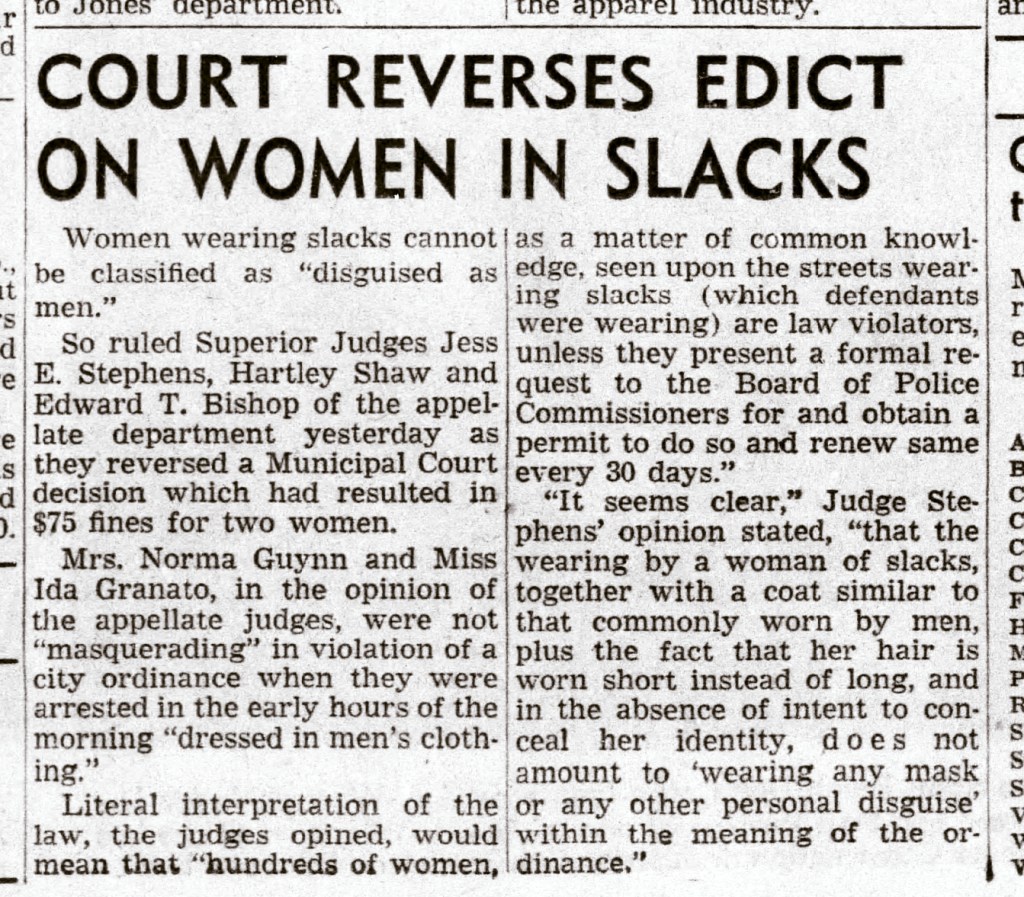
To sum up, despite Valverde’s “tenacity and perseverance” she did not in fact help women, obviously, who were instead aided by panel of Judges Jess Stephens, Hartley Shaw and Edward Bishop, appellate division of the L.A. Superior Court in the widely-known People v. Guynn, 1950, CRA 2551 and People v. Granato 1950, CRA 2552. And Valverde didn’t help men, either, as LAPD continued to make arrests for LAMC 52.51 violations until the fall of 1963, when they were prohibited from doing so by In re Martin, which utilized neither Guynn nor Granato in the decision. In short, there exists no evidence that Nancy Valverde’s encounters with the LAPD or the courts eased the path for others similarly situated between 1948-1963. It doesn’t even add up that she even helped herself by “discovering” some widely-known case law, three years before she retained an attorney, who both knew said case law and then never used it in any related legal arguments.
**************************
Why, you might now be asking, would Council then vote for something so patently, provably, repeatedly fabricated? De León’s motion is devoid of fact and replete with falsehood, which Council likely knew (since I had, in fact, told them so, which is a matter of public record), so one may only assume Council read neither the motion nor my thoughts on the matter…but perhaps they were moved by the passion of the speakers, who addressed Council in chambers on June 7. Of all the speakers, the one with the most to say was Tony Hoover, Treasurer of DLANC, and who spearheaded the legislation. The speakers can be seen presenting to Council here, beginning at 56:00.
Tony Hoover spoke at length about the motion, his “passion project.” At 59:44 he goes off on Fletcher Bowron (whom he calls “Bowen”), about how Bowron “championed an ordinance, 5022 in Los Angeles…Fletcher Bowen felt that people who were gender non-conforming were horrendous to society and needed to be incarcerated. 5022 was a very, very, very harsh ordinance in this city…”
I guess it’s no surprise that a government employee, paid with taxpayer dollars, should have absolutely no idea about government. Bowron was a Republican it’s true, but a liberal pro-public housing politician (being liberal cost him reelection in 1953). He’s an important mayor, and if you’re going to smear him with absurd claims—famously transphobic Bowron despised gender nonconforming people and demanded their imprisonment! etc.—I’m going to need some evidence of this, Mr. Hoover.
Ah yes, the evil Bowron, a mayor under whose watch 52.51 ended enforcement on gender nonconforming women (and for the millionth time, Mr. Hoover, there was nothing called “5022” anywhere near the time of Cooper Do-nuts or Valverde—though it’s even more ridiculous de León’s Legislative Deputy Sarah Flaherty calls it “Ordinance 5200,” thus further distancing the Establishment Narrative from reality). And besides, when Valverde got fed up with being incarcerated and allegedly had to go to the Law Library in 1959, Bowron hadn’t been mayor for six years.
Hoover goes on to repeat the whole bit about how Valverde was arrested repeatedly because she wore pants, and was for this incarcerated for three months without due process. (Uh-huh. Valverde was deprived of her liberty, illegally and unconstitutionally, in direct repudiation of the Fifth and Fourteenth Amendments—not for a day, but for months, just for wearing trousers—and she just took it for thirteen years? ACLU lawyers would have been all over that. Hell, the Kenny and Cohn legal team [lawyers for the Hollywood Ten, who battled HUAC], whose offices were on Bunker Hill would have taken her case pro bono.)
We’re told these arrests and incarcerations went on and on “routinely” until Valverde did research in the Law Library, thus ending her persecution. This, despite the fact that what she found was common knowledge. Hoover goes on to state “she was able to end the enforcement of 5022 on herself in Los Angeles and potentially other people as well” …well, no, because 52.51’s enforcement against ladies in trousers ended a dozen years before her lawyer was even admitted into practice. On and on it goes, making less and less sense…
…and then Hoover calls Valverde “the Rosa Parks of the LGBTQ community,” a comment of such egregious mythologizing, I will let it speak for itself.
At which point Hoover begins on Cooper Do-nuts. He informs the Council it was located on The Run (again, it most certainly was not). He tells the Council that at that time you would lose your business license if you catered to the gay community (what statute was that? oh right, didn’t exist). At 1:02:42 he states that Cooper Do-nuts was unique in that they openly flaunted society’s strictures and hired gender nonconforming people as employees. Daaaannng, not even the Cooper family descendants make THAT claim. (Just for fun, let’s look at some of Cooper’s gender noncomforming employees, like these fellows and these guys.)
Hoover states that Nancy’s barber school was “a couple doors down from Cooper Do-nuts,” an exaggeration I will freely admit isn’t the worst sin in the world—of course, as I showed above, her school was not “a couple,” but twenty doors away—I know, big deal, but, Hoover offhandedly stating this is emblematic of the broader, deeper bastardization of any potential truths that may lurk in the greater narrative.
Then he brings up Cooper’s as a safe haven for “the victims of 5022.” Again, no 5022. There was 52.51, and its attendant statute 52.52, which read, to remind you, like so. And to further repeat, the idea that Cooper’s was a “safe haven for victims” began about a year ago, and out of thin air.
There were a half-dozen more speakers. All repeated the same talking points: Nancy’s bravery and determination ended 5022, CDN was a trans safe haven. Everyone had the good sense not to mention the thoroughly-debunked “riot” narrative…ohhh wait, at 1:06:30 a Mr. Paul Zappia states “in 1959 patrons of Cooper donuts rebelled against police…first known instance… etc. etc.” which caused my eyes to roll so hard you could hear them from space.
That’s the long and the short of it. This corner is now made a monument, based wholly on hot air. The intentions of Tony Hoover, and the Evans family, might be the most noble in history, but this square will forever be stained with having sprouted from fallacies and mendacity. People will forever look at this monument to revisionist history and wonder well, if they can lie about that, what else aren’t they telling the truth about?
De León’s Legislative Deputy stated “the intent is to honor and uplift the contributions of trans and gender non-conforming queer people and the allies.” Fine, if that’s your intent, might I suggest it not be evolved from “we have to create an LGBT monument in DTLA at any cost, truth be damned, let’s invent a bunch of stuff and throw it at the wall and see what sticks, and that’s how we’ll uplift these poor, poor people” because that particular course of action does a profound disservice to the actual history of this community, you dolts. This whole process is ugly and depressing.
Special thanks to esteemed appellate attorney Robert Wolfe, author of numerous articles on Los Angeles’s legal history, for his knowledge and guidance regarding this matter








































 Bunker Hill, Los Angeles
