There will be snacks! The invite reads “light refreshments” (I have no idea what that means, though I assume LAPL has rejected my suggestion of étouffée paired with a good Spätlese) so you won’t go hungry.
Be the first to get the book, fresh out of the shrinkwrap and signedto you no less. (And if you need to pick up a copy of the Bunker Hill book, there are signed copies at the library gift shop.)
Parking is easy and cheap. I’m sure you’re thinking ugh, if I go downtown I’ll have to pay $18 to stackpark in some surface lot but no! Parking in the structure under the library is a snap, and Saturday parking is a one dollar flat rate. (Provided you have a library card, which, of course, you do. But if not, go here; you’ve got two weeks.)
Last but not least, there will be me, presenting a nifty slideshow all about Hylen, his book, and the architectural styles contained therein, which you may watch from the plush confines of the Mark Taper Auditorium.
…and if there were a sixth reason, it would be that you could make a day of it downtown, taking in the area’s other wonders, like Angels Flight, Grand Central Market, the Bradbury Building, the Beaux-Arts marvels of Spring and Broadway, etc. Heck, bring along your copy of Before the Freeways as some sort of phantom Thomas Guide of lost L.A.! Then go have drinks in the revolving Bonaventure bar—you know the drill.
At this point you exclaim where do I sign?! Right here, is where:
I began this blog in advance of the 2020 publication of Bunker Hill, Los Angeles. Since then I’ve self-published a couple more books about Bunker Hill — Bunker Noir! and Marsak’s Guide to Bunker Hill — and now it’s time to announce the new book from Angel City Press! (And believe it or not, it’s not about Bunker Hill! …though y’know, it does have vintage Bunker Hill in it…)
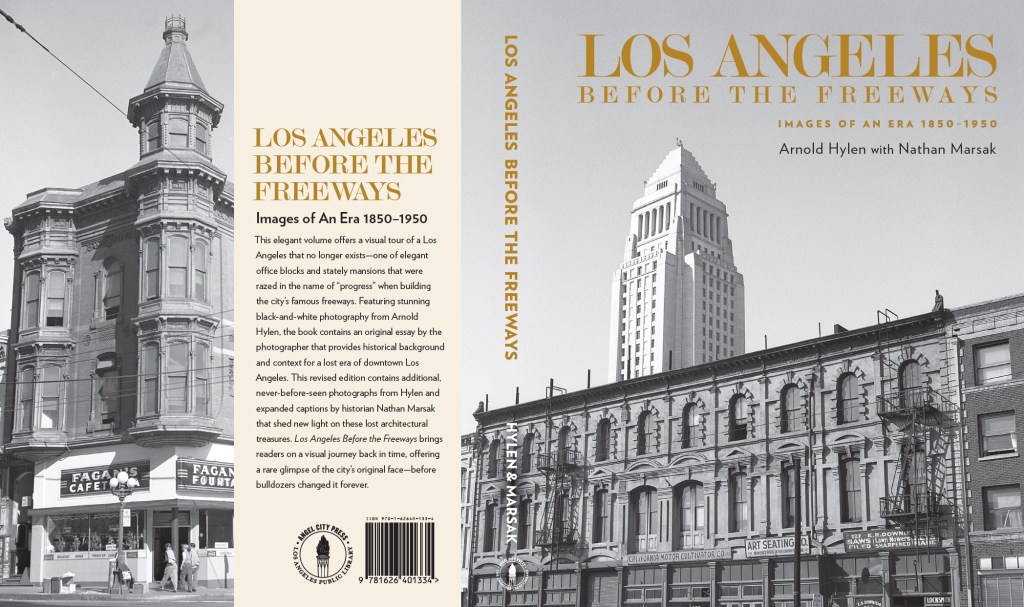
Announcing Los Angeles Before the Freeways!
Though strictly speaking it’s not my book: it was written by a fellow named Arnold Hylen. Hylen had taken a lot of pictures downtown in the 1950s and 60s, compiling his images and research into his 1976 Bunker Hill, A Los Angeles Landmark and 1981’s Los Angeles Before the Freeways: 1850-1950 Images of an Era, both published by Dawson’s Books.
Bunker Hill and Freeways had very limited press runs — 500 and 600 copies, respectively — so finding them can be tough and paying for them even worse:
So I thought it would be a cool idea to ferret out Hylen’s remaining family, acquire the negatives and publishing rights, and get these books in the hands of hungry historians. The Bunker Hillbook turned into something larger, of course, but Freeways…that is being republished now as a standalone, and I won’t be modest on this point: this new version is amazing.
********
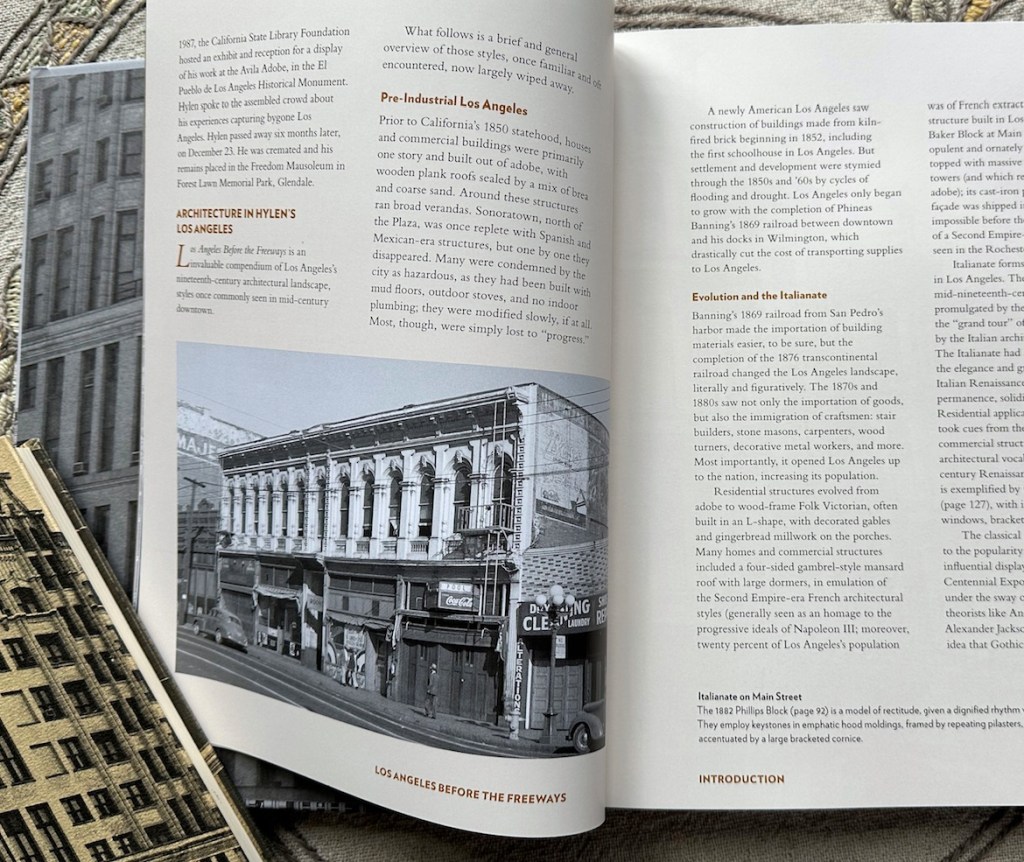
So, how does this new edition differ from the 1981 original? A few standouts—
It’s larger!
Which means the images are bigger…a LOT bigger
And because I scanned the original negatives, there’s greater visual information included in the images
Recognize these images? No you do not! There’s a bunch of Hylen shots, not included in the original, that you’ve never seen before
Including a biography of the man
And an essay about the architectural styles you’ll encounter in the book (and yep, you’ve never seen that shot of Reeve’s Phillips Block before now [not to be confused with Reeve’s other, far more famous Phillips Block one block west])
********
The book will be out, officially, on March 25th. We’re having a big launch party at Central Library on March 22nd, so….COME TO THE LAUNCH PARTY! There will be books there, and snacks, and presentations, and it’s free! Click here!
In the meantime, should you wish to preorder the book, please do so here!
********
One last thing — I asked Pumpkin Patch what her favorite image was, and she turned to this one:
Today’s topic: the Samuel Weller House, 211 South Bunker Hill Avenue
Everyone loves the boom-era mansions of Bunker Hill, which we know primarily through images shot as they neared their demolition, photographed in the 1950s and 60s by the likes of Hylen, Reagh, Conner, et al.
More rare and important are those images captured of a house in its early years. Luckily, many of the most important homes were photographed soon after completion, e.g. these shots of the Crocker, Rose, Melrose, Castle, and Bradbury—
But those shots have been in the public view a long time; many were used in 1977’s Bunker Hill: Last of the Lofty Mansions, and a lot of the shot-within-a-few-years-of-their-completion house pictures, captured from 1888-1900, were some of the first “old Bunker Hill” images to be put online in the mid-1990s. (I should mention as well all the above shots were indeed used in Bunker Hill, Los Angeles.)
So, when a new-to-us image of an early Bunker Hill house is uncovered, it’s big news.
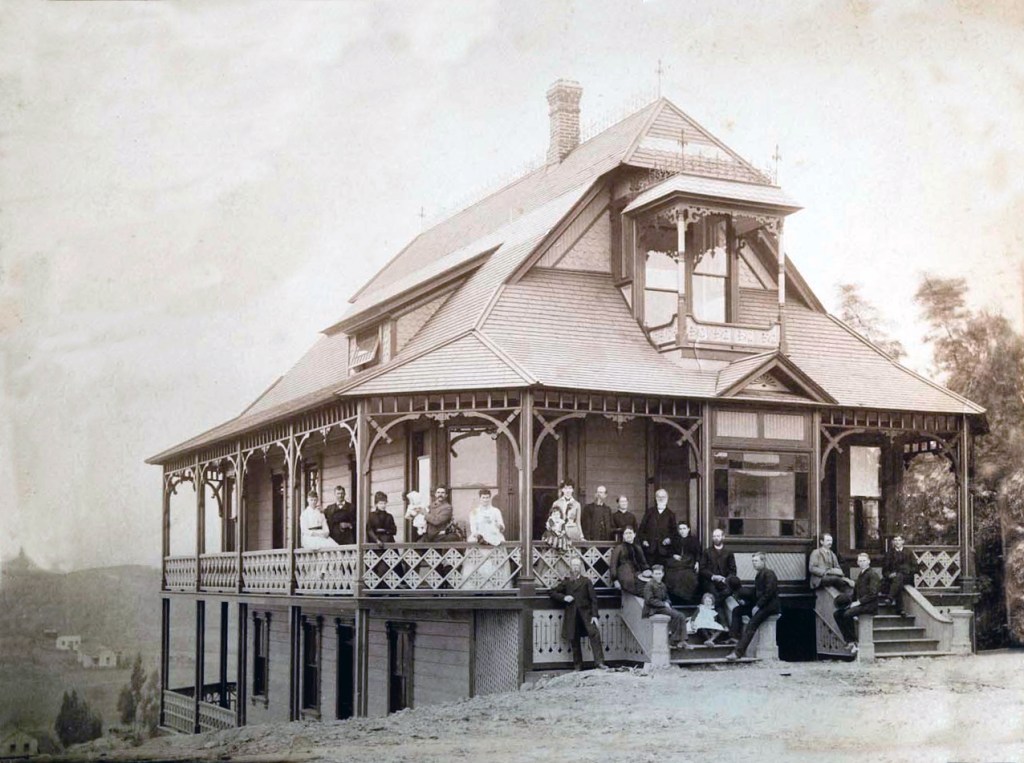
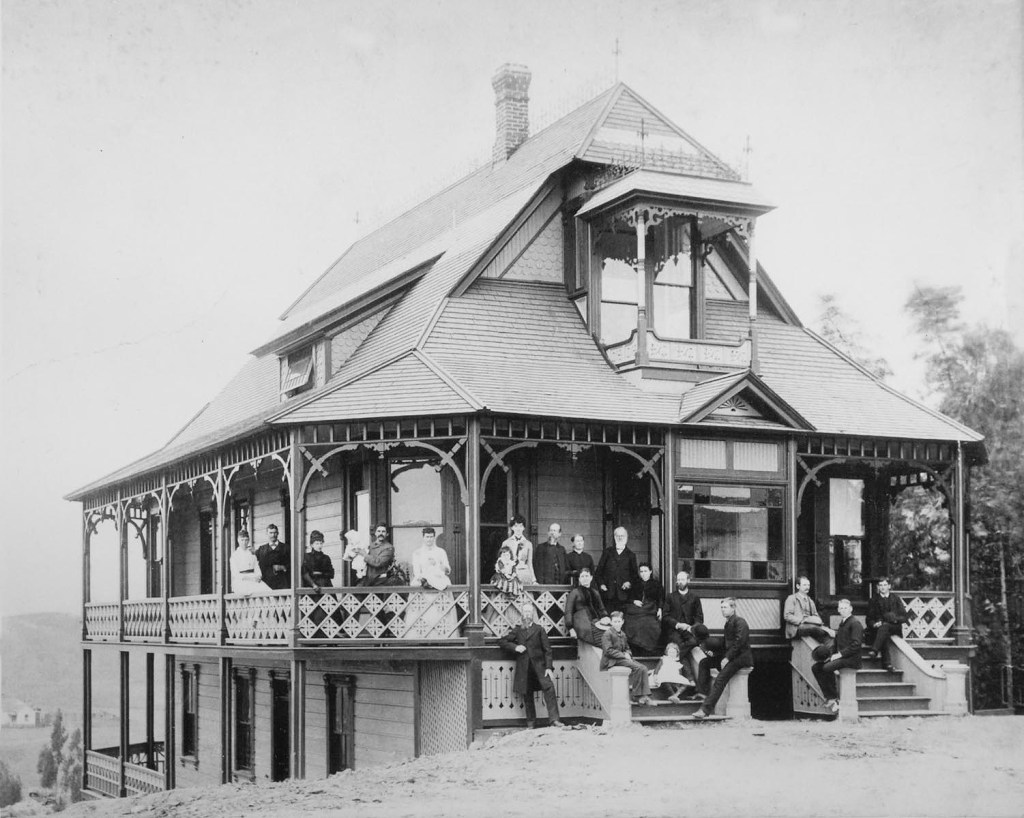
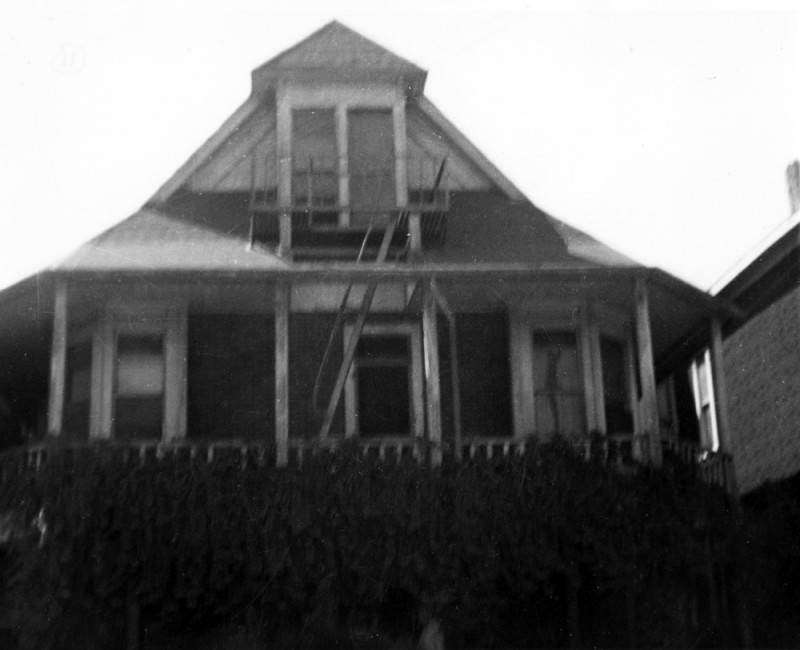
The other day I was contacted by a descendant of Samuel Weller, founding president of Occidental College. Said descendant wondered if I knew about Weller’s house on Bunker Hill, and, was it in my book? I said that no, 211 South Bunker Hill Avenue, built by Weller in 1886, was an important house, but, no decent images of it existed.
At which point she sent me this:
And my jaw dropped. That’s an incredible image of an important house!
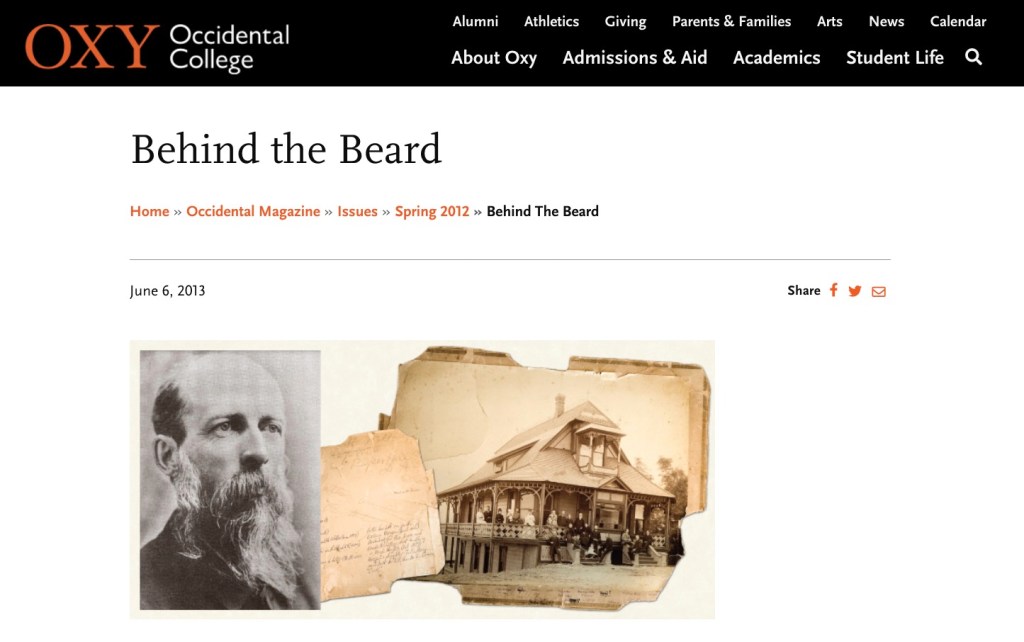
The descendant said that the original of this image lay with Occidental, whom I contacted, and they said no, they had received it from the family, when they included it in this, ten-something years ago:
So the family says Occidental has the original and Occidental says the family has it, and while I still have no idea who is in actual physical possession of the original, I did get this (decent-sized, but I wish it were much larger) scan:
Which has on its verso—
Great information here, but, much of it a bit off. It was certainly not the “first house on Bunker Hill.” Samuel’s father was not named John (you’ll note someone scribbled “Tobias” in pencil to correct this). And it refers to “Samuel Higgins Weller” when his middle name was Harold (understandable, since Samuel’s mother’s maiden name was Higgins). “Octave” Morgan would refer to Octavius Morgan—of the firm Kysor & Morgan (becoming Kysor, Morgan & Walls in late-October 1886)—who certainly may have designed this house, but I do not believe designed “Occidental College’s first building,” which by all evidence was product of the Newsom boys. Of Morgan it goes on to say his “daughter Julia Morgan” designed Hearst Castle, which is a nice thought, but Julia Morgan’s father was Charles Bill Morgan, no relation.
Note, in pencil, “his fathers anniversary birthday” in pencil across: as June 18, 1886 was Tobias Weller’s 85th birthday, it’s not unreasonable to conjecture that that was the day of this photograph.
As I understand it, this would be Samuel at left, and his father Tobias, right
This being architect Octavius Morgan, holding wee Octavius Morgan Jr., born Jan. 1886
A bit about the Weller house construction—the house may have been built/owned not by Samuel Weller, but by the Rev. Oliver Clinton Weller (Samuel’s younger brother), or at least, that’s what the 1886-87 City Directory would indicate:
207? But wasn’t the address 211? Yes but the neighbor to the north was 205, and 207 crops up as an alternate address later…sort of…all will be explained
Nevertheless, come the 1887 directory, we have Samuel H. Weller in residence:
And in the 1887-88 Maxwells’ Directory:
But with the 1888 directory, Weller has already moved to Boyle Heights, site of his new school:
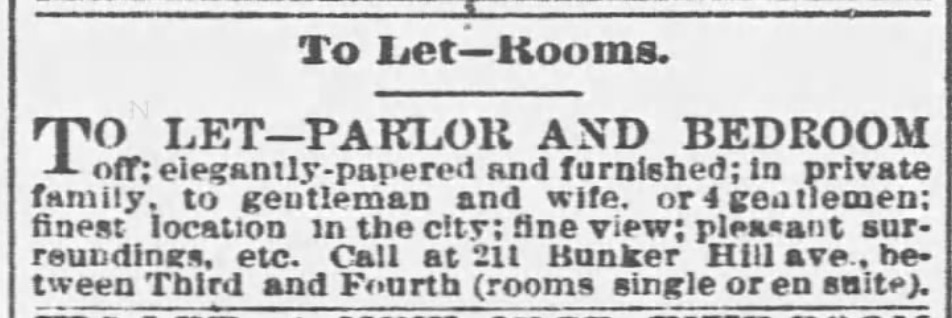
And the Weller house, thereafter, became rented rooms:
Los Angeles Times, April 29, 1888
The 1888 directory shows it’s now the residence of a wood turner, a capitalist, and a lady
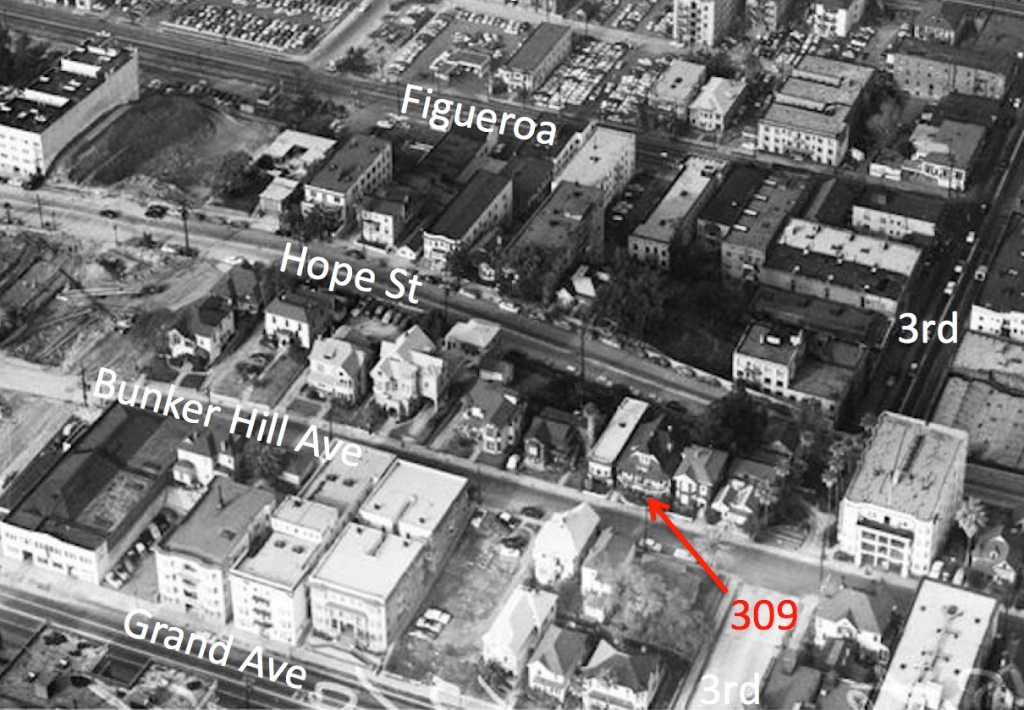
Let’s get you acquainted as to where 211 South Bunker Hill was—which gets tricky because of course it doesn’t retain “211” as its address for very long. Los Angeles went through street renumbering in December 1889, and 211 became 309.
1888 and 1894 Sanborn Maps.Note how 211 becomes 309. 1906 and 1950. Note the use of 307, which suggests 207 was a valid pre-December ’89 address before the renumbering, hence the use of 207 as an address for O. C. Weller in the ’87-88 directory1955. USC
Here’s a shot looking east at Bunker Hill from Figueroa—
Another view looking up at the backside of the house CalStateLibrary
Now let’s look at the house again, and see what we see:
Yes, I hate colorized images and so do you. But there are times I find colorization brings out detail, as is the case here, and since it’s the only known vintage image of this house, I’m gonna play with it in every way possible
Two-story wraparound porches! Now that’s California living. That most of the detailing is reserved for the porch scrollwork and balustrade panels gives it a Folk Victorian flair, albeit not of the “gablefront and wing” configuration most commonly seen in the Folk styles of pre-Queen Anne Bunker Hill. Despite all its picturesque elements — a scrollwork’d balcony and a shed dormer and bicolor variegated shingle, this is a transitional house; had it been built two years later, we’d have seen a proliferation of gables and dormers and likely a turret. Instead, our massing is more sedate, but the Dutch Gable-Jerkinhead roofline is still pretty nutty. Note the stained glass window on the porch, flanked by the matching entrance stairs.
How rare is this image of the Weller house? Exceedingly; it’s basically the only decent image of the house we have. By comparison, we have well-known shots of the Castle near both its birth and death:
And yet virtually none of 309 South Bunker Hill (a scant three doors down from the Castle at 325). For example:
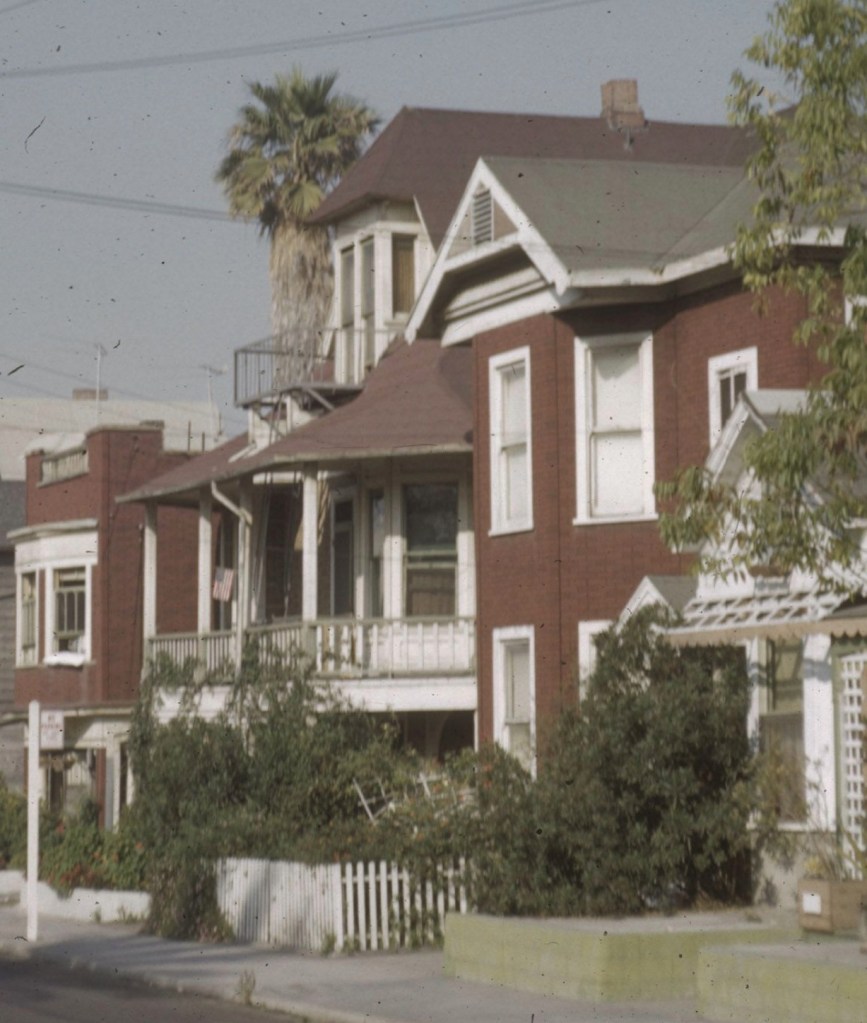
A shot from 1932. Note the upper porch still has its gingerbread and iron cresting, but its lower half has been converted to a fire escape (as done in May 1923 by owner N. J. Crawford). The lower porch appears to have lost its gable and its large piece of art glass.
Note, though, a significant difference: the house as originally built was, at street level, one story (two, if you count the marvelous roof-balcony). Some time later, either the grade was lowered on Bunker Hill Avenue, or the house was raised to bring its lower floor up to the street.
I’ve done some digging to uncover what exactly happened, but am yet to arrive at a satisfactory conclusion. But note in the Sanborn maps above, how between 1894 and 1906 the structure has moved a bit to the north, so as to accommodate 311, which was built, as far as I can tell, in 1899.309 with 311 at left and 305 at right, in June 1954. 309’s upper and lower porches have lost all their decorative elements. This is why it’s so important to have early images of buildings, especially given LABC Section 91.8114, that is, our 1949 “Parapet Ordinance,” which stripped so many buildings of character defining features. HuntingtonJune 1961. A very similar image to the 1954 shot above. HuntingtonHere’s an Arnold Hylen shot you’ve never seen before, ca. 1955, showing some old fellas outside 311 South Bunker Hill with a bit of the former Weller house at right. Note the absence of spandrels, drops, and brackets above, and lack of sawn balustrade panels below.
This image, shot about 1955, ain’t so hot either. LAPL
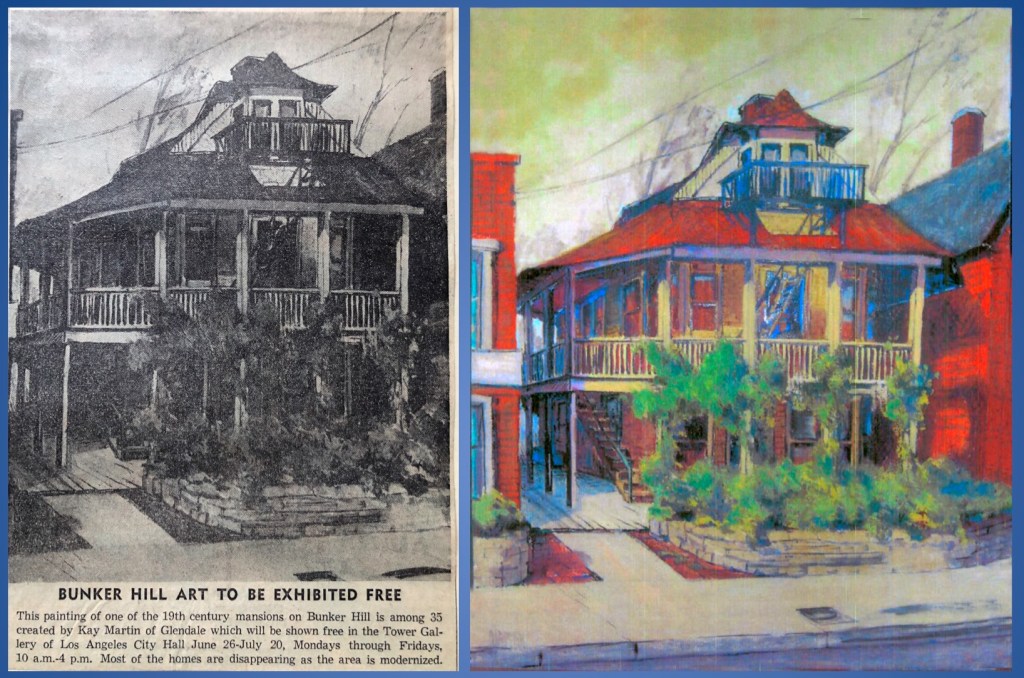
The best capture of the house in its late years is a Kay Martin painting. (To read about Kay Martin, click here.) Left, Los Angeles Times, June 18, 1956And naturally there’s a wonderfulLeo Politi
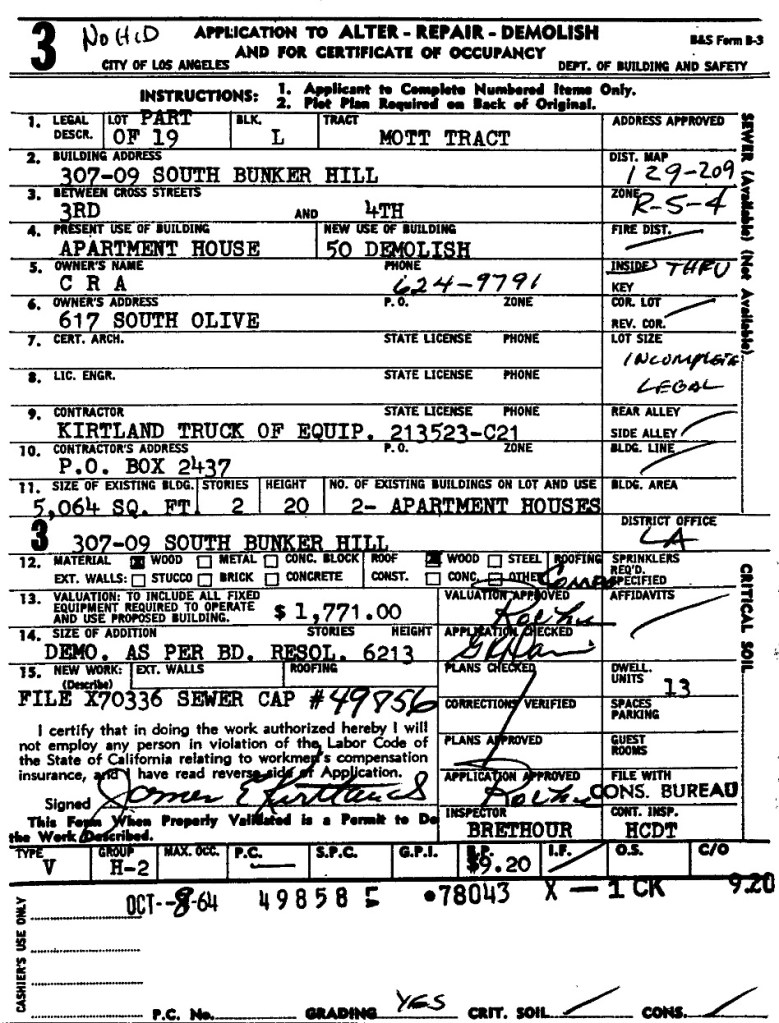
I don’t have to tell you what happened to the house—but I will anyway—it gets eminent domain’d by the CRA and receives its bye-bye papers in October 1964.
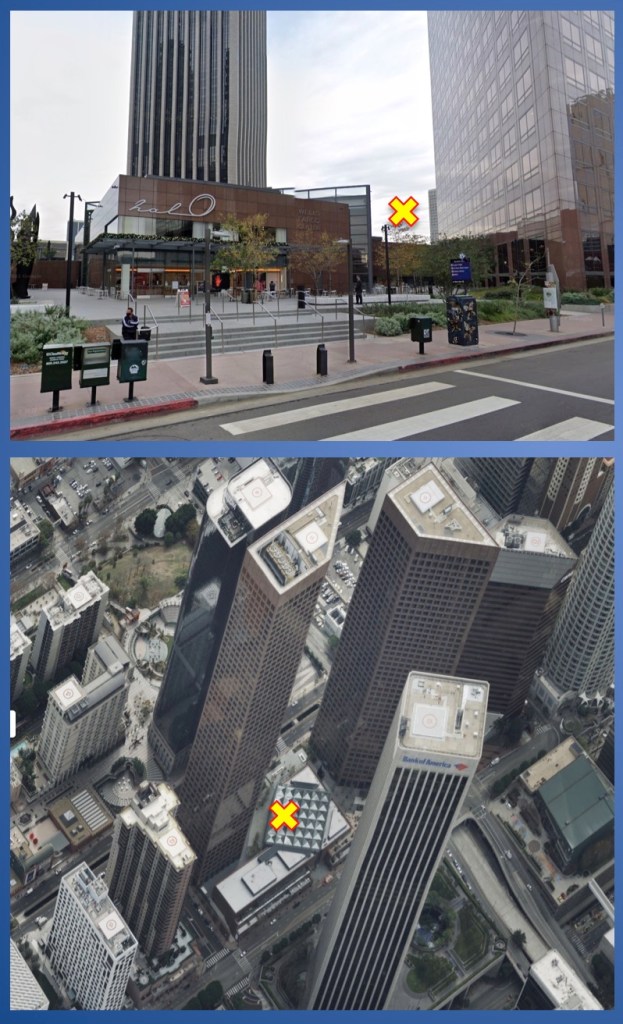
And in case you’re wondering about the former site of Weller’s house: since Bunker Hill Avenue between Third and Fourth has been wiped out, and the hill on which it ran was shaved down about forty feel, next time you’re at the Wells Fargo Center, picture the Weller house as floating over the north side of the Halo foodcourt, or thereabouts…
Happy Washington’s Birthday! Washington’s birthday is, of course, on the 22nd, but has, since 1971, been celebrated the third Monday of February. (Which is today, so happy Washington’s Birthday, and before you say “don’t you mean Presidents’ Day?” be advised I do not, because there is no such thing as Presidents’ Day.)
What does George Washington have to do with Bunker Hill? He never set foot in the Bunker Hill area (unlike President Hayes), and heck, George Washington wasn’t even at Massachusetts’ battle at that other Bunker Hill.
I bring up the subject because, until quite recently, there was a monumental statue of George Washington on Bunker Hill, and this being his day…
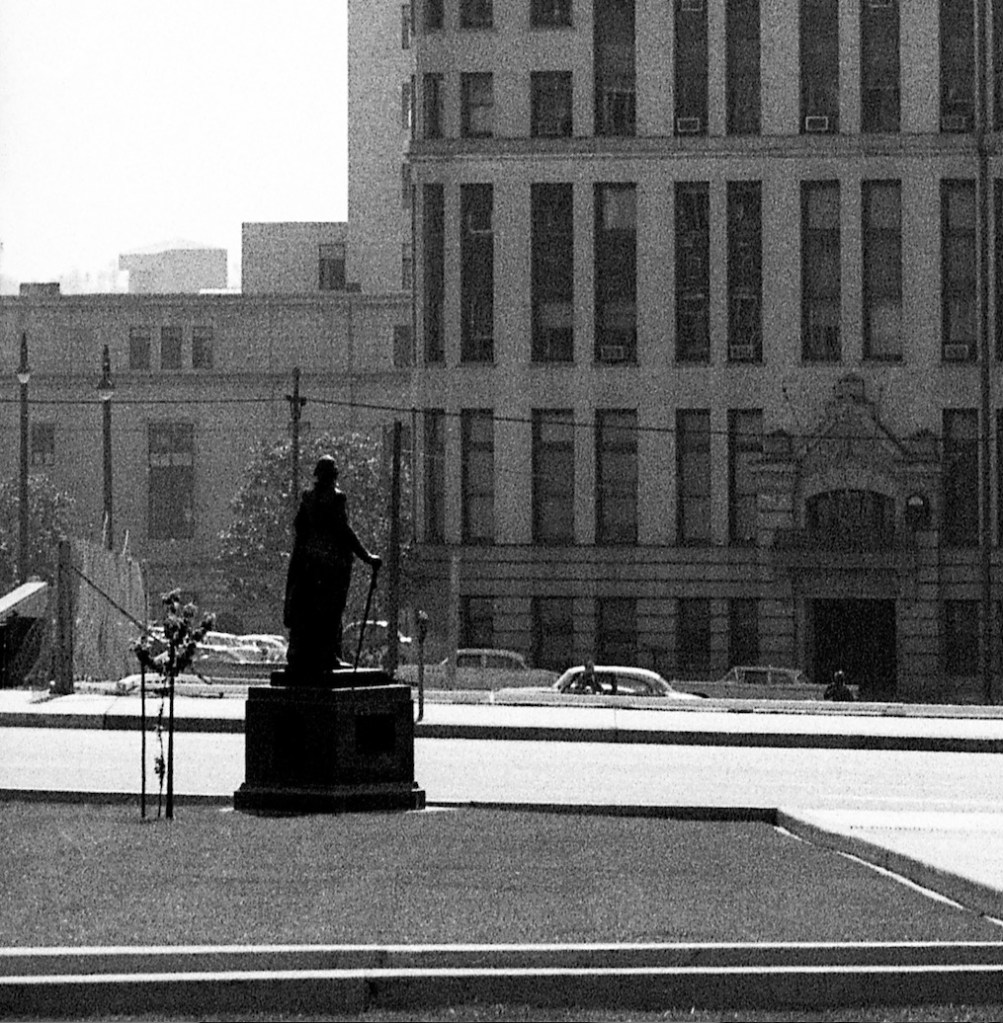
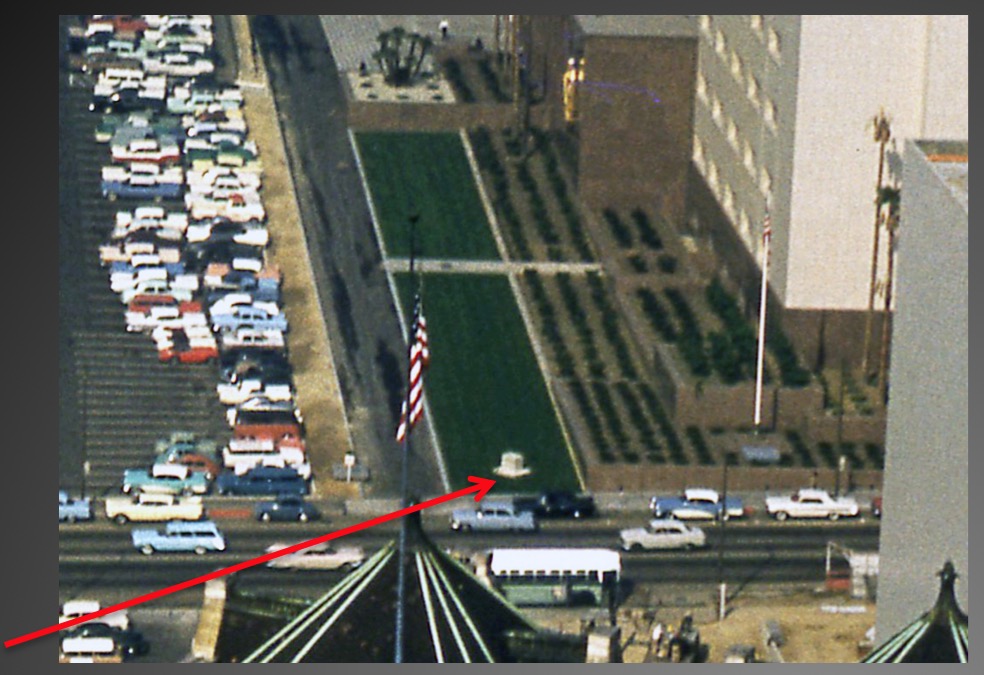
George Washington looks across Hill Street at the Hall of Records; City Hall behind. See the whole of this image on p. 133 of Los Angeles Before the Freeways
I. A Few Words about Washington
It is evident to all we should revere Washington. He led the American forces against Britain, securing victory over tyranny. He presided over the Constitutional Convention, and was the first to sign that founding document. Though elected unanimously twice, he refused to abuse his power, and stepped down after two terms. He was referred to as “The Father of Our Country” as early as 1778 and he remains known so today.
Of course, some people will discount all of this because Washington owned slaves; I suggest those people make a close reading of Winkfield Twyman’s essay on the matter, here.
Eighteen tons of Carrara marble, in the Virginia Capitol rotunda at Richmond. The conventions of neoclassical sculpture would normally dictate Washington be dressed in the garb of antiquity (à la the statues by Canova or Greenough); Washington insisted, however, he be depicted in his contemporary military uniform.
Los Angeles was a bit late to the party, but began work to get a bronze Houdon Washington of its own, in 1935.
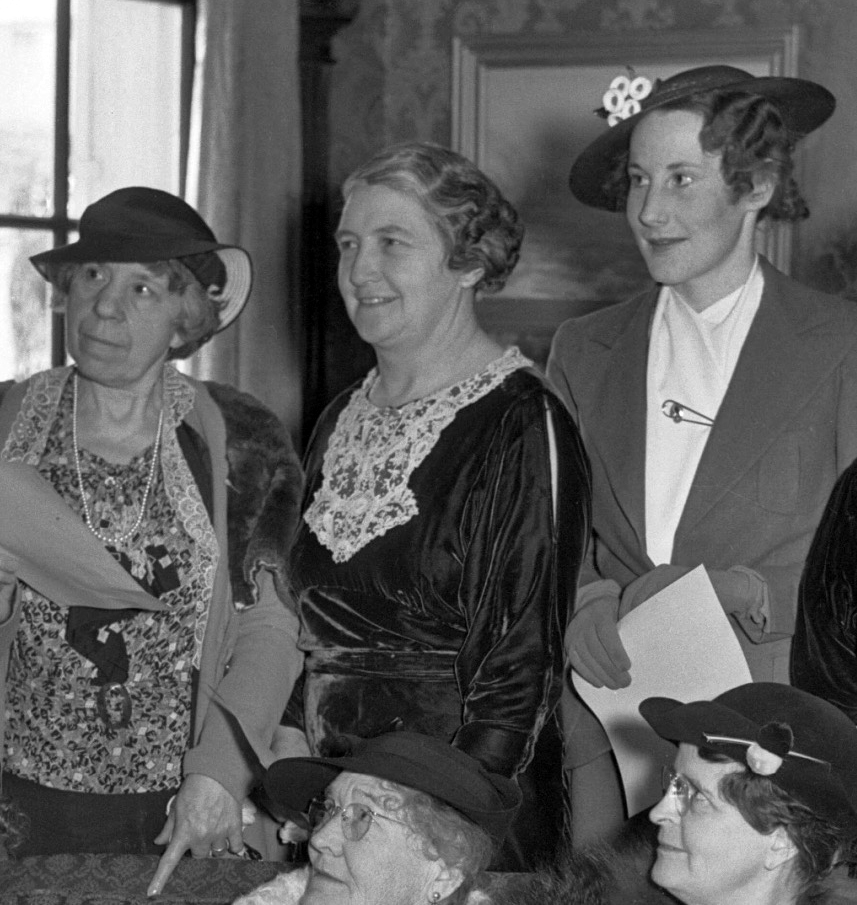
This began as an idea by Bernice Crail. Bernice (daughter of Congressman Moses Ayers McCoid, and wife of Superior Court Judge Charles Steward Crail) was, in September 1935, installed as president of the Los Angeles Chamber of Commerce Women’s Community Service Auxiliary.
Margaret Bernice (Bessie) McCoid Crail, standing center, with other members of Daughters of the American Revolution Los Angeles Chapter, March 1936. She was descended from Robert Lattimore, of Hay’s Company Third Battalion, who fought in the battles of Trenton and Princeton.UCLA
As chair of Civic Beautification, Bernice decided what Los Angeles needed was a monumental Washington statue.
Los Angeles Times, Sept 14, 1935
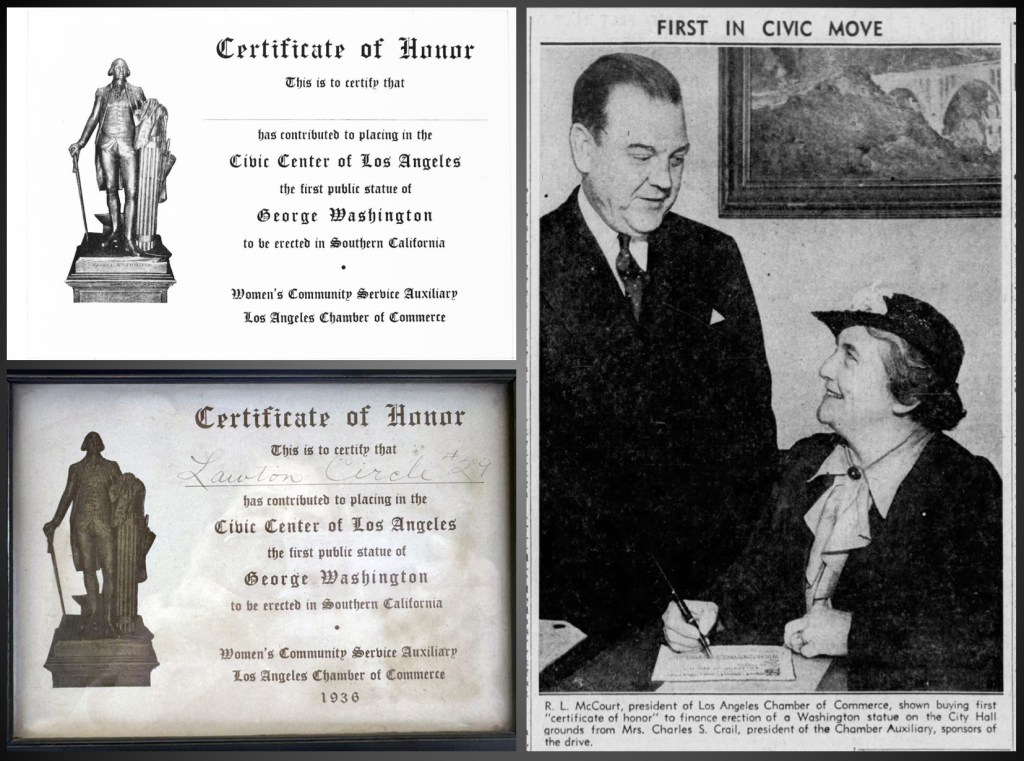
Prominent women across Los Angeles (Bernice, past-president of the Ebell Club, was a mover and shaker) began a citywide movement to sell “certificates of honor” in an effort to raise funds for the statue.
Bernice snags a few bucks from CoC president Robert McCourt. Los Angeles Times, September 14, 1936
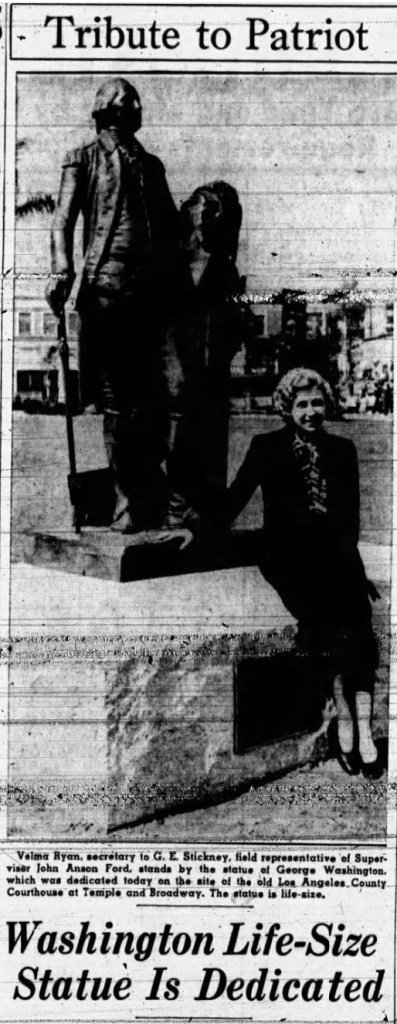
Patriots and art lovers bought certificates, and in 1937 the statue was fully funded, in time for Washington’s Birthday, 1938. The ceremony was held at 10:30am, Tuesday February 22nd 1938, on the grounds of the recently-demolished courthouse. Virginia Law Hodge, State Regent-Elect, Daughters of the American Revolution, delivered the dedication address to over one thousand attendees. Speeches were made, poems were read, and the Works Progress Administration Band played patriotic songs, accompanied by the Belmont High School choir.
This looks west toward Broadway; the building seen across the street is now site of the Neutra/Alexander Hall of Records. Washington faces southeast toward the Gilbert Underwood Federal Courthouse at Spring and Temple, at that time under construction. On Los Angeles Times, February 23, 1938
You will note The Internet, in all its wisdom, will tell you that the statue was dedicated in 1933 (e.g. here and here); but shockingly, The Internet is wrong. Long Beach Press-Telegram, February 22, 1938
Note in the image above the triangular plot left-center: in June 1947 Washington was moved from the old courthouse site to that Spring Street location, near the Hall of Records entrance and directly across from City Hall —
Los Angeles Times, June 17 1947. Needless to say, there was a big re-dedication party that 4th of July, with band music, speakers, and DAR garbed in Revolutionary War-era costume
IV. George Comes to Bunker Hill
As you are undoubtedly aware, the area of Bunker Hill north of First Street — sometimes referred to as Court Hill, given its proximity to the Courthouse (hence the former site of Court Flight) — was, once, a large hill, covered with homes and businesses. That is, until the County decided to buy all the land, kick out all the people, demolish everything (including the hill itself), and redevelop the area with a County Courthouse and Hall of Administration. Like so:
1939 vs. 1961
In late 1960, County Board of Supervisors member Kenneth Hahn had an idea: let’s move the Washington statue from that funny old Hall of Records building to the bright, gleaming new Hall of Administration, which had opened in October.
From the January 1961 slide above: the new pedestal has been installed, awaiting George
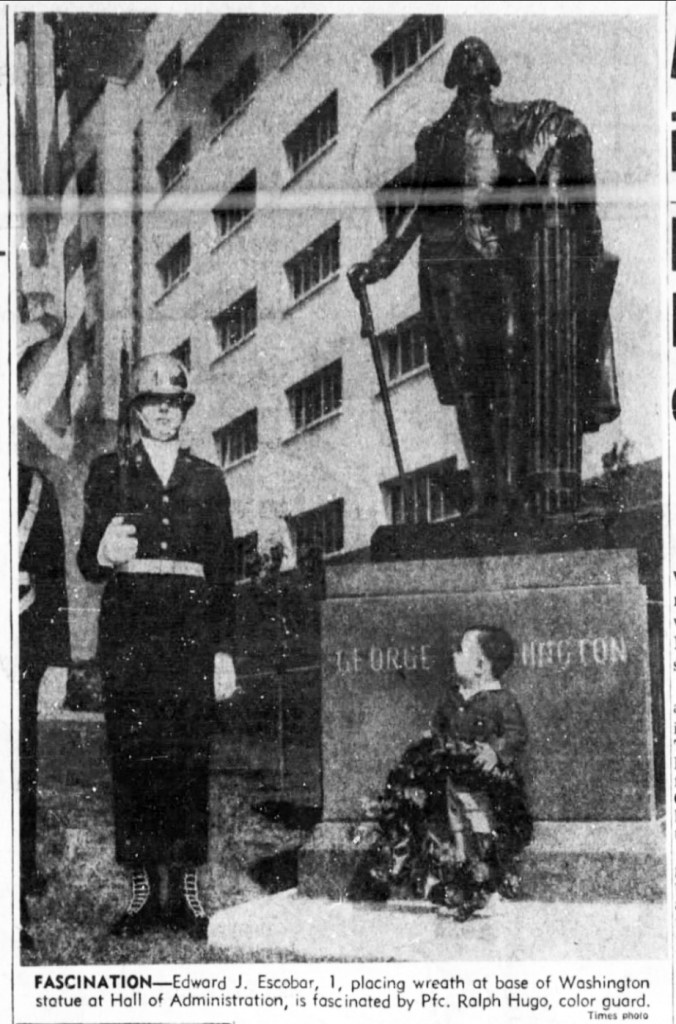
George arrives in time for his birthday.Supervisor Hahn supervises placement at the Hall of Administration, which I like to think is why, thirty years later, they named it after him. Los Angeles Times, February 18, 1961
Edward Escobar’s mother Lillian was past national president of the Children of the Revolution, and a descendant of Adam Mealman, who fought under Washington. Los Angeles Times, February 23, 1961.
A Kodachrome slide from my collection shows the February 1962 Washington Day celebration with Minuteman descendants Sarah Lee Doherty, 7, and brother Theodore, 6, placing a wreath. At left is George W. Turner, President of the Children of the Revolution.
Los Angeles Times, February 23, 1962
Washington had to be moved again, as the strip of grass on which he sat was lost to the development of the Civic Center Mall, known officially as El Paseo de Los Pobladores de Los Angeles, dedicated in May 1966.
You doubtlessly recall the spate of fifty-some Confederate statues removed by municipalities/toppled by protestors after Charlottesville’s 2017 Unite the Right rally, which accelerated into the removal or destruction of another 150+ monuments during the George Floyd protests post-May 2020. (For example, this, this, this, this and this.)
And some people said hold up, you start erasing history without some measure of thought first, next thing you know they’re gonna come for statues of the Founding Fathers! But, were you to query “…what’s next? They’ll come for Washington and Jefferson?” you would be roundly denounced and soundly mocked with a chorus of no-one is going to fall for your lies and divisive hyperbole! no-one is coming for statues of real Americans and no-one will! (Trump himself was taken to task for suggesting such a thing could occur.)
But they did indeed come for Washington, and Jefferson, and many more. For example:
So: it’s Los Angeles, summer of 2020. We’re under stay-at-home orders and the odd curfew so as to halt the spread of the deadly COVID pandemic — your shared sacrifice will slow the virus and protect those most vulnerable! Businesses were closed. Restaurants, salons, churches, all forced to shutter. Loved ones died alone and isolated in hospitals. A trip to the store in the hope of finding toilet paper required waiting in a long line in some parking lot, a socially-distanced six feet apart from one another. Nevertheless, there was a massive upsurge in infections. Why? We don’t know, but don’t worry, we were assured it was absolutely and positively not because of stuff like this, so, go out and protest to your heart’s content.
Thus:
Can you guess what the “special surprise event” was? You guessed it! But read on anyway.
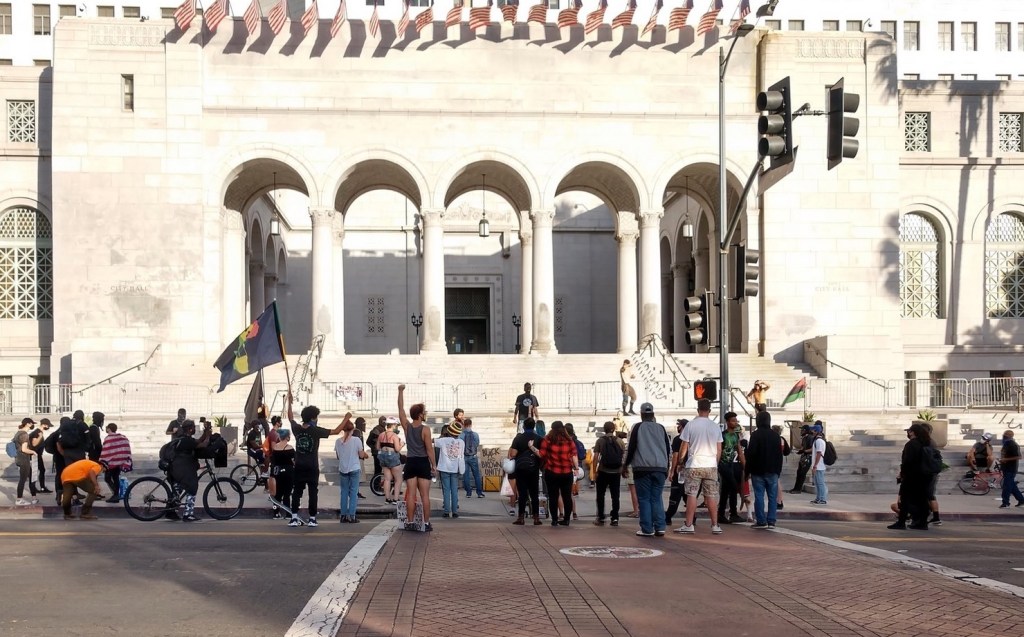
August 13th, and folks show up at City Hall to reclaim their #landback (since it was mostly white folks, I wonder if they got their land back).
And then it was on to the main event:
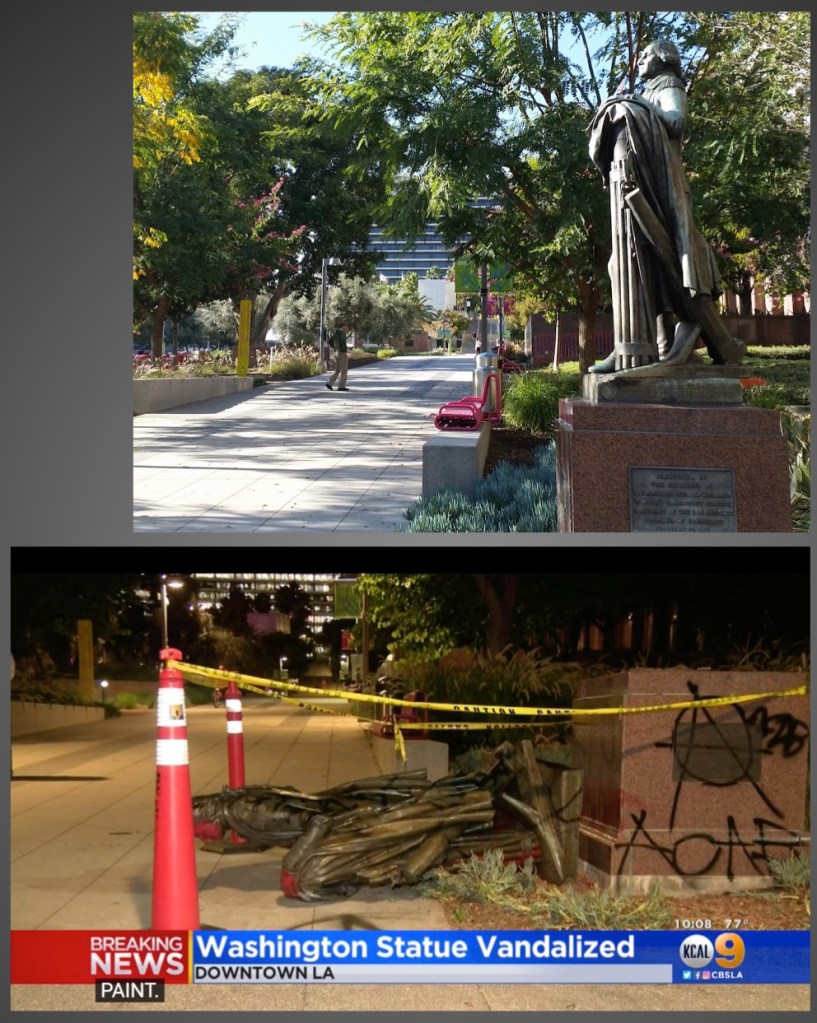
At 6:30, the statue was set upon by the marchers. Six individuals—Christopher Woodard, 33, of Los Angeles; Anna Asher, 28, of North Hollywood; Emma Juncosa, 23, of Los Angeles; Andrew Johnson, 22, of Glendale; Elizabeth Brookey, 19, of Burbank; and Barham Lashley, 30, of North Hollywood—pulled the statue down and spray painted it, but when they saw law enforcement ran into the bushes.
In the bushes they were busy trying to change their clothes, but were caught before they could conceal their identities and avoid detection. They were arrested, and were found to be carrying the tools of the trade—extra clothes, gas masks, laser pointers, helmets and goggles, etc.
Clean up on aisle one! They got a flag, ha ha! F*ck that sh*t.
Since the perps were nabbed red-handed, they paid dearly for their actions! After all, they were guilty not only of felony vandalism (CaliforniaPenal Code § 594 PC) but were subject to being charged under the recently-enacted Executive Order 13933—Protecting American Monuments, Memorials, and Statues and Combating Recent Criminal Violence.
Ha ha! Got you. Did they face consequences? Of course not.
Was there so much as a finger wag? Were they given a stern talking to? Did they at least have to compose a neatly-typed five-paragraph essay titled “Why I Shouldn’t Destroy Monuments to the Father of Our Country?”
No, not in the least. Just let go, and that was that—these were, after all, the glory days of District Attorney George Gascón, who insisted it was a courageous leap toward social justice to embolden criminals, encourage lawlessness, and discomfit victims.
Therefore, the perps had all charges dropped, and didn’t even have to fork out legal fees. Emma Juncosa set up a GoFundMe to pay her lawyer and cover representation of the “Statue Six” — as ponied up by their LEO-hating comrades.
After which, the County cleaned up the statue, replaced it on its pedestal in Grand Park, and we all moved on with our lives like nothing happened, right?
Nahhhh. The County was too afraid of hurting Emma Juncosa’s feelings. (Show us where the bad statue touched you!) Instead of returning the Father of our Country to the Civic Center where it had stood for over eighty years, they hid it, in a second floor conference room at Patriotic Hall.
Don’t get me wrong, I love Patriotic Hall, and I’m glad that when people go up to said second floor conference room, they may enjoy and be inspired by Washington, surrounded by all sorts of cool GAR memorabilia.
Open the door….what’s that over there in the corner by the exit…
…a little closer…
Ta-da!
I wanted to know more about the reasoning behind the move, so I reached out to the Los Angeles County Department of Arts and Culture to ask about the decision making process, and what went into the statue’s restoration and relocation. I got a nice, but short, email back from their Director of Communications, stating that conservation included repairing a fracture and its attachment bolts, and went on to say
After careful consideration, the LA County Department of Arts and Culture identified Bob Hope Patriotic Hall, which houses the County’s Department of Military and Veterans Affairs, as an ideal location for the statue. This location is thematically fitting for the statue of the first Commander in Chief of the United States, sitting in proximity with the various artworks and ephemera relating to military history, figures, and events housed at the Patriotic Hall.
I’m of two minds about this. On the one hand, I’m irked and saddened that we have caved to mobs of America-hating totalitarians who dictate what public statues the public can and can’t see.
On the other hand, because we allow and encourage such behavior, Washington’s statue is no longer safe among people; we can certainly expect another unhinged mob of contemptible “Statue Six” ignorami to again attempt its destruction, hence our need to remove it from view. Thus I begrudgingly admit I am glad L.A.’s Houdon Washington is now safe.
And that’s how George Washington—prominent in the Civic Center for eighty-two years, fifty-nine of those on Bunker Hill—was whisked away for fear the ludicrous-but-violent philistines shall return to finish the job, another step along the path in our charmless descent into barbarism.
*************
And that, my friends, is today’s tale for Washington’s Birthday. Yes, it’s a bit depressing. Might I suggest you now partake in some more upbeat activity, e.g., go internet-visit Mount Vernon, read Washington’s farewell address, and make yourself a cherry pie or some Washington Cake.
We hold these truths to be self-evident, that all movies with Bunker Hill in them are better than others, that they are endowed by their creators to have lots of Bunker Hill in them, that among these include Angels Flight, Bunker Hill Avenue, and some pretty rare stuff once in a while.
************
Let’s look at one of those “rare Bunker stuff in ’em” pictures, specifically, one I had no idea about — it is not, for example, in Jim Dawson’s book — heck, I’d never even heard of this film before Richard Schave sent me a link to it and asked hey, do you know the location of that place about an hour in? Boy, do I…
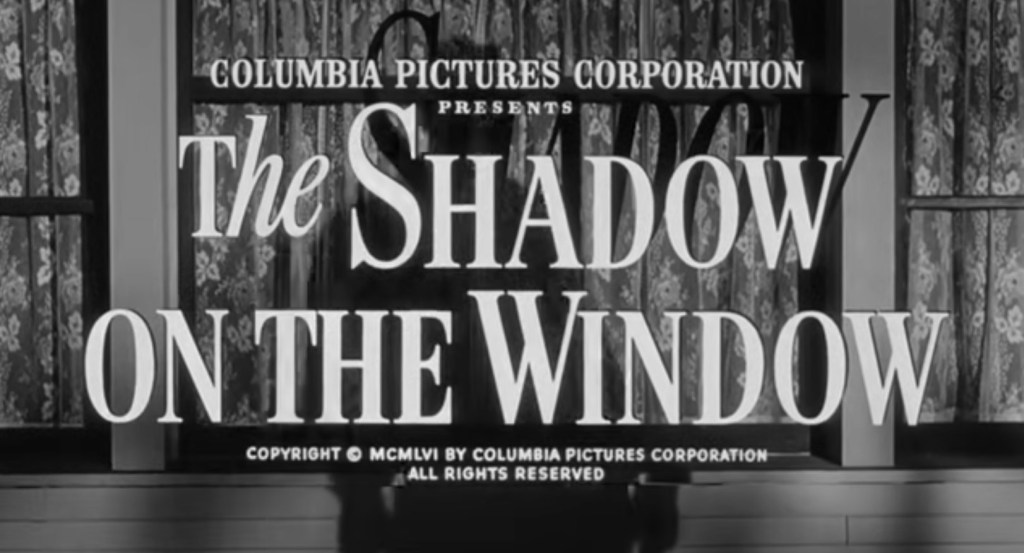
The movie is The Shadow on the Window.
It’s a 1957 picture about young thugs who kidnap a woman and traumatize Jerry Mathers in the process. You may watch the entirety of the movie by clicking here.
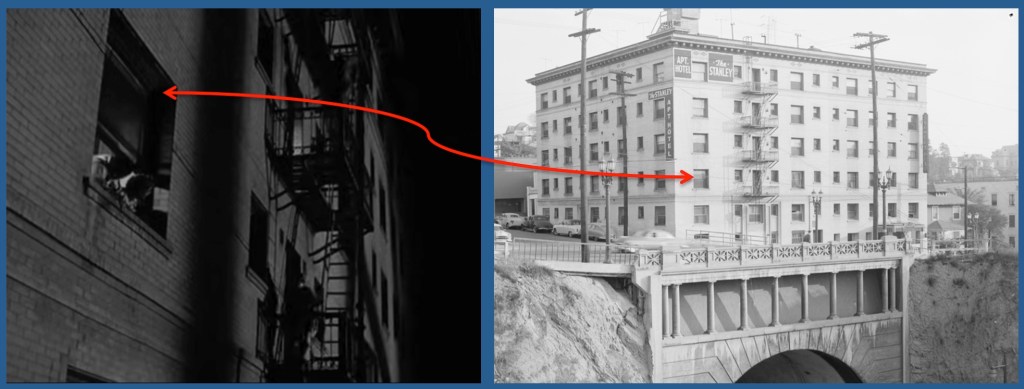
For our purposes, go to about fifty-six minutes in. Corey Allen (whom you remember as the gang leader in Rebel Without a Cause) has gone to his mother’s frowzy apartment to snag a gun and a car, but the cops are on his tail. They arrive:
And where is it they arrive, you ask?
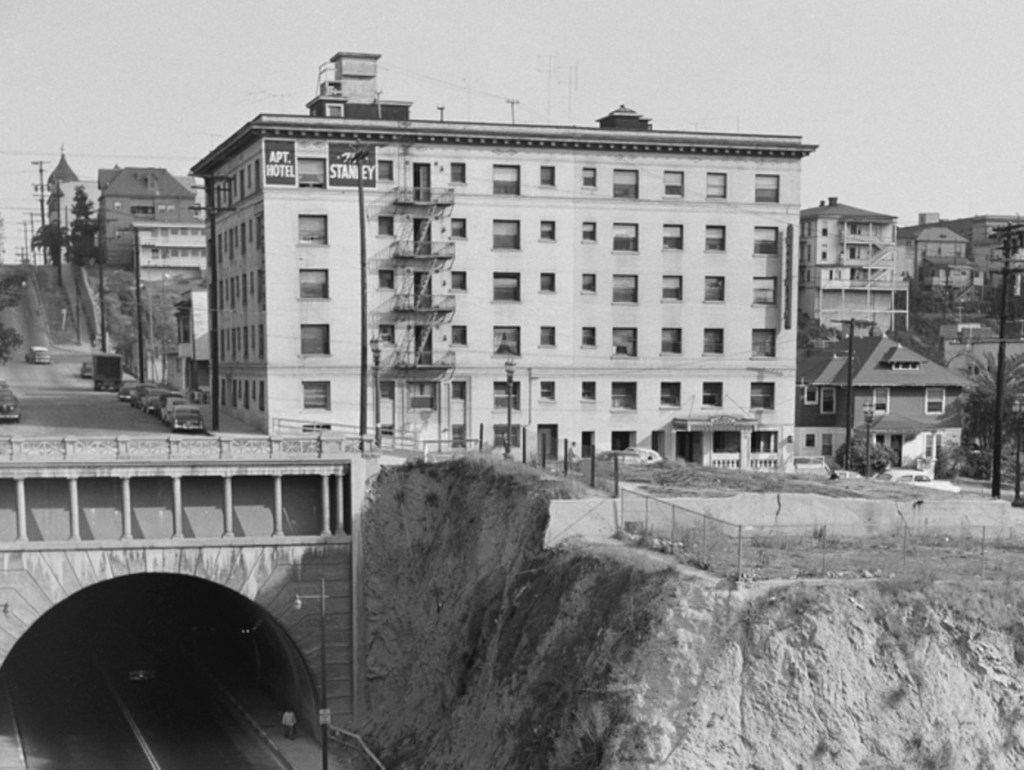
Looking east on Second at the entrance of the tunnel; that tunnel’s gonna be part of the story in short order. Getty
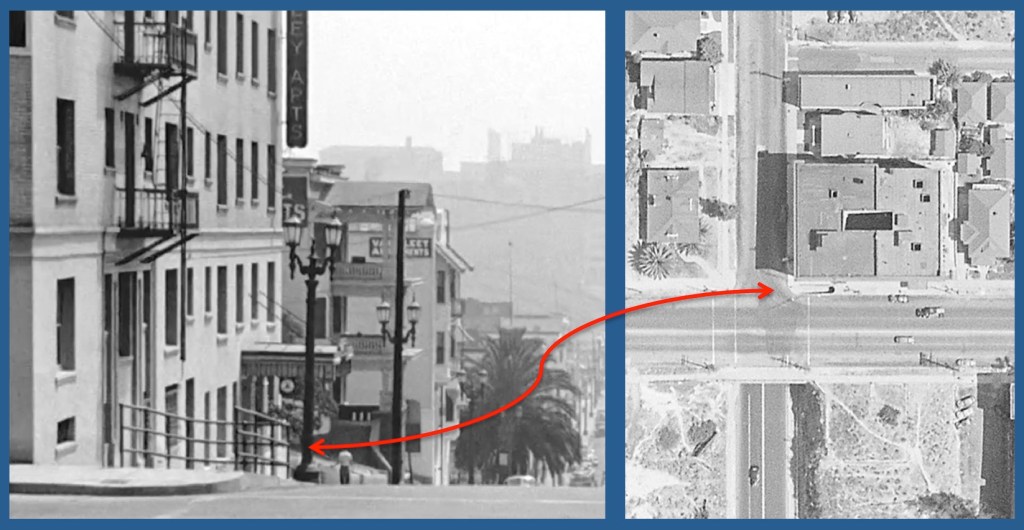
Why it’s the Stanley Apartments, at the southeast corner of Flower and Second streets!
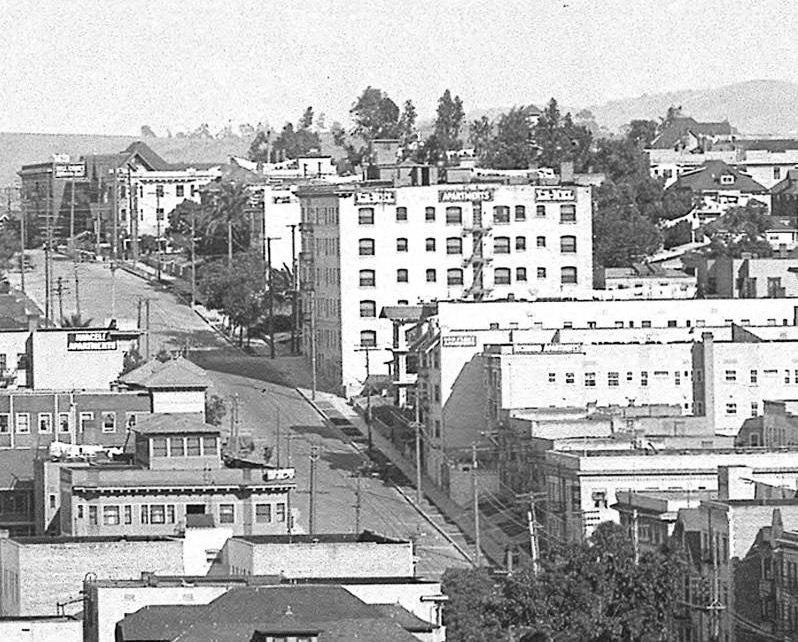
A bit about the Stanley: it began life as the La-Nel Apartments, built in 1913. Designed by Edward John Borgmeyer, it was a project of the Julius R. Smith’s Apartment House Building Company. Borgmeyer specialized in apartment houses, but was known to produce theaters as well (e.g., the Forum).
Looking north on Flower in 1913; the La-Nel, center.WikiCom
It was renamed The Stanley in 1921, after being purchased by Fullerton’s Charles Stanley Chapman (son of Charles Clarke Chapman, “Orange King of California” and founder of Chapman College). Charles Stanley Chapman kept his newly-monikered Stanley for just two years, giving it away in partial trade for the Commodore; nevertheless, the Stanley name stuck.
So anyway, it’s 1957 and someone on the Columbia lot says “go find us a down-at-heels tenement house to shoot at” and voilà—
Right: GettyAnd what do you see when you look south on Flower? The Richfield four blocks south, of course.
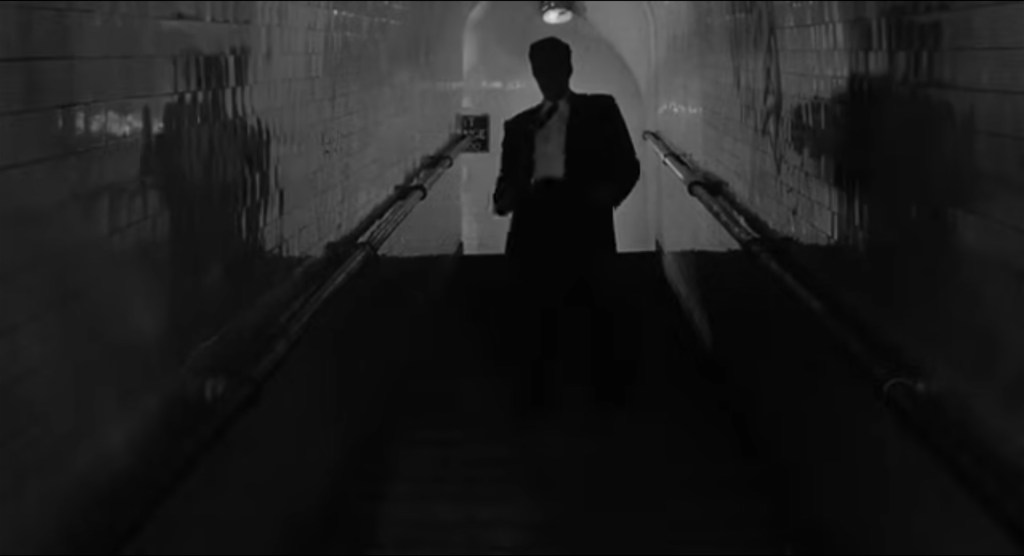
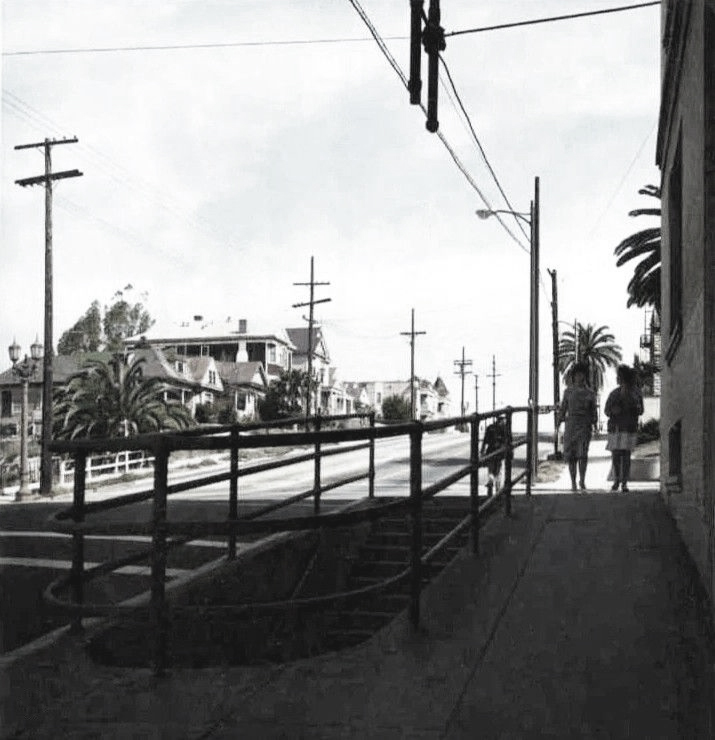
Okay, THEN. Then something absolutely cuckoo-bonkers happens. Corey Allen drops off the fire escape and makes his way into the pedestrian passageway into the Second Street Tunnel. I have never seen a shot of this entrance.
I mean, I knew the railing was there—and I could see the entrance on aerials—
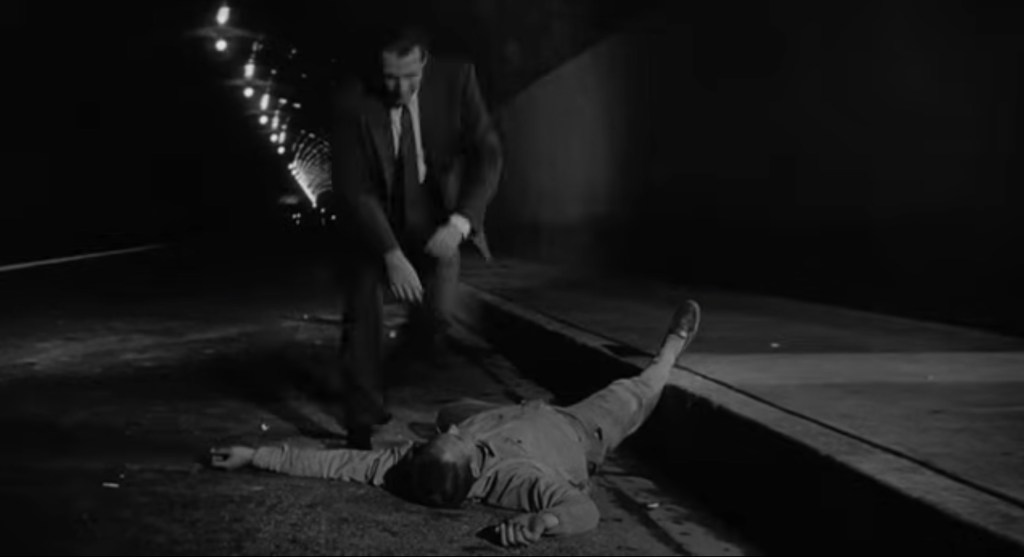
—but I despaired at ever seeing what the heck the tunnel looked like from the sidewalk. Until now. Not only that, they go through the passage where it turns, and emerges into the tunnel, and there’s gunplay! Plus lots of that famed shimmery-white Second Street Tunnel subway tile (imported from Germany, which caused a bit of consternation since we had just battled the Hun to end a War Against Mankind).
There’s even action on the south façade fire escape:
The top image is from 1930 — one can see the entrance to the tunnel next to the Stanley. It would have been added about 1923, as the tunnel neared completion. USC
So much to see! When during the rooftop shootout, you’ll certainly wonder, what are those blinking neon lights in the distance?
They’re at Third and Boylston flashing “sightseeing limousines u-drive cars charter busses,” that’s what. UCLA
And what became of the Stanley? The Community Redevelopment Agency got its demo permit in March 1966, and that was the end of the Stanley.
During the development of the Bunker Hill Towers, Flower Street north of Third was rerouted east toward Hope Street, and the Second Street Tunnel was extended west of Flower, almost to Figueroa; it can therefore be difficult to grasp just where the Stanley, at 210 South Flower Street, once stood…
There in that red box, that’s where
The Stanley was perhaps not the most exciting structure on the hill, so I’m thrilled to give it and its little-considered architect E. J. Borgmeyer some notice.
The view west on Second Street from Bunker Hill Avenue, 1949. LAPL
Enjoy The Shadow on the Window! (Spoiler alert: the Stanley is the best part of the picture.)
So it was no surprise when he wrote and told me you know, my great aunt lived on Bunker Hill during World War Two, want me to send you pictures of her there? Coolness is apparently set in DNA, because she lived not only on Bunker Hill, but in one of the coolest places on the Hill.
I don’t mean any of the great Victorian mansions cut up into apartments, or one of the Edwardian-era Corinthian-column’d apartment houses, which would be cool enough. No, she bucked Bunker convention and lived in some brand-new Streamline flats!
At which point you interject, that’s impossible, the very essence of Bunker Hill is that it was a place lost to time and frozen in place, where nothing new was built for decades on end, descending into a genteel and cinematic decrepitude!
Which I appreciate you saying, although that’s not entirely the case. You might recall the “Modern on the Hill” section of Bunker Hill, Los Angeles (pp. 146-53) wherein I dispense with the idea that all of Bunker Hill was absolutely antediluvian. And in that section, I devote an entire page (151) to the remarkable Avalon Apartments, built in 1938-39.
Thus, let me tell you all about the Avalon, and the awesome pirate who lived there.
I. The Avalon Apartments
The northeast corner of Second and Grand was laid out as part of the Mott Tract, lots 9 and 10 of Section G, back when Grand was still called Charity. Nathan Wilson Stowell, to whom we owe the growth of Los Angeles as much as anyone, bought the corner of Second and Charity and built a house there in 1884 (Charity Street became Grand Avenue in February 1887) . Nathan Stowell also married Florence N. Rivers in 1884. Florence’s uncle was Ernest Bradford Rivers, who worked for Stowell; EB Rivers worked with Stowell when Stowell sold part of his Second and Charity property to Robert Larkins, so that Larkins could build his magnificent Richelieu.
Los Angeles was scandalized when in 1905 Nathan Stowell, 53, abandoned his wife for a 22-year-old. Florence was awarded the house in the divorce, and it remained in Rivers hands, specifically, in the hands of Florence’s nephew Henry Edmund Rivers, son of her uncle Ernest.
Henry Rivers was in the real estate game, especially so after 1917, when he wed Mildred Strong, daughter of realty mogul Frank Raleigh Strong, who had subdivided dozens of residential areas in Los Angeles, including Silver Lake. (Frank Strong was known to go get drinking with Warren Harding at the Newport Yacht Club, and ironically, Newport Beach plays a large role in the latter part of our story.)
Henry Rivers — who was at the time president of real estate concern Rivers & Parmelee, Inc. at 510 West Sixth Street — had ownership of the old Stowell place, and approached the Department of Building and Safety with some plans in to add rooms to the thing in September 1938. Those plans came to naught, and a demo permit was pulled in November. Rivers had no architect proper, but used licensed engineer John H. Wilke to do the work for the new 24-room structure, built throughout 1938; it opened in late 1938 or early 1939.
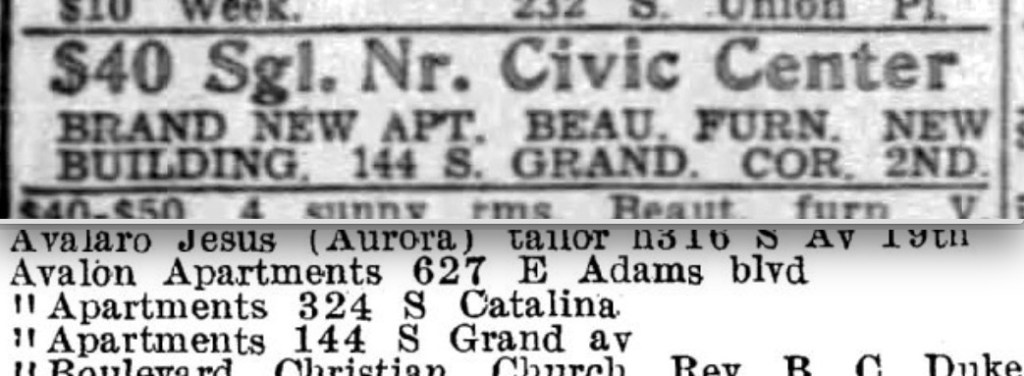
An ad from February 1939, plus, it made the 1939 directory. There were multiple Avalon Apartments, so if you tell someone to visit you there they might end up on East Adams or South Catalina. (Or for all we know they’d end up at Catalina, on Avalon.)Final tile work for the Avalon on Grand is performed in August 1939, and DBS issued the final Certificate(s) of Occupancy.
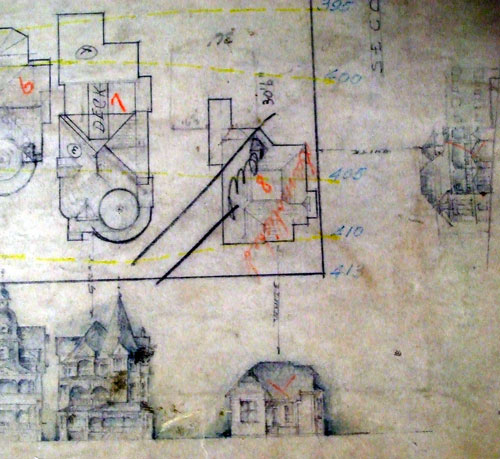
There are, sadly, no images of the Stowell house handy. Here’s a sketch from 1938, when the WPA was ramping up to build their famed model. From here; for more about these drawings, see here.
This is the closest I’ve come to an image of the Stowell house, looking south across the porch of the Richelieu, revealing a bit of the Stowell roofline.
So the poor WPA illustrators of 1938, after they’d sketched the 1884 Stowell house at 144 South Grand, are presented with the fact that it had been torn down and replaced, hence this sheet stuck into the works; it was eventually modeled and placed.
The differing footprints of the 1884 and the 1939 structures (from the 1906 and 1950 Sanborn maps, here). Note the addition of the 529 West Second Street address as well.And while it says there were 24 apartments, it appears there were 24 rooms, as twelve two-room apartments.
And here it is, in one of the few known color shots of the place, April 1957, as photographed by Palmer Conner.An image spliced together from a pan in Kent Mackenzie’s Bunker Hill 1956. Look at that corner window! Lescaze! Gibbons! Schindler!
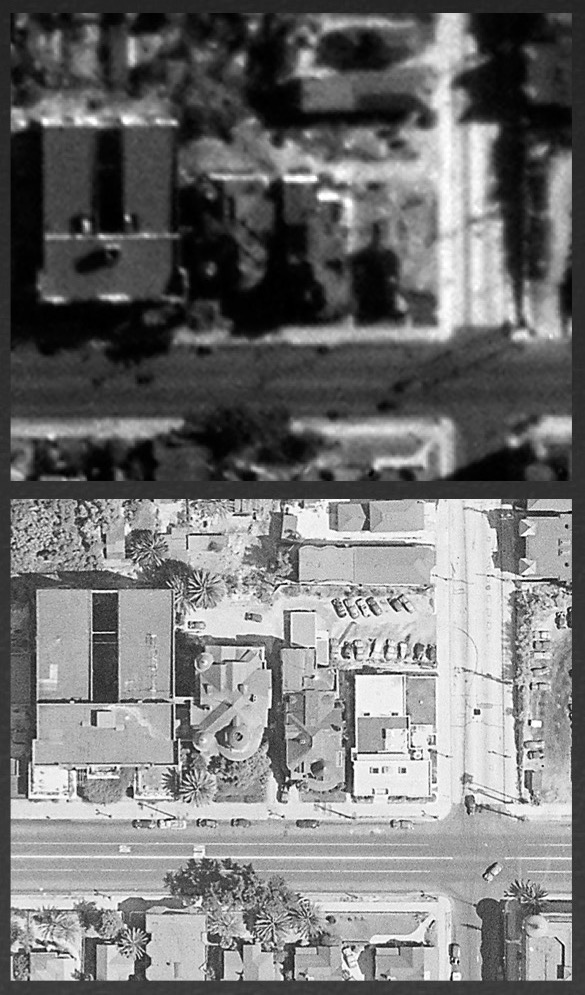
Top, August 1933, left to right, Melrose Annex, Melrose, Richelieu, and the old Stowell house: bottom, August 1941, left to right, Melrose Annex, Melrose, Richelieu, and the new Avalon Apartments.
We’re lucky to have any images of the Avalon. Nobody was going to go to Bunker Hill, as the looming shadow of death stretched over the charming old Victorians, to shoot something modern. The Avalon’s neighbors the Richelieu and Melrose were shot regularly, or a photographer would turn his back on the Avalon to shoot The Dome, on the opposite corner.
That said, we have a couple incredible captures from two motion pictures. One is via the process plate background film shot for the 1948 picture Shockproof — the car turns south on Grand from Second and we are rewarded with this:
As long as we’re on the subject of incongruous modernism, check out that Shell filling station on the opposite corner. The residence there was demolished and replaced by an oil station built by the Pacific Steel Building Company in 1923.See the whole of “A Drive Through Bunker Hill” here.
And then there’s this excerpt, from Kent Mackenzie’s short Bunker Hill 1956, which he made as a USC undergrad before work on The Exiles.
Bunker Hill 1956 used to be on Vimeo and other places online, but has apparently been scrubbed. It’s an extra on Disc 1 of The Exiles DVD, available from Milestone.
Check out this guy on his deck with his fluffy pal! Now that’s California living. Then he heads inside to his pad at 529 West Second (supplementary address to 144 South Grand).
So now you get it, right? That there as this amazing Modern apartment building on Bunker Hill at Second and Grand? Ok, well now let’s meet the crazy pirate that lived there!
II. Sally Brown
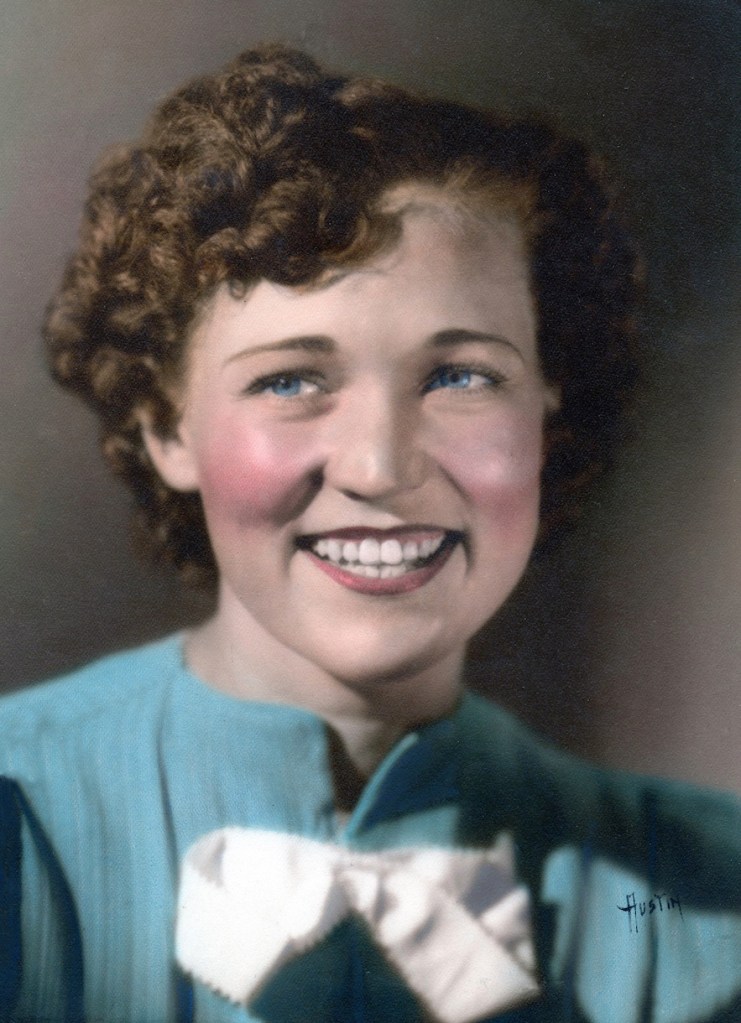
Sally Christine Glover was born to James Luther and Edna Ethel (née Lynn) Glover in Eula, Texas — a small community smack dab in the middle of the state — on May 8, 1914. Her people came to the colonies from England mostly as 17th century Virginia settlers, with some Ulster Scots emigrating to the Carolinas in the 18th. A number served in the Revolution, and through the 19th century they dispersed west, into Mississippi and Alabama, with some relocating to Texas.
James and Edna had twelve children (including Dorothy Louise “Dot” Glover, grandmother of the aforementioned Bryan, about whom I began this post). James and Edna move the family to Riverside in the early 1920s, and by 1930 are in Anaheim.
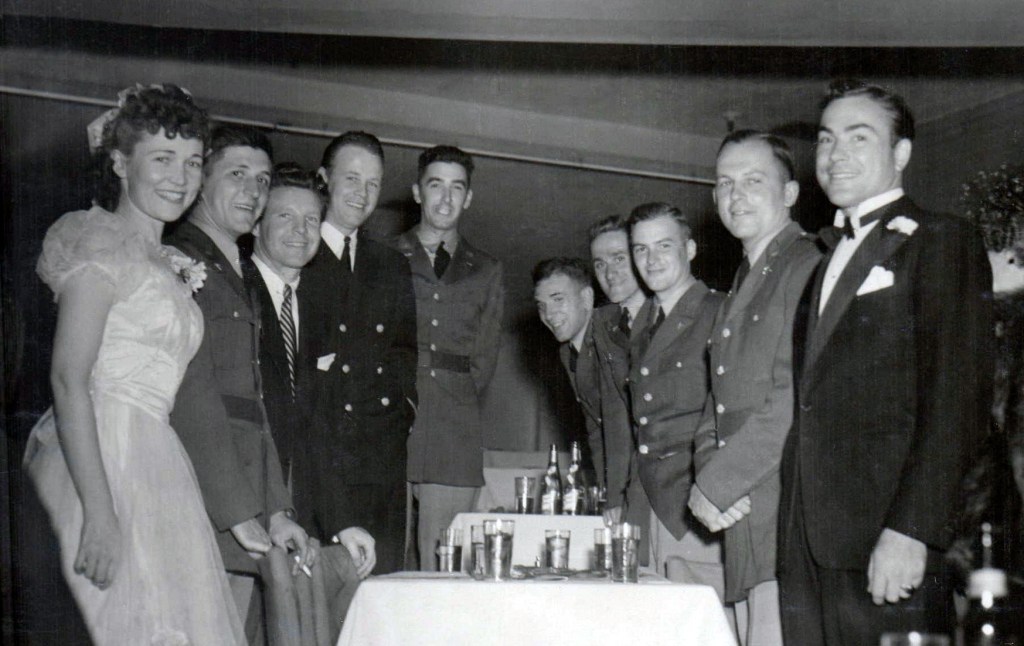
Sally meets Robert Leslie Brown, a Colorado boy who’d moved himself to Newport Beach. They get married in Yuma — Yuma being, like Vegas back in the day, a great place for a quick and easy wedding — on September 28, 1939:
Sally and Bob flank wedding attendees. The fellows are Army enlisted, likely Army Air Corps, attached to Yuma’s Fly Field. The fellow in the dark coat is Navy, likely a pal from back in Newport Beach. And while they are not drinking champagne, you’ll note they are drinking the Champagne of Beers.
In 1940 they lived at 1569 Miramar Dr. in Newport Beach; he was a clerk at the Balboa Fun Zone, and she worked as a switchboard operator for the telephone company.
One of the things they liked to do is be pirates.
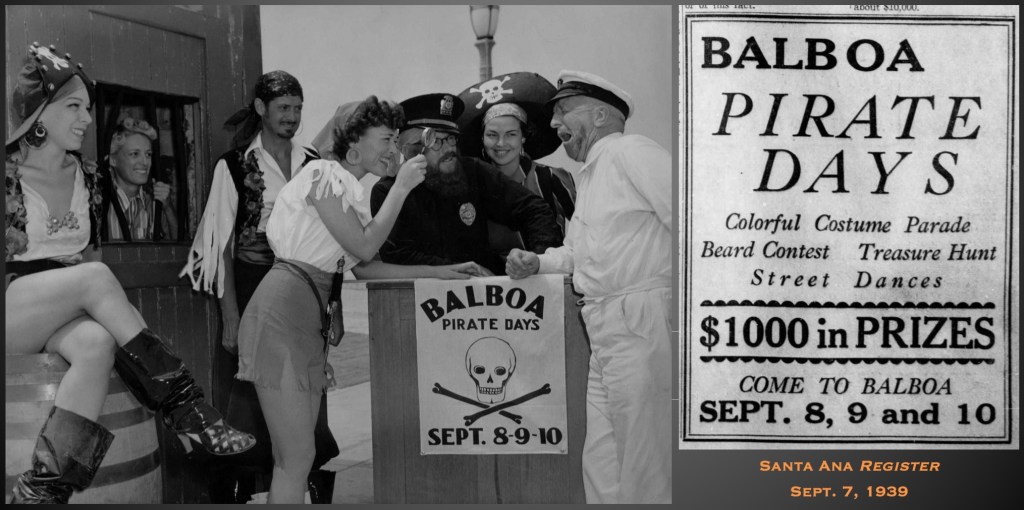
That’s Sally, center, judging the beard contest.
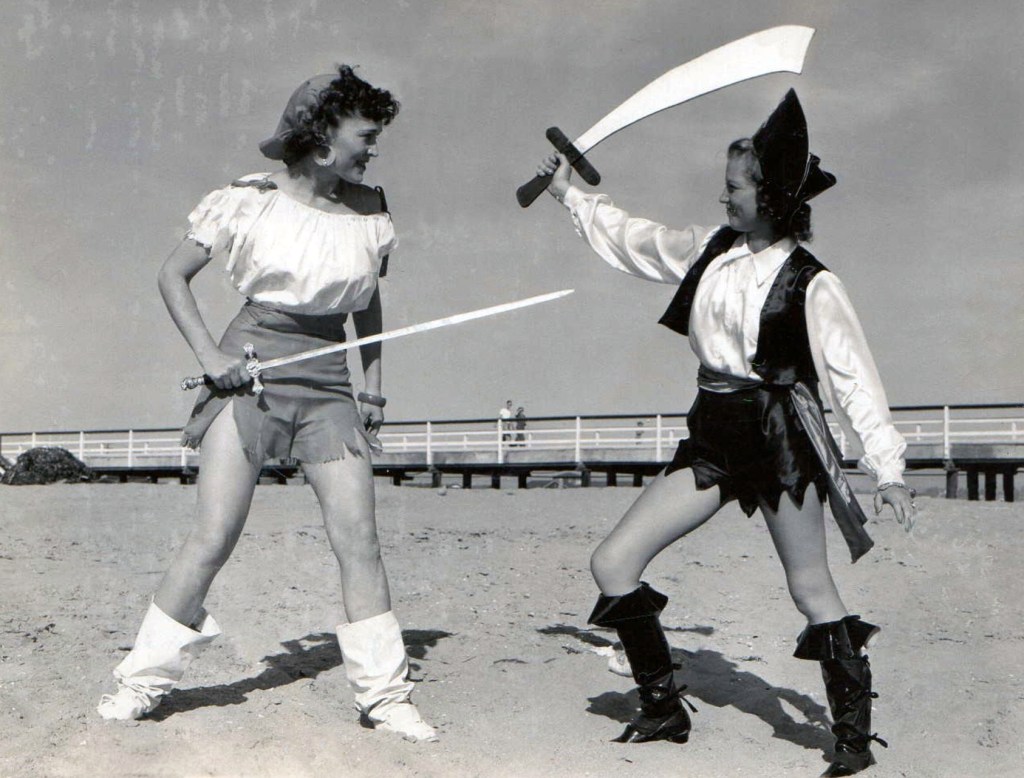
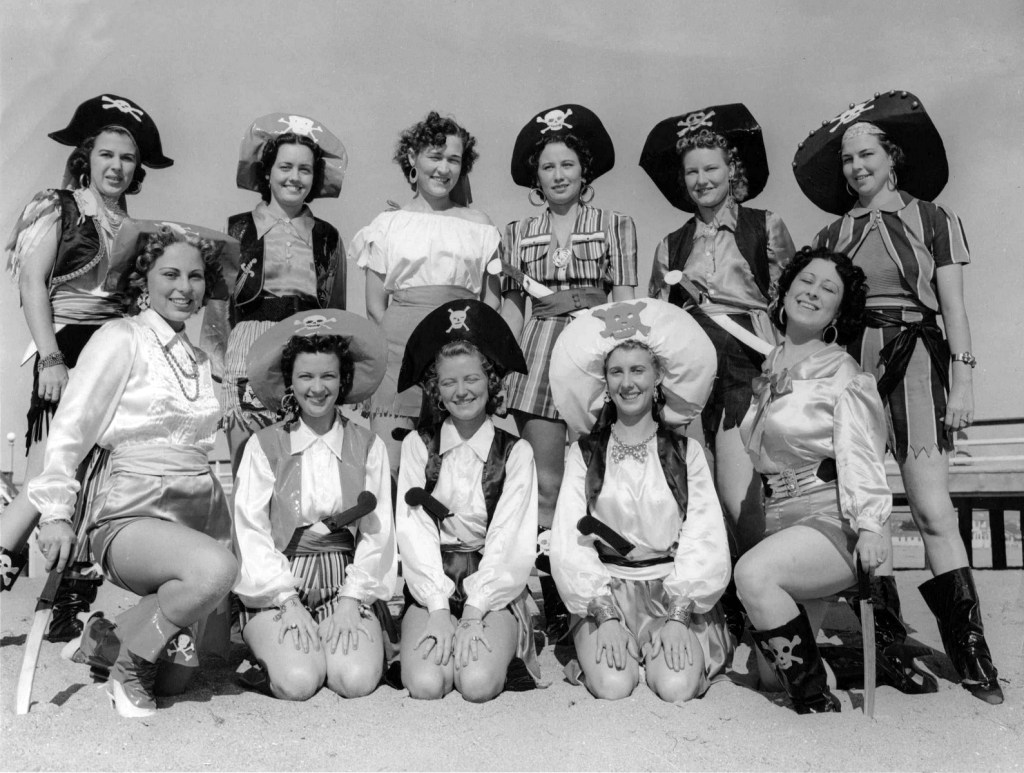
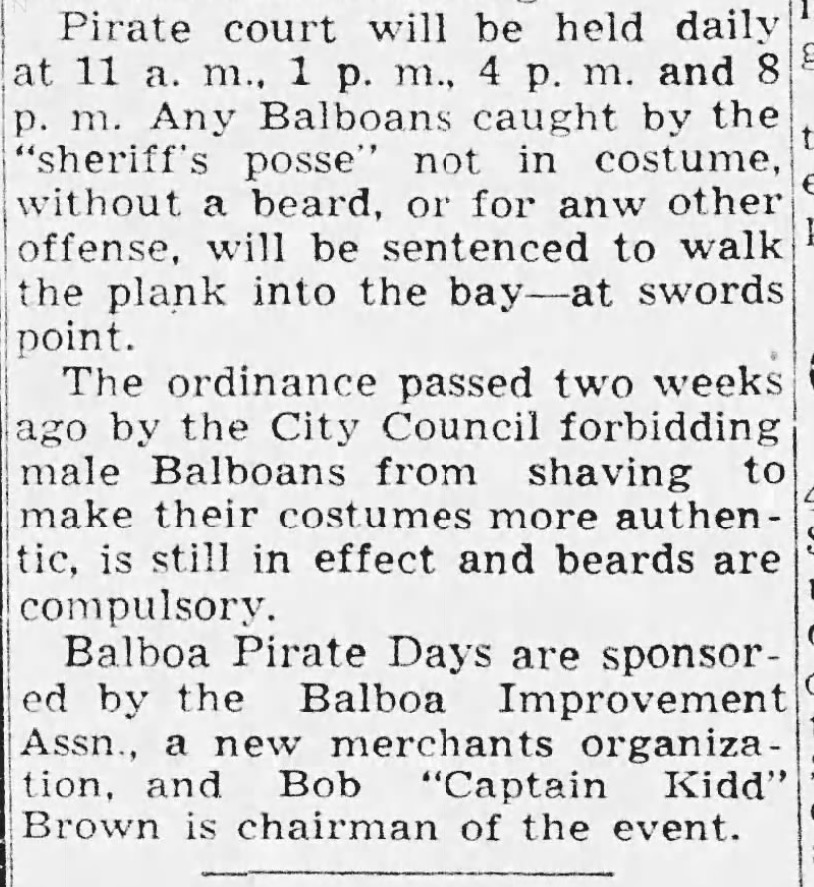
Balboa Pirate Days was conceived of by the Junior Chamber of Commerce in 1935 as a way to bring business to town, and it was glorious. Tall ship battles, a boat landing and invasion, music and street dances, and a ball in the famed Rendezvous Ballroom where the Pirate Queen and her court were crowned. Residents who refused to dress like pirates were put on trial in a kangaroo court, thrown in a brig at the base of the pier (note the imprisoned gal, above), forced to walk the plank (or were just tossed into the bay), and fined (which went to charity).
Pirate invasion! (Sally, second from right.)Walk the plank ye landlubber! (Sally takes a knee, bottom.)Sexy internecine pirate battles!Pirates pose! (Sally, top row, sans chapeau.)
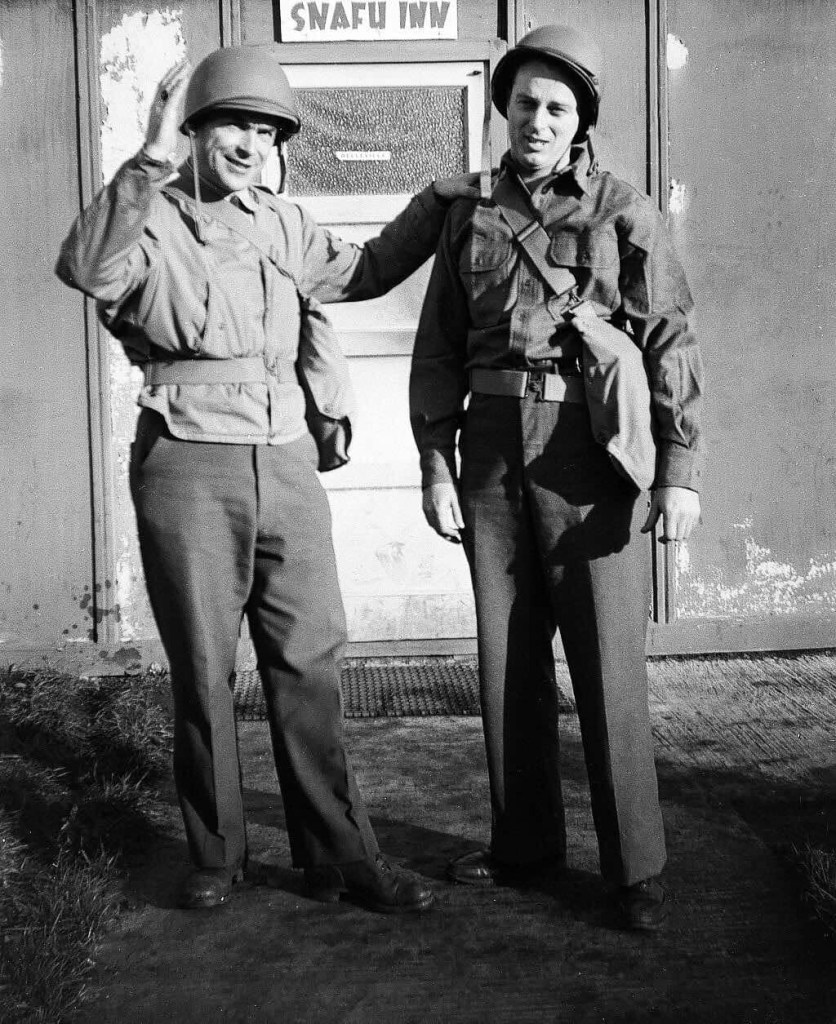
Bob, left, with Howard Willis Ward (Howard married Sally’s sister Dot, Bryan’s grandmother) in stateside training. They’re not even PFC one-stripes yet, but grunts just issued their gear. The SNAFU Inn is probably the enlisted men’s…they weren’t allowed in there.
With Bob overseas, Sally moved from Orange County to downtown Los Angeles, now promoted to supervisor in the telephone company offices (either in the Pacific Telephone & Telegraph Southern California Telephone Company offices at 740 South Olive St., or its other offices, on Bunker Hill, at 433 South Olive).
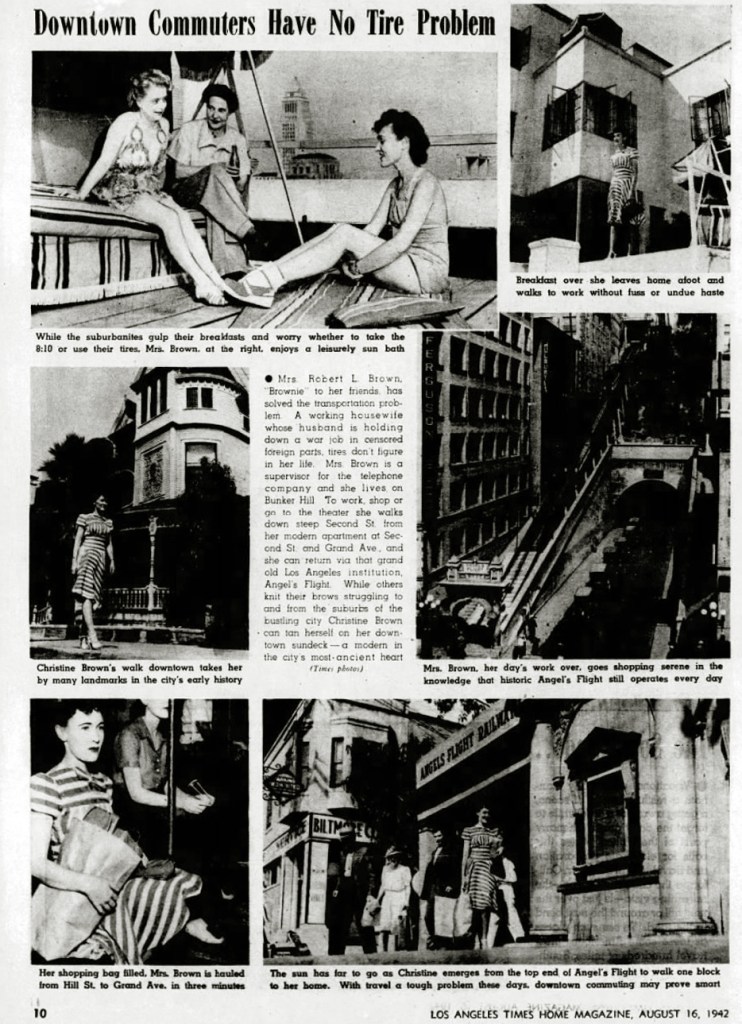
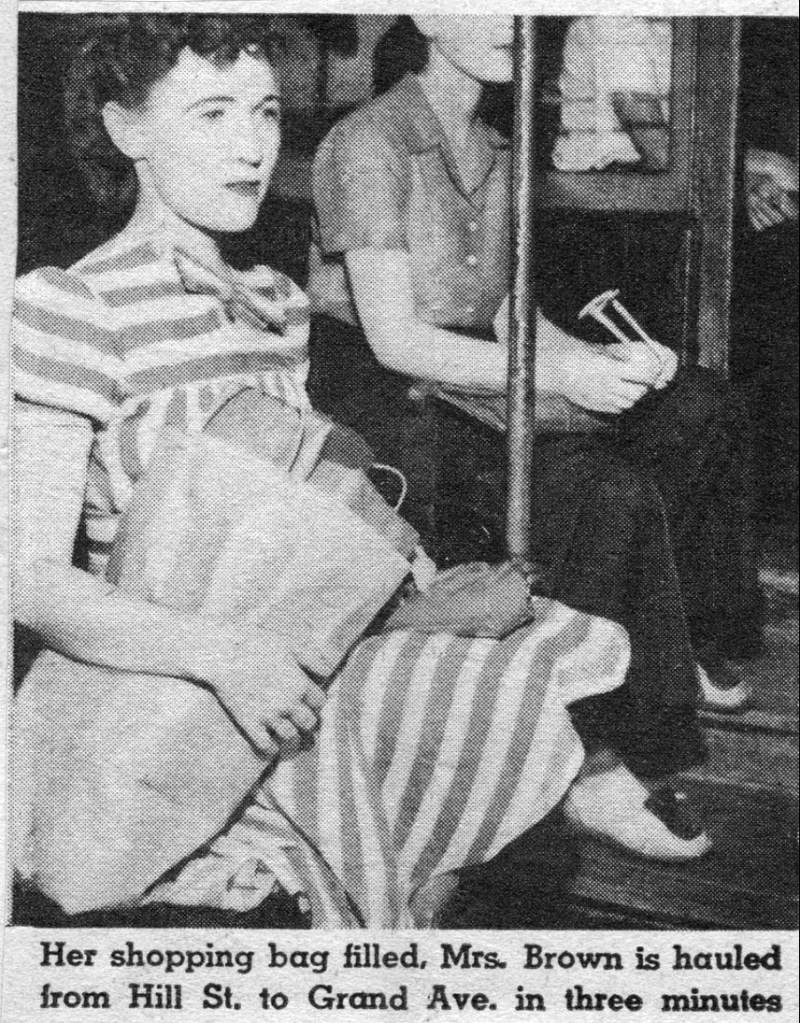
As such, she moves into a place on Bunker Hill, said place being the Avalon Apartments. In August 1942, the Los Angeles Times supplement “Home Magazine” ran this piece —
You’ll notice that she is referred to by her middle name, Christine, in the Times piece. Though she may have gone by Christine during this part of her life, her family refers to her as Sally, so that is the name I have chosen to use for this post.
— about how War Production Board orders regarding rubber rationing means nothing to the plucky, patriotic gal who lives and works downtown! It reads as a sort of proto-green, New Urbanist treatise on neighborhood live/work accommodations.
Nice to know Angels Flight had reached the status of “grand old Los Angeles institution” at only forty years old
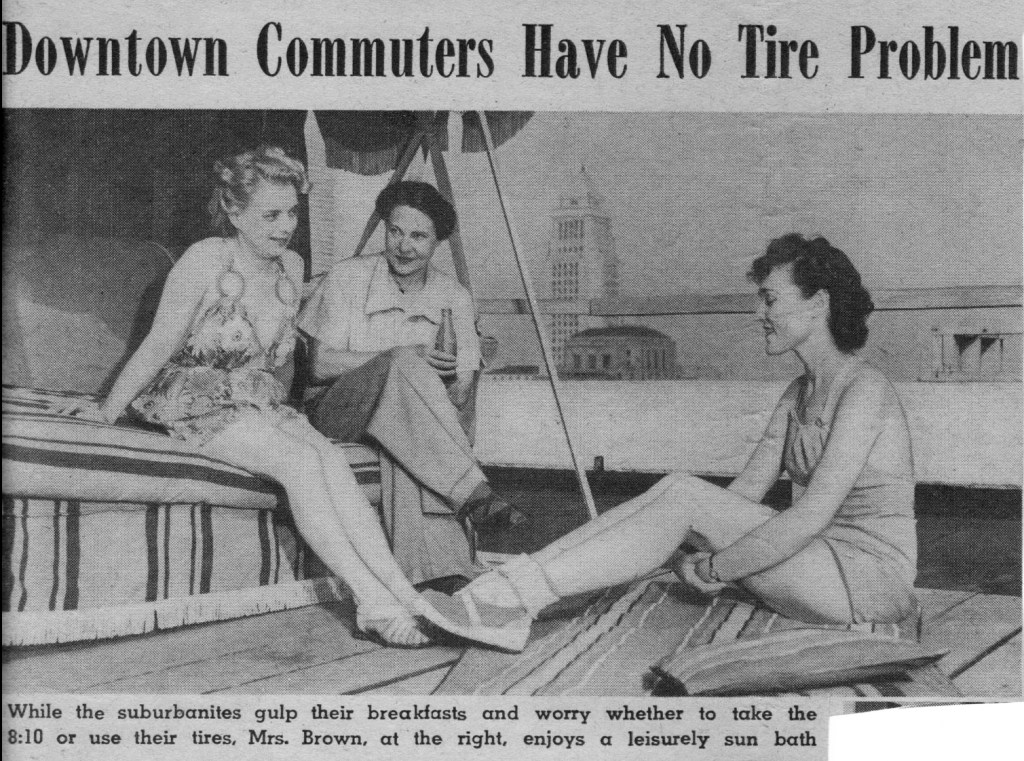
Check out her leisurely morning sun bath! Vitamin D for health and pleasure! Take that, suburbanites!
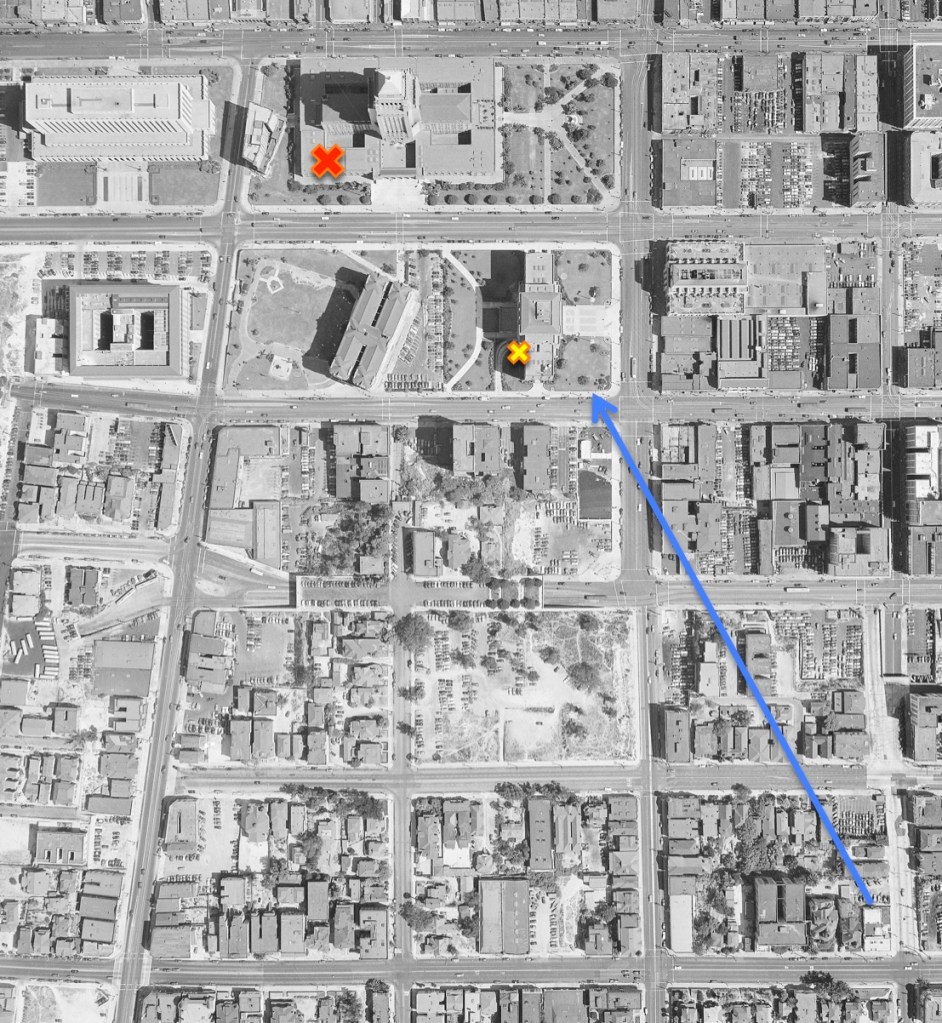
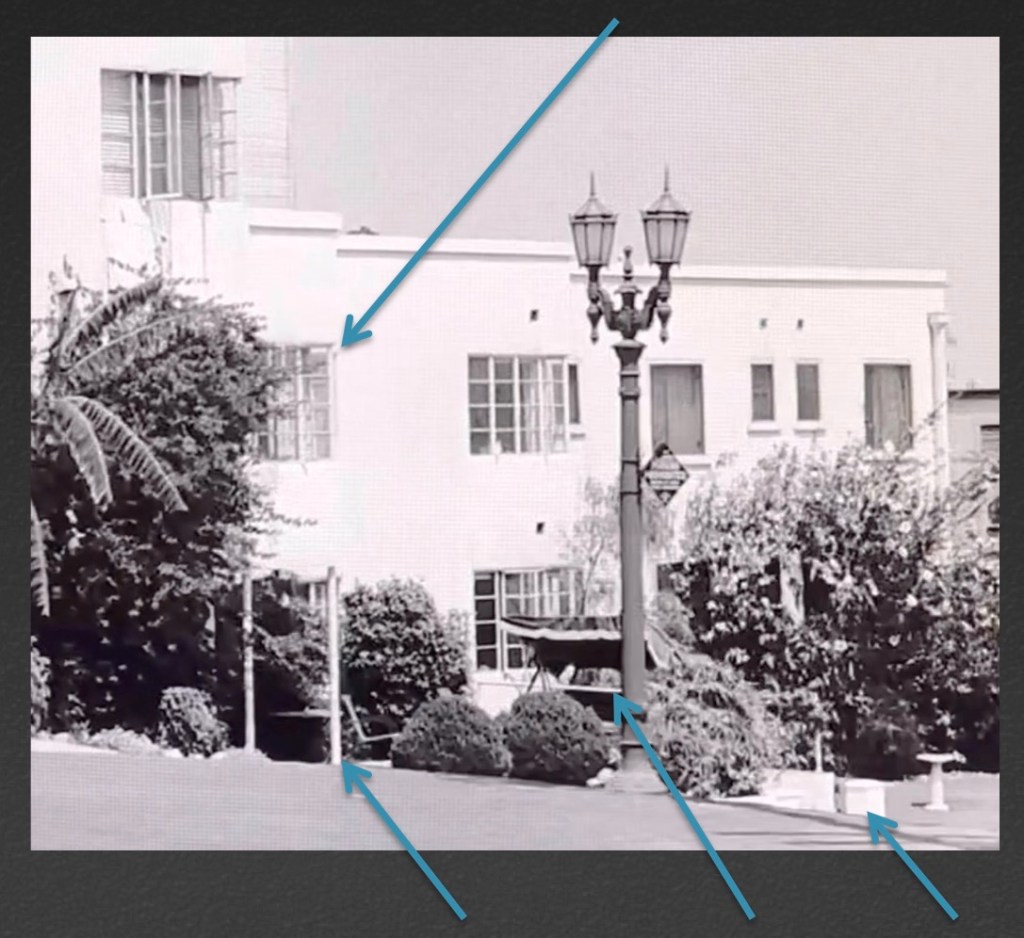
Note in the sun bath image, in the distance is City Hall and, beneath it, the California State Building (demolished 1975). Above, the blue arrow points from the roof of the Avalon to the California State Building (yellow star) and City Hall (red star).When Bryan sent me this image of his aunt, I lost my damn mind. Shots looking up at the south façade are nonexistent. The metal corner casement window! Pilotis channeling Corbu!
To note in the image above — the concrete pillar near her feet, the canvas-covered swing, the piloti, the upper window. Screengrab from the Shockproof process plate
One such landmark is the Richelieu, the Avalon’s adjacent neighbor.
A nice shot of Angels Flight, though pulled from the Times archives for this spread; it appears to predate 1942 by about a decade.
Well to be accurate, the Flight hauled her from Hill to Olive Street, and the ride is just sixty seconds. Maybe they’re counting the two minutes it took to walk from Olive to Grand.
Fighting ended, and Bob returned home. The Browns had daughter Barbara and son Robert Jr. in short order, and lived at 304 E. Oceanfront, then 211 East Central (now Balboa Blvd.) in Balboa.
The Balboa Pirate Days returned; here’s an image of Sally leaping ashore, in a news item from 1946:
Venice Evening Vanguard, September 2, 1946
Note, bottom, Sally’s husband Bob as event chairman. Santa Ana Register, September 4, 1946
But the pirate days would not last much longer. After the 1947 season, city fathers had grown tired of the drunken rowdiness and put a kibosh on the whole affair.
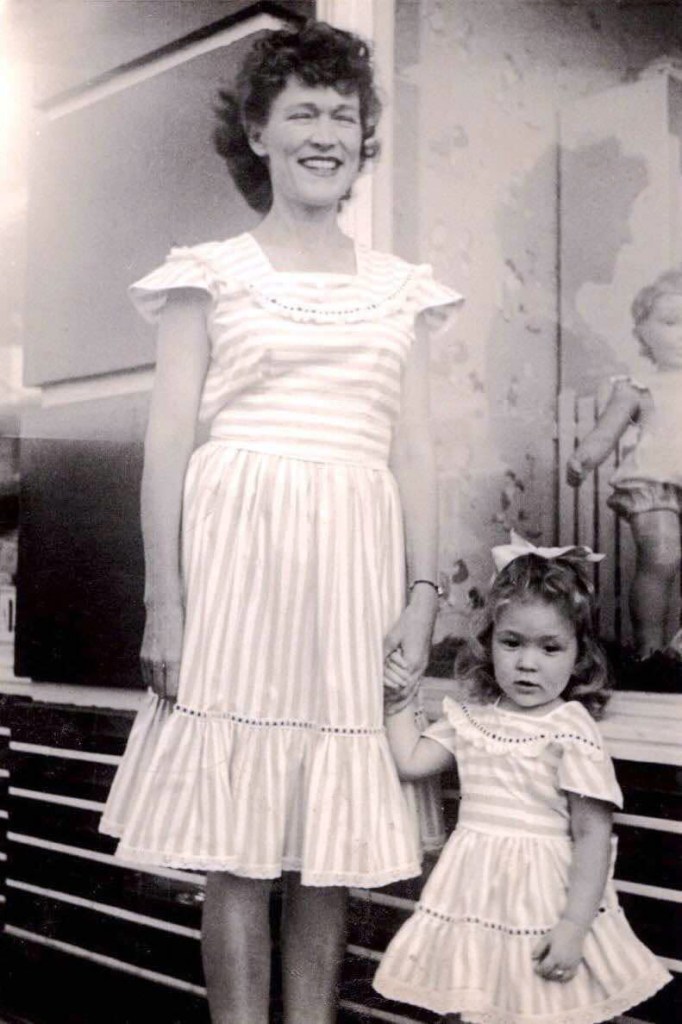
Sally and daughter Barbara, on Balboa in 1948
Sally gave up the telephone company and became a realtor, working many years in Newport and on Balboa. Here’s Sally and Bryan’s grandmother Dot on their Balboan bikes:
Sally Christine Glover Brown died in August 1980, up in Yolo; her ashes were scattered at the Point Bonita Lighthouse
Sally’s daughter Barbara recounts how, in the 1950s, her mother would still go out for drinks with pals Pinkie and Renie (Irene) with whom she’d lived on Bunker Hill back in the day. I am deeply indebted to Barbara for the wonderful images of her mother! And of course to Bryan Moore who alerted me to the existence of his great-aunt and her amazing time on Bunker Hill.
And what happened to the Avalon? It had only just turned eighteen when the County came for the entire block bounded by First, Second, Olive and Grand, to be a parking lot for the new Courthouse and Hall of Administration project.
X marks the spot where the Avalon once stood, replaced by a parking garage:
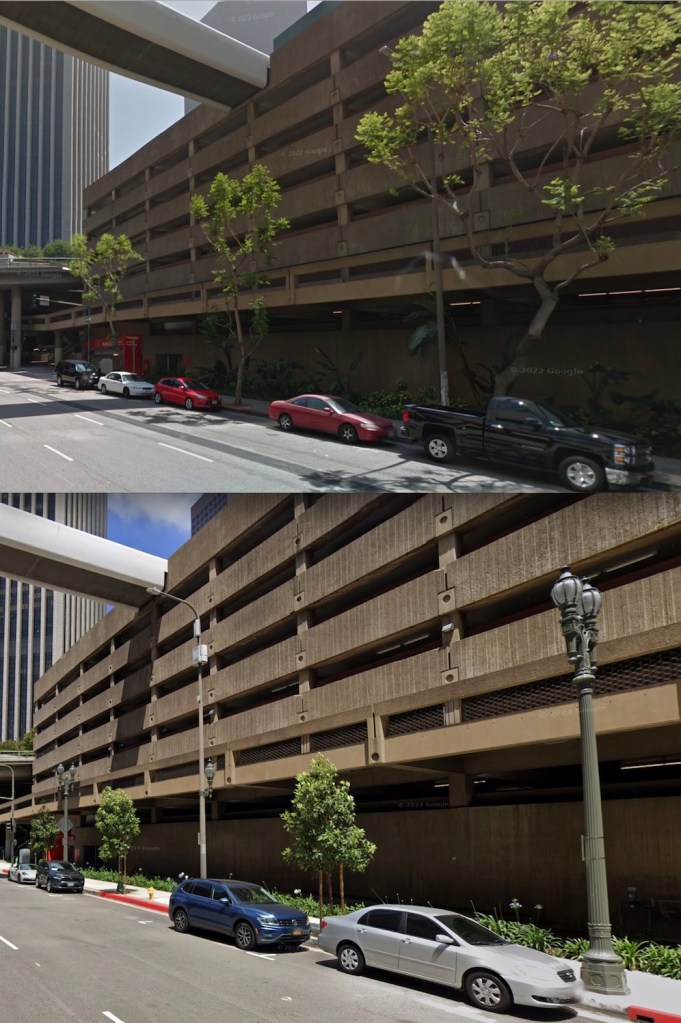
The block bounded by First, Olive, Second and Grand was built up in 1969 with this “temporary” parking garage. As designed by engineer Charles Bentley, it was a revolutionary concept, roughly akin to an Erector Set, whereby it could be taken apart and reassembled elsewhere. The County commissioned Bentley to build the garage on Bunker Hill after it had seen his company, Portable Parking Structures, Inc., put one up at Temple and San Pedro Streets. Though Bunker Hill’s 1,062-car structure was designed to be portable, it never moved, nor was it relocated when, in 2018, just shy of its fiftieth birthday—a stay longer, historically, than a great many Bunker Hill buildings—it was unceremoniously demolished. Huntington/Huntington
Bentley’s parking structure was tossed in the dumpster and in its place went The Grand — this went in the dumpster too: LA’s siren #93, a Federal Model SD-10 “Wire Spool” which was a protected historic resource, illegally removed and tossed, and the City just…shrugged.
If you have a relative who’s lived on Bunker Hill, don’t hesitate to contact me! See the “Contact” link at the upper right of this page. Thank you!
As a teen in the 1980s I sat through no small quantity of “youth culture” pictures. Most were terrible. Some were great (Repo Man); some were so-bad-they’re-great (Valley Girl); and some were objectively terrible, and yet absolute genius (Surf II).
Some were a cut above, like 1984’s Night of the Comet.
Night of the Comet has a lot going on. It’s a feminist treatise on the power of strong women and sisterhood. It’s a trenchant critique of Reagan-era consumer culture. It explicates the ennui of Late Cold War nuclear anxiety.
Me, I just like it ‘cuz it’s full of Bunker Hill.
NIGHT OF THE COMET
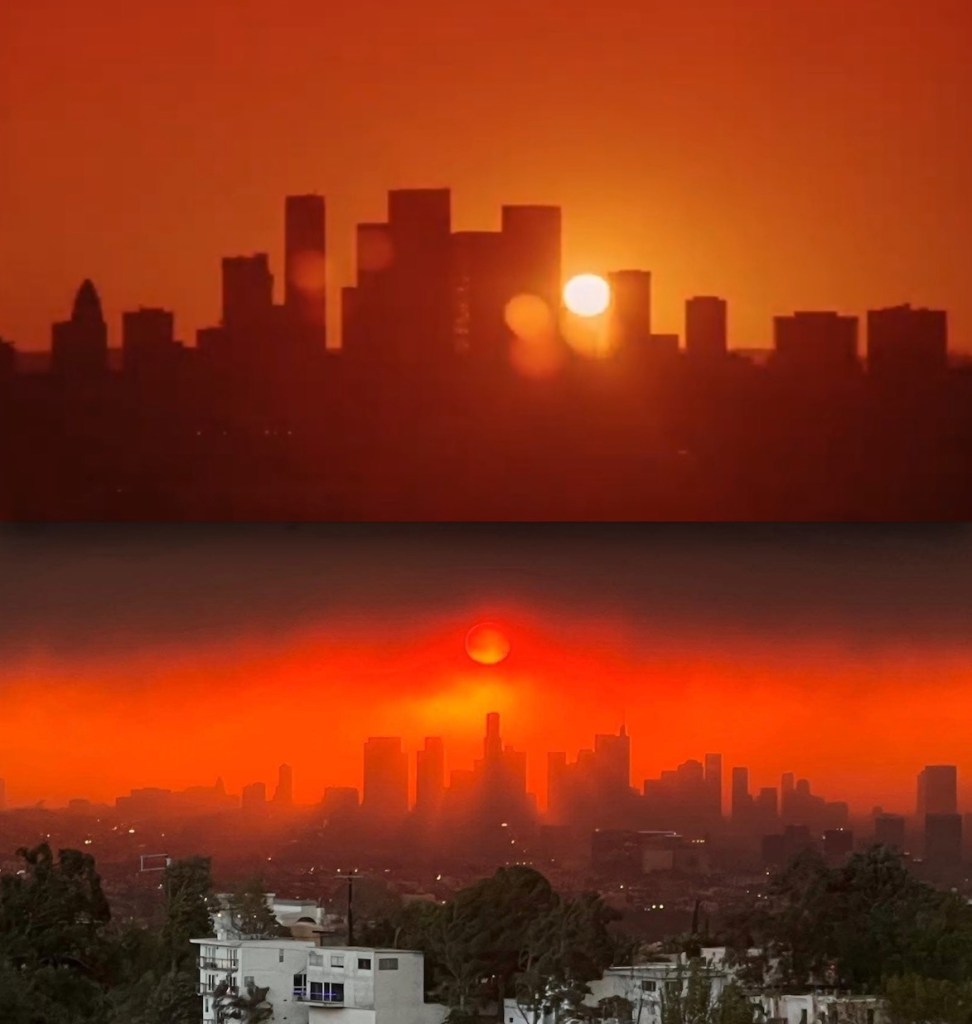
Let me mention at the outset, this was a really weird post to compile. Tuesday last I was busy command-shift-4’ing endless Comet screengrabs of an eerily still Los Angeles enveloped by a terrible reddish-orange post-apocalyptic haze. All of a sudden, wind roared like a freight train, and the power transformers exploded, plunging us into darkness. The next day, still no power — just an eerily still world outside, enveloped by a terrible reddish-orange post-apocalyptic haze.
An establishing shot of post-comet Los Angeles in Night of the Comet (at 11:15); downtown Los Angeles the morning of January 8, 2025(from here)
**********
Night of the Comet, in a nutshell: the earth has passed through the tail of a comet, wiping out all the people. But teen sisters Regina and Samantha are so independent (having sex! fighting with mom!) they are spared obliteration. They then must navigate a post-comet world full of zombies and mad scientists, while dancing around in a mall to Girls Just Wanna Have Fun. It’s basically Day of the Triffids, but looks like Liquid Sky, plus it’s a Christmas movie, with Mary Woronov. Like I said, there’s a lot going on.
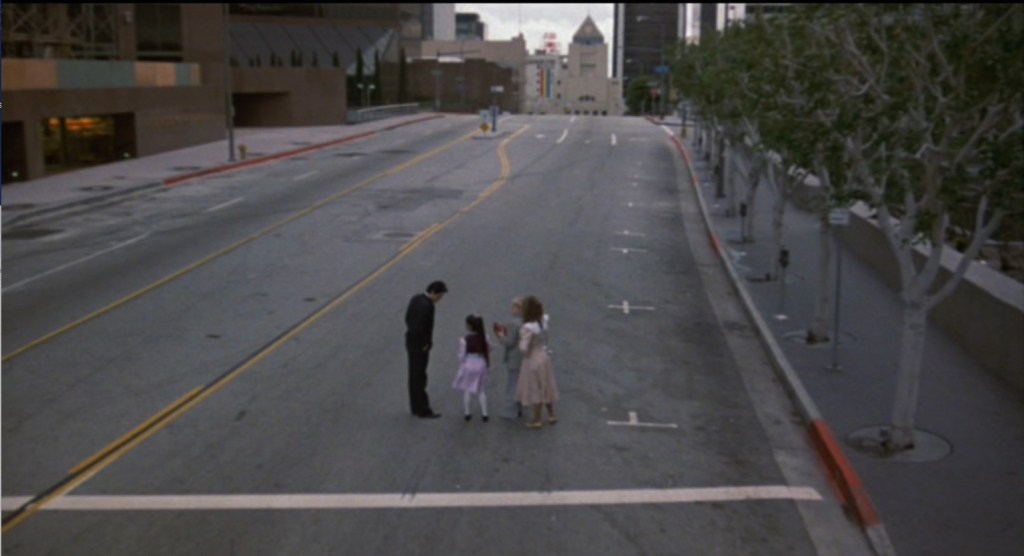
Much of which is going on on Bunker Hill. The filmmakers figured Bunker Hill, then in its nascent days of development, would be pretty empty and therefore useful in depicting a desolate, uninhabited world. They figured right.
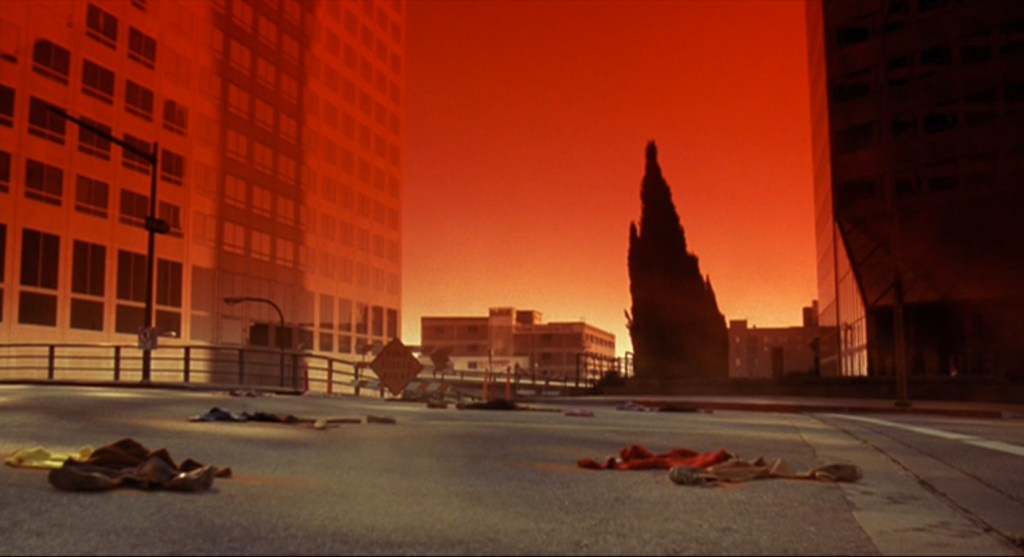
Note at lower left: see the heels and the dress and the pile of red dust? That’s what happens to you when you look up at a comet, you comet-looker.
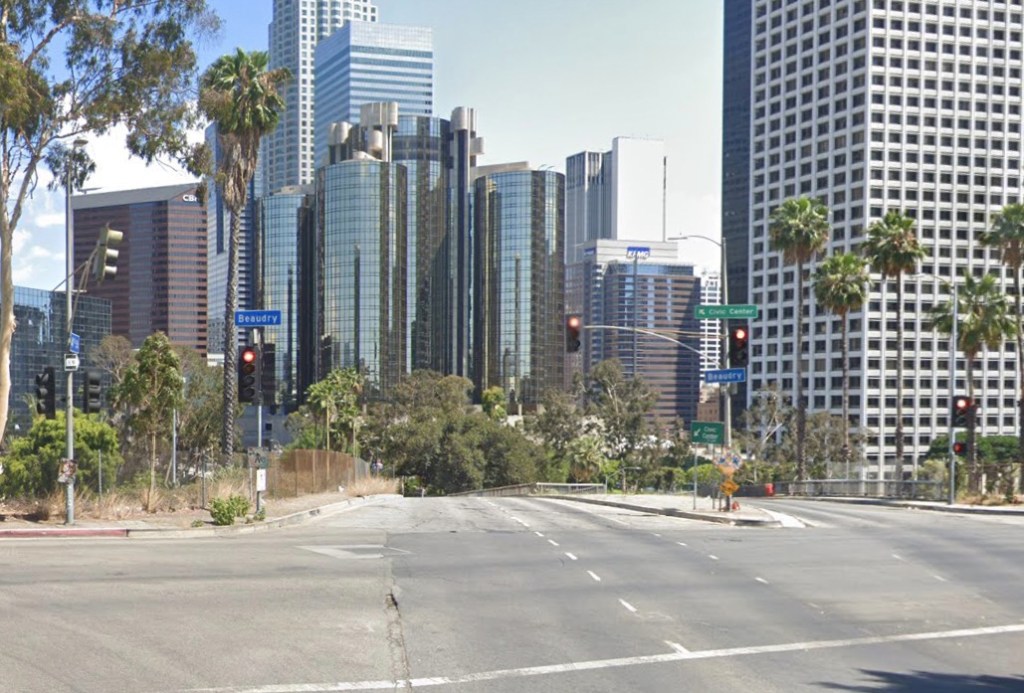
Looking east on Fourth across Beaudry
Looking east on Fourth across Grand Avenue. The low structure, center, at the northwest corner of Fourth and Olive, is the Mutual (née Central) Garage, built in 1923, demolished in 1989. Note the Italian cypress at center-right; they were installed as part of the 1982 O’Melveny & Myers bank tower project.
The garage is gone, having been replaced by Two California Plaza. The cypresses are gone, too, and O’Melveny & Myers is now CBRE. Right-center is 35-story Perla LA, at Fourth and Broadway, built by the Chinese government.
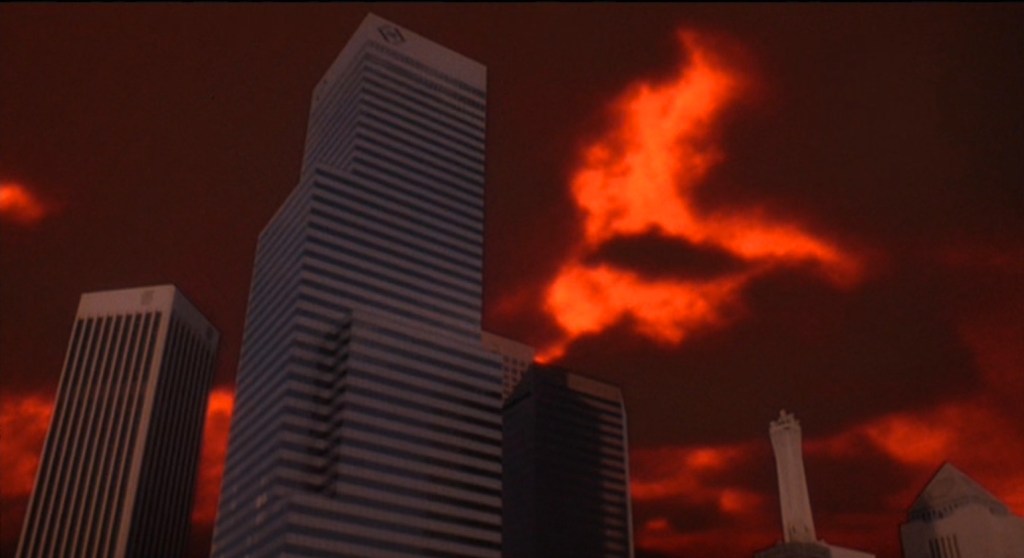
Looking up at the blood-red & Hallowe’en-orange post-comet sky from Flower just south of Fifth. Note the Wells Fargo and Security Pacific logos (about which I discuss a bit, here).
The Library (1989) and Gas Company (1990) towers have been added to the landscape. At right, behind CentralLibrary, a bit of the Biltmore Tower (1987).
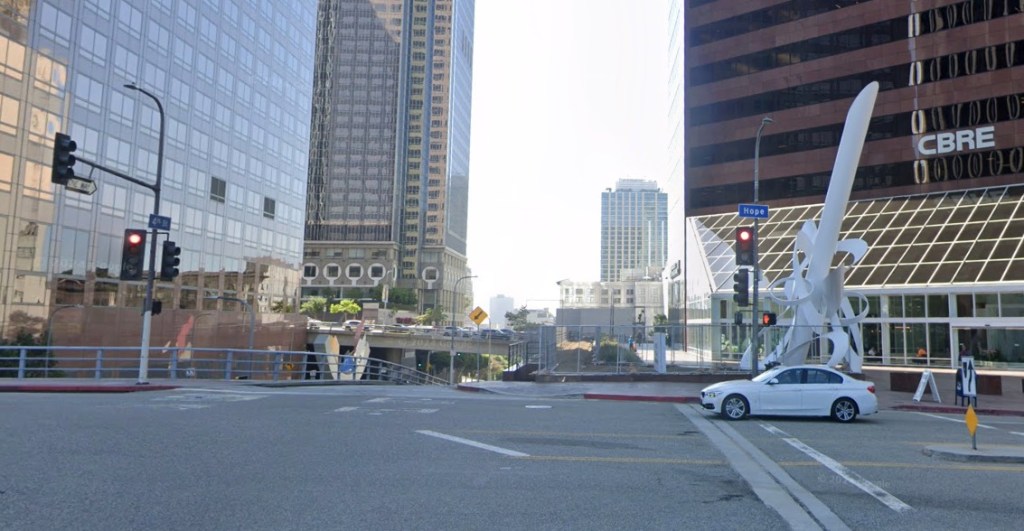
Looking up Third, from Hope, toward Grand. Note the Broadway tower of the Million Dollar/MWD at left-center, peeking above Grand.
The back stairs into the Wells Fargo Center appear much the same. The view across Grand, with the Angelus Plaza towers and the Million Dollar beyond, is now blocked by the Omni Hotel (1992). At left, the Grand Promenade (1989).
Looking south on Grand Avenue from Third. The Crocker Center south tower, left, was still under construction when this was shot; it opened in July 1985.
Crocker Center, now Wells Fargo Center, is the expression of early-80s corporate monolith. See what the late Fredric Jameson had to say about it, here.
Looking south on Grand from Third again. There’s that 1923 Central Garage at left.
Everything to the east of motorcycle-riding Catherine Mary Stewart is now the site of One California Plaza (1985) and Two California Plaza (1992).
The view across Third down Grand. That pit at left would be filled in by the Cal Plaza towers and MOCA; the pit at right, by the Grand Promenade and Emerson residential projects.
There are a whole lot of “let’s find movie locations” websites, and many of them cover Night of the Comet. But I notice—as far as I can tell—none have ever identified the location of this target practice sequence. Well, here you go.
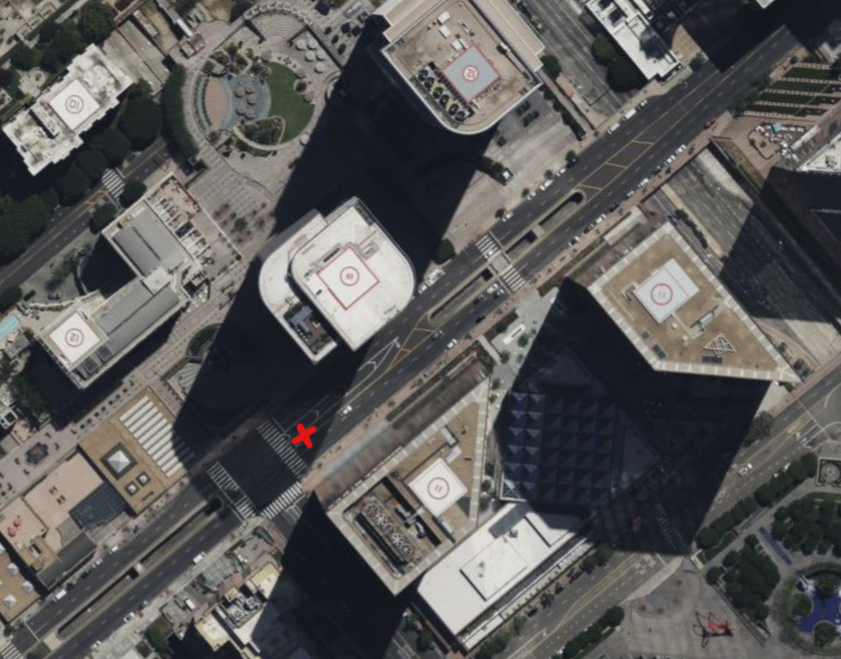
They are standing at the X, facing the oval, the car at which they shoot. A 1983 aerial via Framefinder
At this point you ask, what are structures behind them? Good question!
When Southern California Edison built their 1931 HQ, they had Allison & Allison design this Art Deco annex, attached to HQ by an elevated pedestrian bridge. To the left of the Edison Annex is Station 42 at 428 South Hope St, built by Los Angeles Gas & Electric in 1924 as a switch motor generator and transformer station. It was purchased by the Bureau of Power and Light in 1937, and served later as a distributing station for the DWP. Both structures were demolished in 1988 for the Library Tower project, which included a new street called “Hope Place.” Huntington
Hope Place, where the two structures once stood.Note in the machinegun-screengrab from NotC, at far left, you may glimpse the corner of the O’Melveny & Myers tower, also seen here at left
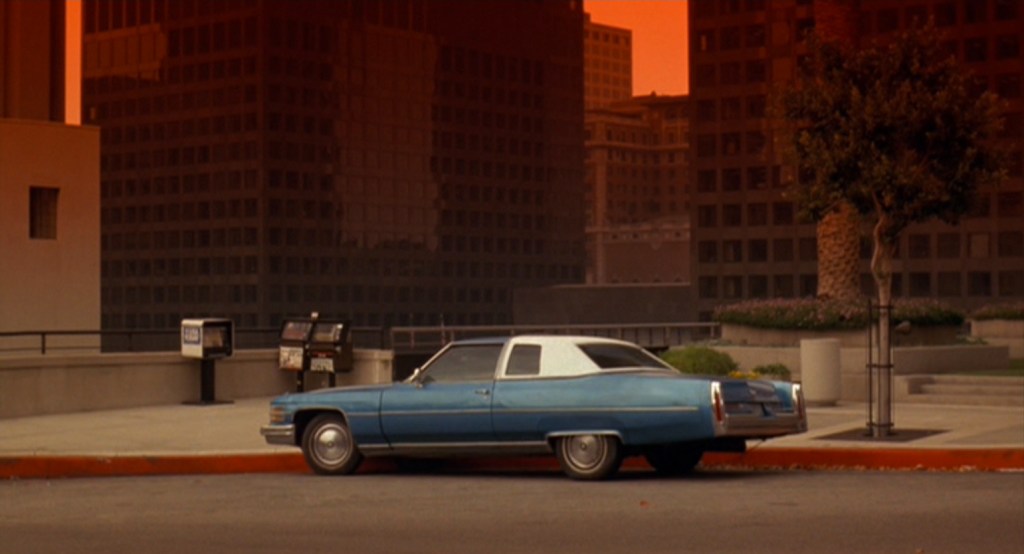
They then shoot the hell out of this poor defenseless ’75 Coupe de Ville:
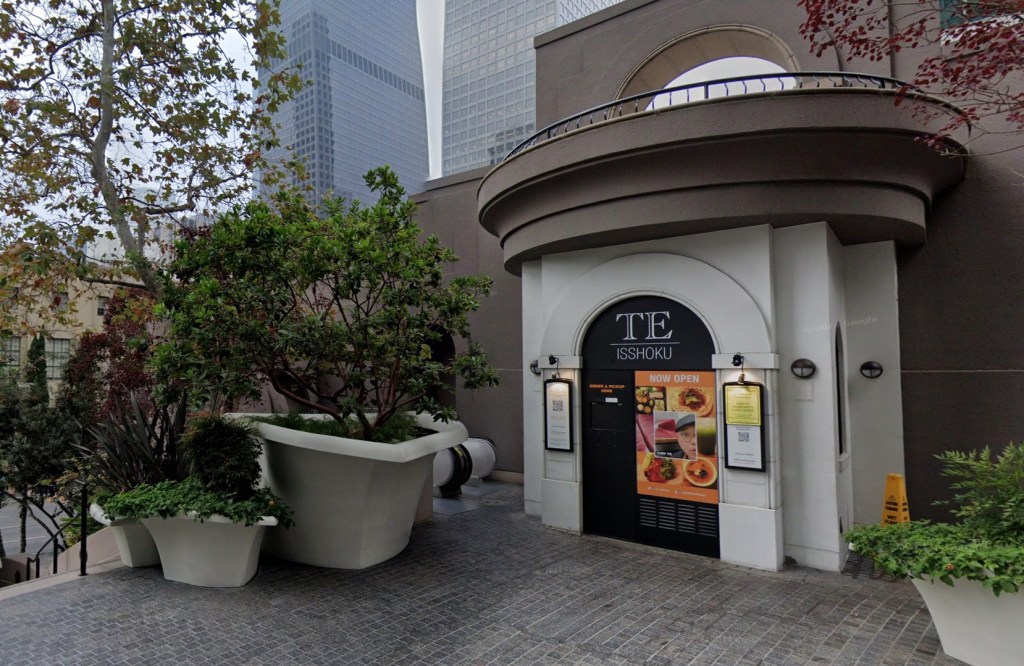
In this shot, we are atop the old Fifth Street retaining wall (seen at left, with a window of Central Library behind). The tree at right is newly-planted, for the recently-completed Wells Fargo Tower (now 444 S Flower). The camera faced toward the X; note the Library at left, and how we peer between the two towers of the ARCO Plaza
The Bunker Hill Steps replaced that length of Hope Street, so, midway up the steps is about where that Cadillac would have been.
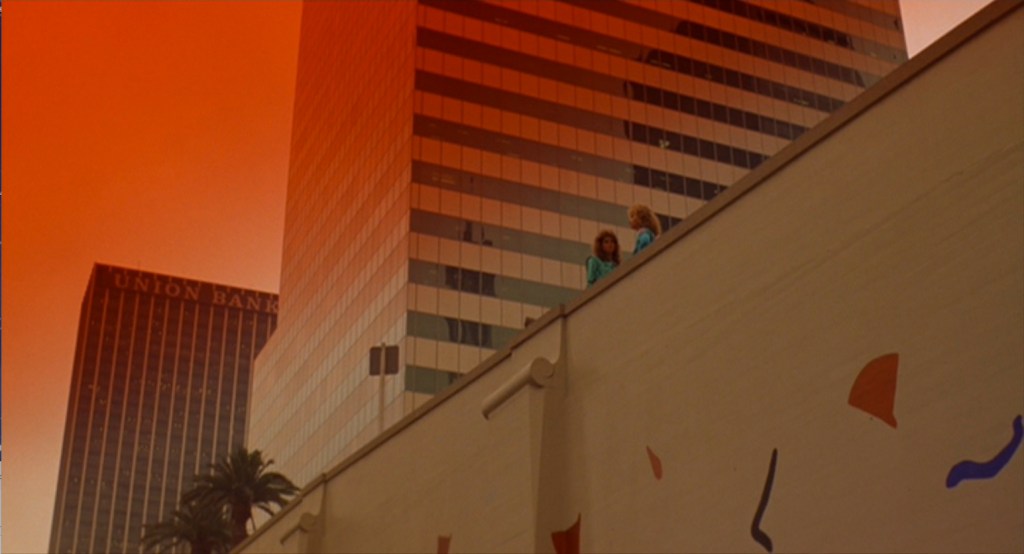
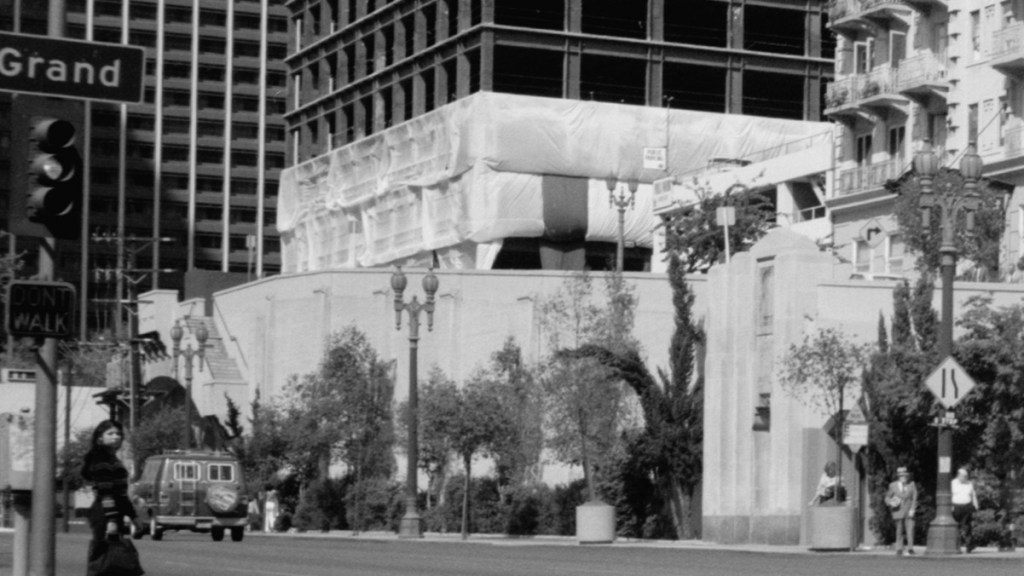
Then they chat atop the retaining wall, in front of the new Wells Fargo Tower, with Union Bank behind. A 1981 shot of the retaining wall, with the Wells Fargo Tower under construction, and Union Bank again in the distance. That retaining wall was demolished in 1986; you might remember this image from Part I of this series. LOC
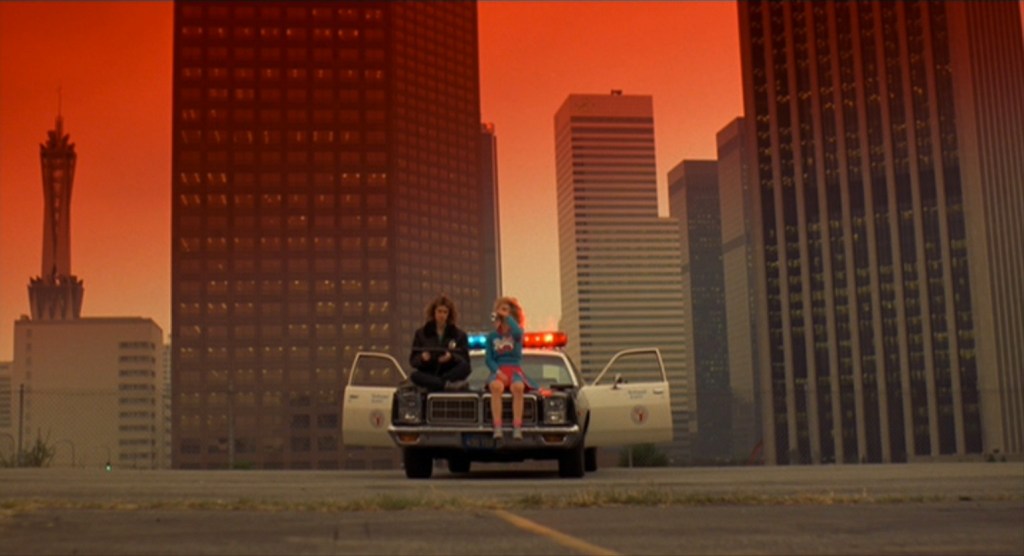
Then there’s this incredible and oft-used image of the two gals atop the hood of a cruiser:
Looking south from near First and FlowerNote how in the 1984 “gals on a patrol car” shot you could look up between the Crocker tower on the left and the Security Pacific tower on the right. No longer; today they’d be in the corner of the Disney Hall, and the view south is blocked by DH, as well as the Broad, Emerson, et al. Similarly, this was shot at the northeast corner of Third and Hope. Today it’s the backend of the Grand Promenade, now known as 255 Grand.
Oh, so, spoiler alert: at the end of the picture, with the death-dust washed away by rains, it’s up to Reggie and Sam to repopulate the world. Reggie becomes a suburban mom and Sam runs off with Reggie’s erstwhile videogame nemesis.
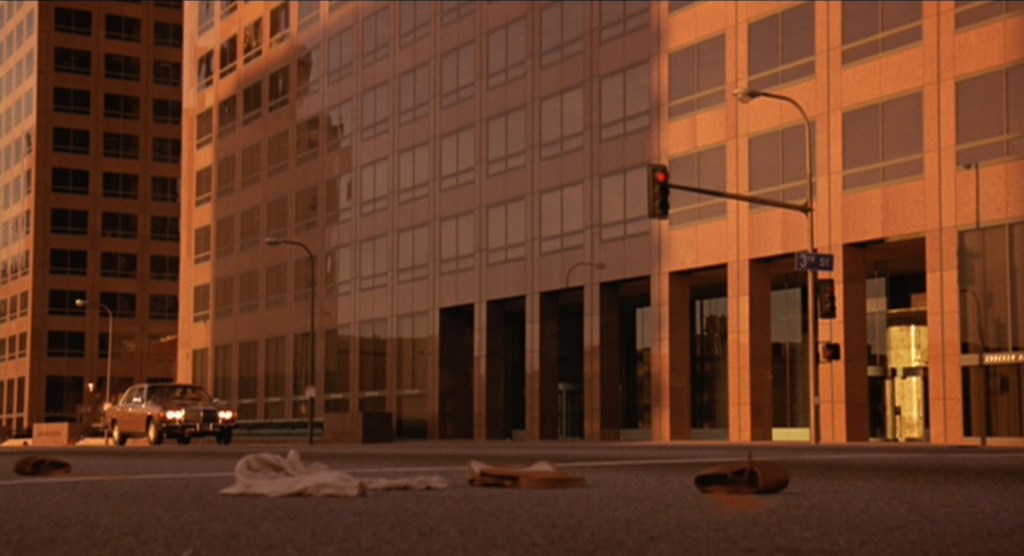
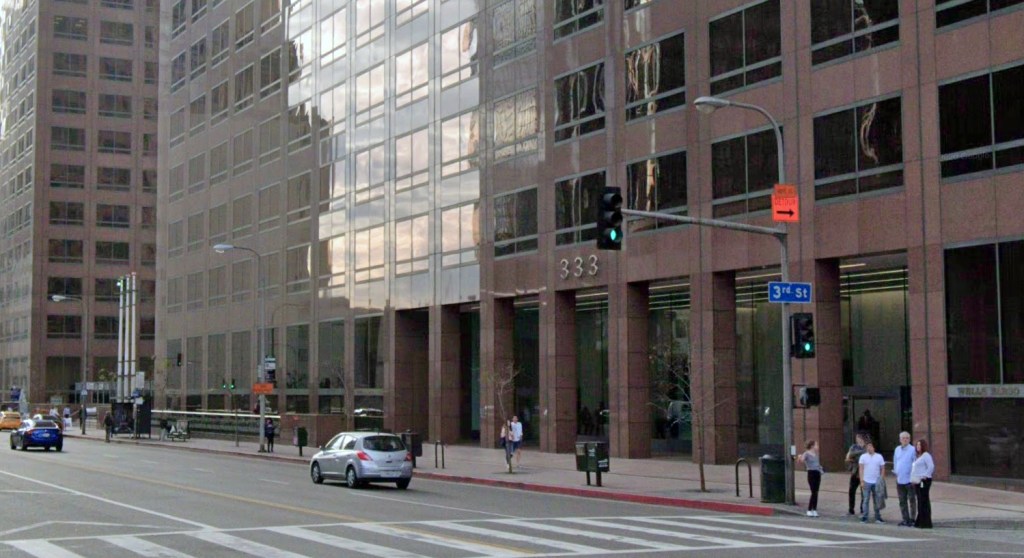
The happy family-of-the-future outside Security Pacific, 333 South Hope
Sam wonders “what’s my place in this new world?”
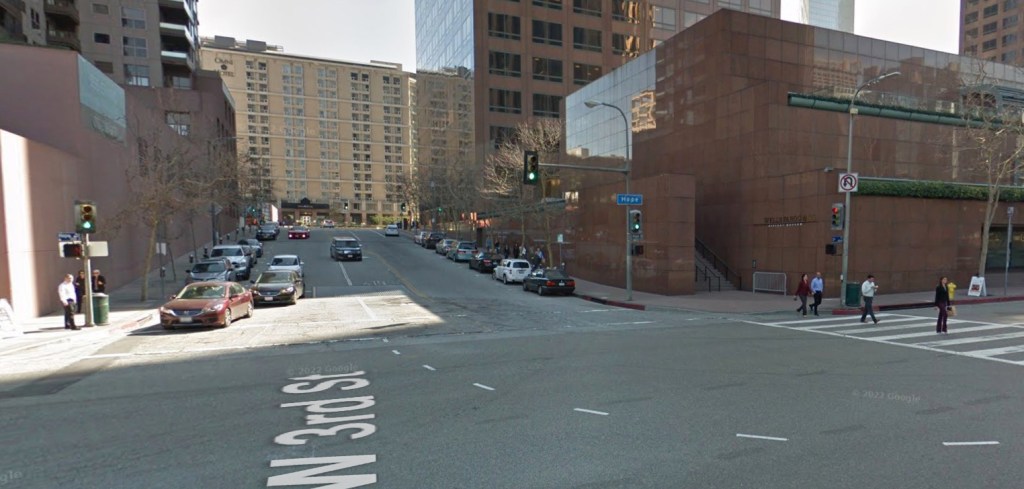
330 South Hope, AKA the backside of the Wells Fargo Center
But she needn’t wonder any longer, because here comes another Mercedes (an ’81 380 SL convertible) to whisk her awaytoward a glorious future
And in our parting shot, our new family plays football in the street —
Keen-of-eye folk will note the Jesus Saves neon to the left of the library tower
I spy Alexander Liberman’sUlysses, installed in 1987
***********
And that concludes our Bunker Hill-themed look at devoid-of-life, end-of-days LA. Shall it come to pass? Whither are we bound? I don’t know. But then, I never thought we’d live in a world without the McNally House.
My gut tells me Los Angeles’s dystopian future will look more than They Live than Return of the Living Dead, but I’ve been wrong before. God help us all.
Watch Night of the Comet in its entirety, here. A nifty music video that encapsulates the spirit of the film is here. Of course, if you want to learn more about the structures discussed in this post (the Bunker Hill Steps, Security Pacific Tower, Wells Fargo Center, etc. etc.) you might want to pick up the one-and-only guide to Bunker Hill, here.
Part I, detailing the evacuated, Venusian-menaced Bunker Hill of 1954 in Target Earth, is here.
People who own Marsak’s Guide to Bunker Hill have sometimes asked how did you get all those shots of Bunker Hill devoid of any sign of life?
In my years of architectural photography I have worked to shoot structures with as few cars and people in frame as possible, striving to depict buildings as standing alone, à la sculpture in a museum. That activity takes no small amount of patience and timing, but it produced some great shots for Marsak’s Guide:
That said, above and beyond the whole “patience and timing” business, the production of these images benefited greatly from a little thing called The Pandemic. Covid locked down the world, and told everyone to go inside; I, of course, did nothing but go outside, and revel in the newly-depopulated universe.
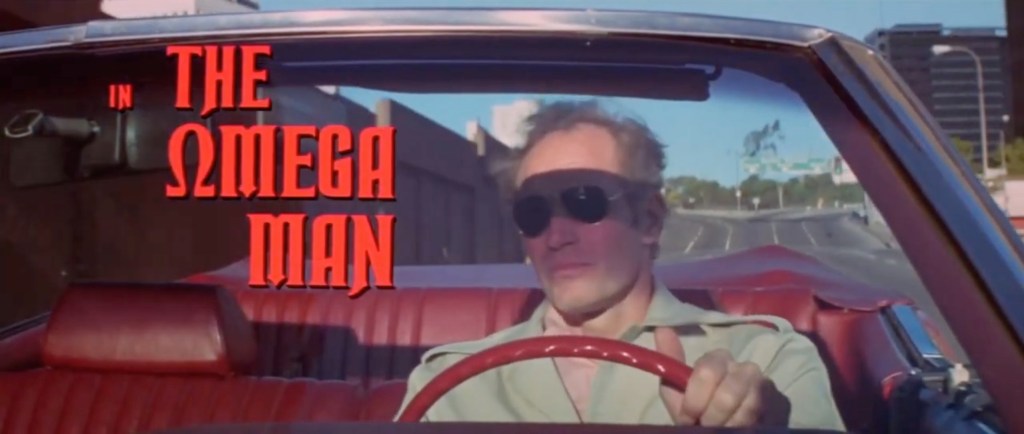
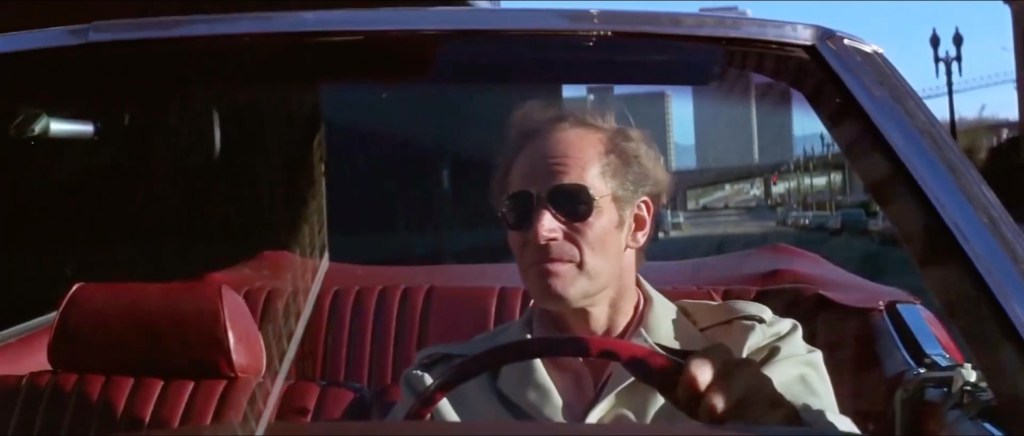
This is my roundabout way of saying pandemics are really useful for going outside, shooting architecture, or, shooting at pandemic-zombies with your S&W M76 (while wearing a safari jacket and driving a red 1970 Ford XL convertible).
The Omega Man
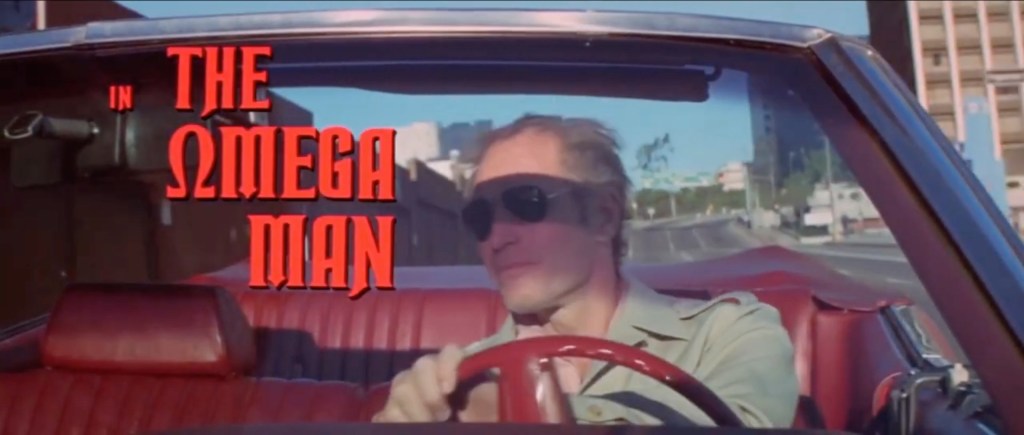
In Richard Matheson’s 1954 novel I Am Legend, a plague ravages earth courtesy of bats (not unlike, say, a certain earth-ravaging plague five years ago) at which point a guy named Robert Neville battles vampires, in Gardena of all places. The 1971 film The Omega Man, based on Matheson’s book, made the plague a result of biological warfare via some Sino-Soviet war, whereby Neville drives around greater Los Angeles, battling vampires (but fleshed out into “The Family,” a cult of mutant albinos bent on destroying technological prowess, like a bunch of freaky-deaky Ted Kaczynskis).
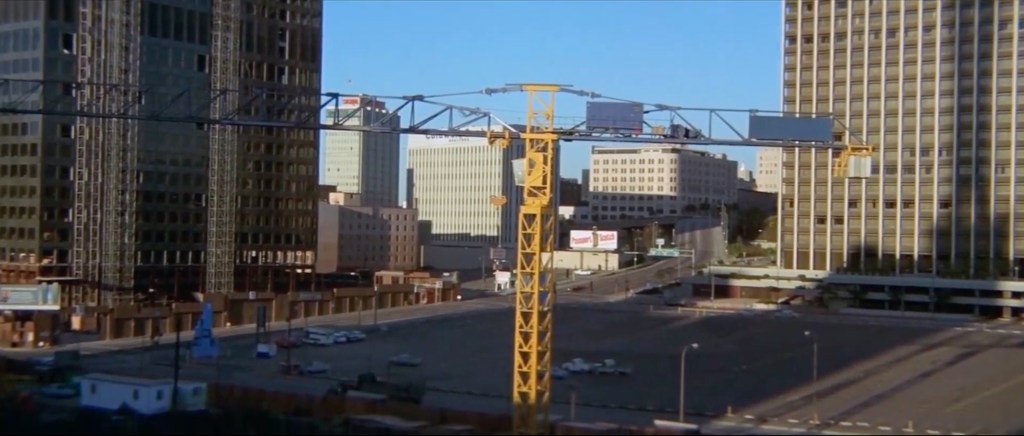
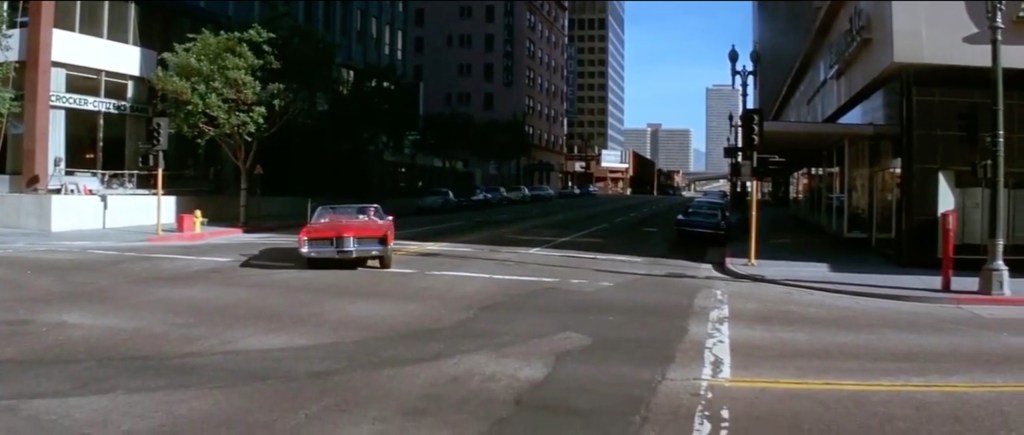
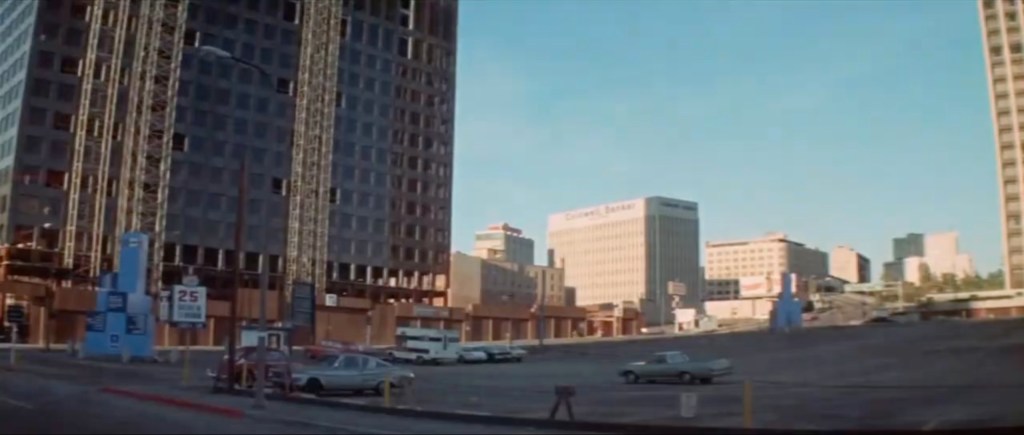
The opening few minutes of the picture are a marvel to behold. Omega Man‘s film crew took to Los Angeles’s empty Sunday morning streets in late 1970, filming Neville (Charlton Heston) driving around a sunlit downtown, while the photophobic zombie horde cowered in darkness. The first shot of the film, Heston heads east on Fifth Street, through the intersection of Figueroa:
Look real hard next to the crane, and you can see Heston’s red convertible about to enter the intersection. At right is the Union Bank; at left, with the construction fence, is the ARCO Plaza towers under construction. The big parking lot is the future site of the Bonaventure. The yellow crane in the foreground is being used to build the ARCO towers parking garage (atop which Ketchum YMCA would be built in 1986). Heston turns south onto Flower from Fifth; behind him you can see the newly-opened Bunker Hill Towers, and the Fourth Street overpass.
In the image above, note the streetlights lining Flower between Fifth and Fourth—those are “Downtown Double” Model 1906 electroliers, custom designed for Los Angeles by Union Metal of Canton, Ohio. They were, of course, ripped out during the area’s redevelopment. But in late 2021 there were brought BACK—
This is the greatest thing to have happened to Bunker Hill in a very long time! I have no idea which City agency is responsible but I suspect Metro may have had a hand in it.
Note this cool construction sign he drives past, with a rendering of the ARCO towers—
Continuing south on Flower, turning east onto Wilshire. Bunker Hill Towers up Flower in the distance.
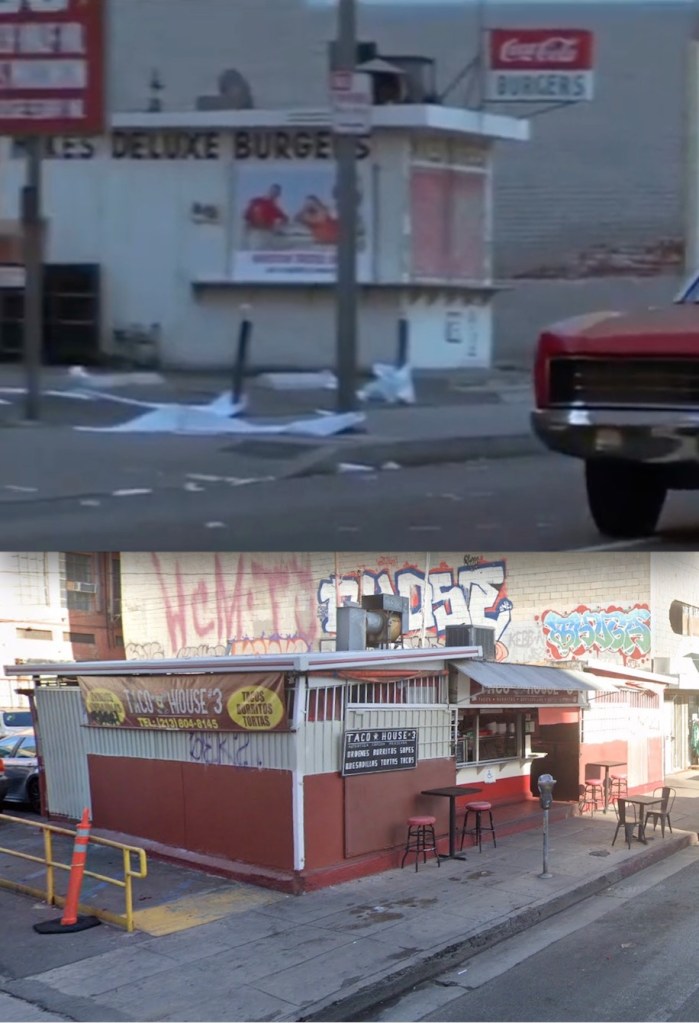
Then at about a 0:40 in there’s the most incredible thirty-second sequence of Heston blowing through three Wilshire intersections, shot from the top of One Wilshire. But since this is a Bunker blog and not an “L.A. locations” blog, you’ll just have to take that in on your own. And, again, I’m not going to go into all the other places Heston drives by (the movie is oft-noted for its inclusion of The Olympic theater), but I will point out that “Mikes Deluxe Burgers”—which is a 1946 lunch stand at 827 Santee built by one Alvin Jaines—is still extant, albeit enlarged by additions, and reborn as “Taco House #3.”
I mean, how many 1946 lunch stands (“lunch stand” on its 1946 permit; “hot dog stand” on its ’47 CO…the 1956 directory lists it as “Hy’s Hot Dog Stand”) still exist downtown???This place is a national treasure, dammit
Then the credits come up and he’s back driving down Fifth Street, between the Union Bank and the under-construction ARCO towers—
Oh right,it’s Ωmega Man
Then, Heston’s all alone at the DWP building (which should remind you of this shot from here).
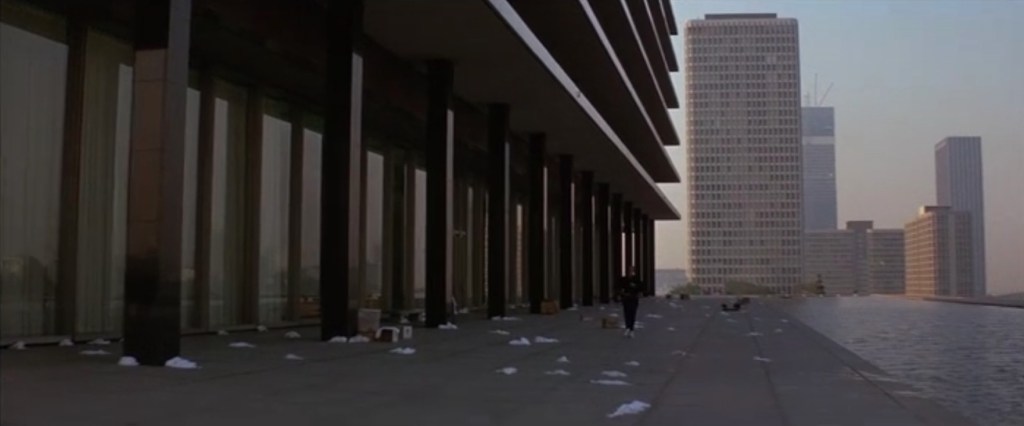
Lastly, there’s a collection of still images, showing a silent and empty city, among them being these two:
The tallest structure, Bunker Hill Towers, is now flanked by the Promenade Plaza condo development, and the big pit center is of course home to the Crocker/Wells Fargo Plaza, Broad, Disney Hall, etc.And yes, they should have grabbed a shot of this when the DWP fountains were off. Shot from the newly-finished Crocker Citizens Bank; compare this image to page 31 in Marsak’s Guide.All sorts of fun things to look at. If you know your “old downtown” you might spot the California State Building at First and Broadway, which would be irretrievably damaged by the Sylmar Quake just two months after OM’s downtown filming. Note too the Criminal Courts Building (now Clara Shortridge Foltz) under construction to the left of City Hall.
The opening scene of The Omega Man (Heston’s amazing 8-track music, btw, is Theme from A Summer Place as performed by the Ron Grainer Orchestra) is here, though you should really watch the whole movie; the trailer will convince you of that!
***************
Tune in next week, when I cover the post-comet Bunker Hill of valley girls and office towers in 1984’s Night of the Comet.
One of the benefits of loving Bunker Hill is seeing the area depicted on screen. Bunker Hill appeared in early comedies, and later, in television programs, but the Hill is best known for its supporting role in all those moody postwar films noir. Bunker Hill-in-the-movies is of course covered in Bunker Hill, Los Angeles, and in Bunker Noir! and also this post, featuring my compendium of Angels Flight in cinema. The definitive work on the subject is, of course, Jim Dawson’s Los Angeles’s Bunker Hill: Pulp Fiction’s Mean Streets and Film Noir’s Ground Zero! available here (check out Jim’s related website here).
For the next couple posts, though, I want to dig into Bunker Hill’s use, specifically, as a barren post-apocalyptic hellscape, as portrayed in three films: Target Earth (1954), The Omega Man (1971), and Night of the Comet (1984).
TARGET EARTH
Old Bunker Hill was, of course, no stranger to cinematic depictions playing up its empty streets. Consider Van Helfin’s mad dash through the deserted Hill in Act of Violence, or Jack Palance nefariously piloting his Oldsmobile through its desolate streets in Sudden Fear:
For example, Bunker Hill’s quiet community of live-and-let-live older folk allowed Roger Corman to shoot quick and cheap (and without permits) on the hill in December 1959 for his Little Shop of Horrors.
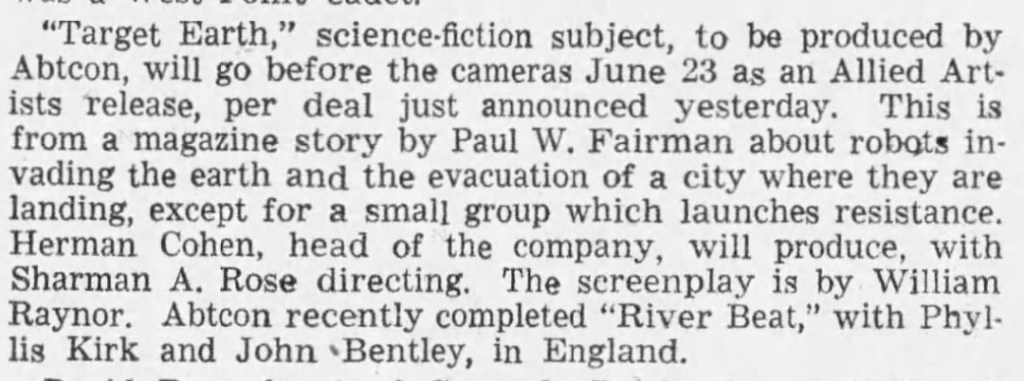
But only one film utilized Bunker Hill’s quiet neighborhood as the perfect setting for a deserted city menaced by sometimes-invisible death-ray-wielding Venusian space robots: Target Earth. It’s a cheapie made by indie outfit Abtcon Pictures in 1954, on the heels of successful 1953 alien invasion pictures like War of the Worlds and Invaders from Mars.
Spoiler alert: you will not be paralyzed with fear
Granted, Target Earth‘s uninhabited Hill and empty LA wasn’t, I will admit, “post-apocalyptic” in the strict sense, as much as the city was voluntarily deserted…eh, so sue me. It was empty and spooky and that’s the point. Target Earth‘s film crew shot on the Hill on a Sunday morning in late July, when the city was still sleeping it off.
Los Angeles Times, June 5, 1954. The picture didn’t actually begin shooting until the week of July 17th, at the Kling Studios. Kling Studios was, of course, the old Chaplin studios on La Brea. An early outing by the great Herman Cohen.
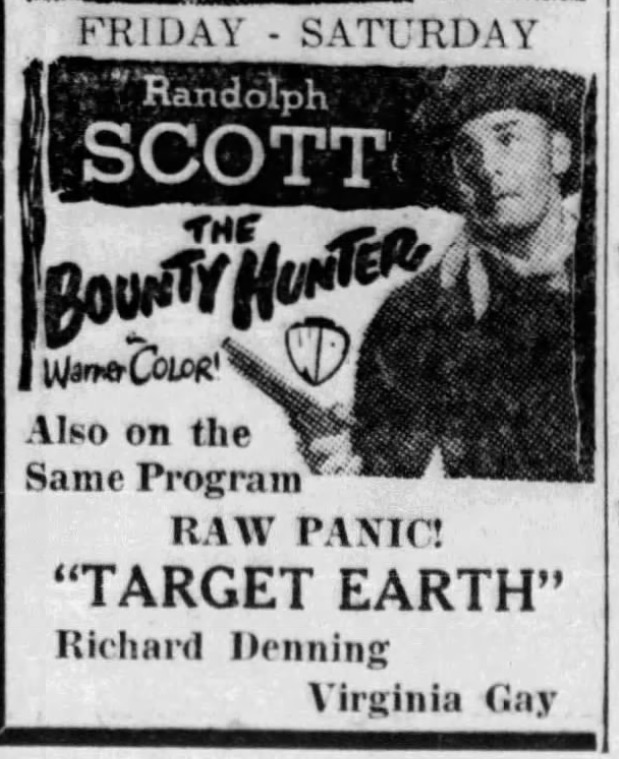
An ad for B-picture Target Earth in the Turalre Advance Register, Nov. 24, 1954. By Virginia Gay they mean Virginia Grey, who portrays a sassy, wisecracking lush and gets called a “crazy dame” not once but twice.
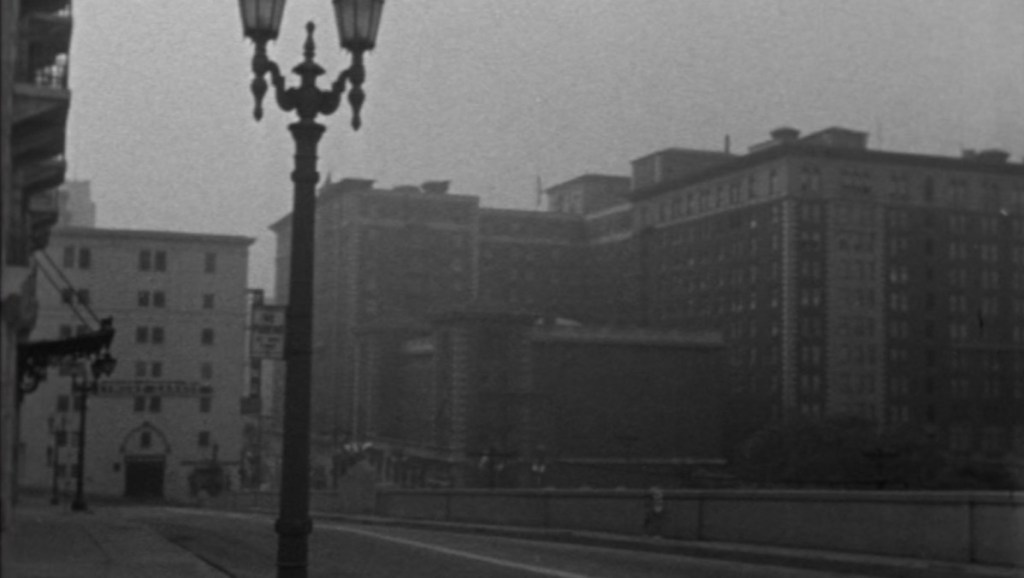
Target Earth begins with Kathleen Crowley (whom you might remember from seminal vampire western Curse of the Undead) waking from her failed suicide attempt to find the city abandoned; she opens her blinds and peers out the window to an empty world, specifically, upper Fifth Street looking toward Grand—
The Engstrum, 630 West Fifth; the SoCal Edison HQ, 601 West Fifth; and across Grand Ave., Grand Central Garage, 535 West Fifth
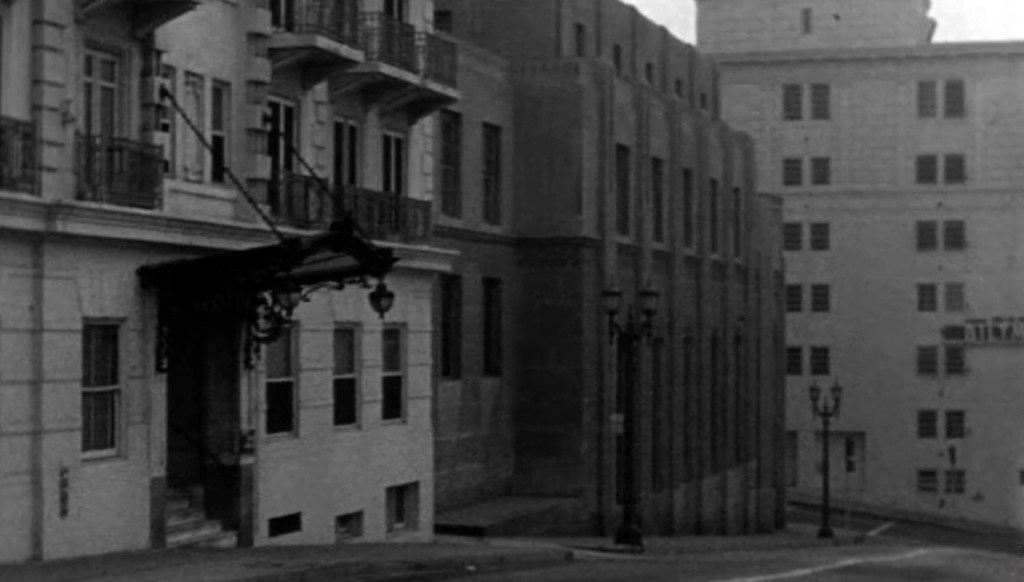
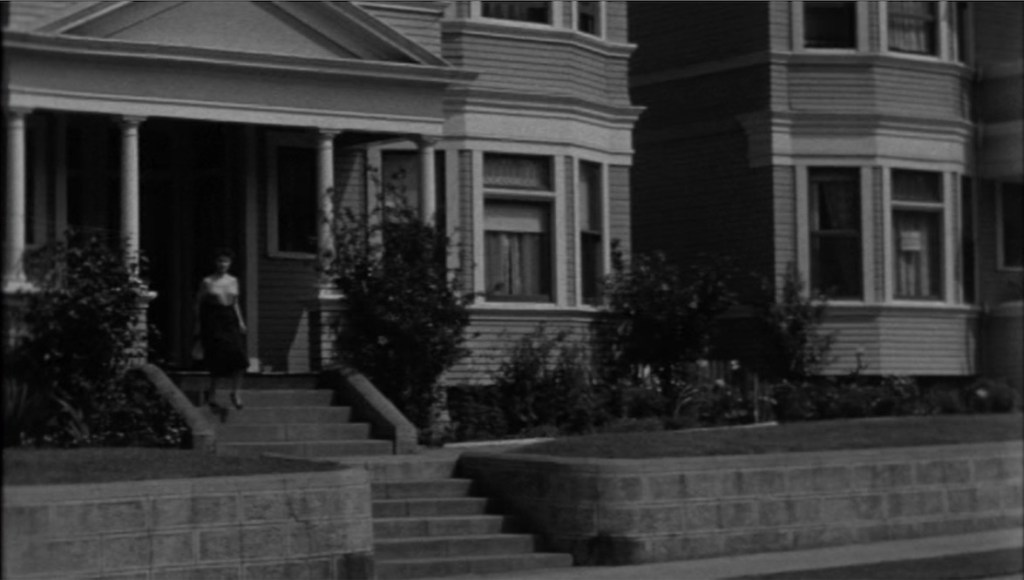
She then exits her pad at 109 South Flower Street:
Which in reality was one block west and four blocks north from the view out her window
A 1962 shot of the southwest corner of First and Flower, by Walker Evans; I wrote about his trip to Bunker Hill here. Metmuseum
Then Crowley looks down at the empty street she saw from her window:
Back on upper Fifth looking toward Grand; the building snuggled into the L-shape of the Biltmore is the Biltmore Theatre
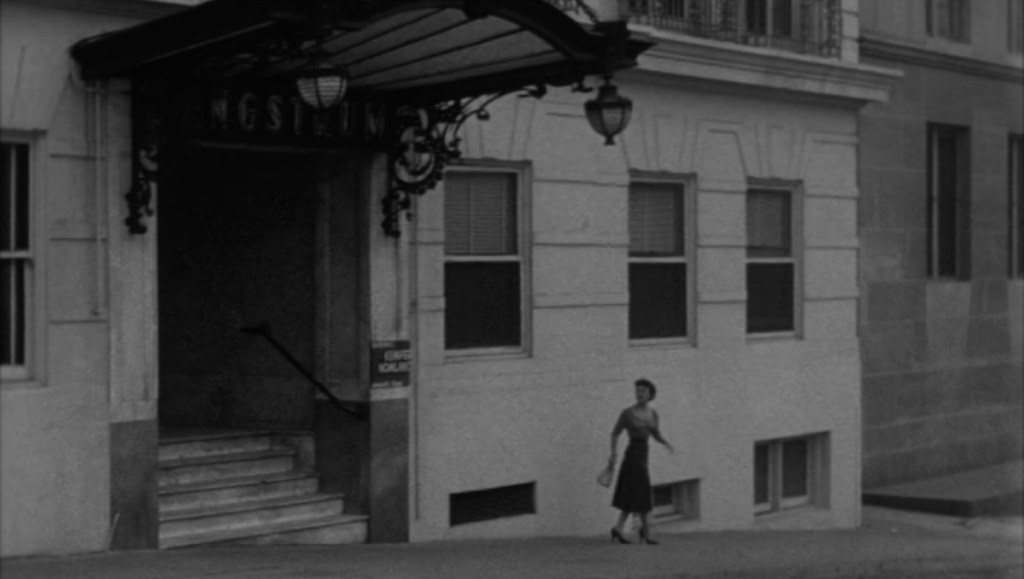
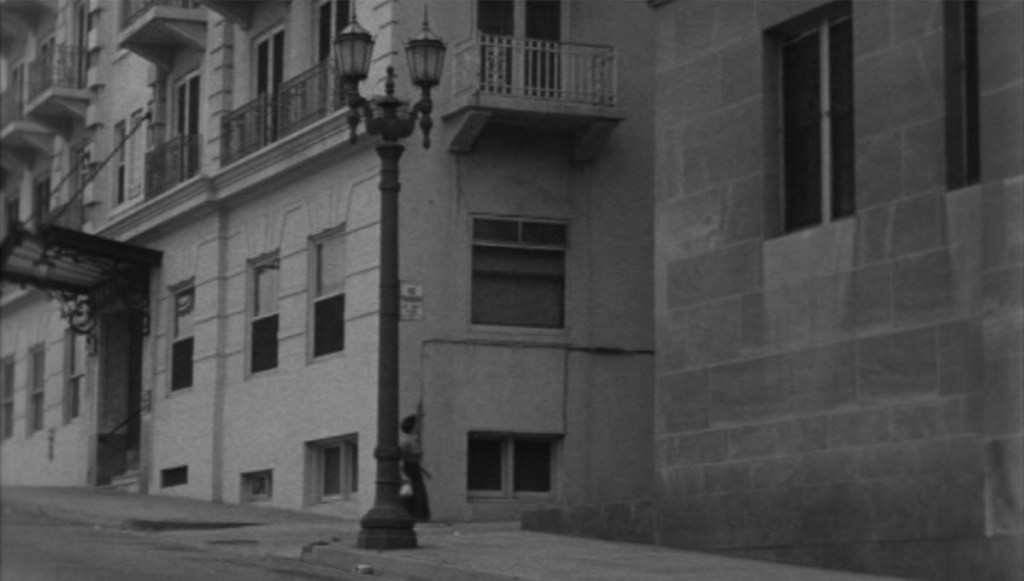
Then, on upper Fifth, she walks past the Engstrum:
Here’s a 1978 color shot of the Engstrum entrance you’ve never seen before. You’re welcome!
And then there’s this reverse shot, her still walking east on Fifth toward Grand, now between the Engstrum and the Edison HQ
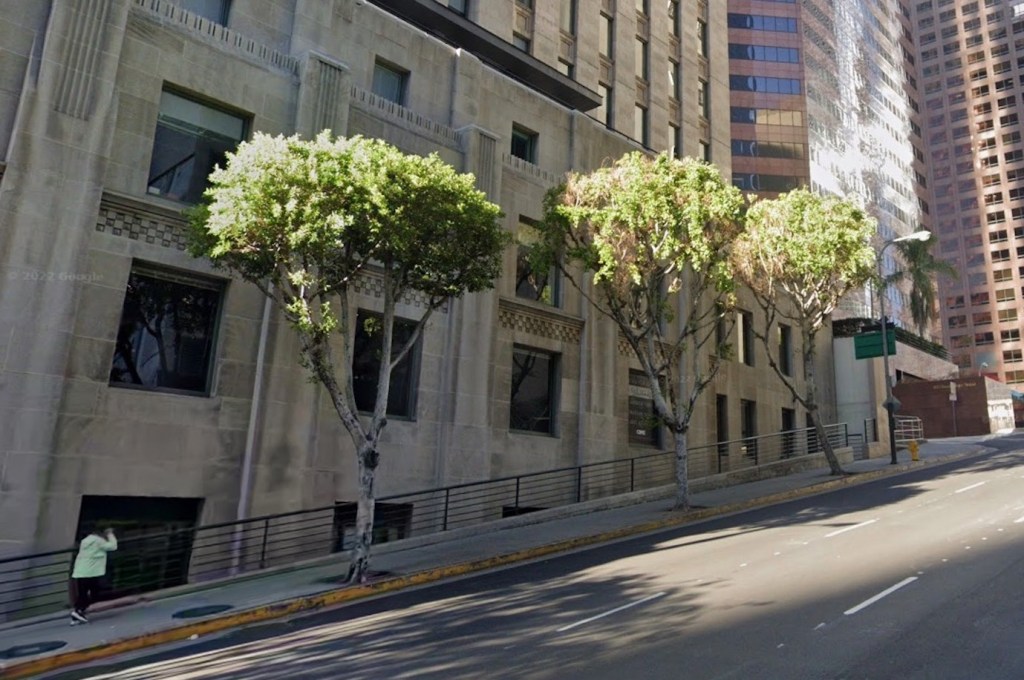
There’s the Engstrum (R. B Young & Son, 1911), up there on upper Fifth. You likely recognize this slide of mine from page seven of the Bunker Hill book. I’ve paired it with a modern shot for reference; the Engstrum and the elevated roadway on which it sat, shored up by a 1930 Carleton Winslow-designed retaining wall, was demolished in 1986.
Still wandering about, wondering where everyone’s gone off to, on Third Street just the other side of the tunnel:
There’s a great shot of Bob’s Cafe, 708 West Third St., on p. 125 of Bunker Hill, Los Angeles. This length of Third Street (replete with dissolute reprobates at night, but deserted come morning when film crews require desolation) is also documented on p. 29 of Bunker Noir!
A shot by Hylen; a confused Crowley was walking the pavement between the Buick and the Plymouth
Next, she heads south on Grand toward Fifth, adjacent the Edison:
That angle today…where the Sherwood and Granada once stood, Welton Becket’s O’Melveny & Myers Tower, and SOM’s Crocker Bank Tower—both from 1982, both featuring polished brown granite and tinted glass, in the grand tradition of office towers from 1982
Lastly, at about 13:30, there’s this shot looking west on Fifth Street from atop the aforementioned retaining wall—
The camera peers over the end of the retaining wall, and looks across the Sunkist facade (right) down Fifth, across Flower Street.
The Target Earth shot would have been captured from about where that fellow is standing in the first image above. These pix are from January 1956, about eighteen months after the movie was shot; note the Early Times ad on the back of the Architects’ Building, Fifth & Figueroa, on both. These were captured, of course, by Robert Frank.
Want to watch Target Earth? Do so here (and, if you so like, colorized here). At 8:03 there’s a shot looking north on Flower across Wilshire, and immediately after, Crowley is seen running past the barber shop at 704 West 6th, at the southeast corner of Sixth and Hope. Around the 13:40 point was shot at the Dominguez-Wilshire and at the corner of Wilshire and Cloverdale; at 14:00 there’s a nice shot looking south on Beverly from Temple. Everything else seems like backlot, although the alien-shadow at 24:40 is against the Statler.
***************
Tune in next week, when I cover post-pandemic Bunker Hill (the cool 1970s pandemic, not the dumb 2020s one) in The Omega Man, and a post-comet Bunker Hill of valley girls and office towers in Night of the Comet.
The most recent issue of photography ‘zine Dog Food is Robert Frank-themed, wonderful in general, but includes a particularly nifty spread called “Anatomy of a Shooting on Bunker Hill” excerpted from my post:
If you’re a completist and collect all things Bunker Hill, or just dig Frank and/or photography, might I suggest you pick up a copy. They are, after all, available free of charge.










































































 Bunker Hill, Los Angeles