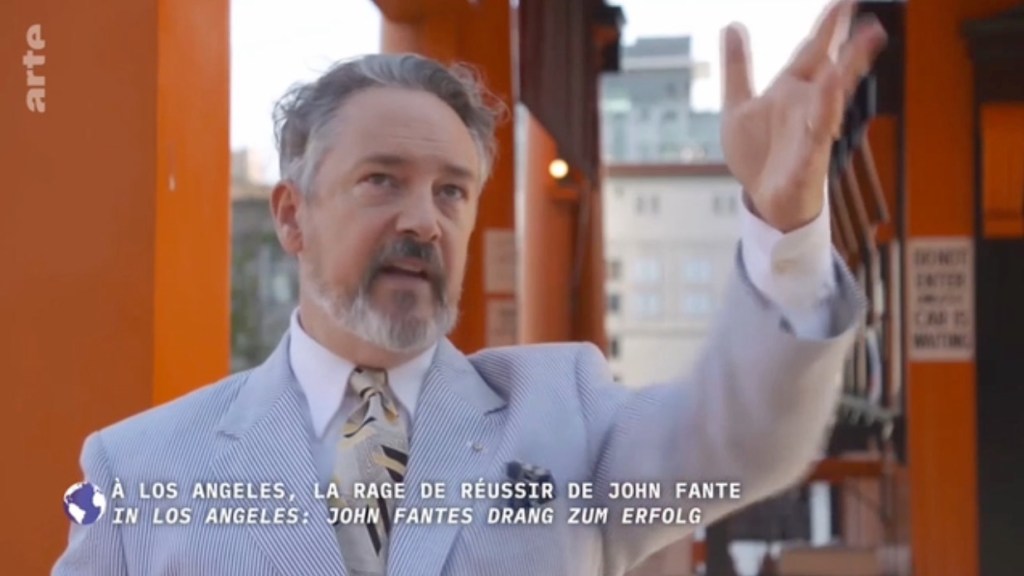
Last summer a couple of my Strasbourgeois pals from Association Relative à la Télévision Européenne were in town to shoot a short feature about the ever-important John Fante.
Fante, of course, famously lived on the Hill, where Third Street ended at Bunker Hill Avenue, in an apartment house named the Alta Vista (which Fante renamed the Alta Loma in Ask the Dust—read all about it in Bunker Hill, Los Angeles).
So they call me up and say “get yourself to Angels Flight, we need you to you to talk about this.”
Ergo:
Arte filmed some other interesting folks for the piece—including Stephen Cooper, who penned the definitive biography of Fante—and added cool vintage images, then overdubbed the whole thing into French, so who knows what I’m going on about (though I like to think that pleases the ghosts of my ancestors in Coutances).
(Having recently published Marsak’s Guide, I thought it would be fun and instructive to post about some of the interesting extant structures on our modern Bunker Hill, as featured in the book.Today, a few words and pictures about the Bonaventure. Will we be going inside the Bonaventure on the tour, one week from now? OF COURSE WE WILL.)
My memories of the Bonaventure are unusually acute. Remembrances of 1970s LA are as you might expect: a bleak and blighted hellscape, devoid of trees, replete with junkies. But the Bonaventure was a bizarre sparkling jewel in a smoggy, sepia city. To gain ingress took some doing, it being surrounded by a giant brutalist concrete wall, but once inside, it was a futuristic maze, and dark as an airport bar.
As I matured and my interests turned to architecture, I discovered the Bonaventure was designed by a nice southern gentleman named John Portman, whose futuristic hotels were in general legendary for their soaring atria. I enrolled at UC Santa Cruz; Fredric Jameson had been a HisCon prof there till 1985—the year I arrived—so his presence was still felt, strongly, and of course any 80s-era study of architecture entailed reading Jameson’s critique of the Bonaventure (see x, y, and especially z, because it has such great vintage footage of the Bonaventure). 1990 saw Mike Davis’ City of Quartz, wherein he called out the Bonaventure as being part of a “single, demonically self-referential hyper-structure, a Miesian skyscape raised to dementia” which was done specifically to erase any future “non-Anglo urbanity.” Jameson is a lovable kook, and Davis an embarrassing fabulist, but whatever, all grist for the mill. Me, I just dug the Bonaventure, and moved to Los Angeles specifically so I could spend all my time in her revolving bar.
Thirty years into my Los Angeles sojourn, after countless revolutions in the BonaVista Lounge, and with all three of my recent books about Bunker Hill featuring the Bonaventure, I can say with no small authority, have you not spent time soaking up its sublimity, or had a cocktail in the (newly-reopened after three years!) revolving lounge, you are not a person. Do not argue this fact, for you would be wrong.
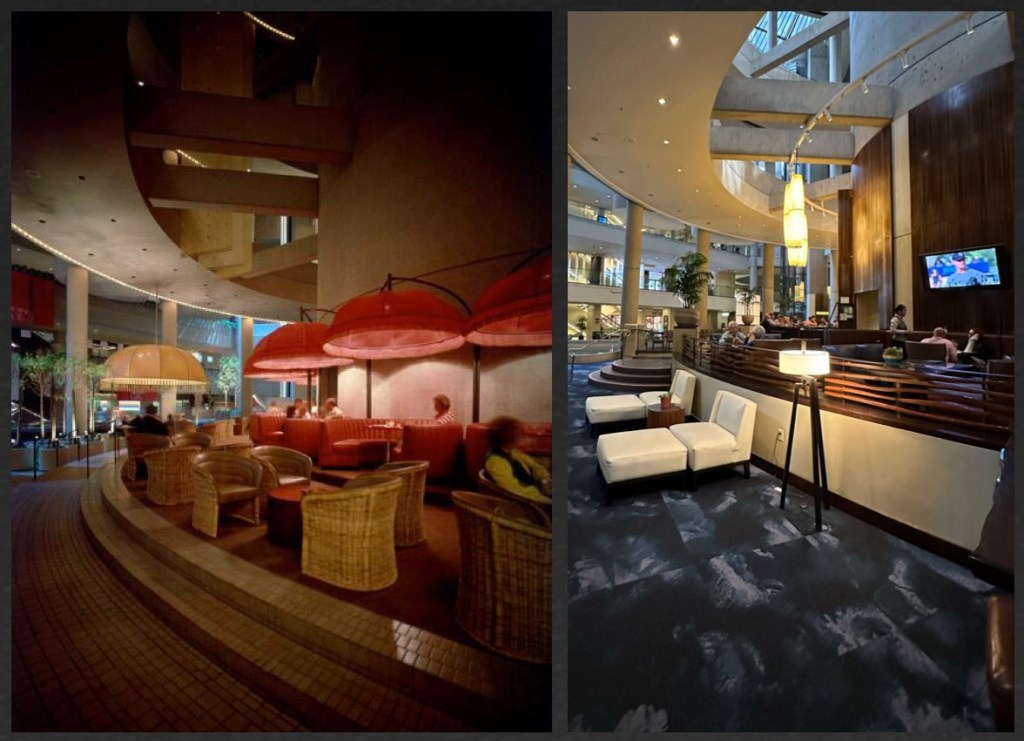
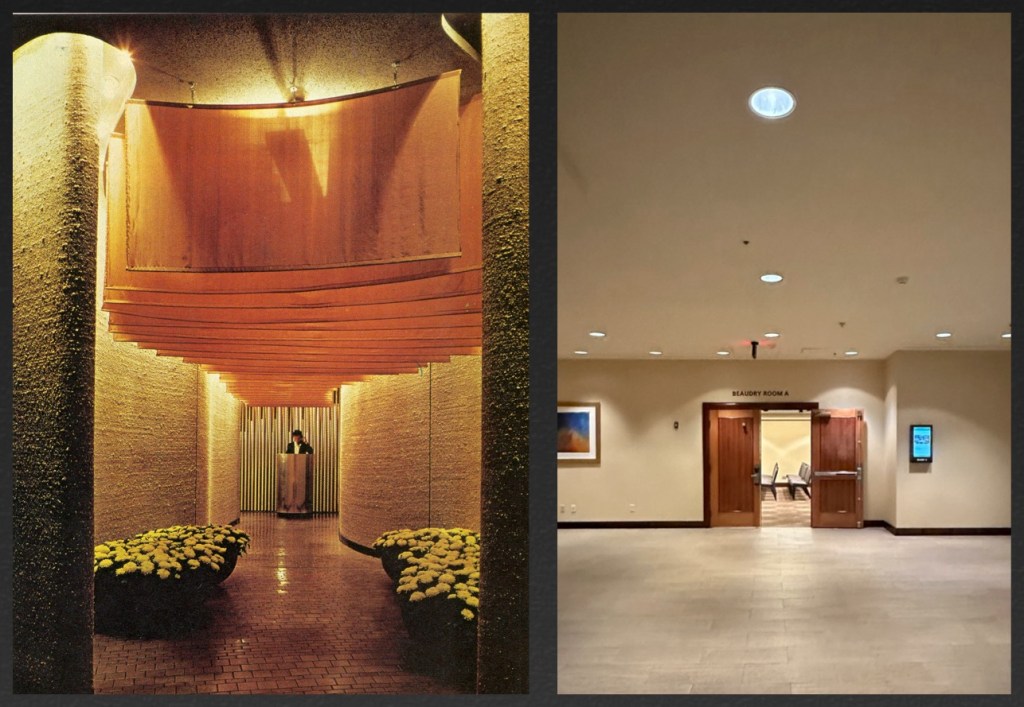
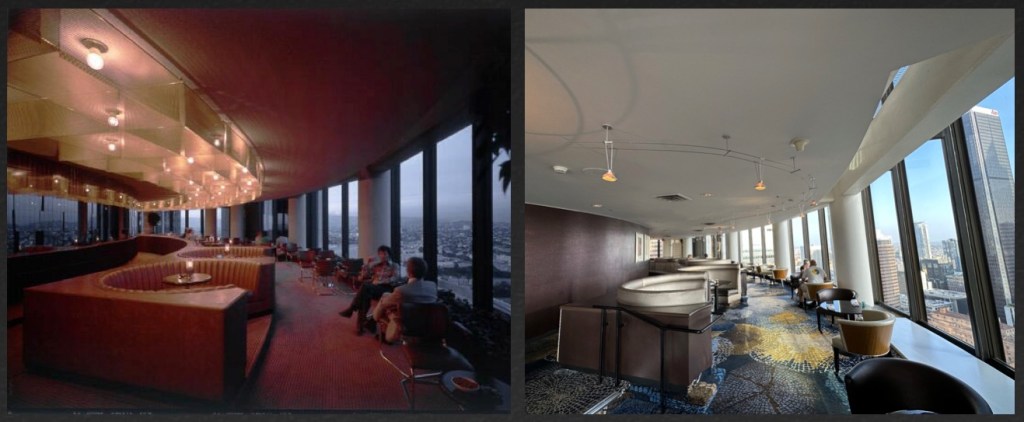
The above being my long-winded way of saying hey! let’s look at some vintage shots of the Bonaventure you may not have seen before, paired with some recent comparison captures.
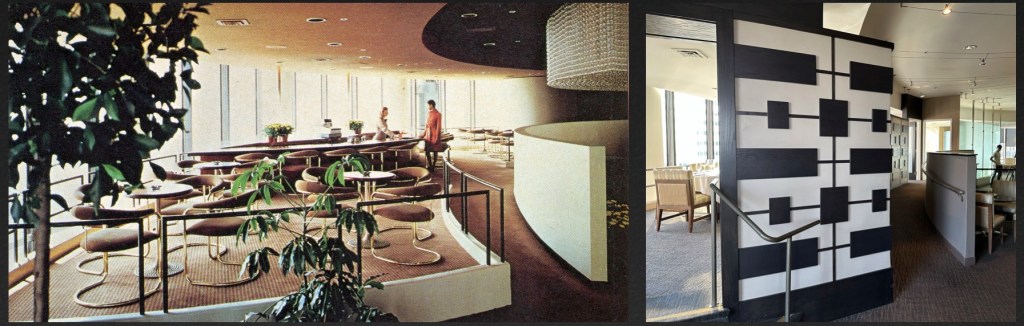
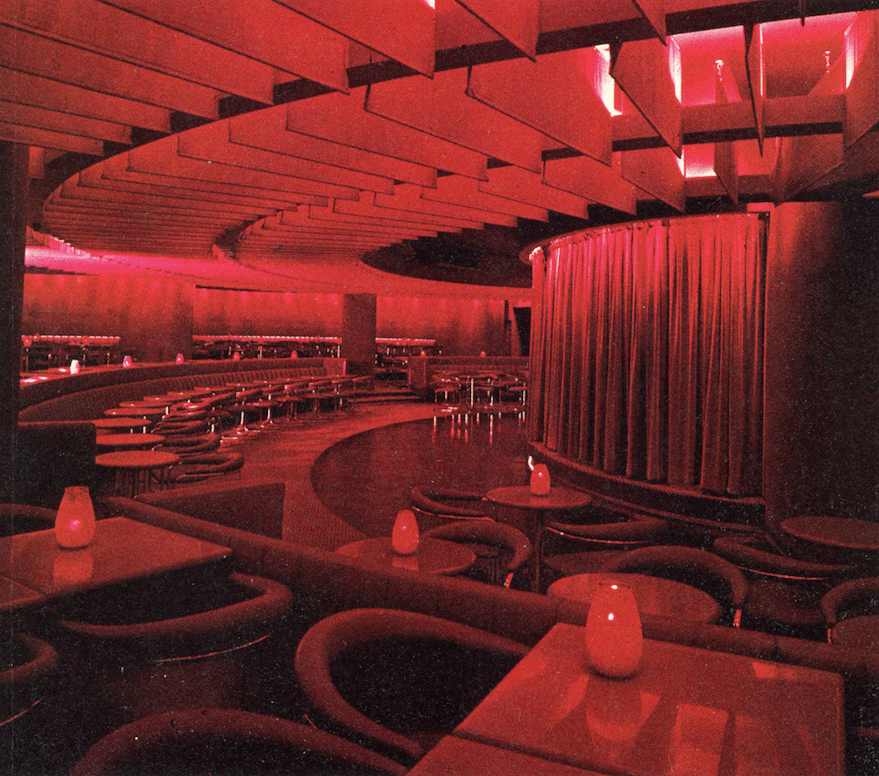
At the southeast corner of the building, Flower Street lobby (which did not exist, yet, in the vintage picture) out of frame to the right. Note how the large round concrete planters have been turned into lamp bases. The elevators were enclosed because air blew hard down through the openings in the ceiling; gusts sprayed water onto guests and scattered papers and menus all about the lobby before their enclosure. At the southwest corner of the building, looking south. There were, once, four equal-sized crescent-shaped water features, and the one at the south end of the building had this nifty jutting round fountain area. Note how it has been filled in, and the water feature cut through with a passage between the bar and the Lakeview Bistro (once known as the Sidewalk Café). Ironic they named it Lakeview, since they removed so much of the “lake”Vintage images of the Bonaventure always include these giant salmon-colored overhanging light-umbrellas, or whatever they are. They, with the beige tile and wicker, evoke the bizarre world that was Carter-era America in all its splendor. Now it’s just some sort of frigid euro-chic with psychiatrist couches and giant TVs blaring baseball games at youThe upper passageways leading to the cantilevered “conversation pods” once had earthtone carpet, plants, and wicker furniture, which softened the enveloping concrete Yes, the entrance to Beaudry’s is now…this. The entrance to “Beaudry Room A.”Beaudry’s was a prestigious four-star restaurant noted for its wine cellar. LA’s only real “serious eating” restaurant rivals to Beaudry’s were, at the time, L’Escoffier in the Beverly Hilton, L’Ermitage on La Cienega, and La Bella Fontana in the Beverly WilshireThe greatest, and slowest, thrill ride in Los Angeles! The revolving BonaVista cocktail lounge. “It’s from the future.”The bar area at the Top of Five (now LA Prime) has been walled off to become a private dining room.The world’s most incredible cabaret. Maps seem to indicate it was in the lobby against Flower Street, before the Bonaventure ripped it out for the new entrance in 1986. But an old timer told me it was two floors above, and was replaced by the Hollywood meeting room. Either way, it’s quite gone. For a time in the early-80s it was notable as where Los Angeles booked its retro circuit—Danny and the Juniors, the Diamonds, the Coasters, Gary Puckett, the Platters, the Drifters, etc.Most of the the above images come from the February 1978 issue of Progressive Architecture; they were shot by Alexandre Georges. The cover, however, was photographed by Wayne Thom, as were a couple of the above
That concludes my then-n-now Bonaventure roundup for the time being (at some point I shall have to scan for you my collection of amateur late-70s Bonaventure interior slides).
So, there’s much movement afoot regarding Cooper Donuts, and as I have covered that topic at length (this then this then this), it seems only fitting we dive back in, with these two things:
1. The City of Los Angeles is voting tomorrow to name Second and Main “Cooper Donut/Nancy Valverde Square,” and 2. there was a piece in the New York Times yesterday about the whole business. Let’s look at both!
The idea of naming the square dates back to December 2021. That’s when it was only supposed to be Cooper Donuts Square. The contention being, that the Cooper Donuts at 215 South Main was the location of the famed 1959 uprising, the “first known instance” of “significant rebellion”.
However, as I have pointed out before, that is absolutely impossible, for two very good and simple reasons. You will recall, there is but a single, lone account of the riot—the one from John Rechy. Rechy stated, in no uncertain terms, that it happened in the spring of 1958…or spring of 1959. But as City building records conclusively prove (borne out by phone books and City directories), there was no Cooper Do-nuts at 215 South Main during either of those times. And, reason number two, Rechy’s lone account (and thus that which constitutes the whole of canon on the matter) of the riot clearly states it happened in the 500 block of Main.
What’s galling is that now people are falsifying history to an even greater extent. For example, Wikipedia. Someone went in to the Cooper Riot page and changed it to be about 215 South Main.
So what our deceitful Wiki-editor did—over the course of ten minutes last April 21st—was add in the fairytale address, then realized it now wasn’t between Harold’s and the Waldorf (as had been stated in the only account of the event literally ever) and thus weakly reworded it to say it was “near” these bars. Three blocks away.
But look! you say. It must be true because there are footnotes!
Yeah, no surprise, none of those footnotes actually say anything about 215 South Main. Because no-one even deigned to entertain such fabricated notions until a few weeks ago, when some people got hot to pass a motion through City Council.
Ok, so we’re all on board that there was no riot there (or in any Cooper’s since the only witness/lone teller of the tale has said it wasn’t at a Cooper’s). Ergo, the focus has shifted—yes the riot is a myth, but no matter, nowwhat’s important is that Jack Evans, who ran Cooper’s, was an ally, and that Cooper’s should be recognized as “being the sole safe place for all LGBTQIA+ persons regardless of gender expression” (as stated in the Community Impact Statement, link here)—though we’ll ignore the fact that Cooper’s at Second and Main was across from the Archdiocese and the Union Rescue Mission, inarguably a tough area for out trans people in the 1950s, who would be more welcome in establishments a few blocks south…which is why Rechy decided to place the story on Main down by Sixth Street in the first place. (I should mention that the nomination still, of course, contends “The first recorded instance in the LGBTQIA+ community of gender-transgressive persons resisting arbitrary police arrest occurred at Cooper’s Do-nuts at 215 S. Main Street in Downtown LA in 1959” which its Government Author certainly knows to be an egregious falsehood.)
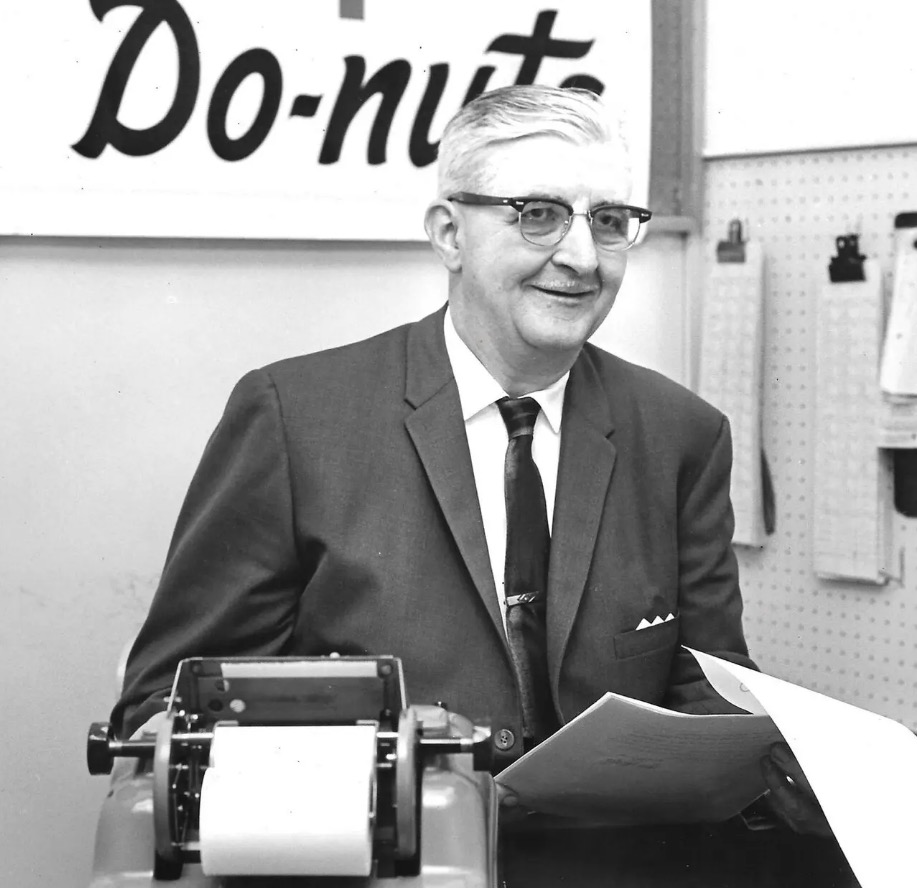
We are told the nomination is important because Cooper Donuts was a “safe haven.” I believe Jack Evans didn’t turn away customers if they had money. That doesn’t make him an ally, that makes him a capitalist. Nevertheless, this guy—
—Jack Chester Evans, a middle-aged (b. 1907) white man from Lorenz, Iowa, we are told by the family, was an ally. Not that there weren’t allies back in the day, but they’re usually progressive Jewish lawyers, not this guy.
Apparently, there’s some deep and affecting story there about how and why Jack and his wife, Colorado-born Marge, were America’s most unlikely allies during the days of the Boise Panic and the blacklisting of Frank Kameny. Seriously, what formative moment occurred in Jack’s life to make him an ally of unparalleled bravery? We want to know!
Recently, when the nominators of Cooper Donuts Square realized the whole Cooper story was pretty thin, they tied Nancy Valverde to it. Nancy is frequently mentioned as “proof” the riot happened, though it wasn’t until 2019, when asked about the subject by Los Angeles Magazine, she suddenly recalled that sixty years ago, she had heard second hand that something had happened somewhere. No matter; what is important, we’re told, is that she went to barber school near to the Cooper Donuts, had short hair and wore men’s clothes, and was welcome at Cooper’s (where she was particularly fond of the glazed donuts).
Now, I have no problem with a Nancy Valverde square, given as she is a famed activist and was trailblazing as an out lesbian in 1950s Los Angeles. But Second and Main? Really? Consider:
We are told in the City’s Community Impact Statement she went to Moler Barber School on Main near Third Street. That said, according to the Los Angeles LGBT Center, Valverde actually didn’t go to barber school: “getting her barbers license was an uphill battle, similar to the rest of her life. She was unable to go to barbers school because she didn’t finish school. However, one day, a man came up to her and told her that if she passes an IQ test, she could get her barbers license. After a lot of hard work, she passed her IQ test and became a barber.”
Also, she was arrested repeatedly for being butch. (And yet, she was accepted at Cooper’s!) “Valverde liked to look dapper when she was young. She purchased men’s slacks and button down shirts and got them tailored to fit her slender frame (from here).” I find it a little odd she was arrested repeatedly for just that, in that there was a fad for 1950s women looking boyish in general. Anyone with even the most rudimentary knowledge of women’s fashion, knows that post-1947 Bold Look into the 1950s, even the most vanilla housewife began wearing trousers with button-down shirts, and cutting their hair short; pixie cuts (and the less severe “Italian Cut”) were all the rage, e.g. Shirley MacLaine and Audrey Hepburn during the time—up to including my own mother who, 22yo in 1959, had short hair and dressed quite boyish, as was distinctly à la mode.
Point being, Valverde would have been accepted at Cooper’s because…why not? Women looking like boys was pretty common, but what Rechy specifically calls out is that boys in tight capris and midriff shirts were the picked-upon donut patrons: it would have been a lot easier for Valverde-in-trousers to go fetch herself a donut, rather than some transgressive boys, especially at a Cooper’s directly across from St. Vibiana’s and the Rescue Mission.
And yet Valverde was arrested repeatedly under LA’s arcane 1898 anti-masquerading law, Ordinance 5022…before she and her attorney overturned that law in court! But what raises an eyebrow is there’s never any evidence of when or how this happened. What date? What court? What judge? This would be a matter of public record down at City Archives, but I’ve got enough to do without going down to Piper Tech to find out. Someone please write me and give me the details, because I’d really like to know. I mean, for example, here it states she overturned the law in 1951. And yet, here it states she overturned the law in 1959. Well? (Protip: she was in fact never arrested under, and neither challenged nor overturned, anything called “Ordinance 5022,” despite what the City’s nomination states; 5022 didn’t exist after 1936, having been renamed Municipal Code 52.51.)
As I’ve said, I’m all for recognizing Valverde, but she didn’t spend much time at Second and Main, when she (perhaps) went to barber college at Third and Main. It seems like the Law Library, or more to the point, her barber shop on Brooklyn Avenue where she was hassled by LAPD, would be more deserving of a plaque.
Nevertheless, despite all this, when City Council votes to name Second and Main “Cooper Do-nuts/Nancy Valverde Square” on Wednesday, I have NO doubt it will be passed unanimously (just as it was passed unanimously by the Board of Public Works a few days ago). Despite conclusive proof there was no Cooper’s remotely near that corner during the time of the claimed uprising, atop the fact that the only witness said it didn’t happen there anyway; despite reasonable doubt that Cooper’s was “the sole safe place for all LGBTQIA+ persons regardless of gender expression” (Jack Evans an ally? And besides, we do have evidence of what Cooper patrons looked like in 1959, and I’m not seeing a lot of midriffs and capris); and man, this whole newly-tacked-on Nancy Valverde bit is kind of just “well, we have to put a Nancy Valverde plaque somewhere, this location is as good as any, I guess.”
II.
As I mentioned above, there’s an article in yesterday’s New York Times about Cooper Donuts. I’m in there! There’s not much I really need to add, that isn’t covered in the above.
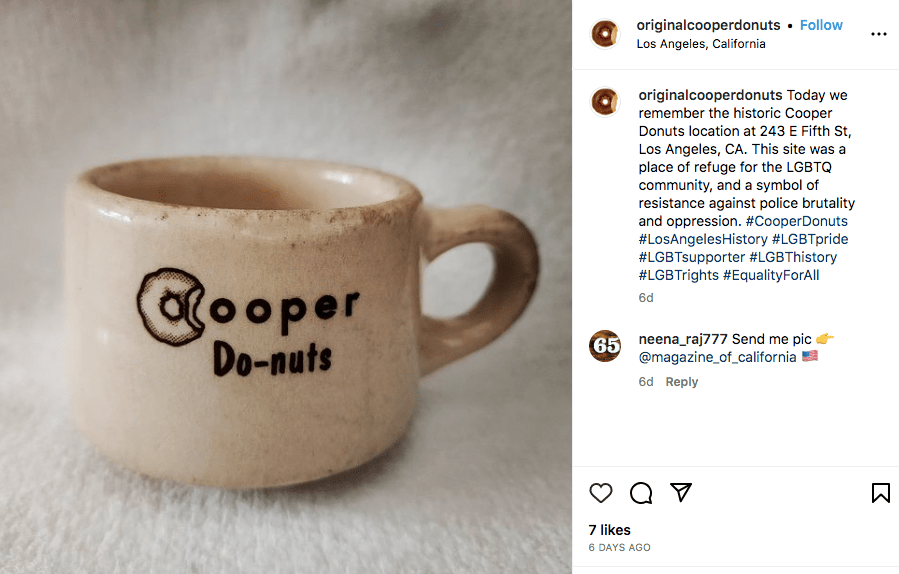
Wellll, except it seems there’s always one more piece of information that requires commenting upon…like some bizarre whack-a-mole of “alternative facts.” See near the end of the NYT piece, where it mentions there was a Cooper Donuts at 243 East Fifth? And then links to Cooper Donuts Instagram post?
So, there was an Evans Cafeteria (it was never a Cooper’s Donut) at 243 East Fifth, and it was only there briefly. 243 became an Evans Cafeteria in 1953, and remained so for three years until that location went out of business in mid-1956 (the space thereafter became a bar called the Pioneer Cafe). “This site was a place of refuge for the LGBTQ community, and a symbol of resistance against police brutality and oppression.” Um, what? How? While I don’t have a shot of 243 East Fifth in its brief stint as a Cooper’s pre-1956, here’s 243, converted from a Cooper’s to the Pioneer Cafe, in 1959:
A lot of worn and hard-looking men head to the rescue mission, which I’m sure was also a “a place of refuge for the LGBTQ community, and a symbol of resistance against police brutality and oppression”…from here
On a related note, here’s an interesting tidbit: we’re supposed to believe anything Jack Evans touched equals #LGBTsupporter and #LGBTrights because he was a trailblazing ally (again, on that we have no evidence, and have to take the family’s word on the matter). But we can say this with certainty, Jack Evans sure didn’t care much for unions and union workers!
Los Angeles Times, 4 December 1941
It mentions his Evans Cafeteria at 215 and, note final sentence, the associated address of aforementioned 243 East Fifth, i.e. Fewster’s “Picketed by the AFL” Cafeteria, before its three-year stint as an Evans Cafeteria. Fewster’s is also associated with Jack Evans: Fewster’s Cafeteria was the establishment of Louis Dufferin Fewster, Jack Evans’ brother-in-law, which is how Jack took over the lease in 1953.
III.
While I have you here, let’s address the elephant in the room. You know, where you say “why is this Marsak guy being such a JERK?” Look, it’s not my fault people are altering Wikipedia with lies and I have call them out on it. Seriously, I don’t want to be the guy righting repeated falsehoods all the time; I did it two years ago with one blog post (because it was related to Bunker Hill), pointing out the impossibility of the tale, and other people keep doubling down to insist it’s true, so the thing keeps snowballing.
In yesterday’s New York Times piece Rechy states he was was weary of the “baffling hostility that has persisted” around his account, calling it “undeserved, incorrect, malicious, infuriating and, yes, saddening.” Really? I’ve no doubt you’re infuriated and saddened, but, the only account that’s incorrect is yours, sir. Simply searching for objective reality, utilizing empirical over anecdotal evidence, and relying on discoverable facts about this tale is assuredly not undeserved, and there has been—anyone and everyone will admit—nothing malicious or hostile about it.
Apparently, though, doing research is HATE. Let’s look at some other typical reactions to my having poked at the story:
Note in the first sentence: should you question the establishment narrative, you are part of an “activist hate group.” So, said activist hate group consists altogether of me, which is kinda rich (since as a short Jewish tweedy historian I don’t exactly come off as a skinhead or whatever), and my pals Kim & Richard of Esotouric, whose politics are ultra-progressive Left (and who I might add have a upcoming tour about Gay downtown LA). Plus no one has in any way tried to “stop” the nomination or monument process. My job as a historian is digging up the truth; what you do with the truth is your business. That you choose to ignore, or worse, deny it, is rather telling.
Another typical comment:
Note the bit “Some armchair historians have claimed that the Cooper Donuts couldn’t have taken place, but we have multiple accounts of people, like Nancy Valverde, who know of the riots and serve as proof that such an action did occur.” First of all, “armchair historian” is pretty funny, since I’m literally a historian, and have never been anything else (resulting in far too many phonebooks). But whatever, more importantly, when Mr. Zappia states regarding Cooper Donuts “we have multiple accounts of people, like Nancy Valverde, who know of the riots and serve as proof that such an action did occur” I would counter (and I hate to sound like a broken record, but) no, you don’t have multiple accounts, you have zero accounts: there was a) Rechy, lone and sole witness who told the (impossible/improbable for so many reasons) tale 45 years after its alleged occurrence and who then flatly stated “there was no riot at Cooper’s”; and b) Valverde, who wasn’t there, but sixty years after it purportedly happened and was pressed on the matter, at which point remembered she’d heard second-hand that something had happened, with no mention of Cooper’s. Those are, strictly speaking, the opposite of “proof.”
IV.
I love two things: history, and downtown LA. People are running about abusing both, so it’s only natural I’d try and right those wrongs. If I’m the one who’s wrong, well, no-one has even made so much as an single effort to refute my claims. Rather, they want to say that I “hate” because they feel like I should be wrong. But the fact is, history matters, and when you build it upon a specious, spurious foundation, it makes the whole thing stink.
What about the two sites associated with gay civil rights activist Morris Kight? 1822 West Fourth, for example, would be a great monument, except developer-lovin’ YIMBY Councilmember Eunisses Hernandez is especially active in the fight to TEAR IT DOWN. Kight’s McCadden address might have a chance, though. Unfortunately for it, it doesn’t have the sex appeal of men dancing and singing in the street and making hardened Parker-era cops flee in terror.
Again, I am quite certain the motion will pass through Council tomorrow and the corner will be our newest monument. What’s troubling—besides our society’s wanton general disregard for truth—is that this monument will forever have the stain of falsehood upon it. All the good intentions in the world do not make confirmation bias, and an ad nauseam repetition of fake news, into reality. And then calling critical thinking and fact checking “hate” is an ugly way to shut down those who question the dominant narrative.
But, now it’s a monument, and you, having read this post, know the truth. Accuracy and fact being as useful as a chocolate teapot in this town, so, enjoy your new monument not to truth, but to truthiness.
Out now! Two years in the making, Marsak’s Guide to Bunker Hill is the only illustrated guidebook to each and every intriguing structure atop today’s post-redevelopment Bunker Hill.
You see, after Bunker Hill, Los Angeles and its companion Bunker Noir!, I thought it high time that—à la eponymous guidebooks like those of Murray, Baedeker, Fodor, Frommer, et al.—I produce a Marsak’s Guide for all those eminently visitable locations in LA’s open-air “museum of modernism.”
This all-new, 64-page, full-color guide includes a map, so that as you explore the Hill you may get your bearings and learn all about the building standing before you. But—with every Hill structure in Marsak’s Guide listed chronologically—it’s no less a joy to read while relaxing in your easy chair, taking in how the Hill’s architecture developed over time.
These are priced at $20; with shipping and handling, $25. If you are inclined to have one of these hot-off-the-presses (seriously, they’re still warm, being proudly printed in Los Angeles) send your $25 thusly:
This weekend being the LA Times Festival of Books, I expect to see you cavorting about the panels and performances but, amid your gambolling, please don’t forget to cavort on over to the Angel City Press tent (Booth #119, near the Tommy Trojan statue) and pay me a visit on either (or both) Saturday and Sunday, from 2-4.
And if I’m not enough of a draw (you did, after all, come see me last year), take a look at this stellar collection of talent:
Poking about the internet today, I found this new-to-me movie posted by the Office of Image Archaeology. It’s pretty neat! The uploading fellow said if you know any locations post ’em in the comments, which I commenced on to doing, but then, ended up here.
The film has some nice shots of Hollywood, and the Civic Center, but for our purposes I will (as you might imagine) stick to the Hill—
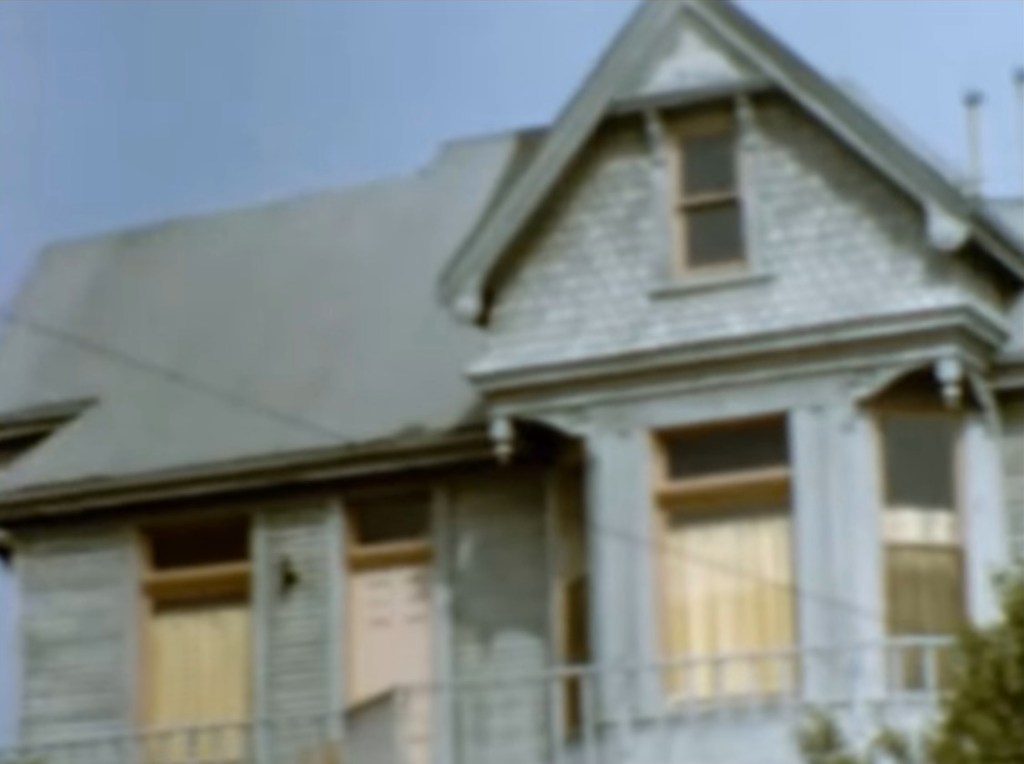
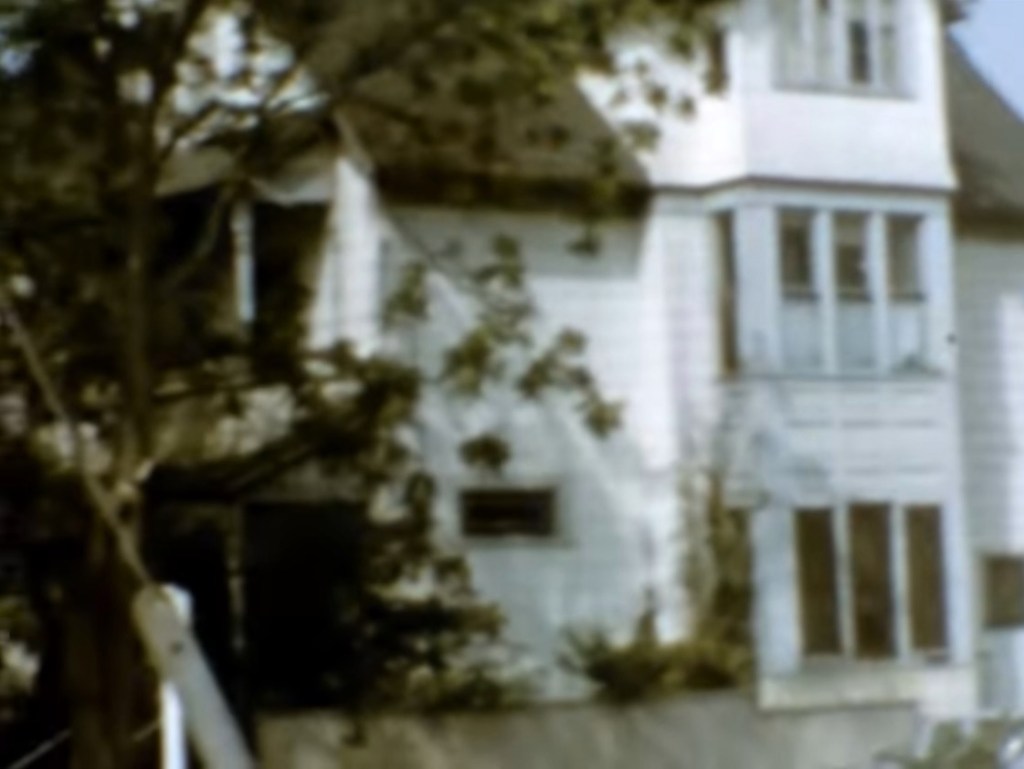
Looking north on South Bunker Hill Avenue; the back of the Alto (which fronted on Grand Avenue) at far right, and the house with the tower is the Brousseau at 238 SBHA Looking north on SBHA, this is 251, AKA the Chester P. Dorland House. Right to Left, the Stanley at Second and Flower; directly behind it, the garage at 123 South Fig; the Richmond Apts at 236 South Flower; the Viertel’s garage at 237 South Fig; and Third Street stretches into the distance on the far left (the Lux Theater at 827 West Third can be glimpsed behind the telephone pole).The Dome at Second and Grand; for more about the Dome, grab your copy of Bunker Hill, Los Angeles and turn to page 107The demolition of the Blackstone ↑ which looked like this ↓The Blackstone (WJ Saunders, 1916), once at 244 South Olive Street. Huntington
It’s very cool we glimpse the Public Service Garage down on Hill Street—
—before it was remuddled into tenth-rate Pomo come the 1980s. The 1925 Public Service Garage at 220 South Hill by architect Loy L. Smith, best known for the Cecil. LAPL
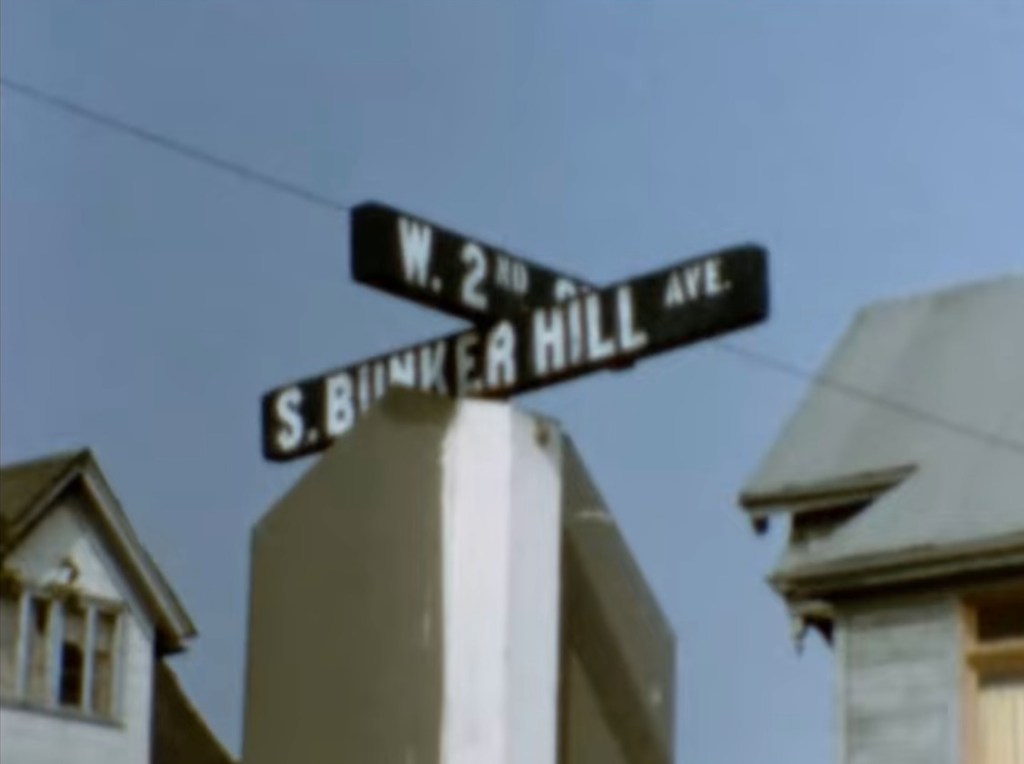
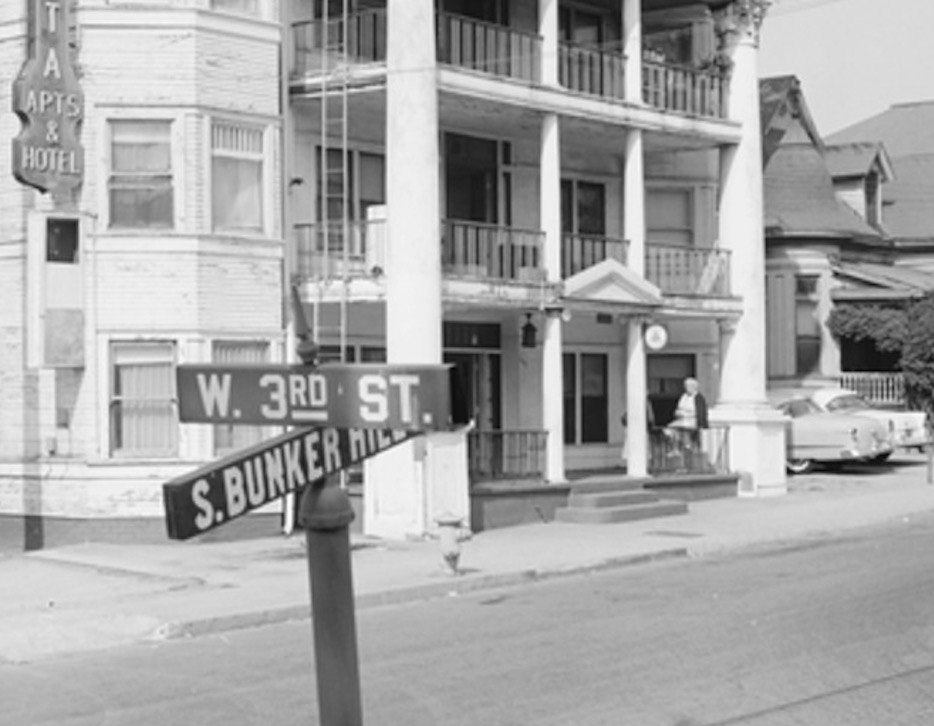
I love this shot of the two aged street signs atop the stop sign. They hadn’t been replaced by the famed 1946 “Shotgun Style” signs we know and love. Reminds me of this shot by Nadel:
…which was taken one block south. Note 251 (lurking behind the Alta Vista) of which you saw a shot a few screengrabs ago. Getty
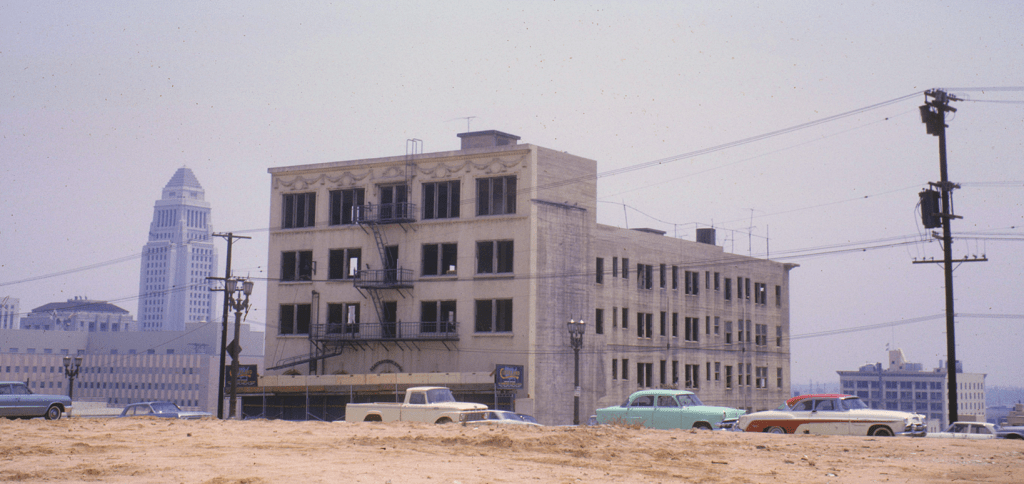
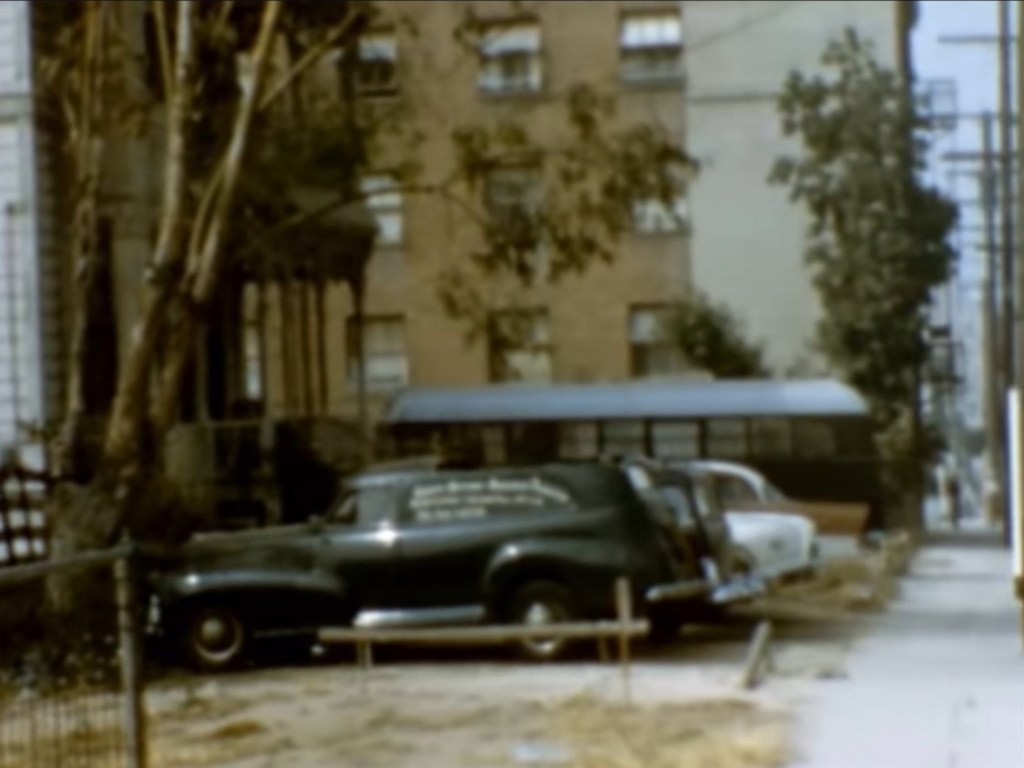
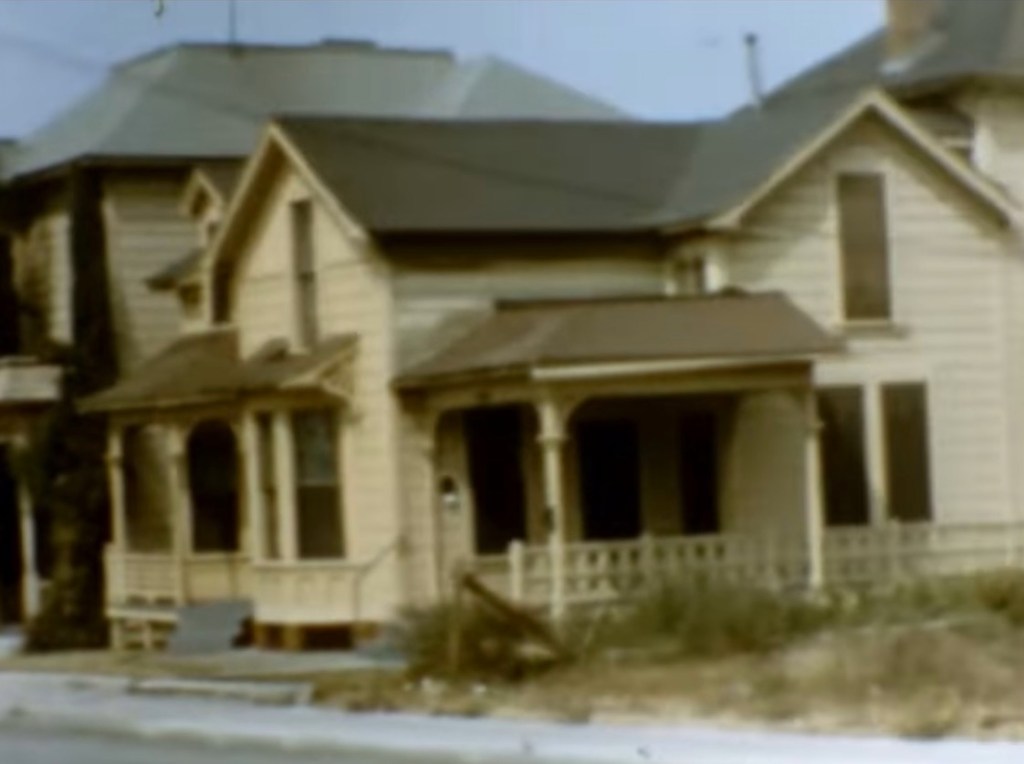
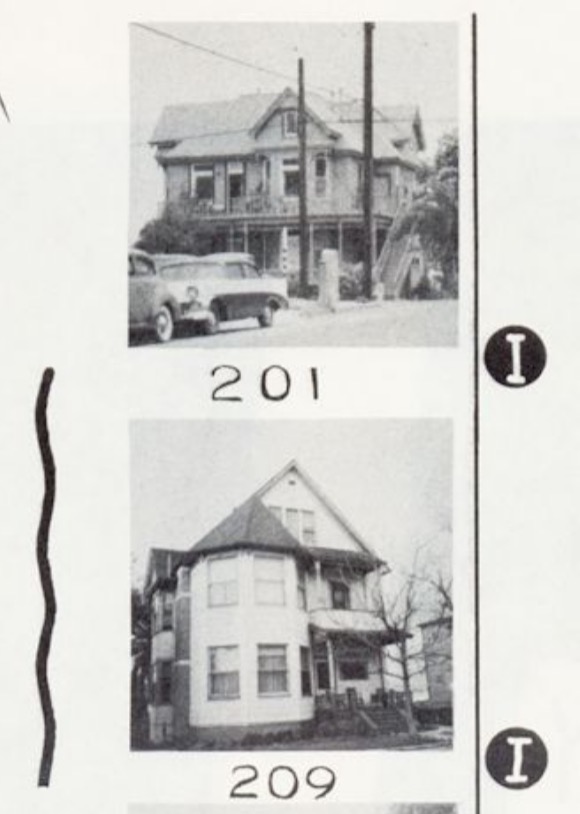
Cars parked outside the Brousseau Mansion, which had been cut up into apartments. This is looking the other way from the first screengrab in this post (note the large bus in both shots). WHAT is painted on that panel van? Which doesn’t quite have the look of a panel van; I’m thinking it’s an early-40s or just-postwar funeral coach, specifically, what was known as a service car, and I’m unable to locate my copy of the McPherson book so I can’t check.The George Stewart House at 237 SBHA; go to your copy of BHLA and turn to p. 92 to see when it was still covered in gingerbread.The JP Miller house, 201 SBHA, which looked like this A bit of 209 SBHA, just south of 201. Shots of 209 are really rather rare. It looked like this:
209 SBHA—grab your copy of BHLA and turn to p. 110, for a shot of its interior, and a short discussion about its importance to early gentrifiers; see pp. 43-44 for more discussion. Huntington
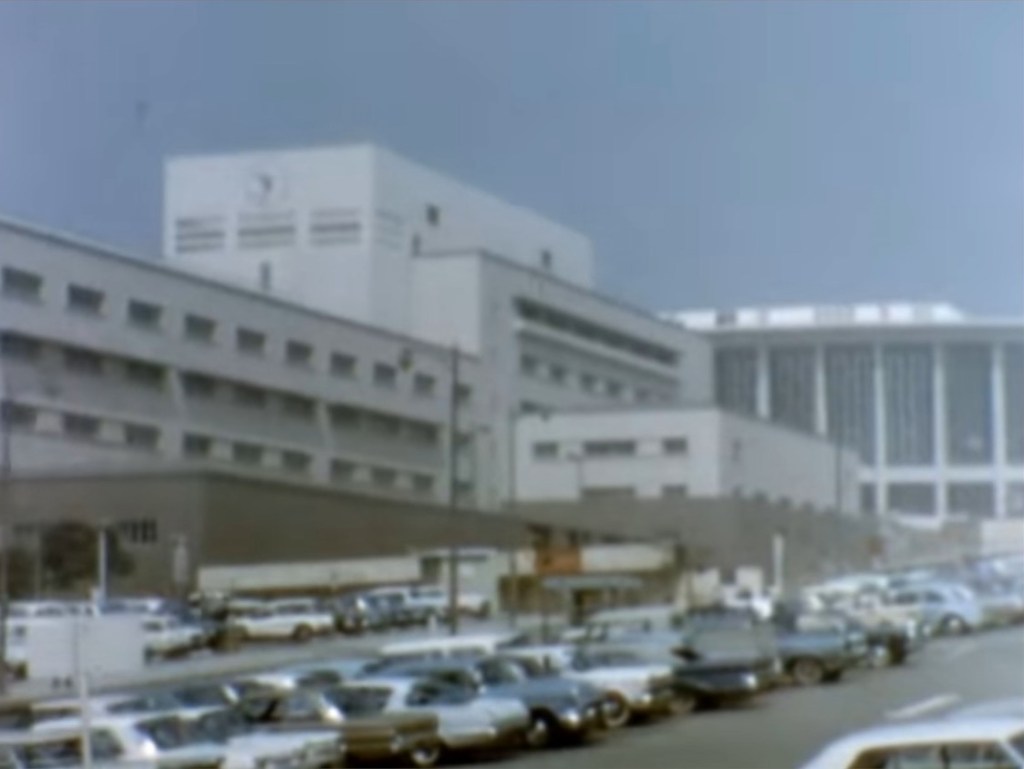
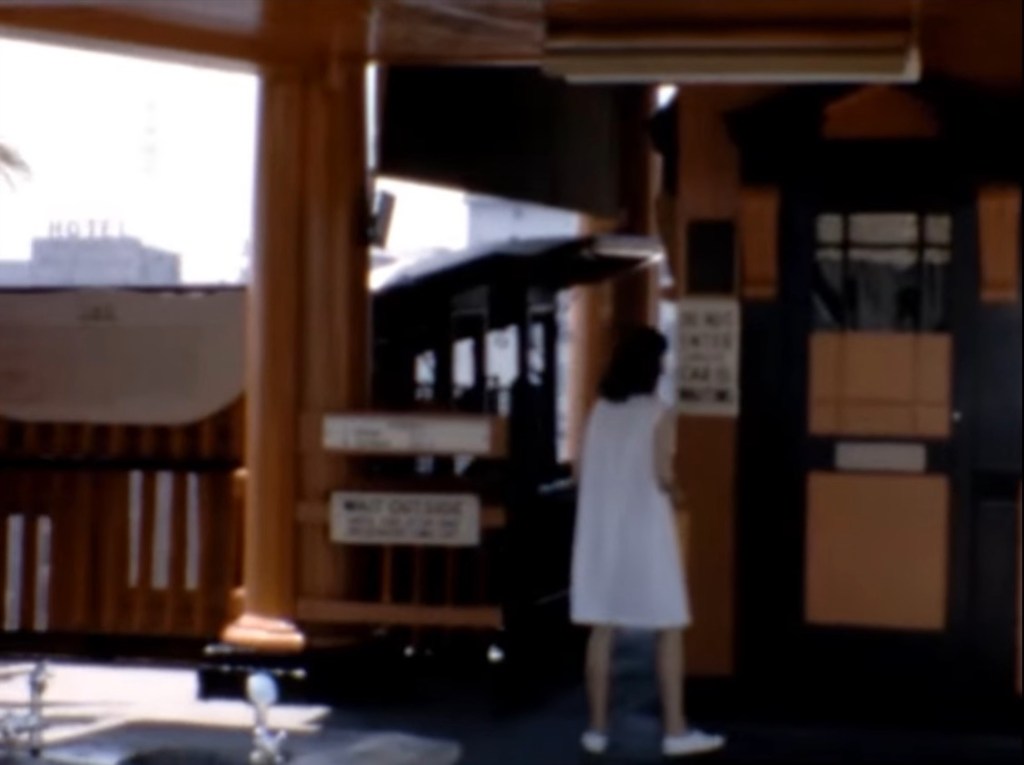
What’s now Grand Park, covered in cars, before the construction of the Civic Center Mall, which broke ground in August 1963. County Courthouse at left and Chandler in background.Shot a bit later than the screengrab above. The Civic Center Mall in early stages of construction. Go to BHLA p. 166 for a before-and-after. It’s not old footage of Bunker Hill without Angels Flight! Here we are at Third and Hill. Turn to BHLA pp. 74-75 for the night shot version of this. Looking south down Olive from the station house on Third. There’s the Mutual Garage at Fourth and Olive; see an image of that on p. 45 of Bunker Noir! Also, as John Bengston points out, the area was captured on film.Standing up at the station house looks very much the same today. (The “Hotel” signage in the background was atop the Hotel Clark. Speaking of the Clark, did you know that they have a website?! I know, that made me guffaw too.)
Of course, watch the entire YouTube upload for some vintage 1960s Hollywood…which I was tempted to explicate but will leave that for the Hollywood folk.
Happy Presidents’ Day! Yes, I know it’s really Washington’s Birthday (it irks me George is not still celebrated specifically) but, I’ll accept it. After all, who morphed Washington’s Birthday into Presidents’ Day? The mighty Angeleno, that’s who: among those many things invented in Los Angeles, Presidents’ Day is among them, as it exists due to the tireless efforts of one Mr. Harold Stonebridge Fischer, he of Compton, California.
What do presidents have to do with our topic at hand? Well, among the many notable folk who have lived on or visited Bunker Hill—my recent post about Anna May Wong being one example—it is asserted by some that President William McKinley has a connection to the Hill. McKinley purportedly stayed in one of its most recognized landmarks, the Melrose Hotel, or, at least, made a Very Important Speech from the Melrose’s porch. Heck, I reported as much in this 2008 post.
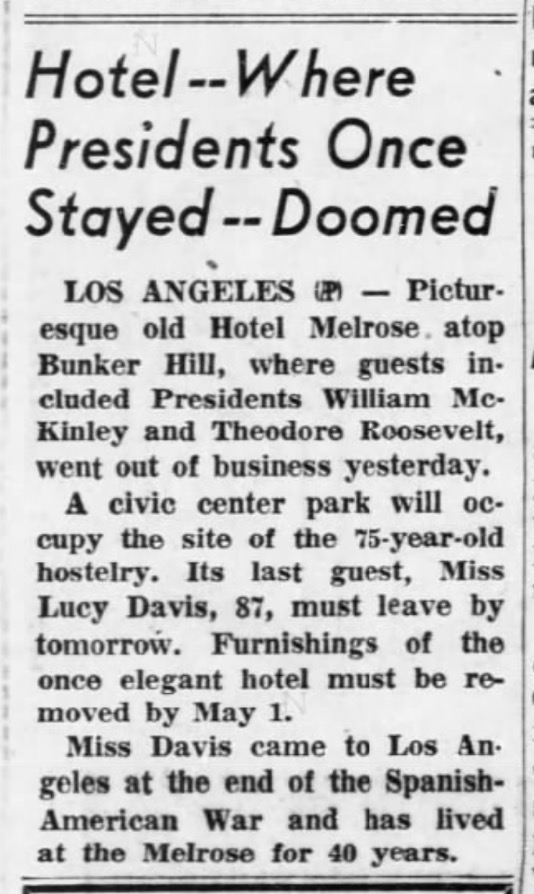
The source of that information is a couple of unnamed little-old-ladies who got to chatting with Times reporter Ray Hebert on Grand Avenue in June 1957.
Los Angeles Times, 03 June 1957
While chatting with Hebert, and the fellow salvaging sinks and whatnot from the doomed Melrose, one of the ladies stated she remembered standing on that very sidewalk watching McKinley on that very porch, “as if it were yesterday.”
McKinley on Bunker Hill would be a huge deal for us Bunker wonks. Love him or hate him—many being divided over his annexation of Hawaii, freeing Cuba, or purchasing the Philippines, Guam, and Puerto Rico—McKinley was arguably the first “modern” president, and we must admire his administration for its monetary policy and a trade reciprocity that shrewdly pulled America out of the crippling 1890s economic depression. All that notwithstanding, I just get all giddy over the fact that McKinley was on Bunker Hill in one of my favorite buildings.
But, of course, it never happened. It’s a neat story, but then so is “there was a streetcar conspiracy!” and “the Dodgers kicked people out of Chavez Ravine!” and those tales aren’t true, either. More analogous is the assertion that “Teddy Roosevelt stayed at the King Edward Hotel!” which, as has been pointed out, didn’t happen either. (Not that no-one ever stayed at the Melrose; it was the hotel of choice for any number of illustrious personages, e.g. Marshall Independence Ludington, though, he’s not exactly McKinley, is he.)
At this point, you might be wondering, what is this Melrose Hotel which McKinley did not in fact visit?
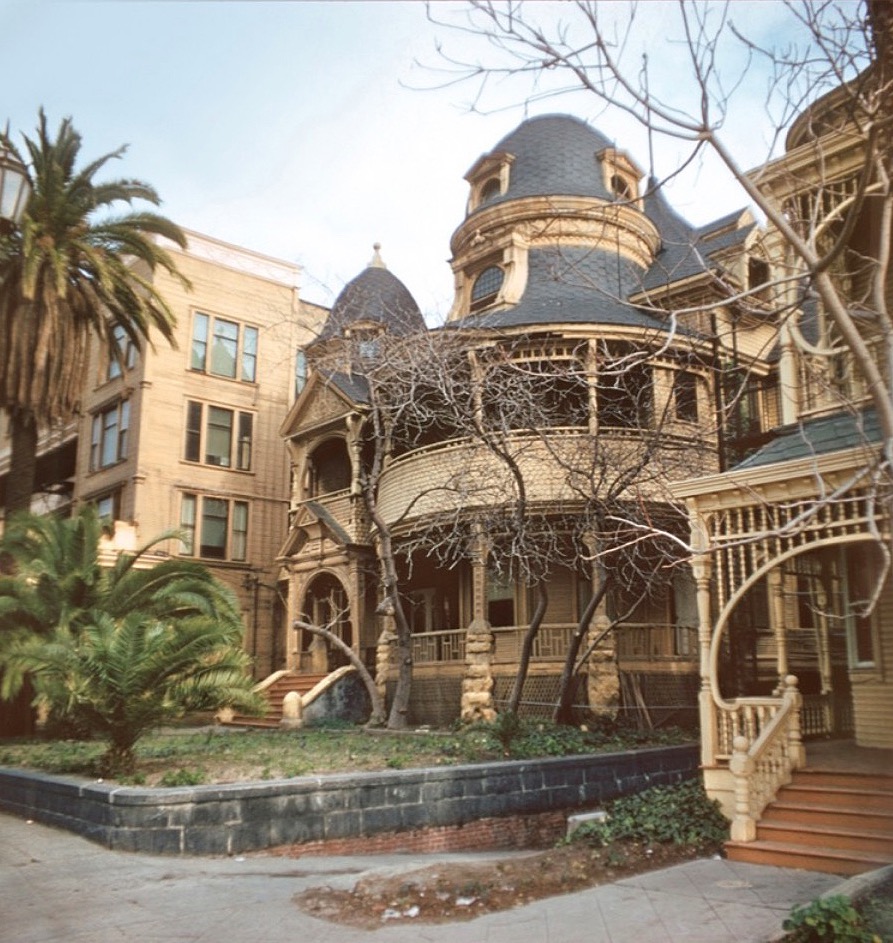
The Melrose, 130 South Grand, the Richelieu at 142 at right, to its south…both now being the location of this
The Melrose was built in the spring of 1889, for Marc William Connor, designed by the firm of Joseph Cather Newsom. For reasons I go into here, I’m of the opinion that it is from the hand of Walter Ferris, Newsom’s draughtsman.
There were a few notes in the news about the end of the Melrose. The 1957 Times article that spoke of McKinley’s presence described the old gal as grotesque and alarming and not unlike a snake, but worst of all, “out of place,” the true sin in mid-Century America:
As I linked to above, Teddy Roosevelt was comfortably ensconced in the Westminster, not the Melrose (nor the King Edward). The question then being, if McKinley didn‘t stay at the Melrose, where was he?
McKinley made his way to the Van Nuys, two blocks south and five blocks east, well off of Bunker Hill.
Los Angeles Times, 9 May 1901
Mind you, McKinley didn’t stay at the Van Nuys; he bunked with fellow Ohioan Harrison Gray Otis at The Bivouac. Members of his entourage, like George Cortelyou, though, stayed at the Van Nuys. A good summation of the 1901 McKinley trip is here.
But still, the little-old-ladies of 1957 insisted they had seen a McKinley speech. And they did, delivered from the balcony of the Van Nuys Hotel:
Los Angeles Times, 09 May 1901
During his welcome reception at the Van Nuys, McKinley decided the throngs deserved an impromptu address, and asked Milo Potter where he might find the nearest suitable balcony. The President was ushered to the balcony of room 22, near the northeast corner of the second floor. That would be here:
Yep, the McKinley Balcony still extant! Should have a plaque upon’t
So. No McKinley on Old Bunker Hill. “Awww,” you say, “now I’m sad. Surely at least one president visited Bunker Hill…”
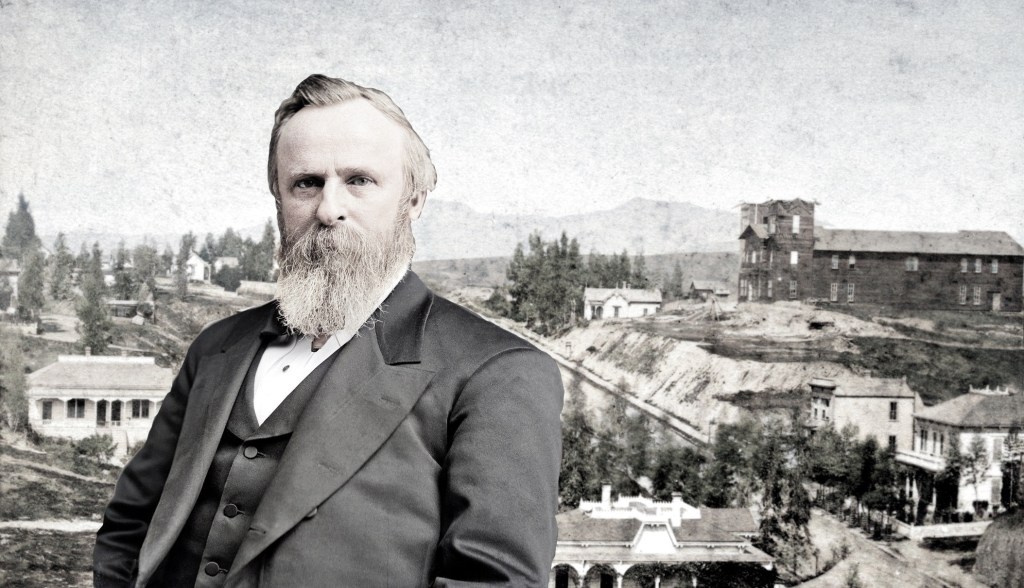
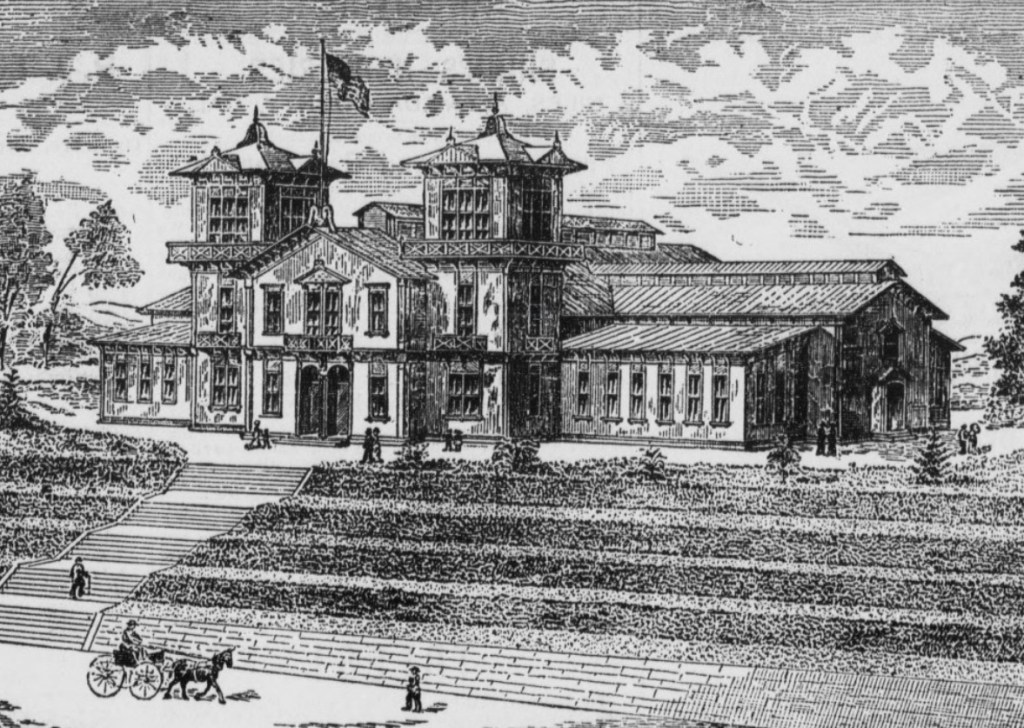
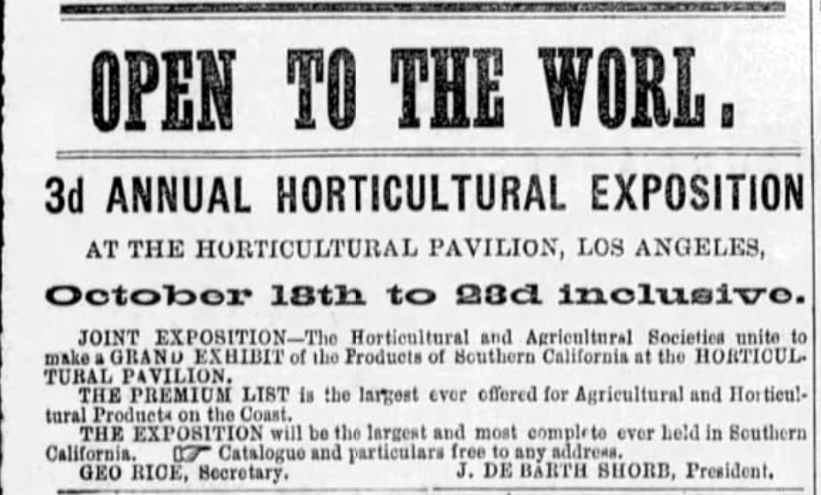
Well, fear not! In October 1880 we were graced by the presence of Rutherford B. Hayes, who stayed at the Cosmopolitan Hotel, on Main near Temple, and then visited the northern reaches of Bunker Hill when he attended the agricultural fair at the Horticultural Pavilion. (You may claim that the Pavilion having been north of Temple Street, its location should rightly be called Fort Moore Hill rather than Bunker Hill, but, I consider the Fort Moore area a northern district of Bunker Hill, and, it being my blog, so there.)
From the Pacific Rural Press, 14 September 1878. The Pavilion’s architect was Ezra Kysor, in his brief stint as Kysor & Hennesy, before he joined forces with Octavius Morgan in 1880.Only the central hall was built; those wings remained on the drafting table.Under construction in mid-1878
Los Angeles Evening Express, 23 October 1880
Hayes spoke to a packed pavilion and then went off to look at all the boostery produce. Then he and his party dined at the New England Kitchen in the pavilion. Even in 1880, Los Angeles had theme restaurants; forty years before the immersive experience of the Jail Café, the ladies of the New England Kitchen dressed in Colonial garb.
Naturally, I contacted the Rutherford B. Hayes Presidential Library, asking after any images that might exist of his Los Angeles trip. Unfortunately, while library archives contain some images of Hayes on his 1880 Western Trip, those images are of his adventures around Yosemite and Menlo Park.
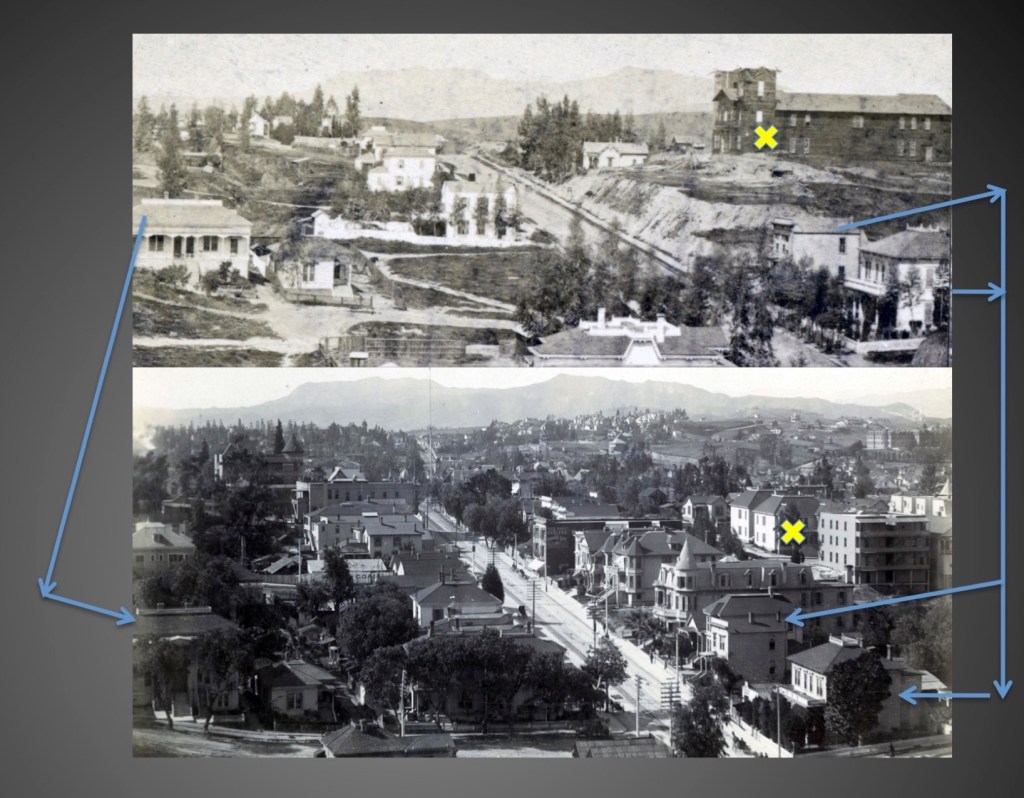
As for the Horticultural Pavilion: it is oft said that the structure burned down, as so stated by Sarah Bixby in Adobe Days. However, its end was in actuality much less dramatic. The pavilion could never meet its mortgage, and it was pulled down in the spring of 1882. The area on which it stood was redeveloped as residential:
Before and after: looking west on Temple Street, in ca. 1878 and ca. 1895. Hill Street runs along the bottom of both images and I’ve paired the matching structures. Now, it’s this.
There has been no shortage of presidential trips to Los Angeles over the years, but I’m yet to discover further evidence of presidential appearances in predemolition Bunker Hill, apart from Hayes.
Bunker Hill adjacent, though…
…here, for example, is Harry Truman cruising south on Spring Street in a 1949 Lincoln Cosmopolitan. There’s the old Hall of Records, and just to its left in the distance, one can make out the scrubby hill where Court Flight used to ply her trade. The square structure with the nine windows is the backside of the Stevens Apts, at 150 North Hill, the corner of Hill and Court Street. LAPL
Presidents still come to our fair city, visit downtown, and it often gets saucy, but none have the moxie (nor the mighty beard) as President Hayes, our Chief Executive of Old Bunker Hill.
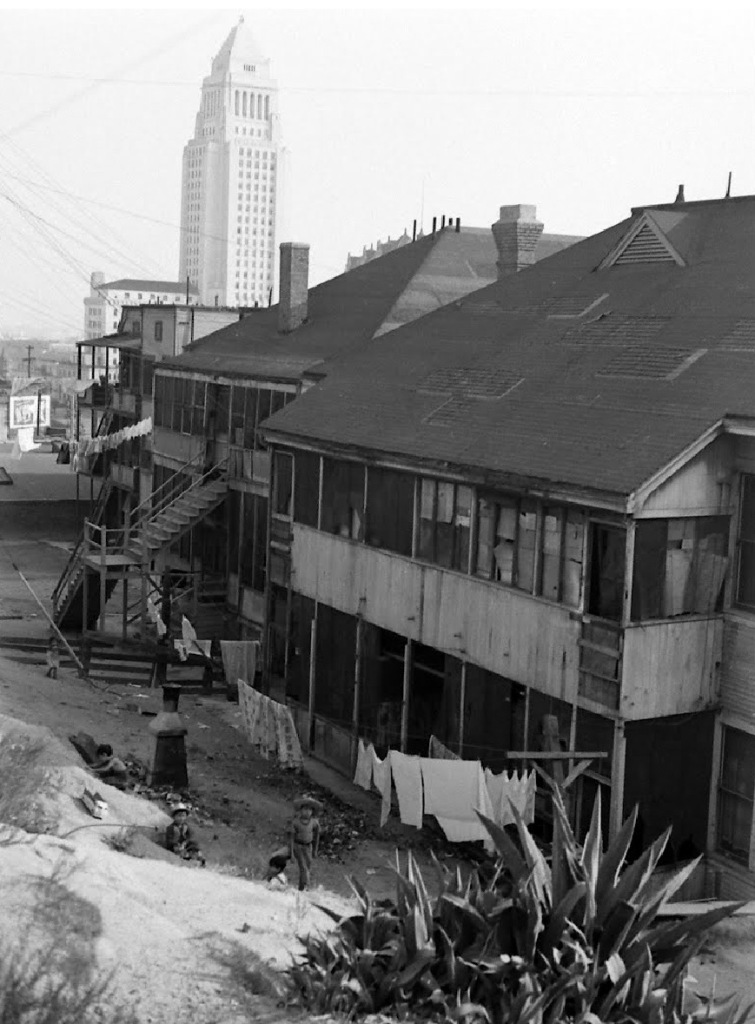
So I’m on the Instagram, when there on the page of forgottenmadness_la, was this post. FMLA noted that the nifty image was part of a LIFE magazine feature titled “Ugly America,” shot by WalterSanders. I flew immediately to the greater collection, archived at Google Arts & Culture, here. I am deeply indebted to FMLA for hipping me to this hoard, so, please go over and follow their IG page; it’s great work.
The image that caught my eye on Instagram. Note how photographer Sanders made a point of shooting the rear of a structure, with the requisite hanging laundry and necessitous children. This was a favorite tactic of photographer Leonard Nadel, who was charged by City agencies to assure neighborhoods looked shabby
From what I can tell, none of Sanders’ images from this shoot, nor any “Ugly America” feature, ever actually ran in LIFE magazine. I certainly would like to read said piece, so I may see what actual arguments LIFE attempted to make.
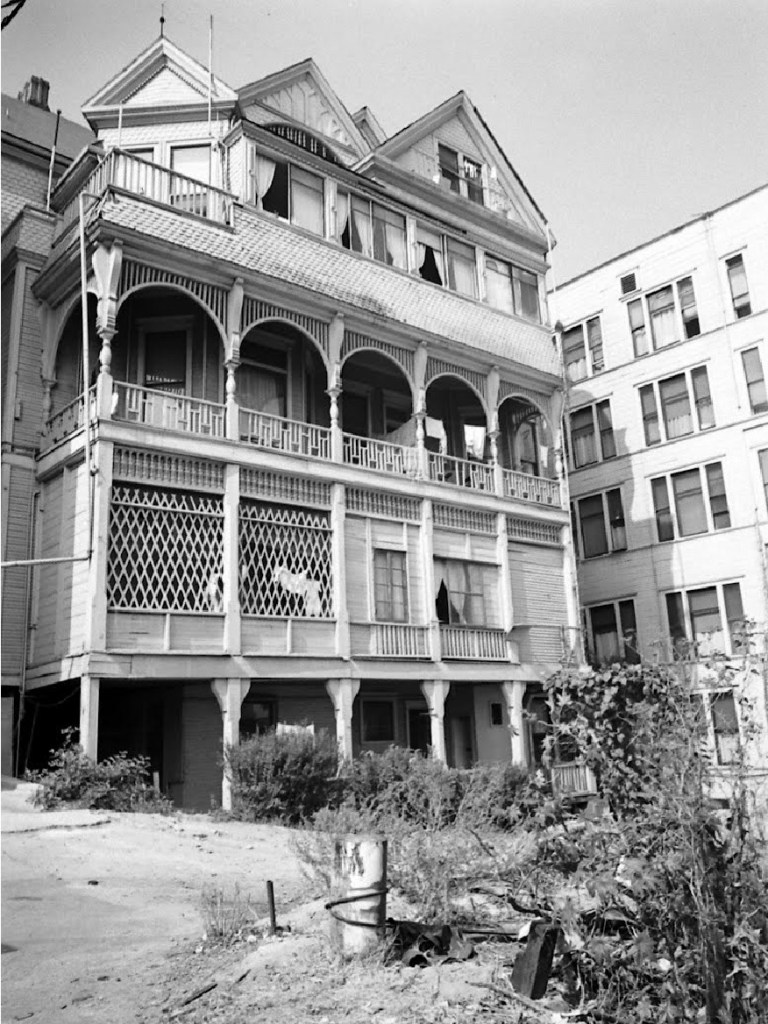
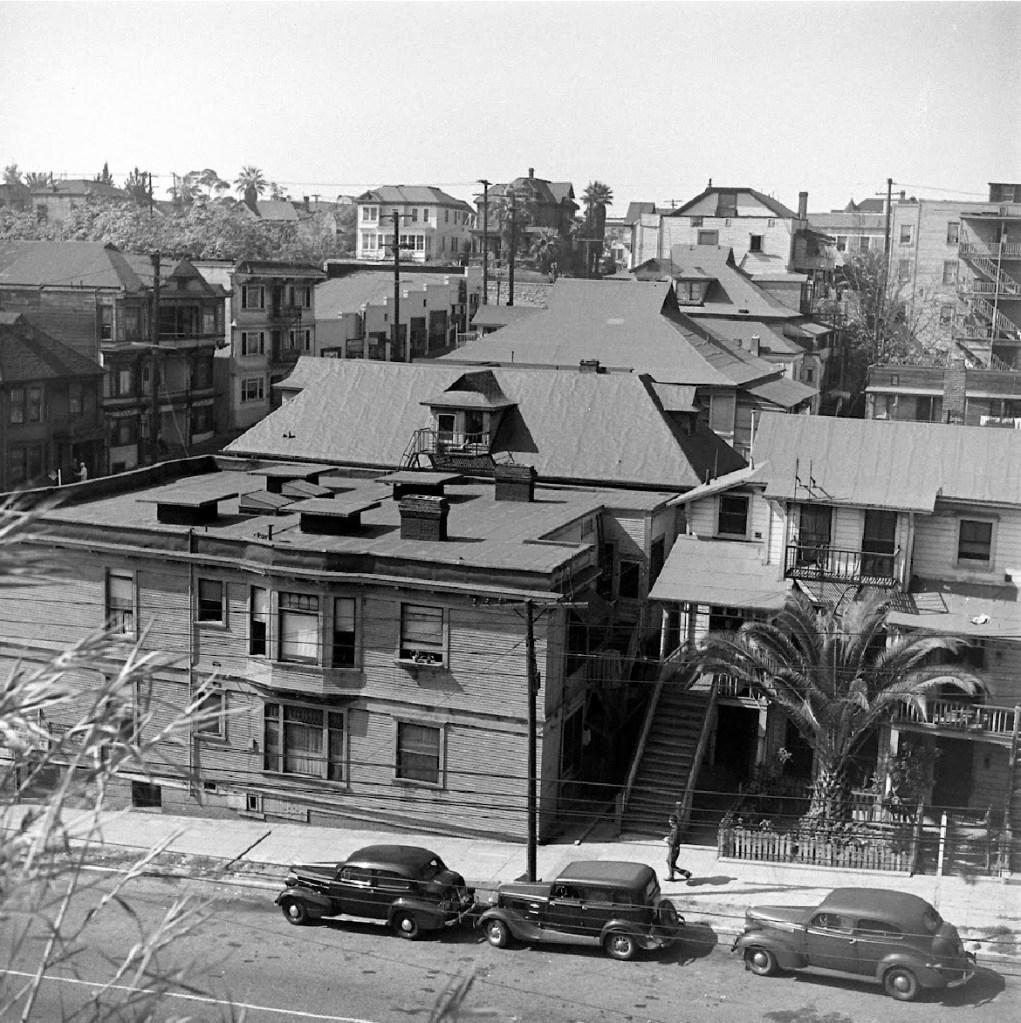
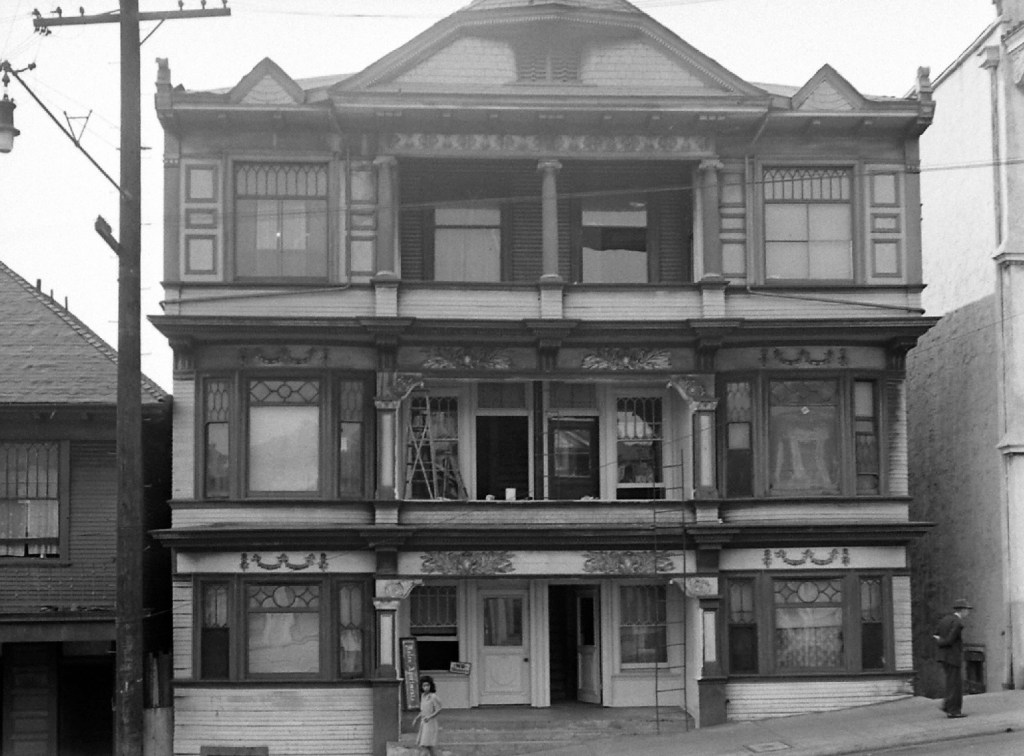
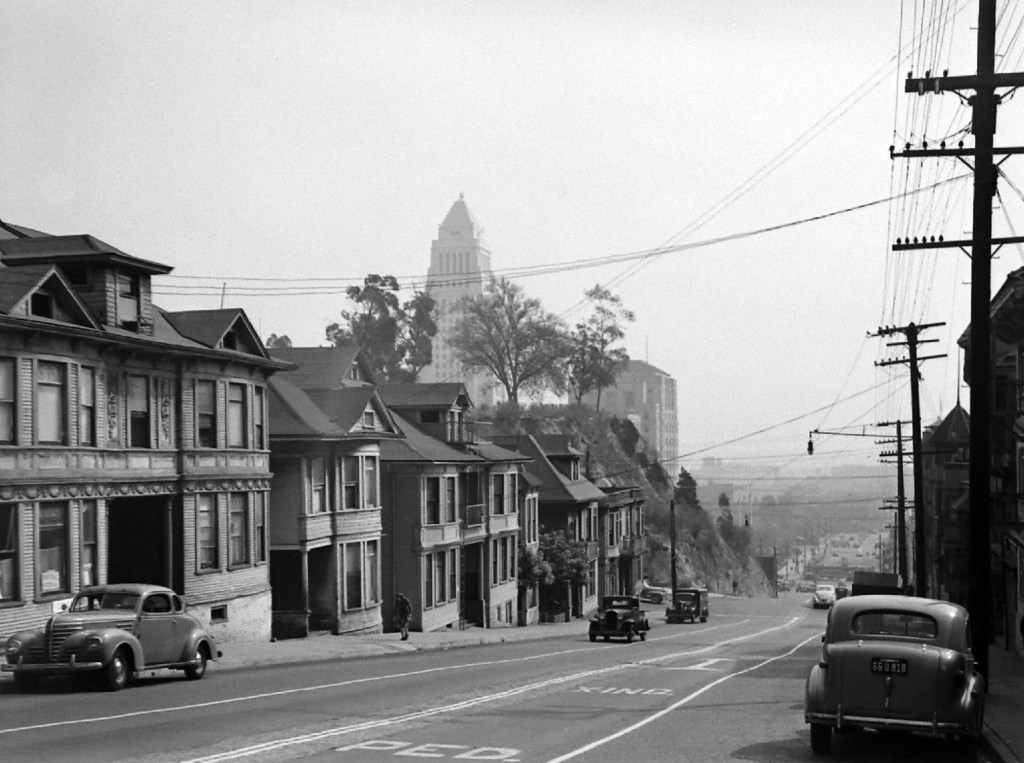
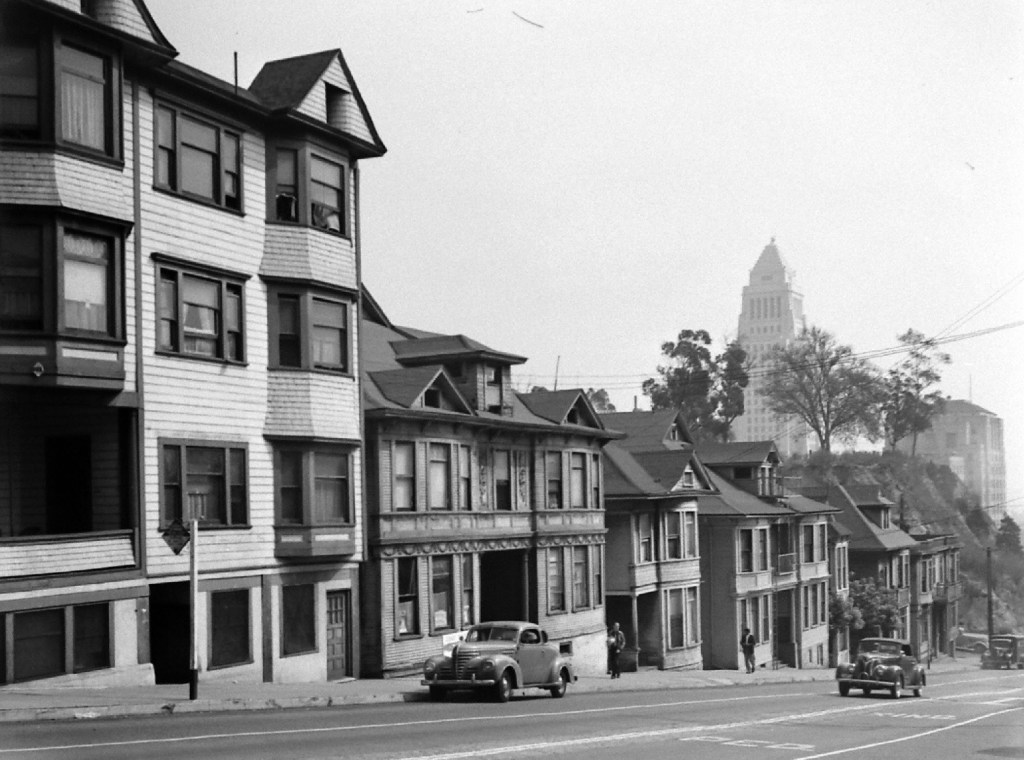
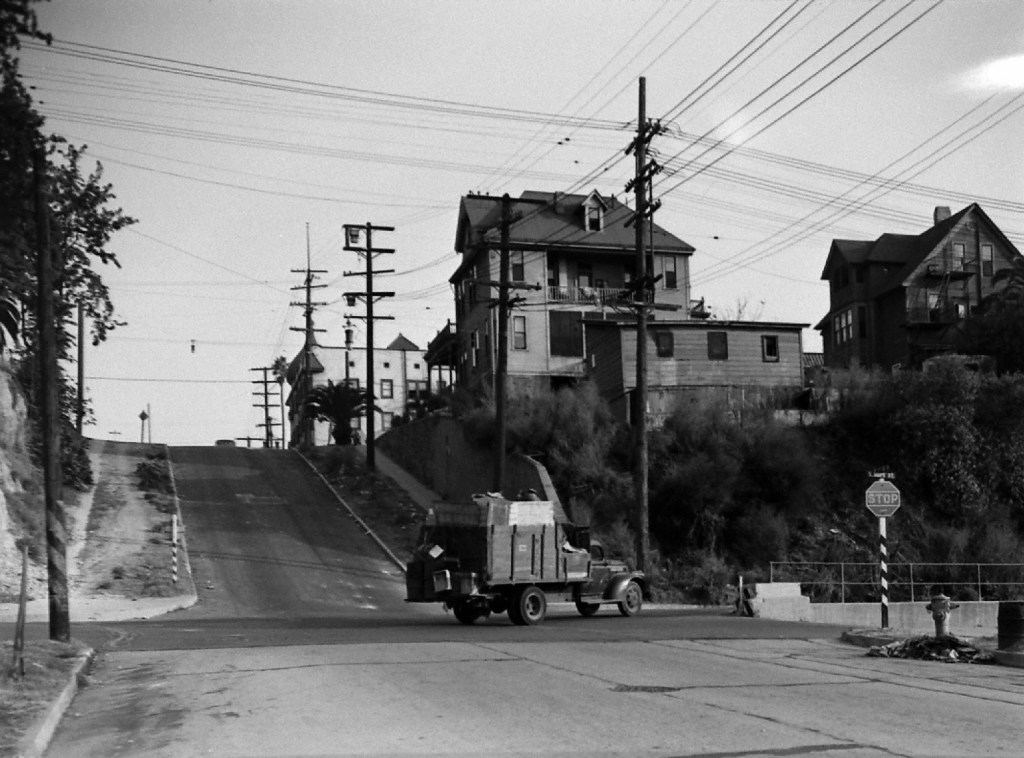
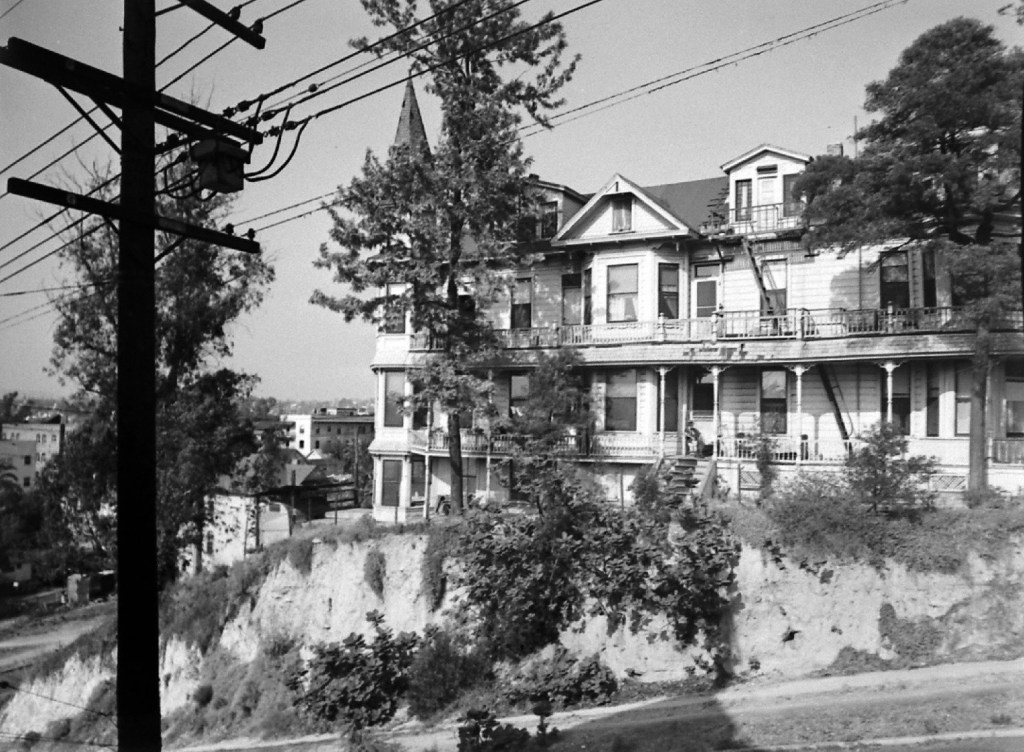
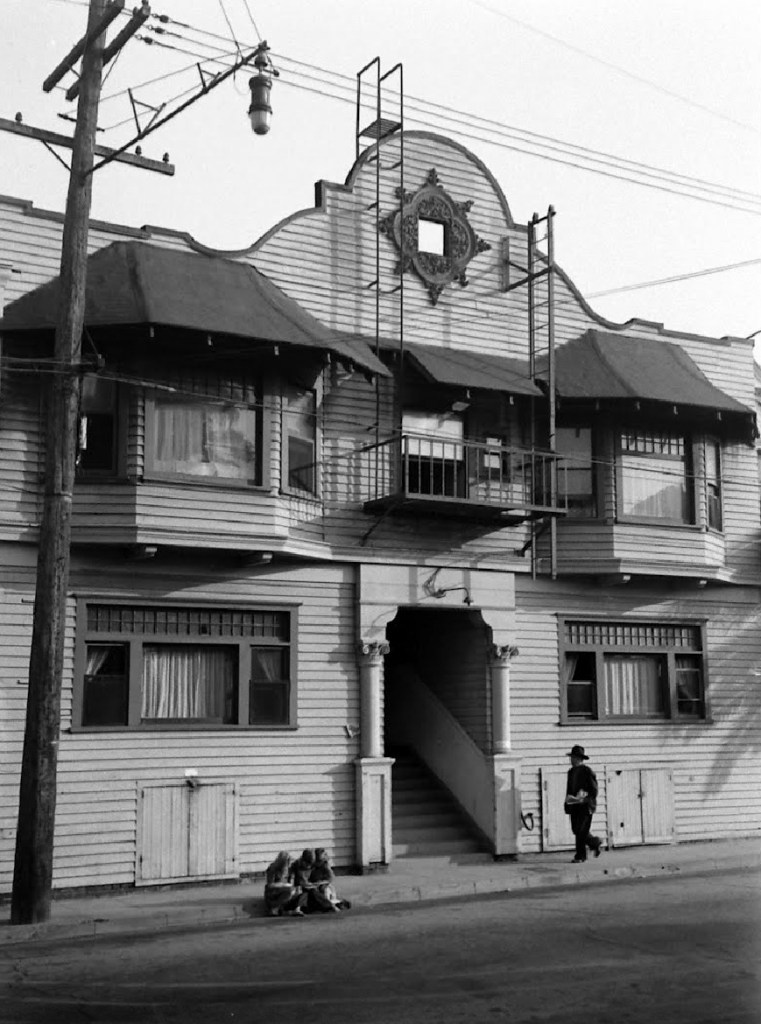
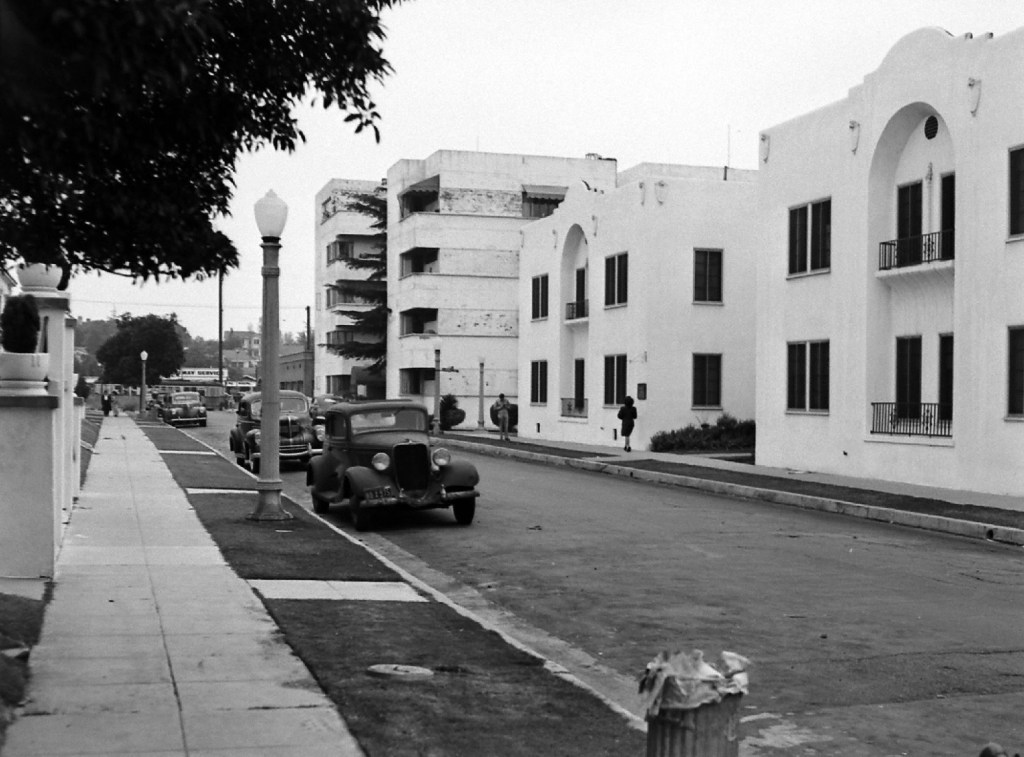
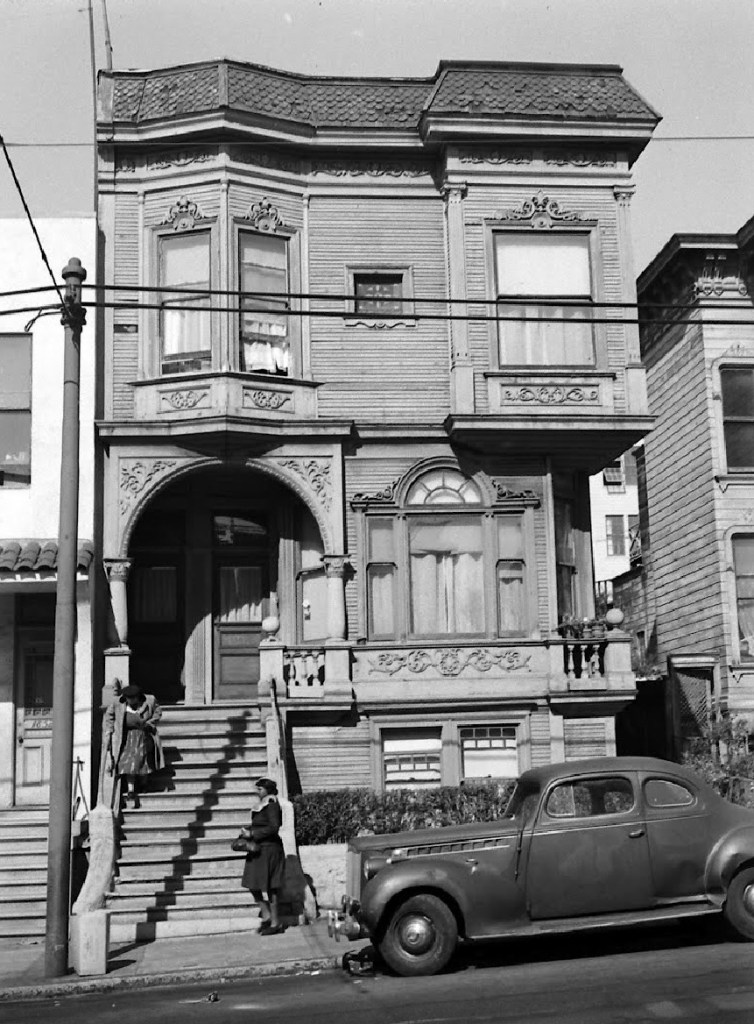
Basically, Sanders went to Los Angeles and San Francisco in November 1945 and shot those intricate and ornate (read: ugly) structures found in their urban cores, along with some opposing shots of the new, orderly suburban developments popping up as part of the beautiful postwar world. In San Francisco, Sanders shot mostly in Chinatown, and when in Los Angeles, on Bunker Hill; those being the two most photogenically timeworn neighborhoods whose structures exhibit the greatest superfluity of ornament—which to the mid-Century mindset was not just ugly, but positively gauche, and vulgar.
Sanders’ shots on Bunker Hill include many of the “usual suspects” but also a number of rare and unusual images. I’ll begin with some of the more oft-photographed:
The Majestic, First and Hope Streets
The Majestic, AKA the Rossmere and the Lima Apartments, in a very dim capture. I’ll grant you it looks rather forlorn here, ugly by 1945 standards (moreso given the dreary lighting), but would we pronounce it so…today? I think it’s a rather remarkable building. It was shot by nearly everyone, from Dickerson in its early days to Palmer Conner and George Mann near the end; I wrote about it here (and here) and it gets a full-page spread in Bunker Hill, Los Angeles.
The Melrose and Richelieu, 130-142 South Grand Avenue
Sanders shot a pair of images of the Melrose, and one of the Richelieu, and this one of the two together. I mean, you’ve probably had enough of these characters after reading this. Now, I haven’t actually gone through all fifty-two issues of LIFE from 1946 to find this purported “Ugly America” article, but seriously, if you have that issue, shoot me some shots of it, because I’m dying to read the copy.
Historically less photographed is that part of the world around First Street, between Olive and Grand, where Sanders took a few shots—
One is struck by home much this looks like Hylen’s shot from Los Angeles Before the Freeways
Above, the southwest corner of First and Olive (with the Mission-Revival Owens Apartments at 502 West First, in all its parapet’d and tile-towered glory), First Street running west up the right side of the image, shot from the towering dirt hill kittycorner.
From the same vantage point, at the opposite (northwest) corner:
The structure at bottom left in the above image is 501 West First (with 107 North Olive to its right). 501 West First shows up again:
Seems Sanders crawled down off the hill to see what these two fellows were getting into.
Six years later, in October 1951, the Examiner shot that same corner when a Deputy Sheriff careened out of control and smashed into that callbox:
Sanders also shot the Nolen Apartments at 512 West First, mid-way up the block on the south side (it can be seen at left in both images taken from the hill)—
Below, we look down First from Grand, with the aforementioned hill in the distance, whence he shot the intersection of First and Olive:
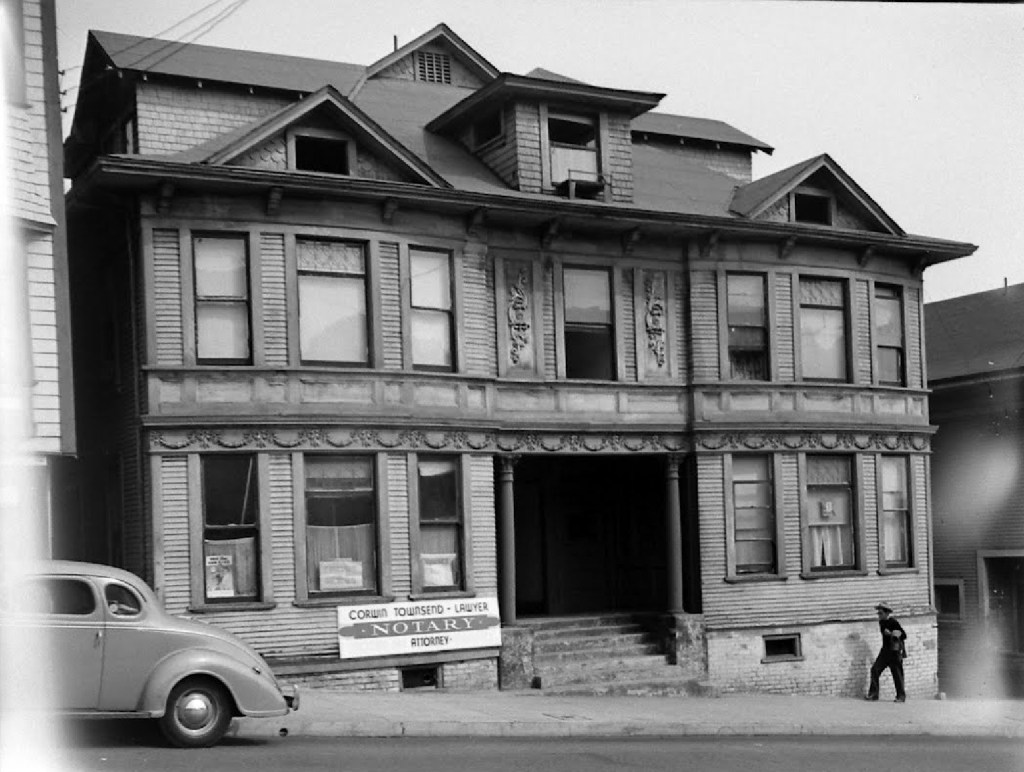
The structure second from left, above, is 519/521 West First:
Note the advert for Corwin Townsend; he was a lawyer into some shady dealings—constantly getting suspended for improper practices
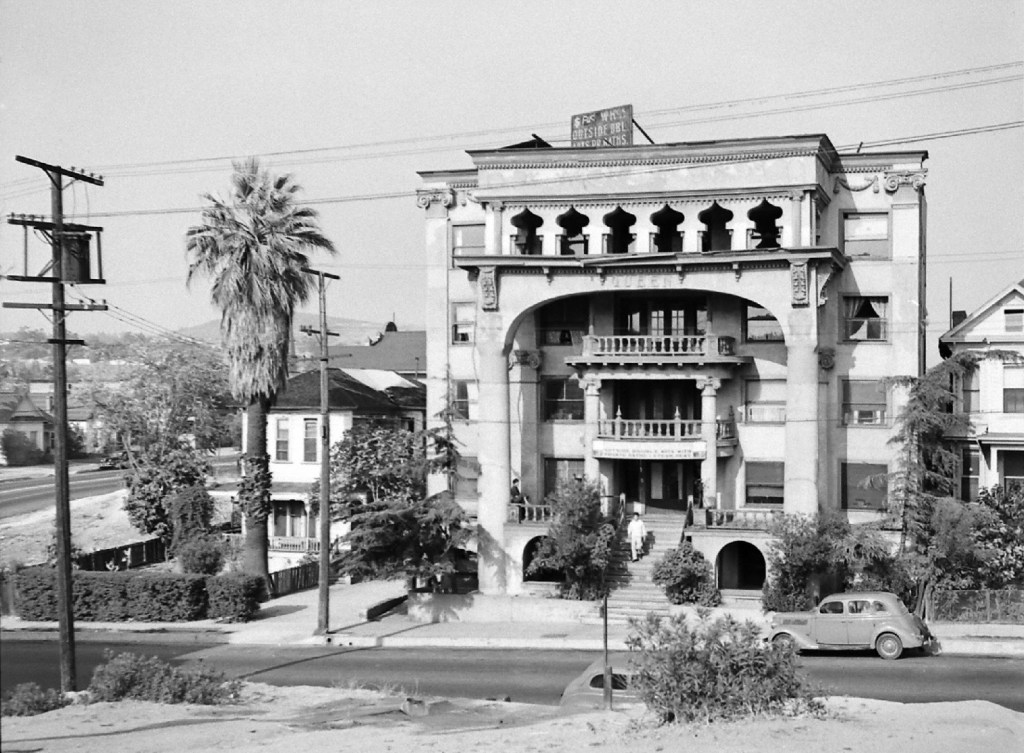
The Queen Apartments—529 California Street
The Queen makes its appearance in BHLA, of course, but it’s the straight-ahead shot we’re used to seeing (in online magazine articles, for example). What makes Sanders’ shots different are his standing further back, and shooting a wide shot from up the street:
The Queen at 529California Street; the 400 block of North Grand Avenue runs north at left. This site now is the slot of the Hollywood Fwy.At right are the Waldron Apts., 509 California Street (A. L. Haley, 1905—note how much it looks like his Touraine Apts). At far left, the small street that dead ends at California is Pavilion Place, a remnant from the the Horticultural Pavilion’s brief time on Fort Moore. The house behind the palm trees is where Emma and husband Alpha Columbus Summers lived when she taught piano and invested $700 into oil wells, eventually making her the Oil Queen of California
The Weygand Apartments, 208 South Figueroa
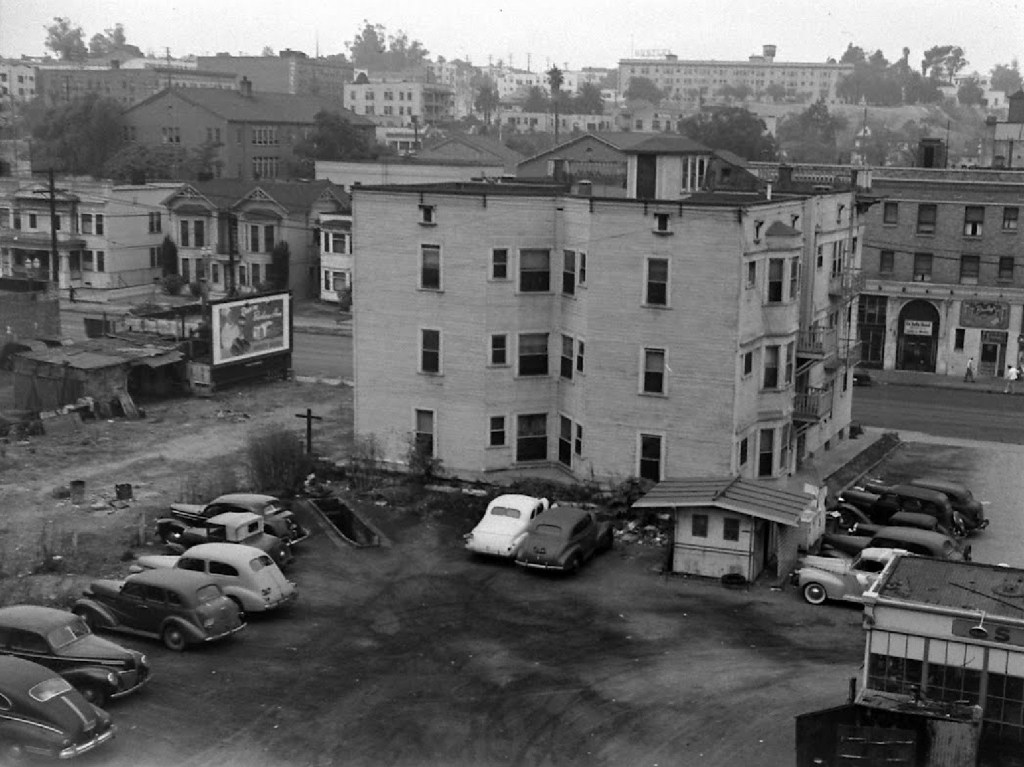
You may be familiar with the wonderfully Neoclassical/Greek Revival Weygrand at 208 South Figueroa from this 1964 shot by William Reagh. Really nice to see this oblique angle from 1945:
The billboard on the side of the building advertises agony-piper Artie Shaw, who in September 1945 began a stint at the Meadowbrook Gardens in Culver City; the other billboard is for Freddie “Schnickelfritz” Fisher at the Radio Room, 1539 Vine St.
Above, a shot of the back of The Weygrand, taken by Sanders while standing at the railing of the Second Street tunnel at Flower. A bit like this Nadel image from 1955, which Nadel shot from the Stanley Hotel.
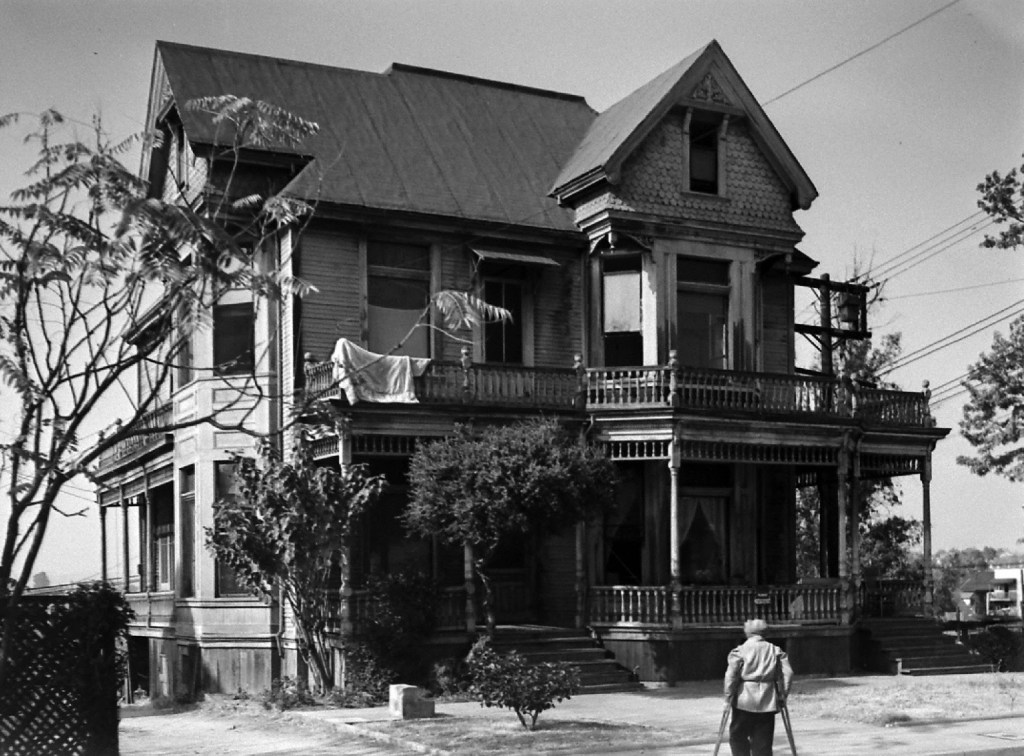
J. P. Miller house–201 South Bunker Hill Avenue
The Miller (seen here in 1896) house is not the most unphotographed house on the Hill, shot as it was, and in color, by George Mann and Walker Evans. Still, I like this image, as it predates those two by fifteen years or so, and shows all sorts of interesting differences (like the loss of the upper railing and those ball-top newels, the enclosure of the back porch, etc).
And the addition of a gentleman on crutches underlines how folks on the Hill were predominantly pensioners
Sanders also shot up at the back of the house from Second and Hope Streets:
While standing on Second between Bunker Hill Ave and Hope Street, Sanders turned his camera to the Berke, which loomed o’er.
Nice enough shot, but doesn’t really tell us anything new about the structure. This Nadel image from 1955 may give you a better idea as to where the Berke stood on Second
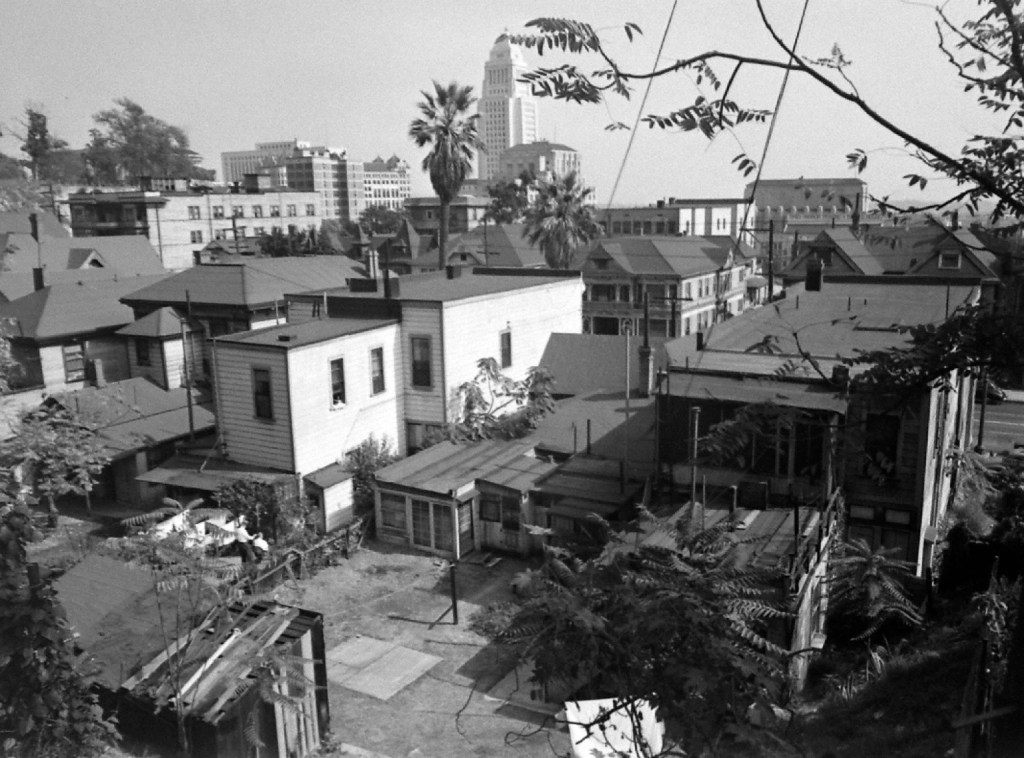
The Backyards of Olive Street
In images worthy of Leonard Nadel, Sanders, standing on the dirt incline near the back of the Melrose, captured the cluttered back yards of the 100 block of South Olive.
From right to left: the backs of 135, 131, 129, 125, 121 and 119 South Olive
The white structure, center, 129 South Olive, gets a shot of itself in the book:
This image of 129 S Olive was shot in 1944, a year before Sanders came to town. Doesn’t look so bad, now does it?
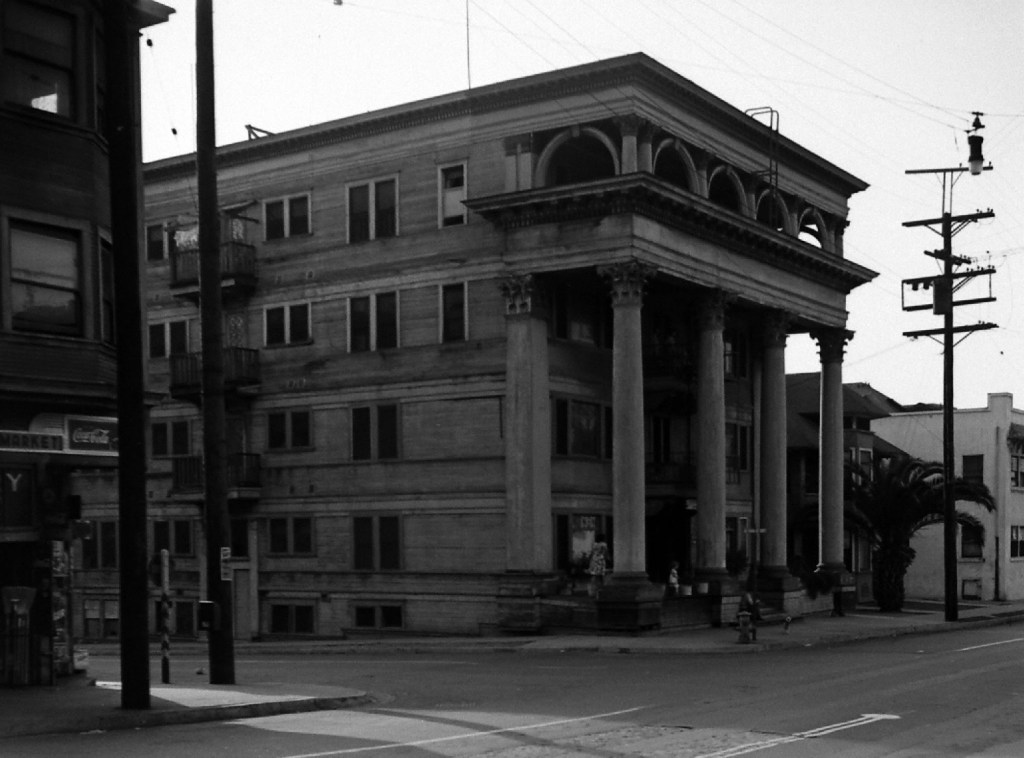
The Gibson—635 West Fourth Street
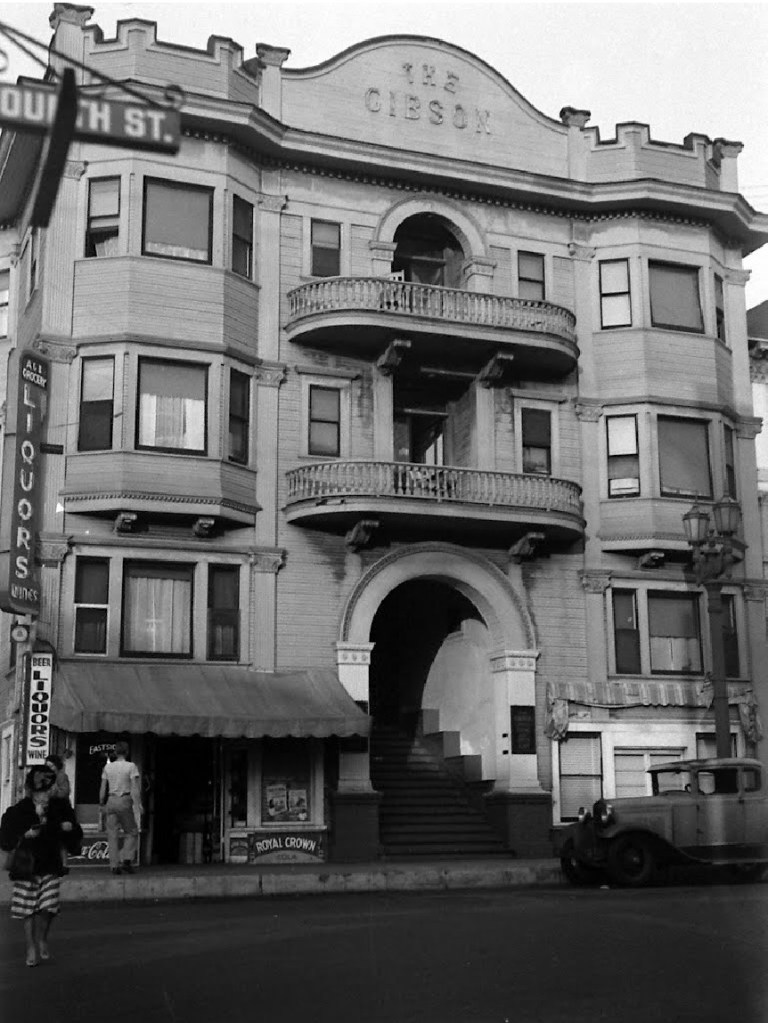
Now we’re getting into some meaty meat. The Gibson at Fourth and Hope is one of my favorite structures:
The Gibson as seen in about 1905. The full image from which this was cropped can be seen on page 55 of Bunker Hill, Los Angeles
Zelda Best Keel had married Fred Gibson in Ohio in 1898; they came to Los Angeles and built the Gibson, at 635 West Fourth St., designed by Zelda’s brother Jesse Reece Keel, in the fall of 1903. She then married Harvey La Chat in April 1907 and they built the Zelda in 1908, also designed and built by the J. R. Keel & Co. She, her brother and their families all lived and died in the Zelda, though they, perhaps fortunately, did not live to see its end. The widening of Fourth Street for the freeway cut took out both the Gibson and Zelda, in the summer of 1954.
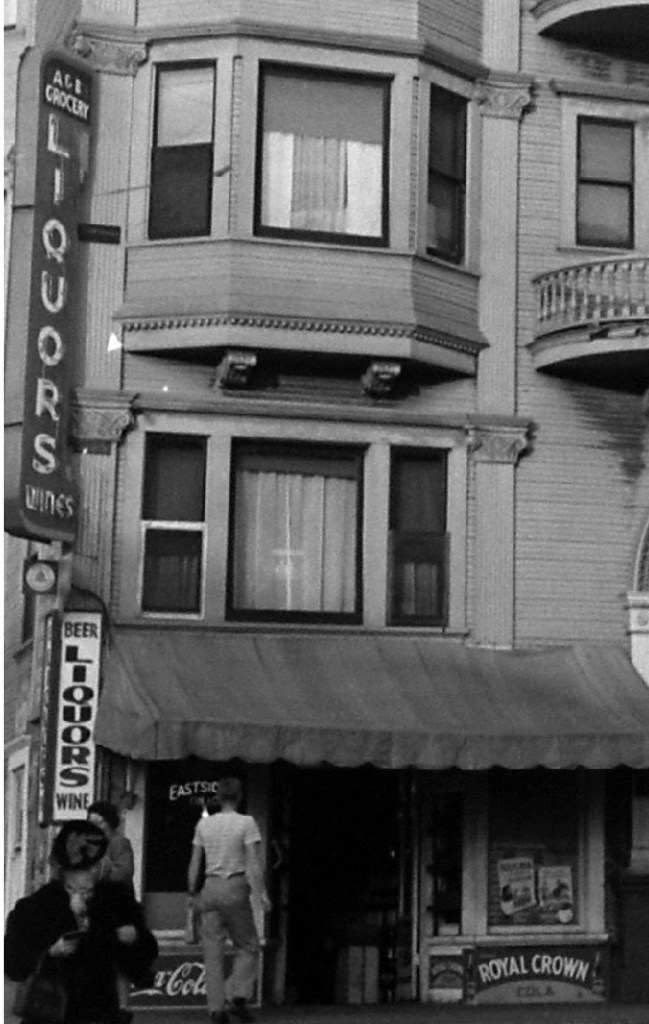
Shots of the Gibson are few and far between, so I was immensely gratified to be rewarded with this one:
I mean, notice how the humble Edwardian-era grocery became the world’s most noir liquor store.
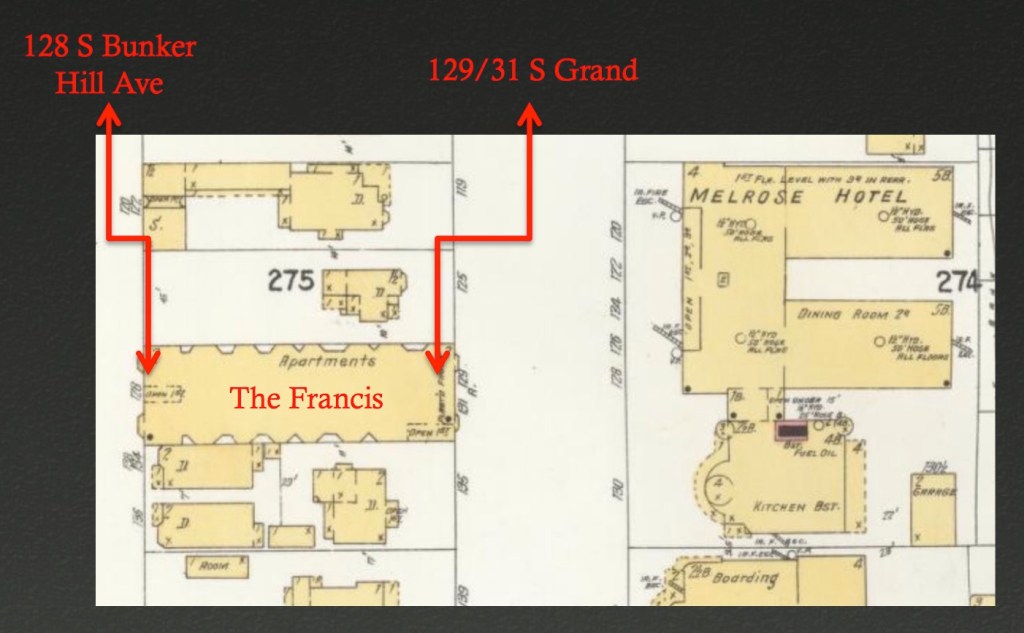
The Francis—129 South Grand/128 South Bunker Hill Avenue
In 1905, Mrs. Fannie Mansfield, widow of Francis Mansfield, engaged architect Arthur L. Haley to built and apartment building between First and Second, that ran from Grand to Bunker Hill Avenue. It was to be known as the Mansfield, but she soon changed its name to the Francis.
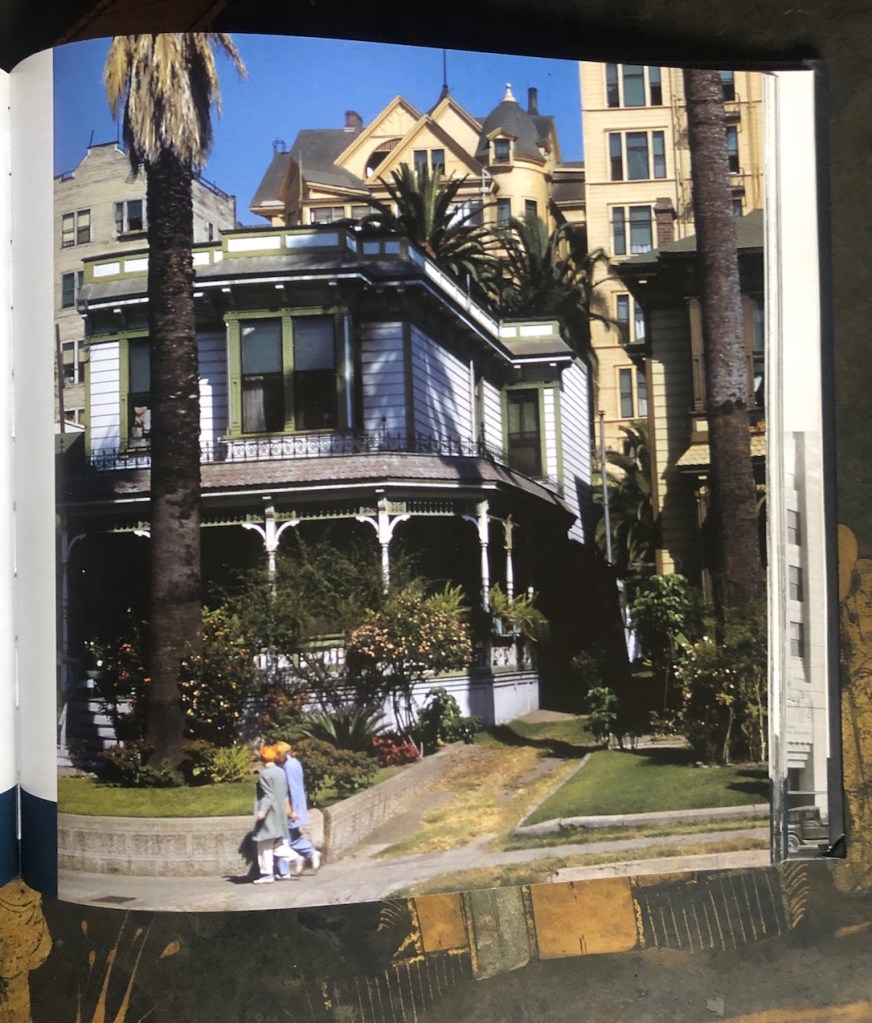
People were forever taking pictures of the Melrose, thus, everyone always had their back to the poor Francis
I’ve only found one proper image of the 131-129 S Grand Avenue frontage, which has its entrance on the south corner of its subtly asymmetrical, plastered, Mission Revival façade:
From Haley’s self-published 1907 book Modern Apartment Houses. Hey look, as originally conceived it had towers!
But have you ever seen the Bunker Hill Avenue side? That one is all bilateral symmetry, and covered in traditional shiplap:
And you may say, well, yes, Nathan, there’s an image of the Francis’ 128 South Bunker Hill side in the Palmer Conner collection:
To which I say not good enough! You can’t even see the quatrefoil! But:
Those then are the Bunker Hill images from Sanders’ November 1945 trip out west; remember, though, they account for about only 10% of the shots from this set. As I mentioned before, Sanders went to other parts of Los Angeles, and up to San Francisco, in his search for Ugly. Some quick examples:
LOS ANGELES
This is the corner of Garey and Ducommun, looking east. As opposed to Bunker Hill, which was a proper residential with some light commercial neighborhood, zoning closer to the river permitted residential/commercial/industrial to reside cheek by jowl
Sanders shot a slew of oil wells in the Temple-Beaudry redevelopment area. We get it, ancient industrial intruding into our modern world = squalor. This was shot here on Beverly looking east.
Looking down Marathon, what are we supposed to think? Ugly? Not ugly? Those are after all the Jardinette Apartments in the distance; Neutra’s first US commission and an overwhelmingly important monument of Modernism
Sanders shot lots of Victorians like this one at 1850 Sutter.Which I only recognized because it had been featured in this post at ReelSF
A postwar suburban housing development. Neat, orderly; one presumes Sanders shot these to counterpoint the wretched foulness of “Ugly America.” Little did he know the Monkees would later record “Pleasant Valley Sunday” and really stick it to The Man
It’s fascinating to get a glimpse into what was considered ugly in 1945, and how that fit into greater cultural prejudices against old buildings (I go into this a bit on p. 64 of BHLA—e.g., the 1941 play/1944 movie Arsenic and Old Lace, in which we learn to stay away from the Victorian house on our block, as it is likely inhabited by psychopathic, poisoning spinsters). One wonders how Sanders, who lived till 1985, felt about his role as a documentarian come the early 1960s, when the Bunker Hill streets he walked in 1945 were depopulated and demolished.
Compare the 1945 LIFE shoot with one from eighteen years later titled “Doomed…It Must Be Saved” in which Walker Evans shot BunkerHill. That feature described a great number of buildings America could not afford to lose…of course, the 1963 LIFE feature didn’t look kindly on anything as recent as fifty-year-old buildings, just as the 1945 feature looked upon fifty-year-old buildings with a jaundiced eye.
Of course, today, on post-redevelopment Bunker Hill, things aren’t looking so hot for fifty-year-old buildings, either. We’re just hitting that sweet spot when building owners really like messing with their properties.
In any event, those then are the Hill shots captured by Sanders in 1945. Thank you for reading! And as I continue to uncover new (to me) Bunker Hill images, I shall endeavor to bring them to you here.
There is, course, no better way to ring in the holiday season than with a three-hour tour, specifically, one focused on serial killers, bar brawls, gangster abductions, desecrated cemeteries, and other horrible happenings. Oh, and a subterranean race of Lizard Men.
Two weeks from today—Saturday, December 17th—the good folk at Esotouric are hosting the Bunker Noir! True Crime on Los Angeles’s Bunker Hill tour. Which shall be led by yours truly, pontificating ecstatically about the Hill’s dark past (peppered with the odd take on its contemporary architectural landscape, I’m sure).






































 Bunker Hill, Los Angeles


